Matt Heimbach and the SCV
 Matt Heimbach (center) receives his membership in the SCV through the Col. William Norris Camp #1398 at Gaithersburg, Maryland, March 1, 2011. Just over a year later Heimbach would be awarded one of the national organization’s highest decorations. From the camp’s April 2011 newsletter.

Matt Heimbach — founder of the White Student Union at Towson University, dabbler in Nazi ideology, and current darling of white supremacy movement — was awarded a Distinguished Service Medal (below, right) at the SCV annual meeting in Murfreesboro last year, along with “many of our own Va Flaggers.” This is according to this announcement, apparently from the Virginia Flaggers themselves, posted on several websites:

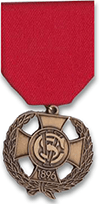 At the same time the Flaggers were at the Hanover Tomato Festival AND Flagging the VMFA, the Sons of Confederate Veterans were holding their National Reunion in Murfreesboro, TN. We were thrilled to learn that many of our own Va Flaggers received recognition for their work over the past year, including:
Commander-in-Chief’s Award: Everette Ellis
Commendation Award: Jamie Funkhouser
Heritage Defense Medal: Billy Bearden, Jamie Funkhouser
Meritorious Service Medal: Everette Ellis, Bob Harris, Ashleigh Moody, Mike Pullen, and Tracy Wright
Distinguished Service Medal: Billy Bearden, Matthew Heimbach, Grayson Jennings, Tommy Thomas, Capt. Tucker, Willie Wells
Commander-In-Chief’s Ladies Appreciation Award: Susan Hathaway
At the same time the Flaggers were at the Hanover Tomato Festival AND Flagging the VMFA, the Sons of Confederate Veterans were holding their National Reunion in Murfreesboro, TN. We were thrilled to learn that many of our own Va Flaggers received recognition for their work over the past year, including:
Commander-in-Chief’s Award: Everette Ellis
Commendation Award: Jamie Funkhouser
Heritage Defense Medal: Billy Bearden, Jamie Funkhouser
Meritorious Service Medal: Everette Ellis, Bob Harris, Ashleigh Moody, Mike Pullen, and Tracy Wright
Distinguished Service Medal: Billy Bearden, Matthew Heimbach, Grayson Jennings, Tommy Thomas, Capt. Tucker, Willie Wells
Commander-In-Chief’s Ladies Appreciation Award: Susan Hathaway
There are a couple of interesting things about this. First, Matt Heimbach is explicitly embraced as one of “our own Va. Flaggers.” If the Flaggers themselves claim him as one of “our own,” that settles it for me.
Second, I’m really curious about what sort of “distinguished service” Heimbach did to receive such a prestigious award. According to the SCV’s most updated award manual (PDF), the Distinguished Service Medal is a national-level award, presented to SCV members who “have served the SCV in an outstanding manner for an extended period of time in a position of responsibility.” Heimbach only joined the organization in 2011 (above), which doesn’t seem to fit with the award’s requirement for recipients to hold “a position of responsibility” for “an extended period of time.” It’s hard to imagine many 21-year-olds receiving that award, so evidently the SCV national organization recognized Matt Heimbach’s little-more-than-a-year tenure as being especially “outstanding” in furthering the SCV’s goals.
How, exactly?

Update, September 2: In August 2011 Heimbach received the SCV’s Army of Northern Virginia Scholarship, an award that includes “monetary renumeration, a certificate and an ANV medal.” So during the 2011-12 academic year, when Heimbach was serving as President of Towson’s Youth for Western Civilization, chalking up “White Pride” grafitti around campus and calling for the hanging of Nelson Mandela, he was doing it at least partly on the SCV’s nickel. Oops.
____________

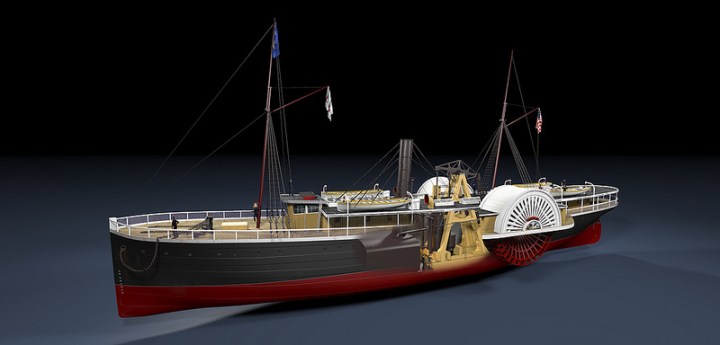
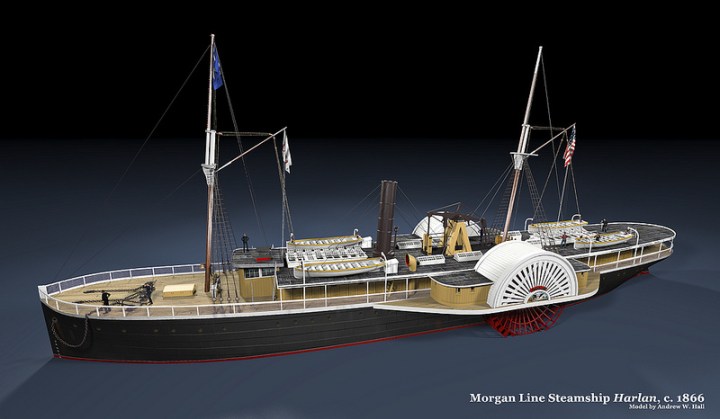
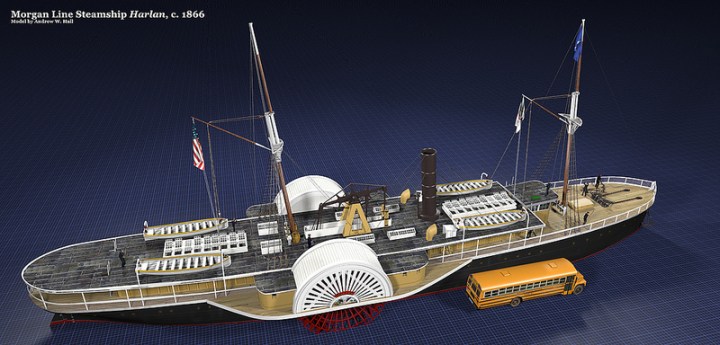
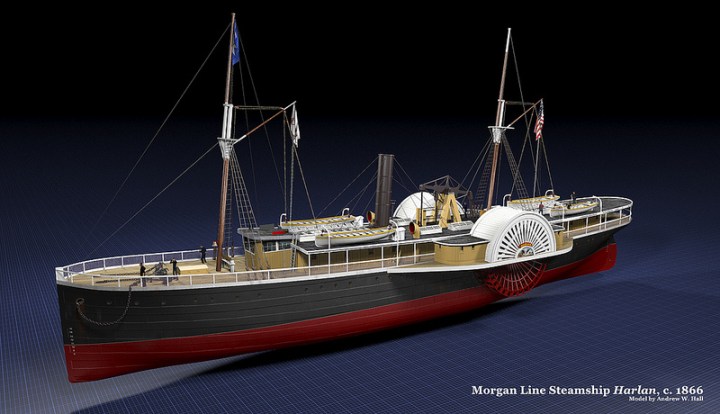
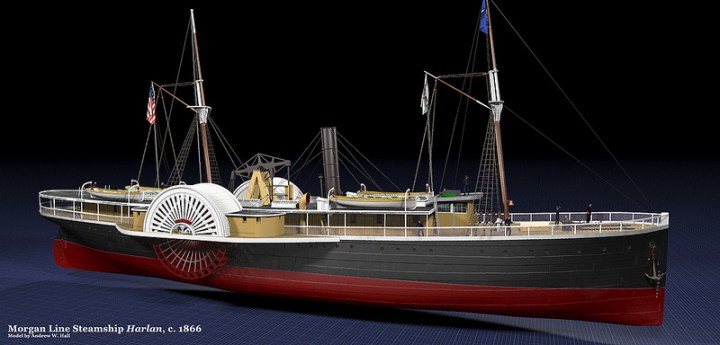
Aye Candy: Morgan Line Steamship Harlan, 1866


New renders of the Morgan Line steamship Harlan (seen previously here), that ran a coastwise route between New Orleans, Galveston and Indianola, Texas in the late 1860s and 1870s. New renders of the Morgan Line steamship Harlan, that ran a coastwise route between New Orleans, Galveston and Indianola, Texas in the late 1860s and 1870s. When she began the route in mid-1866, Harlan ran with three other steamships (Harris, Hewes and Morgan) on a 12-day cycle: New Orleans to Galveston (2 nights); after a brief stop at Galveston, on to Indianola (1 night); overnight at Indianola (1 night) then back to Galveston (1 night); a brief stop again at Galveston and back to New Orleans (2 nights). Fives nights at New Orleans, and then cycle repeats. A published schedule for the line (Galveston Daily News, June 13, 1866) gives the following for one of Harlan‘s voyages:

Harlan would depart New Orleans again on June 17. By running four ships on a schedule like this, there was a steamer departing each port every three or four days. Recall that at this time, there was no rail connection between Texas and the rest of the United States — that came later. The trip between Galveston and New Orleans is a long car ride now, but 150 years ago, a two-night trip aboard a coastal steamer like Harlan was both the fastest and most comfortable way to make the journey.
Harlan was the last of seven ships built to the same design by Harlan & Hollingsworth for the Morgan Line between 1861 and 1866. The first of these ships, St. Mary’s, was purchased new and converted into the Union warship U.S.S. Hatteras. In 1880, Harlan transported former President Grant and his party from Clinton, on Buffalo Bayou near Houston, to New Orleans.
Full-size images available on Flickr.

__________
Wreck of U.S. Coast Survey Ship Identified
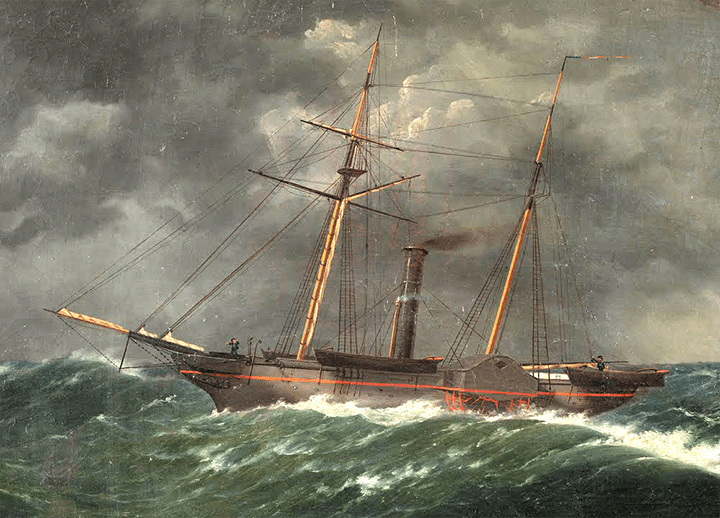 In 1852, W.A.K. Martin painted this picture of the Robert J. Walker. The painting, now at the Mariner’s Museum in Newport News, Va., is scheduled for restoration. (Credit: The Mariners’ Museum)
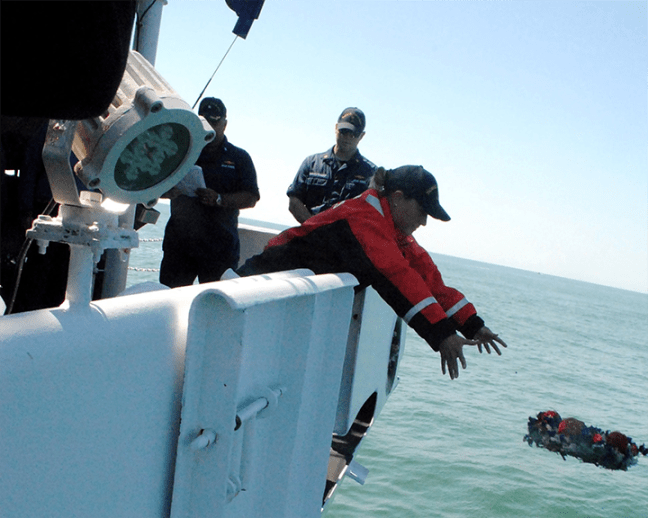
On Tuesday, the folks at NOAA’s Maritime Heritage Program announced the identification of the wreck of the U.S. Coast Survey steamship Robert J. Walker, that was sunk in a collision with a sailing ship in June 1860 off the Jersey shore. From the announcement:
You can read a detailed, contemporary news account of the disaster, from the June 23, 1860 issue of the New York Commercial Advertiser here.
Videos from the wreck site are online here. The visibility is pretty lousy, but the exposed part of the wreck is similar in many ways to that of U.S.S. Hatteras, that was the focus os a NOAA-led expedition last year. Some of the preservation on the Walker site is remarkable. There are even remnants of what are believed to be wool blankets, that have been preserved by being covered in mud, in an anaerobic environment, until recently. (Hurricane Sandy may have played a role in exposing these materials.)
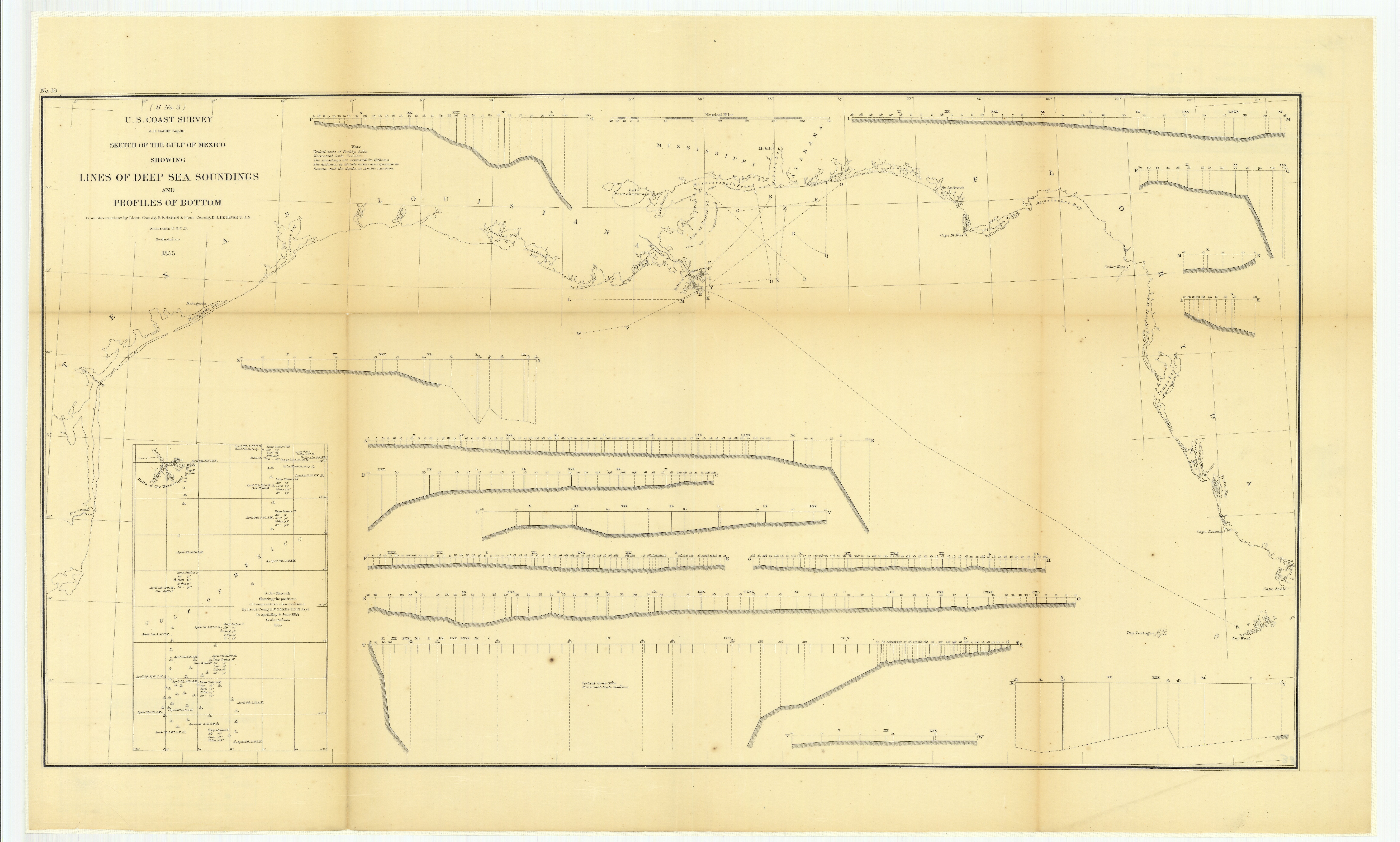
 In her career as a survey vessel, Robert J. Walker probably served off Galveston, as she spent considerable time operating in the Gulf of Mexico. As it happens, her commanding officer during much of that period was Benjamin Franklin Sands (right, 1811-1883), whose first-hand knowledge of the hydrography of the Texas coast would prove useful some years later, when he commanded the Union squadron on blockade duty off Galveston during the closing days of the Civil War. It was Captain Sands who formally accepted Galveston’s surrender in June 1865, an event that effectively ended the Union blockade of Southern ports. You can download a high-res copy of one of Sands’ charts, compiled during his tenure aboard Robert J. Walker, here.
Congrats to NOAA’s Maritime Heritage Program and all its partners in this endeavor.
_____________
More on the Petersburg Photo

Ben Uzel, President of the Colonial Heights Historical Society who identified the location of the Petersburg photo the other day, follows up:
 The second attachment is a photo showing what the site looks like today. The southern river channel was filled in and is now covered by the Norfolk Southern track and a parking lot. Hope this adds to the interpretation.
It does indeed. Thanks!
______________
Friday Night Concert: Seeger Sessions’ “Erie Canal”
This great classic of American folk songs isn’t nearly as old as I once thought. It was published in 1905 by Thomas S. Allen (1876-1919), under the title “Low Bridge, Everybody Down.” There’s a great history of the song in its various incarnations here. In the meantime, enjoy.
Fifteen miles on the Erie Canal
She’s a good old worker and a good old pal
Fifteen years on the Erie Canal
We’ve hauled some barges in our day
Filled with lumber, coal, and hay
And every inch of the way we know
From Albany to Buffalo Chorus:
Low bridge, everybody down
Low bridge for we’re coming to a town
You’ll always know your neighbor
And you’ll always know your pal
Ever navigated on the Erie Canal We’d better look ’round for a job old gal
Fifteen miles on the Erie Canal
You bet your life I’d never part with Sal
Fifteen miles on the Erie Canal
Git up mule, here comes a lock
We’ll make Rome by six o’clock
One more trip and back we’ll go
Right back home to Buffalo Chorus:
Low bridge, everybody down
Low bridge for we’re coming to a town
You’ll always know your neighbor
And you’ll always know your pal
Ever navigated on the Erie Canal Where would I be if I lost my pal?
Fifteen miles on the Erie Canal
I’d like to see a mule as good as Sal
Fifteen miles on the Erie Canal
A friend of mine once got her sore
Now he’s got a broken jaw,
She let fly with an iron toe,
And kicked him in to Buffalo. Chorus:
Low bridge, everybody down
Low bridge for we’re coming to a town
You’ll always know your neighbor
And you’ll always know your pal
Ever navigated on the Erie Canal
___________
Petersburg Photo Update

Recently we had a discussion about this LoC photo, taken in the “Petersburg vicinity” at the close of the war. Tuesday evening I received this update from Ben Uzel, President of the Colonial Heights Historical Society, opposite the Appomattox River from Petersburg. I’m reposting his comment here, with permission:
Here’s the Harper’s Weekly image of Petersburg mentioned, via SonoftheSouth.net:

_______
Against Secession
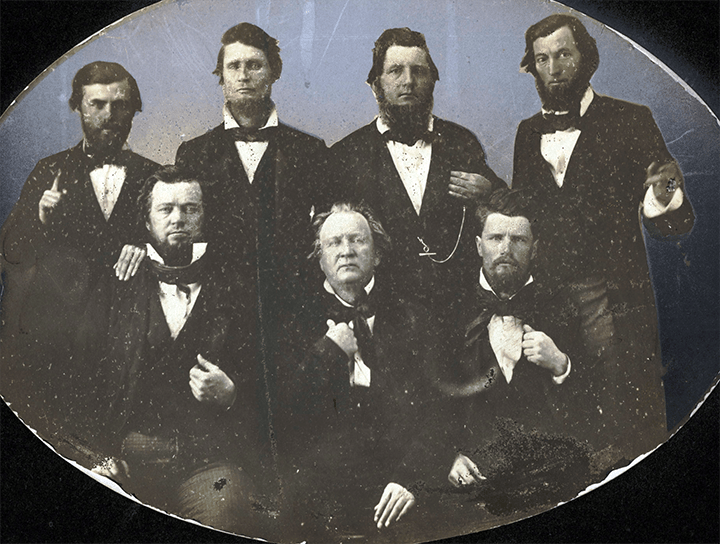
The story behind the image, from Wharton’s History of Texas, from Wilderness to Commonwealth, Vol. 4, 336-38:
____________
Confederate Veterans on Forrest: “Unworthy of a Southern gentleman”
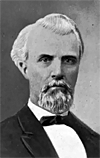 I was looking around recently for some background to the famous Pole-Bearers address given by Nathan Bedford Forrest in July 1875 at Memphis. In his speech to the Freedmen’s group, Forrest emphasized the importance of African Americans building their community, participating in elections, and both races moving forward in peace. Just prior to making his remarks, Forrest was presented a bouquet of flowers by an African American girl, and responded by giving the girl a kiss on the cheek. This single event is sometimes cited as proof that the former slave dealer and Klan leader “wasn’t a racist” or some similar nonsense, as if that modern term had much import in mid-19th century America.
I’ll have more to say about the Pole Bearers speech another time, but if you ever wondered how Forrest’s actions that day were perceived by at least some of his former comrades in gray, now we know. They weren’t happy about it, and went to considerable efforts to say so – publicly. From the Augusta, Georgia Chronicle, July 31, 1875, p. 4:
Geez. Sounds like they were mad, huh?
________
Welcome to Crackertown (formerly Richmond, Virginia)!
Brooks Simpson and Kevin Levin each have posts up this beautiful Sunday on the Virginia Flaggers’ project to put up a big Confederate Battle Flag on I-95, south of Richmond. Both essays are worth your time, and question whether the Flaggers have over-reached in this latest effort. Contra Brooks and Kevin, though, I think the Virginia Flaggers are doing exactly the opposite, making a strategic withdrawal into a well-trodden, clichéd effort that effectively cedes their self-promoted role as leaders in the Confederate Heritage™ movement. Going forward, there will be little reason to view the Virginia Flaggers as much different from any other Confederate heritage group, either in their tactics or their ability to influence broader public opinion.
The I-95 flag project is tacit acknowledgement that the Virginia Flaggers’ two central causes, the Confederate Memorial Chapel in Richmond and the display of flags on city-owned property in Lexington, are not going to have favorable resolutions in the foreseeable future. In Lexington, there were two avenues of challenge, (1) litigation in federal court and (2) electing a new city administration more amenable to the Flaggers’ wishes. As of now, though, the lawsuit is effectively on life support, having been rejected by both district and appeals courts, and back in November the mayor of Lexington was re-elected with a larger share of the vote than she got before. The lease on the chapel comes up for renewal in 2015, but unless I badly misread human nature, the museum administrators who’ve been putting up with years of nasty e-mails, ridicule and name-calling are not going to be inclined to be generous when it’s time to re-negotiate a lease where (as in 2010) they hold all the cards. People just don’t usually react that way.
(Confederate Heritage folks are very proud of their defiance and steadfast resolution in the face of adversity, but never seem to realize that trait exists in others, including those who disagree with them. It was true in 1861 and it’s true today.)
The I-95 project isn’t over-reach, but quite the opposite — it’s grabbing the low-hanging fruit. It’s confirmation that, for all their efforts to promote themselves as being in the vanguard of “restoring the honor” of Confederate veterans, the Virginia Flaggers are no more innovative or successful than a half-dozen SCV camps that have completed (or are working on) similar highway flag projects, from Florida to Texas. The I-95 project doesn’t challenge any institutional or powerful interests. It doesn’t require a successful challenge to authority or overturning any rule or regulation or city ordinance, and doesn’t require winning widespread public support. It doesn’t require voting an elected official out of office, or getting a museum board to fire a director you don’t like. You don’t have to file a lawsuit. There are no great legal, administrative or public opinion obstacles to be overcome if your goal is limited to putting up a big-ass flag on private property — even in Lexington. The I-95 project just requires a relatively small amount of money and some willing supporters, both of which are easily obtained. It’s an easy and highly-visible accomplishment that, among the Flaggers’ supporters, will divert attention away from the resources invested in two high-profile disputes that have consumed thousands of volunteer hours and dollars, and have precious little to show for it – nor are ever likely to.
Brooks is exactly right when he writes that the Virginia Flaggers’
Just so. A giant, automobile-dealership-style Confederate Battle Flag out on the freeway does nothing to “educate” the public about the honor of the Confederate veteran, or any of the other things the Flaggers frequently claim their activities do, one-on-one with the public. The I-95 flag will not change the way visitors to Richmond view that emblem, or encourage people who are now indifferent or hostile to the Flaggers’ view of history to become more sympathetic to it. It will simply reinforce what people already believe about that symbol.
This is not about education or encouraging a dialogue about history; it is not about what Susan Hathaway once referred to as “civil discourse and education.” In this project, the Flaggers have tossed aside such high-minded goals in favor of simply marking their territory, as surely as a dog pissing on the curb. Of all the historic flags associated with the Confederacy and Virginia (e.g., that of the Commonwealth, or the First National), the Virginia Flaggers have chosen the one they know to carry the most ugly historical baggage, the one irrevocably associated over the last three generations with segregation, bigotry, and white nationalism. There are a lot more folks alive today who remember this, than remember this. The I-95 flag in Richmond carries the same meaning and intent that all the other highway flags do – you’re entering unreconstructed territory. For some, that will be a point of Southron Pride. For many others, it will have a much more concrete meaning.
Welcome to Crackertown.
_______________
Texas Revises K-12 Textbooks: Slaves Were “Unpaid Interns”
You knew this was coming sooner or later:
Yes, it’s satire. But just barely.
_________




 Dead Confederates, A Civil War Era Blog

![[Download full size here.]](https://deadconfederates.com/wp-content/uploads/2013/08/1877-map1.jpg)


2 comments