Artifact Thursday: Pressure Gauge from U.S.S. Kearsarge
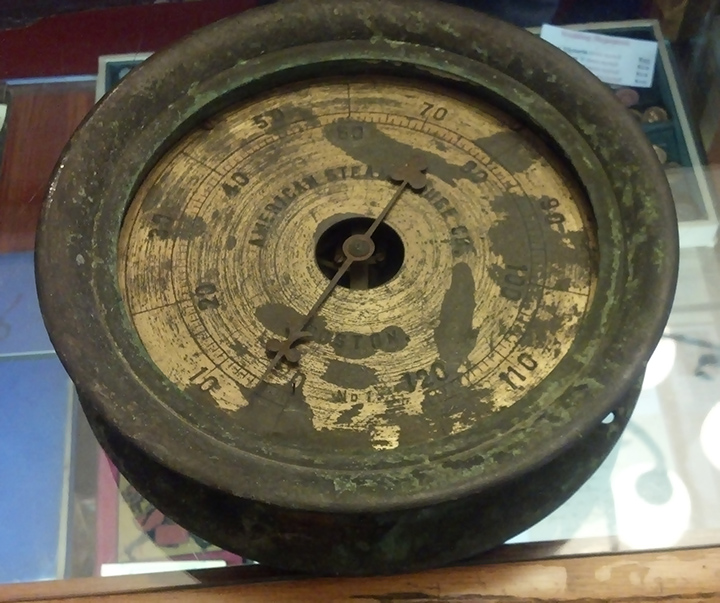

A fellow blogger passed along these images of a steam gauge found in a local antique shop. It was one of three purchased in a lot at an estate auction. After completing his purchase, the buyer found a note affixed to the bottom of this one, attesting to its provenance as being from the ship that sank C.S.S. Alabama off Cherbourg in 1864 — the seller either hadn’t looked, or didn’t understand its significance.

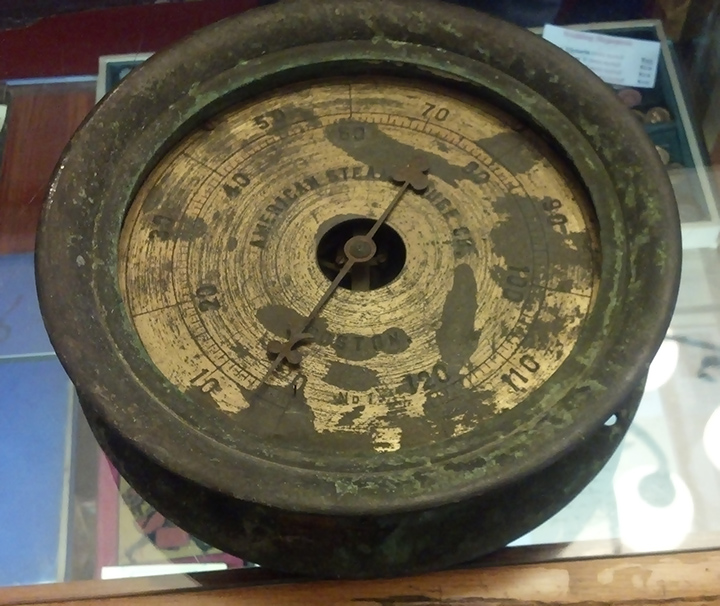
And here’s a similar gauge from the same lot — but apparently not from Kearsarge — to give a better idea of its original appearance:

I don’t know the current owner, or the asking price; I just thought it’s a remarkable and serendipitous discovery. Also unknown is whether this piece was an element of the ship’s engineering plant during the Civil War, or was added during a later refit. Kearsarge went through the postwar decommissioning/recommissioning cycle three different times before she she was finally wrecked on a reef in the Caribbean in 1894. On each of those occasions, the engineering plant likely went through an overhaul that would include replacement or refurbishing of various elements, and a gauge like this would have been generic, not custom-fitted for any particular vessel or powerplant. It’s very similar to, though probably an earlier model, the examples in this 1896 catalog of its maker, the American Steam Gauge Co. of Boston. I still have to dig into the details of Kearsarge‘s powerplant(s) to get a clearer picture there.
Anyway, cool stuff, and a big thanks to my colleague who passed it along!
____________

Monitor Sailors to be Interred at Arlington
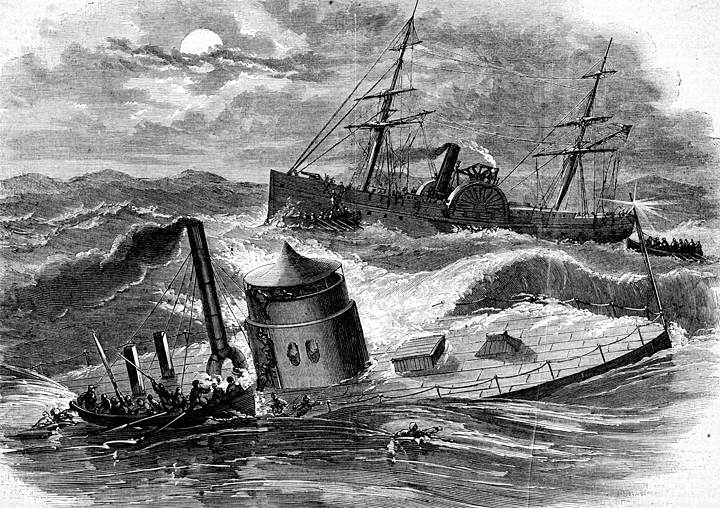
Via Mark Jenkins at CWT, word comes today that the two sailors whose remains were found in the turret of U.S.S. Monitor will be buried on March 8 at Arlington National Cemetery. Although there has been public speculation about their possible identities, those cannot be confirmed, so they will be buried as “unknowns.” Research will continue in an effort to identify them at some future date.
March 8 will be the 151st anniversary of the arrival of Monitor at Newport News, the evening before her famous battle with the Confederate ironclad Virginia. This year also marks mark the 40th anniversary of the 1973 discovery of the Monitor wreck site off Cape Hatteras, and the beginning of an unprecedented series of archaeological and historical studies on the naval history of the Civil War. The work on Monitor provided a template for later investigations on the Confederate submersible H. L. Hunley, located off Charleston more than two decades later.
Earlier posts about Monitor:
___________

Aye Candy: H. L. Hunley


 Update: Apologies for the double-posting on this. After the first versions of these images went online over the weekend, Michael contacted me and pointed out that there was a more updated version of his plans of the boat than the one I’d used. These images, then, are corrected to reflect his most recent edition of the drawings. Most of the changes are small, but the boat has lost that beautiful-but-functionally-inexplicable curve in the profile of her stem (right, in an earlier model); that was apparently caused by exposure to the current and environment after the boat’s loss in 1864.
____________


Digital model of the Confederate submersible H. L. Hunley, as she may have appeared in mid-February 1864, about the time of her successful attack on U.S.S. Housatonic off Charleston, South Carolina. The spar torpedo is based on recent findings announced in January 2013 by archaeologists at the Warren Lasch Conservation Center, which is conserving the boat and its contents. Model based on plans by Michael Crisafulli. Full-sized images available on Flickr. All rights reserved.
More after the jump:
Mississippi Supreme Court Flags Itself


Can’t make this stuff up:

The approximately 10 x 15-foot flag was up for a couple of hours before anyone noticed. Because, you know, Mississippi.
______________
Original image via Cottonmouthblog.
“I suppose I am politically ruined. . . .”


U.S. Representative Joe Coutrtney (D-Connecticut) is very unhappy that Spielberg’s film depicts one of his state’s House delegation as voting against the 13th Amendment. All four House members from that state voted in favor of the measure, so he’s right on the facts. But his argument is silly:
We need to get beyond visions of the past based on what seems obvious or logical or rational in hindsight, and take time to look at what people actually did and and said at the time, which often turns out to be irrational, illogical, self-defeating, and completely out of touch with modern values. In fact, almost five dozen members of the House of Representatives, every one from a Union state, voted “on the wrong side of history” that day. Connecticut was hardly a hotbed of abolitionist sentiment, either; it had hung on to the institution until 1848, and there was great apprehension there about the impact universal emancipation would have on white labor in the state’s cotton mills. These are aspects of Connecticut’s history in the 19th century that Rep. Courtney may not know, but they were very real parts of the political landscape in 1865.
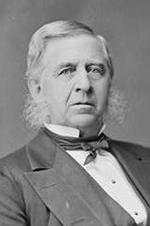 Courtney would have done better to tell the story of Rep. James E. English (right, 1812-90), the lame-duck Democrat who had voted against the measure when it first came up the previous year, but went to rather extraordinary lengths to help pass it when it came up for a vote again in January 1865:

That’s one helluva story, right there. And English was not politically ruined; he went on to serve two terms as the Governor of Connecticut, and served briefly in the U.S. Senate as an interim appointment in 1875-76.
As many folks have pointed out, much of the criticism of Spielberg’s film from historians has amounted to the latter whinging that he and Tony Kushner didn’t make the movie they themselves would have made. Fine, whatever. Rep. Courtney’s criticism is much more valid, even if it’s motivated as much by home-state boosterism as it is by an interest in historical accuracy. Spielberg and Kushner could have — should have — avoided this business altogether by simply depicting the “nay” votes in the House as they really were, explicitly by name, without worrying about what their great-great-great-grandkids might think.

Private Hobbs’ Diary: “We found in the harbour three Gun boats. . . .”
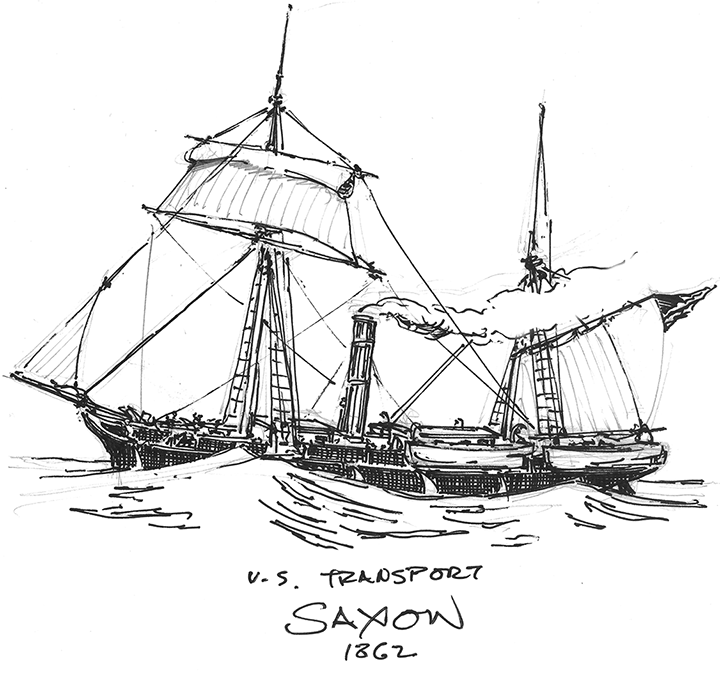
U.S. Army chartered transport Saxon, 1862.
Alexander Hobbs was a private in Company I of the 42nd Massachusetts Infantry. It would be Hobbs’ and his messmates’ misfortune that Company I was one of the three companies of that regiment that eventually occupied Kuhn’s Wharf on the Galveston waterfront, and came under attack by Confederate forces in the early morning hours of New Years Day, 1863. Hobbs kept a diary that encompassed his experiences, which is now part of the collection at the Woodson Research Center at Rice University.
In an earlier post, we traveled along with Hobbs as he and his messmates boarded the chartered transport Saxon [1] at Brooklyn, and made the rough passage down the eastern seaboard, around the Florida Reef, and into the Gulf of Mexico to Ship Island, Mississippi. After a brief stop there for coal, Saxon continues on to the mouth of the Mississippi:
December 16
7 A.M. arrived at the entrance of the Mississippi after a very stormy and disagreeable night back lay-too for some hours waiting for day light to take a pilot the entrance of the river is through low marchy land which extends for (I think) twenty miles from the entrance the river is about three quarters of a mile wide and is very hansome
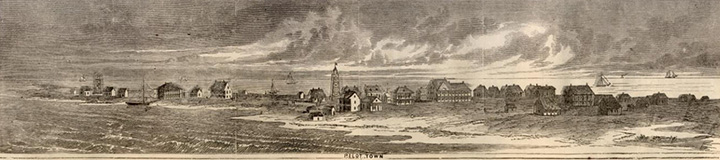
Pilot Town at the mouth of the Southwest Pass of the Mississippi. Harper’s Weekly via SonoftheSouth.net.
We see the remains of many of the few rafts sent down by the rebels to burn Gen Butler [‘s] fleet passed forts St Phillips & Jackson which our gun boats took on thair way too New Orleans the marks of our shot could be plainly seen on the [fort’s] walls it is now garrisoned by a Massachusetts Regt [2] [and we] stopped their untill the medical officer came on bord he found us all well and allowed us to proceed came to anchor at dark within twenty yards of the bank and within twenty miles of the city of New Orleans the scenery on the banks of the river for the most part has been delightful beautifull groves of orange trees which hung full of the golden fruit looked to us very inviting
December 17
Started this morning and arrived at the city at day-light we was all eager to see the “Cresent City”and enjoyed a fine viewfrom the deck of our vessail thare is little to see however as thare is but little business done now we had scarcely anchored before boats came off with fruit, pies, cake & bread the city is under Marsall Law but the poor are much better off than before it was taken by the Federals Flour which than sold for forty five dollars now sells from seven too ten dollars and others then as in proportion we expected to land here but orders came for us to go up the river nine miles to a town called Carrelton [3] accordingly in the evening we ran up the river but not knowing when to stop we went two miles further than we intended and stopped for the night beside a river Steamboat made to carry cotton with a saloon for passengers in the second story She is now laid up to dry and is used as a hospital
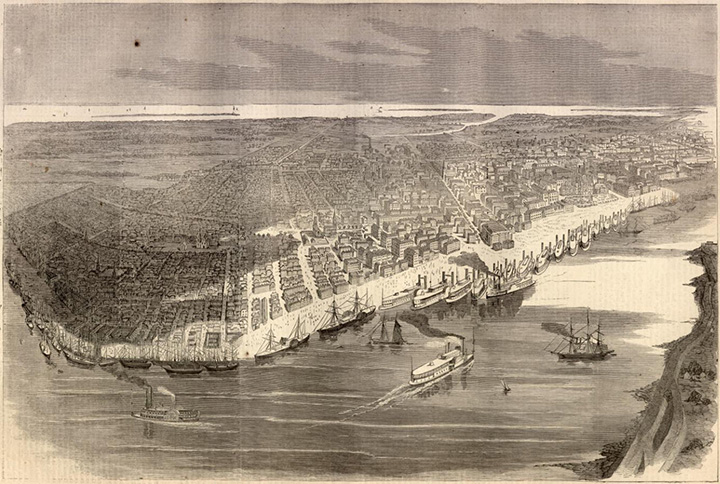
New Orleans, 1862
December 18
Left and steamed down the river two miles and landed at Carrelton at 12 N. marched half a mile and piched our tents on a low wet pieces of land bounded on two sides by grave–yards one a rebel and the other the last resting place of Union Soldiers who had been camped in that vicinity thare was near four hundred from Maine, Mass, Vermt, New York, New Hampshire and some other states thare were two hospitals in the town, full of sick soldiers and it was a sad sight to see some each day carried to the grave without a friend to shed a tear over thair remains doubtless many tears will be shed when the sad tidings are wafted across the ocean to the home they left so lately I have wandered through grave yards before but never see so sad a place as this the graves are onely dug two or three feet deep and immediately fill with water the poor people praise Gen Butler and well they may some of the Ladies say all manner of bitter things about us “Yankees” and scoff at the idea of the Union ever being restored
December 19
Friday gave all our clothes to the Washer women not expecting to leave here soon a few hours afterward the order came to strike our tents and go again on bord the transport we did not know where to find our clothes butafter hunting all over the town we returned to camp in dispare the order was countermandand we again piched our tents afterward some of our boys found thair clothes and before we left they were all recovered
December 21
Broke camp at day light and marched to the bank and embarked on bord the good ship Saxon who was hawled along side the bank stopped a few hours at New Orleans and than proceeded down the river on our way to Taxes the day was verry fine and we had a fine view of the twenty miles passed in the night time on our way up a anchored at night in the river and proceeded toward and morning on our voyage after three days sail with a fair wind and a smooth sea
We arrived off Galveston [December 24] and was brought too by a shot across our bow from a United States Gun boat who spoke us and than signaled for a pilot At 2 P.M. The pilot came on bord but we were obliged to wait two or three hours for the tide to rise toward night we stood in across the bar and struck several times but got across in safety we found in the harbour three Gun boats the largest of which was the Harriet Lane who carried six guns also two Ferry boats [Westfield and Clifton] fitted up with some heavy guns and calculated for the harbour service as she drew only six or seven feet of water
The town is built on an Island connected to the main land by a bridg about two miles long the town form only contained about fifteen thousand inhabitants but nine out of evry ten have gone away since it has been occupied by by [Illegible: hily] by our gun boats
[1] Saxon was a relatively small, 413-ton screw steamer, built at Brewer, Maine, opposite Bangor on the Penobscot River in 1861. She was first registered at Boston, but would spend much of the Civil War under charter to the U.S. Army as a transport. She would continue in civilian for almost three decades after the war, before being abandoned in 1892. Mitchell, C. Bradford, ed. Merchant Steam Vessels of the United States, 1790–1868 (The Lytle-Holdcamper List), (Staten Island, New York: Steamship Historical Society of America, 1975), 196. [2] Probably the 31st Massachusetts Volunteer Infantry. [3] Carrolton was a town upriver from New Orleans from 1833 to 1874, when it was annexed to become part of New Orleans. During the Civil War, Carrolton was somewhat infamous for its various forms of vice, particularly liquor, that caused ongoing discipline problems for the Union military governor, Benjamin Butler. The general’s civilian brother, Andrew, was widely believed to be engaging in all manner of shady business dealings, operating mostly out of Carrolton.
____________Saxon illustration by Andy Hall

VMFA Trepass Case Update
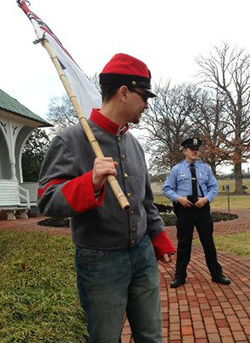 Norwood B. “Tripp” Lewis III will be arraigned at 9 a.m. Monday in Richmond on a Class 1 Misdemeanor charge of “trespass after having been forbidden to do so” (Code of Virginia § 18.2-119). This is a more serious charge than (say) creeping around a cemetery at night, or trespass on school or church property which, unless compounded by other bad acts or intent, are considered lower-level misdemeanors. Lewis was apparently charged with a more serious offense by virtue of the fact that he had been repeatedly warned off the property previously. Lewis is expected to enter a plea of not guilty, in which case a trial date will be set by the court.
In thinking about this case, I realize that I have an analogous circumstance myself. Lewis’ actions, on January 12, were claimed by him to be in honor of his ancestor, who was admitted to what was then the Confederate Home on that property. I have a Confederate ancestor who settled here in Texas after the war, whose property was bought many years later by the state, and a public university built on that land. I’ve even read that the site where my ancestor’s home once stood is now occupied by the university’s student center.
There are similarities with the situation at VMFA. The land in Texas is owned by the state, but administered under law by a publicly-chartered organization, with its own security and the authority to set its own rules. The spot where my relative’s house stood is, within the context of a university, a public space. Could I march up and down in front of the student center with a Confederate flag and uniform to “honor” that relative? Sure. Do I have an inherent right to do so, even if campus police order me off the premises? Does the claim that I’m “honoring my ancestor” provide an affirmative defense against what is otherwise defined by state law as a criminal act? I doubt many courts, at any level and in any jurisdiction, are going to buy that argument. For that matter, I doubt many would even entertain it as a defense, since the charge Lewis is facing — “trespass after having been forbidden to do so” — is extremely narrow, and easily provable by the prosecution. (“Did you tell him not to come back on the property?” “Yes.” “Did he?” “Yes.”) Even on the larger issue of whether Lewis and other Flaggers are within their rights to protest on the VMFA grounds, some of their supporters believe that violates the law. One true Confederate, whose commitment to the Flaggers’ cause has never been doubted, was blunt in his assessment: “the Flaggers ‘BY LAW’ have no right to go on VMFA property.“
Mr. Lewis has a lot to think about this weekend. He has an absolute right to pursue this case and defend his actions as best he can. But I cannot see it ending well for either him or his supporters in the end.
____________
Update, February 4: Lewis received a continuance Monday until new hearing, now scheduled for March 22, with the notation “appoint attorney.” I don’t know if that indicates a request for more time to hire a private attorney, or a request to have the court appoint one for him.
____________
Update, February 7: As Dave Tatum points out in the comments, at Monday’s hearing the state and the VMFA requested an order barring Lewis from the property, which was denied. Both the motion and the court’s denial seem routine to me in a trespassing case of this sort.
____________
Third Assistant Engineer William Francis Law, U. S. Navy
 The other day, when I was poking around the web for images to go with my post on the H. L. Hunley spar, I came across this image (right) of a U.S. Navy engineer officer. My immediate reaction was, that’s a kid dressed up in somebody’s uniform. But it’s not; the notation on the back of the CDV reads, “Uncle Will Law as a Naval Officer Civil War.” Uncle Will was Third Assistant Engineer William Francis Law, appointed in November 1861. Law died on September 24, 1863 of unstated causes.
I’ve been able to find very little about Law in readily-available sources. The second image in the auction lot is a photograph of U.S.S. New Ironsides, that served off Charleston; written on the back of that card, in the same hand, is the note “Uncle Will Law’s ship Civil War.” According to Porter’s Naval History of the Civil War, Law was serving aboard U.S.S. Pinola at the capture of New Orleans in April 1862, and was still part of her complement the following January 1, as part of Farragut’s West Gulf Blockading Squadron. It seems he turns up exactly once in the ORN, a one-sentence mention in a routine report from Commander James Alden to Farragut on September 14, 1862: “Mr. Law succeeded in repairing the Pinola by making a new stem to her Kingston valve.”
About Law’s civilian life, I’ve been able to find even less. He is almost certainly the William F. Law, age 17, who was the eldest child of Benedict and Anna C. Law of Carlisle, Pennsylvania, just west of Harrisburg, at the time of the 1860 U.S. Census. He graduated from the Carlisle Boy’s High School in 1858 and, according to the Philadelphia Inquirer of June 28, 1861, graduated from the Polytechnic College of Pennsylvania with a bachelor’s degree in civil engineering, specializing in road building. Polytechnic was one of only a handful of universities in the United States at that time that offered engineering degrees, and Law’s academic background may have set him a little apart from his fellow engineers. Seagoing engineers in that day, both in the Navy and in the merchant service, were more commonly men with practical experience on shore in machine shops, foundries or similar trades.
I haven’t been able to confirm Law’s service aboard U.S.S. New Ironsides, as indicated on the back of the auction house photo; his name does not appear on these lists of ship’s officers transcribed from the National Archives. If he did serve aboard that ship in the summer of 1863, he saw a tremendous amount of action off Charleston.
One final note — in his undated portrait, taken at the Bogardus studio on Broadway in New York, Third Assistant Law looks to be wearing a gold-braided hat borrowed from a much more senior engineering officer. Maybe the sword, too. Gotta look good for the folks back in Carlisle, I suppose.
______________
Texas’ Black Hole of Stoopid
Corey flags this remarkable exchange between Glenn Beck and David Barton:


What a mendacious jackass. The movie focuses on passage of the amendment in the House of Representatives, where (as in the Senate) passage requires a two-thirds majority. The measure had indeed passed the Senate handily, but that occurred before the time frame of the film, and was never really in doubt. The hurdle was getting it through the House and, as shown in the movie, it only barely passed there, on a vote of 119 to 56. Flip three “aye” votes to “nay,” out of a total of 175 cast, and the count becomes 116 to 59, and the amendment would have failed. When the outcome of a vote turns on less than 2% of the votes cast, it’s not a “slam dunk.”
Beck and Barton both claim to be Constitutional scholars, and are counting on their listeners to be unaware of (1) the central plot of the movie, (2) the actual number of votes cast in each chamber of Congress, and (3) the two-thirds requirement for passage of any constitutional amendment.
Texas is a big place, but even so it’s not big enough safely to contain black hole of rank dishonesty that forms when Glenn Beck and David Barton get together in the same room, talking about American history.
Lord help us. At least Glenn Beck’s Nazi Tourettes seems to have gone into remission, and we can all be thankful for that.
____________





1 comment