Aye Candy: C.S.S. Manassas

Everybody knows about the famous Confederate ironclad Virginia, even if they insist on calling the vessel by its previous name, Merrimack. But there was an earlier Confederate ironclad, that went into action in the defense of New Orleans in the fall of 1861, almost five months before Virginia steamed out of Norfolk to attack the Union fleet anchored in Hampton Roads.
C.S.S. Manassas was originally conceived as a privateer, a privately-owned vessel that, holding a commission from the national government, would be formally authorized to attack (and hopefully capture) enemy shipping. Like Virginia, Manassas was built up from the hull of an existing vessel, in this case the twin-screw steamer Enoch Train. Soon after her completion in the fall of 1861, Manassas was taken over by local military authorities for use in the defense of New Orleans and the mouth of the Mississippi. In October 1861, Manassas participated in a surprise attack on the Federal fleet at the Head of the Passes. The ironclad was seriously damaged in that fight, losing her iron ram, chimneys and having one of her engines knocked off its mount. Under the command of A. F. Warley, however, Manasssas managed to withdraw successfully. The vessel was soon thereafter directly purchased by the Confederate government, and formally commissioned as a C.S. warship.
Manassas went into action again in April 1862, when the Union Admiral Farragut ran his fleet past Forts Jackson and St. Philip. Manassas was in the thick of the action, successfully striking both U.S.S. Mississippi and U.S.S. Brooklyn. A the Union fleet continued upstream, Manassas followed, until Mississippi came about and charged the ironclad. Lt. Warley avoided a collision, but grounded his ironclad on the bank in the process, where she was pounded by Mississippi‘s broadside. Manassas eventually slipped off the bank and drifted downstream, on fire, until the flames reached her magazine. The explosion completely wrecked the vessel.
____________

There are many modern illustrations and models depicting C.S.S. Manassas, and they vary considerably. Many appear to be based on a 1904 drawing by R. G. Skerrett (above), that was used in the ORN. Although Skerrett was a skilled artist who brought much of the Civil War at sea alive with his artwork, he’s most reliable when working directly from photographs or other contemporary sources. In the case of ships for which he had no detailed contemporary image sources to work from (e.g., U.S.S. Westfield), he’s less reliable. In the case of Manasssas, Skerrett’s drawing seems to make the vessel too small overall, with a tiny pop-gun mounted in her bow. Sources conflict on exactly what type of gun Manassas carried — and she may well have been fitted with different pieces at different times in her short career — but generally they agree that the piece was at minimum a 32-pounder, not an insignificant piece, especially at short range.

Several contemporary sources suggest, for example, that the ironclad had two chimneys, arranged side-by-side like contemporary river steamers. South Carolina digital artist Dan Dowdey, for example, used this arrangement in his recreation of Manassas (above). I like Dowdey’s work generally, and particularly his envisioning of Manassas, with the additional nautical bits (e.g., actual bitts) that aren’t mentioned in most accounts, but are necessary to make the real vessel functional.
A colleague recently shared with me reconstruction drawings of C.S.S. Manassas prepared by W. E. Geoghagen in the mid-1960s. Geoghagen was a maritime specialist with the Smithsonian Institution, working with Howard Chapelle, the dean of historic American naval architecture. Geoghagen was also working in that period with Ed Bearss and the National Park Service on the U.S.S. Cairo recovery and reconstruction. I don’t know what sources Geoghagen used for reconstructing the upperworks of the C.S.S. Manassas, but the lower hull of the vessel he drew does conform to the known dimensions of Enoch Train, 128 feet between perpendiculars, and 26 feet in beam. Geoghagen’s drawing depicts a single, thick chimney very similar to Skerrett’s, but with a pronounced rake; I’ve chosen to go with two chimneys, with minor alterations of the topside openings necessary to accommodate them.
But enough prattle. Here’s the pics. Full-size versions available on Flickr:


_________


Additional Monitor Funeral Photos
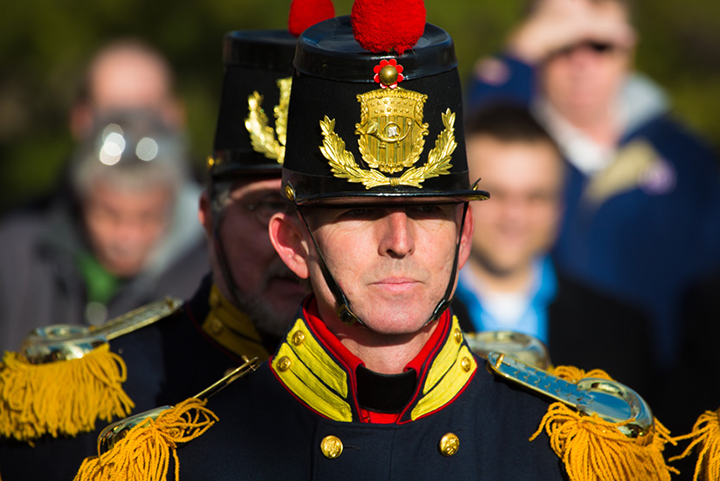

Talking Points Memo serves up a slide show of last week’s funeral for the Monitor sailors at Arlington.
____________Photo by Jeff Malet, MaletPhoto.com.

U.S.S. Monitor Sailors Laid to Rest at Arlington
 Diana Rambo, and her husband Lorin Rambo, from Fresno, Calif., pause at a casket of unidentified remains after services to honor two sailors from the Civil War ship, the USS Monitor, at Arlington National Cemetery, Friday, March 8, 2013 in Arlington, Va. Mrs. Rambo is related to USS Monitor crew member Jacob Nicklis. A century and a half after the Civil War ship the USS Monitor sank, two unknown crewmen found in the ironclad’s turret were buried at Arlington National Cemetery. Friday’s burial may be the last time Civil War soldiers are buried at the cemetery. (AP Photo/Alex Brandon)

Over the last year or so we’ve covered the story of the two members of Monitor‘s crew that were found inside the ship’s turret after it was recovered from the floor of the Atlantic off Cape Hatteras in 2002. Officials had hoped to be able to positively identify them from among the sixteen men known to have been lost with the ship, but have so far been unable to, despite efforts through genealogical research, DNA testing and creating facial reconstructions. On Friday, those two men were buried at Arlington National Cemetery.
A marker dedicated to all 16 men lost with the ship will be placed over the grave site. Efforts to identify the men interred there will continue.
Additional photos of the service after the jump, by Associated Press photographer Alex Brandon.
Palestine, Texas Chamber of Commerce Invites a Lawsuit
Palestine, a town in East Texas, has an annual event in the spring, put on by the Palestine Area Chamber of Commerce, called the Dogwood Trails Festival. For a number of years, the local John H. Reagan Camp of the SCV has participated with a booth on the event grounds, explaining their organization and looking to recruit new members. Not this year:
This is a pretty familiar story these days. Even in places like East Texas, there’s a lot of ambivalence about Confederate Heritage™, especially when (as in the case of the SCV) it’s represented by a Confederate Battle Flag. The CBF is “divisive,” for good reason, and other Confederate symbols have been the subject of considerable controversy there in recent years. I can understand Chamber of Commerce’s desire to avoid the issue altogether. Unfortunately, the board’s prepared statement explaining their decision makes their position much more difficult to defend:
 My emphasis. While the board members — who count among their number at least one attorney — may have meant the larger Palestine community, their statement suggests they’re operating as an extension of the city government, in which case they’re sunk, legally. As I outlined earlier, governmental entities can’t really pick and choose who they affiliate with in the same way that private groups can, and issuing a formal statement that you’re operating “on behalf of the city” is a good way to get yourself sued.
The Reagan Camp is one of the highest-profile, most active camps in the state, and it will be interesting to watch this case play out. #HeritageViolation is trending on Twitter, even as I type. Pass the popcorn.
_________
Talkin’ Buffalo Bayou Steamboats

I’ve recently scheduled a couple of more public talks for the spring. These have proved to be a lot of fun, and (I hope) informative, too. Maybe I’ll see you there!
Buffalo Bayou Steamboats
Book Talk and Signing
Jean Laffite Society
April 9, 2013 (Time TBA)
Meridian Towers Retirement Center
23rd Street and Seawall Boulevard
Galveston, Texas
Cotton by Rail to the SeaBook Talk and Signing, Burton Cotton Gin Museum 24th Annual Cotton Gin Festival
April 20, 2013 (Time TBA) 307 North Main Burton, Texas Buffalo Bayou Steamboats Book Talk and Signing Galveston Historical Foundation Menard Summer Lecture Series Sunday, June 23, 2013 at 2 p.m. Tickets required. Menard Hall, 33rd and Avenue Galveston, Texas 77550
_____________
Image: Volunteers from the Southwest Underwater Archaeological Society examine the remains of the former Buffalo Bayou steamboat A. S. Ruthven, near Parker’s Bluff on the Trinity River, 1997.
“13 Minutes”

The Spring 2013 issue of the Civil War Monitor is now online, and will soon be available on newsstands and in subscribers’ mailboxes. My colleague Ed Cotham and I have one of the issue’s feature articles, “13 Minutes,” describing the January 11, 1863 engagement between the Confederate raider Alabama and one of the Federal vessels on the Galveston blockade, U.S.S. Hatteras. It’s an action that’s often given a passing mention in accounts of the war’s naval conflict, but rarely covered in much detail. Our manuscript is an outgrowth of research done last summer, when we were part of the Hatteras project headed by NOAA. We ended up with a lot of material, some of which had not been published before. The CWM manuscript is the result. I’m really pleased with the outcome, because many accounts of the battle treat it as almost a stand-alone event that happened independently of the broader context of the war. This manuscript does a better job of providing both the context of the event, and its effect on the future course of the war in the western Gulf of Mexico, which was substantial — more substantial than I’d appreciated before we started digging into the subject in detail.

Detail of illustration in “13 Minutes.”
As a gesture to this blog’s readers, CWM Editor-in-Chief Terry Johnston has opened a special user account for y’all to read the Spring 2013 issue in its entirety. The username is deadconfederates and the password is cwm3321 , all in lowercase. This account will only be active for a few days, then the issue goes back behind the paywall. (Book reviews, and the Front Line and Behind the Lines blogs remain open-access.) If you like what you see, please do consider a subscription to the magazine — it’s well worth the money.
I’d also like to pass along my congratulations to Kevin Levin and Brooks Simpson, who also have feature articles in the same issue — Kevin’s on African American servants in the Confederate Army, and Brooks’ on the behind-the-scenes maneuvering by fellow Union Army officers against Grant during the Vicksburg Campaign in the winter of 1862-63. I knew Kevin had one coming, but no idea about Brooks’ piece until I opened an advance copy of the issue myself.
Ed and I originally submitted two sidebars to go along with “13 Minutes,” one on the NOAA expedition, and another on the memorial service held for the two Hatteras crewmen killed in the action. The latter didn’t appear in the magazine due to space limitations, so I’ve appended it here, below the jump:

Visualizing Tariff Revenues
Earlier today my Austin colleague Eric Calistri shared a link to an Excel spreadsheet, distributed by the Economic History Association (download at your own risk), that detailed gross revenues, expenses and net revenues for ports of entry around the United States in the late 1850s. The data is abstracted from a report from the Secretary of the Treasury to the 36th Congress, 1st Session, Senate Executive Document No. 33.
To help visualize that, I’ve taken the gross revenue data for selected ports for FY 1859, and shown how those various ports stack up (ahem!) against one another:
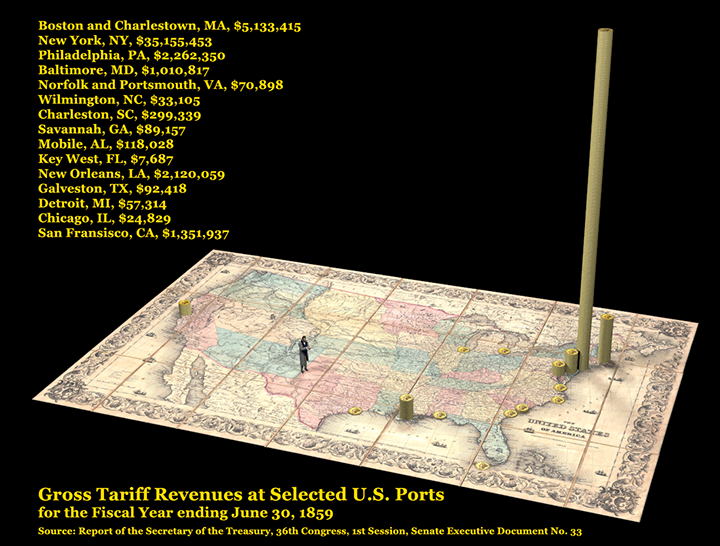
Recall that Professor Williams said that “Southern ports paid 75 percent of tariffs in 1859.″ Sure doesn’t look like it to me. Tariff revenues at New Orleans are similar to those at Philadelphia, but no other Southern port comes anywhere close. Even the second Southern port, Charleston, is only about a tenth the size.
Sometimes it helps to see a thing to really understand it. Full-size image here.
___________
Walter E. Williams Polishes the Turd on Tariffs

Canal boats (foreground) and blue-water sailing ships crowd the waterfront near South Street in lower Manhattan in this 1858 view by Franklin White of Lancaster, New Hampshire. In that year, customs duties collected at the Port of New York alone provided nearly half of all federal revenue. When foreign trade rebounded the next year after the Panic of 1857, customs duties collected at the Port of New York accounted for almost two-thirds of federal revenue. From Johnson and Lightfoot, Maritime New York in Nineteenth-Century Photographs.
The other day, George Mason University economist Walter E. Williams published an opinion piece in the Washington Examiner, asking in the title, “was the Civil War about tariff revenue?” Like many of his columns that deal with that conflict, he tosses in all sorts of obfuscatory boilerplate about Lincoln not liking black folks much, how the Emancipation Proclamation didn’t actually free all the slaves, and how Lincoln, more than a decade before the war began, had made some general comments about the inherent right of revolution. Williams doesn’t get around to discussing, you know, tariff revenue, until the very end, more than nine-tenths of the way through the 657-word piece, when he says (my emphasis),
I want to focus on that line about Southern ports paying 75% of import tariffs, because it’s the core of his entire argument. He’s playing an classic trick, throwing out some impressive factoid, and then asking a rhetorical question based on it, that seemingly has an obvious answer. The problem is that, in this case, his devastating “fact” — “Southern ports paid 75 percent of tariffs in 1859” — isn’t even close to being true.
The first red flag here is that annual tariff data was not collected and reported by the Treasury Department based on calendar years, but by fiscal years that ran from July 1 to June 30. So when Williams says “in 1859,” it’s unclear whether he’s talking about the reporting year that ended in 1859 (FY 1859), or the reporting year that began in 1859 (FY 1860). That’s a revealing slip-up, but it’s also one that doesn’t matter, because the claim is demonstrably untrue for both fiscal years, and so for the calendar year of 1859, as well.
Data for imports and tariffs collected for the year just prior to secession (July 1, 1859 to June 30, 1860, inclusive) is provided in the Annual Report of the Chamber of Commerce of the State of New York, for the Year 1860-61 (New York: John Amerman, 1861), 57-66. I’ve uploaded a PDF copy of the relevant pages here. The first two pages include imports that were not tariffed; in case anyone was wondering, manures and guano were duty-free.
In summary, during that year the Port of New York took in $233.7M, of which $203.4M were subject to tariffs ranging from 4 to 30%. During that same period, all other U.S. ports combined received $128.5M in imports, of which $76.5M was subject to tariff. So the Port of New York, by itself, handled almost two-thirds (64.5%) of the value of all U.S. imports, and almost three-quarters (72.7%) of the value of all tariffed imports:

What about earlier years? The previous year’s report from the New York State Chamber of Commerce carries a table (p. 2) that breaks out imports clearing customs in all of New York State for the previous four fiscal years:

A glance at these numbers makes clear that in spite of some year-to-year variation in import volumes — there was an economic crash in 1857 — the share of imports coming into New York remained remarkably stable, at around two-thirds of all imports coming into the United States. (And this isn’t even including other major ports like Boston and Philadelphia.)
What about customs revenues, specifically? The Chamber of Commerce from 1860 reports — on the very first page — customs revenue for Port of New York for 1859 at $38,834,212, or about 63.5% of the $61.1M in federal revenue that year. The Port of New York, alone, accounted for nearly two-thirds of U.S. Government revenue in 1859. Williams’ assertion that “Southern ports paid 75 percent of tariffs in 1859” isn’t a case of “lying with statistics,” because the statistics don’t actually say anything remotely like that. It’s a case of lying, period.
So where does this made-up-from-whole-cloth assertion come from? Williams’ column has been splattered all over the Internet in the last few days, no doubt because it seemingly affirms modern cultural/political fears about big gubmint avarice. But the idea that Lincoln refused to accede to the Southern states’ secession because they represented the large majority of federal government’s revenue has been percolating around for a while. Thomas DiLorenzo — who Williams cites in the first graf of the piece — made a related and equally implausible claim in his 2002 book, (The Real Lincoln, pp. 125-26) that “in 1860 the Southern states were paying in excess of 80 percent of all tariffs. . . .” People who’d looked at the actual numbers, including friend-of-this-blog Jim Epperson, called him out on that claim, which DiLorenzo eventually (and quietly) revised in his most recent edition to a somewhat more vague “were paying the Lion’s share of all tariffs.” DiLorenzo, not surprisingly, provides no citation to back this claim. But it’s and old turd of a notion that’s been around a long time, that Walter Williams has pulled out, polished off, and given new life on the interwebs.
(DiLorenzo’s wording is a little different, saying that the “Southern states” were paying tariffs. It’s a strange construction, given that the states weren’t paying tariffs at all, and the tariffs were paid by the merchants doing the importing — who were generally Northerners. Even if DiLorenzo were to argue that it was the end-of-the-line consumer who “paid” the tarfiff through higher costs for goods, it’s a claim that defies credulity, as it would require the eleven states that ultimately seceded, with less than a third of the nation’s population, to be consuming more than four-fifths of all the tariffed good brought into the entire county. It’s a ludicrous notion, which is probably why DiLorenzo doesn’t even pretend to offer a source for it.)
Williams and DiLorenzo have both made a good living writing books and essays and giving speeches that are full of half-truths, selective quotes, and (as in this case) outright fabrications, all directed to a narrow but extremely-loyal audience of people who are primed to believe anything bad about the federal government (then or now). Both men hold endowed academic appointments, which means they cost their respective institutions relatively little, and in return are free of heavy teaching loads and the imperative of generating peer-reviewed publications that stalk most faculty members through much of their careers. Fair enough, but Williams’ assertion that “Southern ports paid 75 percent of tariffs” is surely in a league by itself. On its face it strains credulity; one needs only a basic understanding of American history to know how overwhelmingly the Northern Atlantic states and New England dominated this country’s maritime trade through the end of the 19th century. True Southrons™ often cite the heavy involvement of Northern shipping interests in the transatlantic slave trade, but that’s a selective and self-serving focus; that same region overwhelmingly dominated every other aspect of American maritime enterprise, from shipbuilding to whaling to the China trade to the nascent practice of marine engineering.
Williams surely knows this, and knows his assertion about the share of import tariffs paid through Southern ports is preposterous. If he doesn’t know it, he’s unworthy of his credentials, and if he does and asserts it anyway because that’s what his audience wants to hear, then he’s a charlatan on the order of someone like David Barton. I really can’t imagine what’s worse — the idea that he doesn’t actually know he’s wrong, or the idea that he doesn’t give a damn.
____________
UPDATE, February 25: In the comments, Craig Swain points out that he covered this same ground two years ago, over at Robert Moore’s place. I owe Craig an apology, because I not only read that post of his at the time, I also commented on it. I’d completely forgotten about that, at least consciously. Craig does a particularly good job of showing how those same tariff laws, which supposedly were so beneficial to Northern industries, also protected Southerners’ production of things like cotton, tobacco and sugar from competition from overseas.
Given the way spurious claims about tariffs are made over and over again by folks like Williams, naturally they’ve been exposed by others before. But it’s hard to use evidence to counter a belief that’s not based on evidence to begin with.
____________
Aye Candy: David-Class Torpedo Boat
Test renders of a new work-in-progress, a Confederate David-class torpedo boat like those used at Charleston, 1863-65. (The rig that suspended the torpedo spar on the bow, in particular, is missing from this incarnation.) The model incorporates features from a variety of sources, so is intended to show the general appearance of the type, as opposed to any specific, individual craft. At some point I will provide an interior for it, but as only rudimentary diagrams of the boats’ internal layout exist, the interior of the model will be even more speculative than the exterior.


And finally, one of the torpedo boat alongside the submersible H. L. Hunley. The Davids were often used to tow Hunley in and out of the harbor, to save the strength of the hand-powered submarine’s crew:

Full-size images can be seen on Flickr.
______________




15 comments