The Fate of the Confederate Submersible H. L. Hunley

Big news came out Monday in the investigation of the remains of the Confederate submersible Hunley, arguably the most important scientific finding of the project to date. Archaeologists revealed that the cleaned an conserved remains of the iron spar that carried the boat’s 135 lb. (61kg) torpedo still had attached remnants of the explosive device’s copper casing, peeled back by the force of the explosion (above). This is a tremendously important finding, because it shows that the little “fish boat” was close, very close, the blast that sank her opponent, U.S.S. Housatonic. How close?
Here’s why. Hunley was originally intended to tow a floating mine (then called a “torpedo”) behind her, and run under the target ship. If all went according to plan, the mine would be pulled into the side of the enemy vessel and detonate — on the opposite side from where Hunley was.
Unfortunately, this worked better in theory than in practice. In testing, they found that the towing line was prone to getting fouled in the boat’s propeller and rudder mechanism. Hunley’s ability to dive and run completely submerged — in order to pass underneath the target vessel — was problematic, as well, as shown by two prior, fatal sinking of the boat. (Not for nothing was it known as the “peripatetic coffin.”) Clearly, they had to find a method to deliver the mine to its target that gave them precise control, which in turn meant planting the mine against the target ahead of the boat, not towing it along behind.

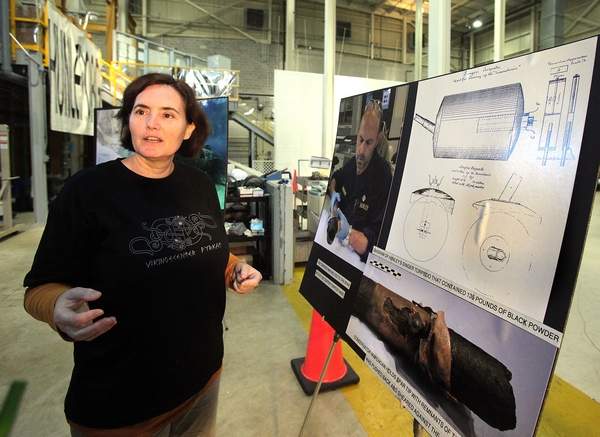 Hunley Project Chief Archaeologist Maria Jacobsen. Charleston Post & Courier.
For years, it’s been generally accepted that Hunley‘s mine was detachable and fitted with a spike or barb, that would be rammed into the target’s hull. Once that was fixed in place, the submersible would back off for a safe distance, and detonate the mine using a lanyard, in the same way that period artillery pieces were fired. Up to today, this was the accepted scenario of how the attack was supposed to have been carried out. The physical evidence revealed in Charleston on Monday, however, suggests that experience gained in another attack on a blockading warship caused a critical change in those plans:

As a result, the scientists now believe, George Dixon and his crew set out on the evening of February 17, 1864, with the intention of placing the mine not in the enemy ship’s side, but under the hull, anticipating that most of the blast would be directed upward, ripping apart that part of the vessel. This interpretation in supported by witnesses aboard Housatonic, who first sighted Hunley a couple of hundred yards off their port bow, then watched as the submersible passed across their bow, then came around to strike their ship well aft on the starboard side, where the contour of the hull sweeps in and up toward the stern.
That sort of attack, if were planned that way as the researchers now believe, almost certainly doomed Hunley and her crew. Nonetheless, neither the project’s chief archaeologist, Maria Jacobsen, nor South Carolina Lieutenant Governor Glenn McConnell, who’s led the fund-raising for the project since its inception, believe Dixon and his crew expected theirs to be a suicide mission. “They were pressed for time, they were pressed for resources, but nothing indicates this was a suicide mission,” Jacobsen said. “They just had to get the job done.”
 Detail of a painting, “Charleston Bay and City,” by Conrad Wise Chapman, showing a Confederate ironclad with a spar torpedo (show in raised position) very similar to that used aboard Hunley. Museum of the Confederacy.
Lots of questions about what happened that night remain, including ones underscored by Monday’s announcement about the spar torpedo. Though the crew probably had little idea of how the concussion from the detonation of the mine would have carried underwater, the force must have been tremendous. While the hull of the boat itself remains covered for now with cement-like concretions of sand and shell, when these are removed beginning next year, Jacobsen and her team will be looking closely for effects of the blast, in the form of popped rivets and opened seams between the iron plates. It would not take many of these to sink a boat like Hunley, that had precious little buoyancy to begin with, even under ideal conditions. If her crew were incapacitated as well, Hunley could easily have drifted, slowly filling with water, until she settled on the bottom some distance away.
We likely never will know all the details of what happened that night in February 1864, but the work of Jacobsen and her team at the Warren Lasch Conservation Center, where Hunley is being studied and preserved, are getting us closer and giving us a better understanding of those events.
In the meantime, I’ve updated the spar on my old digital model of H. L. Hunley. There’s a spool on the starboard side of the boat, next to the forward hatch. Until it was assumed that this was for unspooling the lanyard used to detonate the mine; now I think it may have led through a block on the upper boom, to raise and lower the spar. That’s how I’ve depicted it here:


Finally, a few good Hunley links for those interested in learning more:
Michael Crisafulli’s Hunley reconstruction:http://www.vernianera.com/Hunley/ Michael likely knows more about the construction and operation of the Hunley than anyone not directly affiliated with the project. Great stuff for the technically-minded. (Michael also can give you a guided tour of Jules Verne’s Nautilus, as well.) NPS Housatonic Site Assessment
http://www.cr.nps.gov/history/online_books/maritime/housatonic.pdf NPS Hunley Site Assessment:
http://www.cr.nps.gov/history/online_books/maritime/hunley.pdf
___________

The Short, Eventful Life of the U.S. Transport Che-Kiang

In my recent post on Private Hobbs’ passage from Brooklyn to Ship Island, Mississippi aboard the steamer Saxon, I included an image of another transport on that same expedition, Che-Kiang, which is reported to have collided (above) with a Confederate schooner off the Florida Reef, resulting in the latter vessel’s immediate demise. Che-Kiang was carrying at that time six companies of the 28th Connecticut Infantry, and parts of the 23rd and 25th Connecticut Infantry as well. All reached Ship Island, Mississippi safely, although some were perhaps a little green around the gills from the very rough weather encountered during their passage.
While poking around the interwebs for more information on this ship, though, I came across this article from the June 20, 1863 Straits Times, published in Singapore. Che-Kiang‘s rough passage to the Gulf of Mexico was just the start of her adventures.
In his History of American Steam Navigation (1903) author John Harrison Morrison explains that Che-Kiang was one of several big steamers built in and around New York, to run in Chinese waters. Most were patterned after boats running on Long Island Sound, with the addition of a sailing rig. Although Che-Kiang herself apparently did not, Morrison notes that several of these ships that were built during the war, following the same route as Che-Kiang to the Far East, stopped first at Halifax, Nova Scotia, where they took out British registry in case they were intercepted on the high seas by a Confederate raider. [2] It was not an imaginary threat; the most famous Confederate raider, Raphael Semmes’ Alabama, did in fact follow a similar route and ventured as far east as Singapore in late 1863.
 Track chart showing the known travels of the American steamship Che-Kiang, 1862-64. Original map via National Geographic.
Che-Kiang even played a sad, tiny footnote role in the aftermath of the Battle of Galveston. In late February 1863, U.S. Admiral David Farragut reported to the Navy Department the desertion of Acting Master Leonard D. Smalley, at that time assigned to the gunboat Estrella. Smalley had been one of the officers aboard U.S.S. Westfield when that ship was blown up by her captain, William Renshaw, at the end of the battle on New Years Day 1863. Renshaw and several of his men had been killed in the blast, which Smalley almost certainly witnessed from a short distance. Immediately after, Smalley was called on to serve as pilot to guide the transport Saxon, followed by the rest of the Union squadron, safely out of Galveston harbor. Smalley, it seems, may have been suffering the post-traumatic effects of this incident, for Farragut writes that
Acting Master Smalley was dismissed from the service soon thereafter.
In her first few months of service, Che-Kiang had seen and done some remarkable things, but her eventful life would not be a long one. She caught fire and burned at Hankou (now Wuhan), about 670 statute miles up the Yangtze River from Shanghai, on August 7, 1864. There were no reported fatalities in the disaster. [4]
______________
[1] “The Steamer Che Kiang,” The Straits Times, June 20, 1863, 1.
[2] John Harrison Morrison, History of American Steam Navigation (New York: W. F. Sametz & Co, 1903), 511.
[3] D. G. Farragut to Gideon Welles, February 26, 1863. Official Records of the Union and Confederate Navies in the War of the Rebellion, Series I, Vol. 19, 634.
[4] C. Bradford Mitchell, ed. Merchant Steam Vessels of the United States, 1790–1868 (The Lytle-Holdcamper List), (Staten Island, New York: Steamship Historical Society of America, 1975), 249.
Private Hobbs’ Diary: “The weather continues delightfull. . . .”
Alexander Hobbs was a private in Company I of the 42nd Massachusetts Infantry. It would be Hobbs’ and his messmates’ misfortune that Company I was one of the three companies of that regiment that eventually occupied Kuhn’s Wharf on the Galveston waterfront, and came under attack by Confederate forces in the early morning hours of New Years Day, 1863. Hobbs kept a diary that encompassed his experiences, which is now part of the collection at the Woodson Research Center at Rice University.
My colleague Jim Schmidt has highlighted Hobbs’ account of the Battle of Galveston, and used it as a source in his outstanding recent book, Galveston and the Civil War: An Island City in the Maelstrom, but Hobbs’ entire account of that period is worthwhile, being a privates-eye-view of a military campaign that ended disastrously. Over the next several posts, then, I”ll be sharing Hobb’s story as he and his company make their way south, into the Gulf of Mexico and on to Texas. I’ve broken Hobbs’ narrative out into paragraphs and added a few images that illustrate his story, but his original spelling, punctuation and syntax remain.
We pick up Hobbs’ account on December 3, 1862, as he and Company I board the transport Saxon at Brooklyn, New York.
 December 3
At 5 P.M. went on bord the transport steamer Saxon [1] with three other Companys but being too crowded Co. A was removed too the Quincy the regiment all embarked on four steamers the Saxon, Quincy, [Charles] Osgood, and Chetucket, two of the Steamers were old and did not look safe one company required to be put on bord the Chetucket [sic., Shetucket] and after considerable excitment were finally transferred to the Saxon [2]
December 5
At 8 ½ Oclock AM, the Pilot came on bord when we weighed anchor and seamed down the harbour past Sandy Hook and out too sea we are in [General Nathaniel] Bank[‘s] Expedition and sail under sealed orders but expect to go to Fortress Monroe
December 3
At 5 P.M. went on bord the transport steamer Saxon [1] with three other Companys but being too crowded Co. A was removed too the Quincy the regiment all embarked on four steamers the Saxon, Quincy, [Charles] Osgood, and Chetucket, two of the Steamers were old and did not look safe one company required to be put on bord the Chetucket [sic., Shetucket] and after considerable excitment were finally transferred to the Saxon [2]
December 5
At 8 ½ Oclock AM, the Pilot came on bord when we weighed anchor and seamed down the harbour past Sandy Hook and out too sea we are in [General Nathaniel] Bank[‘s] Expedition and sail under sealed orders but expect to go to Fortress Monroe
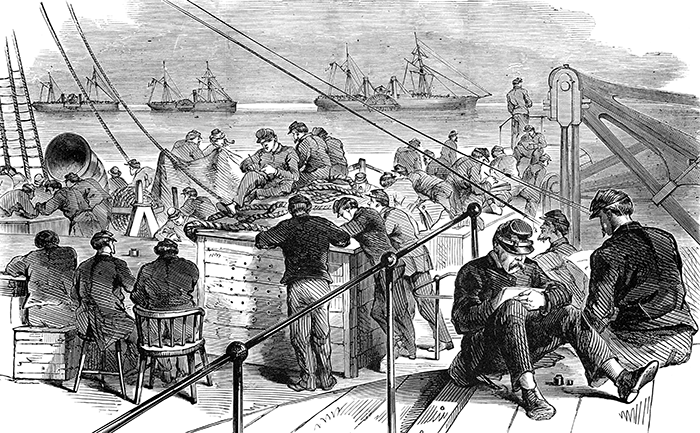 Soldiers in Hobbs’ sister regiment, the 41st Massachusetts, write letters on the the deck of their transport as part of the Banks Expedition. From Frank Leslie, Famous Leaders and Battle Scenes of the Civil War (New York, NY: Mrs. Frank Leslie, 1896).
December 6
Blowing a gale with a heavy sea most of the men are sick and as the ports had too be closed it was very disagreeable to stay below and too cold to stay on deack
December 7
A rough night wind still blowing passed Cape Haterass about 1 A.M. the men still sick turned them on deack and cleaned the ship we are in the Gulf Stream and the water is almost a blood heat but the wind blows very cold. The orders were opened this morning and we find our destination to be Ship Island
December 8
The Weather is growing mild and the men are recovering from the sea sickness with an appetite which threatens to devour evrything at one meal most of them are growling because they cannot get enough to eat and the cooks are mad and sware thair stove will not draw
December 9
The weather is delightfull and every-thing goes on well except the grub they do not give us enough of any-thing except hard bread and that we cannot eat many of the men express the desire that the pirate Alabam may take us
December 10
Weather warm and pleasant three men in irons today for stealing meat last night our Capt tore the stripes off a corporal for being concerned in the robbery and disobeying orders Made land on the cost of Florida and saw a gun boat
Soldiers in Hobbs’ sister regiment, the 41st Massachusetts, write letters on the the deck of their transport as part of the Banks Expedition. From Frank Leslie, Famous Leaders and Battle Scenes of the Civil War (New York, NY: Mrs. Frank Leslie, 1896).
December 6
Blowing a gale with a heavy sea most of the men are sick and as the ports had too be closed it was very disagreeable to stay below and too cold to stay on deack
December 7
A rough night wind still blowing passed Cape Haterass about 1 A.M. the men still sick turned them on deack and cleaned the ship we are in the Gulf Stream and the water is almost a blood heat but the wind blows very cold. The orders were opened this morning and we find our destination to be Ship Island
December 8
The Weather is growing mild and the men are recovering from the sea sickness with an appetite which threatens to devour evrything at one meal most of them are growling because they cannot get enough to eat and the cooks are mad and sware thair stove will not draw
December 9
The weather is delightfull and every-thing goes on well except the grub they do not give us enough of any-thing except hard bread and that we cannot eat many of the men express the desire that the pirate Alabam may take us
December 10
Weather warm and pleasant three men in irons today for stealing meat last night our Capt tore the stripes off a corporal for being concerned in the robbery and disobeying orders Made land on the cost of Florida and saw a gun boat

The transport steamer Che-Kiang, another vessel in the Banks Expedition, collided with (or was intentionally rammed by) a Confederate schooner off the Florida Reefs on the night of December 11, 1862. The schooner sank, and her crew escaped in a boat. Che-Kiang continued on her way, with some damage, eventually discharging her troops at Ship Island, Mississippi. From Frank Leslie, Famous Leaders and Battle Scenes of the Civil War (New York, NY: Mrs. Frank Leslie, 1896)
December 11
passed a wreck on the shore with a tug boat discharging her cargo [3] at 5 P.M. entered Key West to get coal and water Key West is now used by the U.S. Government to store provisions it is a small village and to us who had never been at the south the trees and fruit looked really pleasant The men worked at night taking on bord coal and water some of the boys went on shore and got oranges Lemons Coconuts &
December 12
Left this morning for Ship Island in company with two other transports a fair wind and pleasant weather
December 14
the weather continues delightfull the men are in high spirits except at meal time they have not yet got acostomed to living on Army rations we get mush sometimes which we consider a grate luxury the men who have money to spare go to the second table in the cabin they have thare evry delicacy that can be got on land we have on bord the Col. I.S. Burrell and quite a number of the staff officers they probably thought this the safest ship and she has so far been all we could wish She is the same as was used by Gen Butler as his flag ship in his expiditions to New Orleans
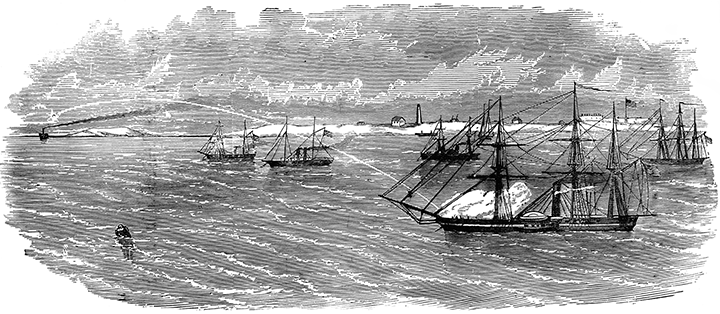 Ship Island, Mississippi, which was used as a primary Union rendezvous and staging area in the Gulf of Mexico. From Frank Leslie, Famous Leaders and Battle Scenes of the Civil War (New York, NY: Mrs. Frank Leslie, 1896).
[1] Saxon was a relatively small, 413-ton screw steamer, built at Brewer, Maine, opposite Bangor on the Penobscot River in 1861. She was first registered at Boston, but would spend much of the Civil War under charter to the U.S. Army as a transport. She would continue in civilian for almost three decades after the war, before being abandoned in 1892. Mitchell, C. Bradford, ed. Merchant Steam Vessels of the United States, 1790–1868 (The Lytle-Holdcamper List), (Staten Island, New York: Steamship Historical Society of America, 1975), 196.
[2] Companies D, G and I, along with regimental staff, traveled aboard Saxon, and were the only part of the regiment to make it to Galveston. Cos. A, B and F, on Qunicy, arrived at New Orleans on December 29; Cos. C and H, on Shetucket, arrived at New Orleans on January 1; and Cos. E and K arrived at New Orleans aboard Charles Osgood, also on New Years Day, 1863. Dyer’s Compendium, Pt. 3, 1263-64.
[3] This may be a reference to another steamer in the expedition, Mememon Sanford with the 156th New York Infantry aboard, that was wrecked and lost on Carysfort Reef, near present-day Key Largo, early on the morning of December 10, with no loss of life
There’s lots more to come.
__________
Update on George W. D. Kirkland at The Sable Arm
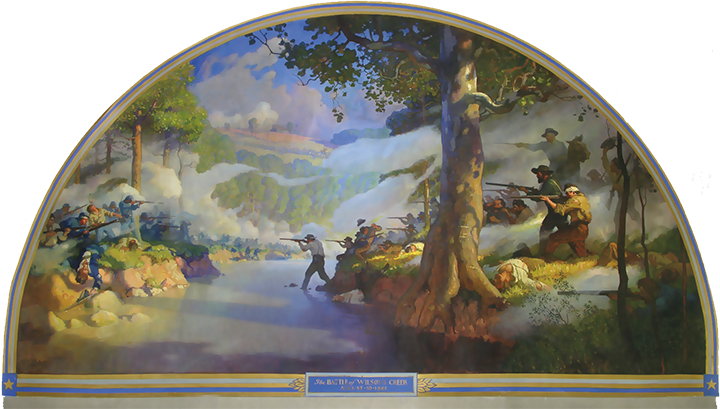
Over at The Sable Arm, Jimmy Price has an update on the story of George W. D. Kirkland, the mixed-race son of Mary Lincoln’s modiste and confidante, Elizabeth Keckley. Kirkland enlisted as a white soldier in a Missouri Unionist regiment and was killed at the Battle of Wilson’s Creek. Good, thoughtful stuff, but then that’s what’s always on tap at Jimmy’s.
_________
Image: Mural depicting the Battle of Wilson’s Creek by N. C. Wyeth, Missouri State Capitol.
Wreck of the Steamship Celt, 1865
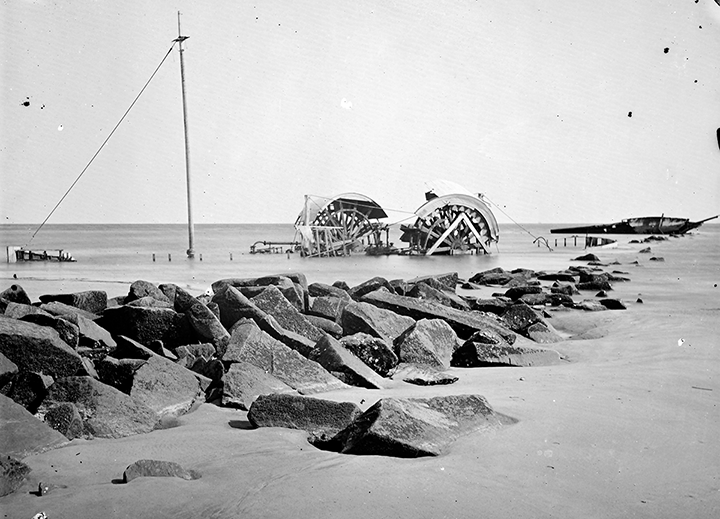

This Library of Congress image is one of the most famous of Civil War blockade runners, but it’s almost never identified — only the location is given, on the shore of Sullivan’s Island, near Charleston. I believe this is the wreck of the sidewheel steamer Celt, ashore just off Fort Moultrie. Although the specific location of this image is not recorded in the LoC catalog information, during the war period there was only one point on Sullivan’s Island with a stone jetty or breakwater extending into the water like the one shown in the foreground of the image. That was Bowman’s Jetty, which entered the water directly in front of Moultrie. Jetties like that are commonly used on barrier islands like Sullivan’s to reduce erosion from currents running parallel to the shore.
This sketch map from the NOAA archives, prepared at the end of the war in 1865 — roughly the same time the photograph was made — shows the wreck site of Celt close up on the beach, with the wrecks of two screw steamers, Minho (lost October 2, 1862) and Isaac Smith (a.k.a. Stono, destroyed June 5, 1863), further out along the jetty. As Isaac Smith/Stono was burned, it seems likely that the wrecked ship in the background is Minho.

![[IMG]](https://deadconfederates.com/wp-content/uploads/2013/01/celtmap.jpg?w=720)
Celt was built at Charleston during the war, which helps explain the relatively simple machinery construction apparent in the image. Launched in 1863, the 160-foot steamship she was used by the C.S. Quartermaster in and around the harbor until February 1865, when she was loaded with cotton and attempted to run out through the blockade. Celt was wrecked near Moultrie on February 14, 1865. Although the steamer was grounded in shallow water, yards from the beach, six or seven of her crew took to a boat and rowed out to a Federal warship instead. Her cargo, or most of it, also ended up in the Federals’ hands (ORN):
The Federals recovered at least 190 bales of cotton from the wreck, but reported in early March that Celt‘s hull “lies stranded on the beach at Sullivan’s Island, back broken, and full of water, and decks ripped up. The machinery is in an irreparable condition; some few pieces might be removed and be of service. Boilers are mostly below water, but judging from the condition of those parts visible, we are of the opinion they are not worth the expense of removing.” This is a good description of her state in the photograph, as well.
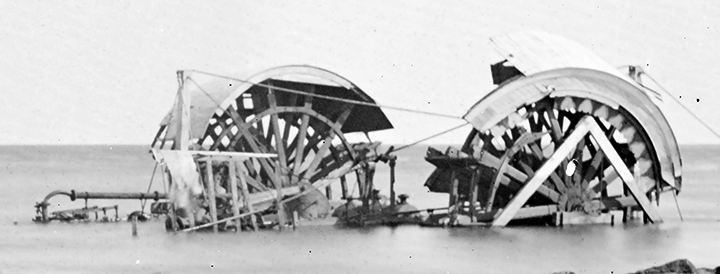
There’s some interesting detail in the photograph that hint at the vessel’s origins as a local craft built under the exigencies of wartime. Celt has two engines (left, above) that, while partially submerged, appear to be arranged as in a Western Rivers boat, and the valving shown looks to be almost identical. Such engines were reliable and simple but not overly efficient. They also operated under very high pressure compared to most seagoing ships, and so may have required a more robust set of boilers. Similarly, the paddlewheels are of very simple construction, with wooden arms and fixed floats (paddle blades). As with the engines, this is a very basic design, easy to build and maintain, but not efficient and somewhat coarse by shipbuilding standards of the time.
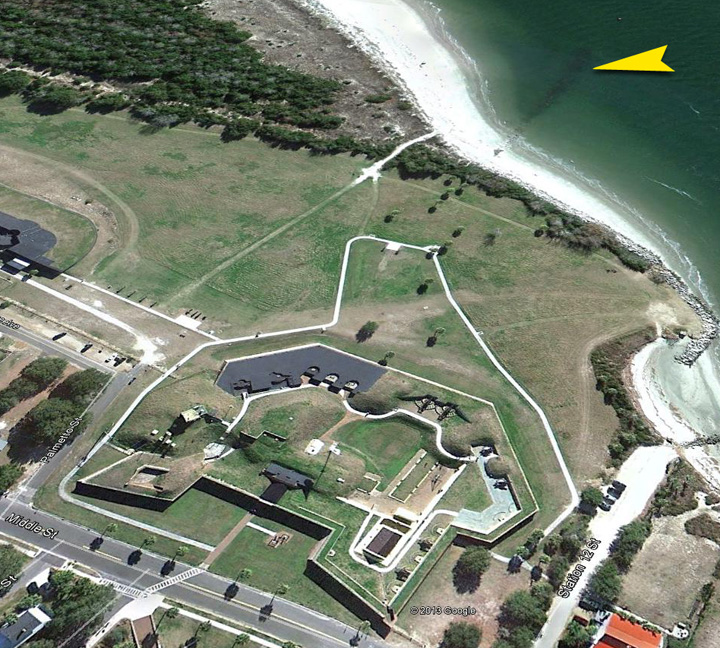
Modern aerial view of Fort Moultrie (via Google Earth), with the remains of Bowman’s Jetty still visible at upper right. The beach has extended further out from its position in 1865, placing (it is believed) the wreck of Celt under the sand.
The wreck site of Celt, as well as Isaac Smith/Stono and Minho, was the subjects of an extensive archaeological survey in 2012 by a team from the University of South Carolina. Although what remains of Celt is now believed to be under sand, some distance back from the shore, the wreck was not located at that time.
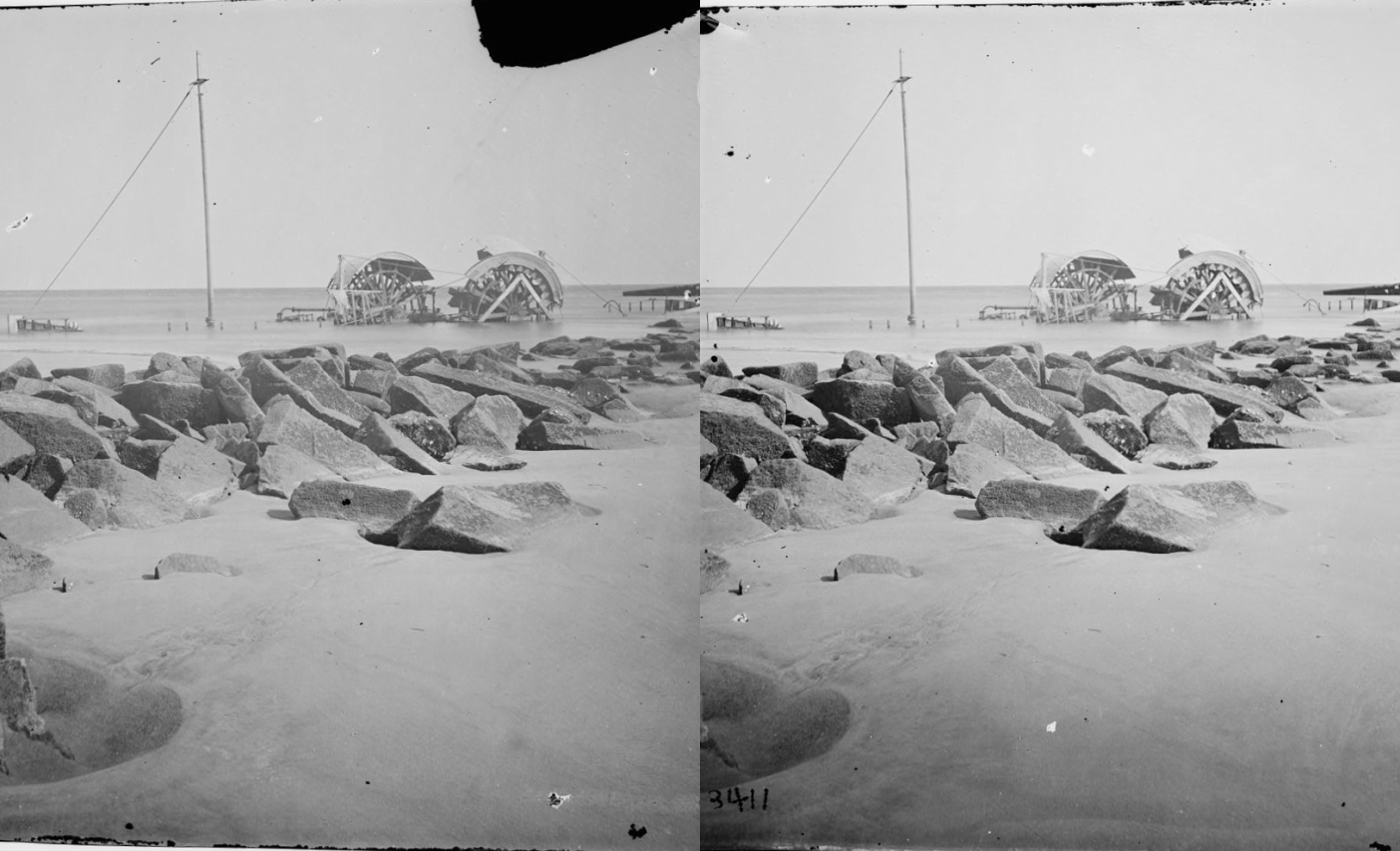
The original images was part of a stereo pair. Here is is in red/cyan, and as an animated GIF:

_____________
“She will sustain the reputation of Baltimore-built vessels”
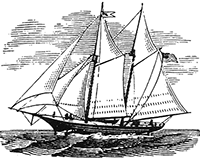 After the blockade off Galveston was established by the arrival of U.S.S. South Carolina on July 2, 1861, one of Captain James Alden, Jr.’s first captures, on July 6, was the local pilot boat Sam Houston. The little schooner was condemned as a prize and taken into the U.S. Navy. She was armed with a single, 12-pounder smooth-bore gun, and spent most of the rest of the war running dispatches, chasing down blockade runners, and serving as a guard boat at various places around the Gulf of Mexico. After the war Sam Houston was decommissioned and sold at auction to one J. B. Walton on April 25, 1866 for $1,998.70, at New Orleans. She was sold again the following month and re-enrolled at Galveston; her last enrollment document recorded was at Galveston in the spring of 1870.
Most sources, including the ORN, do not provide many details about this little boat, but this evening I came across this description of the schooner in the Galveston Civilian and Gazette Weekly, February 7, 1860:
Her postwar registration documents give her a length between perpendiculars of 59 feet 4 inches, with a square stern and an eagle carved into her stem. Must have been a beautiful little vessel, and well-built, to still be serviceable after almost five years ‘ hard naval service. I’d say she lived up to expectation.
___________

U.S.S. Algonquin by A. R. Waud
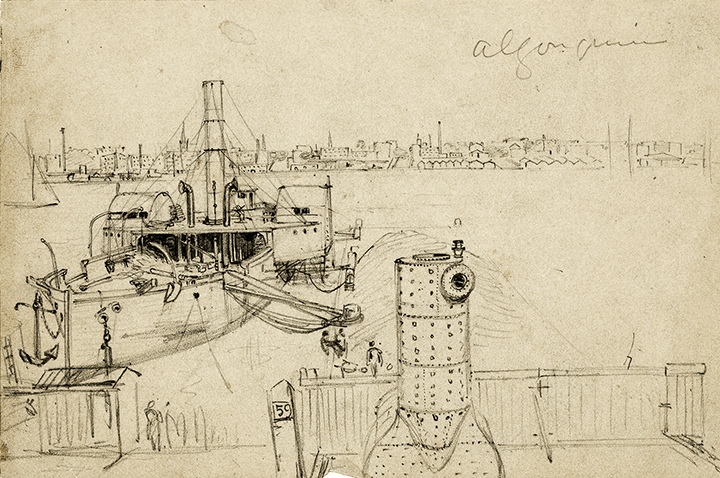
U.S.S. Algonquin, by A. R. Waud. LoC image.
Via the Naval Historical Center:
___________

Lexington Flag Case Update
Word comes today that the an appeal in the SCV’s lawsuit against the City of Lexington will be heard on March 20 by the U.S. Fourth Circuit Court of Appeals in Richmond. Back in June, the district court dismissed the case, finding the ordinance to be “reasonable, nondiscriminatory, [and] content-neutral.” The SCV’s Stonewall Brigade appealed that dismissal, and will now present oral arguments to justify reinstating the case.
However the court rules after the hearing in March, the Stonewall Brigade likely faces an uphill fight. Winning this round at the Fourth Circuit sends the case back for trial in a court that has found it to be prima facie without merit. If the Stonewall Brigade loses before the Fourth Circuit, I presume they can appeal that ruling to the Supreme Court, but it seems extremely unlikely that that body would grant certiorari to hear arguments to reinstate a case that that two lower courts, in succession, have deemed not worthy of a district court’s time. A ruling against them at the Fourth Circuit would likely be “game over” in every practical sense. For the Stonewall Brigade and its supporters, the hearing on March 20 is not so much about winning the game, as it is merely staying in the game at all.
Back when the Lexington ordinance was first passed in 2011, Susan Hathaway said that under the law, the “ordinance is air tight.” She was correct. Nearly a year ago I argued that the Stonewall Brigade will ultimately lose the Lexington flag fight, for reasons I outlined at the time. That reasoning still holds.
___________
JSTOR’s Register-and-Read Program
 JSTOR, the online database of academic journals and publishing, recently announced an expansion of its “Register and Read” program, which had previously been available in a trial version that included only a few dozen journals. Register and Read will allow users who sign up to access up to three articles from 1,200 journals, every two weeks. Articles can be read online, but a smaller number will be available for download, for an additional fee.
For those used to using the regular JSTOR through an institution, or through an individual membership, these are fairly — no, very — severe limitations. But I can also see that for folks who have no access otherwise, who need a specific article or two, this new program might be very useful. Prospective users can download an Excel file listing the included journals here.
I’ve known and worked with a lot of academics in widely-divergent disciplines over the years, and I suspect they have mixed feelings about this move. Like everyone else who writes, whether it’s on a blog, or history, or fiction, or haiku, they all want more people to read their stuff, period. That’s all to the good.
On the other hand, the business model for academic journals is shaky already, heavily subsidized by universities paying tremendously-high subscription fees, and by charges dumped off on individual authors themselves (page fees, image reproduction fees, etc.) Making these same articles available to a wider audience, even on a small scale like the Register-and-Read program, isn’t going to make that situation any better, and may make it slightly worse.
It will be interesting to see what comes out of this.
__________

“Send them along!”
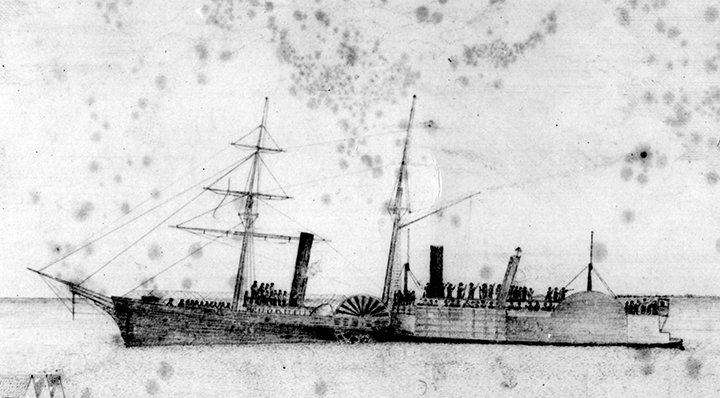 Eyewitness sketch showing the captured Union steamer Harriet Lane (left) and Confederate cottonclad Bayou City, at the end of the Battle of Galveston, January 1, 1863. Rosenberg Library, Galveston.
After the recapture of Galveston on New Years Day, 1863 resulted in the capture of the Union steamer Harriet Lane and the destruction of U.S.S. Westfield, more than a little triumphalism was in evidence. Houston Tri-Weekly Telegraph, January 2:
If the Federals have any more ships they would like to contribute to the Confederate navy, let them send them along. Texas has contributed all she could well spare in the way of men. She would like to add to her contributions, and a navy is the next best thing to the glorious troops she has sent to the field. Send them along, uncle Abraham!
___________




 Dead Confederates, A Civil War Era Blog
5 comments