Warrior Women: Lady Spies in the Civil War
 Rosalind Miles, co-author of Warrior Women: 3000 Years of Courage and Heroism, talks about the role of female spies and agents during the Civil War. This program was made possible by the generosity of Humanities Texas, which provided underwriting for the event that allowed it to be open to the public at no charge.
___________
Image: Confederate spy Rose O’Neal Greenhow. Library of Congress image.
Robin Cross on British Opinion During the Civil War

Robin Cross, co-author of Warrior Women: 3000 Years of Courage and Heroism, discusses the changing sentiment of public opinion in Britain during the Civil War. This program was made possible by the generosity of Humanities Texas, which provided underwriting for the event that allowed it to be open to the public at no charge.
I’ve never heard the name of the Union warship sunk off Galveston in January 1863 pronounced “Hatter-ass.”A good talk, nonetheless.
____________
Image: An 1861 cartoon from the London Punch, with “Jack Bull,” a symbolic characterization of the Royal Navy, admonishing the upstart American Navy not to make trouble in the wake of the Trent Affair. Via Yesterday’s Papers blog.
Police Procedures 101: Disarming the Suspect

When the decision has been made to take a person into custody, the first order of business is to ensure that the person to be arrested cannot cause injury to the arresting officers, himself, or the general public. In this amateur video, we see a suspect who, seconds before, has stated to security officers that “if you put your hands on me I will defend myself,” indicating his intent to resist arrest and use physical force against the officers present. Notice how easily a trained security officer removes a six-foot wooden pole from the suspect’s possession, with an absolute minimum of force, ensuring the physical safety of all parties, including the suspect. The suspect was subsequently placed in custody by local police officers, cited for trespassing, and released with a summons to appear in court.
__________

William C. Davis’ “Monstrous Regiment of Women”
 Jack Davis’ presentation from Saturday morning, “The Monstrous Regiment of Women: Female Soldiers in the Civil War,” is available for viewing here. One of the soldiers he discusses is Private Albert D. Cashier, Co. G, 95th Illinois Infantry, previously covered here. Good stuff.
This program was made possible by the generosity of the American National Insurance Company of Galveston, which provided an outstanding venue for the talk, and Humanities Texas, which provided underwriting for the event that allowed it to be open to the public at no charge.
__________
U.S.S. Hatteras Program Video
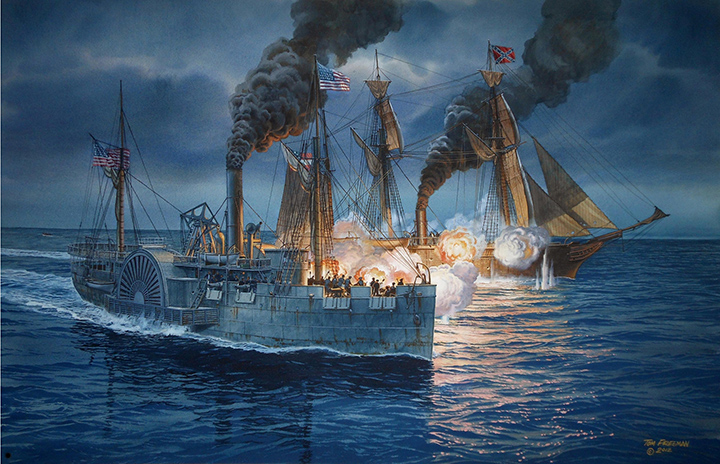
Last night’s program on Hatteras and Alabama is available here for viewing; Dr. Delaney speaks first, followed by Dr. Delgado. More programs from the weekend will be online soon. The program was made possible by the generosity of the American National Insurance Company of Galveston, which provided an outstanding venue for the talk, and Humanities Texas, which provided underwriting for the event that allowed it to be open to the public at no charge.
A gathering of Civil War naval buffs is, I think, the only place you’ll hear someone say, “I’ve been an Alabama fan for a long time,” and they’re not talking about college football.
________
Image: “The Fatal Chase” by Tom Freeman. Copyright © Tom Freeman 2012, all rights reserved. Used with permission.
New 3D Images of Civil War Shipwreck Released

On Friday evening, the Galveston Historical Foundation hosted a program on the battle between U.S.S. Hatteras and the famous Confederate raider Alabama. The program was held on the the sesquicentennial of that action, right down to the hour. (A nice touch, that.) The program was made possible by the generosity of the American National Insurance Company of Galveston, which provided an outstanding venue for the talk, and Humanities Texas, which provided underwriting for the event that allowed it to be open to the public at no charge.
Historian Norman C. Delaney gave the first part of the talk, that discussed the historical background of the fight and its aftermath. Dr. Delaney has published extensively on the maritime and naval aspects of the American Civil War, but his long-interest and focus on the career of C.S.S. Alabama, her officers and crew, mark him as the leading scholar on that ship’s history, a distinction he’s held for many years.
The second part of the talk was given by James P. Delgado, Director of Maritime Heritage for the Marine Sanctuaries Program at NOAA. Delgado is a well-known historian and maritime archaeologist, who served as Chief Scientist on last September’s expedition to map the exposed remains of Hatteras, where she lies on the bottom of the Gulf, about 20 miles from Galveston. Hatteras was the first open-sea use of the BlueView scanning system, which creates a “point cloud” that can be stitched together in a computer lab to create a full, 3D model of an underwater structure. (It’s very similar to LIDAR above the surface.) In 2010, this same system was used to map the sunken wreck of the 1901 Klondike Gold Rusk steamboat A. J. Goddard in Lake Laberge, Yukon Territory. Read more about it at Our Amazing Planet.
There are no plans to raise the vessel, or conduct excavations at the site, which is still considered U.S. Navy property and a war grave. There are hopes, however, that future expeditions, similar to the past one, can use non-distubance techniques to further map the site and better understand the events of that night, 150 years ago.
More images released by NOAA:


Looking aft from midships. At left and right mid-distance are the flanges (hubs) of the ship’s sidewheels, and at center are remains of the ship’s walking beam. In the left foreground is the remains of the steam drum, used to collect steam from the boilers. In the center distance are frames and the ship’s rudderpost.

Starboard paddlewheel flange (left foreground), with the steam drum (right) and remains of the walking beam (top left). The steam drum has evidence of a shot hole from Alabama‘s guns.
 Reconstructed overview of the site with the ship’s stern (right center) and propulsion machinery (center left).

Reconstructed overview of the site with the ship’s stern (right) and propulsion machinery (left).

Overhead view of the site. Hatteras‘ bow is to the left.
![[IMG]](https://i0.wp.com/ww3.hdnux.com/photos/17/23/31/4011610/0/960x595.jpg)
This sketch, made by artist Francis Schell (1834-1909) for Harper’s Magazine shortly after the battle that sunk the USS Hatteras, was not published until now. The Union gunboat was sunk by a Confederate raider in the Gulf of Mexico 20 miles off Galveston on Jan. 11, 1863. Photo: National Oceanic and Atmospheric Administration.
___________
“In sight of the sea, in sound of the surf”

An honor guard stands at the grave of Lt. Commander Edward Lea. Lea’s stone (right) carries his dying words, “my father is here.” January 8, 2011.
One of the most famous, and most poignant, stories of Galveston during the Civil War is that of Albert Lea and his son, Edward. At the outbreak of the war, Edward, an officer in the U.S. Navy, declined to resign his commission and “go south” as many of his comrades did. He remained in the Navy, and in the latter part of 1862, found himself as Executive Officer of U.S.S. Harriet Lane, part of the Navy’s West Gulf Blockading Squadron. Edward’s father, Albert, volunteered his services to the new Confederate commander in Texas, John Bankhead Magruder. As my colleague Jim Schmidt described last year, their paths ultimately converged, tragically, in the aftermath of the Battle of Galveston, on New Years Day, 1863.
After the battle, some of the surviving officers of Harriet Lane asked Major Lea if they could arrange for a Masonic funeral service for their commanding officer, Commander Jonathan M. Wainwright. Lea agreed to take the matter to Magruder, who readily agreed, so a funeral service for both naval officers was hurriedly arranged, with the burial to take place in a donated plot in Episcopal Cemetery. As no clergyman of that faith could be found on short notice, Major Lea himself was asked to preside. Several weeks later, at the request of the Houston Tri-Weekly Telegraph newspaper, Lea described the service:
LETTER FROM MAJOR LEA.
Brownsville, February 11, 1863. Editor Telegraph – Your note of the 7th ult. reached me yesterday. The dispatch of Gen. Magruder, requesting a copy of the brief address made by me at the burial of my son at Galveston, and your cordial expressions on manly sympathy, oblige me to the effort of recalling the few words spoken under circumstances which alone gave them value. We had gained a signal victory, but others had friends to mourn. The day after the battle, we were burying with solemn ceremony our honored dead. The General courteously ordered all due honors to the Captain and 1st Lieutenant of the captured vessel. The surviving officers of the Harriet Lane asked and obtained the privilege of being pall‐bearers. Thus officers of both nations were mingled together. The national hate, engendered by the war, and especially excited by the recent contest, had shown itself particularly in personal aversion to the unfortunate prisoners, who in their private relations were gentlemen. Owing to my double connection with the two services, they seemed to look to me to be shielded from galling expressions of this feelings, whilst they gratified me by expressions of admiration for the private worth of my poor boy, to whose remains they were making a private visit., when I warned them to prepare to bear patiently some contumely [contempt] on their journey inland. They expressed themselves in such strong detestation of the brutalities of Gen. Butler, and otherwise showed so much proper feeling, that, whilst explaining to them how we justly held them personally responsible for all the actions of a tyrant whom they voluntarily served, I felt prompted to say something that might elicit kindness towards them as prisoners. It devolved upon me to say the burial service for the two deceased officers. I held the prayerbook of my son in my hand, and penciling a few lines in the fly‐leaf, showed them to General Magruder, who approved them. At the grave, the impressive Masonic services, as to the deceased Captain, had been joined by the brethren of both nations. When the sublime office for the burial of the dead of the Episcopal Church was said by myself, for both laid in one grave, and then I added these words, as nearly as I can recall them: “My friends, the wise man has said that there is a time to rejoice and a time to mourn. Surely this is a time when we may weep with those that weep. Allow one so sorely tried, in this his willing sacrifice, to beseech you to believe that, whilst with strong arms and brave hearts we defend out rights, those we meet in battle may have brave and honest hearts as well as ourselves. Brave men are ever generous to the unfortunate. We have here buried two brave and honest gentlemen. Peace be to their ashes. Let us tread lightly o’er their graves. Amen.” Many responded “Amen.” The usual volleys were fired, and we left the gallant seamen to rest t amid the flowers in the cemetery f the Episcopal Church, in sight of the sea, in sound of the surf, where such devoted sailors would love to lie. For the error of following their meteor flag in the service of a cruel usurper and tyrant, they have paid with their lives. May we not forgive this error, and honor them for their virtues as the faithful servants of a once common country, as skillful officers, as honorable gentlemen, and as Christian brethren? Having left Galveston hastily, under orders, soon after the burial, I was denied the desired opportunity of thanking privately many officers and citizens who showed me much kindness when needed. Very respectfully, yours, A. M. LEA.
Unbeknown to anyone in Galveston at the time, on the very day Edward Lea died, Admiral Farragut had signed an order for him to return to New Orleans to take command of a vessel of his own:
FLAGSHIP HARTFORD, Off New Orleans, January 1, 1863. SIR: You will consider yourself detached from the U. S. S. Harriet Lane and will report to me at this place by the first opportunity, for the command of the mortar boats. Very respectfully, your obedient servant, D. G. FARRAGUT, Rear-Admiral. Lieutenant-Commander EDWARD LEA, U. S. S. Harriet Lane. P. S.–The vessel for your immediate command will be designated on your arrival here.
Wainwright’s remains were later exhumed and returned to New York, but Edward Lea rests here still, “in sight of the sea, in sound of the surf” — at least figuratively, if not literally.
On Saturday, the Sons of Union Veterans of the Civil War will conduct a reenactment of the Wainwright/Lea funeral, and host a memorial service for all those who died in the Battle of Galveston. The event will be held at Old Episcopal Cemetery in Galveston, 40th Street and Avenue K, at 10 a.m.
___________
Bruce Levine’s Fall of the House of Dixie
 Bruce Levine’s Confederate Emancipation: Southern Plans to Free and Arm Slaves during the Civil War (2007) is probably the best full-length study the contentious debates within the Confederacy over the question of whether to put enslaved men into the ranks of the army, and how to go about doing that. Though such a plan was eventually approved by the Confederate Congress in mid-March 1865 — three weeks before the evacuation of Richmond, and four weeks before Lee’s surrender at Appomattox — it was nonetheless a hard and bitter pill to swallow. Hard-line Confederate ideologues found the very notion an anathema; Howell Cobb famously called the proposal “the beginning of the end of the revolution.” It was, Cobb argued, a “suicidal policy.”
Levine’s new book, The Fall of the House of Dixie: The Civil War and the Social Revolution That Transformed the South (2013), takes a broader view of the cultural and racial norms of the “peculiar institution,” and how those were upturned by war and Reconstruction. On Monday, Terry Gross interviewed Levine on NPR’s Fresh Air:
“The black population of the South had been raised on the notion that, among other things, black men could not, of course, be soldiers,” Levine tells Fresh Air‘s Terry Gross, “that black men were not courageous, black men were not disciplined, black men could not act in response in large numbers to military commands, black men would flee at the first opportunity if faced with battle, and the idea that black men in uniform could exist and … offer them the opportunity to disprove these notions and … more importantly, actively struggle to do away with slavery, was unbelievably attractive to huge numbers of black people.” As its ranks dwindled and in a last gasp, the Confederacy, too, had a plan to recruit black soldiers. In 1865, Confederate President Jefferson Davis approved a plan to recruit free blacks and slaves into the Confederate army. Quoting Frederick Douglass, Levine calls the logic behind the idea “a species of madness.” One factor that contributed to this madness, he says, “is the drumbeat of self-hypnosis” that told Confederates that “the slaves are loyal, the slaves embrace slavery, the slaves are contented in slavery, the slaves know that black people are inferior and need white people to … oversee their lives. … Black people will defend the South that has been good to them. There are, of course, by [then] very many white Southerners who know this is by no means true, but enough of them do believe it so that they’re willing to give this a chance.” Considering what might have happened had there been no war at all, Levine thinks slavery could well have lasted into the 20th century, and that it was, in fact, the Confederacy that hastened slavery’s end. “In taking what they assumed to be a defensive position in support of slavery,” he says, “the leaders of the Confederacy … radically hastened its eradication.”
You can listen to the full, 37-minute interview here, or read the transcript here.
____________ Thanks to Horde member dmf for alerting me to this story.
Resource on New York CW Soldiers
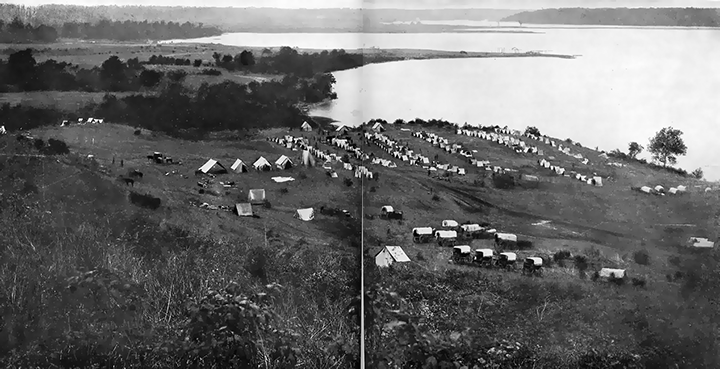
Composite images of the camp of the 2nd New York and 1st Massachusetts Heavy Artillery Regiments at Belle Plain, Virginia, May 16, 1864. Via the New York State Military Museum.

One of the unfortunate things about the compiled service records (CSRs) available at NARA is that, while the extant Confederate records are all digitized and available online through sources like Fold3 (thanks, UDC!), Union records are not. Records for USCTs and some states are complete, some states are partially available, and others have only index cards available, that give the man’s name, “rank in,” “rank out” and unit. Some of the largest Northern states, including Pennsylvania and New York, are in this latter category. It’s a challenge, because those two states alone contributed a sizable proportion of the Union’s troops during the conflict.
Many of my readers will know about this, but the New York State Military Museum maintains an extensive website that includes a ton of information about that state’s units in multiple conflicts, including the Civil War. I haven’t been through the whole thing, but it looks to be huge. As one example, I’ll take the New York counterpart to my local regiment, the 1st Texas Heavy Artillery, the 2nd New York Heavy Artillery. For this unit, the museum’s website includes a brief summary of the unit’s history, including alternate names, a list of known images of the unit and its members, and a bibliography; a table of casualties; transcripts of news clippings and official correspondence, and images and descriptions of both the regiment’s national flag and one of the battery guidons.
But wait, there’s more.
For at least some of the units, including the 2nd Heavy Artillery, the museum has PDFs of State Adjutant General’s report (22MB PDF) that gives summaries of the service records of individual soldiers, like Frank McGuire:
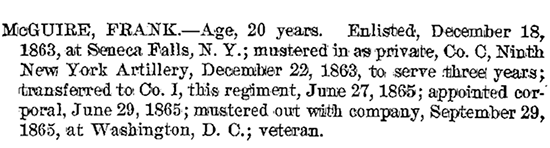
I’m sure not all regiments have as extensive records online as this one, but still. . . . It seems like a tremendous resource, one that I wish every state had. It’s easy to navigate, fast to load, and free. Here’s the main index for the museum’s Civil War files. Happy researching!
______________
Nicaragua Smith and Joseph Cronea
One hundred fifty years ago today, at exactly noon, Private Thomas “Nicaragua” Smith was shot by a military firing squad on a parade ground on the west side of Galveston. Although he was ultimately tried and condemned by a court-martial as a deserter from the 1st Texas Heavy Artillery, Smith was a bonafide bad actor, with a long criminal past as a civilian, going back before the war. A few years before, in fact, a delegation of citizens had escorted him onto a steamship bound for New Orleans, with orders never to return — he was just that kind of guy. Few mourned Nicaragua Smith then, and no one mourns him now.
But the fate of a man captured with Smith, Private Joseph Cronea of the First Texas Cavalry, U.S. Army, needs to be told as well. My colleague Jim Schmidt has the details.
_______________




2 comments