
The Third Battle of Liberty Place
As expected, last week the New Orleans City Council voted to remove four monuments related to the Confederacy, three dedicated to Confederate leaders and one to members of the White League, who staged an attempted coup to overthrow the Republican-led city administration during Reconstruction. The latter monument carried an inscription saluting “the national election of November 1876 [that] recognized white supremacy in the South and gave us our state,” before it was removed in the 1990s.
And as expected, there has been an immediate legal challenge to the City Council’s action. I think this is a good thing; that’s how matters properly get settled. But this assertion from the plaintiffs’ filing strikes me as being dead-on-arrival as a legal argument:
Plaintiffs have a First Amendment right to free expression, free speech and free association, which they exercise by maintaining and preserving the historic character and nature of the City of New Orleans, including their monuments, and by using the monuments as the location for events commemorating individuals and events critical to the outcome of the Civil War.
The plaintiffs most assuredly do have First Amendment rights to free expression, but as the courts have repeatedly (and in my view, correctly) ruled, their First Amendment rights don’t obligate the government to use public resources to promote or sustain them. Specifically when dealing with Confederate heritage issues, the First Amendment argument failed in Lexington, and again last summer with Texas’ SCV license plates. Shouting loudly about the First Amendment is probably a good way to raise donations for legal fees, but I doubt it will get very far in the courtroom in this case.
I don’t know enough details of the monuments’ situation in New Orleans to make any predictions as to how this will all end up. I do expect the City of New Orleans to put up a vigorous defense, beginning with a challenge to the plaintiffs’ standing. But if the plaintiffs do ultimately succeed in keeping one or more of those monuments in place, I’m sure the ruling’s going to be a highly technical one, like the decision on the Liberty Place monument twenty years ago, based on the convoluted mess of overlapping jurisdictions and conflicting claims of ownership.
It will be interesting to see how this all plays out.
________
Update, December 22: TPM’s Tierney Sneed follows up with a story on the coalition of plaintiffs that brought the lawsuit to preserve the monument in New Orleans. She also includes a couple of screencaps of the social media postings by the Louisiana Division of the SCV, including this one:


This is exactly the sort of churlish onanism that undermines every serious argument that heritage advocates might make in a case like this. You can’t be taken seriously when you argue for the nobility of the southern cause and the sanctity of its symbols, and then post silly crap like this as a “defense” of it.
These people are acting like children — angry, angry children.
_______

Life Below the Blue

The other day I learned that Jesse Cancelmo has a new book coming out in February, Glorious Gulf of Mexico: Life Below the Blue. Jesse is an underwater photographer I met while working on the U.S.S. Hatteras Project in 2012. He is, as far as I’m concerned, one of the best underwater photographers out there, anywhere, and his work is all the more remarkable when you consider that the Gulf of Mexico is just not known as a hot spot for marine imagery. Maybe this book will change that.
You can see other examples of his work here. Congrats, Jesse — I can’t wait to get me hands on this one.
______

Odds and Ends

Kids’ activity area in the History Center for Aransas County, challenging kids to study the contents of a Civil War soldier’s haversack. The cloth sacks at left contain rations of coffee, flour, etc.
On Thursday I had the honor of speaking to the Houston Civil War Round Table on blockade-running, and the story of the brief, violent encounter between Dave McCluskey and Paul Börner on the deck of McCluskey’s schooner, Sting Ray. We had good attendance, and lots of smart questions afterward, mostly about aspects of the topic that’s I’d had to cut or skip over, due to lack of time. Folks in southeast Texas should mark their calendars for the January meeting, on January 21, when the presenter will be the incomparable Ed Bearss, speaking on the Kentucky Campaign and the Battle of Perryville. Reservations are required, so if you’re going to attend, please contact the Houston CWRT’s Facilities Chairman, Don Zuckero, at (281) 479-1232 or e-mail him at Reservations-at-HoustonCivilWar-dot-com by 6:00 p.m. on Monday, January 18.
At the meeting I also had the pleasure of meeting Brian Matthew Jordan, whose 2014 volume, Marching Home: Union Veterans and Their Unending Civil War, will be coming out soon in paperback. Brian recently took up a teaching position at Sam Houston State University in Huntsville, and will hopefully become a regular at meetings and conferences in the region.
I also made a quick trip to Rockport, to speak in conjunction with a Civil War exhibit at the History Center for Aransas County and their new exhibit, “Civil War for Coastal Texans: Homefront & Battlefields.” I’d like to thank the History Center, the Stenson-Simpson Chapter of the Daughters of the Republic of Texas, Hampton Inn & Suites of Rockport-Fulton, and (most especially) Pam and Phil Stranahan of Fulton, for extending the best of Coastal Bend hospitality to me and my family.
______
“I will pay more than any other person for No. 1 Negroes”
 A follow-up to my post yesterday on Charleston, and what seemed to me at the time to be a purely gratuitous inclusion of Nathan Bedford Forrest in the section on slave traders.
It turns out that, as a colleague suggested yesterday, that Forrest did indeed make use of the slave market in Charleston to provide the “stock” he would later sell in Memphis and New Orleans. And he was not making an isolated purchase here or there; he was buying on a large scale. Charleston Courier, March 1, 1860, p. 2:

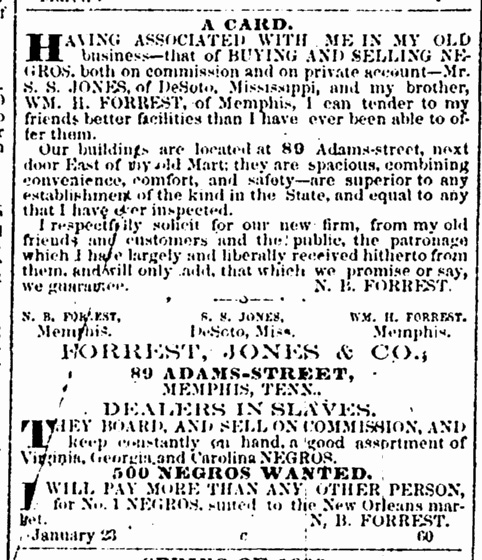
So there it is — even in South Carolina, where there were substantially more enslaved persons in 1860 than free, Nathan Bedford Forrest was a big wheel in the domestic slave trade. If Forrest had lived in South Carolina himself, the 500 slaves he sought to purchase there would have made him one of the largest slaveholders in that state. The inclusion of Forrest in the museum exhibit certainly makes sense now, but it’s unfortunate that Forrest’s role in the Charleston slave market isn’t explained clearly.
______
Prewar image of Forrest via Mississippi Confederates blog.
Notes from the Holy City
I got home late Friday after a much-too-brief trip to Charleston. I was there working on a project, and in making the flight arrangements the travel agent requested (among other things) my passport information. It wasn’t actually needed, buy there’s a joke in there somewhere about needing a passport to travel from the United States to South Carolina.
I didn’t take a proper camera, but I did get a few shots here and there.
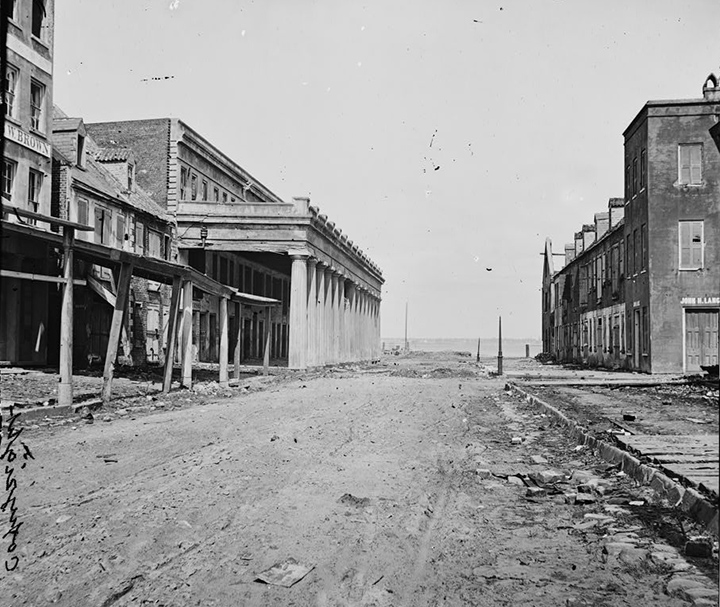
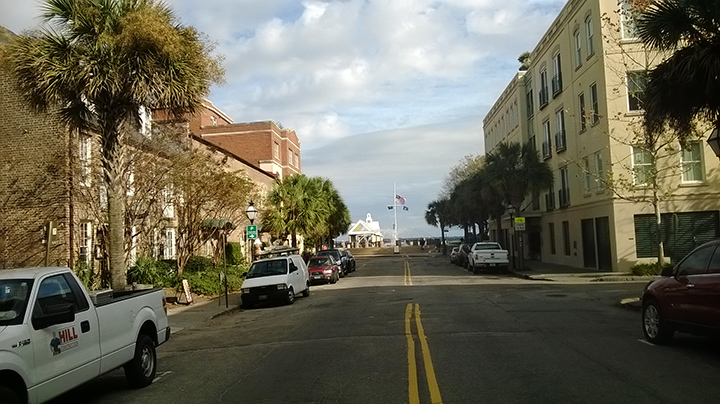
My hotel was on Vendue Range, on the waterfront in South Charleston. Here it is the street in front of the hotel in 1865, and 150 years later. The brick buildings at left with the dormer windows are original.

The old U.S. Customs House in Charleston.

Sunrise.

Wow — didn’t expect to run into this guy in Charleston. (This was a hyper-realistic sculpture, about three times life size, on display in the hotel lobby along with some other remarkable artwork.)
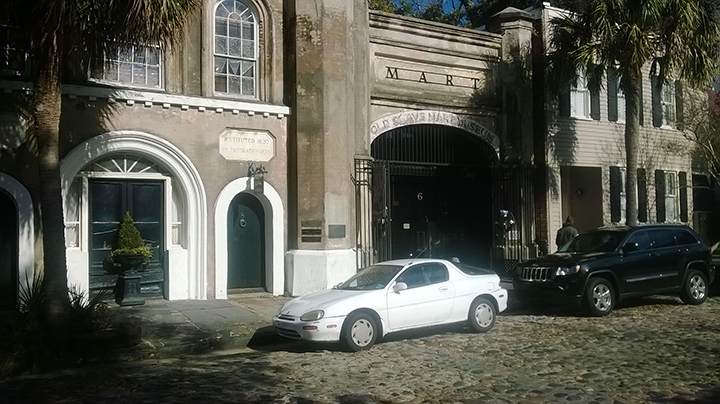
Visited the Old Slave Mart Museum, which is small but very well done. One slightly discordant note was that the first section breaks out into three stories — that of the enslaved person, the slave buyer, and the slave trader. The slave trader section is dominated by a huge image of Nathan Bedford Forrest, in Confederate uniform. Forrest was from Memphis, and (AFAIK) had no connection to Charleston at all. I looked, and didn’t even see Forrest mentioned by name anywhere in that section, even to identify the person in the photo. I don’t have any qualms about calling out Forrest on that account (so to speak), but he has no special relevance to the story they’re telling about Charleston; it’s not a curatorial decision I would have made.
In any case, my experience there was better than Kevin’s.
____
Edit: an online friend who knows Forrest’s story better than I do tells me that Forrest purchased slave “stock” in Charleston that he went on to sell in Memphis. If that had been explained in the exhibit, it would have strengthened the interpretation of Charleston’s importance in the domestic slave trade. (“Slave dealers like Nathan Bedford Forrest, from as far away as Memphis, made purchases through Charleston. . . .”). But if the exhibit said anything like that, I missed it.
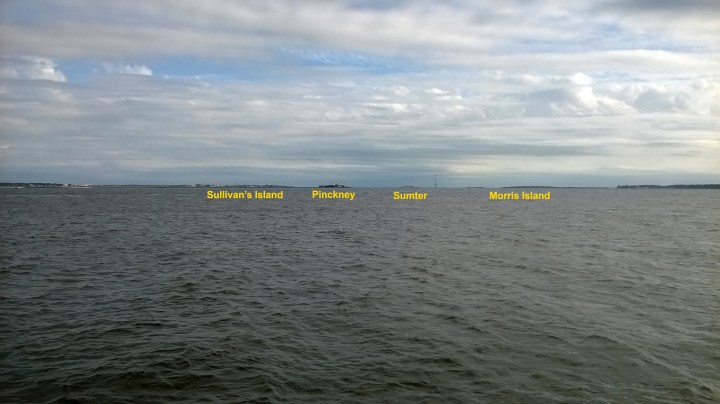
The view from the pier at the end of Vendue Range, looking down the harbor. Castle Pinckney, flying a French tricoleur, stands at center, is a little under a mile away. Fort Moultrie, on Sullivan’s Island, is not discernible, but would be just to the left of Pinckney.
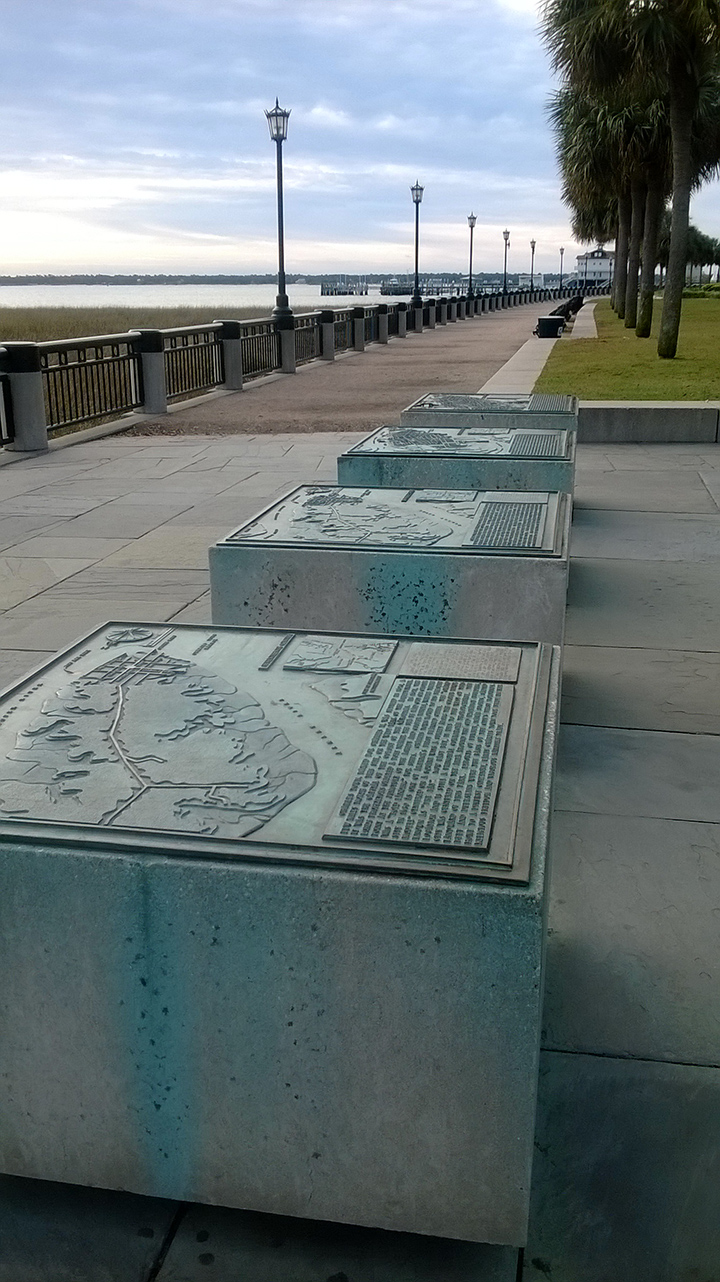
Informative displays on the waterfront, showing Charleston’s development over the centuries. A really superb feature; I know just the place from something like that in Galveston.
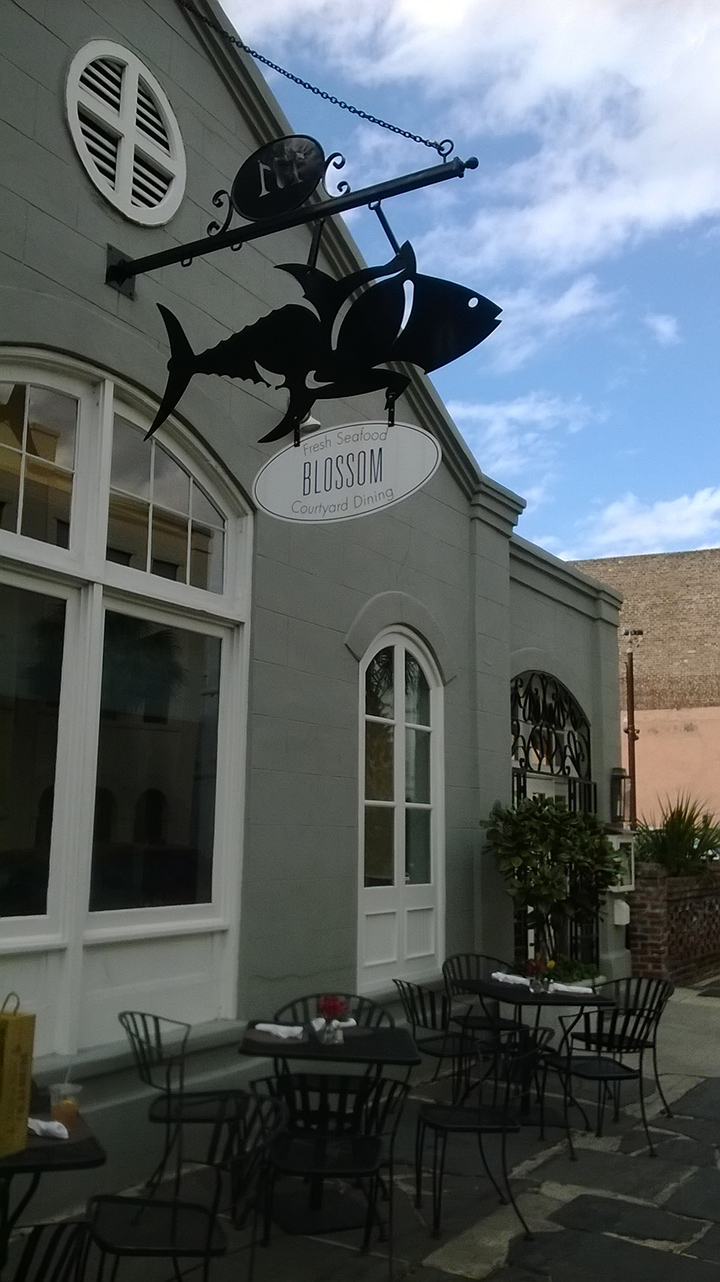
The Blossom restaurant on East Bay Street. Try the grilled mahi mahi on shrimp and rice. Seriously.
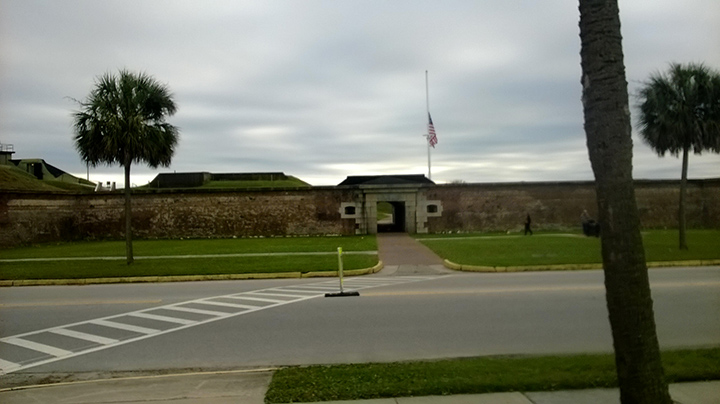
The sally port at Fort Moultrie, on Sullivan’s Island. It was this installation, surrounded by secessionist militia demanding its surrender, that Major Anderson evacuated in late December 1860, to occupy Fort Sumter in the harbor. Visiting the actual site, you can see immediately that it could not be successfully defended, particularly with the small number of men Anderson had at his command.

Fifteen-inch Rodman guns at Moultrie. These pieces were mounted here post-Civil War, and served until the time of the fort’s expansion during the Spanish Was in 1898.
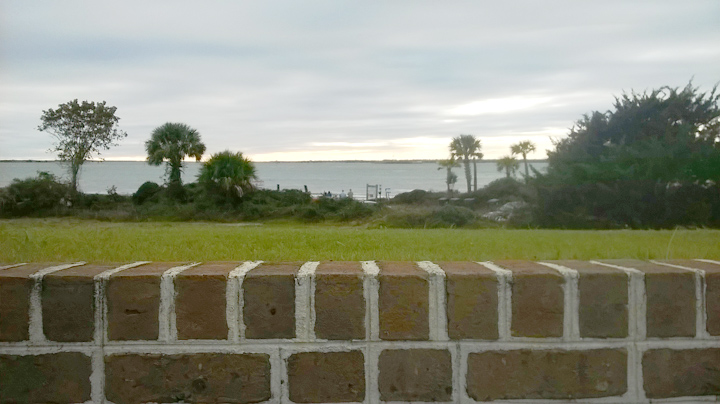
View from the parapet at Moultrie, looking toward Fort Sumter, almost exactly one mile distant.
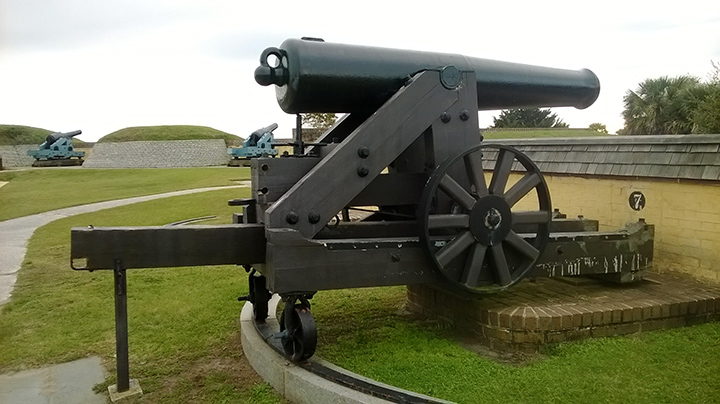
Smoothbore guns (32-pounders?), typical of the artillery mounted at Moultrie during the Civil War.
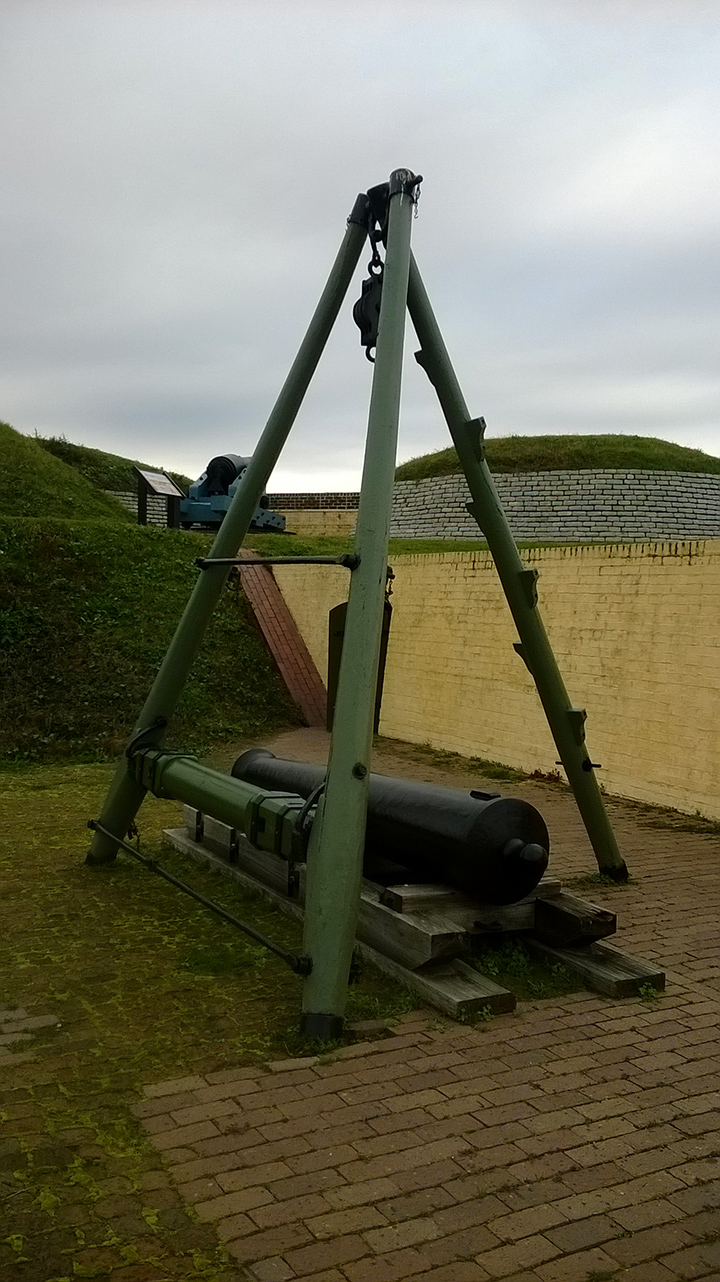
A replica gun “gin” (short for engine) at Moultrie, used for mounting and dismounting guns from their carriages.
All in all, a fantastic trip, but much too short.
______
Speaking at the Houston Civil War Round Table, December 10
Thursday evening I had the pleasure of attending a meeting of the Houston Civil War Round Table, for a talk given by Rick Eiserman, an indefatigable researcher when it comes to the subject of Hood’s Texas Brigade, titled “Will the Real Private Joe Joskins Please Step Forward?” “Joe Joskins” was the author’s name on one of the earliest memoirs of service in the brigade, written at the very end of the war in June 1865. The memoir, which was long thought to have been lost, is so vivid and detailed that the late Col. Harold B. Simpson cited it twenty-nine times in his classic work, Hood’s Texas Brigade: Lee’s Grenadier Guard, even though there’s no record of a Joe Joskins serving in the brigade, or any other Texas unit. Rick’s journey in trying validate the authenticity of the memoir, and to determine the real identity of “Private Joe Joskins,” is a wonderful tale of how diligence, persistence and a little bit of good luck make for for great history writing.
I’ll be speaking next month at the Houston CWRT, on the subject of blockade running on the Texas coast. My talk will highlight the intertwined stories of Dave McCluskey and Paul Börner, whose paths crossed violently on the deck of McCluskey’s blockade-running schooner, Sting Ray, one Sunday morning in the spring of 1864 a few miles off the mouth of the Brazos River. It’s a tremendous honor to be invited to present to the Houston CWRT, given the stature of many of their speakers, folks like Ed Bearss, Caroline Janney, Gary Joiner, and Stephen “Sam” Hood. (And those are just this year!)
My talk is on Thursday evening, December 10. Meet-and-greet starts at 6 p.m., with dinner at 7 and the presentation beginning around 7:45. There is a $30 charge for dinner and the presentation, or $10 for the presentation only — but come for dinner. The meeting is held at the Hess Club, 5430 Westheimer, about a mile west of the Galleria. Allow a little extra time for traffic, but it’s worth it when you get there. Important: If you’re going to attend, please let the Houston CWRT’s Facilities Chairman, Don Zuckero, know at (281) 479-1232 or e-mail him at Reservations-at-HoustonCivilWar-dot-com by 6:00 p.m. the Monday preceding the Thursday meeting. This is important to ensure sufficient food and seating is available.
Hope to see you there!
______
Houston History Book Fair & Symposium
If any of y’all are in the Houston area, I’d love to meet you at the Houston History Book Fair & Symposium this Saturday, November 14. Admission is free, and it’s a great event that highlights local history writers and their work.
Houston History Book Fair & Symposium
Saturday, November 14, 2015, 10 a.m. to 4 p.m.
Historic Julia Ideson Building
550 McKinney Street in Downtown Houston
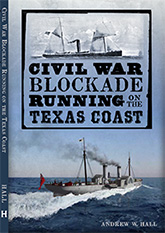
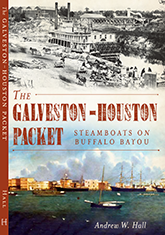
There’s a great list of speakers presenting on their work during the day. I’ll have copies of both my steamboat and blockade-running books for sale ($20 ea., two for $35, three for $50, and 4+ at $15 ea.). If you already have a copy, or want to order one online ahead of time (at a bigger discount than I can make), bring that and I’ll be happy to autograph it. But mostly I’d like to meet and talk to folks. If nothing else, the book fair is a great place to pick up some holiday gifts for friends and family.
Hope to see y’all there!
______

Is a Wirz Execution Photo Misidentified?
This post originally appeared on June 8, 2011.
_____________
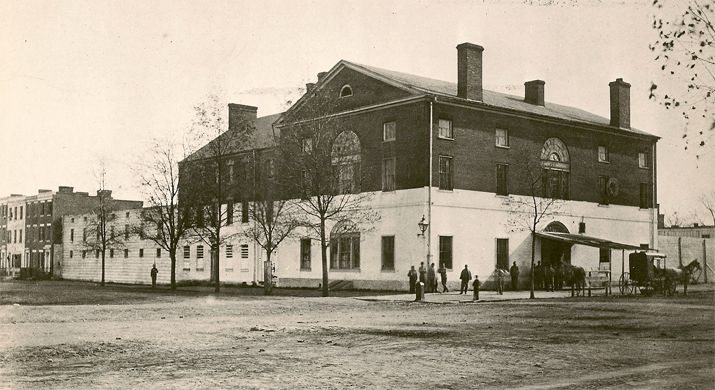
Henry Wirz (1823-1865) remains one of the most controversial figures of the American Civil War. Reviled in the North for his role as commandant of the notorious Confederate prison camp at Andersonville, Georgia, Wirz was tried in the summer of 1865 in Washington, D.C. and condemned to death. He was hanged on November 10, 1865, on a scaffold set up in the courtyard of the Old Capitol Prison (below), on what is now the site of the U.S. Supreme Court.
Wirz continues to have many supporters, who argue that he did the best he could to care for the Federal soldiers imprisoned at Andersonville, with the very limited resources he had at his disposal. The Confederacy, they argue, had not sufficient means to care for its own population, much less enemy prisoners, and point to hard conditions in Northern prisons, where lack of resources was far less a problem, in response. They also point out that one of the key witnesses in the prosecution’s case against Wirz was apparently an imposter, who could not have witnessed the things he testified to under oath. Nearly a century and a half after his death, efforts are still being made to exonerate Wirz and restore his reputation.
This post isn’t about any of that.
Wirz’ execution was the subject of a famous sequence of four photographs, now part of the collection of the Library of Congress, taken by Alexander Gardner. The sequence of the photos, as indicated by both their captions and catalog numbers, is usually given as follows:
- Reading the death warrant to Wirz on the scaffold, LC-B817- 7752
- Adjusting the rope for the execution of Wirz, LC-B8171-7753
- Soldier springing the trap; men in trees and Capitol dome beyond, LC-B8171-7754
- Hooded body of Captain Wirz hanging from the scaffold, LC-B8171-7755
The four images were taken from three different locations (below). The first two appear to have been taken from the roof of the prison kitchen (Point A), looking diagonally across the yard where the scaffold is set up. For the image of Wirz’ body hanging from the beam, Gardner moved the camera to the left, and to a higher position to get a clearer view of the body in the trap (Point B). Gardner may have also wanted to frame his shot to capture the dome of the U.S. Capitol in the background. For the shot labeled “springing the trap,” the camera is again at a lower position, similar to the height of Point A, but still further to Gardner’s left (Point C), again with the dome of the Capitol in the background. Gardner’s framing of these last shots is not subtle.

Plan of the Old Capitol Prison, showing the approximate positions of Gardner’s camera during the Wirz execution sequence. The plan is undated (from here), but shows the facility during its use as a prison during and immediately after the Civil War, 1861-67.
After looking closely at these images, though, I believe that these last two are transposed chronologically; the third image, labeled “springing the trap,” is properly the last image in sequence, and shows Wirz’ body being lowered from gallows into the space below the scaffold. The evidence – and somewhat graphic images of the hanging – after the jump:

Seriously?
The annual InLight Richmond will transform the grounds of the Virginia Museum of Fine Arts next weekend. But perhaps the most electrifying reveal will be the wholesale transformation of the Confederate Memorial Chapel. . . .
It will become a focal point of InLight, with the artists planning to turn the memorial into a trippy funhouse full of disorienting light, sound and shadow.
“By illuminating and amplifying the building and visitors’ presence within it,” Dombroski tells Style, “we will create a heightened sensory experience that invites investigation and introspection.”
The artists plan to install several cinema-grade lights on tall stands to illuminate the exterior of the chapel. The interior will be illuminated solely by the light cast through the stained-glass windows. An array of shadows will form on the ceiling, walls and floor. . . .
Dombroski says the sound of a visitor’s step will be emitted seconds later by a speaker behind the pulpit. Visitors’ shadows will dance around the pews.
“All art work has the potential to be political, even if it’s Disney-like,” says InLight juror Alex Baker, director of Fleisher/Ollman Gallery in Philadelphia.
I like my history with a side order of iconoclasm, and I don’t think old Confederates — or anyone else — ought to be thought of as departed saints. But a “trippy funhouse?” “Disney-like?” That’s just ludicrous.
___________
“Just’a good ol’ boys, never meanin’ no harm. . . .”
I wondered whatever happened with this story:
In an unusual legal maneuver, the district attorney in this suburb of Atlanta has won indictments against 15 supporters of the Confederate battle flag, accusing them of violating the state’s anti-street gang ordinance during a confrontation with black partygoers in July, the district attorney said on Monday.
Prosecutors say that members of the group, which calls itself “Respect the Flag,” threatened a group of African-Americans participating in an outdoor party on July 25. A cellphone video of part of the episode shows several white men driving away from the party in a convoy of pickup trucks with the Confederate battle flag and other banners, including American flags, fluttering from the truck beds. . . .
The Douglas County district attorney, Brian Fortner, a white Republican elected to the office in 2014, announced the indictments in a news conference Monday morning. Each of the 15 was indicted on one count of making terroristic threats, and a second count of unlawfully participating in “criminal gang activity.”
Mr. Fortner said that the Georgia statute upon which the second charge is based, the Street Gang Terrorism and Prevention Act, is “worded very broadly to deal with any type of activity that occurs with a group that’s organized that commits a crime.”
“We respect the rights of all citizens to exercise their First Amendment right,” Mr. Fortner said. “But we’re going to require them, when doing that, to respect the rights of all of the citizens to feel safe and secure.”
Keep in mind that truck rallies like this one have been organized and heavily promoted as a venue for expressing southern pride and heritage. Are these repulsive fools really the ones taking a stand for southern heritage?
_________
Update, October 16: On Thursday, the district attorney who obtained the indictments in this case issued a press release, explaining how those charges were formulated:
Recent press reports have made prominent references to the fact that, at the time the alleged offenses occurred, some of the accused were displaying the modern adaptation of the “Confederate battle flag,” which was a flag used to identify some units of the army of the former Confederate States of America during the American Civil War. This case is not about the display of that flag. Federal courts repeatedly have held that individuals have the right under the First Amendment to the United States Constitution to publically [sic.] display that flag. . . .
In Count 1, the accused are charged with a violation of the Street Gang Terrorism and Prevention Act. The accused are charged specifically with being part of an organization, association, or group called “Respect the Flag”, which was composed of three or more persons who were associated in fact. This organization, association, or group, whether formal or informal, is alleged to have engaged in criminal gang activity by committing the offense of terroristic threats as alleged in Count 2 of the indictment.
In Count 2, the accused are charged with having committed the offense of terroristic threats. The accused are charged specifically with unlawfully threatening to commit a crime of violence to individuals who were attending a party at 9037 Campbellton Street, Douglasville, Georgia, with the purpose of terrorizing those individuals and in reckless disregard for the risk of causing such terror.
The New York Times article I linked previously makes clear that this is an unusual application of the Street Gang Terrorism and Prevention Act, which has been on the books in one form or another since 1992, and was upheld by the Georgia Supreme Court in 2009. Its use in this case will likely be challenged, and that’s fine. I don’t know the ins and outs of Georgia law well enough to make any predictions on how that will fall out. But if these jackasses did anything like what’s been alleged, they absolutely should be prosecuted and, if convicted, go to jail.
_________




3 comments