Why the SCV will Lose in Lexington, and Win in Texas
Several weeks ago the Virginia Division of the Sons of Confederate Veterans filed a lawsuit in federal court in Roanoke against elected officials in the City of Lexington, in response to that community’s adoption of a new ordinance barring anything other than official U.S., Virginia and city flags being flown at public facilities downtown and on the Veterans Memorial Bridge.
Concurrently, the Texas Division of the SCV is pursuing legal action against the state here, challenging the state’s rejection of a special license plate promoting the SCV. Both lawsuits lean heavily on the Equal Protection Clause of the 14th Amendment. While both these cases are only beginning their journey through the courts, and there are plenty of arguments yet to be made on both sides, I believe the SCV will lose in Lexington, but prevail in Texas. And the Equal Protection Clause lies at the core of both outcomes.

 Lexington first. The lawsuit names the City of Lexington and eight individuals, in their “official capacity,” as defendants. These include Mayor Mimi Elrod, City Manager Jon Ellestad, and all six members of the current City Council. Mary P. Harvey-Halseth, a council member who voted against the ordinance, and David Cox, another member who was absent from the meeting, are also included as defendants. You can read the SCV’s federal complaint here (which includes the text of the new ordinance on p. 6), and the minutes of the September 1, 2011 Lexington City Council meeting here.
Public display of Confederate flags — as Brooks Simpson points out, there’s not just one — has long been a contentious issue in Lexington. Twenty years ago, the city tried to ban displays of the Confederate flag on public property, and lost their case in 1993 (Sons of Confederate Veterans, Virginia Division v. City of Lexington, Virginia, et al.,). At that time, the court ruled that the city could not prevent others
to wear, carry, display or show, at any government-sponsored or government-controlled place or event which is to any extent given over to private expressive activity, the Confederate Flag or other banners, emblems, icons, or visual depictions. . . .
The emphasis here is mine, and it’s central to the court’s decision. The ruling in 1993 is based not only on the First Amendment right of Free Speech, but also on the Equal Protection clause of the 14th Amendment, that requires governmental entities to enact laws and policies in an equitable way, without making exceptions, good or bad, for any particular group. That’s clearly what the court had in mind when ruled that the Confederate flag could be displayed in any forum that “is to any extent given over to private expressive activity.” If you do it for one, you have to do it for another.
The Equal Protection Clause is important here because the First Amendment, on its own, is insufficient when it comes to government-sponsored or government-hosted expression. The First Amendment, by itself, is not enough. Freedom of Speech has never been absolute; it does not extend to libelous speech, or direct incitement to violence. And there’s nothing about the First Amendment that obligates Lexington to host on its property any private organization’s emblem or banner — not mine, not yours, and not the Virginia SCV’s. First Amendment concerns only become relevant here if the City of Lexington extends that privilege to some, but not others.
The City of Lexington understood this when crafting the ordinance to exclude all flags except those of select government entities — federal, state and local. The ordinance bars Confederate flags, but only because it bars all others, including those of the two universities in town, the Virginia Military Institute and Washington & Lee. There’s no question that, embarrassed by the conjunction on the calendar of Lee-Jefferson Day and the MLK federal holiday, they were seeking to find a legal way to resolve future conflicts, and so adopted an ordinance that would bar all other flags. That’s a calculation the city council in Lexington chose to make, and they’re on solid legal ground. Even one of the leaders of the “Virginia Flaggers,” a group that protests perceived slights to Confederate symbols and who’s an outspoken critic of the Lexington ordinance, acknowledged at the time of its passage that the “ordinance is air tight.” I agree.

The Texas case, by contrast, presents an entirely different set of facts – namely, that the state already offers dozens of different plate designs for private organizations and causes. Like dolphins? There’s a plate for that. Proud of your alma mater? There’s a plate for that. Are you a Master Gardener? A Dallas Mavericks fan? Do you love red grapefruit? There are plates for all those things. Why, we have plates for schools that aren’t even in Texas. And that’s why, in my view, Texas will be unable to defend its decision last November to deny the SCV plates. If you do it for one, you have to do it for another. And when it comes to specialty license plates, Texas already does it for damn nearly everybody.
As it happens, my own county’s Tax Assessor-Collector, Cheryl Johnson, sits on the TxDot board that considers plates, and voted in favor of the plate the first time it came up for a vote. She later explained her vote by saying that the SCV “have sued before to get the license plate [in other states] and have won. I voted in favor because I didn’t think the state would win any lawsuit.” She’s right about that last part, in my view. (That first vote, in which Johnson voted in favor of the proposal, was a tie; she was not present for the November meeting where it was voted down, 8-0.)
The Lexington and Texas cases bear some similarities; both challenge governmental entities’ decisions to bar the Confederate Battle Flag from display on a public venue. Both lawsuits also base their core arguments on the Equal Protection Clause of the 14th Amendment. But the specific facts of the two cases are miles apart. So long as Lexington continues to bar all outside banners, their ordinance almost certainly falls in line with the Equal Protection Clause, and so passes constitutional muster. Texas, on the other hand, has a years-long history of granting specialty plates to just about any organization that seeks one.
They haven’t got a legal leg to stand on.
____________
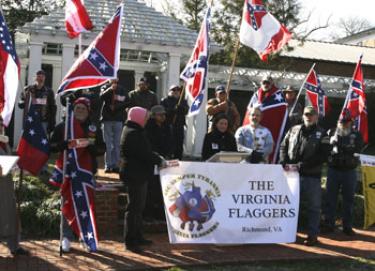
Image: Virginia Flaggers rally in January 2012 at Hopkins Green in Lexington to call for the defeat of Mayor Mimi Elrod. Image via thenews-gazette.com.

“Sponge, load, fire.”

Yesterday the Civil War Monitor presented another segment in the magazine’s “Voice from the Past” series, this one highlighting the account of Samuel Dana Greene, Monitor‘s executive officer, who commanded in that ship’s turret until forced to take over command of the ship when his captain, John L. Worden, was temporarily blinded by a shot from C.S.S. Virginia.
What follows here is another account of the action, this one from the Acting Chief Engineer of the Confederate ironclad, Henry Ashton Ramsay (1835-1916). Ramsay’s perspective on the action is unique; he probably knew the ship better than anyone else aboard, have spent most of the previous three years operating, maintaining, repairing and rebuilding the ship’s machinery. He’d joined U.S.S. Merrimac as Second Assistant Engineer at Panama in 1859, and sailed with her around Cape Horn. During this passage he reported to Merrimac‘s Chief Engineer, Alban C. Stimers. Engineer Stimers would later assist John Ericsson in constructing Monitor, and would serve as that ship’s Chief Engineer during the Battle of Hampton Roads.
Upon Merrimac‘s return to Norfolk, her engines were condemned and the ship laid up. There she remained until the spring of 1861, when she was burned to the waterline during the evacuation of the Navy Yard. When the war came, Ramsay cast his lot with the Confederacy, and soon found himself in Norfolk, working to convert the burned-out hull of Merrimac into a casemate ironclad.
While steaming out into Hampton Roads on the morning of March 8, Flag Officer Franklin Buchanan, commander of the rebuilt ironclad, now rechristened Virginia, called Ramsey up to the pilothouse and asked him how secure the ship’s machinery was in the event of a hard collision. When Ramsay assured him that the boilers and engine well-braced, Buchanan replied, “I am going to ram the Cumberland.” Fifty years later, in an article for Harper’s Weekly, Ramsay described what happened next:
The crux of what followed was down in the engine room. Two gongs, the signal to stop, were quickly followed by three, the signal to reverse. There was an ominous pause, then a crash, shaking us all off our feet. The engines labored. The vessel was shaken in every fiber. Our bow was visibly depressed. We seemed to be bearing down with a weight on our prow. Thud, thud, thud, came the rain of shot on our shield from the double-decked battery of the Congress. There was a terrible crash in the fire-room. For a moment we thought one of the boilers had burst. No, it was the explosion of a shell in our stack. Was anyone hit? No, thank God. The firemen had been warned to keep away from the up-take, so the fragments of shell fell harmlessly on the iron floor-plates.
We had rushed on the doomed ship, relentless as fate, crashing through her barricade of heavy spars and torpedo fenders, striking her below her starboard fore-chains and crushing far into her. For a moment the whole weight of her hung on our prow and threatened to carry us down with her, the return wave of the collision curling up into our bow port.
The Cumberland began to sink slowly, bow first, but continued to fight desperately for the forty minutes that elapsed after her doom was sealed, during which we were engaged with both the Cumberland and the Congress, being right between them.
We had left our cast-iron beak in the side of the Cumberland. Like the wasp we could sting but once, leaving the sting in the wound.
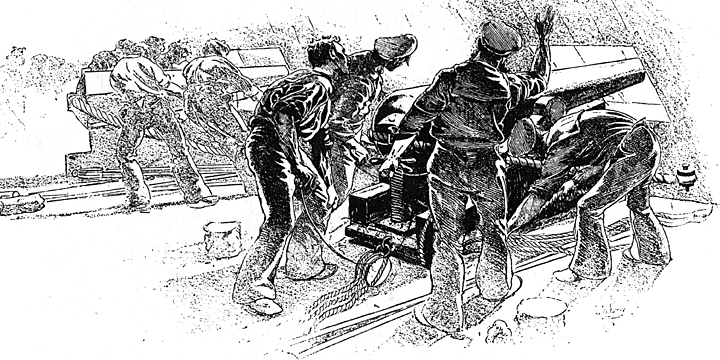
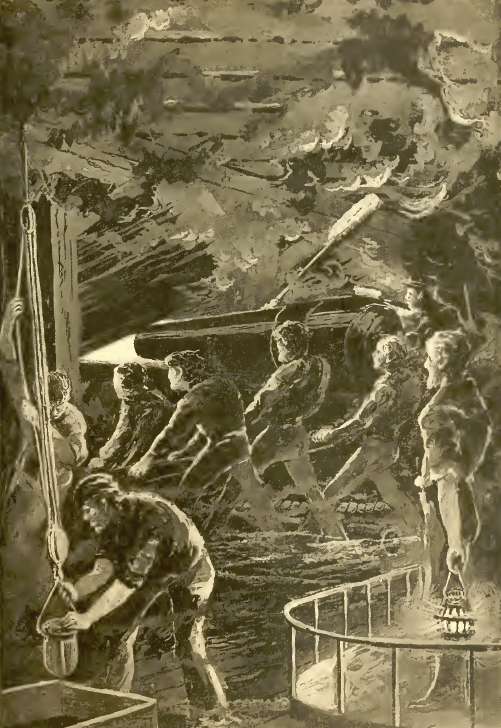
Our smoke-stack was riddled, our flag was shot down several times and was finally secured to a rent in the stack. On our gun-deck the men were fighting like demons. There was no thought or time for the wounded and dying as they tugged away at their guns, training and sighting their pieces while the orders rang out: “Sponge, load, fire.”
Virginia pulls away from U.S.S. Congress after setting her afire, March 8, 1862. Painting by Tom Freeman.
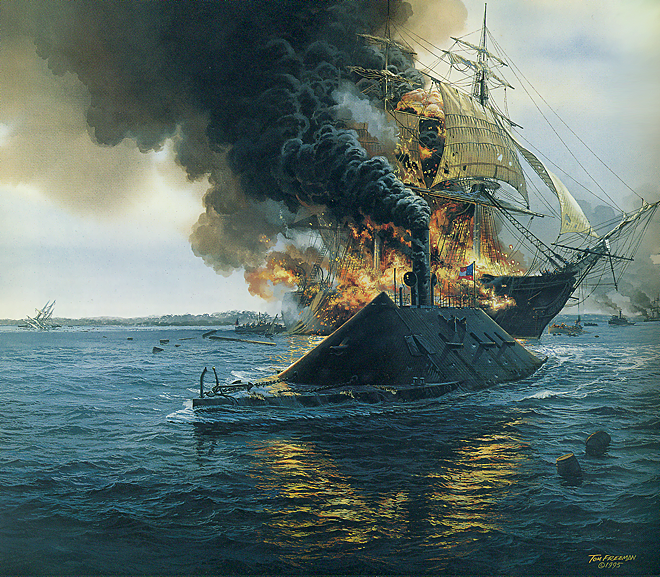
Virginia‘s score for the day included U.S.S. Cumberland, sunk, and Congress, abandoned and fully ablaze. Two more Federal vessels, St. Lawrence and Roanoke, had grounded themselves in trying to escape the guns of the ironclad. U.S.S. Minnesota had moved into shallow water where Virginia could not pursue, so the Confederate ironclad hauled off to her mooring at at Sewall’s Point. Ramsay continues:
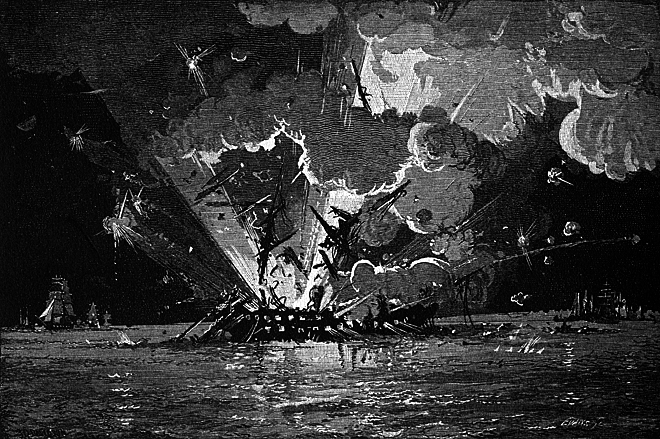
All the evening we stood on deck watching the brilliant display of the burning [U.S.S. Congress]. Every part of her was on fire at the same time, the red-tongued flames running up shrouds, masts, and stays, and extending out to the yard arms. She stood in bold relief against the black background, lighting up the Roads and reflecting her lurid lights on the bosom of the now placid and hushed waters. Every now and then the flames would reach one of the loaded cannon and a shell would hiss at random through the darkness. About midnight came the grand finale. The magazines exploded, shooting up a huge column of firebrands hundreds of feet in the air, and then the burning hulk burst asunder and melted into the waters, while the calm night spread her sable mantle over Hampton Roads.
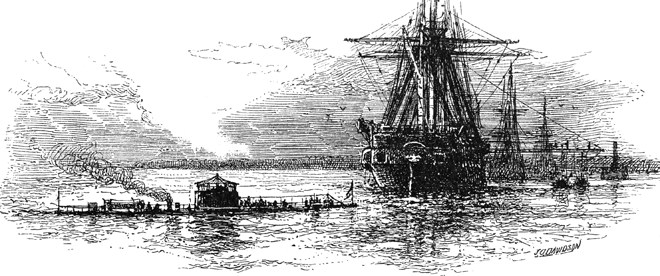
U.S.S. Congress explodes around midnight on the night of March 8-9, 1862. Battles and Leaders.The Monitor arrived during the evening and anchored under the stern of the Minnesota, her lighter draught enabling her to do so without danger. To us the ensuing engagement was in the nature of a surprise. If we had known we were to meet her we would at least have been supplied with a solid shot for our rifled guns. We might even have thought best to wait until our iron beak, lost in the side of the Cumberland, could be replaced. Buchanan was incapacitated by his wound and the command devolved upon Lieutenant Jones.
Monitor arrives alongside U.S.S. Minnesota, late on the evening of March 8, 1862. Battles and Leaders.We left our anchorage shortly before eight o’clock next morning and steamed across and up stream toward the Minnesota, thinking to make short work of her and soon to return with her colors trailing under ours. We approached her slowly, feeling our way cautiously along the edge of the channel, when suddenly, to our astonishment, a black object that looked like the historic description, “a barrel-head afloat with a cheese-box on top of it,” moved slowly out from under the Minnesota and boldly confronted us. It must be confessed that both ships were queer-looking craft, as grotesque to the eyes of the men of ’62 as they would appear to those of the present generation.
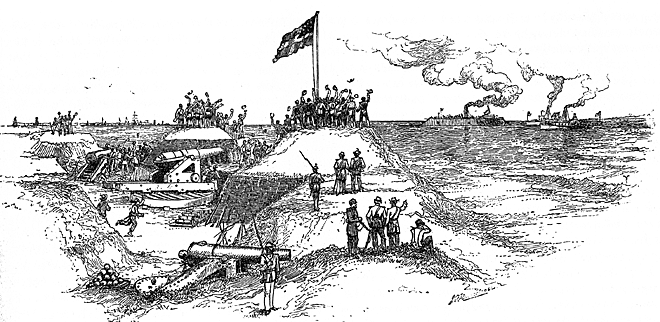
Virginia steams out into Hampton Roads, past the Confederate batteries on Craney’s Island. Battles & Leaders.And now the great fight was on, a fight the like of which the world had never seen. With the battle of yesterday old methods had passed away, and with them the experience of a thousand years “of battle and of breeze” was brought to naught. The books of all navies were burned with the Congress, by a conflagration as ruthless as the torch of Omar. A new leaf had been turned, a virgin page on which to transcribe and record the art of naval warfare.
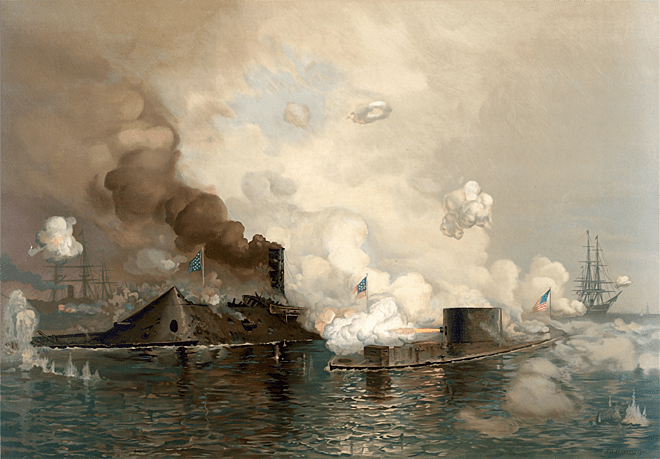
We hovered about each other in spirals, gradually contracting the circuits, until we were within point-blank range, but our shell glanced from the Monitor’s turret just as hers did from our sloping sides. For two hours the cannonade continued without perceptible damage to either of the combatants.
On our gun-deck all was bustle, smoke, grimy figures, and stern commands, while down in the engine and boiler rooms the sixteen furnaces were belching out fire and smoke, and the firemen standing in front of them, like so many gladiators, tugged away with devil’s-claw and slice-bar. inducing by their exertions more and more intense heat and combustion. The noise of the crackling, roaring fires, escaping steam, and the loud and labored pulsations of the engines, together with the roar of battle above and the thud and vibration of the huge masses of iron being hurled against us, altogether produced a scene and sound to be compared only with the poet’s picture of the lower regions.
Inside Virginia’s casemate during the action. From Blue Jackets of ’61: A History of the Navy in the War of Secession.And then an accident occurred that threatened our utter destruction. We stuck fast aground on a sandbar.
Our situation was critical. The Monitor could, at her leisure, come close up to us and yet be out of our reach, owing to an inability to deflect our guns. In she came and began to sound every chink in our armor–every one but that which was actually vulnerable, had she known it.
The coal consumption of the two days’ fight had lightened our prow until our unprotected submerged deck was almost awash. The armor on our sides below the water-line had not been extended but about three feet owing to our hasty departure before the work was finished. Lightened as we were, these exposed portions rendered us no longer an ironclad, and the Monitor might have pierced us between wind and water had she depressed her guns.
Fearing that she might discover our vulnerable “heel of Achilles,” while she had us “in chancery,” we had to take all chances. We lashed down the safety valves, heaped quick-burning combustibles into the already raging fires, and brought the boilers to a pressure that would have been unsafe under ordinary circumstances. The propeller churned the mud and water furiously, but the ship did not stir. We piled on oiled cotton waste, splints of wood, anything that would burn faster than coal. It seemed impossible the boilers could long stand the pressure we were crowding upon them. Just as we were beginning to despair there was a perceptible movement, and the [Virginia] slowly dragged herself off the shoal by main strength. We were saved.
Before our adversary observed we were again afloat we made a dash for her, catching her quite unprepared, and tried to ram her, but our commander was dubious about the result of a collision without our iron-shod beak and gave the signal to reverse the engines long before we reached the Monitor. As a result I did not feel the slightest shock down in the engine-room, though we struck her fairly enough.
1886 chromolithograph of the Battle of Hampton Roads, by J. O. Davidson.The carpenter reported that the effect was to spring a leak forward. Lieutenant Jones sent for me and asked me about it.
“It is impossible we can be making much water,” I replied,” for the skin of the vessel is plainly visible in the crank-pits.”
A second time he sent for me and asked if we were making any water in the engine room.
“With the two large Worthington pumps, beside the bilge injections, we could keep her afloat for hours, even with a ten-inch shell in her hull.” I assured him, repeating that there was no water in the engine and boiler rooms.
We glided past, leaving the Monitor unscathed, but got between her and the Minnesota and opened fire on the latter. The Monitor gallantly rushed to her rescue, passing so close under our submerged stern that she almost snapped off our propeller. As she was passing, so near that we could have leaped aboard her, Lieutenant Wood trained the stern-gun on her when she was only twenty yards from its muzzle and delivered a rifle-pointed shell which dislodged the iron logs sheltering the Monitor’s conning tower, carrying away the steering-gear and signal apparatus, and blinding Captain Worden. It was a mistake to place the conning tower so far from the turret and the vitals of the ship. Since that time it has been located over the turret. The Monitor’s turret was a death-trap. It was only twenty feet in diameter, and every shot knocked off bolt-heads and sent them flying against the gunners. If one of them barely touched the side of the turret, he would be stunned and momentarily paralyzed. Lieutenant Greene had been taken below in a dazed condition and never fully recovered from the effects. One of the port shutters had been jammed, putting a gun out of commission, and there was nothing for the Monitor to do but to retreat and to leave the Minnesota to her fate.
Captain Van Brunt, of the latter vessel, thought he was now doomed and was preparing to fire his ship when he saw the [Virginia] also withdrawing forward Norfolk.
It was at this juncture that Lieutenant Jones had sent for me and said: “The pilots will not place us nearer to the Minnesota and we cannot afford to run the risk of getting aground again. I am going to haul off under the guns of Sewall’s Point and renew the attack on the rise of the tide. Bank your fires and make any necessary adjustments to the machinery, but be prepared to start up again later in the afternoon.”
I went below to comply with his instructions, and later was astonished to hear cheering. Rushing on deck I found we were passing Craney Island on our way to Norfolk, and were being cheered by the soldiers of the battery.
Our captain had consulted with some of his lieutenants, and explained afterward that as the Monitor had proved herself so formidable an adversary he had thought best to get a supply of solid shot, have the prow replaced, the port shutters put on, the armor belt extended below water, and the guns whose muzzles had been shot away replaced, and then renew the engagement with every chance of victory. I remember feeling as if a wet blanket had been thrown over me. His reasoning was doubtless good, but it ignored the moral effect of leaving the Roads without forcing the Minnesota to surrender.
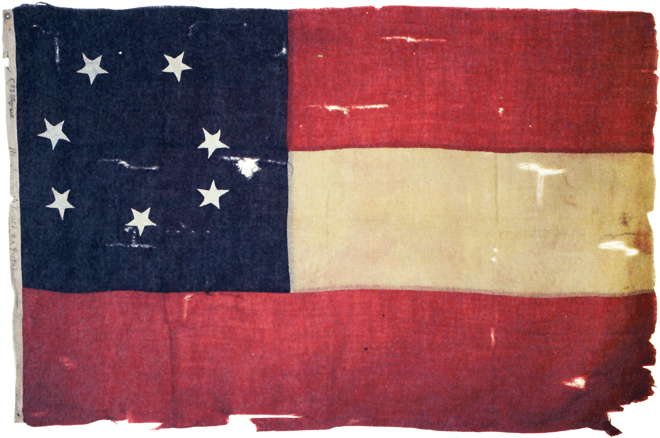
One of C.S.S. Virginia’s ensigns. This ensign was reportedly replaced with a variant with 11 stars during the March 9, 1862 action against U.S.S. Monitor. Time-Life, Arms and Equipment of the Confederacy.As the [Virginia] passed up the river, trailing the ensign of the Congress under the stars and bars, she received a tremendous ovation from the crowds that lined the shores, while hundreds of small boats, gay with flags and bunting, converted our course into a triumphal procession.
We went into dry-dock that very afternoon, and in about three weeks were ready to renew the battle upon more advantageous terms, but the Monitor, though reinforced by two other ironclads, the Galena and the Naugatuck, and every available vessel of the United States Navy, was under orders from Washington to refuse our challenge and bottle us up in the Roads. This strategy filled us with rage and dismay, but it proved very effective.
____________

Monitor‘s Marvelous Marine Mechanics

There will be lots of blog posts today referencing the 150th anniversary of the “Battle of the Ironclads” between U.S.S. Monitor and the Confederate casemate ship C.S.S. Virginia. That’s as it should be.
Some other time I’ll talk about the ship’s compact trunk engine, designed (like the rest of the ship) by John Ericsson. In the meantime, here’s a video (above) showing the operation of a remarkable 1/16 scale model of it, built by Rich Carlstedt (Flickr images here), and (below) a video from 2010 on the conservation of the real thing:

And this little animation of the engine of U.S.S. Monadnock, very similar to that of Monitor. Note how the pistons move entirely independently of each other:
_________________

Do You Know These Men?

My new post on the Civil War Monitor is up at, um, the Civil War Monitor.
In addition, Brooks Simpson has a new post up at the Library of America site on the first “Clash of Ironclads.” Good stuff.
___________

Evilizing General Sherman
Many people have made the point that, for all their alleged disdain for “revisionist” history, those who hold to a “Southern” view of the war are themselves embracing an explicitly revisionist historical narrative. It’s a narrative that was carefully crafted in the decades following the Civil War to exonerate the Confederate cause, depict Southern leaders in the most flattering and noble way possible, and to undermine or denigrate the Union effort to highlight the contrast. This effort, which lies at the core of the Lost Cause, probably reached its zenith in the second decade of the 20th century. But with a few concessions to modern sensibilities — e.g., “faithful slaves” have now become “black Confederate soldiers” — the narrative remains largely as it was a century ago, and is held dear by many. But great longevity doesn’t make a revisionist narrative any less revisionist.
 Now comes the Spring 2012 issue of the Civil War Monitor, and Thom Bassett’s cover story, “Birth of a Demon.” Bassett explains how, through several postwar tours of the South, Sherman was received and honored by both public officials and the citizenry of cities who, present-day conventional wisdom holds, should have held a burning hatred for the man. In New Orleans he was an honored guest at Mardi Gras festivities in 1879, where he was named to the royal court as “Duke of Louisiana.” He was accompanied to the theater there by his old opponent, John Bell Hood, who gave a long speech praising the former Union general. On that same trip Sherman spent three days in Atlanta, where he reported receiving “everywhere nothing but kind and courteous treatment from the highest to the lowest.” Here is what the Atlanta Weekly Constitution said of his visit, on February 4, 1879:
Yesterday General Sherman returned to the scene of this destruction and disaster, and looked upon the answer that our people have made to his torch. A proud city, prosperous almost beyond compare, throbbing with vigor and strength, and rapturous with the thrill of growth and expansion, stands before him. A people brave enough to bury their hatreds in the ruins his hands have made, and wise enough to turn their passion towards recuperation rather than revenge. . . .
It would be a stretch to say that Sherman was popular across the South, but it was clear that he was not considered the reviled monster he later was to become in some quarters.
So what changed? In 1881 Jefferson Davis published his defense of secession, The Rise and Fall of the Confederate Government, and used it to excoriate Sherman to a degree that no other senior Confederate had, including men who’d actually faced him across the lines, like Hood. Bassett:
[Davis] called Sherman’s decision to remove Atlanta’s civilian population after the city’s surrender unparalleled in modern warfare. “Since Alva’s atrocious cruelties to the noncombatant populations of the Low Countries in the Sixteenth Century, the history of war records no instance of such barbarous cruelty as that which this order was designed to perpetrate.” . . . Davis made perfectly clear whom he considered responsible for these depredations, thundering that Sherman had issued an “inhuman order” and that the “cowardly dishonesty of its executioners was in perfect harmony with the temper and spirit of the order.”
Davis’ accusations struck a chord with Southerners, who by this time had come to see the former Confederate president as the living embodiment of the Confederate cause. Sherman provided a useful focus for the lingering resentments of former Confederates, and Davis’ book proved to be the essential catalyst. Sherman came to be reviled not so much because Southerners viewed him that way of their own experience, but because Jeff Davis told them they should.
Sherman and Davis would continue to spar over Davis’ accusations for the rest of their lives — Davis died in 1889, Sherman in 1891 — but the preferred Confederate narrative was set. Despite fifteen postwar years of enjoying relatively good relations with Southerners and an ongoing affinity for the South, Sherman was successfully cast as something inhuman, a monster, responsible for depredations nearly unmatched in human history to that point. Many today still believe that; more, in fact, than seem to have believed it in the years immediately following the war itself.
Whatever one happens to think of Uncle Billy, Bassett’s article really is a must-read as a practical example of the way historical narratives are shaped, refined, and sometimes abused. Civil War Monitor Editor-in-Chief Terry Johnston and his team have been working hard to challenge conventional ways of looking at the conflict, and Thom Bassett’s piece is an excellent example of how they’re doing just that.
It really is not your father’s Civil War magazine.
__________

Friday Night Concert: “The Man in Black”

The other day I came across this recording of Johnny Cash’s first performance of “The Man in Black,” from February 1971. It’s a ragged performance, but given that he’d only finalized the lyrics a few hours before, that’s to be expected. Considering that the song was written very explicitly in reference to the current events of the day, it’s held up damn well over time. I’m not sure if that’s a credit to Cash’s insight, or an indictment of the rest of us that, as a society, we’re still dealing with many of the same, intractable problems.
The other video that’s worth your time is this recording of Cash from that same year, on the Mike Douglas show, along with James Brown. The latter, of course, was billed as “the hardest working man in show business,” but I imagine Johnny Cash could have equally claimed that title. What’s most striking about this interview is Cash’s candid discussion of his addictions, particularly to prescription drugs. He acknowledges that he’d made a previous appearance on Douglas’ show, but had no recollection of it afterward.
Today, when a celebrity going through rehab (at least once; twice is better) is as much a career strategy as it is a health issue, it’s remarkable to hear such candor.
Not Even Trying to Hide It
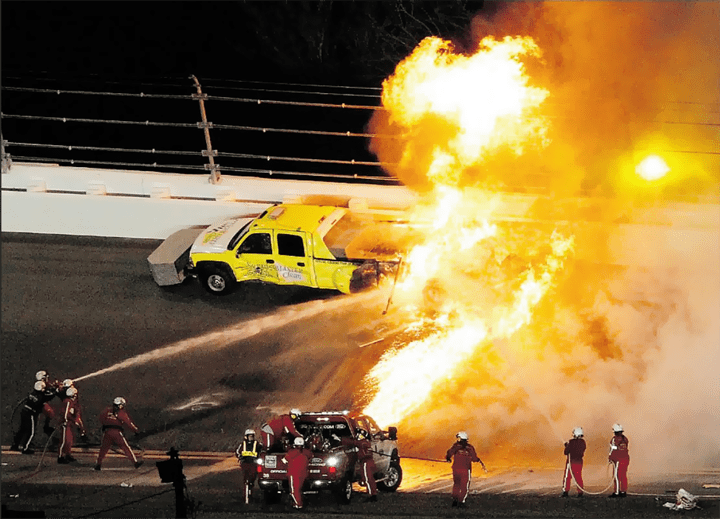
Clint Lacy, who claims his Across Our Confederation blog is “your voice in the Sons of Confederate Veterans,” has figured out the underlying cause of that fiery crash at the Daytona 500 the other night: letting non-white (or maybe just non-Southron) drivers into the sport. No, seriously:
Well Mr. [Brian] France [CEO and Chairman of NASCAR]; Did you get this “diversity thing” right? Did you achieve what you wanted to for this sport?
Because if your Drive to Diversity program was rolled out so that Latin-Americans could roll into dryer trucks filled to the brim with jet fuel you can give yourself a pat on the back.
I saw that wreck, and I have to say that it never entered my mind that it was the inevitable and foreseeable outcome of letting a Columbian, Juan Pablo Montoya, get behind the wheel. Shows you how clueless I am.
It’s Lacy’s conceit that his blog speaks for the rank-and-file membership of the SCV. It doesn’t, and he doesn’t, but his claim that it does makes it an SCV problem nonetheless. They ought to stomp publicly disavow him for attaching their name to foolishness like this, but I’m not holding my breath.
___________
Update: Lacy has responded to this post, claiming that I have issued a call “for a non-for-profit fraternal organization to bring violence to my doorstep.” OK, fine, I’ll rephrase that. Done.
Of course, instead of defending his own words, or clarifying their meaning, Lacy doubles-down, saying that “as far as SCV members go, I would wager that most descendants of Confederate veterans probably aren’t too happy with Brian France’s vision for Nascar, a sport with its roots planted firmly in the South.”
He then goes on to explain that the real problem here is my lack of appreciation for my Confederate heritage. Because if I had a better appreciation for that, I’d understand why Latin Americans shouldn’t be driving in NASCAR. Or something. 😉
___________
Image: Pierre Ducharme, Reuters, Star News Services

Kentucky Confederate Pensions Online
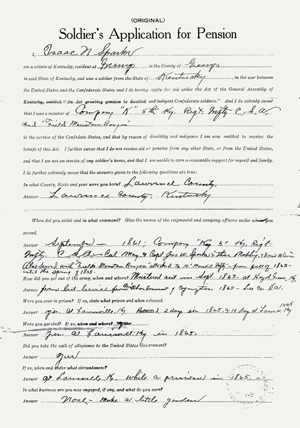 The digitization of important primary source materials continues apace. Yesterday, the Kentucky Department for Libraries and Archives announced that its Confederate pensions holdings are now online. Kentucky never formally seceded from the Union, and didn’t get around to establishing a pension program for Confederate veterans and their widows until 1912. The user interface in this case is dead simple, and the good folks there have added a handy feature I’ve not seen before — applications grouped by regiment, for Kentucky units.
Enjoy.
________
Image: The 1916 pension application for Isaac N. Sparks, formerly of Co. K, 5th Kentucky Mounted Infantry Regiment.

Canister!
Small stories that don’t warrant larger posts all their own.
- NPR had an interesting interview with Reverend Bryant Wright, President of the Southern Baptist Convention, about an initiative within that organization to change its name to something without the word Southern in the title. It’s apparently perceived by some within the church, particularly younger congregants, as a hindrance in attracting new congregations and followers. And it’s been a topic that’s been simmering in the background for over a century. As someone who grew up in SBC churches — RAs, Wednesday night pot-luck fellowship suppers and all that — I feel like I should care more about this than I do.
- Blogger Craig Swain passes along a news item about a new Confederate monument in a cemetery in Socorro, New Mexico, which makes reference to the “War for Southern Independence” and an effort to “liberate our beloved Texas and Southland.” No word if they ever built the monument to the flying saucer that landed there in 1964.
- The “Stainless Banner” variant of the Confederate national flag, displayed aboard the full-size replica of the C.S.S. Neuse in Kinston, North Carolina, is raising some hackles. While I’ve been critical of some public displays of the Confederate flags in the past, this seems to me like a legit context for it.
- In other flag news, NASCAR recently decided to bar the “General Lee” of Dukes of Hazzard fame from an event in Arizona, due to the Confederate Battle Flag emblazoned on its roof. New York resident Valerie Protopapas, one the more outspoken online defenders of Southron Honor™, thinks it’s an ill-conceived move. “If NASCAR is trying to attract blacks,” she says, “they haven’t a chance unless they do something else in those cars other than race around a track.” You stay classy, LadyVal!
- While futzing around YouTube, I stumbled on this Arabic-language documentary shot off Key Largo, Florida. (The good diving video is mostly in Part 4; the segment where he cuts himself with his dive knife is in Part 2) The site is known locally as “the Civil War Wreck,” and I don’t think is explicitly identified in the video. In fact, I’m pretty sure the producers had no idea the actual identity of the wreck, since they spend a lot of time talking about CW ironclads and submarines. It’s actually the remains of civilian merchant vessel Tonawanda, which during the war had been the Navy steam transport U.S.S. Arkansas, which spent much of the conflict with the West Gulf blockading Squadron, running a regular supply route along the coast between Ship Island, Mississippi and the mouth of the Rio Grande. Returned to civilian service under her original name, Tonawanda, she was wrecked on the Florida reef known as “The Elbow” in 1866. And yes, diving in the Keys really is that beautiful. He’s got some nice Great Barracuda video, as well.
- Completely unrelated to the CW, but historians at Hearne, Texas (north of Bryan/College Station) are working to preserve the memory of Camp Hearne, a facility for housing German PoWs during World War II. My father grew up in that area and remembers meeting PoWs as a kid, possibly from Camp Hearne. They were paroled out to work on farms in the area, to partly make up for wartime manpower shortages.
- Historian and Lincoln scholar Harold Holzer just published his 42nd book. Slacker.
 The trailer for Tim Burton-produced Abraham Lincoln: Vampire Hunter is out (above). In the comments below, Jeffry Burden correctly pegs the language as coming out of the Book of Revelation. Anyways, the movie looks like fun. Did you catch the train sequence?
- And on the subject of trains, descendants of Wilson W. Brown (right), a Union soldier and locomotive engineer from Ohio who took part in the famous Great Locomotive Chase, continue their legal wrangling over who’s the rightful heir to his Medal of Honor, one of the first awarded, along with a second, later version of medal. Fortunately, both sides in the lawsuit have agreed to loan the disputed materials to the Southern Museum of Civil War & Locomotive History, now home to the locomotive General, for the sesquicentennial of the Andrews Raid in April.
- Also speaking of trains, William G. Thomas, author of The Iron Way: Railroads, the Civil War, and the Making of Modern America, had a great piece the other day on the use of slave labor during the war in maintaining and expanding railroads across the Confederacy. As one commenter notes, Thomas’ work pretty much decimates the notion that slavery was an institution that only really functioned in an agrarian, plantation-based model and was therefore doomed to fade away in the face of increasing industrialization and mechanization.
- And while we’re on the subject of trains, blogger, historian, and modeler Bernard Kempinski produced this little tongue-in-cheek gem of a movie trailer:
_______________

A Big Win for Galveston Preservation and CW History

From today’s Galveston County Daily News:
In another coup for conservationists, Mitchell Historic Properties, a company owned by the family of billionaire developer George Mitchell, might as soon as today finalize the acquisition of a long-troubled building.
Mitchell Historic Properties plans to buy the east two bays of the Hendley Building on the northwest corner of 20th Street and The Strand. The building long housed Demack & Co., a produce wholesaler that closed in 1999. Demack & Co. couldn’t survive when the University of Texas Medical Branch and Galveston Independent School District began awarding multimillion contracts to larger grocery supply chains outside the city.
Bill Ross, senior vice president and general manager of Mitchell Historic Properties, said plans call for a major renovation of the building. One idea is that Galveston Historical Foundation would move into the first floor. Officials with the foundation could not immediately be reached for comment.
The Demack building has fallen into disrepair and has made the foundation’s Heritage at Risk list since 2003. Several family members claimed ownership of the building, complicating city efforts during the years to bring the building up to code. Mitchell Historic Properties, which is buying the building from James K. Rourke Jr. and Jack Alexander Demack, has invested many millions of dollars restoring 17 historic downtown businesses. Stay tuned.
This is wonderful news. Hendley’s Row — a single, large building encompassing four separate bays — is, along with the old U.S. Customs House, perhaps the most important war-related structure in town that survives. A cupola on its roof (visible in the top photo) was used as a lookout to track Union blockaders during the war, and Confederates occupying the building on the morning of January 1, 1863, used its back windows as a platform for sharpshooters and even light artillery during the Battle of Galveston. This structure has been slowly crumbling for a long time — even under Demack & Co.’s active proprietorship, it was a pretty sorry sight — and it’s great to see the prospect of serious and long-lasting restoration work being done.
___________Image: The Hendley Buildings on Strand Street, Galveston, in the 1870s and in 2011. As one of the tallest commercial buildings in town at the time of the Civil War, the Hendley Buildings (or Hendley’s Row) were a natural lookout point for observers watching both the Gulf of Mexico and Galveston Bay. A red flag flown from this building on July 2, 1861 announced the much-anticipated arrival of the Federal blockade. Upper image: Rosenberg Library.





8 comments