“Confirmed Kill: Union Zeppelin”
__________________

Canister!

Small stories that don’t warrant larger posts all their own.
- The City of Lexington, Virginia will make its case at a hearing in Roanoke on June 11, seeking to have the lawsuit filed against them by the Virginia SCV thrown out. I doubt they will be successful in getting the case dismissed, but it will be the first time (I think) that each side will lay out their positions in court. My earlier thoughts on the plaintiff’s likelihood of prevailing in court are here.
- The Smithsonian’s National Portrait Gallery is opening two new exhibits of Civil War images, including “The Confederate Sketches of Adalbert Volck,” the caricaturist who liked to vilify Lincoln and other Northern figures. Who says Confederate voices are censored in “the Empire”?
- The Confederate submersible H. L. Hunley was known as the “peripatetic coffin” for sinking three times, killing its crew each time. Turns out, it’s not so great on the freeway, either.
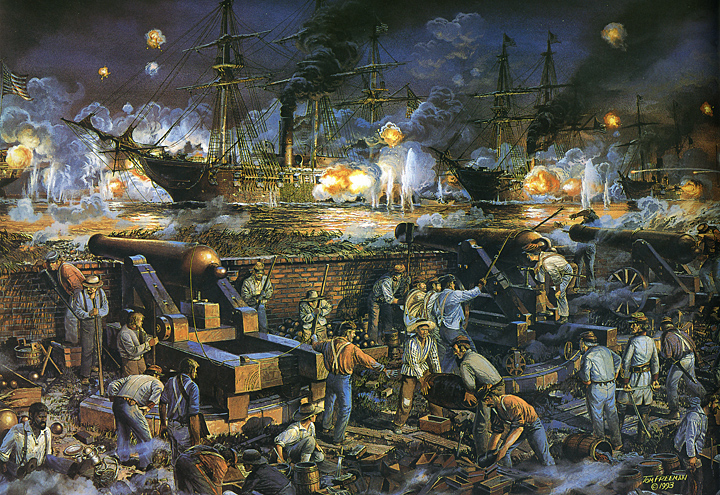
- This month marks the sesquicentennial of the Battle of Forts Jackson and St. Philip, a major strategic development which effectively closed the mouth of the Mississippi to the Confederacy. Wartime operations in this part of the South sometimes don’t feel like they get the attention that they should. The Plaquemines Parish Historical Association in Louisiana is looking to change that.
- In that same area, several Confederate monuments in New Orleans were defaced with graffiti in protest of the Trayvon Martin shooting in Florida. That does nothing to serve the cause of justice, asshats.
- The Harper House on the Bentonville Battlefield State Historic Site in North Carolina served during the conflict as a hospital. Now experts will test to see whether stains in the floorboards are actually from blood, as long believed.
- The Virginia Flaggers continue to generate free publicity for the Museum of the Confederacy’s new Appomattox facility. Lots of familiar faces at the protest Saturday, including Karen Cooper, who was twice the Confederate her colleagues were. I see Billy Bearden was there, too, pushing the Grant-was-a-slaveholder meme. Dramatic but way-inside-baseball slogans seemed to be the theme of the day, and you gotta ask how many regular visitors to the new museum actually understood what the protest was about. I also wonder where Edgerton was; maybe no one was fronting his $20K speaking fee.
- Speaking of the Flaggers, former-state-SCV-officer-turned-culture-wars-columnist Mark Vogl argues that Susan Hathaway, of Virginia Flaggers fame, may be a Southern Sarah Palin. I agree, though probably for different reasons.
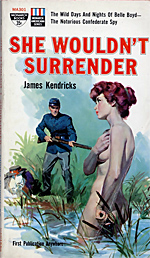 One Southron recently posted the cover of a raunchy 1960 pulp novel, She Wouldn’t Surrender: The Wild Days and Nights of Belle Boyd – the Notorious Confederate Spy (right), as a “dedication to all Southern Belle’s [sic.].” I’m sure they, and any descendants of Belle Boyd living today, are mighty pleased to be depicted with that particular imagery. Other works in the same vein by James Kendricks (pen name of well-known comic writer Gardner F. Fox) include Sword of Casanova, The Adulterers, Beyond Our Pleasure and Love Me Tonight.
- Finally, congratulations to Clint Lacy, who recently changed the tagline of his blog to “we cover the news like the dew covers Dixie.” At least now, when he’s going off on a rant about how Columbian drivers are ruining NASCAR, or race-baiting the presidential campaign, or comparing Rick Santorum to Adolph Hitler, or using a dead teenager as an excuse to whine about all the streets in the South named after MLK, he’s not simultaneously claiming to be “your voice in the Sons of Confederate Veterans.” Whatever else its faults might be, the SCV doesn’t deserve to be linked with that.
_______
Image: Battle of Forts Jackson and St. Philip by Tom Freeman, 1993.
Waite Rawls Pwns the Southrons
There’s a hoary anecdote among museum staffers – invariably told as one personally witnessed by the speaker – about a tired parent, dragging an even-more-tired kid through the galleries. At one point the parents stops, turns, and snaps at the child, “how are we going to see the whole museum if you keep stopping to look at things?”
I thought about that anecdote recently watching the reaction to the brief installation (now removed) at the Museum of the Confederacy’s new annex at Appomattox of an image of the cross-dressing entertainer RuPaul in a sequined dress patterned after the Confederate Battle Flag. Over at Simpson’s Crossroads blog, Jackie Haddock was in full pearl-clutching mode, demanding to know “what were small children to make of this?” When I replied that it was extremely doubtful that many small children would even recognize RuPaul, much less know enough about him to find the image confusing/offensive/troubling, Haddock replied, “for the record in order to learn whom Ru Paul was I had to do a google search.”
Nothing puts the faux in faux outrage like having to go digging around the Internet to sort out why you’re supposed to be outraged in the first place. I’m furious about this, and if you’ll just give me a minute I’ll be able to tell you why! What a joke.
There are a couple of points worth making here. The first is that nothing the MoC does, short of full-out hagiography of the Confederacy and its heroes, would ever satisfy the small-but-loud group of critics who’ve been carping about the institution for years. If it weren’t RuPaul, it would be something else. They would be unhappy to discover a mention that Lee owned slaves, or that there’s a section devoted to Lincoln’s visit to Richmond a few days before his death. If the flag display out front that’s caused so much heartburn, was to feature (say) Union and Confederate national flags of April 1865 flying side-by-side, they’d be bitching about the presence of the “Yankee rag.” Outrage is what these folks do. Fish gotta swim.
The second thing is that, because they’re always looking for a new excuse to take righteous offense, they’re also easily trolled. This latter point causes me to think that, with this RuPaul thing, MoC Director Waite Rawls may have intentionally yanked the Southrons’ chain.
Sure, it may be exactly as he told Martha Boltz the other day, that it was an idea they’d been kicking around to emphasize the outrageous ways the flag has been used, and then removed it within hours when they received complaints. But it could equally have been Rawls and his staff never intended for it to be up more than a few hours regardless.
I’ve never met Waite Rawls, nor corresponded with him. But it’s clear that he’s not a stupid man, nor one to be intimidated easily. Given the ridiculous vitriol that man’s received — everything from being called “traitor” and “scalawag” to having Southrons urge their comrades to “get in ‘these peoples’ face and spit and spit again” and hint (repeatedly) that he should be lynched — I’d be surprised if Rawls didn’t also have a pretty cynical sense of humor about the fools who carry on like that. He’d have to. Given the unwarranted crap he’s had to put up with in recent years from people who should be working to support that institution, Waite Rawls is entitled to have a little fun at their expense. I’d like to think that’s what happened here, and wouldn’t be a bit surprised if it did. Well played, sir.
I hope to visit the Museum of the Confederacy at Appomattox sometime soon. I kinda wish I’d been there to see the RuPaul picture, too — not for the sake of the picture itself, but to watch visitors’ reactions. It must have been fabulous.
_________

Readin’ Blockade Runners
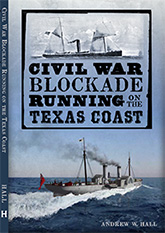
 I’d like to thank the folks who came out to the Houston Museum of Natural Science Tuesday evening to attend my talk on blockade runners. It was a good time — folks laughed where intended to, not where they weren’t, and there was lots of good Q&A at the end. I did get a little too technical on ship construction and machinery, though, and I oughter watch out for that in the future. Not everyone is that interested in frame spacing and entrance lines.
I’d also like to thank the folks who made my talk possible, particularly Amy Potts from HMNS and Ed Cotham. Thanks, y’all!
One thing that I didn’t have a chance to do, using the format of the talk, was to provide a list of suggested readings. And so:
- J. Barto Arnold III. The Denbigh‘s Civilian Imports: Customs Records of a Civil War Blockade Runner between Mobile and Havana. College Station, Texas: Institute of Nautical Archaeology, 2011.
- W.T. Block, Schooner Sail to Starboard: The US Navy vs. Blockade Runners in the Western Gulf of Mexico. College Station, Texas: Institute of Nautical Archaeology, 2007.
- Eric J. Graham. Clyde Built: Blockade Runners, Cruisers and Armoured Rams of the American Civil War. London: Birlinn Ltd, 2008.
- Thomas E. Taylor, Running the Blockade: A Personal Narrative of Adventures, Risks and Escapes during the American Civil War. Annapolis: Naval Institute Press, 1995.
- Rodman L. Underwood, Waters of Discord: The Union Blockade of Texas During the Civil War. McFarland, 2008.
- William Watson, The Civil War Adventures of a Blockade Runner. College Station, Texas: Texas A&M University Press, 2001.
- Stephen R. Wise. Lifeline of the Confederacy: Blockade Running during the Civil War. Columbia, South Carolina: University of South Carolina Press, 1991.
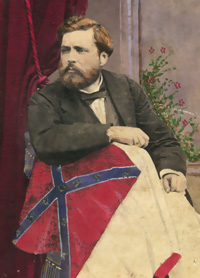
Image: Unidentified Confederate blockade runner, hand-tinted portrait taken in Matanzas, Cuba after the war. Lawrence T. Jones III Texas Photographs, DeGolyer Library, Southern Methodist University.

Petersburg Battlefield Looter Gets Prison

This guy was not a visitor who, on a whim, pocketed a couple of Minié balls he found lying on the ground. He also kept a detailed, day-by-day journal of his looting activities. From the Richmond Times-Dispatch:
By his own account, Santo wrote that he recovered more than 18,000 bullets, 68 fuses, 31 cannonballs and shells, 13 buckles, seven breastplates, five saber tips and 91 buttons over 1,014 days.
“The defendant’s journal is a tell-all of his misconduct, identifying with a high degree of specification where he engaged in metal detecting/relic hunting and when and what he recovered,” wrote Assistant U.S. Attorney N. George Metcalf in federal court papers. “He even kept a running tally of the items he found from day to day on a yearly basis.”
Santo’s handwritten journal, recovered during a July 10, 2011, search of his Petersburg home, proved to be his undoing. On Wednesday, the 52-year-old unemployed Pennsylvania native was sentenced in U.S. District Court in Richmond to one year and one day in a federal prison.
He pleaded guilty in December to two counts of damaging archaeological resources and one count of pillaging Petersburg National Battlefield Park.
Santo is regarded as the park’s most prolific relic thief.
Unfortunately, Santo’s conviction still leaves important, unanswered questions:
[Park historian Jimmy] Blankenship said one of the issues that concerned the court was the amount of relics Santo apparently sold. “We know he found over 18,000 bullets,” Blankenship said. “We only confiscated something like 8,500. So what happened to the other 10,000 bullets?”
But archaeology, as opposed to private treasure hunting on public land, remains a hard sell to the general public. As one archaeologist notes on the Historical Archaeology e-mail list,
If you want to see where the public perception of archaeology is, or if you have wondered who would watch and champion shows like Digger or American Digger, just read the comments at the end of the article. To nearly all commenters, the perpetrator is a hero who has rescued the artifacts from the ground, something the power-loving authorities and archaeologists have no desire to do so.
Trust me, professional archaeologists would love to have the resources to devote to a systematic study of sites like Petersburg, but they don’t. (And note that comprehensive study of a battlefield site can completely revise our understanding of well-known engagements, as Doug Scott’s study of the Little Bighorn and the THC’s work to reconstruct the Red River War both attest.) But there’s little public support for investing in that sort of work, which requires a lot of time by highly-trained people, and is therefore expensive. Buckets of Minié balls and uniform buttons, looted from public land — which is to say, stolen from us — don’t do a damn thing to improve our knowledge or understanding of the conflict.
One additional note: Santo’s 366-day sentence is common in the federal system for low-level, non-violent criminals. The federal system does not have parole, but does allow some credit for inmates with good behavior or who participate in rehab or educational programs while incarcerated. This can knock, I believe, about 15% off the time they actually spend in jail. But to be eligible for this, the law requires that the prisoner be sentence to “more than a year” behind bars — thus the sentence of 366 days. Santo will likely serve about ten-and-a-half months, and then be put on some form of supervised release.
______________Image: Containers of Civil War era bullets and park boundary markers (enclosed in plastic that he took as trophies). Via Petersburg National Battlefield Park.

Canister!

Small stories that don’t warrant larger posts all their own.
- The City of Lexington, Virginia has filed a petition to dismiss the Virginia SCV’s lawsuit against the city, which seeks to overturn a 2011 ordinance that bars all non-governmental flags from city property, including light poles. (The ordinance does not prohibit the flag on private property, nor parades or other displays of the Confederate flag, as is sometimes claimed.) This latest filing is a standard motion that doesn’t add much significant to the case. My earlier thoughts on the plaintiff’s likelihood of prevailing in court are here.
- The long-running lawsuit of Candice Hardwick (above, with Confederate activist/performance artist H. K. Edgerton in 2006) appears to have come to an end, with the dismissal of her federal lawsuit against the administration of Latta High School, in Latta, South Carolina. In 2006, then-fifteen-year-old Hardwick was suspended twice from school for wearing a Confederate flag shirt. She sued, and her case became a cause celebré among heritage groups.
- Near Raleigh, North Carolina, volunteers spent six hours digging up the graves of two brothers, Joseph and Joel Holleman, to move the remains to a nearby cemetery to be reburied alongside other Civil War veterans. This story is the most ghoulish thing I’ve read in a long time; it reeks of necro-voyeurism. The original graves were marked, identified, and not threatened by development or erosion. Nor, as far as I know, was there any wish on the part of these men’s descendants to have this done. So they dug them up anyway, because (in the words of the event’s organizer), ““my heart says this is the right thing.” The folks who scream “GRAVE DESECRATION!” and “SPITTING ON THE GRAVES OF AND DISHONORING AMERICAN VETERANS!” when a cemetery owner removes Confederate stick flags ought to be up in arms about this foolishness. But they ain’t gonna say boo about it.
- Speaking of disturbing graves. . . .
- It looks like Kentucky will finally shut down its Confederate Soldiers Pension Fund, a mere fifty years after anyone was eligible to receive benefits from it. Don’t do anything precipitous, y’all.
- Union County, North Carolina, is moving one step closer to putting up a monument to local African American men who went into the field with the Confederate army as personal servants of soldiers. The description of the men in question by historians interviewed is reasonably accurate, but it’s still all very muddled. Earl Ijames doesn’t help by observing that “history has attempted to negate what they did. . . .They would die for their freedom before freedom was available for their own people. . . .For Union County, Jesse Helms’ (home) county, this makes a big statement that we are a society that has evolved into a more integrated society.” I have no idea what he’s saying, but it sure sounds good.
- Fed up with Waite Rawls, John Coski and the Museum of the Confederacy, the SCV is soliciting money to build and operate the Confederate Museum at Elm Springs in Columbia, Tennessee to counter the “forces of political correctness,” who are attempting “to ban any and all things Confederate through their ideological fascism.” The first 20 camps or divisions to contribute $1,000 or more will each receive a commemorative gavel, “made from wood taken from the damn [sic.] at Fredricksburg [sic.] during the War.“

Finally, I’d like to remind folks that I’ll be speaking on Civil War blockade runners in Texas at the Wortham MAX Theater at the Houston Museum of Natural Science on Tuesday at 6:30 p.m. It should be fun.
_______Image: Candice Hardwick, 15, walks to Latta High School with H.K. Edgerton, a former NAACP leader from North Carolina who is board chairman of the Southern Legal Resource Center. Photo by Mary Ann Chastain, Associated Press.
Talkin’ Blockade Runners

I’d like to extend my thanks to the SCV John Bell Hood Camp No. 50 for hosting my talk on blockade runners Monday evening. A few members recalled my earlier talks on the subject from 10+ years back, and came armed with questions. I talked a little long (surprise!), but I got a lot of solid info in there. I even got in a plug for Jim Schmidt’s upcoming book on Galveston during the war. It’s going to be a good one.
Tuesday evening at 6:30 my friends Bob Gearhart, Amy Borgens, and Edward T. Cotham, Jr. will present “U.S.S. Westfield, A Civil War Shipwreck in Galveston Bay” in the Wortham Theater at the Houston Museum of Natural Science:
In the fall of 2009, a team of marine archeologists working under the direction of the U.S. Army Corps of Engineers supervised the recovery of artifacts from USS Westfield, a Staten Island ferryboat that had been converted into a Civil War gunboat after its purchase by the U.S. Navy in 1861. Westfield saw significant Civil War action, participating in battles at New Orleans, Vicksburg and other places along the Gulf Coast. Its destruction at the Battle of Galveston on January 1, 1863, was one of the most important and dramatic events of the Civil War in Texas. This audiovisual program uses rare historic documents and images to describe the conversion of a ferryboat to armored warship and examine the military career of this unique “fighting ferryboat” and its impact on the war in Texas. It retraces the series of events that led to the relocation of Westfield’s wreck and the challenging project that resulted in recovery of tons of artifacts undergoing conservation at the Conservation Research Laboratory at Texas A&M University. Among the artifacts being conserved is a more than 4 ton Dahlgren cannon capable of firing a projectile almost 2 miles.
And next Tuesday, March 27, I’ll be presenting my own talk there, “For-Profit Patriots: Civil War Blockade Running on the Texas Coast.” Hope to see y’all there!
____________Image: Andy Hall and marine archaeologist Amy Borgens prepare to dive on the site of a wreck believed to be that of the Civil War blockade runner Will o’ the Wisp, July 2009.


Canister!

Small stories that don’t warrant larger posts all their own.
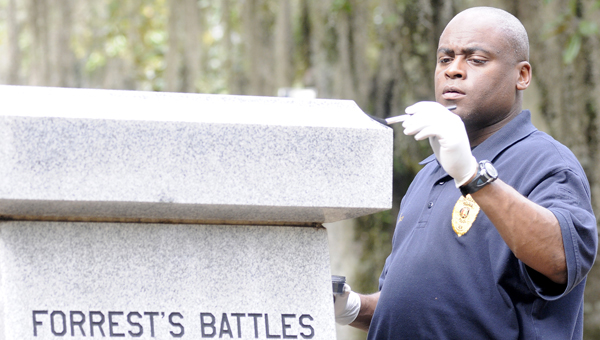
- A life-sized bust of Nathan Bedford Forrest was stolen last weekend from the Old Live Oak Cemetery in Selma, Alabama. Police reported no leads, and it’s unclear whether the Forrest monument was specifically targeted, or if the bronze was stolen for its metal value.
 Ron Wilson (right), a coin and precious metals dealer from South Carolina, is under investigation by the state for allegedly running a multimillion dollar Ponzi scheme involving the purchase of silver securities. Wilson, a former National Commander of the SCV, was one of the so-called hard-liners that came to prominence within that organization in the early 2000s, bent on a more aggressive, politically-engaged course for the group. Wilson remains prominent in local Confederate heritage circles, and apparently hawked his dubious investments among his butternut friends. Wilson has a history of skeevy business dealings dating back to his tenure as a local elected official, some of which involved steering favors to his SCV buddies.
- Also in South Carolina, State Senator Glenn McConnell has agreed to serve as that state’s Lieutenant Governor. McConnell has been invaluable in raising funds and public support for the recovery and conservation of the Confederate submarine H. L. Hunley, but he’s also caught grief for posing for some seriously ill-advised photos. Cartoonist Kate Salley Palmer wonders whether McConnell, who’s been a fixture in South Carolina state politics for decades, is really enthusiastic about relinquishing his senior post in the State Senate. John Courson, the new South Carolina Senate Pro Tem, was (with McConnell) one of the Senate Republicans that negotiated the compromise by which the Confederate flag was removed from the State House in Columbia and placed at the Confederate memorial, where it remains today. (Update: the claim about Cleburne’s coat is being the one in which he was killed is in dispute, as noted in the comments below.)
- The coat worn by Confederate General Patrick Cleburne when he was killed at Franklin in November 1864 will be one of the centerpiece artifacts on display at the new Appomattox site of the Museum of the Confederacy. Cleburne is, after Jackson, Lee and Forrest, probably the most-celebrated Confederate general officer today, but his prominence at the museum is being overshadowed by the controversy surrounding that institution’s decision not to fly a Confederate flag out front.
- Cole Grinnell has a great new blog post up at the Civil War Monitor, “How I tried and failed to escape the Civil War.”
- Finally, ninety-two year-old Pete Seeger sings (what else?) “Forever Young,” part of an album celebrating Bob Dylan’s 50-year career. More about the song here.
___________
Image: Sgt. Tori Neeley with the Selma Police Department dusts the top of the Nathan Bedford Forrest Monument for fingerprints Monday after a large, bronze bust of Bedford was discovered missing. — Tim Reeves, Selma Times-Journal.
Happy St. Patrick’s Day

Detail of “Sons of Erin,” by Don Troiani. Father Corby rides across the advancing line of the Irish Brigade at Sharpsburg.

On a day when everyone’s just a little Irish, the Very Rev. Dr. Stephen Duncan of Galveston is marching in New York:
Next weekend I will travel to New York City and march with my Civil War re-enactment group the 69th New York State Volunteers Historical Society as a part of the famous Irish Brigade from the Civil War. This unit traditionally leads the St. Patrick’s Day Parade in New York and this year will be in two of the parades — one for the old Cathedral and the other, larger parade in the afternoon.
The men of the Irish Brigade and their chaplain, Father Corby, helped change the perception of Americans about the Irish.
During the Civil War, many Irish immigrants and Irish Americans enlisted and served with distinction on both sides. There were more Irish serving in Union blue, but there were significant numbers with the harp of Erin under the gray.
Many had joined as members of the Fenian Society. They were determined to gain experience in modern warfare so they could return to Ireland and free it from the yoke of England.
Their fathers and grandfathers had served in the last Irish rebellion and many had fallen on Vinegar Hill.
In the end, the fact that England tacitly supported the South by continuing to buy cotton and sell supplies fueled the fervor of the Irish love for the Union and the freedom it represented for Ireland.
It was how well the Irish performed their duties as soldiers that got the attention of the (non-Irish) American officers.
The Irish as a unit were fearless in battle. They did what they were told even in the face of insurmountable odds, such as at Fredericksburg.
The soldiers closest to the Confederate lines at the end of that dreadful battle wore the green sprig of boxwood in their kepis — reminders of the green of Ireland that Gen. Meagher had asked them to wear as they marched off to the strains of the Garryowen.
At Gettysburg, Father Corby, later president of the University of Notre Dame, climbed on a rock and asked the unit to kneel to receive general absolution before the battle.
The men dropped to their knees, their hats off in prayer. He exhorted them to do their duty and to make a full confession later if they were able and then pronounced the Latin words absolving them of their sins.
The non-Catholic officers nearby were impressed. Certainly this was not the first time general absolution had been given on an American battlefield, but something about the men of the Irish Brigade, en masse, going to their knees in prayer affected the Union officers greatly.
It began a notice that these Irish Catholics were somehow more human, more God-fearing, more American and more like themselves than they had been told all their lives.
Though there were terrible losses, the unit continued through the entire war.
After the Civil War, many of the young soldiers followed Father Corby back to Notre Dame where they became students and loaned their moniker “the Fighting Irish” to that French-founded University de Notre Dame du Lac (founded by the Holy Cross Fathers from France).
To this day, Notre Dame is a symbol of Ireland and Catholicism here in the United States — more than a great football team, more than a fantastic school — a place where the Irish in America found their home.
I think it is a good thing indeed that on every St. Patrick’s Day everyone is at least a wee bit Irish. Erin Go Braugh.
_____________

Virginia Flaggers, Manufactured Outrage and the UDC

The hot new topic this week in Confederate Heritage™ is an incident that happened last Saturday in Richmond, where the Virginia Flaggers, a group that protests perceived slights to the Confederate flag, was put off the property of the national headquarters of the United Daughters of the Confederacy, with the assistance of local law enforcement. You can watch a video of part of that encounter, above.
The video went viral on the Internet machine, as the kids say these days, among Confederate Heritage groups, spurred on by posts by folks like Billy Bearden and Mark Vogl. It prompted the vitriolic hyperbole one has learned to expect from such quarters, including comments like these, posted at the Southern War Room:
the guardians embrace treason
The South has been betrayed by her very daughters, the United Daughters of the Confederacy!
Sucking the breast of the PC crowd!
Well for me, they have Sold Their Soul To The Devil, they are Traitors Of The Highest Measure…
Maybe we could convince the UDC chapters to secede from the National Chapter.
If it sleeps with the enemy, acts like enemy, talks like the enemy…. It IS the enemy!
The SCV National & your camp…. Should have their hands around the necks of those that don’t up-hold the charge.
And of course, there’s the casual, sort-of-joking-but-maybe-not-really reference to lynching:
Well, we all knew what the founders did to treasonous leaders……..there was usually rope involved. The founding fathers would roll in they’re graves if they could see what we’ve allowed. Please understand I’m talking about federal leaders…..but some of our UDC are giving in to liberals and their ideas.
While Bearden, who argues that the UDC leadership are trying to “sell out their birthright!!,” claims to have witnessed the incident himself, he leaves no hint that Saturday’s confrontation has been one brewing for months, and one that went entirely according to script, at least from the perspective of the Flaggers. In fact, none of the righteous outrage over this incident acknowledges that was a long time coming, and in fact was set up by the Virginia Flaggers themselves — or at least one of the group’s leaders — knowing full well that they would be removed from the property by the police.
On Wednesday, UDC President-General Martha Rogers Van Schaick posted a lengthy response to the allegations being made by the Flaggers, including a detailed chronology of the UDC’s interactions with Susan Hathaway of the Virginia Flaggers, going back to late 2011. Van Schaick’s account makes it clear that the UDC had repeatedly declined to participate in, endorse or host any of the Flagger’s activities. Hathaway subsequently acknlowledged that “the account in the the statement today by Mrs. Van Schaick, with a few minor exceptions, is accurate, and in fact, is almost exactly as has been previously reported.” But she didn’t specify what her “few minor exceptions” were, so we’re left with is President General Van Schaick’s account as the only detailed description of the events leading up to Saturday. It’s long, but worth reading in detail:
On December 14, 2011, an email was received from Ms. Susan Hathaway by the UDC Office Manager requesting that the VA Flaggers be allowed to use two flag poles outside the UDC Memorial Building to fly one Confederate Battle Flag on each. The email was forwarded to me for action.
On December 26, 2011, I responded to Ms. Hathaway advising that Pelham Chapel is not a UDC memorial and that our involvement in this issue could be construed as a ‘political activity’ that would possibly put our 501(c)(3) tax-exempt status at risk. I further advised that our Bylaws prevent our involvement in ‘political activity’ and for that reason; the UDC was unable to allow the use of the flag poles located on the front of our UDC Memorial Building. I reminded her that the First National Flag flies daily in front of the UDC Memorial Building in perpetual honor of our Confederate ancestors.
On Wednesday afternoon, March 7, 2012, Ms. Hathaway came to our building and asked to speak with me. Mrs. Lucy Steele, Chairman of the Memorial Building Board of Trustees (who was in the building on other business) and I met with Ms. Hathaway. The request was that they be allowed to ‘gather’ on the front of our property. She was advised that we would not allow that.
The request was then made to allow them to ‘gather’ on the back corner of our property. Mrs. Steele pointed out that the property at the back corner belonged to VMFA but that we did not have a problem with it but she would have to seek approval from VMFA.
Ms. Hathaway then asked if the “No Trespassing” signs that had been posted recently were because of them and if they gathered on our property would the police be called. She was told that, as with any trespasser, we would call the police.
We explained to Ms. Hathaway that there have been instances of people sleeping under the bushes around the building. Recently during a work day, a man was seen crouching between the bushes and the building with binoculars which raised questions as to his intentions. The police were called at that time. “No Trespassing” signs were placed on our property in an effort to protect not only our building but our employees as they come and go, often times during early morning and evening hours.
On Saturday, March 10, 2012, during our Annual Spring Board Meeting, the VA Flaggers gathered on the sidewalk in front of the UDC Memorial Building. A short time later, they were observed leaning and perched on the cannons ignoring signs stating do not climb on the cannons. They then moved from the cannons to the steps leading to our building for a group photo. At this point, Mrs. Steele went out to ask them to move from the steps to the sidewalk – some moved immediately. Others remained on the steps. During this time, the Richmond City Police were called.
Reasonable people can disagree on whether or not the presence of the Virginia Flaggers on their property threatened the UDC’s tax-exempt, 501(c)(3) status. But whether on not the UDC had a good reason to reject the Flaggers is immaterial; they’re a private organization and they chose to do so. The bottom line remains: the UDC had (1) repeatedly denied the Flaggers authorization to use the UDC headquarters property, (2) explained that any such activity by the Flaggers would be considered trespassing, and (3) stated that such a circumstance would be handled according to the UDC’s usual practice, which is to call the Richmond Police Department. According to Van Schaick, Ms. Hathaway was told this in person at the UDC headquarters by herself and the Chairman of the Memorial Building Board of Trustees, Lucy Steele, on the Wednesday preceding the rally.
So, of course, the Flaggers went anyway. And the UDC did exactly what it said it would, which is to order them off the site and call the po-po. And then the Flaggers — without mentioning any of the events or discussions that had gone before — tossed it up on YouTube and various Southron social media sites. Dodging bullets…FROM BEHIND! The guardians embrace treason!
It was a set-up, staged and orchestrated to make the Virginia Flaggers look like victims of PC oppression. It’s ludicrous. Oh, there are victims here, but they ain’t the Virginia Flaggers; they are President General Van Schaick, Chairman Steele, and other members of the UDC leadership who’ve made clear their unwillingness to get dragged into the dispute over the Pelham Chapel next door, and for their troubles have now been framed by the self-appointed Defenders of Southron Heritage™ as traitors to the memory of their Confederate ancestors, and made the target of “jokes” about lynching.

I haven’t posted much about the Virginia Flaggers, because until recently I was ambivalent about them. I like the idea of peaceful protest; in general, it’s a healthy thing. It’s small-d democracy in action. While I think the Flaggers are wrong about Lexington, I’ve also thought they had a legitimate case to make for the Pelham Chapel.
But they’ve also proved to be mendacious and dishonest in promoting their efforts, eager to depict themselves as victims, and constantly trying to stir the pot. Take this video from last fall on their YouTube channel, for example, titled “Black woman attacked for carrying Confederate Flag.” What “attack” are they referring to? The passerby on the street engages another Flagger, Karen Cooper, in a discussion about their protest. There’s no shouting, no name-calling; no one gets all in anyone else’s face — where’s the “attack,” exactly? It’s dishonest, self-serving navel-gazing, in which the True Southrons™ are always the victims. “Attacked,” really?
Then there’s this video, “Va Flagger Tossed off State Property at VMFA for Carrying “That” Flag! 2-18-2012,” where Flagger Jimmy Jones is set up to confront a security guard at the Virginia Museum of Fine Arts, the main target of the Flaggers. The video is shot from a distance, but — by remarkable and fortuitous coincidence — Jones is wearing a mic to catch the dialogue with the guard. Perhaps the Flaggers were looking to record the security guard saying something incendiary, but the best they got was him saying, “because I said so.” Now there’s an outrage for you!
And now we have this foolishness with the UDC. Hathaway claims she wasn’t looking to pick a fight with the UDC, and I doubt she’ll get one — if for no other reason, because the leadership of the UDC has consistently sought to avoid getting dragged into the rough-and-tumble over display of the Confederate Battle Flag, as is their right. The UDC had made their position very clear, well in advance. So why deliberately force a confrontation? Perhaps posing in front of the UDC headquarters was perceived as a win-win; if the UDC did nothing, the image might imply UDC support of the Flaggers; if the UDC had them removed from the premises (as warned, and as actually happened), the Daughters could be depicted as the unreasonable aggressors in the incident, arbitrarily bringing down the boot heel of the PC police (literally, police) on innocent protesters, just out to display their pride in their Confederate heritage. And of course, that latter narrative is exactly how the Flaggers ended up depicting it. It’s a spiteful, manipulative and cynical approach, but it works, at least for folks who aren’t paying attention.
Of course, that narrative only works when listener doesn’t know the long backstory of the discussions and communication that went on before last Saturday. President General Van Schaick managed to put the lie to that narrative when she provided the actual context of Saturday’s event, a context that Hathaway acknowledged is “with a few minor exceptions. . . accurate.” If the Virginia Flaggers — or rather, the leadership of the Virginia Flaggers — set out to make the UDC look bad, they only ended up making themselves look shrill and desperate. Somehow, I think the United Daughters of the Confederacy will survive.
If the Virginia Flaggers, and the larger Confederate heritage movement, really believed themselves to be under siege, they’d be trying to build alliances with others, not seek conflict with them. They’d look to find common ground with folks like the United Daughters of the Confederacy, and the Museum of the Confederacy, and all the rest. But they don’t because, at some deeper level, folks like Martha Van Schaick, Waite Rawls and the rest are more useful as exaggerated, cartoon-like enemies, a common foe against whom the true believers can unite in shared resentment and carefully-stoked outrage. Even in the short time I’ve observed it, it’s clear that the Confederate heritage movement defines itself as much or more by whom they oppose, as by what they believe. It’s an ever-tightening spiral of anger and bile, and it won’t result in any positive outcome; it puts off people more than it attracts. It’s an approach that unites them, but also increasingly isolates them from the rest of American society — Southerners, Civil War buffs, the general public, everybody — and that’s a dead-end road. These folks may feel like they’re circling the wagons, but increasingly it looks like they’re circling the drain.
___________






7 comments