The Black Confederate Who Stole the Steamboat Planter
In my post about Robert Smalls and the “abduction” of the Confederate steamer Planter the other day, I overlooked the last two grafs of the Harper’s Weekly story which, line-for-line, may be the most interesting of the piece:
Our correspondent sends us a drawing of an infernal machine [i.e., a mine], drawn by one of the negro hands of the Planter named Morrison. This chattel, Morrison, gives the following account of himself:
Belonged to Emile Poinchignon [Poincignen]; by trade a tinsmith and plumber; has lived all his life in Charleston; was drum-major of the first regiment of the Fourth Brigade South Carolina Militia, and paraded on the 25th of last month; has a wife and two children in Montgomery, Alabama, whom he expects to see when the war is over. I asked him how he learned to read and write. Answer: “I stole it in the night, Sir.”
Okay, okay. Calling William Morrison a “black Confederate” seems pretty silly under the circumstances. But William Morrison must, in some ways, capture all the complexities of of the situation of many African American men in the Confederacy during the war. Through his trade as a craftsman, Morrison probably enjoyed better circumstances than the majority of enslaved persons in the South, but he remained bound by the system. He suffered from a long, distant absence from his wife and children — no doubt an involuntary one. He learned to read and write not through the efforts of a kind and paternal master, but secretly, though his own initiative — “I stole it in the night.” And when he saw the opportunity to steal himself from his master, he didn’t just run off, but did so in a way that would cause the largest possible damage and embarrassment on the Confederacy, in a way that would (not coincidentally) assure his own death if recaptured. And finally, when he did reach the Federal blockading fleet, he shared with them intelligence about Charleston’s harbor defenses: a mine that, by virtue of his skills as a tinsmith and plumber, he may have actually helped assemble with his own hands.
William Morrison was neither a “happy Negro,” nor a “faithful slave.” Next time someone points to a vague reference to an African American musician or otherwise connected to the Confederate military, and then waxes eloquent about that as evidence of black Confederates fighting for home and hearth against the Yankee invader, etc., etc., ask them about William Morrison of the steamboat Planter.
________________Image: Detail of the print, “Heroes in Ebony — The captors of the Rebel steamer Planter, Robert Small, W. Morrison, A. Gradine and John Small.” Library of Congress.


C.S.S. Georgia to be Excavated


Good news on the nautical archaeology front, in that the wreck of C.S.S. Georgia, and ironclad battery deployed to protect the city of Savannah, will be excavated and preserved as part of the $653M harbor improvement program. The cost of the excavation and conservation is estimated to be around $14M, or just over 2% of the total project cost.
Georgia was originally intended as an ironclad warship, but a lack of suitable powerplant — the bane of Confederate casemate ironclads from Virginia on — resulted in her being moored as a floating battery instead. In twenty months of service she never fired a shot in anger, but would have been a formidable opponent had the Union navy tried to force the port as they did at Charleston, Mobile, and elsewhere. The battery was scuttled by her crew just before Christmas 1864 just as Sherman was poised to seize the city at the end of his “March to the Sea.” You can read more about C.S.S. Georgia here.

Location of the wreck of C.S.S. Georgia (gold ring), opposite Old Fort Jackson.


Photo by Mike Stroud (via To the Sound of the Guns) of a 32-pound banded rifle recovered from the wreck of C.S.S. Georgia, displayed on a reproduction carriage at Fort Jackson.
I saw a comment about this story in which someone snarked, “the Confederate Navy still continues to hinder the US Navy.” Funny, but inaccurate, as the U.S. Navy (through the Naval Historical Center) generally provides a lot of encouragement and guidance when it comes to wrecks like this. (All former Confederate government property transferred to the United States at the end of the war, so former Confederate vessels like Georgia and the famous C.S.S. Alabama are now considered U.S. Navy property, and under their stewardship.) The problem is, the Navy doesn’t have the resources to undertake expensive work like this, and has to rely on other agencies that do have budgets for them, to get the actual work done.
It’s also worth noting that the reason this work is being undertaken at all is because of federal laws that require investigation, assessment, and (in some cases) archaeological recovery of significant historical/cultural material that lies on public land, that would be disturbed or destroyed by development or construction. Most states have similar laws. What will be done in this case is very much like the U.S.S. Westfield Project in Texas, although (I gather) with a bigger budget and the prospect of recovering significant parts of the ship’s structure intact. Without those preservation laws, wrecks like C.S.S. Georgia would’ve been reduced to soggy toothpicks by dredging many years since.
____________
Image: (top) Naval Historical Center; (bottom) 32-pounder image by Mike Stroud, via To the Sound of the Guns
Why Movies Are More Gooder Than Reality

My favorite scene in the 1993 film Gettysburg is this one, where Hood rides to General Longstreet, his corps commander, to protest the order to make a frontal assault on Little Round Top. It’s brief, direct, and poignant; the way the dialogue is framed, even someone who knows nothing about Gettysburg understands immediately that the attack is doomed to fail. It perfectly encapsulates the conflict between the generals; too bad that encounter never happened.
At least, it didn’t happen the way it’s depicted in the movie, which is widely heralded in some quarters as being particularly faithful to the historical record. There’s no question that Hood protested his orders to make a frontal assault on the Federal position, and reluctantly complied with his orders, but the details of how that exchange came about are considerably different, as reported by three officers who were there.
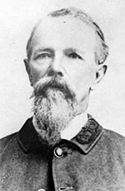 Here is Evander M. Law’s (1836-1920, right) account of the event, from his article, “‘Round Top’ and the Confederate Right at Gettysburg,” published in the December 1886 issue of The Century Magazine. At the time, Law commanded the Alabama Brigade in Hood’s Division, and succeeded to command of the division when Hood was wounded early in the action:
I found General Hood on the ridge where his line had been formed, communicated to him the information I had obtained, and pointed out the ease with which a movement by the right flank might be made. He coincided fully in my views, but said that his orders were positive to attack in front, as soon as the left of the corps should get into position. I therefore entered a formal protest against a direct attack. . . .
General Hood called up Captain Hamilton, of his staff, and requested me to repeat the protest to him, and the grounds on which it was made. He then directed Captain Hamilton to find General Longstreet as quickly as possible and deliver the protest, and to say to him that he (Hood) indorsed it fully. Hamilton rode off at once, but in about ten minutes returned, accompanied by a staff-officer of General Longstreet, who said to General Hood, in my hearing, ” General Longstreet orders that you begin the attack at once.” Hood turned to me and merely said, ” You hear the order ? ” I at once moved my brigade to the assault. I do not know whether the protest ever reached General Lee. From the brief interval that elapsed between the time it was sent to General Longstreet and the receipt of the order to begin the attack, I am inclined to think it did not. General Longstreet has since said that he repeatedly advised against a front attack and suggested a movement by our right flank. He may have thought, after the rejection of this advice by General Lee, that it was useless to press the matter further.
Just here the battle of Gettysburg was lost to the Confederate arms.
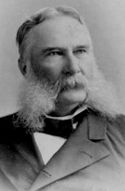 In his own account, James Longstreet (1821-1904) acknowledges Hood’s appeals not to go forward with the attack as planned, but also suggests that even when the matter was decided, Hood dragged his feet in executing it:
Hood’s division was in two lines, Law’s and Robertson’s brigades in front, G. T. Anderson’s and Benning’s in the second line. The batteries were with the divisions, four to the division. One of G. T. Anderson’s regiments was put on picket down the Emmitsburg road. General Hood appealed again and again for the move to the right, but, to give more confidence to his attack, he was reminded that the move to the right had been carefully considered by our chief and rejected in favor of his present orders. . . .
Prompt to the order the combat opened, followed by artillery of the other corps, and our artillerists measured up to the better metal of the enemy by vigilant work. Hood’s lines were not yet ready. After a little practice by the artillery, he was properly adjusted and ordered to bear down upon the enemy’s left, but he was not prompt, and the order was repeated before he would strike down.
In his usual gallant style he led his troops through the rocky fastnesses against the strong lines of his earnest adversary, and encountered battle that called for all of his power and skill. The enemy was tenacious of his strong ground ; his skilfully-handled batteries swept through the passes between the rocks ; the more deadly fire of infantry concentrated as our men bore upon the angle of the enemy’s line and stemmed the fiercest onset, until it became necessary to shorten their work by a desperate charge. This pressing struggle and the cross-fire of our batteries broke in the salient angle, but the thickening fire, as the angle was pressed back, hurt Hood’s left and held him in steady fight. His right brigade was drawn towards Round Top by the heavy fire pouring from that quarter, Benning’s brigade was pressed to the thickening line at the angle, and G. T. Anderson’s was put in support of the battle growing against Hood’s right.
There’s no mention in either Law’s or Longstreet’s accounts of the two men arguing the matter face-to-face.
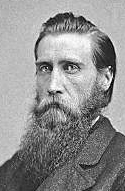 Division commander John Bell Hood (1831-79), in his posthumously-published memoir, gave this version of events, recounted in a letter he’d written to Longstreet a decade after the conflict:
A third time I despatched one of my staff [to Longstreet] to explain fully in regard to the situation, and suggest that you had better come and look for yourself. I selected, in this instance, my adjutant-general, Colonel Harry Sellers, whom you know to be not only an officer of great courage, but also of marked ability. Colonel Sellers returned with the same message, ‘General Lee’s orders are to attack up the Emmetsburg road.’ Almost simultaneously. Colonel Fairfax, of your staff, rode up and repeated the above orders.
After this urgent protest against entering the battle at Gettysburg, according to instructions — which protest is the first and only one I ever made during my entire military career — I ordered my line to advance and make the assault.
As my troops were moving forward, you [Longstreet] rode up in person; a brief conversation passed between us, during which I again expressed the fears above mentioned, and regret at not being allowed to attack in flank around Round Top. You answered to this effect, ‘ We must obey the orders of General Lee.’ I then rode forward with my line under a heavy fire. In about twenty minutes, after reaching the peach orchard, I was severely wounded in the arm, and borne from the field.
Hood’s account is the earliest of the three, and closest to the scene in the film. But while it does recount a face-to-face meeting between him and Longstreet, it differs from the movie encounter in two critical aspects. First, Hood makes it clear that it was Longstreet who came to him, not the other way around. More important, when they did meet, the issue had already been decided, and Hood’s Division was already advancing. At this point, the decision to commit his troops to a frontal assault was final — “I again expressed the fears above mentioned, and regret at not being allowed to attack in flank around Round Top.” Like Law, Hood says his formal protest was made through staff officers earlier, not directly to Longstreet himself, and there’s no suggestion that when they did met, their exchange was anywhere near as heated as depicted in the movie.
So what really happened? All three accounts are pretty consistent, given the passage of years, and none has Hood riding over to his corps commander to make his plea in person. (Indeed, to have absented himself from his division to do so during a battle, in fact, might have been seen as dereliction; generals are surrounded by staff officers and couriers for just that purpose.) If the two discussed it at all in person, as Hood describes, it was after the matter had already been settled and his division’s regiments were on the move.
Kevin has mentioned before how another important Civil War film, Glory, both highlighted and badly over-simplified the “pay crisis” that enveloped the 54th Massachusetts and other early black regiments. Virtually all films of that sort have to simplify events, compress timelines and (sometimes) create composite characters to advance the story at a regular pace, and help the audience follow the plot. It’s just a fact of story-telling on film.
I don’t especially fault Ron Maxwell, who both directed Gettysburg and wrote the screenplay, for handling this part of the story, in this way. It neatly, and dramatically, encapsulates the real-life conflict between Old Pete and Sam Hood in a way that more-historically-accurate shots of staff officers galloping back and forth across the Pennsylvania countryside could never achieve. It’s more effective storytelling, and it accurately reflects the positions of the principals. But even when, as in this case, it speaks to a larger truth, one should never confuse it with the truth.
And I still love that scene.
__________

LoS President: Democracy Only Works When White Folks Run Things
You’ve got to appreciate the candor of J. Michael Hill, founder, president, and self-described “big chief” of the League of the South; he leaves no one in doubt about what really matters to him:
Majority rule only works where there is already a consensus of sorts on the fundamental issues within a particular society. For instance, in a Christian nation that enjoys a high degree of homogeneity in its racial and ethnic make-up, language, institutions, and inherited culture, most matters up for a vote are largely superficial policy issues. They don’t tamper with the agreed-upon foundations of the society. However, in a multicultural and multiracial polyglot Empire such as ours is today, the concept of majority rule is often fraught with dire (and even deadly) consequences for the losers, especially if the winners bear a grudge. As I write in 2012, there are projections that these United States—and our beloved Southland–will have a white minority by 2040 (or before, depending on immigration policy). Simply put, that will mean the end of society as we know it. You and Bill Clinton may be OK with this, but I’m not. Who stands to lose by this devil’s bargain? The descendants of America’s founding stock will be the losers. As a native white Southerner, I’m primarily concerned about the future of the South. Our ancestors bequeathed us a republican society based on Christian moral principles, the English language, racial (and some degree of ethnic) homogeneity, and British legal and political institutions. All this will be gone with the wind if we don’t stand as united white Southerners against the unholy leftist trinity of “tolerance, diversity, and multiculturalism.”

To be sure, this line of argument is nothing new coming from Hill; this essay dates back to 2007 (at least), with only a few slight edits. It’s not a gaffe, a one-off, but rather suggestive of a thought-out, stable perspective on Hill’s part. It’s policy, and an idea he’s expressed before:
We are already at war—we just don’t know it. One instance: Immigration. This is not just a matter of policy. It’s a matter of our very survival as white men and women of European Christian stock on this land we call the South. It is a zero sum game—we win or they win. There is no middle ground for compromise. Losing means that my grandchildren will grow up in a third world country. Multiculturalism and diversity means “we” cease to exist as a viable and prosperous people.

You have to wonder what Hill sees as the role and voice for African Americans and others is in his vision of an independent South is; some of those folks undoubtedly have families that trace back as far as Hill’s does, regardless of how they came to be there. (And note, as Will Rogers used to say, “some of them were there to meet the boat.”) What is their voice, their political agency in the “Free South” Hill and the League of the South envision? Sure, there will always be a place for highly-paid entertainers, fluffing people like Hill and assuring them how grateful black folks ought to be for helping them when the Supreme Court forced Jim Crow on the South, but what about everybody else?
Honesty can be invigorating, even when it’s unpleasant — like getting a cold bucket of water dumped on you. For all the discussion of abstract concepts like liberty and freedom, Hill’s core concern is, explicitly, about maintaining and preserving white power — political, cultural and social. His candor should be welcomed; it’s always good to know exactly where he and the League of the South stand, and what they stand for.
_______________

Come On, Texas!


On Saturday I had the opportunity to take a “hard-hat” tour of U.S.S. Texas (BB-35), which is preserved as a museum ship at the San Jacinto Battleground, near Houston. She’s one-of-a-kind, the last dreadnought battleship from the first great arms race of the 20th century. The tour was arranged by my colleague, Amy Borgens, for the benefit of the Marine Archaeological Stewards group. The tour was led by Ship Manager Andy Smith and the ship’s Curator, Travis Davis. There’s not very much about Texas that one or the other of those men doesn’t know.
It was quite remarkable, and I would urge anyone with a particular interest in technology or maritime history to take a similar tour if you can. Though the focus was mostly on the technology of the ship — structure, fittings and operation –there were quite a few very human touches, like personal locker whose owner had made a careful running account, inside the door, of all the other Texas sailors who owed him money. It was a long list. One of our group, a Navy veteran himself, commented that “there’s a guy like that in every division.”
The ship desperately needs a major overhaul and rebuilding of specific areas. There’s a significant amount of money set aside for this work already, but it’s not likely to be enough given the scale of the task, and plans are still being made to see how best to tackle the ship’s restoration and preservation with the resources available. As Ship Manager Andy Smith explained, it’s a bit of a chicken-and-egg problem. It’s hard to raise money without very concrete, specific plans as to how you’re going to spend it; at the same time, though, it’s hard to make detailed and pragmatic plans if you don’t know how much money you’re going to have to work with.
“Come on, Texas!” was a cheer her sailors used when rooting for their messmates in athletic competitions with other ships in the fleet, and it seems appropriate for this stage in the ship’s life, as well. In a few days, on May 18, 2012, U.S.S. Texas will mark her 100th birthday. Here’s hoping she’s still around for her 200th.

This diagram shows the locations appearing in the following images, roughly in order from aft (left), moving forward. More pictures after the jump:
Was Confederate Conscription an Instrument of Social Justice?
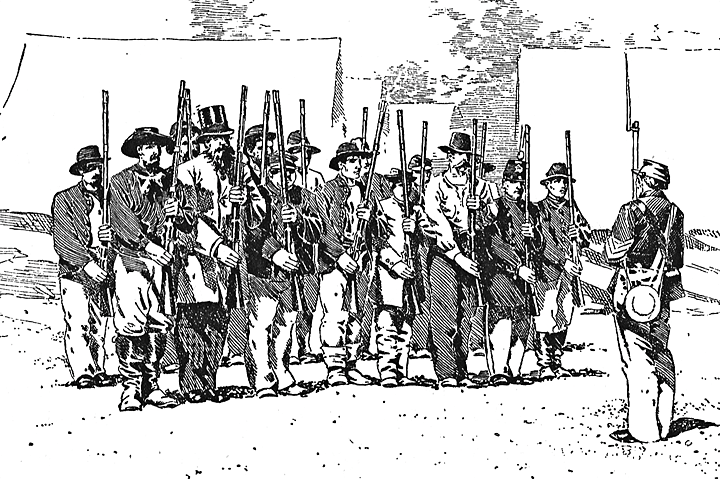
Was the Confederate Conscription Act what we today might describe as an instrument of social justice? Over at the Civil War Monitor, I point out that some Confederates at the time thought so. The money quote:
Equal burthens and equal benefits is a cardinal principal in American liberty.
_____________
Image: “The Awkward Squad” by Walton Taber.

Canister!
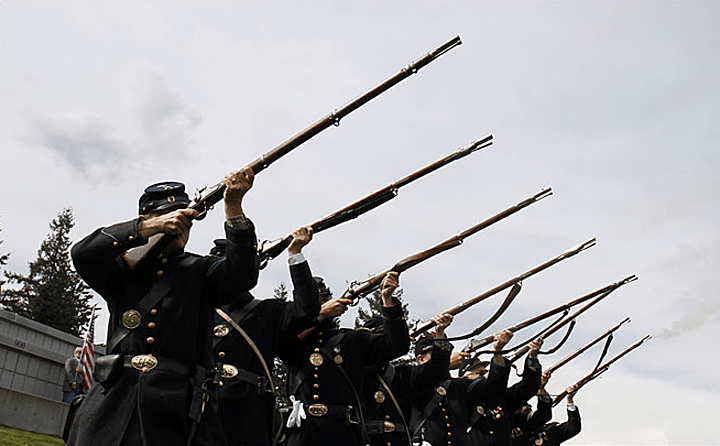

I apologize for the recent lack of substantive posts here; I’ve been focusing on other historical work lately. Still, there’s plenty going on out there worth noting.
- Last weekend a formal military funeral (above) was held in Portland, Oregon for former Union soldier Peter Knapp and his wife, Georgianna. For reasons now unknown, the Knapps were cremated but their ashes went unclaimed until a modern researcher, Debbie Peevyhouse, learned of them. Knapp enlisted in Company H, 5th Iowa Volunteer Infantry in July 1861 and saw action in numerous battles, including Iuka, Shiloh and Vicksburg. He was later taken prisoner, and confined at Andersonville. Ms. Peevyhouse organized a formal interment for the Knapps at the Willamette National Cemetery, but is unhappy that the facility, which opened in 1950, uses flat headstones instead of the upright stones normally used for Civil War Veterans. She’s done well by Mr. Knapp’s memory — the ceremony really was an impressive thing — but making an issue out of the form of headstone is not really constructive.
- I’ve seen people try to donate some weird stuff to museums, but (thankfully) I never had to deal with something like this.
- Speaking of the National Museum of Civil War Medicine, they’re going to be opening a satellite museum in the office Clara Barton used in Washington during her efforts to locate and identify missing soldiers after the war. No word whether the museum will follow Dixie Outfitters’ lead and describe Barton as a “Confederate heroine.”
 The Charleston Post & Courier has a neat article on the conservation of the lantern found in the wreck of the Confederate submersible H. L. Hunley. The lantern has been a subject of ongoing interest because one of the Union survivors of Hunley‘s attack on U.S.S. Housatonic reported seeing a blue light, possibly intended as a signal, about an hour after the attack. If that blue light came from Hunley, it would be an important datum point in reconstructing the timeline of the attack and the sinking of the Confederate boat. Unfortunately, it’s still not clear whether this particular lamp (right) was the source of such a light.
- Former SCV Texas Division Deputy Commander Mark Vogl continues his stream-of-consciouness burbling, this time in a paean to Confederate Memorial Day. He talks a bit about the the Federal occupation of Galveston in the fall of 1862 and its subsequent recapture on New Years Day, 1863, by forces under the command of John Bankhead Magruder. There’s much in Vogl’s piece that I could take issue with, but I’ll limit myself to suggesting that he start by correctly spelling the name of the Confederate general he’s supposedly honoring. Given the vague assertions and simplistic bromides of his Confederate Memorial Day speech, students enrolling in Vogl’s Confederate War College may want to check on its refund policy.
- Note to CW reenactors out there: if you’re going to give a guest lecture to a college history class, better check in with campus police first.
- Also in reenacting news, Santa Anna is retiring after going 0-and-10 at San Jacinto. I think it’s rigged.
- An old friend of this blog, Valerie Protopapas, was recently honored by the new Copperhead Society, an organization for non-Southerners who nonetheless “have made significant contributions to Liberty, and Confederate heritage.” Protopapas was selected for her “her fearless and strident essays and writing in defense of liberty, historical truth and the Confederate cause.“ Undoubtedly it was her insightful suggestion that NASCAR drivers “do something else in those cars” to attract African American fans, or comparing Lincoln to Hitler, or arguing that freedmen were like six-year-old children, or maybe it was calling me a Trotskyite, that allowed her to edge out fellow New Yorker “Wild Bill” Vallante for the inaugural award.
- A few weeks ago the New York Times ran an article on new research by J. David Hacker, suggesting that the long-accepted figure of about 620,000 dead from the war was far too low; a more accurate number is somewhere around 750,000. But historian James Downs of Connecticut College, an author on the impact of disease on African Americans during the war and in the decade after, argues that even these newer numbers are too low, because they overlook the deaths of many tens of thousands of black laborers, slaves and civilians, on both sides of the conflict.
- And finally, the odious Kirk Lyons has started a new business, selling SCV uniforms patterned after those worn by UCV members a century ago. That’s a really interesting idea, and they don’t look half bad.
Anything I missed? Put it in the comments.
___________Images: (top) Soldiers in Civil War Union uniforms fire a salute during the military funeral for Civil War veteran Peter Knapp at Willamette National Cemetery in Portland, Ore., Friday, April 13, 2012. Knapp is the first Civil War veteran buried at Willamette National Cemetery, Oregon’s largest veterans’ cemetery. His ashes had been sitting on a shelf at the Portland Crematorium since 1924. (AP Photo/Don Ryan); Hunley lamp, Tyrone Walker/postandcourier.com.

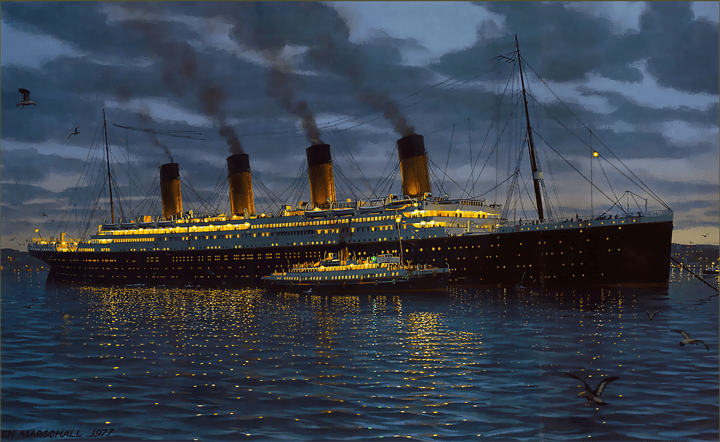
Did a C.S.S. Alabama Crew Member Die in the Titanic Disaster?

__________
Image: Titanic at Cherbourg on the evening of April 10, 1912. Original painting by Ken Marschall, 1977.

Was Lincoln a Flip-Flopper?
 Tuesday morning NPR had an interesting segment on David Hebert Donald’s Lincoln, the first in a new series of interviews that discuss presidents from the past in the context of the 2012 presidential campaign. Participating in the discussion were three other prominent Lincoln biographers, Eric Foner (right), Doris Kearns Goodwin, and Andy Ferguson. As you might guess, with those panelists the discussion was less about Donald’s work than it was about those three making the key points they wanted to make — which is just fine with me. You can listen to the piece here, or read the transcript here.
I particularly liked this exchange between the interviewer, Steve Inskeep, and Eric Foner, whose book on Lincoln and the question of slavery, The Fiery Trial, won the 2011 Pulitzer Prize in History:
INSKEEP: If it were up to you, each of you, if you were presidential speechwriters, how would you want candidates to think of Lincoln, deploy Lincoln when they’re talking about him today? FONER: You know, I would love to see a candidate – I don’t care which party we’re talking about – forthrightly say: I have changed my mind about this. That’s what Lincoln did during the Civil War. He changed his mind over and over again. He didn’t change his core beliefs. Lincoln was a flip-flopper, if you want to use the terminology of modern politics. But we don’t seem to allow our politicians to do that anymore. INSKEEP: Andrew Ferguson, you’re smiling. FERGUSON: It’s partly because politicians won’t let their speechwriters talk that way. I don’t think that Dr. Foner should wait for a phone call from any political campaign because… FONER: I’m not holding my breath.
I get what Foner’s saying, but he does his own scholarship a serious disservice by labeling Lincoln “a flip-flopper.” Lincoln knew his own mind, and was from early adulthood (if not earlier) opposed to slavery, personally. That never changed. But neither was it a priority for him as a public official, either. He was not, regardless of how he was depicted by the fire-eaters in the run-up to the 1860 election, a secret abolitionist bent on overturning the institution where it already existed. He himself held attitudes and spoke in terms that would be deeply offensive today. He told an occasional “darkey” joke. He explained once that, in his view, whites and African Americans could not peaceably live together. He considered any number of schemes in considering the “Negro problem,” including voluntary recolonization to Africa. (Colonization was an idea, one should note, that long pre-dated Lincoln and long survived him, as well.)
Confederate apologists often point to these ugly examples and say, “Lincoln believed so-and-so, ” or “Lincoln said such-and-such.” They do this reflexively, as a means of deflecting criticism of slavery in the the South. Such mentions of Lincoln are often narrowly true, but they miss the larger, and much more important, truth that lies at the core of Foner’s (and many others’) work, which is that Lincoln himself changed and grew over time. The president who told “darkey” jokes also had Frederick Douglass as a visitor to the White House in 1863, the first African American to enter that building not as a servant or laborer, but as a guest. The president who’d said he would be willing not to free a single slave if it would preserve the Union also asked Douglass, in the summer of 1864, to use his contacts to get as many slaves into Union lines as he could before that fall’s presidential election, which Lincoln fully expected to lose. The chief executive who had toyed with the idea of re-colonizing former slaves back to Africa publicly suggested, just days before his death, that suffrage should be extended to at least some freedmen, specifically those who’d served in the Union army.
I personally don’t have a lot of use for political flip-floppers, whose deeply-held convictions change according to the latest Rasmussen polls. But neither do I have a lot of use for those who are unwilling to learn, to grow, and to change their minds when the circumstances warrant. That latter group are the ideologues, and while they may shape the debate over public policy, they end up accomplishing very little themselves. Successful leaders are those who are able to distinguish between what they would prefer and what they can accomplish, and push hard for the latter. Idealism has its role, but pragmatism gets the job done. The perfect, the saying goes, must not be the enemy of the good.
Presidents don’t have the luxury of being all-or-nothing ideologues: not in 2012, or in 1862. They are expected to lead, but can only lead where the country — or at least a large part of the country — is willing to follow. Wholesale emancipation — regardless of how much Lincoln might or might not have wanted it at the time — was never a possibility in 1861. It was not a priority for Lincoln, nor was it a priority for the rest of the country. But by the third year of the conflict, it was an established war aim for the Union. Lincoln understood, as well, that his Emancipation Proclamation was a wartime expedient, a stop-gap measure that would not likely hold up once the conflict ended, so he backed the 13th Amendment, passed by the House of Representatives and Senate weeks before his own death.
Flip-floppers chose the positions they do because they believe those position will make them popular. And they do, for a time, before the public catches on to the fact that they’re being played. There are many words that might describe Lincoln during his presidency, but “widely popular” isn’t generally one of them. He might not have won the presidency in the first place had not some Southern states, including my own, kept him off the ballot altogether in 1860; he only took 55% of the popular vote in 1864, when an ultimate Union victory was clearly visible on the horizon. Lincoln probably would have been a far more popular and successful politician in his own day if he had paid more attention to public opinion, and chosen more popular positions. He would have had a much easier time of it, but American history would look very, very different. And not in a good way.
________________

Canister!


Small stories that don’t warrant larger posts all their own.
- The Civil War Trust has unveiled a pretty spectacular interactive module on the Battle of Shiloh. (h/t Kevin)
- The sesquicentennial brought a record number of visitors last year to the place where the shootin’ war started. Here’s hoping that trend continues across the country.
- SCV National Commander Michael Givens has a vision of ten thousand Flaggers protesting the VMFA. Given that the big 2012 Heritage Rally in Richmond a few weeks back attracted 300 to 400 participants, they have a ways yet to go.
- Along more practical lines, the local SCV camp in Augusta, Georgia put up a barrier to keep skateboarders off the monument on Broad Street. Seems like a good move.
- A symposium is set to discuss the Salisbury Confederate PoW camp site next Friday through Sunday in North Carolina. There will be presentations by historians and archaeologists, as well as memorial services on Sunday.
- In Pennsylvania, volunteers are more than halfway to their fundraising goal in an effort to restore 133 graves of Union veterans at the Chartiers Cemetery in Carnegie.
- Mark Vogl’s at it again, explaining how awesome the Confederate constitution was because it would have prevented the Wall Street bailout, and that the C.S. government was “concerned with fairness and providing opportunity to anyone willing to take it.” Or something.
- A while back, a city official in Charlottesville made a stupid suggestion about pulling down Confederate monuments. That, apparently, encouraged someone to tell that official’s child to “tell your mother that she’s a F’in whore and to get her F’in hands off our heritage.” Is this someone’s idea of defending Southron honor?
- Last month, I highlighted efforts to identify the remains of two men lost in the sinking of U.S.S. Monitor. Here, via C-SPAN, is a discussion of the project and those efforts.
- In somewhat related news, in Virginia there was a reenactment of the funeral of Midshipman William Christian Hutter, a snotty aboard C.S.S. Raleigh who was killed at the Battle of Hampton Roads on March 8, 1862.
- On May 18-27, the Masquerade Theatre group in Houston will perform the Tony-nominated musical The Civil War, drawn from letters, diaries, and firsthand accounts of the conflict. This will be a bit of a homecoming, as the show debuted in Houston in 1998 before it moved to Broadway.
- Google Earth users can click this link to download an 1864 map of Richmond, Virginia, from the OR Atlas. It doesn’t line up as neatly as I’d like, but I offer a money-back guarantee if not satisfied. Sorry, no refund without a receipt.
- And here’s one for Washington, D.C. in 1861. The alignment is a bit off toward the south, around Alexandria and Bailey’s Crossroads, but still fun to tinker with.
- Finally, I was happy to find the wartime picture (above) of Union tinclad No. 19, U.S.S. St. Clair, which was one of the first steamboats brought to Texas after the war. Her new civilian owners made a big deal of her features and amenities, but managed to avoid mentioning that she’d been a Yankee gunboat during the “late unpleasantness.”
Any more worthwhile stories out there? Put ’em in the comments.
____________
Image: Wilson’s Creek National Battlefield; WICR 31991.





8 comments