Texas Confederate Pension Files on Ancestry


As anticipated, the Texas State Library and Archives Commission’s Confederate pension records are now available online at the subscription genealogy website Ancestry.com. Hard copies will still be available for order as before but, in keeping with a policy change last fall, researchers will be notified of the cost and must send in their payments before the library staff will make the copies. The actual cost is still appallingly, scandalously low.
The correct section at Ancestry is difficult to find, and is not yet indexed in their military pensions catalog. Use this link to go directly to that section, and be sure to select Texas for the state, as below:

The page reproduced above is a more-or-less random example from the files. It’s an affidavit in support of the 1913 application of Mary Ann McKinney of Mesquite, Texas. Her late husband, Eli Harris McKinney, had served in the 17th Alabama Infantry, and to support her application she submitted this affidavit from two men from Alabama who testified that Eli “was a good soldier and served as such untill [sic.] the close of the war.” (Eli’s CSR, available through Fold3, shows him enlisting in September 1862 and being surrendered with Joe Johnston’s army in North Carolina in April 1865.) Eli had died in 1881, ten years after his marriage to Mary; she began receiving a pension in March 1914 and continued to receive it until her own death in Ranger, Texas in August 1922. Mary McKinney’s application also provides an important reminder about Confederate pensions: they were issued by the state in which the applicant lived, not the state he was born in, or of the unit in which he served.
The Texas State Library and Archives Commission had an efficient and inexpensive system for providing these materials before, but efforts to put these materials online (even on a paid subscription site) are really opening doors for both professional and avocational researchers. Records that used to take weeks or months to obtain by postal mail can now be retrieved in minutes. How damn cool is that?
____________

Minnesota City Councilman Weasels Out of “Redneck” CBF Fooferraw


That didn’t take long.
Ed Hansen, the West St. Paul City Council member who caught some flack over the weekend for flying a Confederate Battle Flag with the word “REDNECK” on it at his home, collapsed like a dollar-store lawn chair when faced with his constituents at a council meeting Monday night. Of course, he didn’t admit he’d made a mistake, and instead went off on a self-absorbed whinge about people being “thin-skinned and. . . so easily offended.” He also insisted that
the flag had become a distraction because people “wanted to get into debates about Civil War history.”
Funny how that happens.
Personally, I think the other Confederate-redneck-flag guy, Ken Webber in Oregon, has chosen a wrong path in (first) his refusal to remove the flag from his truck when it was parked at his private employer’s lot, and (second) in pursuing a legal case he’s likely to lose. But I’ll give Webber this much: he’s got more stones than “One-and-Done” Councilman Ed Hansen of West St. Paul, Minnesota.
_________
Original Image Caption: “This is a question of personal liberty. It has nothing to do with racism,” said West St. Paul City Council member Ed Hansen, photographed Monday outside his home in West St. Paul. In addition to the Confederate flag hanging on his deck railing, Hansen is brandishing the Gadsden flag with a coiled rattlesnake, which has been adopted by the tea party movement. Since the photo was taken, Hansen decided to remove the Confederate flag. (Pioneer Press: Richard Marshall)

Canister!

Items that don’t warrant a post of their own, but are of note nonetheless:
- A while back there was some news coverage of the fact that, while other Alabama museums are struggling desperately, funding for the Confederate Memorial Park in Mountain Creek remains substantial as it benefits from a special, set-aside tax in that state, not the general fund. One of those museums is the privately-operated Helen Keller museum, which is fearful of losing valuable documents because state funding programs for conservation has been slashed. Curiously, Keller herself was the daughter and granddaughter of Confederate officers, and was even profiled in the Confederate Veteran magazine in 1903 as a “daughter of the South.” Now a bill has been filed in the Alabama legislature that would redirect those funds to the state’s Medicaid program.
- Did you know the federal government is still paying two Civil War pensions? I didn’t.
 The case of Ken Webber, the rural Oregon school bus driver who was fired after refusing to remove a large Confederate flag from his truck, blazoned “REDNECK,” when it was parked in his employer’s lot, continues. His former employer, a private transportation contractor, has asked for a dismissal of the case. (The school district was also a defendant in Webber’s lawsuit, but I believe was excused by the court because Webber didn’t work directly for them.) The interesting thing about this case to me is that Webber, as far as I can see, hasn’t made any claim that his flag is an expression of Southern culture or Confederate heritage or any particular historic connection; he seemingly equates the Confederate Battle Flag with redneckism/redneckitude/redneckery. Advocates for public display of the Confederate Battle Flag ought to be uneasy about that.
- Update: No sooner did I post this, than there’s a story of another Confederate “redneck” flag, this one in Minnesota, displayed by a city council member. His neighbors are not thrilled. Good times.
- That fiberglass statue of Nathan Bedford Forrest outside of Nashville was seriously vandalized recently, to the tune of several thousand dollars’ damage. The owner of the private monument was quick to assert that it was done because of Black History Month, adding that ” I have to go through something like this every February.” The local cops have no idea what he’s talking about.
- Finally, a production company called Southern Legacy Films, a company organized explicitly “to promote the Southern Cause,” is producing a movie to “tell both sides” of the Great Hanging at Gainesville, Texas. In that infamous event, a mob of local men, supported by Confederate state troops, rounded up and hanged, after a drum-head tribunal, twenty-one men who were suspected of being Union sympathizers. Seven had actually been condemned by the tribunal; incensed, the crowd grabbed fourteen more and strung them up. too. Twenty-one other men were shot, hanged or lynched in other violence, bring the total death toll to over forty. The picture is a joint project between the Texas SCV and Southern Legacy Films. The mob’s actions, according to a local SCV member working with the production company, was simply the result of the “tensions of the time.” I have no idea how one tells the story of the Great Hanging in a way that reflects well on the Confederacy or the mob, but it looks like they’re going to try. Funny how the abuses of Sherman’s bummers (real or imagined) are never waived off by True Southrons™ as simply the result of the “tensions of the times.” (h/t Kevin)
__________

HMNS Lecture Monday, “They Fought Like Tigers: Skirmish at Island Mound”
A quick reminder that tomorrow evening, Monday, at 6:30, the Houston Museum of Natural Science will present another in its lecture series in conjunction with the Discovering the Civil War exhibition. Historian Chris Tabor will present “They Fought Like Tigers: Skirmish at Island Mound.” From the museum website:
The action fought by the 1st Kansas Colored Volunteers on October 29, 1862, marked the first time that an African-American regiment experienced combat during the Civil War. No quarter was asked and none given by either side during the fight, which involved brutal hand-to-hand combat. A veteran of the U.S. Marine Corps, Chris Tabor has focused his research on the particularly brutal warfare that raged in Western Missouri. He authored The Skirmish at Island Mound which provides the first ever detailed research into the first battle fought by African American soldiers during the Civil War.
_________

Friday Night Concert: “John Henry”
Just try sitting still through this. I dare you. . . .
_____________

Radical Reconstruction, Insurgencies, and the Concept of Dau Tranh

Atlantic commenter XinJeisan flags an interview with Ohio State University historian Mark Grimsley, conducted by Mike Few for the Small Wars Journal. It’s an interesting piece, because it effectively summarizes the course of Reconstruction in the former Confederacy, and also because it puts that struggle over political power in the context of other insurgencies in world history. Here, Grimsley argues that the level of violence in the South, while low compared to the wholesale slaughter that preceded it, was nonetheless one that today would be considered a war:
A more clunky response, since you mention social scientists, would be to point to the Correlates of War Study, which defines a war as any event that results in a thousand or more battlefield deaths each year. If you substitute “deaths from political violence” for “battlefield deaths,” then several years during Reconstruction would come close to meeting this standard. In Louisiana alone, for example, an estimated 2,500 people perished between 1865 and 1876.
My own state, Texas, provides another example. Grimsley notes that a disproportionate number of Federal troops posted in the old Confederacy during Reconstruction were in Texas, in part to guard the border with Mexico. Nonetheless, violence against African Americans and whites believed to be aligned with the Reconstruction government was commonplace. Even officers of the Freedmen’s Bureau were targets. I blogged recently about NARA’s “Discovering the Civil War” exhibition, currently at the Houston Museum of Natural Science, and the inclusion of a bound volume of incidents recorded by Freedmen’s Bureau officers, “Criminal Offenses Committed in the State of Texas, 1865-68.” According to the companion book to the exhibition, the three volumes of the set record some 2,000 separate incidents of white-on-black violence between September 1865 and December 1868, ranging in scope from simple assault to torture to murder. Many are clearly linked to the economic and social turbulence of Reconstruction — several incidents on this page are noted as being brought about by a dispute over wages, for example, while other cases are less clear — but there is no avoiding the conclusion that African Americans were common targets of violence during the period.

One page from the “Criminal Offenses Committed in the State of Texas, 1865-68,” listing reported attacks in September and October 1866. The descriptions of incidents (column 6) include “kicking a woman,” “assault & battery,” “beating woman with quirt on head, face & shoulders,” “cutting with a hatchet,” “shooting,” “fracturing skull” and “homicide.” Three of the twelve victims were women; all but one were black (column 8). All of the alleged perpetrators (column 5) were white. From the companion volume to “Discovering the Civil War.”
Grimsley continues, arguing that white Southerners’ efforts to reclaim power through violence and intimidation was mainly the work of local groups, and that the Klan was more akin to a brand than a top-down, operational structure:
Southern whites never created an insurgency in the Maoist sense of a centrally directed people’s war. The Invisible Empire of the Ku Klux Klan was a myth. What you had instead was a complex insurgency of local groups who conducted terrorist campaigns of intimidation and assassination. These efforts were uncoordinated but had the effect of undermining the Republican state governments.
Some of these groups operated under the guise of the Ku Klux Klan, but in most instances the Klansmen were effective only in curtailing attempts by African American families to assert some degree of economic independence. Only in South Carolina did the Klan become a major threat to the state government. The largest and best organized of these groups were the White Leagues in Louisiana, the Rifle Clubs in Mississippi, and the Redshirts in South Carolina. The latter two succeeded in “redeeming” their respective states. The first came close to doing so, and would have succeeded had the U.S. government rendered their efforts unnecessary, by abandoning Reconstruction and simply handing them Home Rule.
It’s important to understand that, in saying “the Invisible Empire of the Ku Klux Klan was a myth,” Grimsley’s making a point about the Klan as a unified command structure. Even though the Klan had a national leadership for purposes of recruitment and communication, the individual dens, as they were known, were largely autonomous. And even they comprised only part of the many groups that sprang up across the South to oppose and undermine the process of Reconstruction.
Finally, Grimsley pulls back to look at white Southerners’ response to Radical Reconstruction — terrorism, voter intimidation, political machinations — as part of a unified whole that, in concept, is not at all unique to the American historical experience:
The pattern of the Reconstruction insurgency closely corresponds with dau tranh, a Vietnamese term that literally means “the struggle” but has a much richer connotation. Dau tranh rejects the idea that insurgency should be confined to guerrilla warfare. Instead it prescribes the exploitation of any and all means to achieve the desired objective. If given access to the political process by the targeted government—as occurred during Reconstruction—an insurgency following the tenets of dau tranh does not accept the legitimacy of that process (as the targeted government hopes it will), but simply regards such access as an additional tool by which to undermine and overthrow the government. Dau tranh employs social measures (in the context of Reconstruction, the ostracism of white southerners who supported or tolerated the Republican order), economic measures (the discharge of black laborers and boycotts aimed at uncooperative white merchants and planters), agitation and propaganda (the Democratic press), and paramilitary measures (intimidation and violence). As one of its foremost interpreters has explained, “the basic objective in dau tranh strategy is to put armed conflict into the context of political dissidence. Thus, while armed and political dau tranh may designate separate clusters of activities, conceptually they cannot be separated. Dau tranh is a seamless web.”
It’s telling that dau tranh (or đấu tranh) has the same meaning as jihad in Arabic — “the struggle.” In Arabic, jihad has a wider meaning that’s not limited to violent conflict, as it is commonly misunderstood in the West. Further, Grimsley’s characterization of the Reconstruction-era Klan — “a complex insurgency of local groups who conducted terrorist campaigns of intimidation and assassination. . . operated under the guise of the Ku Klux Klan” — is not unlike a description of al Qaeda, Arabic for “the base.” Al Qaeda is a very real, and still very dangerous organization, but much of the violence committed in its name, particularly in the Middle East, is done by small groups acting on their own, with little or no involvement by the larger organization. The horrific London bombings in 2005 were inspired by al Qaeda and violent Islamist rhetoric, but the conception, planning and execution of the attack were carried out by terrorists acting on their own initiative within the United Kingdom. International inspiration, but local action. Take Grimsley’s quote from earlier in this paragraph (“a complex insurgency of local groups. . .”), swap out the name of the Klan for al Qaeda, and you’ve got a fair description of the organizational structure of international terrorism over the last decade.
I don’t want to overstate this narrow analogy between modern, Islamist terrorism and the Reconstruction-era violence in the former Confederacy. But Grimsley’s observations are enlightening when it comes to viewing white Southerners’ efforts to push back against Radical Reconstruction. Political agitation, intimidation, violence and murder were all used, in concert and in parallel, to restore something akin to the status quo antebellum. In that sense, it’s remarkable how much the insurgency of white Southerners against the policies and supporters of Reconstruction resembles insurgencies elsewhere. As Mark Twain purportedly said, history doesn’t actually repeat itself, but sometimes it does rhyme.
__________Image: Thomas Nast’s depiction of the driving forces behind the Democratic candidate in the 1868 presidential election, Horatio Seymour. The standing figures are (from left) a caricatured, cudgel-wielding Irish Catholic immigrant street tough, symbolizing the violence of the New York City Draft Riots of 1863; Nathan Bedford Forrest, brandishing a knife labeled “the Lost Cause” and a lapel badge inscribed “Fort Pillow”; and August Belmont, a Manhattan financier who’s shown waving a packet of money marked “Capital for Votes.” All three stand on the body of an African American man, a former Union soldier. Image via HarpWeek.com, which also has more detail on the image.
“Devil’s Den”
 S. Thomas Summers’ new volume of poetry, Private Hercules McGraw: Poems of the American Civil War, is out now. I’d highlighted Summers’ work a while back (here and here) during a guest-blogging stint at The Atlantic, but I don’t think I’ve done so yet here. The release of Private Hercules McGraw gives me an opportunity to correct that.
Private Hercules McGraw is a series of interconnected free-verse poems in the voice of the title character, chronicling his experiences during the war. S. Thomas Summers is a teacher of Writing and Literature at Wayne Hills High School in Wayne, NJ and an adjunct writing professor at Passaic County Community College in Wanaque, NJ. He blogs original Civil War poetry at Lint in My Pocket — Artillery on the Ridge. Used with permission.
Devil’s Den
by S. Thomas Summers
I could tell, sun was gonna pour fire
and we was gonna sweat. Found Willy
soaking up as much shade as he could
under an oak big enough to offer Goliath
a place to sit. Willy was glad to see me breathing,told me we was gonna fight again.
that we was gonna run up some hill
named Devil’s Den. Willy was scared.
Seemed a rattler fat as a log lived ‘tween the rocks
on that hill. Guess it was the devil localsspoke about. Anyways we started moving
and Yanks started spitting at us, but Willy
kept an eye out for that snake. Bullets didn’t
bother him none. Once I yelled —
Willy, there’s that devil now. He done fainteddead away. Whole regiment probably thought
he-caught one cause he lay still as death.
It’s the only time the war let me laugh.

______________

Edgar Allan Poe at Gettysburg
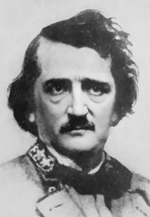 I’ve just finished Walter Jon Williams’ 1989 short story, “No Spot of Ground.” In Williams’ alternate history, Edgar Allan Poe does not die in a dissipated, incoherent condition in a Baltimore charity hospital in 1849, but recovers to conquer his alcoholism with the help of a wealthy Maryland widow, marries the widow’s beautiful young daughter, and founds a successful literary magazine. With the coming of the war, Poe goes south and obtains a commission as a Colonel in the Confederate army.
Poe is old for field command — just two years younger than Robert E. Lee, to the day — but he manages to advance in spite of his prickly relations with his fellow officers. Poe is personally brave enough, but hardly an heroic figure. As depicted by Williams, Poe is vain, dismissive of the skills of other officers, considering them to be his social and intellectual inferiors. They are, he believes, mere vulgar prose in contrast to his elevated poetry. Poe is utterly paranoid about their plots against him. Every burble of disorganization or mislaid communication in the field — things that a later generation would refer to with the acronym SNAFU –Poe views as part of a larger plot to make him look like an incompetent. Poe has little regard for the common Confederate soldier and, one imagines, the feeling is mutual. Poe imagines the entire Federal army facing him across the lines. Williams also gives the reader a glimpse of Poe’s obsession with romantic death, and his inability to move past the loss of his first wife, Virginia Clemm (1822-47), even though he assures himself he’s moved on. Unlike the Confederate officers of another recent bit of Civil War fiction, here Poe carries all the prejudices and attitudes of his day and place.
The main action of Williams’ tale takes place in late May 1864, when Poe unexpectedly takes command of George Pickett’s division at Petersburg, and moves with them into the line north of Richmond near Hanover Junction, just after the Battle of North Anna during the Overland Campaign. But much of the story is told in flashback, including a segment where Poe commands one of Pickett’s brigades in the famous assault on the third day at Gettysburg:
The sound was staggering, the banging and the clanging of the guns, guns, guns, but fortunately Poe had nothing to do but keep his feet moving forward, one after another. The officers had been ordered to stay dismounted, and all had obeyed but one: Dick Garnett, commanding the brigade on Poe’s left, was too ill to walk all that way, and had received special permission to ride.
Garnett, Poe knew, would die. The only mounted man in a group of twelve thousand, he was doomed and knew it.
Somehow there was an air of beauty about Garnett’s sacrifice, something fragile and lovely. Like something in a poem. The cemetery, their target, was way off on the division’s left, and Pickett ordered a left oblique, the entire line of five thousand swinging like a gate toward the target. As the Ravens performed operation, Poe felt a slowly mounting horror. To his amazement he saw that his brigade was on the absolute right of the army, nothing beyond him, and he realized that the oblique exposed his flank entirely to the Union batteries planted on a little rocky hill on the Yankee left.
Plans floated through his mind. Take the endmost regiment and face it toward Yankees? But that would take it out of the attack. Probably it was impossible anyway. But who could guard his flank?
In the meantime Pickett wanted everyone to hit at once, in a compact mass, and so he had the entire division dress its ranks. Five thousand men marked time in the long grass, each with his hand on the shoulder of the man next to him, a maneuver that normally took only a few seconds but that now seemed to take forever. The guns on the rocky hill were plowing their shot right along the length of the rebel line, each shell knocking down men like tenpins. Poe watched, his nerves wailing, as his men dropped by the score. The men couldn’t finish dressing their ranks, Poe thought, because they were taking so many casualties they could never close the ranks fast enough, all from the roaring and the soaring of the guns, guns, guns. . . He wanted to scream in protest: Forward! Guide center! but the evolution went on, men groping to their left and closing up as the shells knocked them down faster than they could close ranks.
Finally Pickett had enough and ordered the division onward. Poe nearly shrieked in relief. At least now the Yankees had a moving target.
But now they were closer, and the men on the Yankee ridge opened on Poe’s flank with muskets. Poe felt his nerves cry at every volley. Men seemed to drop by the platoon. How many had already gone? Did he even have half the brigade left?
The target was directly ahead, the little stand of trees on the gentle ridge, and between them was a little white Pennsylvania farmhouse, picture-book pretty. Somewhere around the house Poe and his men seemed to lose their sense of direction. They were still heading for the cemetery, but somehow Garnett had gotten in front of them. Poe could see Garnett’s lonely figure, erect and defiant on his horse, still riding, floating really, like a poem above the battle.
The cemetery was closer, though, and he could see men crouched behind a stone wall, men in black hats. The Iron Brigade of Hancock’s Corps, their muskets leveled on the stone wall, waiting for Garnett to approach. . . .
And then suddenly the battle went silent, absolutely silent, and Poe was sitting upright on the ground and wondering how he got there.
I don’t consider myself a fan of the alternative history genre, but I liked Harry Turtledove’s “Lee at the Alamo,” and enjoyed this one, as well. Has anyone else read it? Thoughts?
___________

“The volunteers were panting for strife”
Other bloggers have praised the special Civil War issue of The Atlantic, which appeared on newsstands some weeks ago, and is still available for order. It’s really a remarkable collection of essays, published at the time in that magazine, that capture a lot of the detail and color of the period. Although the cover inevitably touts contributions by the great names in American literature and history — Douglass, Hawthorne, Longfellow, Twain — to me, some of the most revealing pieces are those composed by writers much less known today, whose work seems as fresh and new as when it was first published. Much of it was what we now view as reported journalism — not just observations or analyses of current events, but writers to traveled to the center of events, talked to the people there, and reported back what they discovered.
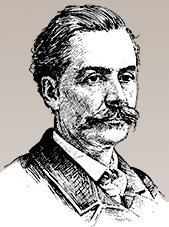 One example of such an essay is one by John William de Forest (right, 1826-1906) who, 151 years ago, disembarked from a steamer in Charleston to spend ten days in the city, trying to gauge the sentiment of the state that, just a month before, had taken the precipitous step of seceding from the Union. Lincoln would not take the oath of office as president for another six weeks, but de Forest quickly discovered that concerns about the president-elect and his party were the things that werre driving secession, and the standoff over Fort Sumter, out in the harbor:
“Why do you venture on this doubtful future?” I asked of one gentleman. . . . “Your great grievance is the election of Lincoln?”
“Yes”
“Is Lincoln considered here to be a bad or dangerous man?”
“Not personally. I understand that he is a man of excellent private character, and I have nothing to say against him as a ruler, inasmuch as he has never been tried. Mr. lincoln is simply a sign to us that we are in danger, and must provide for our own safety.”
“You secede, then, solely because you think his election proves that the mass ofthe Northern people is adverse to you and your interests?”
“Yes.”
“So Mr. [U.S. Senator Louis T.] Wigfall of Texas hit the nail on the head, when he said substantially that the South cannot be at peace with the North until the latter concedes that slavery is right?”
“Well, — I admit it; that is precisely it.”
I desire the reader to note the loyal frankness, the unshrinking honesty of these avowals, so characteristic of the South Carolina morale. . . . All those Charlestonians whom I talked with I found open-heartened in their secession, and patient of my open-hardheartedness as an advocate of the Union. . . .
“But have you looked at the platform of the Republicans?” I proceeded. “It is not adverse to slavery in the States; it only objects to its entrance into the Territories; it is not an Abolition platform.”
“We don’t trust in the platform; we believe that it is an incomplete expression of the party creed,-that it suppresses more than it utters. The spirit which keeps the Republicans together is enmity to slavery, and that spirit will never be satisfied until the system is extinct”. . . .
When I asked one gentleman what the South expected to gain by going out, he replied, “First, safety. Our slaves have heard of Lincoln, — that he is u black man, or black Republican, or black something, — that he is to become ruler of this country the fourth of March, — that he is a friend of theirs, and will free them. We must establish our independence in order to make them believe that they are beyond his help.”
My impression is, that a prevalent, though not a universal fear, existed lest the negroes [sic.] should rise in partial insurrections on or about the fourth of March. A Northern man, who had lived for several years in the back-country of South Carolina, had married there, and had lately traveled through a considerable portion of the South, informed me that many of the villages were lately forming Home Guards, as a measure of defence against the slave population. . . .
De Forest noted a certain fatalism about the coming conflict, with even those who opposed secession convinced that the agitation for war was so strong there, that it would eventually prevail over calmer minds. “The volunteers were panting for strife,” de Forest’s anti-secessionist acquaintances explained, and “Governor [Francis] Pickens was excessively unpopular because of his peaceful inclinations.” Armed hostilities were seen as a foregone conclusion; the only question was, when. Anticipation of the opening bombardment, even in January, already had people on edge:
During the ten days of my sojourn, Charleston was full of surprising reports and painful expectations. If a door slammed, we stopped talking, and looked at each other; and if the sound was repeated. we went to the window and listened for Fort Sumter. Every strange noise was metamorphosed by the watchful ear into the roar of cannon or the rush of soldiery. Women trembled at the salutes which were fired in honor of the secession of other States, fearing lest the struggle had commenced and the dearly-loved son or brother in volunteer uniform was already under the storm of the columbiads.
De Forest returned to New York, and when hostilities began, organized a company of the 12th Connecticut Volunteers. He mustered out in late 1864, and subsequently served with the Veteran’s Reserve Corps. After the war he returned to South Carolina as Assistant Commissioner of the Freedmen’s Bureau at Greenville. De forest wrote extensively about the war, but his graphic descriptions of the conflict were badly out of step with the romantic and idealistic depictions of his day.
_____________





8 comments