Virginia: Secession in the Defense of the Defense of Slavery
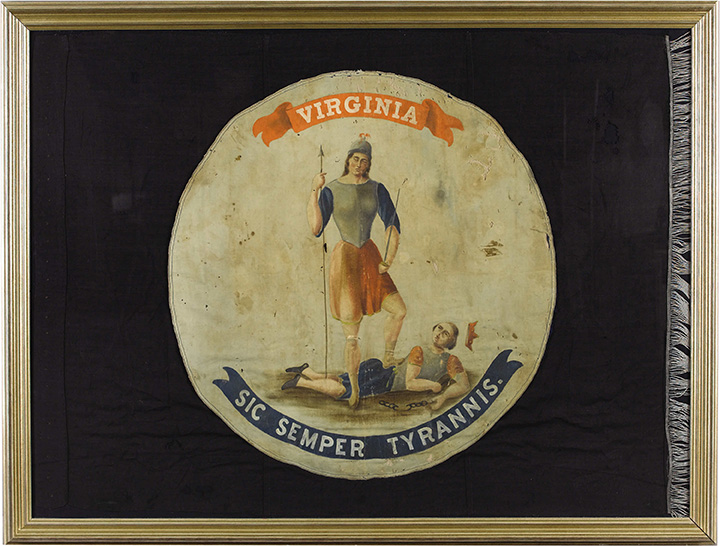

In April 2010, the conservative commentator Pat Buchanan penned an essay called, “The New Intolerance.” The piece was subsequently re-blogged by the Sons of Confederate Veterans, who posted it under the headline, “Buchanan Exposes Yankee Terrorists.” Buchanan’s essay was part of the kerfuffle over Virginia Governor Bob McDonnell’s declaration of Confederate History Month, the text of which was drafted for his office by the SCV, and omitted any mention of slavery at all. McDonnell subsequently reissued a revised proclamation, and in 2011 established a broader statewide commemoration, “Civil War History in Virginia Month.”
Buchanan’s essay revolves around the oft-made claim that “Virginia did not secede in defense of slavery.” He continues:

Buchanan doesn’t bother to explain why Mississippi or Texas should be considered to be Virginians’ “kinfolk,” in a way that much closer states — say, Pennsylvania or Ohio, with which Virginia shared a common border in 1861 — were not. Fortunately, those who wrote Virginia’s ordinance of secession said explicitly what they had in common, citing “oppression of the Southern slaveholding States” as part of the justification for its actions:
Virginia was not a fire-eating state that led the way on secession. But when the chips were down, the Commonwealth recognized slaveholding as the common bond that (1) defined the seceded states, (2) held Virginia to South Carolina, Mississippi, Georgia, Texas and those other states that seceded earlier, and (3) was deemed stronger and more vital to Virginia’s interest than its bond to the Union.
Does that count as ” seceding in defense of slavery?” Maybe. But it certainly counts as seceding in the defense of the defense of slavery.
___________
Image: Virginia regimental flag, via Encyclopedia Virginia.
Talkin’ Hatteras and Alabama
On Thursday, October 17 at 6:30 p.m., I’ll be speaking at the Brazoria County Historical Museum on the fight between U.S.S. Hatteras and the famous Confederate raider Alabama, as well as the NOAA-led project to map the remains of the Union warship in 2012. Hatteras holds the unfortunate distinction of being the only Union warship sunk in action in the Gulf of Mexico, and her destruction had (as Ed Cotham and I described earlier this year in the Civil War Monitor) a profound effect on the subsequent history of the Civil War in Texas. Come out on the 17th and I’ll explain exactly why that is.
My talk is being done as part of the BCHM’s annual programming for Texas Archaeology Awareness Month. They have some other great programming lined up, as well:
There’s one other talk coming up soon at BCHM, that I would recommend:
Infinite Monster by Leigh Jones and Rhiannon Meyers, both reporters for the Galveston County Daily News at the time, is the best re-telling of the story of Hurricane Ike I’ve read. Having gone through Ike (five years ago this month), It’s not a happy subject, but this book is really worth your time.
_________

“It is General Hood; say nothing about it.”
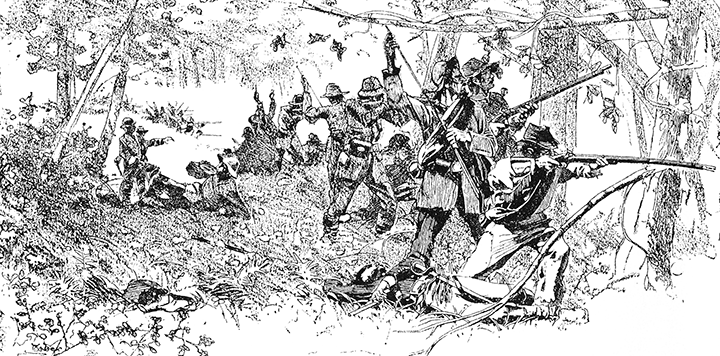 Walton Taber, “Confederate Battle Line at Chickamauga.”
The account of Chickamauga by Private Lawrence Daffan, Company G, 4th Texas Infantry:
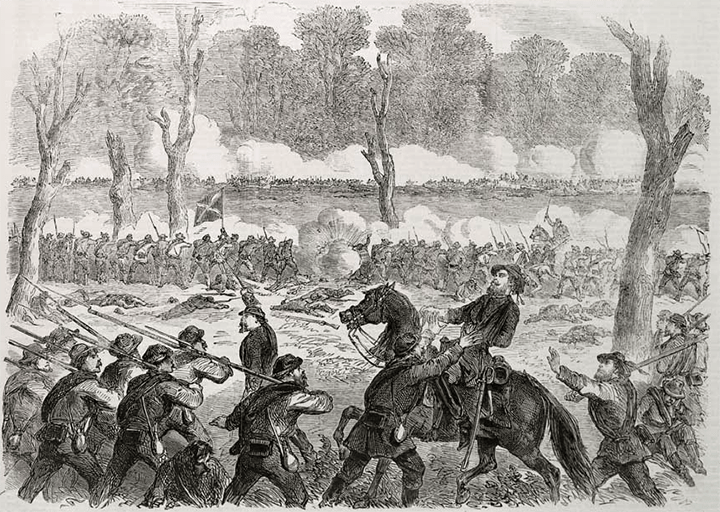 Hood wounded at Chickamauga. Illustrated London News, December 26, 1863.
I saw General Hood wounded, and saw the men wrap him and carry him away in a blanket. I rushed up and pulled the blanket open to be sure that it was General Hood; the officer in charge of the litter corps spoke very rough to me about this, saying, “yes, it is General Hood; say nothing about it.”
This was all under fire. These places all have special names now, but I give my account as a boy soldier.
Hood wounded at Chickamauga. Illustrated London News, December 26, 1863.
I saw General Hood wounded, and saw the men wrap him and carry him away in a blanket. I rushed up and pulled the blanket open to be sure that it was General Hood; the officer in charge of the litter corps spoke very rough to me about this, saying, “yes, it is General Hood; say nothing about it.”
This was all under fire. These places all have special names now, but I give my account as a boy soldier.
___________

Canister!

Small stories that may not warrant posts of their own:
- The contentious Nathan Bedford Forrest statue in Memphis was vandalized this week. Whatever one feels about that monument, vandalism is a crime, dumbasses.
- The original Medal of Honor issued to Joshua Lawrence Chamberlain was found and returned to the Joshua L. Chamberlain Museum in Brunswick.
- The City Council in Selma, Alabama recently voted to offer the one-acre plot known as Confederate Circle to the local UDC for $60,000. The UDC claims to own it, but neither side can clearly document title to the property. The local UDC head, Pat Godwin, sounded a little dismissive when she said, “I see no reason why the UDC should purchase the property when we already own it.” Uh, maybe. I think the UDC needs to find a more affirmative response than that, because the city is moving on it.
- The Los Angeles Review of Books had a profile of Dixie Outfitters the other day. For a guy who’s made a fortune selling history-themed apparel, Dewey Barber sure does deflect a lot of questions about history.
- The Bullock Texas State History Museum recently put on exhibit the battle flag of the Third Texas Infantry (above), that served in South Texas before joining Walker’s Texas Division in 1864. Their only major action was the Battle of Jenkin’s Ferry, which was the combat shown in flashback at the beginning of the Spielberg Lincoln film last year. The flag is unusual, being red stripes on a blue field. It was reportedly made in Cuba and brought in through the Union blockade.
- I’m reading Cecil Brown’s Stagolee Shot Billy, about the famous ballad. Everybody’s heard Lloyd Price’s famous version, but I bet you haven’t heard the version recorded for play on Dick Clark’s American Bandstand show — it’s so cleaned up, it makes no damn sense at all.
- James Reston, Jr. has a new book coming out that argues that when Lee Harvey Oswald killed JFK in Dallas 50 years ago, he was actually aiming for Texas Governor John Connally. I don’t think much of most assassination conspiracy theories, which are usually too convoluted to seem plausible, but Reston’s theory — not about who shot the president, but why — seems at least worth considering.
- Confederate reenactors, beware! Among you there are infiltrators, “false flaggers” (get it?) who are being paid to subvert the hobby with political correctness and anti-Southron sentiment. Or so says this person.
- Over at To the Sound of the Guns, Craig Swain continues to do definitive and original blogging on events at Charleston during the war, tied to the sesquicentennial. Bloggers will know the discipline and focus required for a sustained effort like that. This week, Craig shared the story of one of the most historic photographs of the war. It’s not much to look at, and you may not have paid much attention to it before, but it’s absolutely worth your time.
- John McClain, the dean of Houston sportswriters, makes a compelling case that Tennessee Titans owner Bud Adams should be in the NFL Hall of Fame. He’s right, but the whole idea makes Houston Oiler fans queasy.
Got any more? Put ’em in the comments below.
_______________
Civil War Monitor for Fall 2013
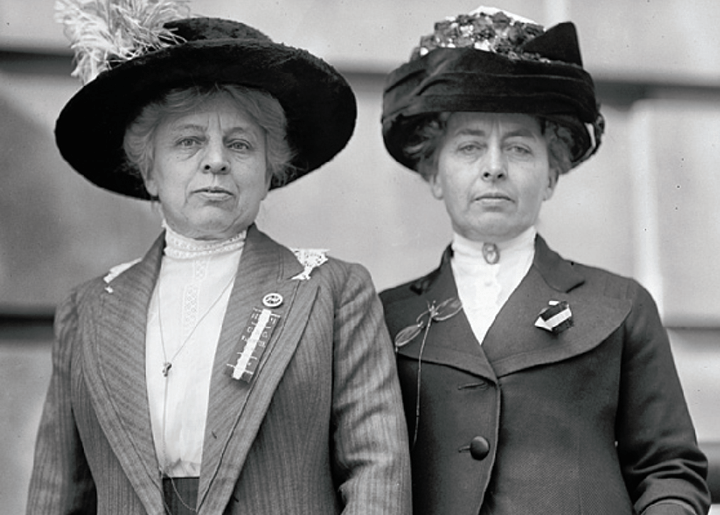 “Without the fraternal bonds of soldiering or political and financial incentives, northern and southern women found little reason to commiserate. They might join with their counterparts across the Mason-Dixon line in the name of issues such as temperance, but remembering the war remained a whole other issue.” — Caroline E. Janney
The Fall 2013 issue of the Civil War Monitor made its online debut today, and it’s a good one. This issue includes:
- “Destination: Chickamauga,” by Sam Elliott and David A. Powell, a traveler’s guide to the must-see spots around that Georgia battlefield and in surrounding communities.
- “Napoleon Perkins Loses His Leg,” by Megan Kate Nelson, chronicling one soldier’s experience of being maimed on the battlefield.
- “Ironclads in Action,” one of the earliest examples of combat photography (taken 150 years ago Sunday!), by Bob Zeller of the Center for Civil War Photography.
- “Henry Lord Page King,” a profile of a Confederate staff officer killed at the Battle of Fredericksburg, by Stephen Berry.
- “Sherman’s Mississippi Raid” by Clay Mountcastle, an account of Kerosene Billy’s operations early 1864 that convinced him of the feasibility of what would later become known as the “March to the Sea.”
- “Why I Fight” by Matt Dellinger, with photos by Jonathan Kozowyk, profiling a dedicated Zouave reenactor.
- “An Act of War,” a collection of Jonathan Kozowyk’s portraits of Civil War reenactors.
- “The Puritan and the Cavalier” by Jeffery D. Wert, exploring the unlikely friendship between Stonewall Jackson and J. E. B. Stuart.
- “Hell Hath No Fury,” by Caroline E. Janney, documenting the role that women played in keeping wartime passions alive in the decades after the war, even as the veterans themselves settled into reconcilliation.
- “Memoirs: The Ultimate Confederate Primary Sources,” an appreciation of postwar autobiographies by Robert K. Krick.
Good stuff, all of it. The Fall 2013 issue of the Civil War Monitor should be appearing on newsstands and in subscribers’ mailboxes soon. Considering a subscription? Click here.
______________
Matt Heimbach and the SCV
 Matt Heimbach (center) receives his membership in the SCV through the Col. William Norris Camp #1398 at Gaithersburg, Maryland, March 1, 2011. Just over a year later Heimbach would be awarded one of the national organization’s highest decorations. From the camp’s April 2011 newsletter.

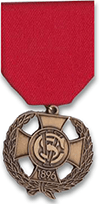
Matt Heimbach — founder of the White Student Union at Towson University, dabbler in Nazi ideology, and current darling of white supremacy movement — was awarded a Distinguished Service Medal (below, right) at the SCV annual meeting in Murfreesboro last year, along with “many of our own Va Flaggers.” This is according to this announcement, apparently from the Virginia Flaggers themselves, posted on several websites:

 At the same time the Flaggers were at the Hanover Tomato Festival AND Flagging the VMFA, the Sons of Confederate Veterans were holding their National Reunion in Murfreesboro, TN. We were thrilled to learn that many of our own Va Flaggers received recognition for their work over the past year, including:
Commander-in-Chief’s Award: Everette Ellis
Commendation Award: Jamie Funkhouser
Heritage Defense Medal: Billy Bearden, Jamie Funkhouser
Meritorious Service Medal: Everette Ellis, Bob Harris, Ashleigh Moody, Mike Pullen, and Tracy Wright
Distinguished Service Medal: Billy Bearden, Matthew Heimbach, Grayson Jennings, Tommy Thomas, Capt. Tucker, Willie Wells
Commander-In-Chief’s Ladies Appreciation Award: Susan Hathaway
At the same time the Flaggers were at the Hanover Tomato Festival AND Flagging the VMFA, the Sons of Confederate Veterans were holding their National Reunion in Murfreesboro, TN. We were thrilled to learn that many of our own Va Flaggers received recognition for their work over the past year, including:
Commander-in-Chief’s Award: Everette Ellis
Commendation Award: Jamie Funkhouser
Heritage Defense Medal: Billy Bearden, Jamie Funkhouser
Meritorious Service Medal: Everette Ellis, Bob Harris, Ashleigh Moody, Mike Pullen, and Tracy Wright
Distinguished Service Medal: Billy Bearden, Matthew Heimbach, Grayson Jennings, Tommy Thomas, Capt. Tucker, Willie Wells
Commander-In-Chief’s Ladies Appreciation Award: Susan Hathaway
There are a couple of interesting things about this. First, Matt Heimbach is explicitly embraced as one of “our own Va. Flaggers.” If the Flaggers themselves claim him as one of “our own,” that settles it for me.
Second, I’m really curious about what sort of “distinguished service” Heimbach did to receive such a prestigious award. According to the SCV’s most updated award manual (PDF), the Distinguished Service Medal is a national-level award, presented to SCV members who “have served the SCV in an outstanding manner for an extended period of time in a position of responsibility.” Heimbach only joined the organization in 2011 (above), which doesn’t seem to fit with the award’s requirement for recipients to hold “a position of responsibility” for “an extended period of time.” It’s hard to imagine many 21-year-olds receiving that award, so evidently the SCV national organization recognized Matt Heimbach’s little-more-than-a-year tenure as being especially “outstanding” in furthering the SCV’s goals.
How, exactly?

Update, September 2: In August 2011 Heimbach received the SCV’s Army of Northern Virginia Scholarship, an award that includes “monetary renumeration, a certificate and an ANV medal.” So during the 2011-12 academic year, when Heimbach was serving as President of Towson’s Youth for Western Civilization, chalking up “White Pride” grafitti around campus and calling for the hanging of Nelson Mandela, he was doing it at least partly on the SCV’s nickel. Oops.
____________
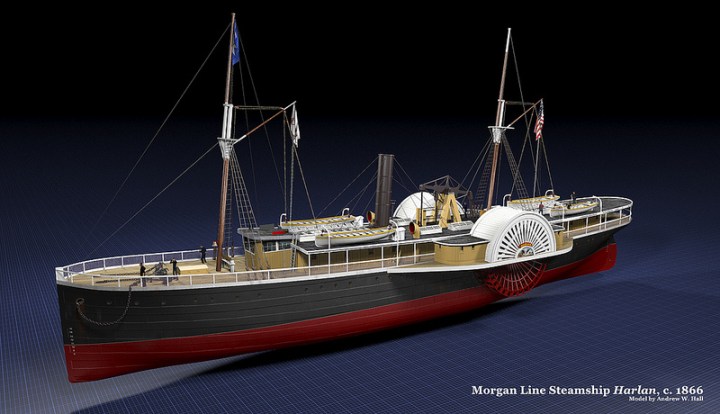
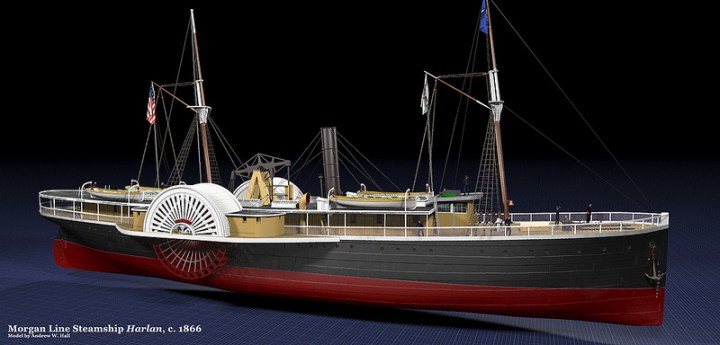
Aye Candy: Morgan Line Steamship Harlan, 1866

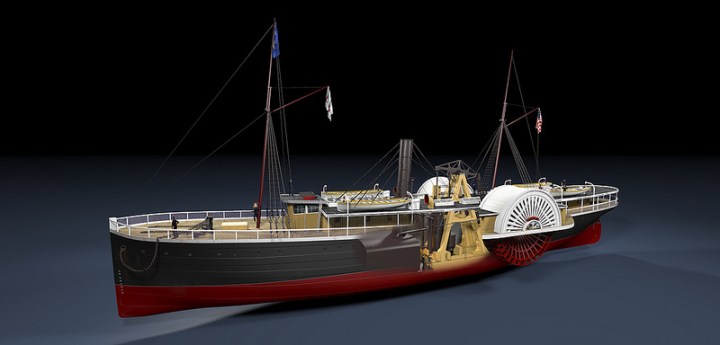
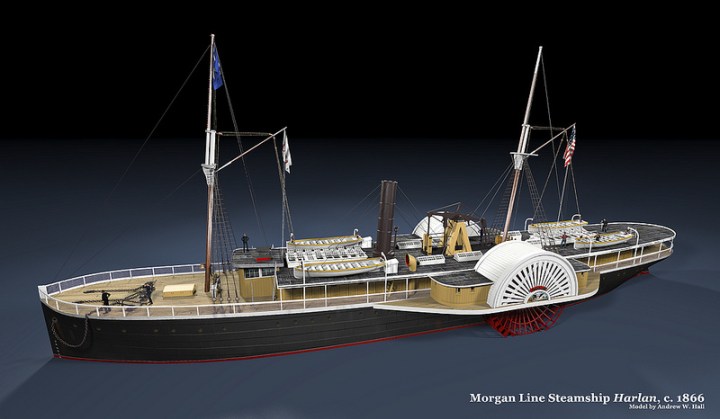
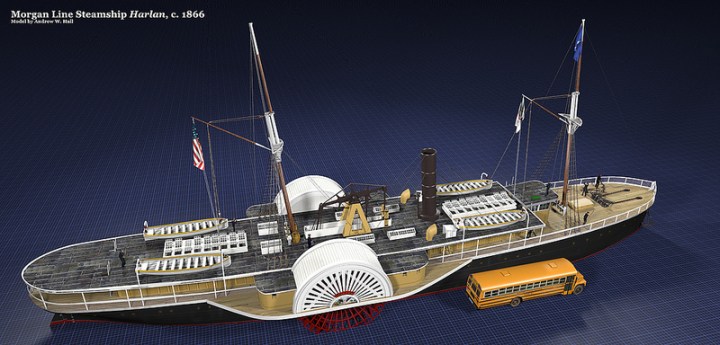
New renders of the Morgan Line steamship Harlan (seen previously here), that ran a coastwise route between New Orleans, Galveston and Indianola, Texas in the late 1860s and 1870s. New renders of the Morgan Line steamship Harlan, that ran a coastwise route between New Orleans, Galveston and Indianola, Texas in the late 1860s and 1870s. When she began the route in mid-1866, Harlan ran with three other steamships (Harris, Hewes and Morgan) on a 12-day cycle: New Orleans to Galveston (2 nights); after a brief stop at Galveston, on to Indianola (1 night); overnight at Indianola (1 night) then back to Galveston (1 night); a brief stop again at Galveston and back to New Orleans (2 nights). Fives nights at New Orleans, and then cycle repeats. A published schedule for the line (Galveston Daily News, June 13, 1866) gives the following for one of Harlan‘s voyages:
Harlan would depart New Orleans again on June 17. By running four ships on a schedule like this, there was a steamer departing each port every three or four days. Recall that at this time, there was no rail connection between Texas and the rest of the United States — that came later. The trip between Galveston and New Orleans is a long car ride now, but 150 years ago, a two-night trip aboard a coastal steamer like Harlan was both the fastest and most comfortable way to make the journey.
Harlan was the last of seven ships built to the same design by Harlan & Hollingsworth for the Morgan Line between 1861 and 1866. The first of these ships, St. Mary’s, was purchased new and converted into the Union warship U.S.S. Hatteras. In 1880, Harlan transported former President Grant and his party from Clinton, on Buffalo Bayou near Houston, to New Orleans.
Full-size images available on Flickr.

__________
Wreck of U.S. Coast Survey Ship Identified
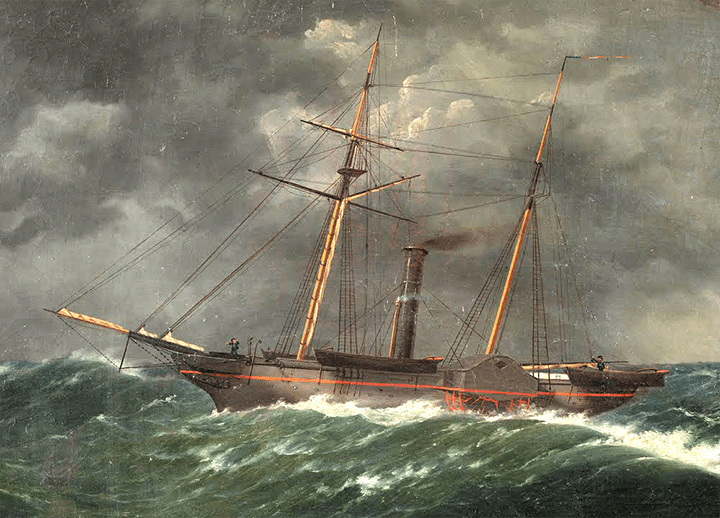 In 1852, W.A.K. Martin painted this picture of the Robert J. Walker. The painting, now at the Mariner’s Museum in Newport News, Va., is scheduled for restoration. (Credit: The Mariners’ Museum)
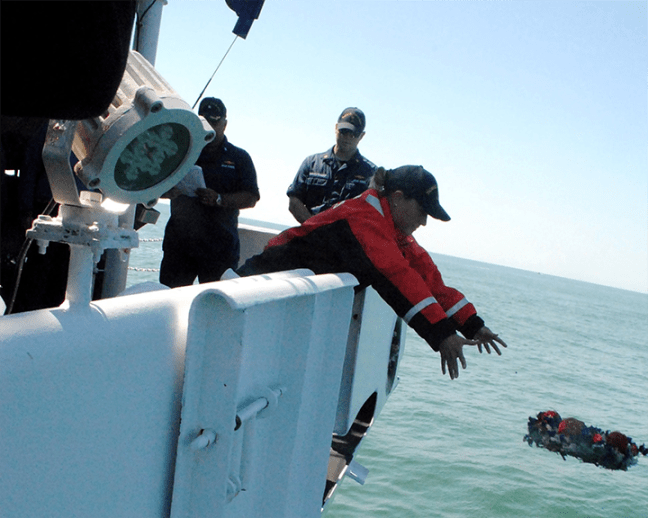
On Tuesday, the folks at NOAA’s Maritime Heritage Program announced the identification of the wreck of the U.S. Coast Survey steamship Robert J. Walker, that was sunk in a collision with a sailing ship in June 1860 off the Jersey shore. From the announcement:
You can read a detailed, contemporary news account of the disaster, from the June 23, 1860 issue of the New York Commercial Advertiser here.
Videos from the wreck site are online here. The visibility is pretty lousy, but the exposed part of the wreck is similar in many ways to that of U.S.S. Hatteras, that was the focus os a NOAA-led expedition last year. Some of the preservation on the Walker site is remarkable. There are even remnants of what are believed to be wool blankets, that have been preserved by being covered in mud, in an anaerobic environment, until recently. (Hurricane Sandy may have played a role in exposing these materials.)
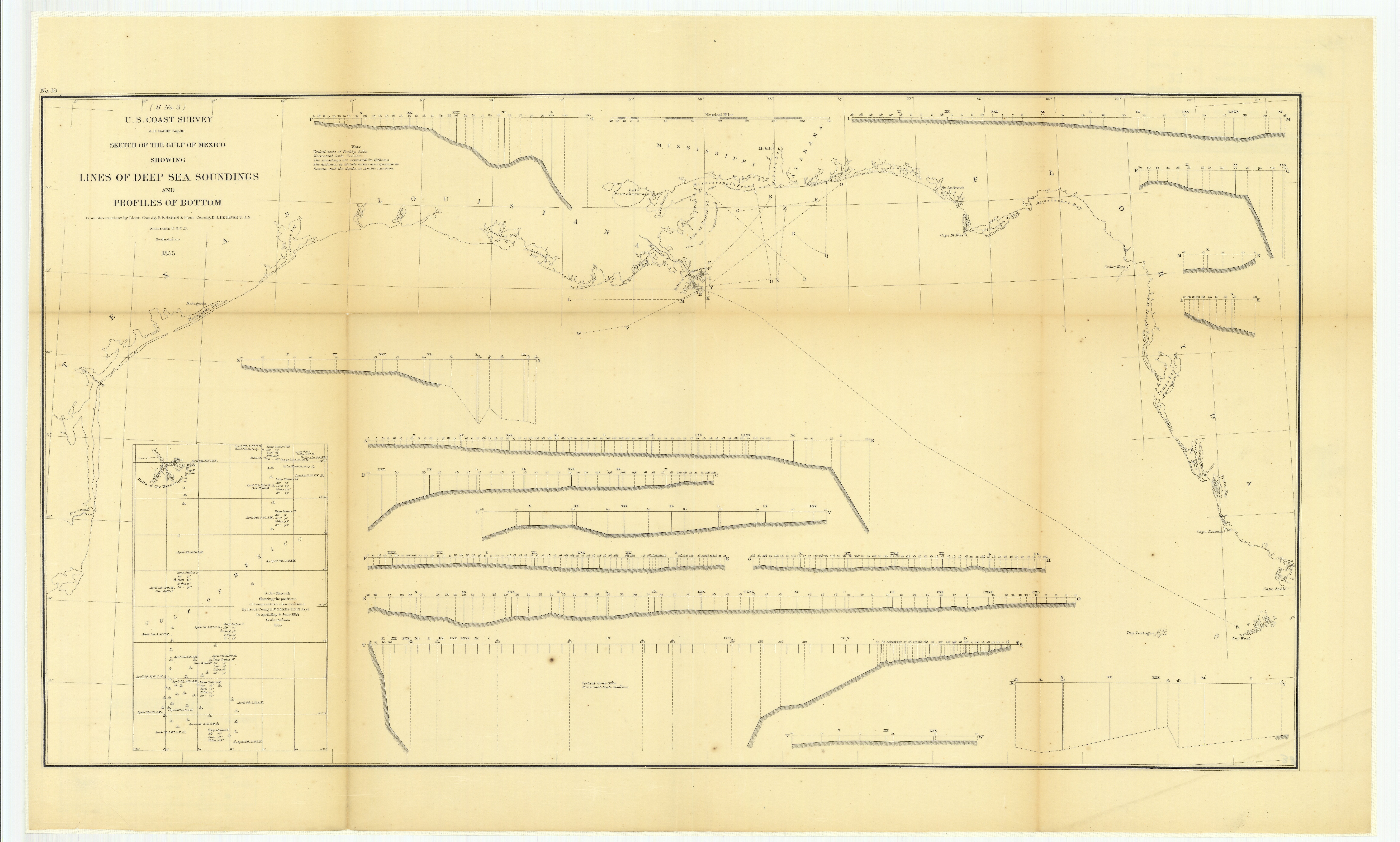
 In her career as a survey vessel, Robert J. Walker probably served off Galveston, as she spent considerable time operating in the Gulf of Mexico. As it happens, her commanding officer during much of that period was Benjamin Franklin Sands (right, 1811-1883), whose first-hand knowledge of the hydrography of the Texas coast would prove useful some years later, when he commanded the Union squadron on blockade duty off Galveston during the closing days of the Civil War. It was Captain Sands who formally accepted Galveston’s surrender in June 1865, an event that effectively ended the Union blockade of Southern ports. You can download a high-res copy of one of Sands’ charts, compiled during his tenure aboard Robert J. Walker, here.
Congrats to NOAA’s Maritime Heritage Program and all its partners in this endeavor.
_____________
More on the Petersburg Photo

Ben Uzel, President of the Colonial Heights Historical Society who identified the location of the Petersburg photo the other day, follows up:
 The second attachment is a photo showing what the site looks like today. The southern river channel was filled in and is now covered by the Norfolk Southern track and a parking lot. Hope this adds to the interpretation.
It does indeed. Thanks!
______________
Friday Night Concert: Seeger Sessions’ “Erie Canal”
This great classic of American folk songs isn’t nearly as old as I once thought. It was published in 1905 by Thomas S. Allen (1876-1919), under the title “Low Bridge, Everybody Down.” There’s a great history of the song in its various incarnations here. In the meantime, enjoy.
Fifteen miles on the Erie Canal
She’s a good old worker and a good old pal
Fifteen years on the Erie Canal
We’ve hauled some barges in our day
Filled with lumber, coal, and hay
And every inch of the way we know
From Albany to Buffalo Chorus:
Low bridge, everybody down
Low bridge for we’re coming to a town
You’ll always know your neighbor
And you’ll always know your pal
Ever navigated on the Erie Canal We’d better look ’round for a job old gal
Fifteen miles on the Erie Canal
You bet your life I’d never part with Sal
Fifteen miles on the Erie Canal
Git up mule, here comes a lock
We’ll make Rome by six o’clock
One more trip and back we’ll go
Right back home to Buffalo Chorus:
Low bridge, everybody down
Low bridge for we’re coming to a town
You’ll always know your neighbor
And you’ll always know your pal
Ever navigated on the Erie Canal Where would I be if I lost my pal?
Fifteen miles on the Erie Canal
I’d like to see a mule as good as Sal
Fifteen miles on the Erie Canal
A friend of mine once got her sore
Now he’s got a broken jaw,
She let fly with an iron toe,
And kicked him in to Buffalo. Chorus:
Low bridge, everybody down
Low bridge for we’re coming to a town
You’ll always know your neighbor
And you’ll always know your pal
Ever navigated on the Erie Canal
___________




![[Download full size here.]](https://deadconfederates.com/wp-content/uploads/2013/08/1877-map1.jpg)
7 comments