“It’s the Civil War dead, not ‘living historians,’ who deserve our attention”

Civil War historian Glenn W. Lafantasie has a provocative new article over at Salon, “The Foolishness of Civil War Reenactors.” It’s not really so much about reenactors — though they get a thumpin’, as a recent U.S. president would say — but actually about how we, as a country, will observe the Civil War Sesquicentennial.
It should not be necessary to point out that the Civil War was tragic, not romantic, but the romanticism is what dominates public conceptions of the war. Allen Nevins, a brilliant historian whose work is now mostly ignored by younger scholars, once attempted to emphasize the war’s enormous tragedy by making this profoundly powerful point: “We can say that the multitude of Civil War dead represent hundreds of thousands of homes, and hundreds of thousands of families, that might have been, and never were. They represent millions of people who might have been part of our population today and are not. We have lost the books they might have written, the scientific discoveries they might have made, the inventions they might have perfected. Such a loss defies measurement.” Nevins wrote those words in 1961, and it seems unlikely that his admonition, or anything I could add to it, will impress Civil War enthusiasts to abandon the romantic myths of the war in favor of a stark realism that lays out, without any varnish, how Americans suffered and sacrificed as they killed one another in droves.
Even some academic historians shrink from accepting the hellishness of the Civil War. One scholar, Mark E. Neely Jr., complains that vital aspects of the war have become hidden by what he believes has been an overemphasis on the conflict’s destructiveness, what he condemns among his fellow experts as “a cult of violence.” He argues, in fact, that the Civil War was, comparatively speaking, no more violent or destructive than other wars, which may or may not be so, but his contention that the war was somehow less violent than historians have claimed flies in the face of the fact that 620,000 Americans died in the four years between 1861 and 1865. Historians haven’t exaggerated the war’s human toll; if anything, they still have not dealt effectively with the sensationalized romance — promulgated in part by the Civil War generation itself — that smothers our comprehension of the contest between North and South as an excessive expression of an American tradition of violence. . . .
It’s worth reading the whole thing.
__________
Image: “2010 – Reenactment; Pellicer Creek Raid (Civil War),” by Flickr user iambrianna. Used under Creative Commons license. H/t: Kevin Levin

“The color of the white man is now, in the South, a title of nobility.”
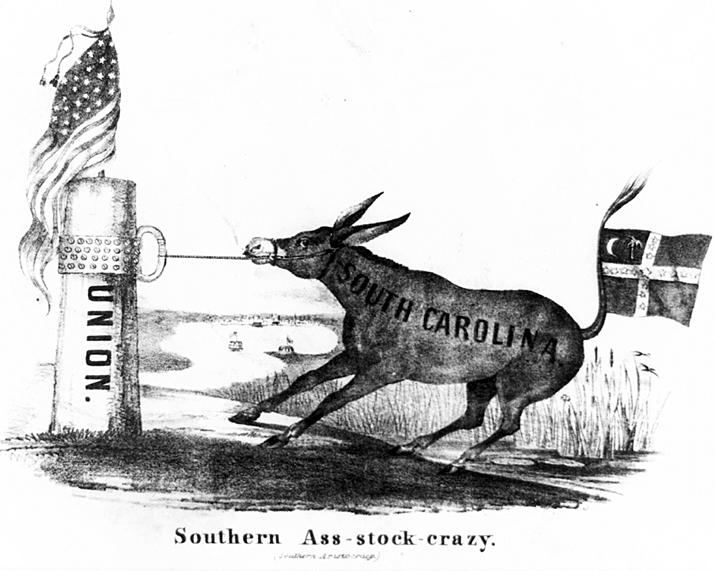
A few days ago we posted on the writings of James D. B. DeBow, a publisher and essayist who brought his considerable talents to the denunciation of abolitionism, and the defense of slavery, in the years leading up to the war. In his December 1860 booklet The Interest in Slavery of the Southern Non-Slaveholder, DeBow argued that slavery was not only an economic necessity, but absolutely essential to maintaining an aristocracy of white men that must — always — be above those of African descent, regardless of their economic standing:
The non-slaveholder of the South preserves the status of the white man, and is not regarded as an inferior or a dependant. He is not told that the Declaration of Independence, when it says that all men are born free and equal, refers to the negro equally with himself. It is not proposed to him that the free negro’s vote shall weigh equally with bis own at the ballot-box, and that the little children of both colors shall be mixed in the classes and benches of the school-house, and embrace each other filially in its outside sports. . . . No white man at the South serves another as a body servant, to clean his boots, wait on his table, and perform the menial services of his household. His blood revolts against this, and his necessities never drive him to it. He is a companion and an equal. When in the employ of the slaveholder, or in intercourse with him, he enters his hall, and has a seat at his table. If a distinction exists, it is only that which education and refinement may give, and this is so courteously exhibited as scarcely to strike attention. The poor white laborer at the North is at the bottom of the social ladder, whilst his brother here has ascended several steps and can look down upon those who are beneath him, at an infinite remove.
 DeBow was not the only Southern writer to make this argument. At the end of October 1860, South Carolina State Senator John Townsend (1799-1881, right) published a pamphlet, The Doom of Slavery in the Union – Its Safety Out of It. Along with DeBow’s booklet, The Doom of Slavery was one of the most popular secessionist tracts of the day. A few weeks after his pamphlet appeared, Townsend went on to sign of the South Carolina’s Ordinance of Secession. Here, Townsend makes explicit that slavery is not just central to the perpetuation of social order in the South, but the maintenance of a uniquely Southern system of caste:
The Effects to the Non-Slaveh0lder.
We forbear to notice the effect of the abolition of slavery upon the Banks, Insurance Companies, Railroads, and all other corporations, depending upon a rich a and flourishing country for their own prosperity. But in noticing its effects upon the different classes and: interests in the South, we should not omit to notice its effects upon the non-slaveholding portion of our citizens.
Accompanied as that measure is to be, by reducing the two races to an equality—or, in other words, in elevating the negro slave to an equality with the white man—it will be to the non-slaveholder, equally with the largest slaveholder, the obliteration of caste and the deprivation of important privileges. The color of the white man is now, in the South, a title of nobility in his relations as to the negro; and although Cuffy or Sambo may be immensely his superior in wealth, may have his thousands deposited in bank, as some of them have, and may be the owner of many slaves, as some of them are, yet the poorest non-slaveholder, being a white man, is his superior in the eye of the law; may serve and command in the militia; may sit upon juries, to decide upon the rights of the wealthiest in the land ; may give his testimony in Court, and may cast his vote, equally with the largest slaveholder, in the choice of his rulers. In no country in the world does—the poor white man, whether slaveholder or non-slaveholder, occupy so enviable a position as in the slaveholding States of the South. His color here admits him to social and civil privileges, which the white man enjoys nowhere else. In countries where negro slavery does not exist, (as in the Northern States of this Union and in Europe,) the most menial and degrading employments in society are filled by the white poor, who are hourly seen drudging in them. Poverty, then, in those countries, becomes the badge of inferiority, and wealth, ordistinction. Hence the arrogant airs which wealth there puts on, in its intercourse with the poor man. But in the Southern slaveholding States, where these menial and degrading offices are turned over to be per formed exclusively by the negro slave, the status and color of the black race becomes the badge of inferiority, and the poorest non-slaveholder may rejoice with the richest of his brethren of the white race, in the distinction of his color. The poorest non-slaveholder, too, except as I have before said, he be debased by his vices or his crimes, thinks and feels and acts as if he was, and always intended to be, superior to the negro. He may be poor, it is true; but there is no point upon which he is so justly proud and sensitive as his privilege of caste; and there is nothing which he would resent with more fierce indignation than the attempt of the Abolitionist to emancipate the slaves and elevate the negros to an equality with himself and his family. The abolitionists have sent their emissaries among that class of our citizens, trying to debauch their minds by persuading them that they have no interest in preventing the abolition of slavery, But they cannot deceive any, except the most ignorant and worthless, the intelligent among them are too well aware of the degrading consequences of abolition upon themselves and their families (such as I have described them), to be entrapped by their arts. They know that, at the North and in Europe, where no slavery exists, where poverty is the mark of inferiority; where the negros have been put upon equality with the whites, and “money makes the man,” although, —that man may be a negro;—they know, I say, that there the white man is seen waiting upon the negro;—there he is seen obeying the negro as his ostler, his coachman, his servant and his bootblack. Knowing, then, these things, and that the abolition of slavery, and the reign of negro equality here, may degrade the white man in the same way as it has done in those countries, there is no non-slaveholder with the spirit of the white race in his bosom, who would not spurn with contempt this scheme of Yankee cunning and malice.
It’s always hard to know whether, and to what extent, essays like DeBow’s and Townsend’s shaped the beliefs and motivations of bot the general public in the South and Confederate soldiers, specifically. They are, in may respects, like highly-politically-partisan cable channels and websites today, in that they (or the ideas they express) form part of the larger rhetorical environment that influences individuals’ views. We can get a better, if imperfect, handle on this today through polling (“Where do you mostly get your news?”), but the exact dynamics of the phenomenon 150 years ago are harder to discern.
Another aspect that bears on this, as well, is that essays like these, or excerpts from them, were picked up and carried in other publications across the South, so they got far more circulation than the actual print run of the original pamphlet would suggest. I came across the Townsend quote, for example, in the Trinity Advocate, published in Palestine in East Texas. Arguments like DeBow’s and Townsend’s went far and wide.
I haven’t worked with large assemblies of contemporary sources, but McPherson addresses the differences in stated motivations between slaveholders and non-slaveholders in Cause & Comrades, and gives a number of examples of non-slaveholders who expressed very much the same ideas Townsend and DeBow both argue, that they saw themselves as defending not an economic institution, but a social order, explicitly based on white supremacy, of which the institution of African slavery was central. “Herrenvolk democracy,” he summarizes (p. 109), “– the equality of all who belonged to the master race — was a powerful motivator for many Confederate soldiers.”
McPherson also touches on something that Chandra Manning is much more explicit about, which is the concept of “liberty,” which was an idea shared widely between slaveholders and non-slaveholders alike. When they spoke of principles like liberty and property rights, there is an implicit belief that those are things that apply to white men (and to a much lesser extent, white women), and to no one else (pp. 29-30):
When Confederate soldiers spoke of liberty, they referred not to a universally applicable ideal, but to a carefully circumscribed possession available to white Southerners. No mere abstraction, liberty had to do with the unobstructed pursuit of material prosperity for white men and their families. As one Virginian put it, liberty consisted of the “good many comforts and privileges” that his family could enjoy without outside interference. While exclusive in terms of race, liberty was inclusive in terms of class. In other words, while liberty applied strictly to whites, it applied to all whites, regardless of present social class or economic condition, because all whites, by virtue of being white, enjoyed the right to individual ambition and aspirations of material betterment through means of their own choosing.
The institution of slavery was so central to daily life across much of the South that it is part of the “home and hearth” that so many Confederate soldiers saw themselves as defending.
So while it’s usually impossible to demonstrate that this Debow essay influenced that Confederate soldier, it seems clear that the ideas they expressed were very much a part of political discourse, and found a receptive audience in the Confederate ranks, both among slaveholders and non-slaveholders. Certainly this line of thinking wasn’t the only one out there — individuals’ motivations to do anything are rarely so simple as that — but scholarship like McPherson’s and Manning’s shows that these arguments were absolutely part of the mix, and the common rationalization that non-slaveholders must, Q.E.D., not have seen any interest in defending the institution is just that — a self-serving rationalization that papers over the cognitive dissonance that inevitably goes with Confederate hagiography.
_______________
The latter part of this post, beginning, “it’s always hard to know. . ,” was originally a comment in response to Marc Ferguson. In retrospect, it seems more appropriate as part of the text. Image: “Southern Ass-Stock-Crazy (Southern Aristocracy),” 1861, Library of Congress.

Frankly, my dear. . . .

The scene, driving into school Friday:
[Kid digs around for loose change in the console]
Me: What are you looking for?
Kid: I need 75 cents for popcorn.
Me: Popcorn?
Kid: Yeah, Ms. _____ lets us get popcorn, we’re watching a movie in her history class.
Me: What movie?
Kid: Gone with the Wind. It’s awful, and we all get popcorn ’cause it’s sooooo booooring.
Turns out they’d spent the entire week, since Monday, watching Gone with the Wind in class. The good news, I suppose, is that (according to the Kid) none of it registers with the the other middle school students. They’re not following the plot, they can’t keep the characters straight, and the dialogue is mostly incomprehensible. They’re distracted that one of the leading male characters “has a girl’s name.” The clothing looks ridiculous. They have only the vaguest sense of the course of the war, which is the mostly-off-screen event that drives the entire plot of the picture. Interaction between characters like the one pictured above just don’t register. Gone with the Wind, it seems, is a waste in the classroom when presented in this way; it might as well be a Bollywood musical, with all the dialogue and lyrics in Hindi, for all the effect it’s having. The only thing it’s teaching this class is to remember to bring their three quarters every day for popcorn. (Kevin, teaching at the high school level, has used segments from GwtW, but that’s an entirely different approach to classroom use of the film.)
There’s no question that Gone with the Wind is one of the classic films of all time. And it should be remembered in that context. But it’s portrayal of the Antebellum South and its depiction of slavery is atrocious, Hattie McDaniel’s Oscar notwithstanding. It’s not a history lesson.
I feel like I know Ms. _____ reasonably well, and I’m surprised, to say the least. No idea what’s going on here, or why GwtW would be the film of choice, even if one does choose to coast the rest of the year. (State-mandated standardized testing, which seems to be the tail that wags the dog, wrapped up last week.) There are much better, more historically accurate films out there, although they may not be do-able for the classroom. Glory, for example, is rated R; although the violence in it is probably not more gruesome than what’s seen on prime-time broadcast teevee, an R-rated film is a non-starter in the classroom. Gettysburg came out just four years later, and it’s only PG.
What’s done is done for this year, but I think I’ll drop a note to Ms. _____. I really hate to be one of those parents who’s always getting up in the teacher’s face, and the plain truth of the matter is that we’ve rarely had reason to complain. But there’s got to be something better than this.
__________________

Non-Slaveholders’ Stake in Defending the “Peculiar Institution”
Last week we looked at the prevalence of slaveholding in the South in 1860, on the eve of the Civil War. While many in the Southron Heritage™ movement will argue that a tiny, tiny fraction of Confederate soldiers owned slaves — two percent, three percent, five percent — the actual proportion of Confederate households that included slaveholders was several times higher, upwards of a third of all free households across the eleven states that formed the Confederacy. Most folks associated with Confederate heritage groups will, it seems, very quickly volunteer that their own ancestors didn’t own any slaves, and thus the protection and expansion of that institution, so explicitly central to the secession of South Carolina, Mississippi and other states, must not have factored into said ancestors’ decision to fight for the South. It’s an appealing argument, but the reality is not nearly so simple as that.
While the beliefs and motivations of specific individuals are always varied — and, after the passage of 150 years, are very often unknown — on the eve of the war there were many who argued that protection of slavery was explicitly in the interest of all Southern whites, not only those who owned slaves. Newspaper editorials, pamphlets, speeches, all called on the white population of the South, slaveholder and non-slaveholder alike, to stand together in defense of their shared interest in protecting slavery, for themselves, for their families, and for their children.
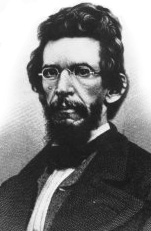 As Civil War blogger Allen Gathman pointed out recently at Seven Score and Ten, the most influential advocate of this idea was James D. B. DeBow (right). DeBow was a former superintendent of the U.S. Census who, in the years prior to the war, published extensive tracts justifying the institution of slavery as an economic and moral good. There was, perhaps, no stronger or widely-read advocate in the defense of slavery, nor one whose writings — thanks to his service with the Census Bureau — carried the sheen of academic authority that DeBow held. In December 1860, on the eve of secession, the same month South Carolina seceded, DeBow published a booklet titled The Interest in Slavery of the Southern Non-Slaveholder, in which he argued that non-slaveholding whites were every bit as interested in protecting and preserving the institution as the large plantation owners:
The fact being conceded that there is a very large class of persons in the slaveholding States, who have no direct ownership in slaves; it may be well asked, upon what principle a greater antagonism can be presumed between them and their fellow citizens, than exists among the larger class of non-landholders in the free States and the landed interest there? If a conflict of interest exists in one instance, it does in the other, and if patriotism and public spirit are to be measured upon so low a standard, the social fabric at the North is in far greater danger of dissolution titan it is here.
Though I protest against the false and degrading standard, to which Northern orators and statesmen have reduced the measure of patriotism, which is to be expected from a free and enlightened people, and in the name of the non-slaveholders of the South, fling back the insolent charge that they are only bound to their country by its “loaves and fishes,” and would be found derelict in honor and principle and public virtue in proportion as they are needy in circumstances; I think it but easy to show that the interest of the poorest non-slaveholder among us, is to make common cause with, and die in the last trenches in defence of, the slave property of his more favored neighbor.
The non-slaveholders of the South may be classed as either such as desire and are incapable of purchasing slaves, or such as have the means to purchase and do not because of the absence of the motive, preferring to hire or employ cheaper white labor. A class conscientiously objecting to the ownership of slave property, does not exist at the South, for all such scruples have long since been silenced by the profound and unanswerable arguments to which Yankee controversy has driven our statesmen, popular orators and clergy. Upon the sure testimony of God’s Holy Book, and upon the principles of universal polity, they have defended and justified the institution. The exceptions which embrace recent importations into Virginia, and into some of the Southern cities from the free States of the North, and some of the crazy, socialistic Germans in Texas, are too unimportant to affect the truth of the proposition.
Gotta love that last line about “the crazy, socialistic Germans in Texas.”
DeBow provides a whole range of arguments and carefully-picked data to buttress his position, and goes on to detail ten separate arguments illustrating why the protection of slavery is as much or more in the interest of the non-slaveholder as it is in the man with large numbers of bondsmen. Debow lays out, point by point, explanation of how the continued existence of African slavery protects each white man’s status as an individual, the welfare of his family, the future wealth of his children, and the prosperity of his state and region:
4. The non-slaveholder of the South preserves the status of the white man, and is not regarded as an inferior or a dependant. He is not told that the Declaration of Independence, when it says that all men are born free and equal, refers to the negro equally with himself. It is not proposed to him that the free negro’s vote shall weigh equally with bis own at the ballot-box, and that the little children of both colors shall be mixed in the classes and benches of the school-house, and embrace each other filially in its outside sports. It never occurs to him, that a white man could be degraded enough to boast in a public assembly, as was recently done in New York, of having actually slept with a negro. And his patriotic ire would crush with a blow the free negro who would dare, in his presence, as is done in the free States, to characterize the father of the country as a “scoundrel.” No white man at the South serves another as a body servant, to clean his boots, wait on his table, and perform the menial services of his household. His blood revolts against this, and his necessities never drive him to it. He is a companion and an equal. When in the employ of the slaveholder, or in intercourse with him, he enters his hall, and has a seat at his table. If a distinction exists, it is only that which education and refinement may give, and this is so courteously exhibited as scarcely to strike attention. The poor white laborer at the North is at the bottom of the social ladder, whilst his brother here has ascended several steps and can look down upon those who are beneath him, at an infinite remove.
5. The non-slaveholder knows that as soon as his savings will admit, he can become a slaveholder, and thus relieve his wife from the necessities of the kitchen and the laundry, and his children from the labors of the field. This, with ordinary frugality, can, in general, be accomplished in a few years, and is a process continually going on. Perhaps twice the number of poor men at the South own a slave to what owned a slave ten years ago. The universal disposition is to purchase. It is the first use lor savings, and the negro purchased is the last possession to be parted with. If a woman, her children become heir-looms and make the nucleus of an estate. It is within my knowledge, that a plantation of fifty or sixty persons has been established, from the descendants of a single female, in the course of the lifetime of the original purchaser.
6. The large slaveholders and proprietors of the South begin life in great part as non-slaveholders. It is the nature of property to change hands. Luxury, liberality, extravagance, depreciated land, low prices, debt, distribution among children, and continually breaking up estates. All over the new States of the Southwest enormous estates are in the hands of men who began life as overseers, or city clerks, traders and merchants. Often the overseer marries the widow. Cheap lands, abundant harvests, high prices give the poor man soon a negro. His ten bales of cotton bring him another, a second crop increases his purchases, and so he goes on opening land and adding labor until in a few years his draft for $20,000 upon his merchant becomes a marketable commodity.
7. But should such fortune not be in reserve for the non-slaveholder, he will understand by honesty and industry it may be realized to his children. More than one generation of poverty in a family is scarcely to be expected at the South, and is against the general experience. – It is more unusual here for poverty or wealth to be preserved through several generations in the same family.
8. The sons of the non-slaveholder are and have always been among the leading and ruling spirits of the South; in industry as well as in politics. Every man’s experience in his own neighborhood will evince this. He has but to task his memory. In this class are the McDuffies, Langdon Cheeves, Andrew Jackson, Henry Clays [sic.], and Rusks, of the past; the Hammonds, Yanceys, Ors, Memmingers, Benjamins, Stephens, Soules, Browns, of Mississippi, Simms, Porters, Magraths, Aikens, Maunsel Whites, and an innumerable host of the present, and what is to be noted, these men have not been made demagogues for that reason, as in other quarters, but are among the most conservative among us. Nowhere else in the world have intelligence and virtue disconnected from ancestral estate, the same opportunities for advancement and nowhere else is their triumph more speedy and signal.
9. Without the institution of slavery the great staple products of the South would cease to be grown, and the immense annual results which are distributed among every class of the community and which give life to every branch of industry, would cease. The world furnishes no instances of these products being grown upon a large scale by free labor. The English now acknowledged [sic.] their failure in the East Indies. Brazil, whose slave population nearly equals our own, is the only South American State which has prospered. Cuba, by her slave labor, showers wealth upon old Spain, whilst the British West India Colonies have now ceased to be a source of revenue, and from opulence have been, by emancipation, reduced to beggary. St. Domingo shared the same fate, and the poor whites have been massacred equally with the rich.
One suspects that these arguments convinced a great many white Southerners that, while they might not own slaves now, its was essential to preserve the very fabric of their family and society to protect and defend the “peculiar institution.”
Are you convinced?
_____________

For the Ferroequinologists
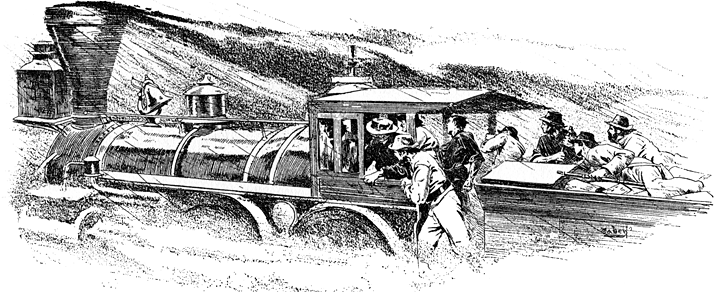
Over at the Civil War Picket, Phil Gast mentions a proposal that would (sort of) reunite the Texas and the General, engines made famous in the “Great Locomotive Chase” in 1862. From the linked news item:
In celebration of the 150th anniversary of the Civil War, [Marietta, Georgia Mayor Steve] Tumlin said he’d like to display The Texas across the tracks from the historic Kennesaw House, in a parking lot managed by the Downtown Marietta Development Authority, or nearby.
Tumlin is asking the council to pass a resolution to make inquiries with the state, city of Atlanta and Cobb Legislative Delegation about a possible relocation of The Texas to Marietta, whether permanent or temporary. . . .
The General is now housed in The Southern Museum in Kennesaw.
Camille Russell Love, director of cultural affairs for the city of Atlanta, said The Texas is owned by Atlanta. It was moved to Atlanta’s Grant Park in 1911 and moved into the Cyclorama building in 1927, when that building was under construction.
Love, who is in charge of the Cyclorama, said no one has contacted her about moving the steam engine.
“My first question would be how could they get it out? Someone would have to dismantle the building,” she said.
Yeah, there are a few minor details to work through.

The proposed Texas locomotive display area (red shading) in Marietta, between the Kennesaw House museum and the dumpsters behind the Krystal Burger drive-thru. At upper right on the corner (black sign) is the Gone with the Wind Movie Museum. Why, fiddle-de-dee!
It would be six different kinds of awesome to have those two locomotives together, but it’s pretty silly to move one, now miles away from the other, to a site slightly fewer miles away from the other. And the notion of putting a 155-year-old locomotive out in the weather — even under cover — should be a non-starter. It’s a big, heavy artifact, to be sure, but it’s still an artifact, and not replaceable. The pair need to be displayed together; if you’re going to put the Texas in a parking lot behind a burger joint, you might as well leave it in Atlanta. These locomotives both should be carefully preserved and interpreted, to inspire future Civil War bloggers as they’ve done for generations. For their part, I can’t imagine why Atlanta would want to give up the Texas. This really sounds like an idea that needs to incubate a while longer.
In the meantime, Friday is always a good day for Buster Keaton:

In other news, the good folks over at the League of Ordinary Gentlemen asked about cross-posting Thursday’s piece on Confederate soldiers and the prevalence of slaveholding. Those guys are a smart, eclectic bunch, and I’m honored to share a little electronic real estate with them. I wear 7¼ in a bowler, thanks.
Dead Confederates recently passed 1,000 comments. Thanks to all of you who take time to write, and thanks especially for keeping things (mostly) civil. Given the consternation my writing seems to cause in some quarters, y’all may be surprised to know that in the nearly-a-year this blog has been online, I’ve only had to drop the ban-hammer on two parties. I’d like to think of that as a success.
Everybody have a great weekend, and keep the people of those areas devastated by tornadoes, particularly Alabama, in your thoughts and prayers.
_______________
Image: “Confederates in Pursuit,” by Walton Taber. Yuh, I know the Texas ran in reverse during the chase. I still like the image.

“Ninety-eight percent of Texas Confederate soldiers never owned a slave.”

It would be a shame to let April slip by without a mention of Texas State Senate Resolution No. 526, which designates this month as Texas Confederate History and Heritage Month. The resolution uses a lot of boilerplate language (including an obligatory mention of “politically correct revisionists”), and also makes the assertion that “ninety-eight percent of Texas Confederate soldiers never owned a slave.” This is a common argument among Confederate apologists, part of a larger effort to minimize or eliminate the institution of slavery as a factor in secession and the coming of the war, and thus make it possible to maintain the notion that Southern soldiers, like the Confederacy itself, were driven by the purest and noblest values to defend home and hearth. Slavery played no role it the coming of the war, they say; how could it, when less than two percent (four percent, five percent) actually owned slaves? In fact, they’d say, their ancestors had nothing at all to do with slavery.
But it’s wrong.
It’s true that in an extremely narrow sense, only a very small proportion of Confederate soldiers owned slaves in their own right. That, of course, is to be expected; soldiering is a young man’s game, and most young men, then and now, have little in the way of personal wealth. As a crude analogy, how many PFCs and corporals in Iraq and Afghanistan today own their own homes? Not many.
But even if it is narrowly true, it’s a deeply misleading statistic, cited religiously to distract from the much more relevant number, the proportion of soldiers who came from slaveholding households. The majority of the young men who marched off to war in the spring of 1861 were fully vested in the “peculiar institution.” Joseph T. Glatthaar, in his magnificent study of the force that eventually became the Army of Northern Virginia, lays out the evidence.
Even more revealing was their attachment to slavery. Among the enlistees in 1861, slightly more than one in ten owned slaves personally. This compared favorably to the Confederacy as a whole, in which one in every twenty white persons owned slaves. Yet more than one in every four volunteers that first year lived with parents who were slaveholders. Combining those soldiers who owned slaves with those soldiers who lived with slaveholding family members, the proportion rose to 36 percent. That contrasted starkly with the 24.9 percent, or one in every four households, that owned slaves in the South, based on the 1860 census. Thus, volunteers in 1861 were 42 percent more likely to own slaves themselves or to live with family members who owned slaves than the general population.
The attachment to slavery, though, was even more powerful. One in every ten volunteers in 1861 did not own slaves themselves but lived in households headed by non family members who did. This figure, combined with the 36 percent who owned or whose family members owned slaves, indicated that almost one of every two 1861 recruits lived with slaveholders. Nor did the direct exposure stop there. Untold numbers of enlistees rented land from, sold crops to, or worked for slaveholders. In the final tabulation, the vast majority of the volunteers of 1861 had a direct connection to slavery. For slaveholder and nonslaveholder alike, slavery lay at the heart of the Confederate nation. The fact that their paper notes frequently depicted scenes of slaves demonstrated the institution’s central role and symbolic value to the Confederacy.
More than half the officers in 1861 owned slaves, and none of them lived with family members who were slaveholders. Their substantial median combined wealth ($5,600) and average combined wealth ($8,979) mirrored that high proportion of slave ownership. By comparison, only one in twelve enlisted men owned slaves, but when those who lived with family slave owners were included, the ratio exceeded one in three. That was 40 percent above the tally for all households in the Old South. With the inclusion of those who resided in nonfamily slaveholding households, the direct exposure to bondage among enlisted personnel was four of every nine. Enlisted men owned less wealth, with combined levels of $1,125 for the median and $7,079 for the average, but those numbers indicated a fairly comfortable standard of living. Proportionately, far more officers were likely to be professionals in civil life, and their age difference, about four years older than enlisted men, reflected their greater accumulated wealth.
The prevalence of slaveholding was so pervasive among Southerners who heeded the call to arms in 1861 that it became something of a joke; Glatthaar tells of an Irish-born private in a Georgia regiment who quipped to his messmates that “he bought a negro, he says, to have something to fight for.”
While Joe Glatthaar undoubtedly had a small regiment of graduate assistants to help with cross-indexing Confederate muster rolls and the 1860 U.S. Census, there are some basic tools now available online that will allow anyone to at least get a general sense of the validity of his numbers. The Historical Census Browser from the University of Virginia Library allows users to compile, sort and visualize data from U.S. Censuses from 1790 to 1960. For Glatthaar’s purposes and ours, the 1860 census, taken a few months before the outbreak of the war, is crucial. It records basic data about the free population, including names, sex, approximate age, occupation and value of real and personal property of each person in a household. A second, separate schedule records the name of each slaveholder and lists the slave he or she owns. Each slave is listed by sex and age; names were not recorded. The data in the UofV online system can be broken down either by state or counties within a state, and make it possible to compare one data element (e.g., households) with another (slaveholders) and calculate the proportions between them.
In the vast majority of cases, each household (termed a “family” in the 1860 document, even when the group consisted of unrelated people living in the same residence) that owned slaves had only one slaveholder listed, the head of the household. It is thus possible to compare the number of slaveholders in a given state to the numbers of families/households, and get a rough estimation of the proportion of free households that owned at least one slave. The numbers varies considerably, ranging from (roughly) 1 in 5 in Arkansas to nearly 1 in 2 in Mississippi and South Carolina. In the eleven states that formed the Confederacy, there were in aggregate just over 1 million free households, which between them represented 316,632 slaveholders—meaning that somewhere between one-quarter and one-third of households in the Confederate States counted among its assets at least one human being.

The UofV system also makes it possible to generate maps that show graphically the proportion of slaveholding households in a given county. This is particularly useful in revealing political divisions or disputes within a state, although it takes some practice with the online query system to generate maps properly. Here are county maps for all eleven Confederate states, with the estimated proportion of slaveholding families indicated in green — a darker color indicates a higher density: Alabama, Arkansas, Florida, Georgia, Louisiana, Mississippi, North Carolina, South Carolina, Tennessee, Texas, Virginia, All States.
Observers will note that the incidence of slaveholding was highest in agricultural lowlands, where rivers provided both transportation for bulk commodities and periodic floods that replenished the soil, and lowest in mountainous regions like Appalachia. The map of Virginia, in particular, goes a long way to explaining the breakup of that state during the war.
Obviously this calculation is not perfect. There are a couple of burbles in the data where populations are very low, for example Mississippi, where the census recorded two very sparsely-populated counties having more slaveholders than families (possible, but unlikely), or on the Texas frontier, where the data maps the finding that almost every family probably included a slaveholder. But in spite of its imperfections, it nonetheless presents a picture that more accurately describes the presence of slaveholding in the everyday lives – indeed, under the same roof – of citizens of the Confederate States than the much smaller number of slave owners does.
Aaron Perry, whose seven slaves are enumerated above in an excerpt from the 1860 U.S. Census Slave Schedule, illustrates the point. Perry, a Texas State Representative who raised hogs and corn in Limestone County (east of present-day Waco) had two sons, William and Mark (or Marcus), living with him at the farm at the time of the census. The elder Perry owned $3,000 worth of land, and nearly four times that in personal property, most of which must have been represented in those seven slaves. When the war came, both sons joined the Eighth Texas Cavalry, the famed Terry’s Rangers. Because neither of the sons – aged 21 and 17 respectively at the time of the census – held formal, legal title to a bondsman, Confederate apologists would claim that they are among the “ninety-eight percent of Texas Confederate soldiers [that] never owned a slave,” and, by implication, therefore had no interest or motivation to protect the “peculiar institution.” Nonetheless, it was slave labor that made their father’s farm (and their inheritance) a going concern. It was slave labor that, in one way or another, provided the food they ate, the shelter over their heads, the money in their pockets, the clothes they wore, and formed the basis of wealth they would inherit someday. And when they went to war, it was slave labor that made it possible for them to bring with them the mounts and sidearms that Texas cavalrymen were expected to provide for themselves. While the Perry boys left no record of their personal thoughts or motivations upon enlisting, the notion that these two young men must have had no interest, no personal stake, in the preservation of slavery as an institution is simply asinine on its face.
You don’t have to talk to a Confederate apologist long before you’ll be told that only a tiny fraction of butternuts owned slaves. (This is usually followed immediately by an assertion that the speaker’s own Confederate ancestors never owned slaves, either.) The number ascribed to Confederate soldiers as a whole varies—two percent, five percent—but the message is always the same, that those men 150 years had nothing to do with the peculiar institution, they had no stake in it, and that it certainly played no role whatever in their personal motivations or in the Confederacy’s goals in the war. But such a blanket disassociation between Confederate soldiers and the “peculiar institution” is simply not true in any meaningful way. Slave labor was as much a part of life in the antebellum South as heat in the summer and hog-killing time in the late fall. Southerners who didn’t own slaves could not but avoid coming in regular, frequent contact with the institution. They hired out others’ slaves for temporary work. They did business with slaveholders, bought from or sold to them. They utilized the products of others’ slaves’ labor. They traveled roads and lived behind levees built by slaves. Southerners across the Confederacy, from Texas to Florida to Virginia, civilian and soldier alike, were awash in the institution of slavery. They were up to their necks in it. They swam in it, and no amount of willful denial can change that.
Coming up: Did non-slaveholding Southerners have a stake in fighting to defend the “peculiar institution?”
_____________________
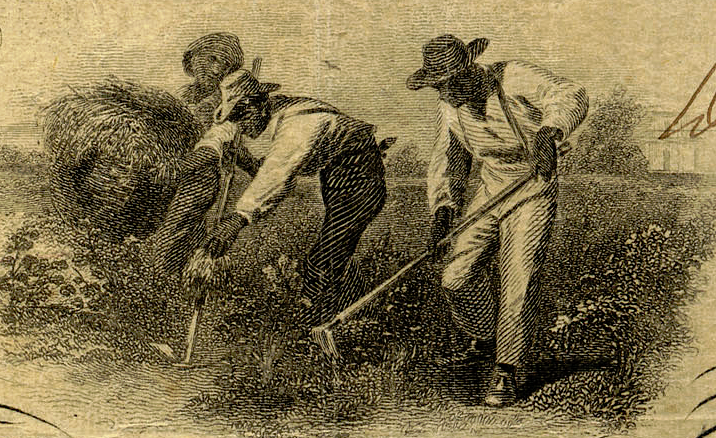
Images: Top, list of seven slaves belonging to Texas State Representative Aaron Perry of Limestone County, Texas, from the 1860 U.S. Census slave schedules, via Ancestry. Below, central image on the face of a Confederate States of America $100 note,issued at Richmond in 1862, featuring African Americans working in the field, via The Daily Omnivore Blog.
This post is adapted from one originally appearing in The Atlantic online in August 2010.

“His name will be inscribed on the roll of true-hearted patriots”

In my recent post on the Lincoln assassination, and the common dismissal of John Wilkes Booth as a “madman” whose actions are both inscrutable and unconnected to the Confederate cause, commenter Corkingiron asked about how Booth’s actions were received at the time, in the South. It’s a great question; the American Experience documentary I cited in reply suggests that condemnation of Booth’s act was immediate and universal.
In fact, it was not.
Not Surprising

Over at Civil War Emancipation, Donald R. Shaffer highlights a table by David C. Hanson of Virginia Western Community College, that compares slaveholding states’ date of secession with their populations of slaves and slaveholders as recorded in the 1860 U.S. Census. Shaffer notes that “David C. Hanson makes a definite connection between the concentration of slaves and slaveholders in a particular southern states and when it seceded from the Union in 1860-61, and whether it seceded at all. Certainly, there is plenty of anecdotal evidence connecting slavery and Civil War causation, but this table also makes a compelling statistical case.”
No shit. It turns out that for the eleven states that actually seceded, the proportion of free persons owning slaves was an excellent predictor of the order in which they seceded, beginning with South Carolina. I plugged the numbers into Excel and found that the percentage of slaves as part of the state’s overall population was equally reliable as a predictor. Assigning each state a number corresponding to its order of secession (South Carolina = 1, Mississippi = 2, etc.), the correlation coefficient for both the percentage of slaveholders among the free population, and for the proportion of slave among the overall population, was in both cases beyond -0.9. In short, each percentage is a nearly perfect predictor of where each state falls in the order of secession. The states with the largest proportions of slaves and slave-holders seceded earliest.
_____________

TSHA’s Handbook of Civil War Texas
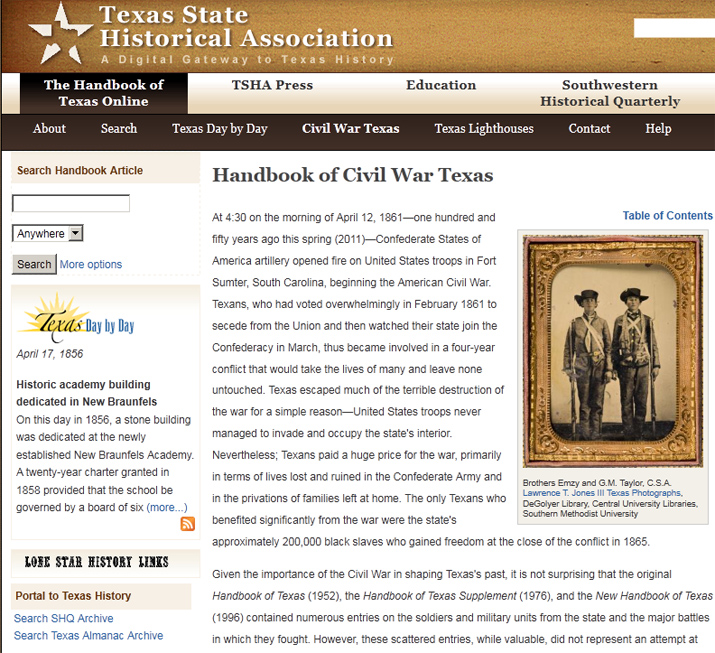
Regular commenter Dick Stanley, who blogs at the 13th Mississippi Infantry and Knoxville 1863, the Novel, points to a new resource available from the Texas State Historical Association, the online Handbook of Civil War Texas. It’s not a separate website, but rather an index to Civil War-related material already covered in the Handbook of Texas, which has for many years been a standard reference for anyone with a serious interest in Texas history. The Handbook began as an actual two-volume handbook, published in 1952; a supplementary volume was released in 1976. The New Handbook of Texas appeared in 1996 — six large volumes of around 1,200 pages each, and at several hundred dollars not a practical purchase for many — but the following year the TSHA began putting the Handbook online, opening up a valuable resource to all.
__________________

“. . . the madman Booth”
 April 15 is the anniversary of the death of Abraham Lincoln. There may be no other event in American history that’s inspired more what-ifs than the question, “what if Lincoln had served a full second term?”
Earlier today I read a post elsewhere that made a passing reference to “the madman Booth.” This, I think, lets him off too easy, as though he were a mere lunatic no one could have stopped, no on could have prevented, and no one could have predicted.
This is wrong.
Booth was not a madman, a random nutter, acting at the behest of voices in his head. His motivations and self-justifications were firmly grounded in the tumultuous events of the time, rather than a fantasy that existed only in his own mind. While the actor was undoubtedly unhinged and irrational on some levels, he didn’t meet the criminal justice system’s definition of insane, then or now. He plotted in considerable detail. He successfully organized a crew — misfits and hangers-on though they were — and held them together for an extended period. He pulled together complex plans for kidnapping and then murder that, while impractical in retrospect, were nonetheless specific and detailed. He convinced two other men to attempt murder as well, though one lost his nerve at the last moment. He had an extended network of sympathizers and supporters who, if not actively involved in the assassination plot, certainly knew of his grumbling and scheming and did nothing to impede him. One wonders, when they first heard that Lincoln had been shot, how many people immediately thought of John Wilkes Booth?
Above all, he genuinely believed that his actions were directly supporting the Confederate war effort, or (after Appomattox) exacting its revenge, and expected his name to go down in history as a great Southern hero. Sadly for our country, South and North alike, some people still see him that way.
What are your thoughts on Booth, his conspirators, and the Lincoln assassination?
_____________





 Dead Confederates, A Civil War Era Blog


19 comments