No Gettysburg Casino
From Linda Wheeler, writing at the NYT A House Divided Blog:
The controversial proposal to open a gambling casino near the Gettysburg battlefield was shot down this morning when the Pennsylvania Gaming Control Board chose a different applicant for the license. This is the second time developer and philanthropist David LeVan has failed to convince the board that a site near the Gettysburg battlefield is the best place for a gaming business.
Instead, the board voted 6-1 to award the license to a resort in the southwestern part of the state, one of four contenders for the license.
Good. From last summer, a video in opposition:
_________________

“We’re Number One! We’re Number One!”
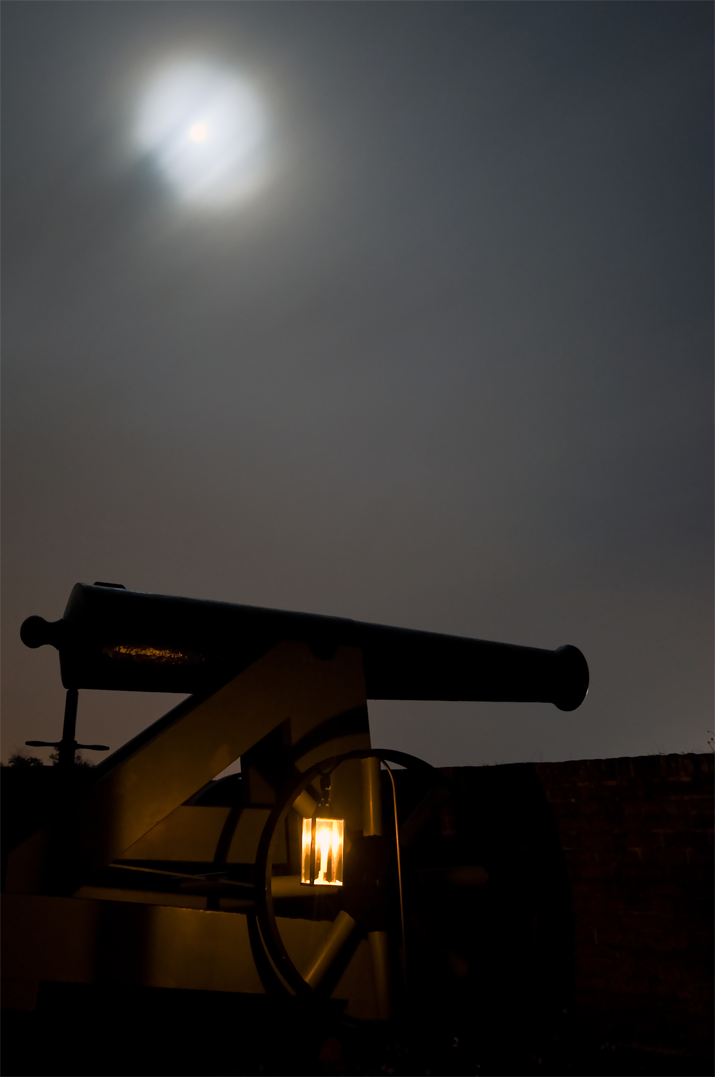
Michael Lynch, blogging at Past in the Present, flags an Associated Press story out of Florida, in which the local SCV camp is pushing to have an extremely minor incident in January 1861 recognized as “the first shot” of the Civil War:
Amid the turmoil [surrounding Florida’s secession], about 50 federal troops under the command of Lt. Adam J. Slemmer encamped at Fort Barrancas, at what is now Pensacola Naval Air Station. The fort of arched brick passageways and tunnels overlooks the turquoise waters and white-sand beaches of Pensacola Bay.
On the night of Jan. 8, the men had raised a drawbridge around the fort, which dated to when Spain controlled Florida, because of growing tensions in the surrounding Naval yard, said historian David Ogden, a ranger at Gulf Islands National Seashore.
According to Slemmer’s report, just after midnight, guards heard footsteps outside and challenged the intruders and heard no response, Ogden said. Slemmer made no mention of shots being fired.
It wasn’t until after the war ended in 1865 that one of the would-be intruders, R.L. Sweetman, wrote to Slemmer and later to Slemmer’s widow and made reference to the blank shot fired at Fort Barrancas as the war’s beginning.
“In his letter, Sweetman said something like ‘Your husband can claim that he commanded the post where the first shot was fired,”‘ Ogden said.
This event, such as it was, occurred a few hours before cadets from the Citadel fired on the steamer Star of the West, attempting resupply of Fort Sumter.
Lookit, I understand historical boosterism, and wanting recognition for one’s own community as having played a crucial part in dramatic, national events. And I recognize that Florida, like Texas, is not really thought of as a “Civil War state” in the mind of the public in the same way that, say, Virginia is. That’s unfortunate, because Florida played an important part in the war, both on land and especially with the Federal blockade. (Full disclosure: my g-g-grandfather and his father served in a Florida old-men-and-boys home guard unit late in the war, and another relative served with Captain Dickison‘s cavalry.) But this “first shot” business is silly. A warning round popped off into the darkness, the “first shot” of the Civil War? Based on a claim made in a single letter, years later? Really? Why would one push this event as the “first shot,” as opposed to the Star of the West incident, or the bombardment of Fort Sumter? Is it merely local boosterism?
Dale Cox, the unofficial historian for the Florida Panhandle chapter of the Sons of the Confederate Veterans, wrote on his blog that he considers the Pensacola shot the first of the Civil War, saying in an interview that it marked the first time federal troops fired toward Confederate agitators.
Got it. The Yankees started it.
People love superlatives, to be the first, or the last, or the biggest, or the bloodiest, or. . . well, you get the idea. But sometimes the quest for such distinctions get in the way of good history. Tell the story of Fort Barrancas, for sure — but don’t make yourself look desperate in doing it.
___________________
Image: “Fort Barrancas, moon-lite cannon,” by Flickr user divemasterking2000. Used under Creative Commons license.

Rosewood Cemetery Marker Dedication, Galveston
Update: A new reader asks about the title Dead Confederates juxtaposed with a story about an African American cemetery. It’s the name of the blog, which generally deals with the American Civil War, and I didn’t even realize how it would look. I hope folks will understand and not be offended, because that was not my intent. I apologize for how this looks, and hope readers will consider the blog as a whole, and not by this particular whiplash-inducing combination of phrases.


Tucked away in a nearly-impossible-to-find part of Galveston is Rosewood Cemetery, a burial ground for African Americans between 1911 and the last known interment, in 1944. Historical records identify 411 burials there, but only a handful of graves remain clearly marked. The site was originally a couple of hundred yards from the Gulf beach, but after the Seawall was extended past the site in the 1950s, and subsequent fill operations closed off the cemetery’s natural drainage, leaving the site subject to periodic flooding. Over time, grave markers succumbed to natural deterioration, vandalism or simply settled into the soil. Many of the markers that remain have been displaced from their original locations.
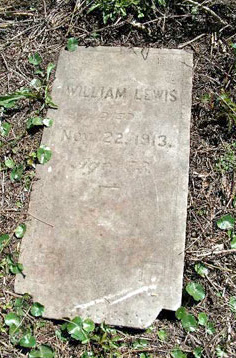 There’s only one marker clearly identifying the person interred there as a former member of the military, that of World War I veteran Ben L. Scott (c. 1896 — Feb. 21, 1937). Many more burials there are of freedmen and -women who were born into slavery. William Lewis (c. 1840 — November 22, 1913) is almost certainly one of those.
Eventually the land including the cemetery passed into the hands of local developers John and Judy Saracco. The Saraccos, well-known members of the local community, were aware that the cemetery lay within the boundaries of their new holdings, and had the property surveyed to define its limits. The Saraccos then had the cemetery fenced to maintain its boundary while development went on around it.
In 2006, the Saraccos donated the Rosewood Cemetery land to the Galveston Historical Foundation, which now maintains the property. The formal re-dedication of the cemetery was held in June 2007. In January 2008, local Boy Scout Sean Moran raised money and organized a crew to construct a new rail fence to surround the cemetery property. That fence was destroyed nine months later, during Hurricane Ike, so Moran — by now a college student — raised yet more money and organized volunteers to re-install a new fence again in March 2010.
This coming Saturday, April 16 at 10 a.m., there will be a dedication ceremony for the new Texas Historical Commission Historic Cemetery marker for Rosewood Cemetery, on 63rd Street, just back from Seawall Boulevard. The Galveston Historical Foundation is still seeking information on persons interred at Rosewood; if you have any information on such persons, please contact Brian Davis at 409.765.3419 or brian.davis@galvestonhistory.org.
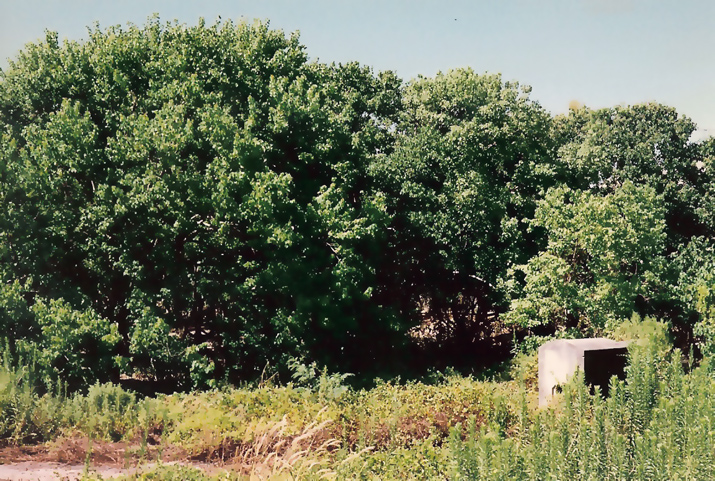
Two photos of the cemetery in 1999:

And pictures from last Saturday’s cleanup project after the jump:
“Forced” to Fire the First Shot
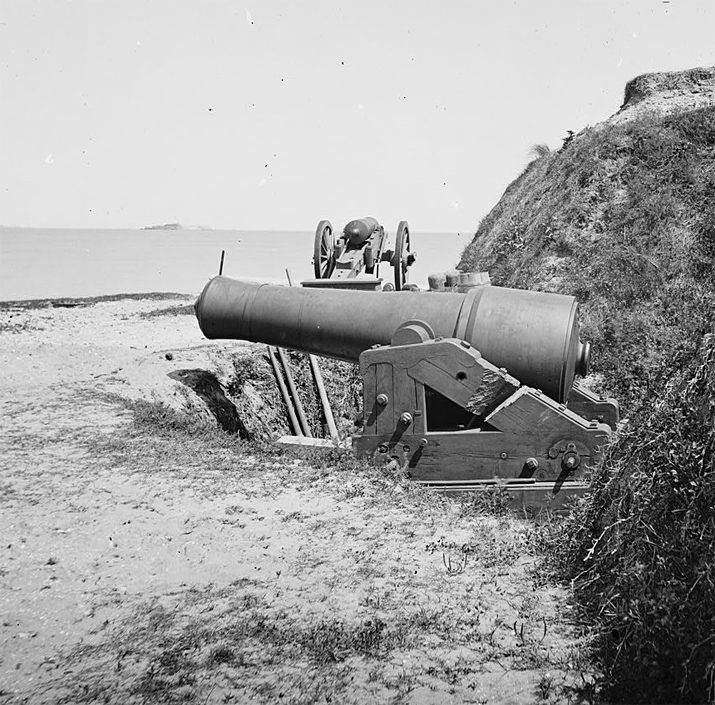
One hundred fifty years ago, Captain George Sholter James of the South Carolina Artillery passed word to his subordinate, Lieutenant Henry Farley, to open fire on Fort Sumter, a half-mile away to the east, with a ten-inch mortar positioned at Fort Johnson. The concussion of that first shell would reverberate for the next four years.
I’m not very good about remembering or observing anniversaries. (My wife will confirm this.) And I probably wouldn’t write anything at all about the bombardment of Fort Sumter, but for a piece that appeared Monday in the Washington Post‘s Civil War sesquicentennial blog, A House Divided. The blog itself is a group blog, which publishes short pieces by a variety of historians, written in response to specific questions. For Monday’s installment, the question was, “by attempting to resupply Ft. Sumter, did President Lincoln purposely provoke the war?” The selected respondents this time were Dennis Frye, Chief Historian at Harpers Ferry National Historical Park; Craig Symonds, Professor Emeritus at the United States Naval Academy, Mike Musick, former Subject Area Expert for the U.S. Civil War with the National Archives in Washington, D.C.; Brag Bowling, director of the Stephen D. Lee Institute and past Commander of the Army of Northern Virginia, Sons of Confederate Veterans and past President of the Richmond Civil War Roundtable; John Marszalek, Giles Distinguished Professor Emeritus of history at Mississippi State University; and Lonnie Bunch, Founding director of the Smithsonian’s National Museum of African American History and Culture.
Each of the authors has a slightly different take on the question, though most conclude that Lincoln’s efforts to resupply Sumter were explicitly not intended to provoke a shooting war. Bowling disagrees in an essay that is filled with common talking points about the Sumter crisis and Lincoln’s supposed Machiavellian plotting to “force” the Confederate artillerymen into firing the first shot. Bowling’s essay is a trimmed-down version of one he’d written a couple of weeks ago for the Georgia Heritage Council website.
Of Governors and Generals, Secession and Soap
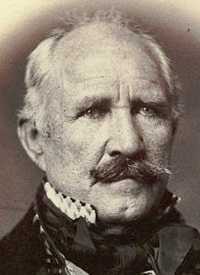 Much has been written about Texas’ secession and the removal of Governor Sam Houston, who adamantly opposed leaving the Union. Houston, a dyed-in-the-wool Jacksonian Democrat, was a flawed man in many ways, but he was dead right on secession, and foresaw better than most the ultimate outcome of the conflict that the fire-eaters so blithely dismissed. But this account of Houston’s final visit to the governor’s office, clearly intended to ridicule the old war-horse, just leaves me sad. From the San Antonio Daily Ledger and Texan, April 15, 1861:
Deposition of Sam Houston.
The circumstances attended the deposition of Sam Houston, as Governor of Texas, were quite dramatic, and in some respects ludicrous and comical. The Convention of Texas, called by the loud voice of the people against the denunciations and opposition of Governor Houston, having passed the act of secession, and accepted and ratified the Constitution of the Confederate States, prescribed a form of oath to be taken by all the State officers. This oath included a renunciation of all allegiance to foreign powers, and especially to the Government of the United States, and a declaration of fidelity to the Constitution of the Confederate States. When the oath was proposed to Governor Houston, he peremptorily refused to take it; whereupon the Convention declared the office of Governor vacant; and Lieutenant Governor Clark, under the Constitution, having taken the prescribed oath, succeeded to the office. Governor Clark was not slow in entering upon the Gubernatorial functions, and proceeding to the Governor’s office, assumed the chair and entered upon the duties of the office. By and by, the deposed Governor came hobbling to his old office — Old Sam’s San Jacinto wound having broken out afresh, as it always does on occasions of political trial. Perceiving Governor Clark occupying the chair, Old Sam addressed him:
“Well, Governor Clark,” giving great emphasis to the title, “you are an early riser.”
“Yes, General,” replied the Governor, with great stress upon the military title of his predecessor, “I am illustrating the old maxim, ‘the early bird gathers the worm.’ ”
“Well, Governor Clark, I hope you will find it an easier seat than I have found it.”
“I’ll endeavor to make it so, General, by conforming to the clearly expressed will of the people of Texas.”
The General, having brought a large lunch basket with him, proceeded to put up various little articles of personal property, and to stow them away very carefully. Catching his foot n a hole in the carpet and stumbling, the General suggested to Governor Clark that the new Government ought to afford a new carpet for the Governor’s office, whereupon the Governor remarked that the Executive of Texas could get along very well without a carpet.
Approaching the washstand, the General called the attention of Gov. Clark to two pieces of soap — one, the Castile soap, was his own, private property; and the other, a perfumed article, was the property of the State, and added, “Governor, your hands will require the very frequent use of this cleansing article;” whereupon Gov. Clark, pointing to the washbowl, which was very full of black and dirty water, remarked, “General, I suppose that is the bowl in which you washed your hands before leaving the office.”
Having gathered up all his duds, Old Sam made a little farewell speech, very much in the style of Cardinal Woolsey [sic.], declaring his conviction that, as in the past, the time would soon come when Texas would call him from retirement, and he hoped Gov. Clark would be able to give as good an account of his stewardship as he could now render. Halting at the door, the General made a profound bow, and with a air of elaborate dignity said, “Good day, Governor C-l-a-r-k.” “Good day, General Houston,” was the Governor’s response. And thus the “Hero of San Jacinto” concluded his political career.
Old Sam deserved better. So did Texas.
____________
Image: Senator Sam Houston of Texas, 1859. Library of Congress.

Ancestry Continues to Impress
I’ve been using Ancestry.com for a year or so now. While it’s been a tremendous help in tracing my own family lineage, it’s become invaluable in tracking some of the people I’ve discussed here on the blog. Even if I never looked up another family member again, I’d still consider it worthwhile. It’s not cheap, but for the blogging I do, access to online resources like Ancestry, Footnote and GenealogyBank are simply part of the price of admission.
But they continue to impress with new additions. Who would’ve though of this:
The Military Headstone Archive: a one-of-a-kind new collection
Ancestry.com has undertaken an ambitious project to chronicle military headstones, starting with 33 Civil War cemeteries. This interactive collection lets you search gravesites, attach headstone images to your tree and find GPS coordinates for your soldier ancestor’s final resting place. You’ll also get rich context about some of the Civil War’s most important battlefield cemeteries.
In practice, the system is a little dodgy. As a test, I looked up several headstone photos on Flickr, more-or-less- at random, and tried to find them in the new database. I couldn’t locate the first few, but did find that of David Mowery listed as below, at Shiloh:

. . . and this one for William E. Miller at Gettysburg:

One more tool in the collection, and a welcome one.
______________

NYT Disunion: Census of Doom
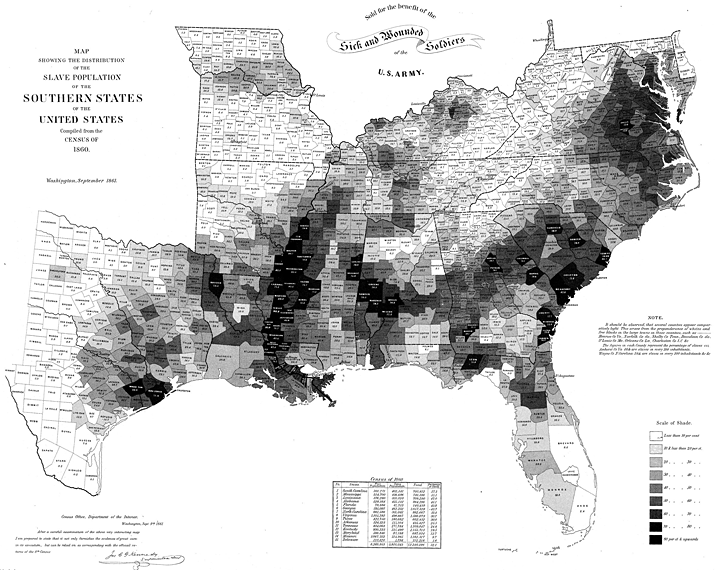
On Friday, Adam Goodheart had a great column at the New York Times Disunion blog, called “The Census of Doom.” Leaving aside the tongue-in-cheek (or merely cheeky) title for a moment, Goodheart makes an important point that’s sometimes overlooked. While historians of the period use the data from the 1860 U.S. Census all the time, it’s easy to forget the impact those numbers had on the political debate in the frenetic run-up to secession:
Eighteen-sixty was a federal Census year, and the results had begun coming in early that autumn — with exquisitely poor timing, as far as Southern paranoia and Northern hubris were concerned. At the very moment that the slave states faced the imminent election of a Republican, antislavery president, a candidate who would win without a single vote in the Deep South, came other, equally shocking signs of change.
Preliminary figures that began appearing in the press as early as September 1860 confirmed what many Americans already suspected: immigration and westward expansion were shifting the country’s balance of population and power. Since the last count, in 1850, the North’s population had increased an astonishing 41 percent, while the South’s had grown only 27 percent. (Between 2000 and 2010, by comparison, the entire nation’s population grew just 9.7 percent.) Tellingly, the statistical center of national population had shifted for the first time not only west of the original 13 states, but also from slave territory into free: from Virginia to Ohio.
For Slave Power, the writing was on the wall.
___________________
Image: Map showing the density of slave population in Southern and border states, based on the 1860 U.S. Census.

A Beating in Fort Bend County, Cont.
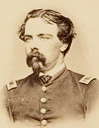 Over the weekend I posted about the attack on Captain William H. Rock (left), the Freedman’s Bureau agent in Fort Bend County, Texas. Rock was a former USCT officer who joined the Freedmen’s Bureau in mid-1866, and spent two full years, December 1866 to December 1868, as the agent in Fort Bend County, one of the longest tenures in such a position in Texas. Christopher Bean’s 2008 doctoral dissertation, “A Stranger Amongst Strangers: An Analysis of the Freedmen’s Bureau Subassistant Commissioners in Texas, 1865-1868,” gives considerable insight on Rock’s service at Richmond, drawn from that officer’s correspondence with his superiors at the bureau. Rock comes across as a diligent and proactive agent, spending more time visiting the laborers on the farms and plantations of Fort Bend County than he did in his office, and working to adjust freedmen and -women to make the successful transition to cultural and political norms that, in times of slavery, had always been outside their reach.
It was a challenge, to be sure. As noted previously, at the time of the 1860 U.S. Census, there were almost exactly twice as many slaves in Fort Bend County as free persons, with only nine free colored persons in the entire county. By 1870, more than three-quarters of the county’s population was described as “colored.” Fort Bend had been a hotbed of Confederate sympathy; when (white, male) Texans went to the polls to vote on secession in early 1861, the vote in Fort Bend County was 486 to 0. The county sheriff, J. W. Miles, had reportedly been a private in the famously-rowdy Eighth Texas Cavalry, Terry’s Rangers, before being discharged for illness in 1862. Fort Bend County was a rough place, even for a man as seemingly diligent and earnest as William Rock.
For his part, Captain Rock went about his business mostly on his own. Unlike other agents of the bureau in Texas, Rock declined to be provided with a detachment of soldiers to assist in enforcing his authority — at least during the first months of his time in Richmond. It was subsequently reported that he had, in fact, requested a detachment later on, but it’s not clear if such was ever actually provided.
 Following my last post, blogger Daniel R. Weinfeld left a detailed comment, remarking on the striking similarities between the official explanation of the attack on Captain Rock, and those that followed the murder of John Quincy Dickinson (right, 1836-71), the Jackson County, Florida Clerk of Court, in 1871. Dickinson, a former officer of the 7th Vermont Infantry and a former agent for the Freedman’s Bureau, was the senior Republican in the county, and a target for white Regulators looking to return the county to white, Democratic control during what became known as the “Jackson County War.” (More about Dickinson’s assassination here.) Weinfeld sees a remarkable parallel in the way both the Dickinson murder, and the assault on Captain Rock two years previously, were explained away by the local white community:
The “scenario” presented in Flake’s Bulletin conforms exactly with the same rationalizations/accusations made by Regulators at other times and places to justify assaults on Bureau officers and Republican officials in the South. . . . In the “investigation” [of Dickinson’s murder] conducted by the county judge, as reported by FL Democratic newspapers, allegations were made that (1) the assassin was a black man, who (2) was jealous over an alleged affair between Dickinson and a black woman and (3) that Dickinson had swindled local land owners out of their property at tax auctions. Otherwise, the papers asserted, Dickinson had been respected by his white neighbors! All this slander was vigorously denied by Dickinson’s friends and the Republican press. My research shows that Dickinson was without a doubt assassinated by Regulators waiting in ambush. The black man involved was likely hired by the Regulators as a lookout. Dickinson’s “offense” was his political activity as a Republican and his defense of voting and civil rights for African Americans.
It’s almost like the Regulators had a check list they passed around: implicate African American in committing the assault – check; accuse victim of sexually consorting with blacks – check; then allege financial improprieties by victim – check. . . . I’m also guessing that examination of the Democratic press over the previous two years would show that Capt. Rock was not so completely loved by local whites as Flake’s pretends, and that local whites had made insinuations about his conduct or partiality to blacks in the past.
There actually are plenty of hints as to some of what was going on in Richmond with Captain Rock, and the notion that (as was claimed after the attack) Rock “was regarded with favor by nearly all the citizens” was patently untrue. As before, here are some contemporary news excerpts. We can all read the words, of course, but what do you read behind them?

Flake’s Bulletin, June 15, 1867:
We are informed by Lieutenant Rock, agent of the Freedmen’s Bureau of Fort Bend county, that the people of that county exhibited sentiments of perfect submission to the reconstruction laws, and a desire to abstain entirely from all participation in political matters, except that of voting for such union men as may be nominated. It would be well for them to give this sentiment public expression.

Galveston Daily News, September 5, 1867. Sheriff Miles, it seems, had physically attacked Captain Rock more than a year before the New Years’ Eve incident:
SHERIFF VERSUS CAPTAIN.
The Brazos Signal says Sheriff J. W. Miles, of Fort Bend, complained to Capt. Rock, Bureau Agent at Richmond, of unwarrantable interference with his duties. The Captain threatened the Sheriff with removal, and the latter replied that a whipping would follow. The removal order came, and the Signal tells the rest:
Mr. Miles has always been very prompt in the discharge of his duties, and suddenly remembering that he had promised the captain, hurried off in search of him., finding him near the Verandah Hotel. We only know the result of the meeting, viz: that Mr. Miles kicked and cuffed the captain in a manner unbearable, and the captain would not have been to blame in the least for resenting it on the spot. The affair was strictly personal, and we think the captain has too much generosity to involve the whole community in the difficulty.
Mr. Miles was arrested by the City Marshal, and gave bond for his appearance Friday morning, but not giving the captain due credit for generosity, he forfeited the bond by not appearing. The Captain will not certainly be harsh with Mr. M., as he showed no malignant intent. Fighting is supposed to be one of the principal ingredients of a soldier’s profession, and we think it is characteristic of any profession whatever, to look kindly on an amateur of marked ability. We hoot at the idea of the captain wanting Gen. Griffin, and the principal part of the army, to support him against an amateur, though he has shown himself unusually proficient. It is to be regretted, but we might as well laugh as cry. Captain Rock was tried before his Honor the Mayor and dismissed.
What do you make of the last paragraph, going on at length about Capt. Rock’s supposed fighting ability, “one of the principal ingredients of a soldier’s profession?” What’s the Brazos Signal saying?
Galveston Daily News, September 5, 1867
Fort Bend. – The Brazos Signal of the 31st ult., says:
A citizen wants to know what construction the registrars can place on the act of Congress, to register a negro [sic.] who has been tried and convicted of a felony, when they will not allow a man to register merely because he once superintended hands at work on the road. This, the gentleman informs us, is the case. That Capt. Rock asked the negro if he had ever been up before a court, and he told him all about it. Such work puzzles men that think they are loyal, they can’t see by “those lamps.”
Here is the total registration, up to Aug. 30th, of Fort Bend County, furnished us by Capt. Rock, fewer whites and more black votes than any other county in the state – 110 whites to 1198 blacks; total 1218; rejected only 28. We can’t register without crying; the office will close on the 6th. It is our duty to try.
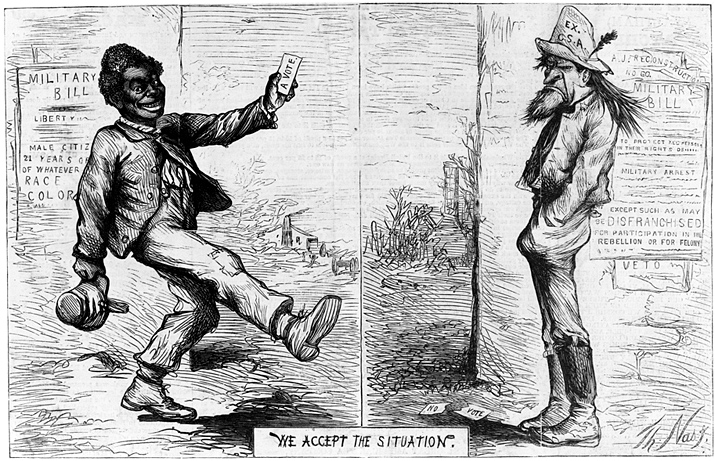
An 1867 Harpers Weekly cartoon by Thomas Nast, ridiculing both freedmen voting for the first time, and resentful, disenfranchised former Confederates.
Flake’s Bulletin, February 8, 1868, warning against planters being “fleeced” by the Freedmen’s Bureau.
In speaking of the aid offered by the Freedmen’s Bureau, the Galveston News says:
It is true that the planters are hardly pressed, and it is true that the bureau makes the offer of help without requiring interest. Yet the precaution taken for securing the principle and other things connected with it, should be looked into carefully before the offer is accepted. We frankly confess that some scheme for fleecing and oppressing the planters will be gotten up, in the hope that their great and pressing necessities will induce them to embrace it. And therefore we join the New Orleans Bulletin in advising the planters to examine every proffer of aid through the bureau with critical inspection before imposing responsibilities on themselves by its acceptance.
A man, named Wm. Shakespeare, once said something about “conscience making cowards of people.” Can the News remember the quotation?

And finally, from Flake’s Bulletin, January 20, 1869, giving a somewhat different account of the incident from the assailant, Tom Sherrard/Ross:
THE RICHMOND AFFAIR.
In the News of yesterday appears a card of R. J. Calder, Esq., County Judge of Fort Bend, half a column in length, in reply to a card of Capt. Rock, published in this paper. A gentleman requested us to copy the card of Judge Calder, which we are compelled to decline to do for the following reasons: First. Had Judge Calder desired its publication in Flake’s Bulletin, he would have addressed it himself to the bulletin, not to the News. Second. The card of Judge Calder is too lengthy. We have already published both sides of the affair, to wit: the card of Capt. Rock and the card of many citizens of Richmond, published in the 13th inst. But we append the affidavit of the negro [sic.], Tom Ross, the man who attacked and beat Capt. Rock, embraced in the card of Judge Calder:
STATEMENT OF TOM ROSS.
On the first night of January, 1869, there was a negro dance at Capt. Rock’s quarters in Richmond. I went to the dance, hearing that it was a free ball for the blacks. I remained there for a quarter of an hour, and then left. Returning a short time afterwards, I met Frances Lamar, a colored girl, who was kept by Capt. Rock as his wife. She was standing at the door; on seeing me she left and went to the Captain’s bed-room. Soon afterwards she and the Captain came out of the room; the Captain had a double-barreled shot gun behind him. The Captain approached me, and turning half-way round, said to me, “Take this,” meaning the gun. I stepped back from him, and told him, “I did not want it.” The Captain walked away and to some persons, and immediately approached me again. His woman asked him if he had heard what I said. On answering “no,” she told him that I said I did not want the gun. The woman had taken the gun from the Captain, and had it in her hand at this time. The Captain then said to me, “Do you see that door?” I answered “yes.” He said, “Then you take it, and that God d__n quick.” The fight then commenced by my striking him with my naked fist, having no weapon of any kind with me. While fighting, this woman attempted to shoot me with the gun, but was prevent by bystanders. The Captain getting the worst of it, I was taken off him, and I straightway left the house. No person had offered me money to whip the Captain, neither did I go there expecting a difficulty.
I was arrested and tried before a magistrate, Judge R. J. Calder, and fined $10 for fighting. I was born the slave of Judge John Brahsear, of Houston.
His
Tom X Ross
MarkThe State of Texas, Fort Bend County. —–
Personally came and appeared before the undersigned authority, Tom Ross, a freedman, who, being by me duly sworn, says that the forgoing affidavit, signed by him making his mark, and all the statements and allegations therein contained, are true.
In testimony whereof I hereunto sign my name and affix my seal of office, this, 13th day of January, 1869.
R. J. Calder,
County Judge, Ft. Bend Co.
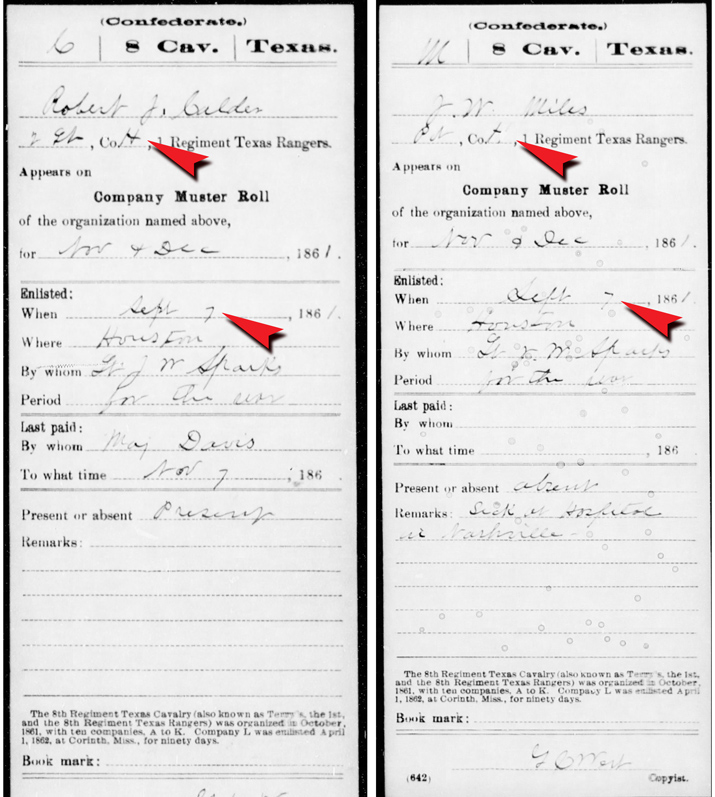
Here’s a fact that this news item omits: Judge Calder’s son, also named Robert James Calder, had enlisted on the same day, in the same company (Co. H), of the Eighth Texas Cavalry as Sheriff Miles (below). The two young men served together for a year before Miles’ discharge. The younger Calder was later made an officer, and was killed in action in January 1864. Does this fact have any relevance?
_____________

A Beating in Fort Bend County
The other day a commenter dismissed my argument about the importance of interpreting the historical evidence, and making a critical assessment of each bit of documentation that bears on a particular subject. Practicing history, I had said, requires making careful judgments about the sources at hand. “I make no judgments on [sic.] way or the other. . . ,” my correspondent assured me, “I just present the historical fact.”
 I thought about that little bit of self-deception this weekend when I came across two accounts of the beating of Captain William H. Rock (right), the Freedman’s Bureau Agent at Richmond, Texas, late on New Years’ Eve, 1868. Captain Rock was appointed to the bureau in June 1866, and in January 1867 was assigned to the office in Fort Bend County, west of Houston. Fort Bend lay at the heart of Anglo Texas, being part of Stephen F. Austin’s original colony, and was later home to several of the state’s largest plantations. At the time of the 1860 U.S. Census, slaves outnumbered free persons in Fort Bend County, two-to-one. By 1870, the ratio of “colored” persons to all others in Fort Bend was more than three-to-one.
One of the particular difficulties in writing about the Texas and the South in the immediate postwar period is that much of the press at the time was highly partisan, with individual newspapers closely aligned with specific political parties and candidates. During Reconstruction, Texas papers were particularly divided over the threat, and even the actual existence, of the “Ku Kluxes.” Some, like the Houston Union and the Austin Republican, spoke out early and vehemently against the group, while others insisted they were a myth, and argued that the violence and intimidation attributed to them were actually the work of Radical Republican groups like the Loyal League.
So here’s your chance to wade into two very different accounts of the same incident, published in different newspapers. How would you assess these two accounts? What might make you question the reliability of one or the other, and why? What makes your Spidey Sense tingle? What questions do you have after reading these, and how would you address them?

From the Houston Union, January 8, 1869
OUTRAGE AT RICHMOND, TEXAS
The Ku Klux Rampant! They assault and attempt to assassinate Capt. Rock, Agent of the Freedmen’s Bureau. – They leave him for dead.
From Capt. W. H. Rock, who has been living at Richmond, Fort Bend County, and acting as agent for the Freedmen’s Bureau for that county, we learn the following particulars of a most cowardly and brutal assault upon him upon the night of the 1st of January. The Capt. was first attracted by a noise about his premises, and glancing out of the window of his private room discovered a number of white men about his house. He immediately went from his private room to his office adjoining. On opening the door he was knocked down by an unprincipled negro [sic.] named Tom Sherrard, who he afterwards learned had been employed by the Ku Klux to do the deed. After knocking the Capt. down, a couple of the Klan filed into the room, and standing between a colored man who had come to the Capt.’s rescue and the prostrate Capt., permitted the black ruffian to kick and beat him until it was supposed life was extinct. The names of the white men so far as known to Capt. Rock, who participated in this brutal assault upon a representative of the United States Government, are James McGarvey, Joe Johnson, and the Sheriff of the county, one J. W. Miles. The two former, with drawn six shooters, prevented aid from Capt. Rock’s friends, while the latter was heard to remark as they left the house, “it was well done,” supposing, of course, that Capt. Rock was dead. Life, however, was not extinct, and after departure of the murderous crew, his friends succeeded in caring for, and restoring him. Knowing that if it was found out he was alive, they would return, Capt. Rock secreted himself in a neighboring hen-coop, where he remained until next morning, when he made complaint to the chief justice of the county, but perceiving the signs about him and the information brought to him by trusty colored men, that his life would pay the forfeit of an appearance against the parties, Capt. R. concluded to leave the place. Accordingly, Saturday night he secreted himself in the cabin of a friendly colored man, where he remained until Sunday night. In the meantime, the country round about was scoured, and every negro cabin entered and searched, but in vain. His hiding place was secure. While this secreted, word came to him that Capt. Bass, the County Assessor and Collector had made threats to shoot him on sight. Sunday night the 3d., he started to get across the Brazos. Monday night found him across, but without means to getting to Houston some thirty miles away., as the colored people in the whole neighborhood had been visited and their lived threatened if they gave him any assistance in escaping. Monday and Tuesday thus passed away, and as good luck would have it, a horse was procured and after riding all night the Capt., arrived safely in Houston covered with mud and disfigured and sore by bruises.
We are assured by Capt. Rock that the above statement is a true narrative of this great outrage and that it can all be sustained in a court of justice, or before a military commission. The colored men who all know the facts of the case, would not dare to testify in any court at Richmond without the presence of troops. One of them, expressing sympathy for Capt. Rock, was most cruelly beaten, and subsequently, at night, taken from his cabin and beaten until he was supposed to be dead, after which, tieing [sic.] a rope about his neck, he was dragged to an out of the way corner and left for dead.
Other outrages have been committed recently in this delectable town. Last Sunday a band of young rowdies went to the church where the colored people were holding [a] religious meeting, and literally drove them out, and broke up the meeting.
The teacher of the colored school in Richmond, has been driven away, and violence and treason stalks abroad in all its hideous deformity.
This is a terrible picture, and we shall be denounced for exposing it to the public; but the truth is not half told. In truth, there is not a loyal man in the town of Richmond. As an example, a prominent merchant there, named Greenwood, and the express agent, one Albertson, openly avowed they would spend their money freely to prevent the hired ruffian, Sherrard, from being brought to justice. We call upon the managers of the Express Company in this city to remove this man, who thus, by his means and influence, encourages the commission of outrages upon representatives of the Government.
Capt. Rock has often signified to the commanding General the necessity of stationing troops at Richmond. He has for a long time been cognizant of the disloyal disposition of the people there, and knew that as soon as the Bureau was discontinued the rights of the colored people would be utterly ignored, which he now informs us is the case. They are intimidated, brow beaten and worried, and unless a stop is put to it, a fearful outbreak ere long will be the consequence.
An official report of the state of affairs in Fort Bend county will be made by Capt. Rock to Gen. Canby, and we hope and trust the latter will send sufficient troops there to bring all concerned in this affair to justice, as well as protect the loyal men of the county from the malignant persecutions of the Ku-Klux cut throats.
The town where public sentiment permits such outrages as narrated above, should be put under military government and kept there until its return to good behavior makes it safe to remove it.

A week later, on January 16, 1869, Flake’s Bulletin in Galveston published a rebuttal signed by prominent members of the Richmond community, including two men implicated in the previous article, Sheriff J. W. Miles and Express Agent William H. Albertson:
ATTACK ON THE FREEDMEN’S BUREAU AGENT AT RICHMOND.
Special to Flake’s Bulletin.
Houston, Jan. 7 – Capt. Rock, lately in charge of the Freedmen’s Bureau at Richmond, has just arrived in this city, having ridden from that place last night, in order to escape the pursuit of a band of desperadoes in that county. – He was attacked, badly beaten, and was left for dead. His present appearance is sufficient evidence of the treatment to which he was exposed. The outrage occurred on the night of the 31st ult. and the 1st. inst. The majority of citizens deplore the act, and assisted the Captain to escape.
Flake’s Bulletin, Jan. 8.
We desire to speak in defence of our county, and give a truthful account of the subject in the above extract.
Capt. Wm. H. Rock, Sub-Assistant Commissioner of the Bureau of Refugees, Freedmen and Abandoned Lands, lived in this county for about two and a half years, and during that time was regarded with favor by nearly all the citizens. Several decisions of his bore heavily with some, but they, as well as the public, were charitable enough to attribute the same to the evil machinations of the “ardent,” instead of any ill feeling that the Captain possessed; and towards the close of his administration it was often remarked that he had made about as good an officer of the kind as we probably could have gotten. Many regretted that his office compelled one who seemed so much a gentleman to associate with freedmen to the exclusion of whites.
Well, the Bureau collapsed, and when Captain Rock became free – no longer obedient to his masters – it was expected that he would assert his rights, and fully justify the good opinion that had been formed of him; but his actions on the event proved most conclusively that his just, and even willing disposition to deal fairly with the whites was caused alone from fear, and that the “nigger” was in him from the first, but for that aforesaid fear. Now comes the cause for which this Sabraite was forced to flee the land, as alleged above. During Christmas week Capt. Rock, having no further use for an office, converted his establishment into a ball room, and darkey maidens, accompanied by African beaux, held nightly revels to sweet sounds of music. It was at one of these lovely affairs that Tom Sherrod, a very worthy freedman, attended – not, however, without an invitation from “Captain and Mrs. Rock,” in writing. This last personage, a dark and bony [bonny?] Venus, formerly the property of one of our citizens. Previous to the time, Capt. R. had insulted the wife of Tom, yet he (Tom) went to the ball, was ordered out, and it is reported that Capt. R. drew upon his a double-barreled gun, and that Tom was acting in self-defense.
This may be so or not; certes that Tom demolished the valiant captain in the presence of the whole party. Now we firmly believe that no jury in the United States would have convicted this boy Tom, or any other man, for chastising the brute who insulted his wife, even had the charge been murder instead of simply assault.
Upon the following day Captain R. made an affidavit that Tom had assaulted him with brass knuckles, and a warrant was issued for his arrest; in the mean time a distress warrant was issued, and Capt. Rock’s furniture, etc., was attached for house rent, and he left in charge of same – not being able to vacate on account of the wounds from which he was still suffering. That night, though, the attached articles were conveyed, under cover of darkness, to some unknown place, and the captain ditto, no one knows where, and few except his creditors care. He leaves many debts behind, due to both whites and blacks. The latter he deceived by telling them he was going to Austin after troops, while the former knew he was making tracks from the countless hundreds of dollars which were pressing him.
This is but a meagre account of all the acts of Captain Rock in this place, and we would have preferred his departure from our midst in silence, and would have done so except for the flagrant falsehoods contained in the above extract.
Since writing the above we learn that the freedman Tom was arrested and tried yesterday, and was fined ten dollars and costs.
C. H. Kendall, D. C. Hinkle, J. W. Miles, W. C. Hunter, Geo. O. Schley, E. Ryan, G. W. Pleasants, S. R. Walker, Ed. D. Ryan, W. Andrus, T. J. Smith, G. F’ Cook, J. P. Marshall, H. L. Somerville, R. F. Hill, B. W. Bell, G. M. Cathey, J. T. Holt, Chas. C. Bass, Alex Curr, Wm. Ryon, W. K. Davis, J. H. Hand, N. G. Davis, S. Mayblum, H. Jenkins, W. H. Albertson.
The statement of the foregoing extract is not true.
W. E. Kendall, B. F. Atkins
Why did not Captain Rock pay me his board bill, and settle with the Union League for money of theirs that he used for his own purposes?
W. P. Huff, Member Union League, Fort Bend Co.
______________
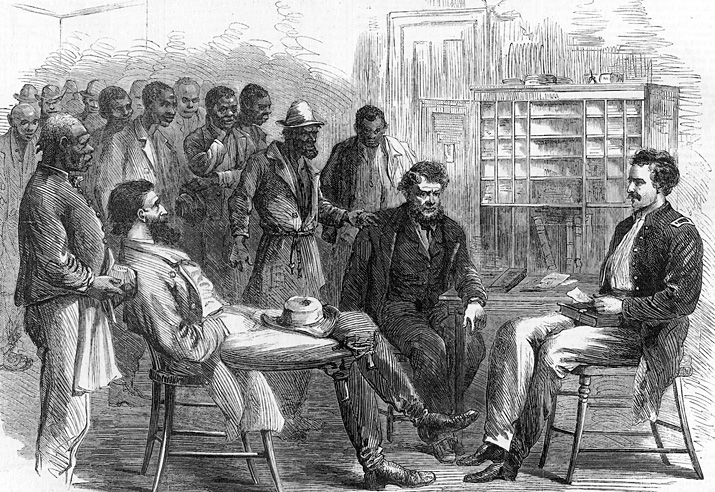
Image: The Freedmen’s Bureau at Memphis, c. 1868. William H. ROck CDV portrait via Cowan’s Auctions.

McDonnell’s Office Silent on Civil War Month Proclamation

Readers will recall that, last September 24, Virginia Governor Bob McDonnell announced that beginning in April 2011, that state’s Confederate History Month will be replaced by Civil War in Virginia Month. Needless to say, he caught hell for it at the time, and months later there was still grumbling from the usual suspects. Here is what McDonnell said in September:
I was far less successful in capturing the full meaning of our history when, four months later, I issued a proclamation concerning Confederate History Month. My major and unacceptable omission of slavery disappointed and hurt a lot of people, myself included. Young people make mistakes, and I suppose sometimes young administrations do as well. Ours was an error of haste and not of heart. And it is an error that will be fixed.
Next April our office will issue a “Civil War in Virginia” proclamation commemorating the beginning of the Civil War in our state.
This proclamation will encapsulate all of our history. It will remember all Virginians—free and enslaved; Union and Confederate. It will be written for all Virginians.
Well, it’s April 1, 2011. I called the Governor McDonnell’s office late Friday afternoon and the gentleman who answered the phone professed no knowledge one way or another whether such a proclamation would be forthcoming. He suggested I keep checking the website or sign up for e-mail notices to see when — and if — such a proclamation is made.

Update, April 6: The governor’s proclamation is out, and at first read, it hits just the right note:
Civil War History in Virginia Month
WHEREAS, the month of April is most closely associated with Virginia’s pivotal role in the American Civil War; it was in April 1861 that Virginia seceded from the Union following a lengthy, contentious and protracted debate within the Commonwealth, and it was in April 1865 that the War was essentially concluded with the South’s surrender at Appomattox. In the four years that fell between those momentous months, Richmond served as the capital of the Confederacy, and it was on Virginia soil that the vast majority of the Civil War’s battles were fought, in places like Manassas, Malvern Hill, Fredericksburg, Chancellorsville, the Wilderness, New Market, Cold Harbor, and Petersburg, locations now forever linked with the indelible history of this perilous period; and
WHEREAS, the largest wartime population of African-American slaves was in Virginia, yet through their own acts of courage and resilience, as well as the actions of the United States army and federal government, they bequeathed to themselves and posterity a legacy of freedom; and
WHEREAS, slavery was an inhumane practice that deprived people of their God-given inalienable rights, and the Emancipation Proclamation and the Civil War ended its evil stain on American democracy and set Virginia and America on a still-traveled road to bring to fruition the great promises of the Declaration of Independence, the Constitution, and the Bill of Rights, and ensure that all Americans have the opportunity to enjoy equally the blessings of liberty and prosperity; and
WHEREAS, the military leadership and tactics of Virginians like Confederate Generals Robert E. Lee and Thomas J. “Stonewall” Jackson and Union General George Henry Thomas are still studied, analyzed and discussed today; the heroism of brave individuals like William Harvey Carney, who was born a slave in Norfolk, gained his freedom through the Underground Railroad, and received the Medal of Honor for his valor as a Union soldier at the battle of Fort Wagner, inspires us through the ages; and the Commonwealth is the final resting place of thousands of Union and Confederate soldiers; the many cemeteries in which they lie reminding us of the cost and pain of the War and telling the stories of those who fought; and
WHEREAS, following the War, Virginia began the difficult process of returning to a nation that was, in many ways, born within her borders; that transition was aided by the actions of leaders like General Robert E. Lee who set the strong personal example of reconciliation and grace crucial in helping the people of Virginia return peacefully to the Union, instructing Virginians to “….abandon all these local animosities and make your sons Americans.”; and former Dinwiddie County slave Elizabeth Keckley who returned to Virginia as a guest of President Lincoln and expressed forgiveness and conciliation stating: “Dear old Virginia! A birthplace is always dear, no matter under what circumstances you were born”; and
WHEREAS, the General Assembly of Virginia created the Virginia Sesquicentennial of the American Civil War Commission in 2006 “to prepare for and commemorate” the Commonwealth’s participation in the war; and
WHEREAS, from 2011-2015 a diverse and growing Commonwealth will host innumerable public events, lectures, re-enactments, seminars, and remembrances covering every aspect of the war, and no state is more closely connected to this pivotal period of American history, and therefore no state is better suited to host visitors seeking to learn about the Civil War, the Confederacy, slavery, emancipation and the full history of our United States, and for that reason Virginia encourages visitors from across the country and the world to visit the Commonwealth during this period,
NOW, THEREFORE, I, Robert F. McDonnell, Governor of Virginia, do hereby recognize April 2011 as CIVIL WAR HISTORY IN VIRGINIA MONTH, and urge all Virginians to participate in commemorations of the war’s 150th anniversary and reflect upon the lives of the courageous men and women of those difficult times by attending seminars and conferences, and by visiting battlefields, cemeteries, exhibitions, historical markers, libraries, museums and historical sites throughout the Commonwealth, and by taking part in a diversity of events and activities that highlight our shared history and heritage, as we strive to enact the vision laid out in the preamble to the United States Constitution of “a more perfect union.”
Good on Governor McDonnell. Let the fireworks begin — in every sense of the word.
_______________
Image: Virginia Gov. Bob McDonnell addressing an audience at Norfolk State University on September 24, 2010, during which he announced that the state’s former observance of Confederate History Month would be replaced by Civil War in Virginia Month. Photo by Adrin Snider, Daily Press.





 Dead Confederates, A Civil War Era Blog
leave a comment