H. K. Edgerton to Seek Presidential Pardon for Ron Wilson


Much to my happy surprise, H. K. Edgerton responded to my recent post about Ron Wilson. He’s going to be requesting a presidential pardon for South Carolina con-man, because, um, too many people hold high regard for Abraham Lincoln, or something:

I am deeply grieved about what happened to the Honorable Ron Wilson and to those who were hurt by his actions. And I pray for them and for Ron equally. There are not many men who have not made serious mistakes in their lives. I shall never falter in my love and respect for Mr. Wilson, and shall never see him as a racist, or the other unkind things that take away from the content of his character that shall always deem him to be an Honorable man. If one chooses to make an Honorable man of Abraham Lincoln, then one should choose to seek a Presidential Pardon for Ron, and one for young Candice Yvonna Hardwick that I have already asked him for. And I care less about the unkind words spoken here about me. Christ and General Nathan Bedford Forrest had to endure worst.
 For those who don’t know, Candice Hardwick (above and right, via Mugshots.com) is a young woman from Latta, South Carolina. In 2006 she was suspended twice from school for wearing a Confederate flag shirt. She sued, and her case became a cause celebré among heritage groups. Just a few months ago, Edgerton participated in a ceremony presenting Hardwick with a medal for her heritage activities. Nonetheless, her case was dismissed in March and three months later, in June, she burglarized a home in Latta and stole eight firearms. In August she was sentenced to six years in prison, but will likely be out in three.
Hardwick’s story is a sad one, and I’m not unsympathetic to it, but it’s not one that represents a gross miscarriage of justice. There are lots of people serving longer sentences, for lesser crimes, than either Hardwick or Wilson. And the notion that Ron Wilson is “an Honorable man” who simply made a “serious mistake” that should not reflect on “the content of his character” is one of the more preposterous things Mr. Edgerton has said over the years.
As to the “unkind words spoken here” about Mr. Edgerton, it’s actually more serious than that. I’ve directly challenged claims made by Edgerton and others that his organization, Southern Heritage 411, actually holds non-profit status, or that contributions to it are tax-deductible. I can find no evidence that either of these things are true. I’m no lawyer, but I can’t help but think that if Southern Heritage 411 is, in fact, the for-profit corporation that it claimed to be in filings with the Georgia Secretary of State, Mr. Edgerton has made a very “serious mistake” of his own.
As always, of course, Mr. Edgerton is welcome to provide documentation that I’ve got this non-profit stuff all wrong. But I don’t think I do.
_________


Alcohol May Have Been Involved. . . .
Over the weekend by colleague, Ed Cotham, offered a sesquicentennial story about a one-armed Confederate scout, collecting intelligence on the position of Union forces in Galveston. It was very nearly disastrous:

As he approached The Strand area, Barnett was carrying a shotgun in his remaining arm. He was also apparently well-fortified with spirits for his scouting assignment. As news reports today might hint, it was strongly suspected that “alcohol may have been involved.” On this night, that decision almost cost Barnett his city and his life. Galveston was in the possession of the Union, the Federal Navy having captured the city in early October. But the Union presence remained almost exclusively a naval one. The infantry forces assigned to Galveston would not arrive for several more weeks. There were, however, a few Union marines acting as sentries along the waterfront. On this occasion, Barnett did not move with the stealth that his job required and was unlucky enough to be challenged by one of the understandably nervous sentries to identify himself. Barnett told the sentry undiplomatically to go to the nether regions and matters went from bad to worse. The two exchanged several off-target shots. Barnett later claimed that he had only fired his shotgun once. This noise, however, drew the attention of the Federal gunboats in the harbor, which became convinced they were being attacked and began firing randomly into the darkened city.

________
Sunday Night Concert: “Pay Me My Money Down”

In 1944 Alan Lomax recorded a song, “Pay Me,” sung by African American stevedores in Brunswick, Georgia. In 1960 Lomax wrote:
They bellowed songs as they hoisted, heaved and screwed down their cargoes, as had twelve generations of their forebears. By the 1940s, however, their songs were no longer nostalgic or oblique. . . . [Their songs] said directly and openly what they thought, and their song has proved enormously appealing to young people all across America.
The song, with a simple melody and simpler lyrics, became a popular his during the folk music revival of the late 1950s and early 1960s. One of the young people Lomax was talking about in the early ’60s was a kid from Freehold Borough, New Jersey named Bruce Frederick Joseph Springsteen. He revived the song a few years ago for his Seeger Sessions Band. Their cover may not sound much like the one Lomax heard in Brunswick sixty-odd years before, but it is guaranteed to lift your spirits.
[This is a repeat post from September 2011, because today I heard someone butcher this song. This repeat will help get that out of my head.]
_____________

Fighting Upon His Own Hook
From an unsourced newspaper clipping, found in a scrapbook compiled by English phrenologist George Burgess (1829-1905):
FIGHTING UPON HIS OWN HOOK. – A Kentuckian, who disdained the restraints of a soldier’s life, with his name on the muster-roll, preferred “going it alone,” fighting upon his own hook. While the battle was raging fiercest, and the shot flying thick as hail, carrying death wherever they fell, Kentuck might have been stationed under a tall maple, loading and firing his rifle, as perfectly unconcerned as though he was “picking deer.” Every time he brought his rifle to his shoulder one of the enemy bit the dust. A general officer, supposing he had become separated from his company, rode up to bring him behind the redoubts, as he was in a position which exposed his person to the fire of the enemy. “Hallo, my man! What regiment do you belong to?” said the general. “Regiment!” answered Kentuck. “Hold ‘em, yonder’s another of ‘em.” And bringing his shooting-iron to his shoulder, he ran his eye along the barrel – a flash followed, and another of the enemy came tumbling to the ground. “Whose company do you belong to?” again inquired the general. “Company be banged!” was the reply of Kentuck, as he busied himself re-loading. “See that ar fellow with the gold fixins on his coat and hoss. Jist watch me perforate him.” The general gazed in the direction indicated by the rifle, and observed an officer riding up and down the advancing columns of the foe. Kentuck pulled the trigger, and another officer followed his companions that Kentuck had laid low in the death that day. “Hurrah for Kentuck!” shouted the free fighter, as his victim came toppling from his horse; then turning to the general, he continued, “I’m fighting on my own hook, stranger,” and leisurely proceeded to reload.
_________

Ron Wilson: Putting the “Con” in Confederate Heritage

Ron Wilson applauds during the opening ceremonies of the Sons of Confederate Veterans conference on July 22, 2010, at the Civic Center of Anderson, South Carolina. At this point, Wilson was almost a decade into his $57M ponzi scheme. Image via IndependentMail.com.

A couple of weeks ago Ron Wilson, former National Commander-in-Chief of the Sons of Confederate Veterans, was sentenced to more than 19 years in the federal penitentiary for running a $57 million ponzi scheme. The sentence of 235 months was at the top of a range recommended by a pre-sentencing report filed with the court.
This story hasn’t made many national headlines, but it should rightly shake the Confederate Heritage™ movement to its foundations. Ron Wilson was one of the hard-liners that came to prominence within the SCV in the early 2000s, bent on a more aggressive, politically-engaged course for the group, which echoes right down to the present. In fact, Wilson led the charge and , once in office, ruled with an iron fist, purging moderate members and even entire camps from the organization. The ascension of Wilson and like-minded partisans led to a split within the organization and the founding of a separate group called Save the Sons of Confederate Veterans.
Ponzi schemes invariably rely on personal relationships, shared interests and trust to be successful. That was true of Bernie Madoff, it was true of R. Allen Stanford, and it was true of Ron Wilson. In Wilson’s case, a big part of his personal connections were through Confederate heritage groups. Wilson was so wrapped up in Civil War heritage issues that he made it part of his sale pitch to separate people from their life savings:
[Former South Carolina State Representative Dan] Cooper never invested with Wilson. “I never had any money to invest,” he said. Cooper attended a meeting in Greenville in 1992 at which Wilson pitched people on investing in silver. The pitch changed little in the 20 years between then and Wilson’s last meeting in March, before state officials made public their accusations that his business was a fraud. “He talked about how the value of the dollar was unpredictable, not backed by gold,” Cooper said. Recent investors say they often heard Wilson describe how a $20 gold piece bought a fine suit in the 1860s, just as it would today despite the increase in price of the suit, because of the increase in the value of precious metals.
Wilson made money, too, through the sales of books, including some particularly rancid titles. But he didn’t just sell them; he endorsed them, too:
One controversial book was “Barbarians Inside the Gate” by a discredited 1960s Defense Department official. The book is rife with anti-Semitic language and quotes frequently from The Protocols of the Elders of Zion, which claims to expose a Jewish plot to take over the world. Wilson promoted the book by saying on his website: “The author reveals concealed codes and goals that might be extracted from the Protocols of Zion. I thought long and hard about handling this book. I will not back away from the truth in this book. You MUST READ THIS BOOK for yourself.”
Wilson was a major player in local politics in Anderson County, and donated heavily to other candidates. He didn’t seem too concerned about the particulars of the laws concerning such contributions, so long as he backed a winner:
After the March 31 election, Putnam won a runoff against Hamp Johnson. “Ron was always the kind of guy who gave money to whomever looked like was going to win,” Putnam said. “He came to me. I never met with Ron. He wanted to give $1,000 of his personal money.” For the runoff, Putnam said Wilson offered $4,000. “In election laws, you can only give up to $1,000 per individual,” Putnam said. “We turned that down because we didn’t want to take that much money from one person.” Records with the South Carolina Ethics Commission show that several Anderson County politicians received donations from Ron Wilson as well as businesses he owns. These businesses — Atlantic Bullion & Coin in Easley and International Commerce Corp. in Greenville — both list Ron G. Wilson as the registered agent, according to South Carolina Secretary of State records.
Even so, some South Carolina Republicans couldn’t stand him, one blogger referring to Wilson as being “more fascist than Republican.” (Be sure to check out the comments for threats to the blogger posted by Wilson’s supporters — classy folks.) Wilson remained prominent in local Confederate heritage circles, andapparently hawked his dubious investments among his butternut friends. Wilson has a history of skeevy business dealings dating back to his tenure as a local elected official, some of which involved steering favors to his SCV buddies. As far back as 1996, Wilson had been given a cease-and-desist order by the State of South Carolina to stop dealing in securities. But that order was not made public, so Wilson simply ignored it. He continued operating his precious metals business, albeit more quietly than before. He slipped under the radar of state regulators and the SEC for the next fifteen years.
Over the last decade, Wilson seems to have been particularly close to the odious Kirk Lyons and his Southern Legal Resource Center. Wilson and Lyons organized a big Confederate flag rally in South Carolina in 2000, and not long afterward Wilson was added to the board of Lyons’ SLRC. Wilson helped Lyons get elected to the SCV board in August 2000, and the next year Lyons hired Wilson’s daughter to work as a case manager at the SLRC. Even after his tenure as Commander-in-Chief, Wilson continued to hold senior positions in the group, including as “Director of Field Operations.” In 2008 he shared the dais with current SCV C-in-C Michael Givens, where they were both received the organization’s Commander-in-Chief ‘s Award (PDF).
 Of course, Confederate activist/performance artist/beard H. K. Edgerton (right, with Wilson’s grandkids in 2004, via Lyons’ SLRC website), thinks Wilson is just a fantastic guy. When Wilson was appointed to the South Carolina Board of Education a few years ago and critics pointed out his ties to groups like the the Council of Conservative Citizens and the white nationalist League of the South, Edgerton jumped his defense, saying that “black students and parents do not have a better friend in South Carolina that Rob [sic.] G. Wilson.”
Of course, Edgerton has problems of his own when it comes to misrepresenting his business, so maybe his endorsement of Wilson is not so surprising after all.
Investigators found that Wilson’s ponzi scheme began in 2001, the year before he took over the leadership of the SCV; his criminal activity was concurrent with his tenure in that position. And he hurt a lot of people:

Dressed in a suit and tie, [Wilson] walked into the courtroom just before the sentencing hearing. He walked quietly past investors who filled many of the 18 wooden benches and who arrived more than a half hour before the court proceeding. They trickled in one or two at a time, many older and walking slowly. One wore a baseball-style hat that said “Korea Veteran.” Seven investors testified about devastating financial losses that stripped retirement and savings accounts and left them struggling to pay bills. Some said they were trying to go back to work in their 70s. “My future is dimmer than it was,” Roslyn Stoddard told Childs. Jeffrey Cavender, 59, said he convinced his 86-year-old mother to invest with Wilson. He lost his retirement savings and felt “complete emptiness” when Wilson’s business was raided by federal officials, Cavender said. He urged the judge to “put Mr. Wilson away for good.” John Brittain, 76, said more than money was involved for investors. “He stole their hopes. He stole their dreams,” Brittain said of Wilson.
Some people will undoubtedly claim that I’m unfairly criticizing folks like the SCV, Lyons, Edgerton, et al. by simple association. That would be true if (1) Wilson’s bad acts were limited and clearly an aberration from the norm, or (2) the others’ connections to Wilson were limited and superficial. Neither of those things are true.
Wilson’s brother has been quoted as saying that Ron Wilson made a “terrible mistake.” It was terrible, all right, but it wasn’t a mistake. Shoplifting a CD from a store is a mistake. Speeding when you don’t think you’ll get caught is a mistake. Getting so angry that you momentarily lose your composure and clock somebody, that’s a mistake. Cooking the books for ten years is not a mistake. Lying over and over and over to your investors for over a decade is not a mistake. Using the proceeds from your ponzi scheme to build an elegant, private compound out in the country is not a mistake. Wilson’s actions over more than a decade don’t reveal a character flaw, so much as they reveal his actual character.
The folks I’ve mentioned here are not causal acquaintances of Ron Wilson. Up until last March, when the investigation to Wilson became public, these folks were quite happy to be associated with Wilson. They embraced him publicly, personally and professionally. They did favors for him, and got favors in return. This was all concurrent with Wilson running his Ponzi scheme, as well. Until last March, when news of the investigation broke, they were happy — eager, even — to be publicly identified with Wilson.
Since then, of course, not so much. As far as I can tell, none of these folks have said anything about this publicly, and it’s not been mentioned on any of the Southron Heritage™ online discussion boards or forums I’ve seen. That’s unfortunate, because they’ve had eight months now to reflect on their close personal and professional relationships with this crook. The Southron Heritage movement used Wilson to further its goals, and it’s clear that he actively used his own prominence with the SCV and elsewhere to draw in his victims. The Southron Heritage movement was an unwitting accomplice in Wilson’s crime, and now should be doing some serious soul-searching to figure out how such a fraud rose to the pinnacle of their movement.
They won’t, of course, because they’re not interested in rooting out reprehensible characters like Wilson in the their movement. Indeed, they embrace them, and give them prestigious awards (PDF). Sure, they’ll scream bloody murder about black Confederate “deniers,” and supposedly Marxist professors, and fluff each other into a resentful outrage because someone, somewhere, sometime, torched a paper flag, but when crooks in their own ranks leading their organization like Ron Wilson are found out by others, the noble Defenders of Southron Honour™ remain as silent as the grave.
Wilson plead guilty back in July, so barring some unexpected development, there will be no appeal. Wilson can look forward to to getting out of jail sometime in 2029 or thereabouts, when he will be around 82 years old. He’ll still owe restitution then, of course, so maybe he’ll get a greeter job at the Walmart Supercenter there in Easley. No doubt some of his very elderly former investors will be his co-workers there. I’m sure they’ll have lots to talk about.
___________
Foote’s Civil Way Trilogy Available for Download
Update, August 2014: These appear to have been taken offline.
______________
Courtesy of user KHolland over at Civil War Talk, all three volumes of Shelby Foote’s Civil War trilogy are available for download, in several formats (PDF, ePub, Kindle, etc.). Here are the links:
Volume 1: From Sumter to Perryville
Volume 2: Fredericksburg to Meridian
Volume 3: Red River to Appomattox
Note that Archive.org has the files of Vols. 2 and 3 reversed, so when you follow the links it will look like the wrong one. But they’re both there.
Enjoy!
_____________
Spielberg’s Lincoln: Reading the Movie
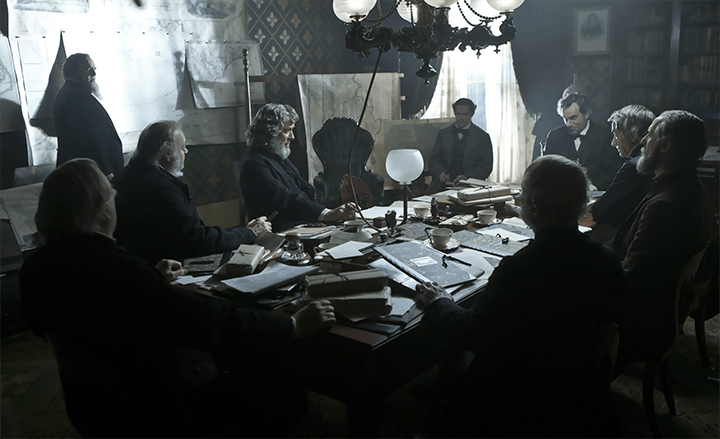

I finally got to see Spielberg’s Lincoln, and it very much lives up to the hype — as improbable as that sounds. I plan on going back to see it again once more in the theater; there are undoubtedly a lot of small touches and bits of dialogue that I missed the first time through. I might write a little about my own thoughts on the film, once they’ve simmered a while, but there’s been so much already written about it by smart and perceptive folks that I’d like to point to a few other reviews and comments on the film that I found worthwhile.
Over at Past in the Present, Michael Lynch marvels at Lincoln brought to life in Daniel Day-Lewis’ performance:
It’s not just that Day-Lewis disappears into the role. It’s that his Lincoln is so complete. We’ve had excellent movie Lincolns before, but I don’t think anyone has captured so many aspects of his personality in one performance. You get the gregarious raconteur as well as the melancholy brooder, the profound thinker as well as the unpolished product of the frontier, the pragmatic political operator as well as the man of principle. He amuses the War Department staff with off-color jokes in one scene, then ruminates on Euclid and the Constitution in another. It’s the closest you’re going to get to the real thing this side of a time machine, a distillation of all the recollections and anecdotes from Herndon, Welles, and the other contemporaries into one remarkable character study.
This actually sneaked up on me. I was sitting there thinking how awkward and ungainly he looks sitting a horse, and realized — but that’s how Lincoln’s contemporaries actually described him. Then I noticed the flat-footed gait, the gangly posture, all true to the character. Above all, he comes across on the screen as tired, bone-weary, but nonetheless focused and determined. Quite remarkable.
A good bit of attention has been given to the absence of Frederick Douglass in the film, particularly by historian Kate Masur in her review in the New York Times. I’ve mentioned before elsewhere that Douglass and Lincoln did not meet face-to-face during the January/February 1865 timeframe of the film, and that Douglass was never part of Lincoln’s inner circle of advisors at any point. But Hari Jones, Curator of the African American Civil War Museum, goes further, arguing (via Jimmy Price) that working Douglass into the script regardless would serve mainly to please modern sensibilities, while doing considerable violence to the historical record:
As for Masur’s criticism of the film, she admits that it is not historically based. Her criticism is simply a question of interpretive choice, which actually means the historical fiction she prefers for the sake of inclusiveness “even at the margins,” and Douglass is her recommended Negro “at the margins.” Douglass was an advisor to Lincoln many such scholars argue. Yet, to be fair to Masur, she only said he attended the inaugural ball in March 1865. Though many scholars assert that Douglass was the leader of the African American community during the war, he was not. Douglass was the editor of a journal read by more European Americans than African Americans. The young African Americans who fought in the Civil War were more likely to read the journal edited by Robert Hamilton, the Anglo-African, than they were to read the Douglass’ Monthly. Masur’s interpretive choice would have placed Douglass in the movie because she does not know who else to put in the frame. I would love to know the professor’s opinion on the movie Glory, a grossly historically inaccurate film. My guess is that she probably compliments the director’s interpretive choice because Douglass was included in that film. He attended a fictitious party at the fictitious Shaw mansion in Boston and was engaged in a fictitious inner circle conversation with Robert Gould Shaw about fighting to free the Negroes. Such fiction is justified because it reveals “a world of black political debate, of civic engagement and of monumental effort for the liberation of body and spirit,” suggesting, of course, that we must make up such stories. Masur’s criticism of Spielberg’s Lincoln demonstrates a propensity common among many contemporary scholars who seek to provide a view of history (an interpretive choice) that is in fact tokenism. Simply stated if they do not know the Negro who really did something related to the subject matter, they put the most famous Negro of the time, their super Negro, in the story simply to have a Negro in the inner circle. Among contemporary scholars, Frederick Douglass is the affirmative action Negro of the Civil War. I wonder if he would be fond of that dubiously esteemed position.
Kevin was glad to see the ugly political debate behind the 13th Amendment, which presents a view of mid-19th century white Northerners that historians know, but the general public often does not:
What I loved most about the movie was the debate on the House floor. I’ve said before that one of the most difficult things to teach is the pervasiveness of racism throughout the country at this time. This comes through clearly in the movie as politicians argue passionately about the consequences of emancipation for white Americans. Blacks will compete for jobs, marry white women, and perhaps one day even vote. While the movie effectively captures the importance of ending slavery the discerning viewer will also be left with the challenges that the nation still faces. For some it may even serve as a reminder of the level of violence witnessed in the north as tens of thousands of southern blacks made their way to cities at the turn of the century in pursuit of a better life.
Kevin also questioned a scene at the very beginning of the film, dialogue between Lincoln and two Union soldiers, one black and one white, that seemed forced and contrived — “ridiculous.” Bjorn Skaptason counters, arguing that the scene, although fictional, is both historically plausible and sets up the larger conflict of the film’s storyline:
I have seen the film just once, like you. I might have taken more away from that opening scene, though. I think the battle scene is clearly the U.S.C.T. soldier describing his experience as part of the 2nd Kansas (Colored) in the battle of Jenkins Ferry, Arkansas. Ken is right that there was a hand-to-hand fight there for a couple of guns during a driving rainstorm in a muddy, plowed field. The Second Kansas took no prisoners in that engagement. The soldier then goes on to describe a reasonable transfer scenario wherein he joined the 116th USCT in Kentucky, and now he is standing in front of the commander-in-chief at a wharf in Washington, D.C. Further, the infantryman is in company with a cavalryman who identifies himself as part of a Connecticut Volunteer regiment (the 5th?). That individual is much more aggressive in challenging Lincoln on the failures of his administration. The infantryman is visibly annoyed by this. There is rich subtext here for historians. The infantryman is a Kansas freedman, escaped from bondage in Missouri, and fighting to destroy slavery. He is thrilled to meet the Great Emancipator. The cavalryman is probably a free born New Englander, obviously well-educated, and committed to a mission of equality that Lincoln is distinctly failing at. He will not let Lincoln get away with empty promises and half measures. The unspoken conflict between these two soldiers, played out in annoyed sideways glances, foreshadows the conflict of the movie – a conflict between overthrowing slavery on one hand and establishing equal rights on the other. They aren’t the same thing, they weren’t perceived as such at that time, and the movie sets up that nuanced view of the situation in the first scene.
Finally, it’s worth everyone’s time to read Harold Holzer’s column over at The Daily Beast, “What’s True and False in ‘Lincoln’ Movie.” Holzer, who served as an historical consultant for the film, was concerned about getting grief for historical errors in the picture. That changed last week, he said, when the director gave the Dedication Day Address at the National Soldier’s Cemetery in Gettysburg:
For a few weeks, I haven’t known quite how I would respond. But yesterday at Gettysburg, Steven Spielberg provided the eloquent answer. “It’s a betrayal of the job of the historian,” he asserted, to explore the unknown. But it is the job of the filmmaker to use creative “imagination” to recover what is lost to memory. Unavoidably, even at its very best, “this resurrection is a fantasy … a dream.” As Spielberg neatly put it, “one of the jobs of art is to go to the impossible places that history must avoid.” There is no doubt that Spielberg has traveled toward an understanding of Abraham Lincoln more boldly than any other filmmaker before him. Besides, those soldiers who recite the Gettysburg Address may simply represent the commitment of white and black troops to fight together for its promise of “a new birth of freedom.” Mary Lincoln’s presence in the House chamber may be meant to suggest how intertwined the family’s private and public life have become. The image of “Old Tippecanoe” Harrison in Lincoln’s office may be an omen for his own imminent death in office. In pursuit of broad collective memory, perhaps it’s not important to sweat the small stuff. From time to time, even “Honest Abe” himself exaggerated or dissembled in pursuit of a great cause. Just check out the shady roads he took to achieve black freedom as “imagined” so dazzlingly in the movie. . . . Sometimes real history is as dramatic as great fiction. And when they converge at the highest levels, the combination is unbeatable.
If you haven’t yet, go see this movie. You won’t be disappointed.
______________Image: Lincoln (Daniel Day-Lewis) and his cabinet are briefed on the plans for the bombardment of Fort Fisher by Secretary of War Stanton (standing left, played by Bruce McGill).


Can Anyone Float Me $899,980 ’til Tuesday?
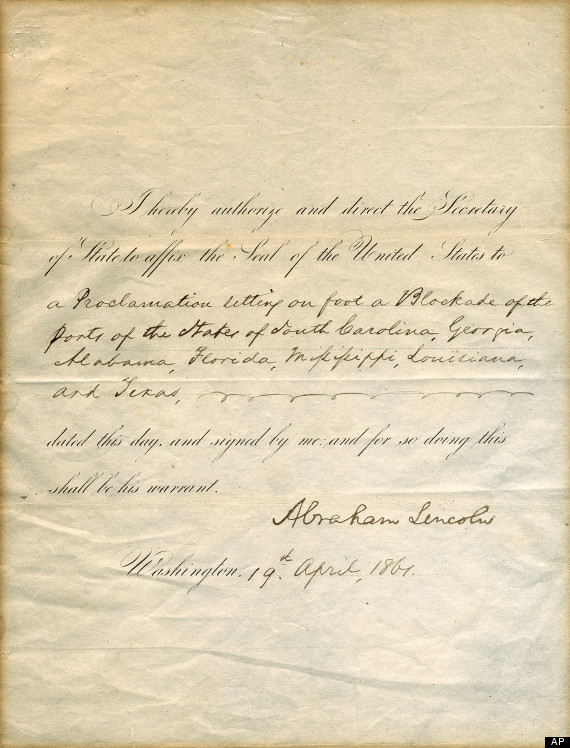

Looking for a unique and memorable gift for that Civil War buff who’s always so difficult to buy for? Look no further:
A document signed by President Abraham Lincoln ordering Union blockades of Confederate ports, marking the official start of the Civil War, is for sale. The Raab Collection in Philadelphia said Tuesday it is selling the document, which it calls one of the most important in American history. The asking price is $900,000. Lincoln’s proclamation is dated April 19, 1861 – a week after the first shots of the conflict were fired at South Carolina’s Fort Sumter. After the Civil War ended in 1865, the U.S. Supreme Court in an opinion ascribed Lincoln’s April 19 blockade order as the official beginning of the war. . . . The document, which has been owned by a private collector who wishes to remain anonymous, was exhibited recently at museums including the National Constitution Center in Philadelphia and the Abraham Lincoln Presidential Museum and Library in Springfield, Ill. The single-page manuscript authorizes Lincoln’s secretary of state to “affix the Seal of the United States to a Proclamation setting on foot a Blockade of the ports of the States of South Carolina, Georgia, Alabama, Florida, Mississippi, Louisiana, and Texas.” The seal was affixed to the blockade proclamation announced that day, effectively declaring war on the Confederacy.
Image: Associated Press

Jackson’s Rock
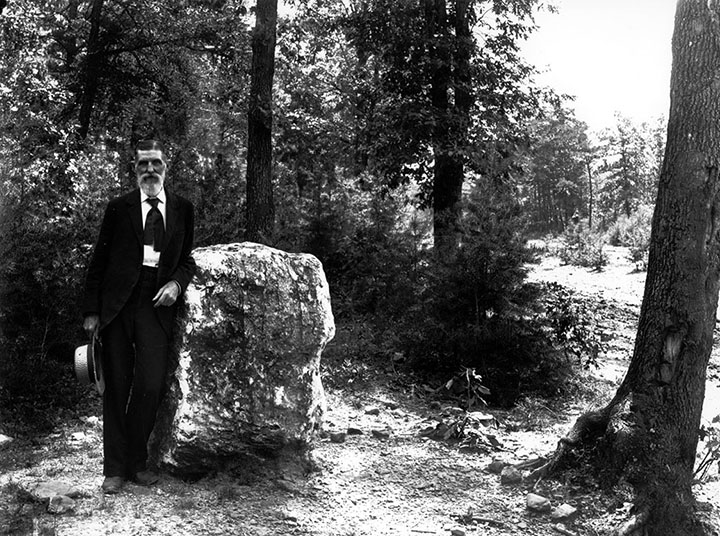
Over at the always-superior Mysteries and Conundrums blog, John Hennessey is finally able to tell the story of “Jackson’s Rock,” the white quartz boulder that purports to mark the spot where Stonewall Jackson was mortally wounded during the Battle of Chancellorsville. The rock has long been understood to have been the oldest monument in the park, but exactly when it was placed, and by whom, had been lost in the mists of time and memory — until now.
I really do have great admiration for this sort of micro-history, telling very small stories, very well. Hennessey and the NPS staff at Fredericksburg are masters at this. Well done, folks. (h/t Kevin)
______________
Image: 19th century image of Jackson’s Rock, via Mysteries & Conundrums blog.




15 comments