Canister!
Small stories that don’t warrant full posts of their own:

- The U.S. Department of the Interior recently named 27 new historic landmarks, including Admiral Farragut’s gravesite in New York and Black Jack Battlefield in Douglas County, Kansas, where abolitionist John Brown’s forces fought a pro-slavery contingent led by Henry Clay Pate.
- Jeanette Keith’s Fever Season, about the 1878 yellow fever epidemic in Memphis, doesn’t really sound like a fun read — but it does sound like an important one.
- So if you’re making a CW-themed movie about, oh, I don’t know — say, the sixteenth president — where do you go to get a dozen pieces of authentic artillery for the film set? Charlie Smithgall of Lancaster, Pennsylvania is your man.
- Margaret Mitchell’s novel Gone with the Wind is hugely popular in Pyongyang.
- Ann “Little Rebel” DeWitt observes that “the movie Lincoln disappoints Lincoln fans. As it turns out the movie isn’t much about slavery, but about Lincoln.” No, I don’t know what that means, either.
- The last known “real son” of a Confederate veteran living in Texas, Marion Wilson, died on Amarillo on November 11. He was 99.
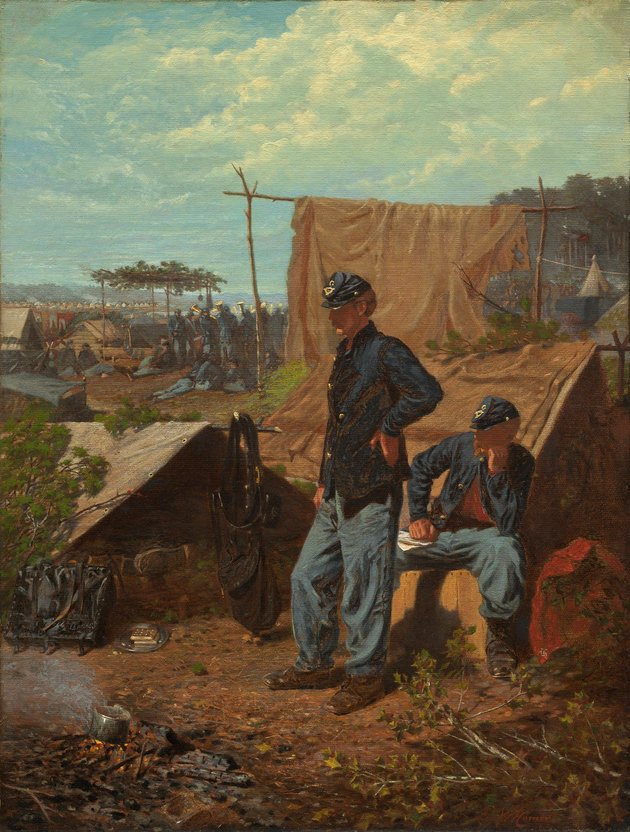
- Winslow Homer’s “Home, Sweet Home” (above) is one of the pieces shown in the new exhibit, “The Civil War and American Art,” at the Smithsonian American Art Museum in Washington.
- Looks like Alabama’s leading advocate for secession is some dude from Mobile who used to run a topless car wash.
- Channing Tatum (Dave’s kin?), star of “Magic Mike” (never heard of it) is supposedly the “Sexiest Man Alive” (um, OK), and apparently has a Confederate ancestor. Isn’t that special?
- Coy Matthew Hamilton may think twice next time about pilfering bones from a Civil War battlefield. (h/t Michael Lynch)
- This year is the 50th anniversary of Topps Civil War News trading cards.
- Archaeologists in Fredericksburg have unearthed a trove of historical materials in a previously-buried cellar.
Got any to add? Put ’em in the comments.
_________________

Steamboat Book Update and Review
My colleague Jim Schmidt, author of Galveston and the Civil War and other Civil War titles, interviewed me recently for his blog, Civil War Medicine (and Writing).
Also, Mark Lardas, a history author and book reviewer for the Galveston County Daily News, puts up his review of the Buffalo Bayou steamboat book. “Surprising and informative?” That works.
I’ll be signing books Saturday afternoon, Nov. 17, at the Galveston Bookshop from 2 to 4 p.m. I’d be happy to meet and talk with any blog readers in the area. If for nothing else, come and meet Gus. You’ll be glad you did.
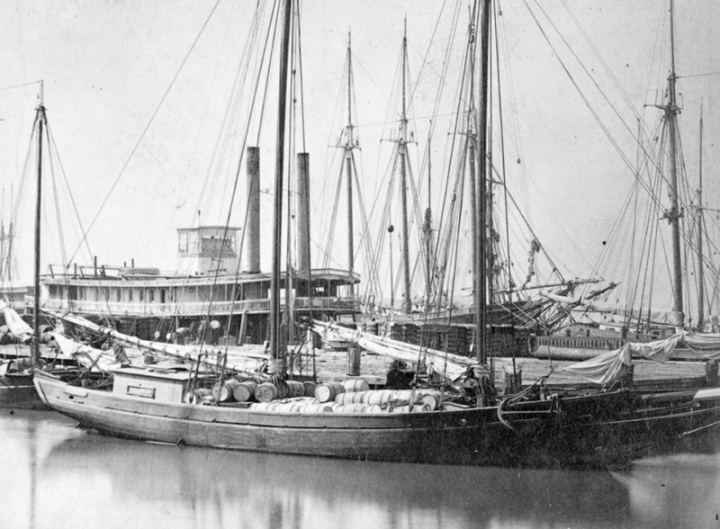
_____________Image: Unidentified sternwheel steamboat (background) at the Galveston wharf, circa 1875. DeGolyer Library, Southern Methodist University.

Passing of Dr. Charles Peery
 This morning I learned of the passing of Dr. Charles Peery of South Carolina, on October 6. He was 71. Peery needs no introduction to those interested in Civil War naval history or archaeology, as he was heavily involved in (and a contributor to) both those areas. It was an inquiry from Peery in 1995 that was the catalyst in locating, identifying and excavating the wreck of the blockade runner Denbigh, a project that continues to be a focus of research today. Peery was a surgeon, specializing in obstetrical and gynecological surgery, but Civil War history and shipwrecks were always the things he was most passionate about:
Peery graduated from Davidson College and earned an M.D. from Duke University. “Yet even while he was in medical school, he would find time to break away on weekends and come down to the coast,” Bright said.
Active in North Carolina diving groups, Peery was one of the young divers who aided in the excavation of the blockade runner Modern Greece in the early 1960s. He later joined work on other wrecks, including the Ranger and the Condor.
Later, with friends, Peery formed a maritime archaeology firm, MARS, to explore and excavate the wreck of the Ella, a blockade runner that was sunk off Bald Head Island in December 1864.
“It was more than just a hobby for him,” said Gordon P. Watts Jr., a marine archaeologist with Tidewater Atlantic Research of Washington, N.C. “He loved history.”
Peery’s work helped lay the foundations for underwater archaeology research in North Carolina, Watts said.
I only met Peery once, when he made a quick visit to Galveston, the one that touched off the research on Denbigh and finding her wreck. When we parted that evening after dinner, Dr. Peery handed me his business card, with his office telephone number on it. “Now if you call that number,” he said, “they won’t let you speak to me directly. But if you tell them it’s about the Civil War, they’ll come get me out of surgery for that.”
Goodbye, Dr. Peery, and thanks for all you’ve done for the rest of us.
In lieu of flowers, the family suggests memorial contributions be made to:
Wounded Warrior ProjectP.O. Box 758517 Topeka, KS 66675
or to:
Friends of the HunleyP.O. Box 21600
Charleston, SC 29413
_____________

A Boy Named Quarantine
One of the interesting things about doing original research and putting it out there for the public — either on a blog, or in longer, more tangible form as a book — is hearing from folks who have stories or documents or information you never knew about. It can be a little frustrating, too, especially when that new information is something you could have used when you were writing, but hey — that’s what second editions are for, amiright?
My friend and fellow blogger, Jim Schmidt, has been researching the history of yellow fever epidemics in the Civil War era for a while now, and the subject figures prominently in his recent (and highly recommended) book, Galveston and the Civil War: An Island City in the Maelstrom. So imagine Jim’s surprise to get an e-mail from a reader telling the story of a Galvestonian with the improbable name of Quarantine B. Schmidt.
___________

Upcoming Book Signings
 Over the past couple of weeks I’ve added several new events to my book schedule. Next Saturday I’ll be at the Houston History Book Fair & Symposium, along with CW authors Jim Schmidt, author of Galveston and the Civil War: An Island City in the Maelstrom, and Ed Cotham, author of Battle on the Bay: The Civil War Struggle for Galveston and other works. Other upcoming events between now and the end of the year include:
Book Signing, Galveston Bookshop Saturday, November 17, 2012, 2 to 4 p.m. 317 23rd Street
Galveston, Texas Buffalo Bayou Steamboats
Book Signing, The Admiralty
(with Jim Schmidt, author of Galveston and the Civil War: An Island City in the Maelstrom)
Saturday, December 2, 2012, 11 to 3 p.m. Dickens on the Strand (Festival Admission required)
2221 The Strand
Galveston, Texas Buffalo Bayou Steamboats Book Lecture and Signing, Houston Maritime Museum Thursday, December 13, 7 p.m. 2204 Dorrington Street
Houston, Texas Buffalo Bayou Steamboats
Book Signing, G. Lee Gallery (with other great authors)
Saturday, December 15, 2012, Noon to 5 p.m.
2215 Postoffice Street
Galveston, Texas

The Galveston-Houston Packet: Steamboats on Buffalo Bayou is also available online at Amazon and Barnes & Noble. I’ll be taking direct orders via PayPal soon; details to follow.
Finally, I was notified last week that the History Press will be releasing the book in electronic format sometime in the next several weeks. I’ve been asked about that by several folks, and I’m pleased to know that’s moving forward, as well.
__________

Cobbler’s Frolic, November 5 at the Atheneum!
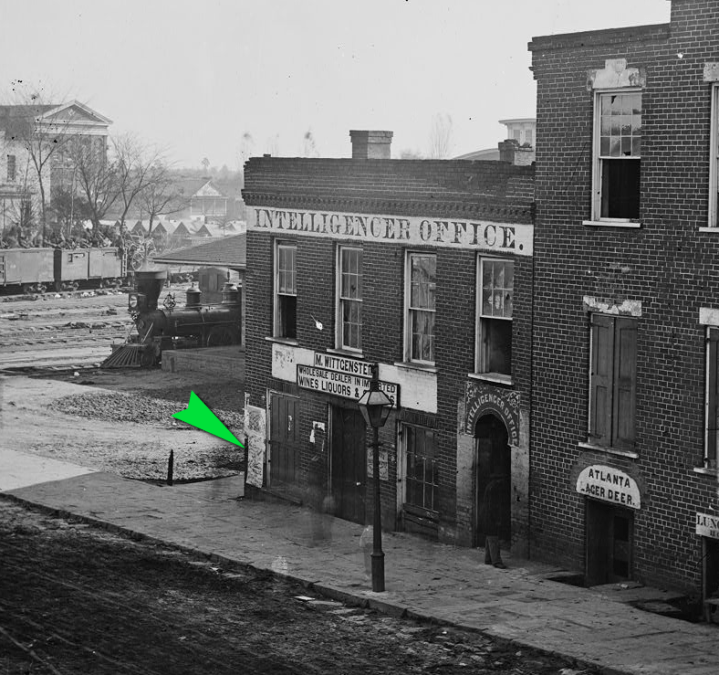
While looking at a high-res version of this photo from the Library of Congress, taken during the Union occupation of Atlanta in the autumn of 1864, I noticed this roughly-lettered broadside posted to the corner of the Atlanta Intelligencer building at the corner of Whitehall (now Peachtree) Street and Alabama, near the railroad depot. The broadside advertises a concert:

![[IMG]](https://deadconfederates.com/wp-content/uploads/2012/10/gobblersfrolic.png?w=409&h=697) BENEFIT NIGHT
BENEFIT NIGHT
Mr. I. Smith
Leader of the Band
of the 33rd Mass.
The Laughable Pantomime of the
COBBLER’S FROLIC
at the Atheneum
Saturday Night Nov 5th
“Mr. I. Smith” would be 37-year-old Israel Smith, Principal Musician of the 33rd Massachusetts Infantry, of New Bedford. Before the war he had led that town’s brass band, prompting the local paper, the Mercury, to write in 1857, “the efforts he has made and the excellence of the band under his leadership, demonstrate the value of his skill as a musician.” According to an 1859 city directory, he lived on Pope’s Island, smack in the center of New Bedford harbor.
As for the performance seven years later in Atlanta, there’s this description of the show from Three Years’ Service of the Thirty-third Mass. Infantry Regiment 1862-1865 by Adin Ballou Underwood:
Peace and quietness reigned in Atlanta. Not a hostile gun was heard there for two months, till a brigade or two of Georgia Militia appeared on the scene one day, and they were quietly made to skedaddle. Everything went “merry as a marriage bell” with the soldiers, and the few inhabitants that still lingered there. Hooker’s old Corps that had been so hard marched and hard fought, relaxed itself, and the bronzed and staid old veterans became gay and festive. Games, parties, dances, serenades, suppers, concerts and an actual Theatre, divided the time with drills, picket and parades in the gay garrison town. One night while the Thirty-Third band was serenading Gen. Sherman, he proposed that it should give a concert in the theatre for the benefit of Mrs. Welch, the widow of the late Masonic Grand Master of the State, whose house he was occupying as headquarters, and who was very poor. The experiment was promptly undertaken. Friends of the beneficiary were to do the star singing. The band rode to the theatre a few times in hacks to rehearse, and on the night set, gave the following programme which was duly printed:The concert was a success artistically and financially, and netted $200 for the beneficiary. Several similar concerts were given with varied programmes, “Thirty-Third Mass. regiment Quick-step (I. Smith) band;” Clarionette solo, J. Calnum;” “Lecture, Woman’s Rights, A. P. Hazard;” “Lord Lovell,” by the same; “Quartette by the Glee Club of Knapp’s Battery,” being some of the additions. Then the season hegan to wane; prices were rather high for enlisted men, getting only $13 a month, and it was rather necessary to get up something striking. A bright idea struck Hazard, and he got up a play. So the following addition appeared on the programmes for October 29th, printed on old blank discharge papers:–
Afterwards the farce, “The Lover’s Serenade” was given. Hazard was musician, author, actor, stage manager, printer, bill poster and property man. The theatre had a great’ run till the very last night before the march, when it took $667. The season lasted four weeks, seventeen nights, and the band took $8000 in all. It gave $2000 to Mrs. Welch and out of the balance kept enough to pay its numbers the amount due from the officers according to their enlistment agreement to the end of their three years. The last night before the city was evacuated, the last train that left it was kept waiting till midnight to take away one of the stock actors. The yield of this bonanza suddenly stopped.
As Underwood notes, a $1 theatre ticket is no small sum for a private earning $13 per month, before any deductions against his pay. It must have been one helluva show to take in $8,000 in seventeen performances — upwards of $500 per night. Of course, the notion of Union soldiers willingly raising (at Uncle Billy’s suggestion) $2,000 in Yankee greenbacks for the benefit of an Atlanta widow doesn’t exactly fit their reputation as the demon horde, either.
And then there’s Underwood’s description of the band’s earlier performance for the president, after which (perhaps understandably) Smith and his fellow bandsmen were a bit full of themselves:
About this time [Spring 1863], while the corps was busy corduroying the vile secesh roads of the neighborhood, it was relieved from that delectable duty one day to be reviewed, together with the Twelfth Corps, by the Commander-in-Chief of the Armies, good President Lincoln. And how the soldiers did reverence that tall citizen, as he rode along the lines on the little mustang, with that beaver [hat], the like of which some in the lines had not seen for two years! While he was at General Hooker’s headquarters, the band of the Thirty-Third was sent for, to go up by special train, to play for the President’s entertainment during his visit there. On its arrival, the five other bands that had been ordered there also, including some excellent ones, were informed that their services were no longer required, as the band of the Thirty-Third Massachusetts would be sufficient. It is said, on competent authority, that Israel Smith, the leader, Amasa Glover, “the irrepressible,” (as he came to be called) the managing man, and the other members of the band, felt rather “stuck up” for some time at this great compliment. They must have realized some contrast between this occasion, when they traveled in state in a special car on the railroad, and enjoyed the delicacies which they managed somehow to have at army headquarters — and a certain other occasion, when they went to visit and play for the Second Massachusetts, when they were treated, doubtless by necessity, on army rations, including ‘army commissary,” that cheers, and does certainly inebriate, if the thirsty soldier does not practise rigid self-denial. The band had· to foot it home, lugging their instruments with them. The hour, of departure was after taps; the road, a mixture. of Virginia mud and snow to the depth of three feet; the distance, seven miles; with these conditions given, and some knowledge of the personnel of the band, and the imagination can easily supply the rest. The load became, in some cases, too heavy, and it is asserted that the devious way of the band could be easily traced next morning, or, rather that morning (of arrival), by the brass instruments sticking out of the snow, strung along like a skirmish line, where they had been thrown away. The amount of frozen music temporarily buried that night will probably never be known.
Israel Smith returned to New Bedford after the war, where he and his wife Sophia raised a family and he worked as a music teacher and musician. He was still living in Winchester, Massachusetts as of 1910, a widowed octogenarian living with his daughter and son-in-law.
_________

Civil War Symposium in Galveston Saturday
 Apologies for being so very late on this one , y’all.
On Saturday, November 3, the Texas Historical Commission, in conjunction with the Galveston Historical Foundation and the Galveston County Historical Commission, will co-host a Sesquicentennial of the American Civil War Workshop at the Galveston Historical Foundation’s Historic Menard Campus from 9 a.m. to noon, followed by a tour of the historic Menard House. This workshop is the last of five held across the state over the past two years, made possible by two grants from the Society of the Order of the Southern Cross.
Scheduled speakers include:

- Linda McBee on Civil War Veterans Buried in Galveston Cemeteries
- Helen Mooty of the Galveston County Historical Museum on the recent restoration and re-dedication of the 1911 Galveston Confederate Memorial
- Dwayne Jones, Executive director of the Galveston Historical Foundation, on plans for the sesquicentennial of the Battle of Galveston in January 2013
- William McWhorter of the Texas Historical Commission on Palmito Ranch Battlefield National Historic Landmark
- Amy Borgens, State Marine Archaeologist with the Texas Historical Commission, on USS Westfield, a Civil War-era shipwreck in Galveston Bay
- Edward T. Cotham, Jr., author of Battle on the Bay: The Civil War Struggle for Galveston and Sabine Pass: The Confederacy’s Thermopylae, on Galveston during the Civil War
- William McWhorter on the proposed 2015 Juneteenth official Texas historical marker
After these sessions, complimentary tour of the Menard House, one of the oldest structures on the island, will be offered by Historical Foundation staff.
This workshop is free and open to the public, but seating is limited. Please call 512.463.5833 to register.


The THC established a Sesquicentennial of the American Civil War Initiative in 2010 with the goal of increasing public knowledge of agency programs that interpret and preserve Civil War sites and topics across the state, such as Palmito Ranch Battlefield National Historic Landmark near Brownsville. In doing so, the THC highlights the history of Texas’ premier role in a seminal event in American history. Galveston historical organizations will provide attendees with a selection of presentations on recent Civil War history projects in the community, and upcoming programming for next year’s Sesquicentennial anniversary of the Battle of Galveston on January 1, 2013.
Download a THC guide to Texas in the Civil War here.
________
Image: Texas Civil War Museum

Spielberg Lays Bare the Ugly Politics of Emancipation


Smithsonian.com has a long feature by Roy Blount, Jr. on the making of Spielberg’s Lincoln, in particular the way it challenges common tropes about the 16th president. The film focuses on Lincoln’s efforts to pass the 13th Amendment in early 1865. Blount’s entire piece is worth reading, but I’m especially impressed that Spielberg and screenwriter Tony Kushner seemingly pull no punches when it comes to the pervasive, casual bigotry of 19th century Americans and the hard-nosed, carefully-crafted political maneuvering necessary to pass such a measure in 1865:
[The film] provides no golden interracial glow. The n-word crops up often enough to help establish the crudeness, acceptedness and breadth of anti-black sentiment in those days. A couple of incidental pop-ups aside, there are three African-American characters, all of them based reliably on history. One is a White House servant and another one, in a nice twist involving Stevens, comes in almost at the end. The third is Elizabeth Keckley, Mary Lincoln’s dressmaker and confidante. Before the amendment comes to a vote, after much lobbying and palm-greasing, there’s an astringent little scene in which she asks Lincoln whether he will accept her people as equals. He doesn’t know her, or her people, he replies. But since they are presumably “bare, forked animals” like everyone else, he says, he will get used to them. Lincoln was certainly acquainted with Keckley (and presumably with King Lear, whence “bare, forked animals” comes), but in the context of the times, he may have thought of black people as unknowable. At any rate the climate of opinion in 1865, even among progressive people in the North, was not such as to make racial equality an easy sell. In fact, if the public got the notion the 13th Amendment was a step toward establishing black people as social equals, or even toward giving them the vote, the measure would have been doomed. That’s where Lincoln’s scene with Thaddeus Stevens [Tommy Lee Jones, above] comes in. _____ Stevens is the only white character in the movie who expressly holds it self-evident that every man is created equal. In debate, he vituperates with relish—You fatuous nincompoop, you unnatural noise!—at foes of the amendment. But one of those, Rep. Fernando Wood of New York, thinks he has outslicked Stevens. He has pressed him to state whether he believes the amendment’s true purpose is to establish black people as just as good as whites in all respects. You can see Stevens itching to say, “Why yes, of course,” and then to snicker at the anti-amendment forces’ unrighteous outrage. But that would be playing into their hands; borderline yea-votes would be scared off. Instead he says, well, the purpose of the amendment— And looks up into the gallery, where Mrs. Lincoln sits with Mrs. Keckley. The first lady has become a fan of the amendment, but not of literal equality, nor certainly of Stevens, whom she sees as a demented radical. The purpose of the amendment, he says again, is — equality before the law. And nowhere else. Mary is delighted; Keckley stiffens and goes outside. (She may be Mary’s confidante, but that doesn’t mean Mary is hers.) Stevens looks up and sees Mary alone. Mary smiles down at him. He smiles back, thinly. No “joyous, universal evergreen” in that exchange, but it will have to do. Stevens has evidently taken Lincoln’s point about avoiding swamps. His radical allies are appalled. One asks whether he’s lost his soul; Stevens replies, mildly, that he just wants the amendment to pass. And to the accusation that there’s nothing he won’t say toward that end, he says: Seems not.

If Blount’s recounting of the film is accurate, then this movie may end up doing a tremendous service to the public’s understanding of that pivotal moment in American history. It may well do for the public’s understanding of Lincoln what Glory did, a generation ago, for recognition of the role African American soldiers played in that conflict. The popular image of Lincoln pure and unblemished saint-on-earth has always been a false and ultimately damaging one, as much as the “Marble Man” has been for Lee. Lincoln’s contemporaries didn’t see him that way. For all that Lincoln was branded as a radical abolitionist in the South, real abolitionists knew he was not one of them. According to Blount, Stevens called Lincoln “the capitulating compromiser, the dawdler,” and even Frederick Douglass, who overcame a deep mistrust of Lincoln and the Republicans in the winter of 1860-61 to become one of the president’s strongest allies and supporters, understood that Lincoln was a man who retained his own biases, yet constantly challenged himself to move beyond those. Lincoln was also a man who, regardless of his personal beliefs, had to work (like all presidents before and since) within the constraints of the political realities of the day. It was Lincoln’s willingness to work the political angle — to cajole, to flatter, to intimidate, to compromise when he had to — that allowed him to accomplish things that a firebrand like Stevens never could have, no matter how righteous his cause. As Blount says, “Stevens was a man of unmitigated principle. Lincoln got some great things done.”
There’s a saying that’s been thrown around quite a bit in the last few years, “don’t let the perfect be the enemy of the good.” In other words, don’t pass up an opportunity to get most of what you want, for the sake of not being able to get everything you want. That’s good advice now, and it was undoubtedly a notion Lincoln — smart lawyer and brilliant politician that he was — would have agreed with.
When the movie hits theaters in a couple of weeks, I’m sure it will be lazily denounced in some quarters as just so much Lincoln mythologizing. A few more industrious folks will likely cite scraps of dialogue from the film to “prove” that ZOMG those Yankees were racists!. They already seem to be priming themselves to denounce it as a failure if it fails to smash every box-office record, ever. In truth, though, I think they may have a lot more to worry about with this film than the prospect of it being a big-screen affirmation of the caricatured, saintly Lincoln. If the movie is anything like Blount claims it is, it will depict Lincoln and those around him as gifted, resolute but often flawed and complex mortals who struggled and bickered and fought, and eventually accomplished great things — things like the 13th Amendment that seem so obviously right now, but were anything but assured then. If the audience takes away that understanding of the events surrounding the close of the war, it will do far more good than any exercise in hagiography might.
I can’t hardly wait.
___________
UPDATE, October 29: Over at Civil War Talk, a member asks why Frederick Douglass is not depicted in the film.
It’s a great question, and I don’t know the answer. But there’s no point in having a blog if one can’t speculate a little, so here goes:
It may be in part because Douglass was not physically present during the events depicted in the main part of the film, which focuses on passage of the 13th Amendment and the Hampton Roads Conference, which took place in January and early February 1865. I believe Douglass resided in Rochester, New York during the entire period of the war, and as nearly as I can tell, Douglass and Lincoln only met face-to-face on three occasions: in August 1863, when Douglass met with the president to urge him to equalize the pay between white and black Union soldiers; at the White House a year later, when Lincoln summoned Douglass to reaffirm his (Lincoln’s) commitment to ending slavery and to ask Douglass to use his connections to get as many enslaved persons within Union lines in the event he lost the election that fall and a new administration would end the war before decisively defeating the Confederacy; and in early March 1865, when Douglass was ushered into the president’s presence briefly at an inaugural reception to congratulate him on his reelection. This last event, though close to the time frame of the Spielberg film, was not really a substantive meeting that would have particular bearing on the story of the film.
 So if my understanding of the structure of the movie is correct, there’s an easy (if not especially satisfying) explanation for his absence from the screen. What will be most interesting to see is whether Douglass’ presence is nonetheless felt in the film — if his words, his writings, his agitating — show up in the script, in allusions by other characters, in the dialogue, or elsewhere. (Elizabeth Keckley’s character [right] would be the obvious opportunity to do this, film-wise, as she admired Douglass and wrote of his being brought to meet the president in March 1865.) The real Frederick Douglass didn’t attend cabinet meetings or negotiations with representatives of the Confederate government aboard River Queen, but he nonetheless exerted a profound influence behind the scenes in both the decision to enlist black troops for the Union and in the struggle to make emancipation permanent in the closing months of the war. If Spielberg and screenwriter Tony Kushner can pull that off — making Douglass and his influence a character in the film without his actually being in the film — that will be remarkable.
I can’t hardly wait.
___________

Canister!
Small stories that don’t warrant full posts of their own:

- The dispute over renovations to a monument to Nathan Bedford Forrest in Selma drags on, and on, and on, sucking in more aggrieved parties as it goes. I haven’t talked about it much here because every aspect of it seems to be exactly according to script, with lots of angry, clichéd rhetoric and hyperbole on all sides. We’ve seen this movie before.
- Charles F. Bryan, President and CEO emeritus of the Virginia Historical Society, points out in an editorial that Jefferson Davis’ wartime administration committed many of the same “big government” sins commonly ascribed unilaterally to Lincoln then, and to the political left today. Among these were creating a “massive debt while imposing heavy taxes on its citizenry. It had a virtual monopoly on foreign trade. It maintained de facto control over raw materials, labor, transportation systems and much of the manufacturing sector. It mushroomed into a huge bureaucracy to keep these controls in effect.” “By happenstance and by design,” Bryan argues, “the new republic was marked by profound centralization and nationalization.” He’s right; deal with it.
- Mark Vogl, the self-styled “chancellor”of the online Confederate War College, has been carping for months about Mitt Romney. He’s argued that “Romney’s Mormon faith is NOT Christian,” and about Romney’s supposed commitment to “socialism,” based on Romneycare in Massachusetts. He’s accused Romney of being a “globalist,” in contrast to candidates Newt Gingrich and Rick Santorum, who Vogl views as “Americans.” He’s whined that Romney’s religious beliefs are getting a pass in the media because “a Mormon is a politically correct minority.” He’s called out Romney for the candidate’s “lies” about his living conditions when working as a missionary in Paris in the 1960s. Several months back Vogl gleefully cheered that “Dixie says no to Romney!” He was outraged that Romney supposedly “supports the Gays against the Boy Scouts!” and didn’t “support Chick-Fil-A in a huge battle about Christianity.” Vogl even went so far as to announce publicly that in November he will “be writing in Jefferson Davis of Mississippi for President of the United States“So guess who he’s supporting now. Go ahead, guess.
- Underwater archaeologists have discovered the wreck of the Confederate gunboat C.S.S. Pee Dee in the Greater Pee Dee River in South Carolina. Archaeologist Chris Amer cautions that the wreck is “as messy as the history that put it there,” probably in part because parts of it were salvaged in the 1950s.
- I’ve observed in the past that the various “flagging” groups have a pretty low threshold for claiming an accomplishment; now it appears they’re claiming “victory” just by showing up.
- Looks like the white nationalist League of the South (LoS) has decided to slink back into the shadows, having changed the status of its Facebook group to “closed,” so that non-members can no longer see the LoSers’ online discussions in real time. This is not entirely unexpected, as the group has come in for some negative media coverage lately. It does raise the question, though, about how their abandonment of social media is going to raise the public visibility of their movement; mens room graffiti and flagging empty office buildings at night isn’t likely to do the trick.
- Next month, the Museum of the Confederacy in Richmond will offer an additional tour, “Servant Life of the Confederate White House,” as part of the interpretation of that site.
- Is this a photograph of A. P. Hill? Sure looks like him.
-
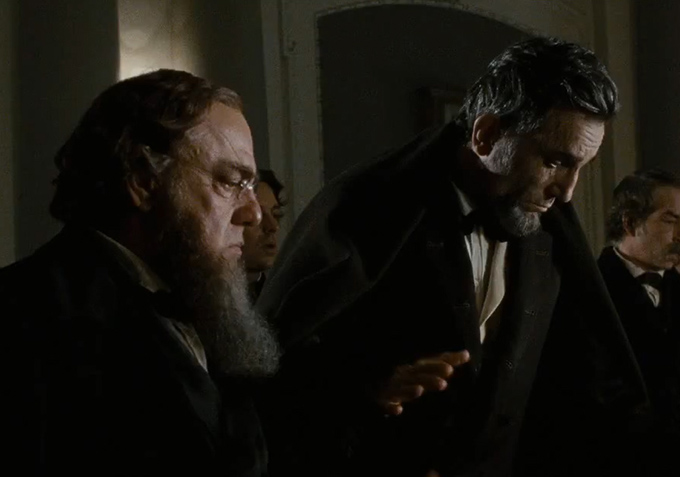
Speaking of look-alikes, check out this still from the upcoming Spielberg film. Can you believe that the actor who’s a dead-ringer for Stanton is also this guy? I never aspired to an acting career, but if I had, I’d want to be Bruce McGill.

- Unrelated to the CW, the Pittsburgh Steelers are doing their dead-level best to make fans regret buying those HD teevees.
- Finally, on a purely personal note, my friend and blogging colleague Jim Schmidt had a very successful book signing Saturday for his new volume, Galveston and the Civil War: An Island City in the Maelstrom. I couldn’t be more happy for Jim, because his volume really does bring a lot of new material and analysis to Galveston’s CW experience. We will both be at the Houston History Book Fair & Symposium in a couple of weeks, and hope to see you there.
______________

Anticipating Lincoln
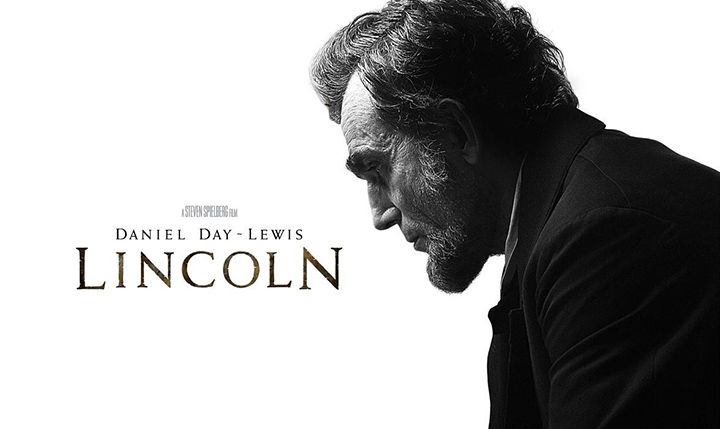
On Sunday evening 60 Minutes did a story on Steven Spielberg and his upcoming film, Lincoln. Much of the interview focused on the way Spielberg’s childhood and relationship with his parents, particularly his father, has been reflected in his films. That’s pretty interesting in its own right, but I do wish more time had been spent on Lincoln.
As a filmmaker, Spielberg has never been known for complex characterizations or ambiguous moral messages. (Or realism.) This film is decidedly different in tone, something the director himself acknowledges. It’s not aimed at the summer blockbuster crowd:

Lesley Stahl: There’s not a lot of action. There’s no Spielberg special effects. Steven Spielberg: Right. Lesley Stahl: It’s a movie about process and politics. Have you ever done a movie even remotely– Steven Spielberg: Never. Like this? Lesley Stahl: Not even close. Steven Spielberg: Never. No. I knew I could do the action in my sleep at this point in my career. In my life, the action doesn’t hold any– it doesn’t attract me anymore. Narrator: With only one brief battle scene, the movie’s more like a stage play with lots of dialog as Lincoln cajoles and horse trades for votes.

Spielberg and his team made a pretty fascinating decision, to focus the film on the last months of Lincoln’s life and his efforts to pass the 13th Amendment, that abolished slavery throughout the United States. The Union military victory was clearly in sight at that point, and Lincoln was trying to make permanent the de facto emancipation brought about by the Emancipation Proclamation and the advance of Federal armies across the South. As we’ve noted before, Lincoln’s commitment to ending chattel bondage permanently by embedding it in the Constitution is evidenced by the fact that he signed the original text of the amendment as passed by both houses of Congress, even though the president has no formal role in approving or endorsing constitutional amendments. The Emancipation Proclamation gets lots of attention, but is also too often misrepresented as the be-all and end-all of emancipation, when it was (as any serious historian will tell you) a temporary, limited, wartime measure, a single, important milestone on the path to real, permanent emancipation. (A path, by the way, that begins with Spoons Butler’s 1861 “contraband” policy at Fort Monroe.) The Emancipation Proclamation is not Lincoln’s legacy; the 13th Amendment rightly is.
Then there’s this, which is an interesting approach, although not one I’m sure I agree with:
Narrator: Although Spielberg took great pains to be historically accurate, he made what some will see as a curious exception in this scene. Steven Spielberg: Some of the Democrats that were voting against the [13th] Amendment, we changed their actual names. So if you go through the names that we call out on the vote, you’re not going to find a lot of those names that conform to history. And that was in deference to the families.
All of this effort and nuance will likely be wasted on the True Southron™ crowd, who are already carping about the film’s likely omission of black Confederates and predicting its dismal failure at the box office. I suspect most of them will refuse to watch the movie, though that will hardly stop them from complaining about its content, real or imagined. While history buffs will be arguing about details — whether this character actually said that, or whether such-and-such scene really happened or is a composite of several actual events — the Southrons will be more vaguely angered that the film exists at all, and that it depicts Lincoln as genuinely committed to ending slavery, willing to push the boundaries of his office and the political landscape to as much as he dared to accomplish that goal. That notion is an anathema to the Southrons, because it puts Lincoln, whatever else his faults, squarely on the right side of the great moral issue facing Americans in the 19th century. Instead they will rehash Lincoln’s casual bigotry against African Americans (true, although almost universal among white Americans in that day), and his willingness to consider voluntary recolonization of freedmen to Africa — an idea that long predated Lincoln’s public life and long survived him, as well. These are, after all, the people who can say with a straight face that Lincoln was “a bigger racist than I ever knew,” and more deserving of moral condemnation than their own ancestors who actually owned slaves. As I wrote several months back,
Confederate apologists often point to these ugly examples and say, “Lincoln believed so-and-so, ” or “Lincoln said such-and-such.” They do this reflexively, as a means of deflecting criticism of slavery in the the South. Such mentions of Lincoln are often narrowly true, but they miss the larger, and much more important, truth. . , which is that Lincoln himself changed and grew over time. The president who told “darkey” jokes also had Frederick Douglass as a visitor to the White House in 1863, the first African American to enter that building not as a servant or laborer, but as a guest. The president who’d said he would be willing not to free a single slave if it would preserve the Union also asked Douglass, in the summer of 1864, to use his contacts to get as many slaves into Union lines as he could before that fall’s presidential election, which Lincoln fully expected to lose. The chief executive who had toyed with the idea of re-colonizing former slaves back to Africa publicly suggested, just days before his death, that suffrage should be extended to at least some freedmen, specifically those who’d served in the Union army.
Lincoln Derangement Syndrome is very real, and Spielberg’s film is certain to push some folks over the edge. So don’t expect much effort from the Confederate Heritage™ crowd to take the movie on its own terms, or to acknowledge anything positive about the 16th president — just a lot of vague complaining about “PC Hollywood” or the “Lincoln myth,” and so on, without much reference to the specific content of the film itself.
For the rest of us, though, it’s looking like this is going to be a film that delves into a part of Lincoln’s life that’s never been brought to the big screen before. I sure it will give historians and bloggers much both to praise and criticize in the coming weeks. My hope is that, like Glory, Lincoln will be a film that, while containing inevitable small historical inaccuracies, will nonetheless tell a greater true story, will loom large in the general public’s understanding of the conflict and inspire a renewed interest in it.
I can’t hardly wait.
_____________





8 comments