“The Confederacy died primarily of gangrene.”
In a discussion on another forum on the effectiveness of Confederate ironclads, my colleague Mark Jenkins made an argument that, over the course of a long war, it was a lack of internal development that doomed the southern cause:

Hindsight is 20/20… or at least clearer than foresight.
I subscribe to the theory that the Confederacy died primarily of “gangrene,” of a lack of circulation, due to the breakdown of the transportation network and infrastructure, leading to supply and morale problems. It’s been fairly well documented that, as a whole, the Confederacy was still mostly self-sufficient in terms of foodstuffs even into 1865, yet there were documented cases of food riots and soldiers going on extremely short rations. It wasn’t because the Confederacy couldn’t produce enough food; it was because the food wasn’t getting to where it needed to be.
The prewar transportation system in the Confederacy, while more advanced than a large part of the world, was still not quite sufficient to needs… there was an incomplete railroad network, the railroads themselves were somewhat less than completely efficient due to items such as different gauges (widths) of track and the fact that, in most cases, railways stopped at cities and started again on the other side, requiring transshipment of goods from one side of the city to the other. In most places, this inadequate railroad network was necessarily supplemented to a large degree by river and coastal transport by small freighters (as it had been since before the railroads).
One of the important but less-heralded effects of the blockade was (completely apart from its effects on imports and exports to the Confederacy) to significantly hamper or stop the coasting trade; where before, it was possible to either ship something from (say) Mobile to Savannah by either boat or by railroad, now it was more constrained to the railroads; and this at a time when the demands on the railroads were increasing due to wartime activities.
On top of this, there was real pressure to divert iron from making and repairing the railroads to other uses, like guns, ammunition, and ironclads; even to the extent of taking up existing railroad tracks. That, in essence, is spending your principal– eating your seed corn.
So, there’s a line of thought that indicates that the Confederacy should have exerted more of an effort in maintaining and reinforcing its transportation infrastructure, particularly the railroads, and that it should have taken precedence over ironclad construction and the like, rather than the other way around. I’m not certain it would have been enough, though.
Personally I don’t see forgoing the construction of ironclads as a realistic option for the Confederacy; although their ironclads didn’t accomplish much in open battle, their mere presence at places like Charleston and on the James River below Richmond were a deterrent factor for Union strategists planning operations against those points during the latter half of the war. Those squadrons were localized “fleets in being” that significantly complicated things for the Federals and undoubtedly slowed their advance. I can’t say “they prolonged the war by X months,” but they were absolutely part of the Confederacy’s ability to hold out in those locations.
Mark is quick to point out that his observation is not entirely original, and in fact is a synthesis of much that he’s read. Fair enough, but there’s a lot of clarity and substance in his phrasing, and he makes a solid point.
What do you think?
_________

Louis Napoleon Nelson in The Confederate Veteran
A colleague doing genealogical research passed along this item regarding Louis Napoleon Nelson from the March 1932 issue of The Confederate Veteran magazine (p. 110). As was the case with his pension record, this is an item that seems to be consistently overlooked or ignored on the numerous websites — 3,000-plus hits on the Google machine — that discuss his activities in 1861-65. Which is odd, considering that the source, Confederate Veteran, was (and is) the official publication of the Sons of Confederate Veterans, a group that has gone to great lengths in recent years to promote Nelson’s story, or at least a particular version of it.

On the 6th of February, after an illness of several weeks, Gen. E. R. Oldham, Commander of the 3rd Brigade, Tennessee Division, U.C.V., died at his home in Henning, at the age of eighty-seven years. Burial was at Maplewood Cemetery in Ripley, with Confederate veterans of the county as pallbearers.
At the grave, four comrades, one of them being GEN. C. A. DeSaussure, Commander in Chief, U.C.V., in Confederate uniforms, held the four corners of the Confederate flag, forming a canopy over the casket as it was lowered.
At the close of the funeral services, Lewis Nelson, an old negro of ante-bellum days, who served his master throughout the war, gave in his own words his estimates of “Mars Ed.”
As the funeral cortege left the home, the old plantation bell, which had been rung for over a hundred years, decorated with a Confederate flag, was tolled eighty-seven times.
So consider this another addition to the public record.
____________ 
A Pirate in the Family

Thomas Tew (left) regales Governor Benjamin Fletcher of New York with tales of plunder at sea, in an engraving by Howard Pyle. Fletcher openly entertained Tew, even as he publicly denounced him as a pirate. Fletcher’s ties to Tew and men like him resulted in his being replaced in 1698 by Richard Coote, Earl of Bellemont. Tew had made his fortune by capturing a treasure-laden ship belonging to the Grand Mughal in 1693. Two years later he attempted the same feat in partnership with Henry Every, and was killed in the ensuing action.
My father has devoted a lot of time in recent years to genealogical research, and has made some interesting connections. Although he uses the Internet in his work, he has so far eschewed Ancestry and similar tree-building sites, preferring to go about his work in a more traditional way. This is probably a good thing because, although I use Ancestry all the time, it’s very easy to get off on the wrong track when picking up information from other researchers’ self-made trees. It’s a little too easy to go click-click-click and, in the space of a few minutes, throw together something that’s pretty much worthless due to a single error somewhere along the way. But I digress. . . .
Recently he shared with me the story of one John Elston (or Alston), a young man from New Jersey who was seized as a pirate in the spring of 1698. I wouldn’t ordinarily claim kinship to someone I can’t trace precisely, but in this case the circumstantial evidence seems substantial. Multiple generations of direct-ancestor Elstons lived in and around Woodbridge, New Jersey (near the southern end of Staten Island) in this period, so it seems likely that John Elston, the “Accidental Pirate” from Woodbridge, is a collateral relative. His story is told in James Strode Elston’s The Elston family in America (Rutland, Vermont: Tuttle Publishing, 1942):
Only a few of the highlights can be given in perhaps the most colorful experience any Elston in this country has had. In “New Jersey Colonial Documents” is a four-page account of John Elston ‘s affidavit [of] May 27th, 1698:
John Elston aged about 20 yeares Declares that about the yeare 1692 being in London shiped himself. . . proceeded on the Voyage to the Groyne where. . . they Runn away with the said ship. . . . This said Elston being then asleep knew nothing of said Action till Comeing upon Decke found the Ship under Saile. . . Saies that the first land they made was the Cape de Verd Islands. . . thence proceeded to the Coast of Guinea touching at the Gold Coast and severall other places. . . that Dureing the time of theire being on the Coast they tooke two shipps Danes and Swedes Laden with Goods for the Guinea trade takeing as many men out of them as were willing to saile. . . turning the shipps a Drift, that in the Action they had a Dispute with said shipps for about halfe an hour looseing one man . . . went for the Cape of Good Hope but stopped not there but at the Island Madagascar . . . went for the Islands of Johanna and Cornaro [the Comoros Islands] where they went on shore and traded with the Indians [sic.]. . . sayled for the Cape that makes the Gulph of Arabia on the Redd Sea. . . at this time there was added to our Company 4 or 5 sayle more. . . came into the Bay of Bengali. . . A Little before Day a ship Came by us within about a Pistoll shott after which we made say]e and after Day fired at her, whome we tooke being a ship of about six hundred Tunns a slight ship haveing only their money on board the Quantity Reputed to be about (or more then) Twenty thousand pounds. Wee kept her in Company about 24 hours takeing out what we thought proper for our own use and then lett her Goe … we fought about an hour and a halfe, she being about sixteen hundred Tunns forty or fifty Gunns mounted and others in hold. . . . We Entred her and kept her about twentyfour hours. That we Esteemed her worth about two hundred thousand pounds. . . . Further on the Coast of India. . . touched a French Island neare Madagascar. . . . Directed our Course to the Vest Indies. . . Arrived at providence one of the Bahama Islands . . . aforesaid John Elston. . . and some others who went a shore at Fishers Island … by way of Fishers Island to East Jersey.
The colonial Governor of New York, Richard Coote, Earl of Bellemont, had originally seized John Elston and William Merrick on suspicion of piracy. But in a letter written July 1, 1698, Bellemont wrote to the Lords of Trade (later the Board of Trade) that he could
find no evidence against them, so that they would be cleared on a tryall here, and I have no instructions to send them for England so that I must admitt them to bail. One of them is not now above nineteen years old, his name is John Alston, was about 12 or 13 years old and was a boy in the ship when [Henry] Every run away with her and as he said forced him away for a cabin boy, that he had no share with the rest-that he acted no ill thing with his owne hand, and could not avoid being in the ship, being forced away, his account appeared to me probable and inclines me to represent this circumstance to you Lordships that if you think fitt he may be represented as an object of His Majesty’s mercy.
The Lords of Trade in London evidently didn’t act on Bellemont’s petition for mercy in the case of Elston and Merrick, as they both remained in jail, denied bond by the Governor of East New Jersey, Jeremiah Basse, for months. But in February 1700 Basse wrote to the House of Commons complaining that “as it was his duty, [he] refused to bayle” (i.e., grant them bond). Whereupon Bellemont, “by a pretended Admiralty power forced them out of your petitioner’s hands, and set them at liberty upon insufficient bayle, to the great hazard and danger of your Petitioner.”
This was probably not the first time the governors of New York and New Jersey didn’t see eye-to-eye, and it certainly wasn’t the last.
The pirate captain Elston and Merrick allegedly sailed under, Henry Every (or Avery), was one of the most infamous of all buccaneers in the so-called “Golden Age of Piracy.” Elston’s affidavit matches, in broad terms, Every’s violent history in the Indian Ocean. This passage from Elston’s account
 at this time there was added to our Company 4 or 5 sayle more. . . came into the Bay of Bengali. . . A Little before Day a ship Came by us within about a Pistoll shott after which we made say]e and after Day fired at her, whome we tooke being a ship of about six hundred Tunns a slight ship haveing only their money on board the Quantity Reputed to be about (or more then) Twenty thousand pounds. Wee kept her in Company about 24 hours takeing out what we thought proper for our own use and then lett her Goe … we fought about an hour and a halfe, she being about sixteen hundred Tunns forty or fifty Gunns mounted and others in hold. . . . We Entred her and kept her about twenty-four hours. That we Esteemed her worth about two hundred thousand pounds. . . .
sounds very much like a description of Henry Every’s attacks on the Grand Mughal’s flotilla in the summer of 1695. If so, Elston’s assertion that the pirates only took “what we thought proper for our own use and then lett her Goe” is self-serving nonsense — Every’s pirates released the ships only after brutally torturing those they captured to get them to reveal their valuables. And there were plenty of valuables — reportedly over half a million gold and silver coins, in addition to crates and chests of jewels and other treasures. Each pirate’s full share was said to be worth £1,000 or more.
I’m dubious of Elston’s claim that he went a-pirating against his will; Defoe’s General History of the Pyrates, which is a near-contemporary account of the era and is the source for much of what we know about men like Every, makes it clear that those crew members who were not part of the original mutiny that began the voyage were offered the chance to go ashore:
The whole Crew being called up, to know who was willing to go on Shore with the Captain, and who to seek their Fortunes with the rest; there were not above five or six who were willing to quit this Enterprize; wherefore they were put into the Boat with the Captain that Minute, and made their Way to the Shore as well as they could.
It’s an interesting story, because this was a time when pirates were not only executed upon conviction, but often had their corpses tarred and gibbeted at a crossroads for all to see for months after — gruesome stuff. Six of Every’s men were convicted and sentenced to death at the Old Baily in London in October 1696.
Perhaps Elston and Merrick really did convince Bellemont of their innocence, or maybe there were other factors at play. Not long before Elston and Merrick were picked up, it had become known that the Governor Bellemont’s own pirate hunter, William Kidd (yes, that one), had himself turned to piracy. Bellemont managed to arrest Kidd in the summer of 1699, while Elston and Merrick were still apparently sitting in jail. Bellemont had Kidd shipped off to England, allegedly to prevent his own ties to piracy from getting a full airing in a local trial. In London Kidd was (inevitably) convicted and executed. You might think that during this period, Bellemont would be eager to show that he was tough on crime piracy, and hanging a pair of low-level pirates after a show trial would help demonstrate that. Instead, Bellemont cut them loose, over the objections of his fellow colonial governor across the Hudson. How Captain Kidd’s larger and better-known story may intersect with that of Elston and Merrick remains to be seen, but the cases were concurrent and all in the mix together.
It’s a curious story but, honestly, it does leave me conflicted. I’m not sure which is more embarrassing — having a real-life pirate in the family, or admitting that I’m kin to people from New Jersey.
_____________
Update, February 2, 2015: Digging further into some trees on Ancestry — a dicey proposition, for reasons I’ve probably mentioned before — it looks like John Elston was the eldest child of William and Elizabeth Cole Elston, and lived from c. 1683 to c. 1750. I’m descended through their fifth child (and fourth son), Samuel, born c. 1692. If true, that would make John “the Accidental Pirate” Elston my uncle.
_____________
Sail Training Day

I had to run an errand at the Texas Seaport Museum Saturday, and realized it was a sail training day. At least they had good weather for it.
____________
Frederick Douglass, Time Traveler?
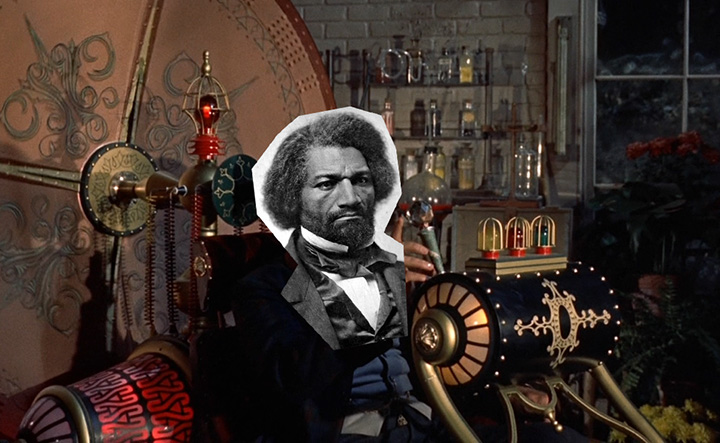
John Stauffer’s essay at The Root (“Yes, There Were Black Confederates. Here’s Why“), that claims to establish the reality of African American Confederate soldiers, has been pretty thoroughly dismantled by both Brooks Simpson and Kevin Levin. But I’d like to point out one small item that neither of them have mentioned. Stauffer cites Frederick Douglass’ oft-quoted assertion from the summer of 1861 that there were black Confederate troops at the site of the then-recent Battle of Manassas, “as real soldiers, having muskets on their shoulders, and bullets in their pockets.” Stauffer continues,
What were Douglass’ sources in identifying black Confederates? One came from a Virginia fugitive who escaped to Boston shortly before the Battle of First Manassas in Virginia that summer. He saw “one regiment of 700 black men from Georgia, 1000 [men] from South Carolina, and about 1000 [men with him from] Virginia, destined for Manassas when he ran away.”
Stauffer likely picked up this quote from an endnote on p. 467 of Frederick Douglass: Selected Speeches and Writings (Philip S. Foner and Yuval Taylor, eds., Chicago Review Press, 2000). Unfortunately for Stauffer, Foner and Taylor also provide the source for the quotation — a speech given in Boston on February 5, 1862, and quoted the next day in the Boston Daily Journal and Evening Transcript newspapers. Stauffer is claiming that Douglass, writing in the summer of 1861, based his claim on a speech that wouldn’t be given for another six months.
Douglass did, in fact, hear this story, because he was the headline speaker at the Emancipation League meeting in Boston where the unnamed “Virginia fugitive” told it — but not in 1861.
Frederick Douglass was a remarkable man, but as far as I know he wasn’t a time traveler. In citing an 1862 speech as a source for a Douglass essay written in 1861, Stauffer has either (1) broken genuinely new historical ground in his discovery that Douglass had mastered the fourth dimension, traveling forward through time and space to Boston in February 1862 to collect information he would use upon his return to 1861 Rochester, or (2) shown himself to be just as sloppy and misleading in his efforts as most of the other folks who’ve taken up the mantle of “scholarship” on this subject.
You decide which of those possibilities seems more likely.
_______

Acting Ensign Paul Borner, U.S. Navy
 Recently I was able to acquire an original, Civil War-era CDV of a young man named Paul Borner (right). I am not generally a collector of items like this, but there were special circumstances in this case.
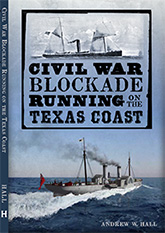
Borner was a junior naval officer, first an Acting Master’s Mate and then an Acting Ensign, on several U.S. Navy ships on blockade duty during the war. In May 1864, twenty-eight-year-old Borner was put in charge of a boarding party on the captured schooner Sting Ray. What happened next is described in Chapter 3 of the blockade-running book:
A lack of available ships prevented the U.S. Navy from maintaining an around-the-clock watch off the Brazos until the latter part of 1863, but attempts to get in and out of Velasco continued right through the end of the war. One of the more remarkable incidents there occurred in May 1864, when USS Kineo stopped and seized the schooner Sting Ray, nominally of British registry, some miles off the mouth of the river. Kineo’s commander, Lieutenant Commander John Watters, was suspicious of the schooner’s paperwork, which claimed she was sailing from Havana to Matamoros. Not wanting to delay Kineo’s return to the river mouth, Watters put a boarding party on board the schooner, under the command of Acting Ensign Paul Borner, with instructions to follow Kineo back to her station. (more…)
Nerd Teevee
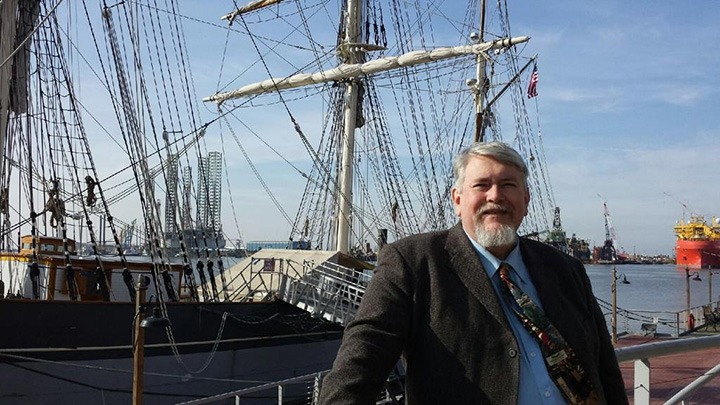
On Friday I had the pleasure of giving an interview on blockade running and Texas during the Civil War for the C-SPAN 2 series, C-SPAN Cities Tour, that highlights the history of smaller cities around the country. The Galveston episode will include interviews with Galveston Historical Foundation Executive Director Dwayne Jones, Texas A&M University at Galveston Professor Steve Curley, and my friend Sharan Zwick from the Galveston Bookshop.
The weather, which had been coldgrayrainingwetyuck for the better part of a week, cleared spectacularly Friday, just in time for the C-SPAN crew’s shooting schedule. I’d like to thank Tiffany Rocque from C-SPAN for inviting me to be a part of their production, and Jamie White and the folks at the Texas Seaport Museum for allowing us the perfect location. The show should air on the weekend of March 7-8.
______
Image via C-SPAN Twitter
Happy New Year, Lexington (and a Pretty Good Old Year, Too)!

Later this week the Virginia Flaggers, and various other heritage activists outside agitators will head for Lexington to celebrate Lee-Jackson Day, and to protest that city’s ordinance barring non-official government flags from municipal light poles. Again this year, the Virginia Flaggers are calling on everyone who attends to avoid spending any money in town, going so far as to post a convenient map showing the boundaries of the city.
To recap briefly, in the late summer of 2011, the Lexington City Council adopted an ordinance that limited the display of flags on city-owned light poles to the official United States, Virginia and City of Lexington flags. Contrary to what many people seem to believe, this move didn’t impinge on anyone’s individual rights — people are still welcome to display Confederate flags on their own property, parade with them, or loiter on street corners with them. Even their right to act like batshit crazy people remains unaffected by the new ordinance. Personal freedom of expression is alive and well in Lexington.
By barring all flags other than official government ones, the city put itself on solid legal ground. At the time the ordinance was passed, lead Virginia Flagger Susan Hathaway admitted as much, describing the language in the ordinance as “air tight.” The subsequent legal battle in federal court has proved her right, with the Virginia SCV’s challenge to the ordinance being rejected at both the district and circuit court levels.
 Not long after the City of Lexington passed its ordinance, the Virginia Flaggers announced a couple of other initiatives to get the city’s position reversed. The first was a political campaign (right) to oust the city’s mayor, Mimi Elrod, in the November 2012 municipal elections. That failed when Elrod was handily re-elected with a larger share of the vote than she’d received in 2008. The other initiative was a boycott of businesses in Lexington, the idea being that by making tourism-related small businesses suffer, the Virginia Flaggers would build a groundswell of local support for having the ordinance repealed. This was in spite of the fact that when the City Council held a hearing on the proposed ordinance in 2011, almost all the residents of Lexington who chose to speak on the ordinance expressed support for it; opposition to it came almost entirely from people who don’t actually live in Lexington.
The Virginia Flaggers, and Susan Hathaway in particular, openly acknowledge that the purpose of the boycott is to punish “the town that has turned its back on Lee and Jackson and its rich Confederate heritage.” (Ignore the fact that Lexington and Rockbridge County continue to use Lee and Jackson prominently in their tourism promotion.) Over the last three years the Virginia Flaggers have, from time to time, gleefully pointed to some bad economic news item out of Lexington and taken credit for it. They take considerable pride in claiming to be responsible for imposing economic hardship on their fellow Virginians, which is odd given their tendency to wrap themselves Christian righteousness. Nevertheless, there’s no clear linkage between the Flaggers’ boycott and these events — e.g., the closing of a local theater that had been struggling financially for years prior to the ordinance — and some of their claims, such as increasing unemployment in Lexington since the initiation of the boycott, are patently untrue.
As I’ve noted before, anecdotes about individual businesses and selected datum points don’t really tell the full story. After all, businesses fail and people lose their jobs even in boom times, for reasons that have little to do with the overall local economy. The real story has to be told with the most comprehensive information and data available, and that’s where Lexington’s Comprehensive Annual Financial Report comes in.
Lexington’s annual fiscal year (FY) runs from July 1 to June 30. About sixth months after the end of the fiscal year, the city publishes on its website a detailed report on the city’s finances — revenues, expenditures, debt servicing, all that stuff that makes most peoples’ eyes glaze over. (You can download reports going back to FY2010 here.) But there is one table that’s very relevant to anyone interested in measuring the effects of the Virginia Flaggers’ boycott of the city, the one that lists the City of Lexington’s sources of revenue. Three of them are particularly important measures of tourism-related business activities in the city — local sales and use taxes (i.e., people buyin’ stuff), restaurant food taxes (people eatin’ out), and hotel and motel room taxes (people stayin’ overnight). In the absence of hard (and importantly, all-encompassing) data on business activity in Lexington, these numbers seem to be a pretty good indicator of how things are going.
And how are they going? By these important measures, economic activity in Lexington continues to improve, as it has steadily since the Great Recession. With the recent publication of the FY2014 comprehensive report, we now have five years’ worth of annual data, extending back to July 2009, more than two years before the announcement of the boycott. Here are the actual numbers:

And the trends:
Sales Tax Revenue:

Restaurant and Food Tax Revenue:

Motel/Hotel Tax Revenue:
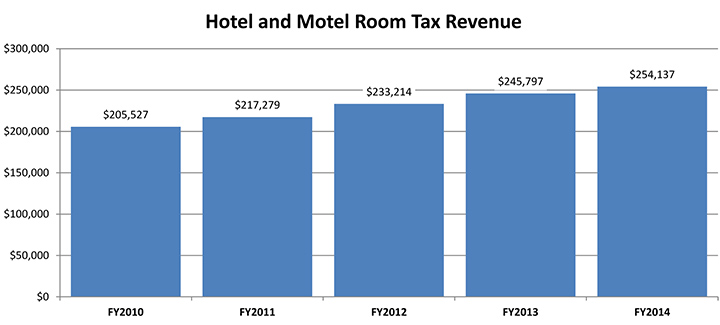
So things are looking up in Lexington generally — and steadily — as they have been for years now. There’s no real evidence that the Flaggers’ boycott, that began in the middle of the city’s FY 2012, has had a negative impact on the local economy, much less a substantive one.
That’s not to say that everything’s rosy in Lexington, in terms of the economy. For many years now, Lexington has had a much higher unemployment rate than both the Commonwealth of Virginia and the United States as a whole, but unemployment in Lexington peaked in July 2010, more than a year before the flag ordinance was passed, and has been on a downward trend ever since. (Lexington’s unemployment rate is extremely seasonal, spiking every summer and dropping in the winter, but again that’s a pattern that’s been there for years.) Lexington’s (and Rockbridge County’s) economy draws heavily on Civil War tourism, and that’s likely to drop off some with the end of the sesquicentennial this year. But in broad terms, Lexington appears to be in better shape economically today than it was a year ago, when it was in better shape than the year before, and so on back to 2010. So congratulations to Lexington on another pretty good year economically, and to an even better year in 2015.
____________
Thursday Night Concert: “The Battle of New Orleans”
As Michael Lynch reminds us, today was the bicentennial of the Battle of New Orleans, the last major fight of the War of 1812. Everyone knows Johnny Horton’s famous version of the song, but it was written by Jimmie Driftwood, who recorded what I think is a superior version, truer to its folk form and spirit.
__________




 Dead Confederates, A Civil War Era Blog


5 comments