2012 Menard Summer Lecture Series
The Galveston Historical Foundation has announced its 2012 Menard Summer Lecture Series, this year focusing on the sesquicentennial of the Civil War. I’ve been honored to be asked to participate, along with some of great historians it’s been my pleasure to know. Presentations will be offered on Sunday afternoons in June, July and August, on the dates listed. Reservations are recommended. Tickets for individual lectures are $10 for GHF members and $12 for non-members; tickets for the entire series are $35 and $40, respectively. Reservations may be made with Jami Durham at GHF at 409-765-3409.

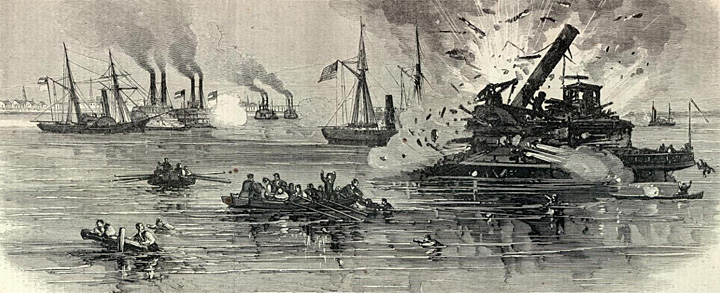
“Overview: The Battle of Galveston”
Dr. Donald Willett, June 3rd at 2:00 p.m.
On October 8, 1862 the city of Galveston, the largest and wealthiest city in Texas, surrendered to Union forces. For most Texans this action was unacceptable. In response, the Confederacy sent General John Bankhead Magruder to the Lone Star State to avenge the defeat. Magruder quickly put in place a brash plan that defied all military logic, defeating the superior Union forces and forcing them to abandon the “Queen City of the Gulf.” Galveston became the only Southern seaport ever recaptured by the Confederacy and the only major seaport still in Rebel hands when General Robert E. Lee surrendered his army to Ulysses S. Grant at Appomattox Courthouse. Don Willett is an Associate Professor in the Maritime Studies Program at Texas A&M University at Galveston, where he teaches classes on American and Texas history, the American Civil War and reconstruction and the history of American sea power. He earned his BA from St. Edward’s University, his MA from Stephen F. Austin State University and his doctorate from Texas A&M University. He is past president of the East Texas Historical Association and on the Board of Directors for the Gulf South Historical Association. Willett has published two books on Texas history, The Texas That Might Have Been: Sam Houston’s Foes Write to Albert Sidney Johnston and Invisible Texans, as well as several articles. He is currently working on an anthology of Galveston titled Galveston Odyssey: Essays on Galveston History.
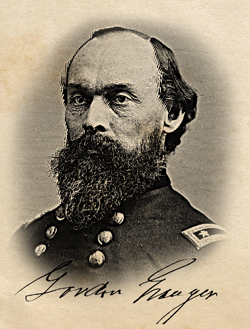 “The General Behind Juneteenth”
Edward T. Cotham, Jr., June 17th, 2:00 p.m.
It has become one of the most important symbols of the end of the Civil War and the coming of Emancipation. But what do we really know about the events that shaped it? On June 19, 1865, General Gordon Granger issued General Orders No. 3 from his headquarters in Galveston. Granger’s order confirmed that the Emancipation Proclamation was in effect in Texas. Celebrated today as the origin of the “Juneteenth” festivities, General Granger’s June 19 order was actually the result of a long chain of political and military events involving the battles and leaders of the Civil War. In his multi-media presentation, Ed Cotham will describe the events that led to General Granger’s arrival in Galveston, the issuance of the Juneteenth order, and the reaction to that order.
Edward T. Cotham, Jr. is the prize-winning author of many books and articles on Civil War history, emphasizing the battles and skirmishes in Texas. A frequent lecturer on these subjects, Ed also leads occasional tours of Texas battlefields and state historic sites. His published works include Battle on the Bay: the Civil War Struggle for Galveston, Sabine Pass: the Confederacy’s Thermopylae, and The Southern Journey of a Civil War Marine: The Illustrated Note-Book of Henry O. Gusley. Ed wrote a chapter on Federal naval strategy and Texas in The Seventh Star of the Confederacy: Texas during the Civil War. This book was the winner of the Fort Worth Civil War Round Table’s A.M. Pate, Jr. Award for excellence in research and writing on the Civil War in the Trans-Mississippi.
Mr. Cotham is President of the Terry Foundation in Houston, Texas. The Terry Foundation is the largest private source of scholarships at Texas universities with more than 700 Terry Scholars on scholarship. He holds an undergraduate degree in Economics from the University of Houston and a Masters Degree in Economics from the University of Chicago. A native Texan, Cotham returned to Texas to obtain a Law Degree from the University of Texas in 1979.

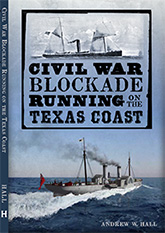
“For-Profit Patriots: Blockade Runners of the Texas Coast”
Andrew Hall, July 15th at 2:00 p.m.
In the closing months of the Civil War, long, low blockade runners slipped in and out of Texas ports, racing both to keep the Confederacy supplied, and to generate dramatic profits for their owners. It was a risky, high-stakes gamble that was the foundation for many fortunes on both sides of the Atlantic. Almost 150 years later, archaeologists and historians have begun to uncover the stories of these remarkable vessels. The discovery of the paddle steamer Denbigh in 1997, and of a wreck believed to be the famous Will o’ the Wisp in the aftermath of Hurricane Ike, open the door to a long-overlooked story of patriotism, avarice and daring during those last desperate months of the conflict.
Andrew Hall has served as a volunteer with the Texas Historical Commission investigating shipwrecks for more than 20 years, and was part of the first group of state marine archaeological stewards appointed in the United States in 2001. Hall served as co-principal investigator of the Denbigh Project, the most extensive excavation and research program on a Civil War blockade runner in the Gulf of Mexico. He has served as historian, illustrator or website developer on several nautical archaeology projects, including the 1686 wreck of the French ship La Belle (1995-97) the Civil War blockade runner Denbigh (1997-2003), and the U-166 Project (2003). He wrote the chapter on the interface between nautical archaeology and the Internet in the International Handbook of Underwater Archaeology (2002), and has co-authored several other journal articles.
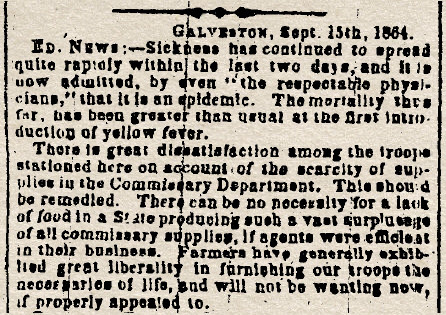 “Yellow Fever in Galveston During the Civil War”
James Schmidt, August 12th at 2:00 p.m.
“No disease brought more fear and more deaths to Galveston’s early residents than yellow fever,” one modern historian has justly declared. No less than seven major epidemics struck Galveston between 1837 and 1860, killing more than two thousand people. Yet another deadly yellow fever epidemic struck Galveston in the summer and autumn of 1864 during the Civil War, striking civilians and Confederate troops that garrisoned the island. The lecture will examine the grim – yet interesting – role that yellow fever played during the Civil War in Galveston, including misconceptions of the causes of disease, precautions that could have been taken, and heroism displayed in sick rooms, in the voices of those who lived through it.
James Schmidt is a chemist by training and profession. After receiving his B.S. in Chemistry from the University of Central Oklahoma, he has worked in a number of private, government, and industrial laboratories, and is currently employed as a scientist with a biotech firm in The Woodlands, Texas.
Mr. Schmidt has had a life-long interest in history, with a special regard for the Civil War. His historical writing credits include more than fifty articles for The Civil War News, North & South, Learning Through History, World War II, and Chemical Heritage magazines, and other publications. Mr. Schmidt is also a popular speaker and has given lectures on the Civil War to groups around the country.
Mr. Schmidt’s books, Lincoln’s Labels: America’s Best Known Brands and the Civil War, Years of Change and Suffering: Modern Perspectives on Civil War Medicine co-edited with Guy Hasegawa, and Notre Dame and the Civil War: Marching Onward to Victory, have received praise from both popular and academic historians alike. His next book, Galveston and the Civil War: Voices of an Island in the Maelstrom, will be published by The History Press in Fall 2012.
It’s going to be a great summer.
___________

Major Patton, Discipline, and the Limits of Enthusiasm in the Civil War
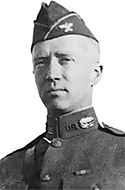 In 1932 a U.S. Army cavalry officer, Major George S. Patton, Jr., submitted a term paper to the Army War College on the likely characteristics of the next major war, and how the military should prepare for that event. As part of the background to his analysis, Major Patton gave brief synopses of previous wars going back to Egypt’s Sixth Dynasty, and the broad lessons to be derived from them. This is what Patton wrote about the American Civil War:
In the Civil War both sides used identical organizations and tactics.
Lesson. — Identical methods produce long wars. Up until the Summer of 1863 a regular force on either side would have had decisive results. After that date both sides were professional in everything but discipline. NOTE. — In 1864, Lee wrote a long order on the necessity of securing discipline. (HENDERSON) The initial successes of the South were largely due to the fact that the superior enthusiasm — emotional urge — replaced discipline. In the North this enthusiasm was less marked, especially in the eastern armies.

The reference Patton cites appears to be this passage in G. F. R. Henderson’s Stonewall Jackson and the American Civil War:
That [Lee’s] circular [on discipline] was considered necessary after the troops had been nearly four years under arms establishes beyond all question that the discipline of the Confederate army was not that of the regular troops with whom General Lee had served under the Stars and Stripes; but it is not to be understood that he attributed the deficiencies of his soldiers to any spirit of resistance on their part to the demands of subordination. Elsewhere he says, “The greatest difficulty I find is in causing orders and regulations to be obeyed. This arises not from a spirit of disobedience, but from ignorance.” And here, with his usual perspicacity, he goes straight to the root of the evil. When the men in the ranks understand all that discipline involves, safety, health, efficiency, victory, it is easily maintained; and it is because experience and tradition have taught them this that veteran armies are so amenable to control. “Soldiers,” says Sir Charles Napier, “must obey in all things. They may and do laugh at foolish orders, but they nevertheless obey, not because they are blindly obedient, but because they know that to disobey is to break the backbone of their profession.” Such knowledge, however, is long in coming, even to the regular, and it may be questioned whether it ever really came home to the Confederates. In fact, the Southern soldier, ignorant, at the outset, of what may be accomplished by discipline, never quite got rid of the belief that the enthusiasm of the individual, his goodwill and his native courage, was a more than sufficient substitute. ‘The spirit which animates our soldiers,’ wrote Lee, ‘ and the natural courage with which they are so liberally endowed, have led to a reliance upon those good qualities, to the neglect of measures which would increase their efficiency and contribute to their safety.” Yet the soldier was hardly to blame. Neither he nor his regimental officers had any previous knowledge of war when they were suddenly launched against the enemy, and there was no time to instil into them the habits of discipline. There was no regular army to set them an example ; no historic force whose traditions they would unconsciously have adopted; the exigencies of the service forbade the retention of the men in camps of instruction, and trained instructors could not be spared from more important duties. Such ignorance, however, as that which prevailed in the Southern ranks is not always excusable. It would be well if those who pose as the friends of the private soldier, as his protectors from injustice, realised the mischief they may do by injudicious sympathy. The process of being broken to discipline is undoubtedly galling to the instincts of free men, and it is beyond question that among a multitude of superiors, some will be found who are neither just nor considerate. Instances of hardship must inevitably occur. But men and officers-for discipline presses as hardly on the officers as on the men-must obey, no matter at what cost to their feelings, for obedience to orders, instant and unhesitating, is not only the life-blood of armies but the security of States; and the doctrine that under any conditions whatever deliberate disobedience can be justified is treason to the commonwealth.
That the Confederate armies matched off to war in 1861 with great enthusiasm is undoubted, as was the widespread belief that one Confederate soldier could whip five, ten, twenty Yankees. But Patton makes the point that both the Union and Confederate armies, being overwhelmingly composed of non-professionals, always lacked that final ingredient that marked professional armies, that of unbending discipline. (Lee may have bemoaned the lack of discipline, but was himself known to be a soft touch.)
In his paper, Patton suggests a drop-off in Confederate enthusiasm from mid-1863 on, but Henderson goes further, making the argument that when the enthusiasm that had marked the Confederate effort during the first two years of the war began to fail, after two hard years of war and twin defeats at Vicksburg and Gettysburg, the Union was just finally taking hold of a cause that would carry them to victory. Henderson writes:
Enthusiasm in the [Union’s] cause was fast diminishing when Lincoln, purely on his own initiative, proclaimed emancipation, and, investing the war with the dignity of a crusade, inspired the soldier with a new incentive, and appealed to a feeling which had not yet been stirred. Many Northerners had not thought it worth while to fight for the re-establishment of the Union on the basis of the Constitution. If slavery was to be permitted to continue they preferred separation; and these men were farmers and agriculturists, the class which furnished the best soldiers, men of American birth, for the most part abolitionists, and ready to fight for the principle they had so much at heart. It is true that the effect of the edict was not at once apparent. It was not received everywhere with acclamation. The army had small sympathy with the coloured race, and the political opponents of the President accused him vehemently of unconstitutional action. Their denunciations, however, missed the mark. The letter of the Constitution, as Mr. Lincoln clearly saw, had ceased to be regarded, at least by the great bulk of the people, with superstitious reverence. They had learned to think more of great principles than of political expedients; and if the defence of their hereditary rights had welded the South into a nation, the assertion of a still nobler principle, the liberty of man, placed the North on a higher plane, enlisted the sympathy of Europe, and completed the isolation of the Confederacy.
It’s worth recalling that, though he was born in California, Major Patton was a Virginian by family history, a former cadet of the Virginia Military Institute, and the namesake of his grandfather, a Confederate officer mortally wounded at the Third Battle of Winchester. When Patton was a child, one of his father’s closest friends, and a frequent visitor to the Patton household, was John S. Mosby, one of the most famous cavarlymen of the war. Patton’s “Confed cred,” as it were, is unassailable, and his admiration for the soldiers of the Confederacy is unquestioned. But at the same time, neither he nor his source, Henderson, fall into the ideology of the Lost Cause, that the South was simply overwhelmed by force of numbers, its nobility and morale intact. Rather, they argue that a lack of discipline, in both armies, was temporarily offset by gung-ho enthusiasm and esprit, that finally came to full flower in the Union army — “investing the war with the dignity of a crusade” — just as it began to falter in the Confederate ranks.
Are they right?
(H/t to Tom Ricks’ fantastic Best Defense blog.)
__________
Image: Colonel George S. Patton, Jr., between the World Wars. Fort George G. Meade Museum.

Canister!

I apologize for the recent lack of substantive posts here; I’ve been focusing on other historical work lately. Still, there’s plenty going on out there worth noting.
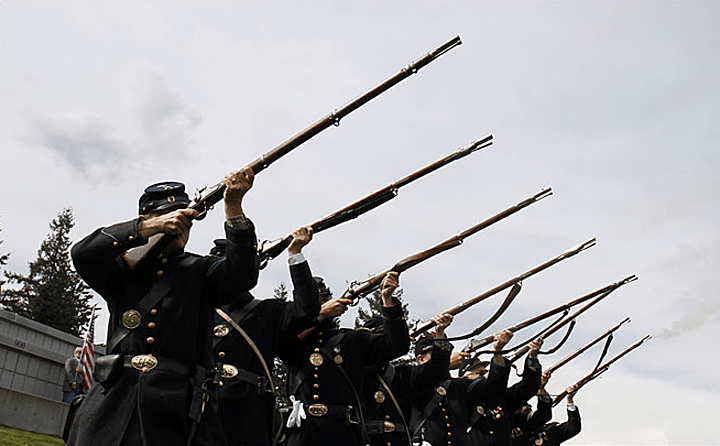
- Last weekend a formal military funeral (above) was held in Portland, Oregon for former Union soldier Peter Knapp and his wife, Georgianna. For reasons now unknown, the Knapps were cremated but their ashes went unclaimed until a modern researcher, Debbie Peevyhouse, learned of them. Knapp enlisted in Company H, 5th Iowa Volunteer Infantry in July 1861 and saw action in numerous battles, including Iuka, Shiloh and Vicksburg. He was later taken prisoner, and confined at Andersonville. Ms. Peevyhouse organized a formal interment for the Knapps at the Willamette National Cemetery, but is unhappy that the facility, which opened in 1950, uses flat headstones instead of the upright stones normally used for Civil War Veterans. She’s done well by Mr. Knapp’s memory — the ceremony really was an impressive thing — but making an issue out of the form of headstone is not really constructive.
- I’ve seen people try to donate some weird stuff to museums, but (thankfully) I never had to deal with something like this.
- Speaking of the National Museum of Civil War Medicine, they’re going to be opening a satellite museum in the office Clara Barton used in Washington during her efforts to locate and identify missing soldiers after the war. No word whether the museum will follow Dixie Outfitters’ lead and describe Barton as a “Confederate heroine.”
 The Charleston Post & Courier has a neat article on the conservation of the lantern found in the wreck of the Confederate submersible H. L. Hunley. The lantern has been a subject of ongoing interest because one of the Union survivors of Hunley‘s attack on U.S.S. Housatonic reported seeing a blue light, possibly intended as a signal, about an hour after the attack. If that blue light came from Hunley, it would be an important datum point in reconstructing the timeline of the attack and the sinking of the Confederate boat. Unfortunately, it’s still not clear whether this particular lamp (right) was the source of such a light.
- Former SCV Texas Division Deputy Commander Mark Vogl continues his stream-of-consciouness burbling, this time in a paean to Confederate Memorial Day. He talks a bit about the the Federal occupation of Galveston in the fall of 1862 and its subsequent recapture on New Years Day, 1863, by forces under the command of John Bankhead Magruder. There’s much in Vogl’s piece that I could take issue with, but I’ll limit myself to suggesting that he start by correctly spelling the name of the Confederate general he’s supposedly honoring. Given the vague assertions and simplistic bromides of his Confederate Memorial Day speech, students enrolling in Vogl’s Confederate War College may want to check on its refund policy.
- Note to CW reenactors out there: if you’re going to give a guest lecture to a college history class, better check in with campus police first.
- Also in reenacting news, Santa Anna is retiring after going 0-and-10 at San Jacinto. I think it’s rigged.
- An old friend of this blog, Valerie Protopapas, was recently honored by the new Copperhead Society, an organization for non-Southerners who nonetheless “have made significant contributions to Liberty, and Confederate heritage.” Protopapas was selected for her “her fearless and strident essays and writing in defense of liberty, historical truth and the Confederate cause.“ Undoubtedly it was her insightful suggestion that NASCAR drivers “do something else in those cars” to attract African American fans, or comparing Lincoln to Hitler, or arguing that freedmen were like six-year-old children, or maybe it was calling me a Trotskyite, that allowed her to edge out fellow New Yorker “Wild Bill” Vallante for the inaugural award.
- A few weeks ago the New York Times ran an article on new research by J. David Hacker, suggesting that the long-accepted figure of about 620,000 dead from the war was far too low; a more accurate number is somewhere around 750,000. But historian James Downs of Connecticut College, an author on the impact of disease on African Americans during the war and in the decade after, argues that even these newer numbers are too low, because they overlook the deaths of many tens of thousands of black laborers, slaves and civilians, on both sides of the conflict.
- And finally, the odious Kirk Lyons has started a new business, selling SCV uniforms patterned after those worn by UCV members a century ago. That’s a really interesting idea, and they don’t look half bad.
Anything I missed? Put it in the comments.
___________Images: (top) Soldiers in Civil War Union uniforms fire a salute during the military funeral for Civil War veteran Peter Knapp at Willamette National Cemetery in Portland, Ore., Friday, April 13, 2012. Knapp is the first Civil War veteran buried at Willamette National Cemetery, Oregon’s largest veterans’ cemetery. His ashes had been sitting on a shelf at the Portland Crematorium since 1924. (AP Photo/Don Ryan); Hunley lamp, Tyrone Walker/postandcourier.com.


Did a C.S.S. Alabama Crew Member Die in the Titanic Disaster?

__________
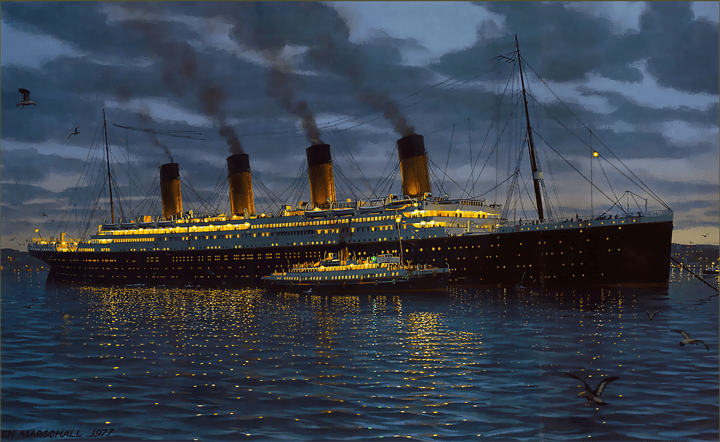
Image: Titanic at Cherbourg on the evening of April 10, 1912. Original painting by Ken Marschall, 1977.

Spam, Spam, Spam, Eggs, Sausage and Spam

The other day Michael Lynch made a note of how much spam he gets through the comments section of his blog. My experience is much the same; most of the spam gets weeded out automatically and I never see it, but a few slip through every day that I delete manually. You can pretty much tell them at a glance, because they (1) never refer specifically to anything in the post, and (2) always include at least one link to whatever product or service they’re advertising. Here’s a representative sampling — sans links — of spam I’ve gotten in the last few days:
Simply wish to say your article is as astounding. The clarity on your post is just excellent and i can suppose you are knowledgeable on this subject. Fine along with your permission allow me to clutch your RSS feed to stay up to date with drawing close post. Thank you 1,000,000 and please carry on the gratifying work. Its like you learn my thoughts! You seem to understand so much approximately this, such as you wrote the ebook in it or something. I think that you just can do with a few % to force the message home a little bit, however other than that, this is wonderful blog. An excellent read. I will definitely be back. I like your fantastic web site, I was searching for this all over. best regards La vita non è tutto birra e birilli Your disadvantage of used bucket trucks mostly is their performance. They could be regarding cheap however, not in good and so the upkeep charges and also reconditioning from it would likely sum it up to a different bucket truck too. Your bucket truck has numerous components that needs to be managed which means you needs to be contemplating these things now. This can be risky too in the event the past proprietor failed to specify how much time and exactly how frequent the18 wheeler was utilized. This blog has inspired me to start working on my own blog Hi {That is a valid point|This is an interesting article|} {Can you post more?|Can you post about private student loans?|} Thanks Keep working, nice post! This was the information I had to know. My wife and i ended up being absolutely thankful Michael could finish up his investigation from your ideas he made out of your site. It is now and again perplexing to just find yourself giving out secrets which other people may have been making money from. And we fully grasp we have got the blog owner to thank for that. The entire explanations you made, the simple website menu, the relationships your site assist to promote – it’s got many overwhelming, and it is helping our son and the family consider that the subject matter is entertaining, and that’s highly vital. Thank you for all the pieces! If a new article is posted or if any changes occur on this site I’m interested.
And my personal favorite:
are you sick of possums?
I honestly cannot say I’m sick of possums, although they’re not a special problem here in town. (I was surprised one evening a couple of months ago to find one poking around on my front porch, though.) Anyone care to guess which of these originally included a link to a catalog for what used to be euphemistically referred to as “marital aid devices”?
No, it’s not the possum one.
_____________________

Was Lincoln a Flip-Flopper?
 Tuesday morning NPR had an interesting segment on David Hebert Donald’s Lincoln, the first in a new series of interviews that discuss presidents from the past in the context of the 2012 presidential campaign. Participating in the discussion were three other prominent Lincoln biographers, Eric Foner (right), Doris Kearns Goodwin, and Andy Ferguson. As you might guess, with those panelists the discussion was less about Donald’s work than it was about those three making the key points they wanted to make — which is just fine with me. You can listen to the piece here, or read the transcript here.
I particularly liked this exchange between the interviewer, Steve Inskeep, and Eric Foner, whose book on Lincoln and the question of slavery, The Fiery Trial, won the 2011 Pulitzer Prize in History:
INSKEEP: If it were up to you, each of you, if you were presidential speechwriters, how would you want candidates to think of Lincoln, deploy Lincoln when they’re talking about him today? FONER: You know, I would love to see a candidate – I don’t care which party we’re talking about – forthrightly say: I have changed my mind about this. That’s what Lincoln did during the Civil War. He changed his mind over and over again. He didn’t change his core beliefs. Lincoln was a flip-flopper, if you want to use the terminology of modern politics. But we don’t seem to allow our politicians to do that anymore. INSKEEP: Andrew Ferguson, you’re smiling. FERGUSON: It’s partly because politicians won’t let their speechwriters talk that way. I don’t think that Dr. Foner should wait for a phone call from any political campaign because… FONER: I’m not holding my breath.
I get what Foner’s saying, but he does his own scholarship a serious disservice by labeling Lincoln “a flip-flopper.” Lincoln knew his own mind, and was from early adulthood (if not earlier) opposed to slavery, personally. That never changed. But neither was it a priority for him as a public official, either. He was not, regardless of how he was depicted by the fire-eaters in the run-up to the 1860 election, a secret abolitionist bent on overturning the institution where it already existed. He himself held attitudes and spoke in terms that would be deeply offensive today. He told an occasional “darkey” joke. He explained once that, in his view, whites and African Americans could not peaceably live together. He considered any number of schemes in considering the “Negro problem,” including voluntary recolonization to Africa. (Colonization was an idea, one should note, that long pre-dated Lincoln and long survived him, as well.)
Confederate apologists often point to these ugly examples and say, “Lincoln believed so-and-so, ” or “Lincoln said such-and-such.” They do this reflexively, as a means of deflecting criticism of slavery in the the South. Such mentions of Lincoln are often narrowly true, but they miss the larger, and much more important, truth that lies at the core of Foner’s (and many others’) work, which is that Lincoln himself changed and grew over time. The president who told “darkey” jokes also had Frederick Douglass as a visitor to the White House in 1863, the first African American to enter that building not as a servant or laborer, but as a guest. The president who’d said he would be willing not to free a single slave if it would preserve the Union also asked Douglass, in the summer of 1864, to use his contacts to get as many slaves into Union lines as he could before that fall’s presidential election, which Lincoln fully expected to lose. The chief executive who had toyed with the idea of re-colonizing former slaves back to Africa publicly suggested, just days before his death, that suffrage should be extended to at least some freedmen, specifically those who’d served in the Union army.
I personally don’t have a lot of use for political flip-floppers, whose deeply-held convictions change according to the latest Rasmussen polls. But neither do I have a lot of use for those who are unwilling to learn, to grow, and to change their minds when the circumstances warrant. That latter group are the ideologues, and while they may shape the debate over public policy, they end up accomplishing very little themselves. Successful leaders are those who are able to distinguish between what they would prefer and what they can accomplish, and push hard for the latter. Idealism has its role, but pragmatism gets the job done. The perfect, the saying goes, must not be the enemy of the good.
Presidents don’t have the luxury of being all-or-nothing ideologues: not in 2012, or in 1862. They are expected to lead, but can only lead where the country — or at least a large part of the country — is willing to follow. Wholesale emancipation — regardless of how much Lincoln might or might not have wanted it at the time — was never a possibility in 1861. It was not a priority for Lincoln, nor was it a priority for the rest of the country. But by the third year of the conflict, it was an established war aim for the Union. Lincoln understood, as well, that his Emancipation Proclamation was a wartime expedient, a stop-gap measure that would not likely hold up once the conflict ended, so he backed the 13th Amendment, passed by the House of Representatives and Senate weeks before his own death.
Flip-floppers chose the positions they do because they believe those position will make them popular. And they do, for a time, before the public catches on to the fact that they’re being played. There are many words that might describe Lincoln during his presidency, but “widely popular” isn’t generally one of them. He might not have won the presidency in the first place had not some Southern states, including my own, kept him off the ballot altogether in 1860; he only took 55% of the popular vote in 1864, when an ultimate Union victory was clearly visible on the horizon. Lincoln probably would have been a far more popular and successful politician in his own day if he had paid more attention to public opinion, and chosen more popular positions. He would have had a much easier time of it, but American history would look very, very different. And not in a good way.
________________

Canister!


Small stories that don’t warrant larger posts all their own.
- The Civil War Trust has unveiled a pretty spectacular interactive module on the Battle of Shiloh. (h/t Kevin)
- The sesquicentennial brought a record number of visitors last year to the place where the shootin’ war started. Here’s hoping that trend continues across the country.
- SCV National Commander Michael Givens has a vision of ten thousand Flaggers protesting the VMFA. Given that the big 2012 Heritage Rally in Richmond a few weeks back attracted 300 to 400 participants, they have a ways yet to go.
- Along more practical lines, the local SCV camp in Augusta, Georgia put up a barrier to keep skateboarders off the monument on Broad Street. Seems like a good move.
- A symposium is set to discuss the Salisbury Confederate PoW camp site next Friday through Sunday in North Carolina. There will be presentations by historians and archaeologists, as well as memorial services on Sunday.
- In Pennsylvania, volunteers are more than halfway to their fundraising goal in an effort to restore 133 graves of Union veterans at the Chartiers Cemetery in Carnegie.
- Mark Vogl’s at it again, explaining how awesome the Confederate constitution was because it would have prevented the Wall Street bailout, and that the C.S. government was “concerned with fairness and providing opportunity to anyone willing to take it.” Or something.
- A while back, a city official in Charlottesville made a stupid suggestion about pulling down Confederate monuments. That, apparently, encouraged someone to tell that official’s child to “tell your mother that she’s a F’in whore and to get her F’in hands off our heritage.” Is this someone’s idea of defending Southron honor?
- Last month, I highlighted efforts to identify the remains of two men lost in the sinking of U.S.S. Monitor. Here, via C-SPAN, is a discussion of the project and those efforts.
- In somewhat related news, in Virginia there was a reenactment of the funeral of Midshipman William Christian Hutter, a snotty aboard C.S.S. Raleigh who was killed at the Battle of Hampton Roads on March 8, 1862.
- On May 18-27, the Masquerade Theatre group in Houston will perform the Tony-nominated musical The Civil War, drawn from letters, diaries, and firsthand accounts of the conflict. This will be a bit of a homecoming, as the show debuted in Houston in 1998 before it moved to Broadway.
- Google Earth users can click this link to download an 1864 map of Richmond, Virginia, from the OR Atlas. It doesn’t line up as neatly as I’d like, but I offer a money-back guarantee if not satisfied. Sorry, no refund without a receipt.
- And here’s one for Washington, D.C. in 1861. The alignment is a bit off toward the south, around Alexandria and Bailey’s Crossroads, but still fun to tinker with.
- Finally, I was happy to find the wartime picture (above) of Union tinclad No. 19, U.S.S. St. Clair, which was one of the first steamboats brought to Texas after the war. Her new civilian owners made a big deal of her features and amenities, but managed to avoid mentioning that she’d been a Yankee gunboat during the “late unpleasantness.”
Any more worthwhile stories out there? Put ’em in the comments.
____________
Image: Wilson’s Creek National Battlefield; WICR 31991.


Canister!

Small stories that don’t warrant larger posts all their own.
- The City of Lexington, Virginia will make its case at a hearing in Roanoke on June 11, seeking to have the lawsuit filed against them by the Virginia SCV thrown out. I doubt they will be successful in getting the case dismissed, but it will be the first time (I think) that each side will lay out their positions in court. My earlier thoughts on the plaintiff’s likelihood of prevailing in court are here.
- The Smithsonian’s National Portrait Gallery is opening two new exhibits of Civil War images, including “The Confederate Sketches of Adalbert Volck,” the caricaturist who liked to vilify Lincoln and other Northern figures. Who says Confederate voices are censored in “the Empire”?
- The Confederate submersible H. L. Hunley was known as the “peripatetic coffin” for sinking three times, killing its crew each time. Turns out, it’s not so great on the freeway, either.
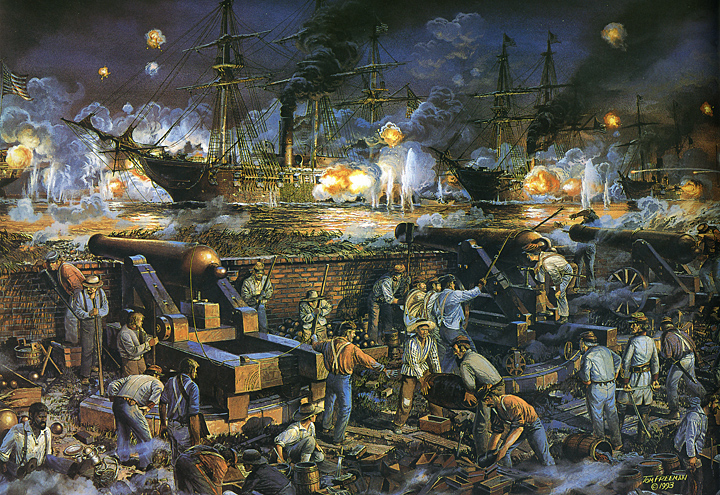
- This month marks the sesquicentennial of the Battle of Forts Jackson and St. Philip, a major strategic development which effectively closed the mouth of the Mississippi to the Confederacy. Wartime operations in this part of the South sometimes don’t feel like they get the attention that they should. The Plaquemines Parish Historical Association in Louisiana is looking to change that.
- In that same area, several Confederate monuments in New Orleans were defaced with graffiti in protest of the Trayvon Martin shooting in Florida. That does nothing to serve the cause of justice, asshats.
- The Harper House on the Bentonville Battlefield State Historic Site in North Carolina served during the conflict as a hospital. Now experts will test to see whether stains in the floorboards are actually from blood, as long believed.
- The Virginia Flaggers continue to generate free publicity for the Museum of the Confederacy’s new Appomattox facility. Lots of familiar faces at the protest Saturday, including Karen Cooper, who was twice the Confederate her colleagues were. I see Billy Bearden was there, too, pushing the Grant-was-a-slaveholder meme. Dramatic but way-inside-baseball slogans seemed to be the theme of the day, and you gotta ask how many regular visitors to the new museum actually understood what the protest was about. I also wonder where Edgerton was; maybe no one was fronting his $20K speaking fee.
- Speaking of the Flaggers, former-state-SCV-officer-turned-culture-wars-columnist Mark Vogl argues that Susan Hathaway, of Virginia Flaggers fame, may be a Southern Sarah Palin. I agree, though probably for different reasons.
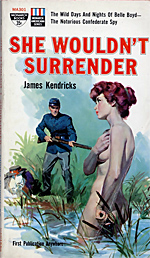 One Southron recently posted the cover of a raunchy 1960 pulp novel, She Wouldn’t Surrender: The Wild Days and Nights of Belle Boyd – the Notorious Confederate Spy (right), as a “dedication to all Southern Belle’s [sic.].” I’m sure they, and any descendants of Belle Boyd living today, are mighty pleased to be depicted with that particular imagery. Other works in the same vein by James Kendricks (pen name of well-known comic writer Gardner F. Fox) include Sword of Casanova, The Adulterers, Beyond Our Pleasure and Love Me Tonight.
- Finally, congratulations to Clint Lacy, who recently changed the tagline of his blog to “we cover the news like the dew covers Dixie.” At least now, when he’s going off on a rant about how Columbian drivers are ruining NASCAR, or race-baiting the presidential campaign, or comparing Rick Santorum to Adolph Hitler, or using a dead teenager as an excuse to whine about all the streets in the South named after MLK, he’s not simultaneously claiming to be “your voice in the Sons of Confederate Veterans.” Whatever else its faults might be, the SCV doesn’t deserve to be linked with that.
_______
Image: Battle of Forts Jackson and St. Philip by Tom Freeman, 1993.




 Dead Confederates, A Civil War Era Blog


3 comments