“. . . to be divided between Robert Smalls and his associates.”

“Prize money” is a concept very familiar to maritime history buffs, or those who’ve read a lot of Forester or O’Brian. The idea was simply to provide a monetary incentive to naval personnel not just to destroy, but to capture intact, enemy vessels that could be either used as warships by their captors, or sold at auction to private owners. (Several ACW blockade runners went through this cycle several times.) A captured ship would be put through a legal proceeding — a “prize court” — and if “condemned,” it would be sold and (after deductions for expenses related to the appraisal, court costs and sale), the proceeds divided up among the crew of ships participating in the seizure of the vessel. The lion’s share of the money would be shared by the captain and officers of the capturing ship, on the assumption that they were more responsible for the capture than individual sailors; a successful cruise might set up a lucky naval captain for life, financially, while a sailor or ordinary seaman would collect enough for a wild evening of eating, drinking, and other, uh, forms of shoreside entertainment.
Prize money isn’t mentioned much in popular accounts of the ACW at sea, but it was nonetheless an important element in the minds of sailors in the Union blockading squadrons at the time. The Federals used a relatively complex formula at the time for apportioning prize money. After deductions for expenses, one-half of the money went straight to the government. Five percent went to the commander of the regional blockading squadron (in this case, the South Atlantic Blockading Squadron), and a further 1% went to the local squadron commander. These shares combine to account for 56% of the value of the prize.
The remaining 44% was divided among the officers and crew of the capturing vessel(s). This amount was split into 20 equal shares, with the captain taking 3 shares, the officers and midshipmen taking 10 shares, and the enlisted men dividing up the remaining 7 shares between them.[1] Clear as mud, right? Here’s a made-up example to show how it worked:
Say a Union gunboat off Charleston, U.S.S. Hypothetical, captured a Confederate ship. Hypothetical has 1 captain, 10 officers and snotties, and 70 enlisted men in her crew. After deductions for the adjudication of the prize, the captured Confederate ship has a value of $10,000. With me so far? Here’s how that scenario would break out in terms of prize monies:
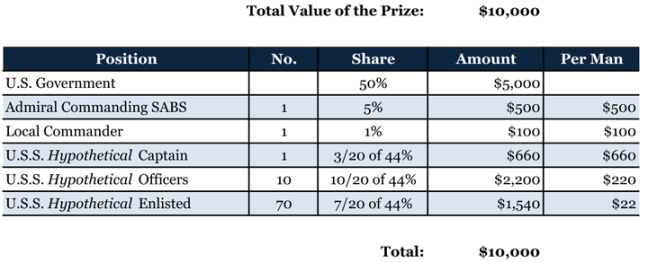
You can see immediately that a lucky and industrious ship’s captain could amass a substantial amount of money quickly, and a senior admiral on a prize-rich station – say, the North Atlantic Blockading Squadron, off Cape Fear and Wilmington, North Carolina – could become wealthy indeed. The disparity of prize money distribution between the senior officers and ordinary seamen (who, after all, were exposed to most of the same risks) was a perennial complaint around mess tables in navies on both sides of the Atlantic:
‘
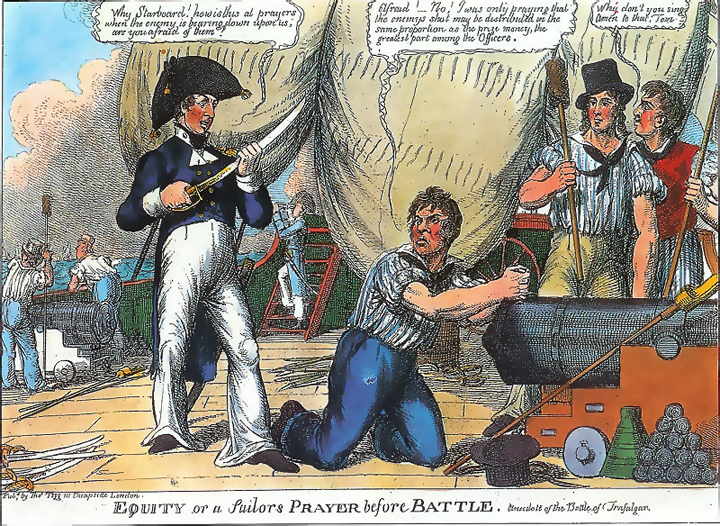
A British cartoon from the time of the Napoleonic Wars. The officer asks the praying sailor if he’s afraid of the enemy. “Afraid? No!,” the sailor replies, “I was only praying that the enemy’s shot may be distributed in the same proportion as the prize money, the greatest part among the officers!”

 Anyway, that’s how prize money was supposed to work in the Union navy during the Civil War. The case of Planter and her makeshift crew, though, had some unusual wrinkles. First, the Confederate steamer was not really captured in action, but rather simply ran out to the nearest Union warship (in this case, U.S.S. Onward), and surrendered. More important, Planter’s makeshift crew were not U.S. naval personnel, and so not eligible for prize money under normal circumstances. Samuel F. Du Pont (left, 1803-65), the flag officer commanding the South Atlantic Blockading Squadron, wasn’t sure how to handle the question of prize money in this case, but passed the question along to Washington. “I do not know whether. . . the vessel will be considered a prize,” Du Pont wrote in his report of the incident to Secretary of the Navy Gideon Welles, “but, if so, I respectfully submit to the Department the claims of this man Robert [Smalls] and his associates.”[2]
 Welles may or may not have sorted out the legal complexities of the case for himself, but he hardly had time to consider it regardless. On May 19, 1862 – just six days after Planter’s daring run out of Charleston — Senator James W. Grimes of Iowa (right, 1816-72), a member of the Naval Committee, introduced legislation authorizing the Welles to have the steamer and its gear appraised, and half the values awarded to “Robert Small [sic.] and his associates who assisted in rescuing [Planter] from the enemies of the Government.” The legislation further instructed Welles to, at his discretion, invest the monies in U.S. securities and pay Smalls and his companions the interest “annually until such time as the Secretary of the Navy may deem it expedient to pay him or his heirs the principal sum.” In the House of Representatives, the Senate bill was held up briefly on procedural grounds by the infamous Copperhead, Clement Vallandigham of Ohio, but it passed a week later on May 26, 1862, by a vote of 121 to 9, with Vallandigham in the latter group. The bill was formally enrolled the next day, and signed by the president on May 30, just over two weeks after Smalls’ escape.[3] The full act read:
Be it enacted by the Senate and House of Representatives of the United States of America in Congress assembled, That the Secretary of the Navy be, and he is hereby, authorized to cause the steam transport boat Planter, recently in the rebel service in the harbor of Charleston, and all of the arms, munitions, tackle, and other property on board of her at the time of her delivery to the Federal authorities, to be appraised by a board of competent officers, and when the value thereof shall be thus ascertained to cause an equitable apportionment of one-half of such value so ascertained as aforesaid to be made between Robert Small[s] and his associates who assisted in rescuing her from the enemies of the Government. Section 2. And be it further enacted, That the Secretary of the Navy may, if he deems it expedient, cause the sum of money allotted to each individual under the preceding section of this act to be invested in United States securities for the benefit of such individual, the interest to be paid to him or to his heirs annually until such time as the Secretary of the Navy may deem it expedient to pay to him or his heirs the principal sum as aforesaid.
The provision for Planter’s prize monies to be invested in securities and held indefinitely at the discretion of the Secretary of the Navy is, as far as I know, virtually unknown when it comes to regular U.S. naval personnel. To be sure, as with anything associated with governmental bureaucracy and accounting, delays, lost paperwork, and missing approvals were routine, and it was common for seamen and officers to wait many months, or even years, to receive the prize monies they’d earned during the war. (I once researched a case in which a Union officer’s claim against a civilian ship went all the way up to the Supreme Court, where he lost in late 1867. Or rather, his estate lost; the officer himself had died more than two years before.) But once prize money was cleared to be awarded, it was distributed. There’s little doubt that this case was handled as it was because the recipients were African Americans, former slaves, who were assumed to be unable to trusted to handle large sums of money wisely. It was well-intentioned, but patronizing and ultimately an insulting rationalization that kept Robert Smalls and his crew from receiving direct compensation for their actions for a long time, if ever.
Welles forwarded the text of the new legislation to Flag Officer Du Pont on June 6, along with instructions to have the captured steamboat appraised.[4] In due course, Planter was inspected and assessed to be worth $9,000; the four loose guns, intended by the Confederates for the new battery being built on pilings in the middle of Charleston Harbor, were valued at an additional $168, for a total of $9,168. That number is strikingly low for a nearly-new steamboat in good operating condition, loaded with munitions; I may discuss that in another post. Regardless, under the legislation passed in May 1862, Smalls and his crew were entitled to half that amount, or $4,584. Du Pont ultimately divided the monies as follows:
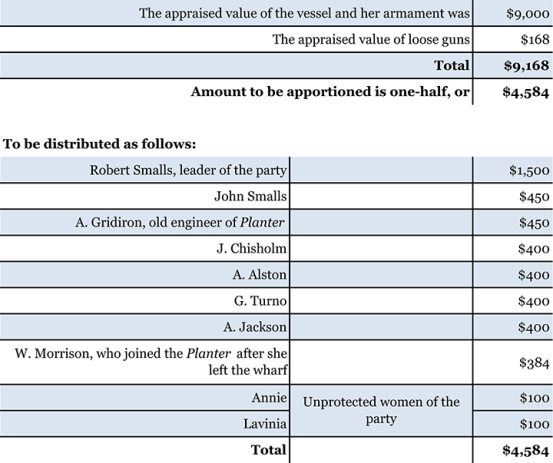
How much was their prize money worth, in modern terms? An historical economist might say, “quite a bit” or “a lot.” In fact, there’s no single, direct answer to that question. There are a variety of formulae and indices used by economists to track the value of currency over time, and they give widely (and wildly) different results. Even in a single category, tracking income and wealth, the modern equivalent of the prize money awarded the crew of Planter varies between a low of around $106,000 to as high as $12M. The equivalent using unskilled labor as a basis of comparison pegs the modern equivalent at around $737,000, which seems very roughly in the ballpark to me.
Did Robert Smalls, William Morrison and the others ever see any of the principal of the money they’d been awarded by Congress? I’d like to say they eventually did, but if fact I don’t know. For certain, there would be plenty of people, in government and out, to whom the idea of turning over a large sum of money to freedmen and –women would be an anathema, and there were plenty of ways for them to rationalize cheating Smalls and the others of their hard-earned reward. (Think about the corrupt recruit depot quartermaster in the film Glory.) I hope they did eventually receive their prize money, along with the interest it had accrued.
[1] Rodman L. Underwood, Waters of Discord: The Union Blockade of Texas During the Civil War (Jefferson, North Carolina: McFarland & Co., 2003), 35.
[2] S. F. Du Pont to Gideon Welles, “Abduction of the Confederate steamer Planter from Charleston, S. C., May 13, 1862.” May 14, 1862. Official Records of the Union and Confederate Navies, Series I, Vol. 12, 821.
[3] Congressional Globe, Senate, 37th Congress, 2nd Session, May 19, 1862, 2186-87; ibid., 2363; ibid., 2392; Statutes at Large, 37th Congress, 2nd Session, 904.
[4] Gideon Welles to S. F. Du Pont, “Letter from the Secretary of the Navy to Flag-Officer Du Pont, U. S. Navy, transmitting copy of an act of Congress in the case of Robert Smalls and others.” ORN, Series I, Vol. 12, 823.
____________
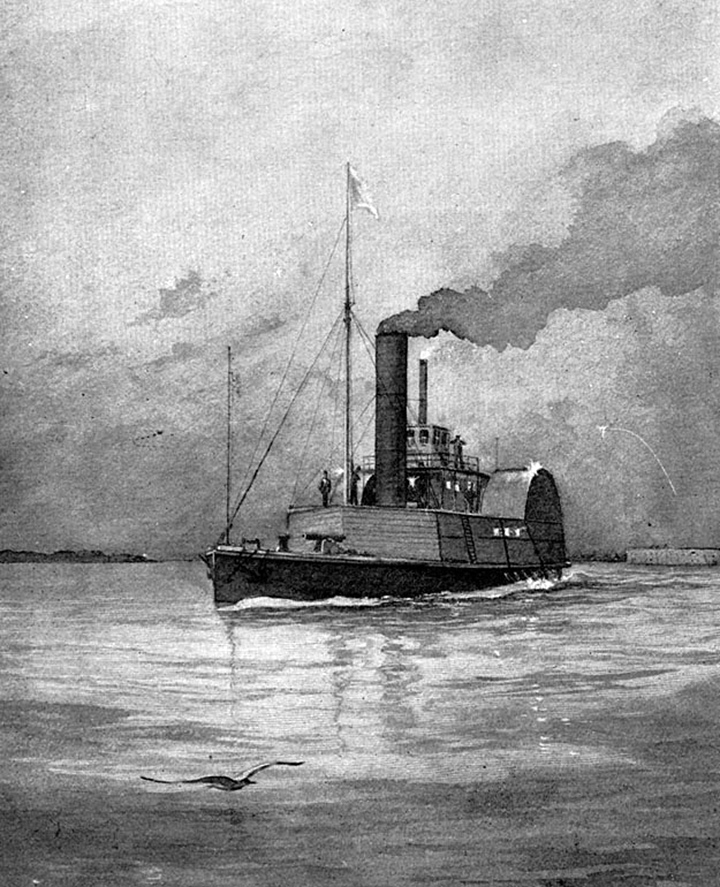
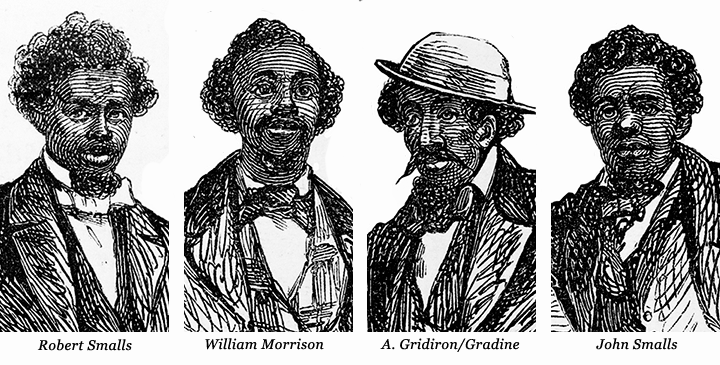
Images: Top, escape of the steamer Planter by R. G. Skerrett, from the ORN. Images of Planter’s crew adapted from “Heroes in Ebony–The captors of the Rebel steamer Planter, Robert Small, W. Morrison, A. Gradine and John Small,” Frank Leslie’s Illustrated Newspaper, June 21m 1862, via Library of Congress. Gridiron’s name is given elsewhere as “Gradine”; I’ve adopted the spelling used in official naval correspondence.

Sucks to Be You, Lieutenant
 Pity poor Brevet Lieutenant F. G. Ravenel, Aide-de-Camp to Brigadier General Roswell S. Ripley (right, 1823-87), the officer in charge of the Confederate defenses at Charleston. Ravenel had to start an otherwise routine Tuesday morning by writing this memorandum to his boss:
HDQRS. SECOND MILITARY DIST. OF SOUTH CAROLINA,
Charleston, S. C., May 13, 1862. GENERAL: I have to report that the steamer Planter was stolen from Southern Wharf at between 3 and 3.30 o’clock this morning and taken to the enemy’s fleet, off the bar, where she was visible till late in the forenoon. By telegram from Stono this afternoon it is reported that she has gone south. The Planter is a high pressure, light-draft boat, drawing ordinarily not more than 3½ to 4 feet, and has been employed in the Confederate service in the transportation of ordnance, etc., to and from the various posts in the harbor and other localities in the neighborhood. She was under the command of C. J. Relyea as master, Samuel H. Smith, a Charleston pilot, being mate, and Zerich Pitcher, engineer, with a colored crew, eight in number, and all slaves. Neither the captain, mate, nor engineer were on board at the time of her departure, notwithstanding Paragraph VIII, in Orders No. 5, viz: All light-draft steamers in the employ of the Government will be in readiness to move at once, their officers and crews, when at the wharf, remaining on board day and night. Four of her colored crew and one of the colored crew of the steamer Etowah are missing, and are supposed to be parties to the theft. The Planter was to have taken to the Middle Ground battery early this morning a portion of the armament for that fortification, which had been put on board yesterday afternoon, viz, a banded rifle 42, one VIII-inch columbiad, one VIII-inch seacoast howitzer, and one 32-pounder. She had also mounted for her own use one 32-pounder and a 24-pounder howitzer, and for use in Fort Sumter a X-inch columbiad carriage, all of which have fallen into the hands of the enemy. From an examination of the guard in the neighborhood of the wharf whence the Planter was stolen, it would appear that about 8 o’clock last night two white men and a white woman went on board of her, and as they were not seen to return it is supposed that they have also gone in her. The sentinel on post about 50 yards from where the Planter was moored noticed her movement from the wharf at between 3 and 3.30 o’clock, but did not think it necessary to stop her, presuming that she was but pursuing her usual business. The Planter, after leaving the wharf, proceeded along the bay as far, perhaps, as the Atlantic Wharf, where, after a short stoppage and the blowing of her whistle, she was turned and proceeded on her course to sea. She passed Fort Sumter at 4.15 o’clock and was reported by the sentinel on duty to the officer of the day. She was supposed to be the guard boat and allowed to pass without interruption.

This is going to ruin the general’s whole damn day when he reads this, especially since the new battery where those guns were to be taken, on the Middle Ground bar in Charleston Harbor, is going to be named after the general. There are laws against mistreating animals, but not so much ADCs. 😉
_________________

The Black Confederate Who Stole the Steamboat Planter
In my post about Robert Smalls and the “abduction” of the Confederate steamer Planter the other day, I overlooked the last two grafs of the Harper’s Weekly story which, line-for-line, may be the most interesting of the piece:
Our correspondent sends us a drawing of an infernal machine [i.e., a mine], drawn by one of the negro hands of the Planter named Morrison. This chattel, Morrison, gives the following account of himself:
Belonged to Emile Poinchignon [Poincignen]; by trade a tinsmith and plumber; has lived all his life in Charleston; was drum-major of the first regiment of the Fourth Brigade South Carolina Militia, and paraded on the 25th of last month; has a wife and two children in Montgomery, Alabama, whom he expects to see when the war is over. I asked him how he learned to read and write. Answer: “I stole it in the night, Sir.”
Okay, okay. Calling William Morrison a “black Confederate” seems pretty silly under the circumstances. But William Morrison must, in some ways, capture all the complexities of of the situation of many African American men in the Confederacy during the war. Through his trade as a craftsman, Morrison probably enjoyed better circumstances than the majority of enslaved persons in the South, but he remained bound by the system. He suffered from a long, distant absence from his wife and children — no doubt an involuntary one. He learned to read and write not through the efforts of a kind and paternal master, but secretly, though his own initiative — “I stole it in the night.” And when he saw the opportunity to steal himself from his master, he didn’t just run off, but did so in a way that would cause the largest possible damage and embarrassment on the Confederacy, in a way that would (not coincidentally) assure his own death if recaptured. And finally, when he did reach the Federal blockading fleet, he shared with them intelligence about Charleston’s harbor defenses: a mine that, by virtue of his skills as a tinsmith and plumber, he may have actually helped assemble with his own hands.
William Morrison was neither a “happy Negro,” nor a “faithful slave.” Next time someone points to a vague reference to an African American musician or otherwise connected to the Confederate military, and then waxes eloquent about that as evidence of black Confederates fighting for home and hearth against the Yankee invader, etc., etc., ask them about William Morrison of the steamboat Planter.
________________Image: Detail of the print, “Heroes in Ebony — The captors of the Rebel steamer Planter, Robert Small, W. Morrison, A. Gradine and John Small.” Library of Congress.


C.S.S. Georgia to be Excavated


Good news on the nautical archaeology front, in that the wreck of C.S.S. Georgia, and ironclad battery deployed to protect the city of Savannah, will be excavated and preserved as part of the $653M harbor improvement program. The cost of the excavation and conservation is estimated to be around $14M, or just over 2% of the total project cost.
Georgia was originally intended as an ironclad warship, but a lack of suitable powerplant — the bane of Confederate casemate ironclads from Virginia on — resulted in her being moored as a floating battery instead. In twenty months of service she never fired a shot in anger, but would have been a formidable opponent had the Union navy tried to force the port as they did at Charleston, Mobile, and elsewhere. The battery was scuttled by her crew just before Christmas 1864 just as Sherman was poised to seize the city at the end of his “March to the Sea.” You can read more about C.S.S. Georgia here.

Location of the wreck of C.S.S. Georgia (gold ring), opposite Old Fort Jackson.

Photo by Mike Stroud (via To the Sound of the Guns) of a 32-pound banded rifle recovered from the wreck of C.S.S. Georgia, displayed on a reproduction carriage at Fort Jackson.
I saw a comment about this story in which someone snarked, “the Confederate Navy still continues to hinder the US Navy.” Funny, but inaccurate, as the U.S. Navy (through the Naval Historical Center) generally provides a lot of encouragement and guidance when it comes to wrecks like this. (All former Confederate government property transferred to the United States at the end of the war, so former Confederate vessels like Georgia and the famous C.S.S. Alabama are now considered U.S. Navy property, and under their stewardship.) The problem is, the Navy doesn’t have the resources to undertake expensive work like this, and has to rely on other agencies that do have budgets for them, to get the actual work done.
It’s also worth noting that the reason this work is being undertaken at all is because of federal laws that require investigation, assessment, and (in some cases) archaeological recovery of significant historical/cultural material that lies on public land, that would be disturbed or destroyed by development or construction. Most states have similar laws. What will be done in this case is very much like the U.S.S. Westfield Project in Texas, although (I gather) with a bigger budget and the prospect of recovering significant parts of the ship’s structure intact. Without those preservation laws, wrecks like C.S.S. Georgia would’ve been reduced to soggy toothpicks by dredging many years since.
____________
Image: (top) Naval Historical Center; (bottom) 32-pounder image by Mike Stroud, via To the Sound of the Guns
“Disgusting treachery and negligence”
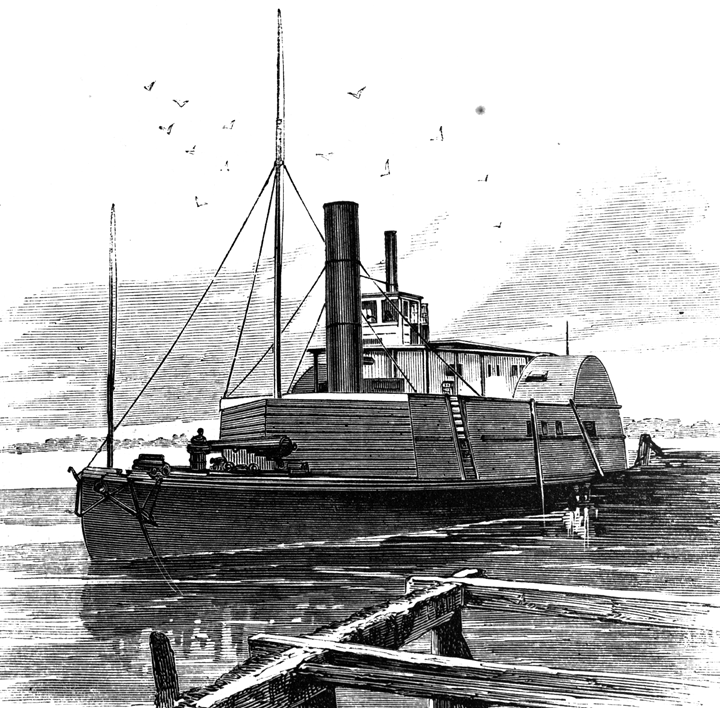
Today is the sesquicentennial of one of the most audacious acts of the Civil War, when Robert Smalls, an enslaved African American trained as a harbor pilot, took his vessel out the Union blockading fleet off Charleston. It’s already been mentioned several places, with due credit to Smalls and his comrades. As Union Admiral David Dixon Porter put it in his naval history of the war, “this required the greatest heroism, for had he been caught while leaving the wharf, or stopped by the forts, he would have paid the penalty with his life.” More on Smalls and Charleston here.
So given the coverage Smalls’ actions will get — and rightly so — I thought it would be interesting to see the coverage from the other side, from the perspective of Confederate Charleston. Here, from the Charleston Mercury, May 14, 1862:
DISGUSTING TREACHERY AND NEGLIGENCE Yesterday, at daylight, the steamer Planter, in the absence of her officers, was taken by four or five of her colored crew from her berth at Southern Wharf, to the enemy’s fleet. She is a high pressure cotton boat, of light draught, formerly plying on the Pee Dee River, but latterly chartered by the Government, with her officers and crew, from Mr. Ferguson, her owner, and used as a transport and guard boat about the harbor of Charleston. Her armament was a 32-pounder and a 24-pound howitzer. The evening previous she had taken aboard four guns for one of the newly erected works, either that on Morris Island or Fort Timber, viz., a 42-pounder rifled and banded, an 8-inch columbiad, both of which had been struck at the reduction of Ft. Sumter, and 8-inch seacoast howitzer, and a 32-pounder. These guns were to have gone to their destinations early in the morning, and been mounted yesterday. Three sentinels were stationed in sight of her, and a detail of twenty men were within hail for the relief of the post. Between half-past three and four o’clock the Planter steamed up and cast loose, the sentinels having no suspicion of foul play, and thinking she was going about her business. At quarter past four o’clock she passed Fort Sumter, blowing her whistle, and plainly seen. She was reported by the Corporal of the Guard as the guard boat, to the Officer of the Day, Captain Flemming, one of the best and most reliable officers of the garrison. The fort is only called on to recognize authorized boats passing, taking for granted that they have their officers aboard. This was done as usual. The run to Morris Island goes a long way out past the fort, and then turns. The Planter on this trip did not turn. The officers of the Planter were [Charles J.] Relyea, Captain; Smith, Mate; and Pitcher, Engineer. They have been arrested, and will, we learn, be tried by court-martial for disobedience of a standing general order, that the officers and crews of all light draught steamers in the employment of the Government will remain on board day and night. The result of this negligence may be only the loss of the guns and of the boat, desirable for transportation. But things of this kind are sometimes of incalculable injury. The lives and property of this whole community are at stake, and might be jeopardized by event apparently as trifling as this. It ism therefore, due to the Service and to the Cause, that this breach of discipline, however innocent in intention on the part of the officers, should be dealt with as it deserves. Without strict discipline, no military operations can succeed.
Note that the black men who stole the boat get only a passing mention; virtually the entire piece focuses on the incompetence and negligence on the part of Confederate authorities in letting them get away with it. There’s no surprise expressed that Smalls and his companions would attempt to take the boat, so much as shock that they were able to pull it off. The newspaper story makes no hint of a betrayed assumption of loyalty on the part Planter‘s enslaved crew members to either their owners, or to the Confederate cause.
The newspaper got the name of the ship’s mate wrong; he was not “Smith,” but John Smith Hancock. He, Engineer S. Z. Pitcher, and Captain Relyea, went to trial; Relyea and Hancock were both found guilty. Relyea was sentenced to three months’ imprisonment and a $500 fine, which if he did not pay would be commuted into a sentence of two additional months. Hancock was sentenced to one month in prison and a $100 fine. Engineer Pitcher argued “in bar of trial” that the charges were vague and insufficient, and after careful deliberation the charges against him were voided.
In his review of the court martial, however, Major General John C. Pemberton, commanding the Confederate Department of South Carolina and Georgia, overturned the convictions of Relyea and Hancock, noting that Planter‘s owner, Ferguson, “seems to have been entirely deficient as to the deportment of his subordinates.” Pemberton found that while Relyea and Hancock were in violation of general orders, “it is not clearly shown that General Order No. 5, referred to in the specification of the charges, had ever been properly communicated to Captain Relyea, or Hancock, the mate, nor do any measures appear to have been taken by their superiors to force an habitual compliance with the requirements of those orders” (Charleston Mercury, August 1, 1862). Relyea and Hancock were released.
I’ve read online that Captain Relyea was lost at sea between Charleston and Nassau in 1864, suggesting that he got involved in blockade running. Not sure if that’s true, but he left behind a spectacular, gold-headed cane of his that was sold twice last year at auction.
_______________

“Not a harbour over 8 feet.”

Over at the Big Map Blog, they have an 1862 map showing the U.S. Atlantic and Gulf coasts. (The original is in the Library of Congress, here.) The map, published in New York, is intended to show the vulnerability of the Confederate coastline, and the difficulty the South would have in establishing an overseas trade essential to its survival. This was at a time when formal diplomatic recognition of the Confederacy, particularly by France and the United Kingdom, seemed a real possibility, and a potentially-decisive factor in the outcome of the war. The map was, according to its creator, Edmund Blunt,

prepared to show at a glance the difference in extent of the Coasts of the U. States occupied by the loyal men and rebels; its circulation it is believed will have the effect of counteracting the exertions of Traitors at home as well as abroad.
Blunt continued, “persons having correspondents in Europe would do well to send copies of this sketch to them for Circulation.” Heh.
There are a lot of reasons to appreciate this map as an informative tool, not least of which is that it conveys fairly complex information with extreme economy of line and text. (Edward Tufte‘s great-grandfather probably loved it.) There’s not an unnecessary figure or word on it, Blunt’s propagandizing notwithstanding. Union-occupied parts of the coast are shown with a bold line, while Confederate-held areas are drawn with a lighter line. Each potentially significant port or inlet is marked with the maximum depth of water over the bar at its entrance, a critical factor that restricted the size of ships that might effectively use that port. I like the map because it becomes immediately clear how geography shaped Union naval strategy on the one hand, and Confederate blockade-running on the other — why, for example, Mobile and (later) Galveston became important blockade-running ports in the Gulf of Mexico, while other ports did not.

The map also serves as a reminder of just how sparsely-populated and inaccessible some parts of the South were in the 1860s. Almost the entire coast of Louisiana is written off, “not a Harbour over 8 feet.” The southern tip of Florida (the Everglades) from the Keys westward, is noted as being “swampy or uninhabited.” Almost all of Florida’s Atlantic coast, from St. Augustine south to the Keys, is similarly dismissed as being unimportant militarily, or for maritime purposes. Sorry, Josephine.
So what are your favorite CW maps, and why?
_______________

Why Movies Are More Gooder Than Reality

My favorite scene in the 1993 film Gettysburg is this one, where Hood rides to General Longstreet, his corps commander, to protest the order to make a frontal assault on Little Round Top. It’s brief, direct, and poignant; the way the dialogue is framed, even someone who knows nothing about Gettysburg understands immediately that the attack is doomed to fail. It perfectly encapsulates the conflict between the generals; too bad that encounter never happened.
At least, it didn’t happen the way it’s depicted in the movie, which is widely heralded in some quarters as being particularly faithful to the historical record. There’s no question that Hood protested his orders to make a frontal assault on the Federal position, and reluctantly complied with his orders, but the details of how that exchange came about are considerably different, as reported by three officers who were there.
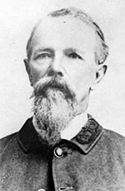 Here is Evander M. Law’s (1836-1920, right) account of the event, from his article, “‘Round Top’ and the Confederate Right at Gettysburg,” published in the December 1886 issue of The Century Magazine. At the time, Law commanded the Alabama Brigade in Hood’s Division, and succeeded to command of the division when Hood was wounded early in the action:
I found General Hood on the ridge where his line had been formed, communicated to him the information I had obtained, and pointed out the ease with which a movement by the right flank might be made. He coincided fully in my views, but said that his orders were positive to attack in front, as soon as the left of the corps should get into position. I therefore entered a formal protest against a direct attack. . . .
General Hood called up Captain Hamilton, of his staff, and requested me to repeat the protest to him, and the grounds on which it was made. He then directed Captain Hamilton to find General Longstreet as quickly as possible and deliver the protest, and to say to him that he (Hood) indorsed it fully. Hamilton rode off at once, but in about ten minutes returned, accompanied by a staff-officer of General Longstreet, who said to General Hood, in my hearing, ” General Longstreet orders that you begin the attack at once.” Hood turned to me and merely said, ” You hear the order ? ” I at once moved my brigade to the assault. I do not know whether the protest ever reached General Lee. From the brief interval that elapsed between the time it was sent to General Longstreet and the receipt of the order to begin the attack, I am inclined to think it did not. General Longstreet has since said that he repeatedly advised against a front attack and suggested a movement by our right flank. He may have thought, after the rejection of this advice by General Lee, that it was useless to press the matter further.
Just here the battle of Gettysburg was lost to the Confederate arms.
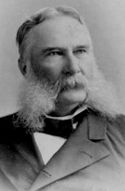 In his own account, James Longstreet (1821-1904) acknowledges Hood’s appeals not to go forward with the attack as planned, but also suggests that even when the matter was decided, Hood dragged his feet in executing it:
Hood’s division was in two lines, Law’s and Robertson’s brigades in front, G. T. Anderson’s and Benning’s in the second line. The batteries were with the divisions, four to the division. One of G. T. Anderson’s regiments was put on picket down the Emmitsburg road. General Hood appealed again and again for the move to the right, but, to give more confidence to his attack, he was reminded that the move to the right had been carefully considered by our chief and rejected in favor of his present orders. . . .
Prompt to the order the combat opened, followed by artillery of the other corps, and our artillerists measured up to the better metal of the enemy by vigilant work. Hood’s lines were not yet ready. After a little practice by the artillery, he was properly adjusted and ordered to bear down upon the enemy’s left, but he was not prompt, and the order was repeated before he would strike down.
In his usual gallant style he led his troops through the rocky fastnesses against the strong lines of his earnest adversary, and encountered battle that called for all of his power and skill. The enemy was tenacious of his strong ground ; his skilfully-handled batteries swept through the passes between the rocks ; the more deadly fire of infantry concentrated as our men bore upon the angle of the enemy’s line and stemmed the fiercest onset, until it became necessary to shorten their work by a desperate charge. This pressing struggle and the cross-fire of our batteries broke in the salient angle, but the thickening fire, as the angle was pressed back, hurt Hood’s left and held him in steady fight. His right brigade was drawn towards Round Top by the heavy fire pouring from that quarter, Benning’s brigade was pressed to the thickening line at the angle, and G. T. Anderson’s was put in support of the battle growing against Hood’s right.
There’s no mention in either Law’s or Longstreet’s accounts of the two men arguing the matter face-to-face.
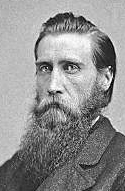 Division commander John Bell Hood (1831-79), in his posthumously-published memoir, gave this version of events, recounted in a letter he’d written to Longstreet a decade after the conflict:
A third time I despatched one of my staff [to Longstreet] to explain fully in regard to the situation, and suggest that you had better come and look for yourself. I selected, in this instance, my adjutant-general, Colonel Harry Sellers, whom you know to be not only an officer of great courage, but also of marked ability. Colonel Sellers returned with the same message, ‘General Lee’s orders are to attack up the Emmetsburg road.’ Almost simultaneously. Colonel Fairfax, of your staff, rode up and repeated the above orders.
After this urgent protest against entering the battle at Gettysburg, according to instructions — which protest is the first and only one I ever made during my entire military career — I ordered my line to advance and make the assault.
As my troops were moving forward, you [Longstreet] rode up in person; a brief conversation passed between us, during which I again expressed the fears above mentioned, and regret at not being allowed to attack in flank around Round Top. You answered to this effect, ‘ We must obey the orders of General Lee.’ I then rode forward with my line under a heavy fire. In about twenty minutes, after reaching the peach orchard, I was severely wounded in the arm, and borne from the field.
Hood’s account is the earliest of the three, and closest to the scene in the film. But while it does recount a face-to-face meeting between him and Longstreet, it differs from the movie encounter in two critical aspects. First, Hood makes it clear that it was Longstreet who came to him, not the other way around. More important, when they did meet, the issue had already been decided, and Hood’s Division was already advancing. At this point, the decision to commit his troops to a frontal assault was final — “I again expressed the fears above mentioned, and regret at not being allowed to attack in flank around Round Top.” Like Law, Hood says his formal protest was made through staff officers earlier, not directly to Longstreet himself, and there’s no suggestion that when they did met, their exchange was anywhere near as heated as depicted in the movie.
So what really happened? All three accounts are pretty consistent, given the passage of years, and none has Hood riding over to his corps commander to make his plea in person. (Indeed, to have absented himself from his division to do so during a battle, in fact, might have been seen as dereliction; generals are surrounded by staff officers and couriers for just that purpose.) If the two discussed it at all in person, as Hood describes, it was after the matter had already been settled and his division’s regiments were on the move.
Kevin has mentioned before how another important Civil War film, Glory, both highlighted and badly over-simplified the “pay crisis” that enveloped the 54th Massachusetts and other early black regiments. Virtually all films of that sort have to simplify events, compress timelines and (sometimes) create composite characters to advance the story at a regular pace, and help the audience follow the plot. It’s just a fact of story-telling on film.
I don’t especially fault Ron Maxwell, who both directed Gettysburg and wrote the screenplay, for handling this part of the story, in this way. It neatly, and dramatically, encapsulates the real-life conflict between Old Pete and Sam Hood in a way that more-historically-accurate shots of staff officers galloping back and forth across the Pennsylvania countryside could never achieve. It’s more effective storytelling, and it accurately reflects the positions of the principals. But even when, as in this case, it speaks to a larger truth, one should never confuse it with the truth.
And I still love that scene.
__________

LoS President: Democracy Only Works When White Folks Run Things
You’ve got to appreciate the candor of J. Michael Hill, founder, president, and self-described “big chief” of the League of the South; he leaves no one in doubt about what really matters to him:
Majority rule only works where there is already a consensus of sorts on the fundamental issues within a particular society. For instance, in a Christian nation that enjoys a high degree of homogeneity in its racial and ethnic make-up, language, institutions, and inherited culture, most matters up for a vote are largely superficial policy issues. They don’t tamper with the agreed-upon foundations of the society. However, in a multicultural and multiracial polyglot Empire such as ours is today, the concept of majority rule is often fraught with dire (and even deadly) consequences for the losers, especially if the winners bear a grudge. As I write in 2012, there are projections that these United States—and our beloved Southland–will have a white minority by 2040 (or before, depending on immigration policy). Simply put, that will mean the end of society as we know it. You and Bill Clinton may be OK with this, but I’m not. Who stands to lose by this devil’s bargain? The descendants of America’s founding stock will be the losers. As a native white Southerner, I’m primarily concerned about the future of the South. Our ancestors bequeathed us a republican society based on Christian moral principles, the English language, racial (and some degree of ethnic) homogeneity, and British legal and political institutions. All this will be gone with the wind if we don’t stand as united white Southerners against the unholy leftist trinity of “tolerance, diversity, and multiculturalism.”

To be sure, this line of argument is nothing new coming from Hill; this essay dates back to 2007 (at least), with only a few slight edits. It’s not a gaffe, a one-off, but rather suggestive of a thought-out, stable perspective on Hill’s part. It’s policy, and an idea he’s expressed before:
We are already at war—we just don’t know it. One instance: Immigration. This is not just a matter of policy. It’s a matter of our very survival as white men and women of European Christian stock on this land we call the South. It is a zero sum game—we win or they win. There is no middle ground for compromise. Losing means that my grandchildren will grow up in a third world country. Multiculturalism and diversity means “we” cease to exist as a viable and prosperous people.

You have to wonder what Hill sees as the role and voice for African Americans and others is in his vision of an independent South is; some of those folks undoubtedly have families that trace back as far as Hill’s does, regardless of how they came to be there. (And note, as Will Rogers used to say, “some of them were there to meet the boat.”) What is their voice, their political agency in the “Free South” Hill and the League of the South envision? Sure, there will always be a place for highly-paid entertainers, fluffing people like Hill and assuring them how grateful black folks ought to be for helping them when the Supreme Court forced Jim Crow on the South, but what about everybody else?
Honesty can be invigorating, even when it’s unpleasant — like getting a cold bucket of water dumped on you. For all the discussion of abstract concepts like liberty and freedom, Hill’s core concern is, explicitly, about maintaining and preserving white power — political, cultural and social. His candor should be welcomed; it’s always good to know exactly where he and the League of the South stand, and what they stand for.
_______________

Come On, Texas!
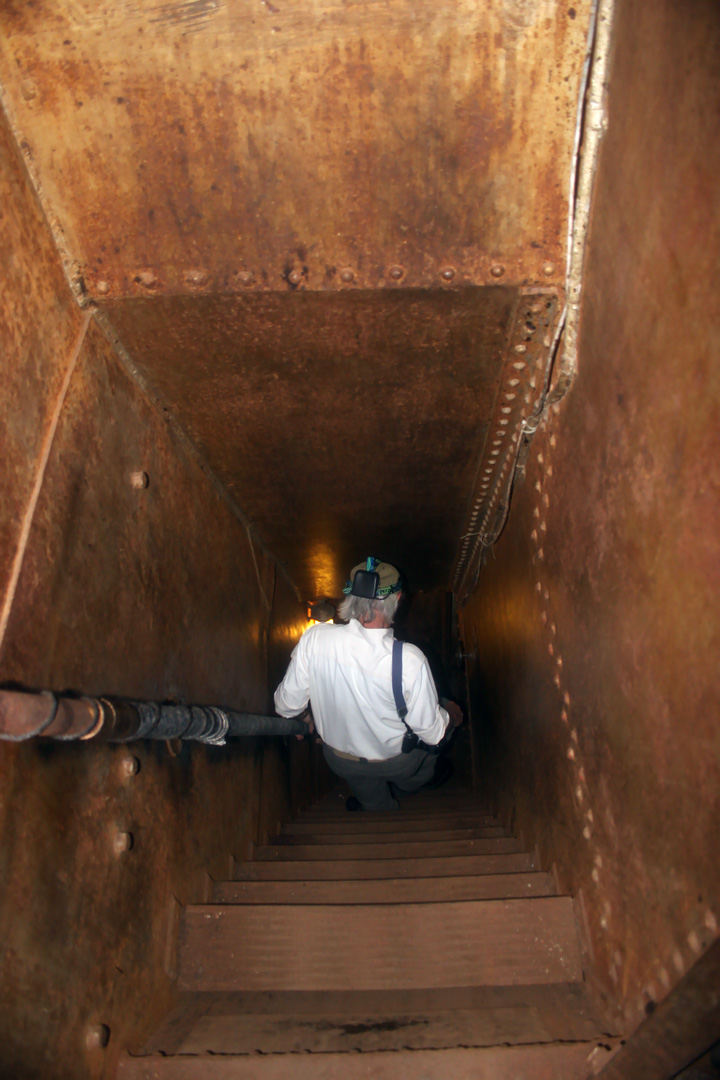

On Saturday I had the opportunity to take a “hard-hat” tour of U.S.S. Texas (BB-35), which is preserved as a museum ship at the San Jacinto Battleground, near Houston. She’s one-of-a-kind, the last dreadnought battleship from the first great arms race of the 20th century. The tour was arranged by my colleague, Amy Borgens, for the benefit of the Marine Archaeological Stewards group. The tour was led by Ship Manager Andy Smith and the ship’s Curator, Travis Davis. There’s not very much about Texas that one or the other of those men doesn’t know.
It was quite remarkable, and I would urge anyone with a particular interest in technology or maritime history to take a similar tour if you can. Though the focus was mostly on the technology of the ship — structure, fittings and operation –there were quite a few very human touches, like personal locker whose owner had made a careful running account, inside the door, of all the other Texas sailors who owed him money. It was a long list. One of our group, a Navy veteran himself, commented that “there’s a guy like that in every division.”
The ship desperately needs a major overhaul and rebuilding of specific areas. There’s a significant amount of money set aside for this work already, but it’s not likely to be enough given the scale of the task, and plans are still being made to see how best to tackle the ship’s restoration and preservation with the resources available. As Ship Manager Andy Smith explained, it’s a bit of a chicken-and-egg problem. It’s hard to raise money without very concrete, specific plans as to how you’re going to spend it; at the same time, though, it’s hard to make detailed and pragmatic plans if you don’t know how much money you’re going to have to work with.
“Come on, Texas!” was a cheer her sailors used when rooting for their messmates in athletic competitions with other ships in the fleet, and it seems appropriate for this stage in the ship’s life, as well. In a few days, on May 18, 2012, U.S.S. Texas will mark her 100th birthday. Here’s hoping she’s still around for her 200th.

This diagram shows the locations appearing in the following images, roughly in order from aft (left), moving forward. More pictures after the jump:
Was Confederate Conscription an Instrument of Social Justice?
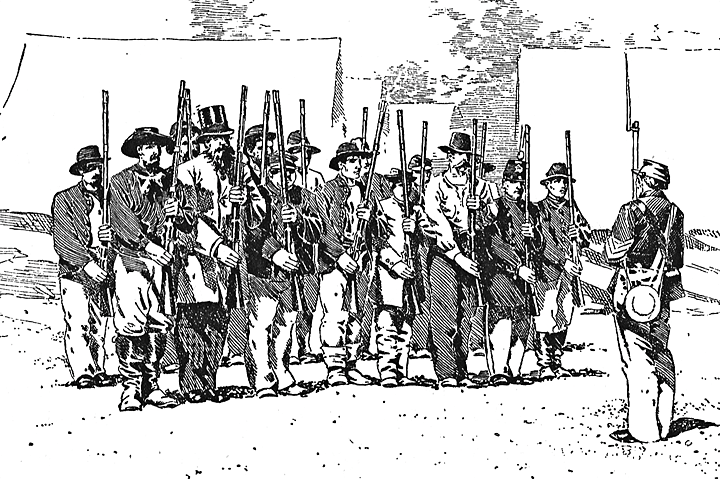
Was the Confederate Conscription Act what we today might describe as an instrument of social justice? Over at the Civil War Monitor, I point out that some Confederates at the time thought so. The money quote:
Equal burthens and equal benefits is a cardinal principal in American liberty.
_____________
Image: “The Awkward Squad” by Walton Taber.





 Dead Confederates, A Civil War Era Blog

9 comments