You Can Only Pick One. . . .
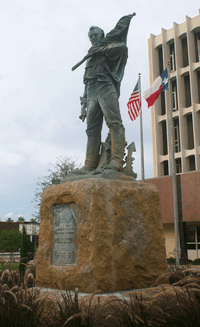 There are two CW events in Galveston coming up this Sunday afternoon that are worth noting. Unfortunately, they’re both happening at 2 p.m. that day.
The first is the re-dedication of Galveston’s Confederate memorial statue, “Dignified Resignation” (right, in 2010) on the grounds of the former county courthouse. The original dedication was held on June 3 1912, exactly 100 years before. The monument was recently cleaned and restored to its original bronze finish, and it looks great. I’ve long liked this particular monument, partly because it has a strong maritime component to it, and partly because it’s an original piece, not the more typical (even clichéd) styles so common to courthouse squares across the country. The primary speaker will be Dr. Judy Bernard, Chairman of District V of the Texas Division of the UDC.
The other event is Don Willett’s talk, “Overview: The Battle of Galveston,” at Menard Hall, 33rd Street and Avenue O. I’ve heard Prof. Willett speak before, but not on this particular subject, and I’m curious to hear what he has to say. Additionally, since I’m going to be doing a talk in that same series in a few weeks, it will probably be a wise move for me to attend the Battle of Galveston talk to see in advance how those are structured.
Kinda wish I didn’t have to pick one or the other, though.
______________

Confederate “Body Soldier” Honored with Fake Grave, Yankee Headstone
 Update, June 12: The researcher behind the stone, Julia Barnes, pushes back hard against my piece below:
Andy, as with many issues, reporters make mistakes. The reporter did a good job and was trying to do a public service. The records for Wade Childs stated that he was a “body servant,” not “body soldier.” The burial site for both men, Lewis and Wade Childs, was the West View cemetery in Anderson. This is not supposition. It is based upon the death certificates. Both were buried in the same cemetery, by the same undertaker, about 12 months apart. This is not a fake grave. It is a placement based upon the records of the Anderson Cemetery records office, the South Carolina Vital Records department, and the Pension records found in the SC Archives, which noted his burial location and date. All of this was reviewed by the City attorney for approval of the placement of the headstone.
Fair enough. More in the comments.
_____________________
Even in the muddle of half-understood documents, vague definitions and simplistic, patriotic tropes one comes to expect of news stories about black Confederates, this one’s a mess:
Childs served as a body soldier with Orrs Regiment of the South Carolina Rifles in the Confederate army during the Civil War. He carried the belongings and camp supplies of white soldiers, one of some 20,000 to 50,000 slaves who labored during the war.
[Julia] Barnes believes he might also be one of the 3,000 to 10,000 black Confederates who Harvard researchers suspect fought for the South. The Southern army did not record black soldiers, said Barnes, an Anderson County historian.
I’ve never heard the term “body soldier” before, but I suspect I will again. It’s a modern obfuscation that both sounds substantive and conveniently elides the terms used 150 years ago. It’s not a term real Confederates would have understood or used. Childs would have been known as a “body servant,” or simply as a slave. There is a passing reference to Wade Childs’ being enslaved, but no reference to soldiers Private John Chiles or Captain James S. Cothran, to whom (according to his pension record) Childs was acting as servant. Childs labored for those men, not for the Confederate army. The headstone makes no reference to Childs’ role whatsoever. That’s almost unheard of on such stones, and suggests very strongly that the folks who put it up feel like the less said about that status, the better.
Mike Barnes, the local SCV camp commander, is quoted as saying that “they are considered veterans by the state of South Carolina,” but in fact the state viewed men like Childs very, very differently than it did rank-and-file Confederate soldiers. South Carolina first awarded pensions to disabled white veterans and their widows in 1887, and gradually expanded eligibility for other white veterans in the decades following. It was almost forty more years, though, before men like Childs were made eligible:
Act No. 63, 1923 S.C. Acts 107 allowed African Americans who had served at least six months as cooks, servants, or attendants to apply for a pension. Then in 1924, apparently because there were too many applications, the act was amended to eliminate all laborers, teamsters, and non-South Carolinians by extending eligibility only to South Carolina residents who had served the state for at least six months as “body servants or male camp cooks.”
The evidence for Child’s involvement with the Confederate military seems to rest entirely on his 1923 pension application (read it here), which is fine as far as it goes. (See another example of the limits of Confederate pension records here.) But the pension application is very clear about what Childs’ (or Chiles’, as it’s given in the application) role was during the war as a servant — none of this vague “body soldier” business mentioned there.
It’s also important to note that, as is often the case with such applications, the case for Childs’ worthiness for such a pension was made not only on his wartime service to his master, but also on his continued adherence to the racial status quo antebellum in the South. “Wade has been a faithful, dependable negro [sic.],” his primary sponsor writes, “humble to white people and always willing to serve them.” Contrary to the assertions of the local SCV camp commander, this is hardly a case of Childs’ service being recognized by the state as being anything like that of white veterans, armed and in the ranks.
Make note also of the fact that, as of 1924, African Americans who had worked as laborers and teamsters, men whose activities were arguably more directly beneficial to the South’s military effort, were explicitly excluded from the pension program in favor of those men like Childs who had served individual white soldiers. Cooks and personal servants counted; the men who built earthworks and drove wagons did not. That was the policy of the state of South Carolina.
All of this is par for the course in “honoring” black Confederates, but there’s an additional element here that adds another layer of dubious research findings:
Barnes and her husband discovered that Childs’ brother Lewis was buried at Westview, a historically black cemetery. They concluded that Wade Childs must be buried there, too.
Westview’s military corner facing Reed Street is “wall-to-wall” with unmarked graves, Barnes said.
“I had been looking and found his brother there,” Barnes said. “It’s logical that he would be there since his brother is there. We don’t know where, but when we saw Lewis, we felt his was there, too.”
Yes, you read that right — they have no damn idea where Wade Childs is actually buried. They’re guessing, and placed a stone in that cemetery, on that spot, because they “felt” that was the spot, that it was “logical” to them. It’s a fake grave, just like the ones in Pulaski — with the exception that the folks in Tennessee at least added fine print noting that location of the person mentioned is unknown. No such truth-telling here.
To add an extra bit of irony, these noble defenders of Southron Honour™ put up a stone with a rounded top, like those of of U.S. veterans, not the peaked top usually used for former Confederates. How on earth did they get that one wrong?
I dare say these folks found a local African American man in the South Carolina pension rolls, and ended up so determined to commemorate their very own black Confederate that little details like, oh, actually knowing where he’s buried became irrelevant to putting up a marker and chalking up another “forgotten segment of South Carolina’s past.” Thank goodness these folks are only promoting heritage — if they called this half-baked foolishness history, they’d be laughed out of town.
______________
Update, May 31: I originally put this down in the comments, but it might be useful to explain further why I’m a bit exercised about this “fake grave” business, an action that I (still) consider to be so misleading as to border on willful dishonesty.
Long-time readers may recall my post just about exactly a year ago on Peter Phelps, a white Confederate soldier who’d been named as a “black Confederate” by another website. In researching Peter Phelps, I found documentation not only of the cemetery he was buried in, but also the section. Unfortunately, there is no marker there now to identify the exact spot, so I posted a photo of the area with a caption that it showed the area where he was buried, but the precise location is not known. That’s fair, that’s accurate, and that’s honest. What I did not do is take a picture of an empty patch of soil and state, “this is Peter Phelps’ grave,” which is essentially what the Barnes are doing with Wade Childs.
As for their assumption that Wade Childs is buried next to his brother, the Phelps case is also instructive. Peter’s wife, Lucinda, died several years before he did, and we know (again from interment records) that she was buried in a plot in the same part of that cemetery. But section and plot numbers also make it clear that they are not buried together, as one might assume a married couple would be. While it may seem “logical” to think that Childs is buried near his brother, in the absence of actual evidence of that, it seems foolhardy to me to make that assumption and set it in stone (literally) for future generations. Visitors to that South Carolina cemetery a week from now, a year from now, fifty years from now, are going to be left with the belief that they saw the grave of Wade Childs, when in fact they might not have been within fifty (or a hundred) yards of it. Does that sort of precision really matter? Yes, I think it does, especially when it involves placing a marker that’s intended to last for generations to come.
As I’ve said, there are many ways to recognize a person, or a burial, without setting up a fake grave. It can be done. Even the faux cemetery for black Confederates at Pulaski, which is disingenuous and misleading in so many ways, acknowledges that the men so “honored” do not actually lie under those stones.
For those who want to engage in the heritage vs. history debate, this commemoration of Wade Childs offers lots to chew on. It’s a great example of the difference between two different approaches. Serious historians know the limits of their knowledge of a subject, and are willing to say “we don’t know that; we don’t actually know where Wade Childs is buried.” A serious historian does not go around setting up a simulated gravesite as a means of “honoring” a deceased person, or making up a term like “body soldier” to muddy the waters around the man’s actual role in the war, while ignoring critical elements of the primary, documentary record that undermine the chosen narrative. “Heritage” advocates do that sort of thing all the time, and aren’t even aware they’re doing it, or understand that it’s a problem.
So by all means, “forward the Colours,” y’all. Just don’t think what you’re doing counts as history.
______________
Image: Jennifer Crossley Howard, IndependentMail.com.

Frederick Douglass on Decoration Day, 1871
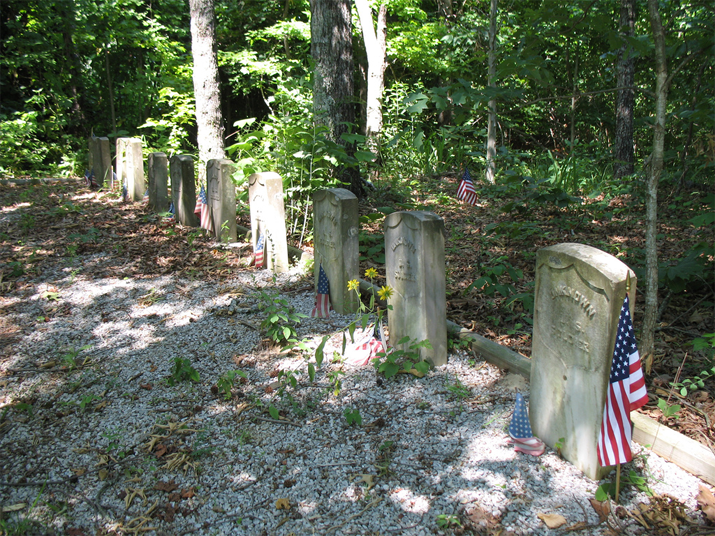
On Decoration Day, 1871, Frederick Douglass gave the following address at the monument to the Unknown Dead of the Civil War at Arlington National Cemetery. It is a short speech, but one of the best of its type I’ve ever encountered. I’ve posted it before, but it think it’s something worth re-reading and contemplating every Memorial Day.
The Unknown Loyal Dead
Arlington National Cemetery, Virginia, on Decoration Day, May 30, 1871Friends and Fellow Citizens:
Tarry here for a moment. My words shall be few and simple. The solemn rites of this hour and place call for no lengthened speech. There is, in the very air of this resting-ground of the unknown dead a silent, subtle and all-pervading eloquence, far more touching, impressive, and thrilling than living lips have ever uttered. Into the measureless depths of every loyal soul it is now whispering lessons of all that is precious, priceless, holiest, and most enduring in human existence.
Dark and sad will be the hour to this nation when it forgets to pay grateful homage to its greatest benefactors. The offering we bring to-day is due alike to the patriot soldiers dead and their noble comrades who still live; for, whether living or dead, whether in time or eternity, the loyal soldiers who imperiled all for country and freedom are one and inseparable.
Those unknown heroes whose whitened bones have been piously gathered here, and whose green graves we now strew with sweet and beautiful flowers, choice emblems alike of pure hearts and brave spirits, reached, in their glorious career that last highest point of nobleness beyond which human power cannot go. They died for their country.
No loftier tribute can be paid to the most illustrious of all the benefactors of mankind than we pay to these unrecognized soldiers when we write above their graves this shining epitaph.
When the dark and vengeful spirit of slavery, always ambitious, preferring to rule in hell than to serve in heaven, fired the Southern heart and stirred all the malign elements of discord, when our great Republic, the hope of freedom and self-government throughout the world, had reached the point of supreme peril, when the Union of these states was torn and rent asunder at the center, and the armies of a gigantic rebellion came forth with broad blades and bloody hands to destroy the very foundations of American society, the unknown braves who flung themselves into the yawning chasm, where cannon roared and bullets whistled, fought and fell. They died for their country.
We are sometimes asked, in the name of patriotism, to forget the merits of this fearful struggle, and to remember with equal admiration those who struck at the nation’s life and those who struck to save it, those who fought for slavery and those who fought for liberty and justice.
I am no minister of malice. I would not strike the fallen. I would not repel the repentant; but may my “right hand forget her cunning and my tongue cleave to the roof of my mouth,” if I forget the difference between the parties to hat terrible, protracted, and bloody conflict.
If we ought to forget a war which has filled our land with widows and orphans; which has made stumps of men of the very flower of our youth; which has sent them on the journey of life armless, legless, maimed and mutilated; which has piled up a debt heavier than a mountain of gold, swept uncounted thousands of men into bloody graves and planted agony at a million hearthstones — I say, if this war is to be forgotten, I ask, in the name of all things sacred, what shall men remember?
The essence and significance of our devotions here to-day are not to be found in the fact that the men whose remains fill these graves were brave in battle. If we met simply to show our sense of bravery, we should find enough on both sides to kindle admiration. In the raging storm of fire and blood, in the fierce torrent of shot and shell, of sword and bayonet, whether on foot or on horse, unflinching courage marked the rebel not less than the loyal soldier.
But we are not here to applaud manly courage, save as it has been displayed in a noble cause. We must never forget that victory to the rebellion meant death to the republic. We must never forget that the loyal soldiers who rest beneath this sod flung themselves between the nation and the nation’s destroyers. If today we have a country not boiling in an agony of blood, like France, if now we have a united country, no longer cursed by the hell-black system of human bondage, if the American name is no longer a by-word and a hissing to a mocking earth, if the star-spangled banner floats only over free American citizens in every quarter of the land, and our country has before it a long and glorious career of justice, liberty, and civilization, we are indebted to the unselfish devotion of the noble army who rest in these honored graves all around us.
______________
Image: Graves of nine unknown Federal soldiers in Pontotoc County, Mississippi. Photo by Flickr user NatalieMaynor, used under Creative Commons license. Text of Douglass speech from Philip S. Foner and Yuval Taylor, Frederick Douglass: Selected Speeches and Writings.

Nathan Bedford Forrest, Reconstructed
 Nathan Bedford Forrest is today more popular than ever among the fans of the Confederacy. More than any other Confederate officer, Forrest is the modern face of the unreconstructed rebel, the pit bull of the Lost Cause.
The real Nathan Bedford Forrest was anything but that.
_____________

Memorial Day in Memphis, 1875

From the Memphis Daily Appeal, May 25, 1875:
Three generations of soldiers were of the long array — the men who fought with Jackson at New Orleans, those who braved the Indians in the Everglades, the later generation who followed Scott and [Jefferson] Davis and [Gideon Johnston] Pillow [a local hero] in Mexico, and the still later who had served with Grant or Lee, with Stonewall Jackson or Sherman, with Forrest or Sheridan, with Joe Johnston or Thomas. . . . These were the links that bound jubilee army to the past, blending with the younger soldiers whose battles were on a grander scale, but whose contests were no fiercer, illustrated for the multitude almost the whole history of the Republic. . . . In these gentlemen [Pillow and Davis] we had united the two later and grandest epochs in our history — the one by which we won an empire, and the other by which we sustained the shock of civil war and survived to enjoy and perpetuate a still more perfect Union. Forrest, the “terrible fighter” and always victorious cavalry raider, marched in the same column with the Federals who had fought him, and shared a seat on the same platform with our best representatives of the Union armies. . . . Mr. Davis, our foremost statesman, did not speak, but he was upon the platform, and by his presence gave indorsement [sic.] to the re-cementing of the bonds of brotherhood. Tribute was paid to the dead, a loving tribute in words and flower, but the Union was over it all — was uppermost in all minds — and the day was thus made sacred to the highest purpose, and the dead were made to serve the noblest use in a text and day on which to preach peace and love, and date the final close of the war and all its bitter dissensions and contentions. Looking back through the night into the day, and recalling the men who were principal actors in the play, the tone and temper of the audience and the drift of what was said and sung can reach but the conclusion impressed upon us when yet the parade was in the thought of its projectors, that it was to be as healing upon the waters, it was to be a proper supplement of our steady march toward complete restoration, the finale of all our efforts to be reconciled to to our brothers of the both, and to do our part toward the consummation of that perfect peace for which all men have longed since that day at Appomattox, when Lee sheathed his sword and bade his troops “good-bye.” It was a great popular upheaval. It was the bursting of a great pent-up feeling of joy and happiness upon the condition of the country, the overflowing of gratitude for the blessings we enjoy of civil and religious liberty, and the determination to to give unmistakable assurances of loyalty and fealty to the Union. . . . The Union was apparent in and over all. The battle-flags of both armies were placed side-by-side or in peaceful embrace, by request, too, of General Forrest, and the same hands draped the graves of the boys in blue and gray alike. The memory we revive of the day is this, and this its lesson. May it endure forever to animate us on each recurring anniversary, strengthening present resolution and and confirming us in our determination to labor hereafter in and for the Union, to make it more glorious and free, the first among the nations of the earth.

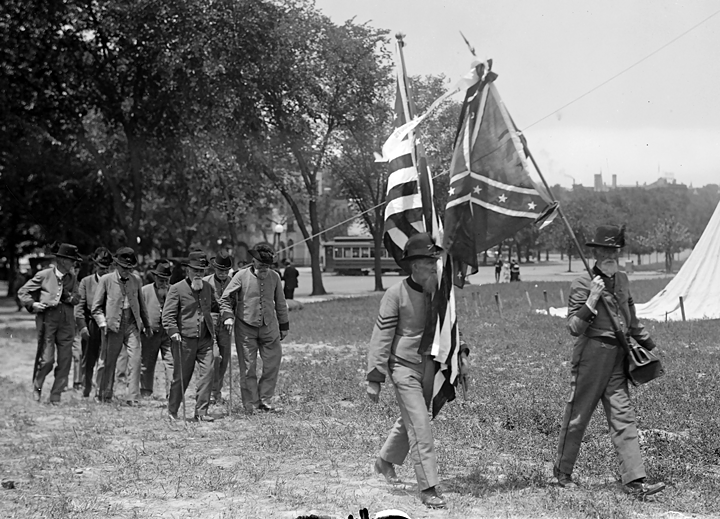
Real Confederates were a lot more willing to aver their loyalty to the Union in the years after the war than some make-believe Confederates are today. I wonder if the Confederate Tarheels in the photo above, in 1917, marched down Pennsylvania Avenue chanting, “Kill Yankees! All of Them!”
Somehow, I doubt it.
_____________Image: Confederate Veterans from North Carolina at the national UCV meeting in Washington, D.C., 1917. Library of Congress.

Have a Happy and Safe Memorial Day

__________________
Image: “Decoration Day No. 1618,” c. 1914. Library of Congress.

The Steamboat Planter in Depth


There’s a well-known stereoview of the South Carolina steamboat Planter, with copies at the NYPL, in the Eric Steinfleldt Collection at SMU, and elsewhere. The image is undated, but I believe it likely is from 1866-76, after the steamer’s wartime service. The ship is a close match for both Planter‘s appearance in 1862, and another postwar image in the collection of the Naval Historical Center in Washington, D.C. (This ship is sometimes mistakenly labeled as being Robert Smalls’ vessel, but it’s an entirely different craft.)
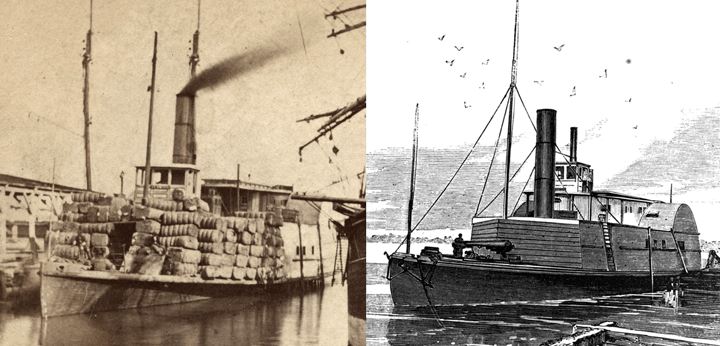
The main difference between this stereo image and the appearance of the ship in 1862 is the location of the pilothouse, a relatively simple modification.
Anyway, get out your red/cyan glasses and enjoy. Instructions on converting an old stereoview to a red/cyan image in Photoshop here.
_____________

1940 Census Update
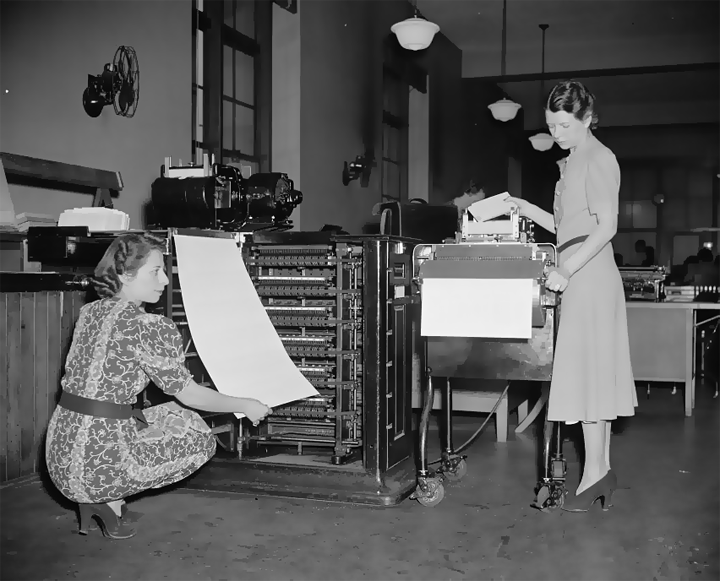
As many of you know, Ancestry recently added the enumeration pages from the 1940 U.S. Census to its website. (The same files can be viewed for free at the National Archives, here.) Indexing the several million pages by name, however, is going to take much longer — months, at least — so it will be a while before users can simply type in a name and find the person they’re looking for, anywhere in the country. For now, you have to start looking by location.
If you know the street address you’re looking for, though, there’s a handy tool available here, developed by two census researchers, Stephen P. Morse and Joel D. Weintraub, that lets users identify the specific enumeration district, which can then be accessed through Ancestry. You’ll still have to look through a number of pages of enumeration rolls, but it’s a heck of a lot easier than going by-guess-and-by-golly.
I looked up several addresses that are of interest to me in this way, and it worked pretty well. I looked up my own address and found who was living in my house 72 years ago. We’d always known what family it was, but it was interesting to see who was actually present, living in the house at that time.
What unexpected discoveries have you found in the 1940 census?
_____________From the original caption: “Herman Hollerith invented a ‘unit tabulator,’ shown on left of photo being operated by Operator Ann Oliver. This machine is fed cards containing census information at the rate of 400 a minute and from these, 12 separate bits of statistical information is extracted. Not so long ago, Eugene M. La Boiteaux, Census Bureau inventor, turned out a smaller, more compact machine, which extracts 58 statistics from 150 cards per minute. This machine is shown on the right and is being operated by Virginia Balinger, Assistant Supervisor of the current Inquiry Section. With the aid of this machine, statistical information from the 1940 census is expected to be compiled in 2 1/2 years.” Library of Congress.

“Buckets of bullets”

There’s a recent addition to the blog roll, Running the Blockade: A Civil War Naval Blog, which shows a lot of promise. It’s written by a blogger who goes by the handle RoadDog, and I’m happy because it’s based in part on findings of archaeological work done on such ships. Right now, RoadDog is dealing with the wreck of Modern Greece, wrecked off Fort Fisher in June 1862. The shipwreck was discovers a century later, and became one of the first — I think the first — vessel of its type investigated using the then-novel discipline of nautical archaeology.
Here, RoadDog describes one young man’s first encounter with the ship and its history, lying practically in his own back yard:
Stan Register was 13, fifty years ago, and worked at a hot dog stand on the beach when the Navy divers showed up. They were staying at a hotel across from his stand and one day they invited him to come out to the barge and watch. He can remember seeing the outline of the wreck below the barge. That day they brought up a small cannon and banded cases of rifles along with four buckets of bullets and let him keep a couple.
As can be seen in the image above, from “buckets of bullets” was not an exaggeration.
_______________
Image from Leslie S. Bright, The Blockade Runner Modern Greece, and Her Cargo.

The Virginia Fraggers

Update: Over at SHPG, Susan Hathaway responds to this post, which she refers to as an “irresponsible hit piece on the Flaggers. . . full of holes and untruths.” Okay.

Looks like the Virginia Flaggers are doubling down in their efforts to pick a fight with the leadership of the United Daughters of the Confederacy. You may recall that, back in March, they intentionally violated directives from the UDC not to come onto UDC property — a warning given in person, a few days previous, to Susan Hathaway, the leader of the Flaggers — and then portrayed themselves as the oppressed victim when the local police were called. Of course, the Flaggers initially neglected to mention the whole you were-warned-in-advance part, and only later acknowledged that after the President-General of the UDC, Martha Rogers Van Schaick, released a detailed statement and timeline of her organization’s interactions with the Flaggers, going back to late last year. Hathaway subsequently acknowledged that “the account in the the statement today by Mrs. Van Schaick, with a few minor exceptions, is accurate, and in fact, is almost exactly as has been previously reported.” Well, no, it wasn’t “as has been previously reported,” at least by the Flaggers themselves. They put out a self-serving, incomplete account of events, and it was President-General Van Schaick who called bullshit on them.
This eagerness to pick an entirely unnecessary fight with a group like the UDC, simply because they refuse to play along with the Flagger’s particular brand of activisim (i.e., “restoring the honor”) is just nuts. It’s short-sighted, self-gratifying idiocy. Yes, the UDC is a low-key group and probably pretty set in its ways. Yes, the UDC doesn’t seem interested in making dramatic headlines. The UDC is certainly not beyond criticism, but they’re entirely within their right to decide what issues they want to make a public stand on, just as they’re free to decide who is and who is not welcome on their property. The only thing the UDC is guilty of is choosing not to play host to the Flaggers’ protest of of the VMFA, the UDC’s own next-door neighbor; everything else is just bombast and angry chest-thumping on the part of the Flaggers.
I read an observation the other day on a completely unrelated subject, to the effect that true believers “always require someone insufficiently pure enough to set themselves against, and they’ll manufacture them out of allies just as soon as they run out of enemies.” There’s a world of truth in that, and it strikes me as a fair assessment of the state of the Confederate Heritage™ movement generally, and the Virginia Flaggers in particular. For all their bluff and bluster, they haven’t got many victories to claim. They did succeed in getting Confederate flags restored to grave sites at a rural cemetery in Georgia, but in their primary protests they’ve been spectacularly unsuccessful. Their first big effort, to prevent passage of a city ordinance in Lexington, Virginia that would bar non-governmental flags from city light poles, was a flop. (No doubt local support for the measure, which was widespread, was in no small part due to the ludicrous spectacle that the out-of-towners brought with them.) There are no Confederate flags displayed at the Pelham Chapel in Richmond. After telling local media to expect “about 1,000 marchers” for the much-heralded Confederate Heritage Rally 2012 in Richmond in February, the actual turnout was about a third of that. No Confederate flag flies outside the Museum of the Confederacy at Appomattox. Mimi Elrod is still mayor in Lexington.
Waite Rawls is still gainfully employed.
With a track record like that, it’s easy to see why folks like Hathaway would decide to create melodramatic stories and faux confrontations. Thus a completely civil sidewalk encounter gets depicted as “Black woman attacked for carrying Confederate Flag.” A Flagger — does he always go around wired for sound? — actually catches on audiotape the egregious abuse of power in which a security guard says, “because I said so.” It’s played up for yucks when, outside the Museum of the Confederacy at Appomattox, the horse of a reenactor portraying General Grant gets spooked by a CBF carried by — you guessed it, a Flagger. They “restore the honor” by flashing a CBF, hastily pulled out of a back pocket, near the Lincoln Memorial. Something tells me the sixteenth president would be highly amused by that sophomoric foolishness, like one of Tad’s infamous White House pranks. “Lucifer’s Temple,” seriously?
Did y’all remember to write “Abe is a doo-doo-head” in the Park Service restroom stall while you were at it?
So the Southron Heritage™ movement is now, increasingly, turning its rhetorical weaponry on its own members. It’s not an entirely new phenomenon, of course; there have been grumblings about insufficiently-activist SCV camps that “meet, eat, and retreat” for years. Mark Vogl, who was reportedly pushed out of his senior role in the Texas Division of the SCV because that group didn’t want to get dragged into the culture wars battles he was waging, continues to complain about the “grannies” who now lead that group. But the gray-on-gray sniping does seem to have taken on a sharper edge of late, and the Flaggers are in the front rank. The vitriol now directed against fellow heritage advocates is remarkable, with an unprecedented level of nastiness. Conservative Republican governors of a Southern state are derided as “scalawags” and “traitors” for failing to embrace Confederate symbols. A well-known SCV color guard is targeted with epithets of “stink faces (above)” for refusing to renege on a prior agreement to participate in ceremonies at the new Appomattox facility. And now the leadership of the UDC, by declining to participate in shenanigans like this, is guilty of “sell[ing] off their birthright!!!“
It’s important to understand that folks like the Flaggers and their supporters, regardless of how much time they spend fluffing reassuring each other that they’re the true Defenders of Southron Heritage, are a small-but-noisy group of folks who aren’t aren’t very representative of Southerners, or even of the descendants of Confederate veterans. They certainly don’t represent the SCV or UDC members I’ve known over the years. The name-calling, sneering mockery and over-the-top rhetoric isn’t the sign of strong, self-confident movement; it’s emblematic of deep and abiding insecurity, a realization that it’s they who are badly out of step with society as a whole, and consequently are desperate to make a name for themselves, even if they have to pick utterly unnecessary fights to do it. The UDC, I’m sure, will survive this just fine, as will the Museum of the Confederacy and the City of Lexington. The Flaggers, not so much, because every contrived outrage distances themselves a little more from the people with whom they should be making common cause.
I used to be pretty ambivalent about the Flaggers; while I thought they were often injecting themselves, as outsiders, in matters that were fundamentally local in nature (e.g., the Lexington ordinance), I also have sympathy, even admiration for acts of smart, clever protest. But after months of watching them their supporters, through their own YouTube clips, blogging, and elsewhere, I’ve come to the conclusion that there’s not a lot of there, there. There’s much angry vitriol and puffery about this or that party not “honoring” the Confederacy, which really seems to begin and end with prominent display of the Confederate Battle Flag. It’s protesting for the sake of protesting, to establish — mainly to each other — that they’re more Southron than all the rest.
So they go off on their own would-be allies, who (in their view) are insufficiently patriotic about the Confederacy. It’s fratricide, it’s unnecessary, and it’s ugly. The Flaggers and their partners will come out on the short end of this one, and it will be of their own doing.
Have at it, y’all. Knock yourselves out.
_____________





 Dead Confederates, A Civil War Era Blog


4 comments