Anticipating Lincoln
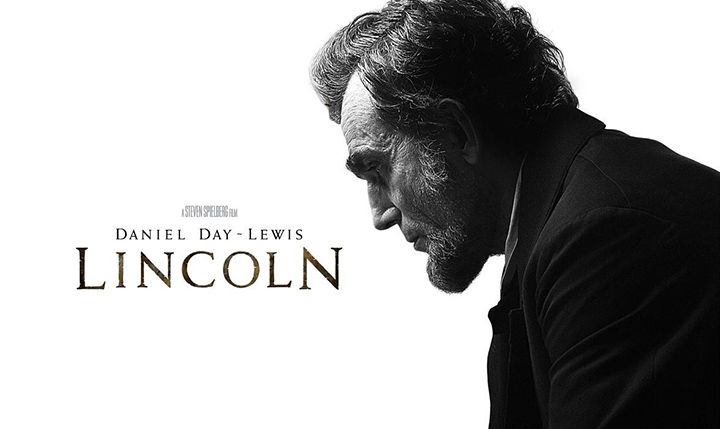
On Sunday evening 60 Minutes did a story on Steven Spielberg and his upcoming film, Lincoln. Much of the interview focused on the way Spielberg’s childhood and relationship with his parents, particularly his father, has been reflected in his films. That’s pretty interesting in its own right, but I do wish more time had been spent on Lincoln.
As a filmmaker, Spielberg has never been known for complex characterizations or ambiguous moral messages. (Or realism.) This film is decidedly different in tone, something the director himself acknowledges. It’s not aimed at the summer blockbuster crowd:

Lesley Stahl: There’s not a lot of action. There’s no Spielberg special effects. Steven Spielberg: Right. Lesley Stahl: It’s a movie about process and politics. Have you ever done a movie even remotely– Steven Spielberg: Never. Like this? Lesley Stahl: Not even close. Steven Spielberg: Never. No. I knew I could do the action in my sleep at this point in my career. In my life, the action doesn’t hold any– it doesn’t attract me anymore. Narrator: With only one brief battle scene, the movie’s more like a stage play with lots of dialog as Lincoln cajoles and horse trades for votes.

Spielberg and his team made a pretty fascinating decision, to focus the film on the last months of Lincoln’s life and his efforts to pass the 13th Amendment, that abolished slavery throughout the United States. The Union military victory was clearly in sight at that point, and Lincoln was trying to make permanent the de facto emancipation brought about by the Emancipation Proclamation and the advance of Federal armies across the South. As we’ve noted before, Lincoln’s commitment to ending chattel bondage permanently by embedding it in the Constitution is evidenced by the fact that he signed the original text of the amendment as passed by both houses of Congress, even though the president has no formal role in approving or endorsing constitutional amendments. The Emancipation Proclamation gets lots of attention, but is also too often misrepresented as the be-all and end-all of emancipation, when it was (as any serious historian will tell you) a temporary, limited, wartime measure, a single, important milestone on the path to real, permanent emancipation. (A path, by the way, that begins with Spoons Butler’s 1861 “contraband” policy at Fort Monroe.) The Emancipation Proclamation is not Lincoln’s legacy; the 13th Amendment rightly is.
Then there’s this, which is an interesting approach, although not one I’m sure I agree with:
Narrator: Although Spielberg took great pains to be historically accurate, he made what some will see as a curious exception in this scene. Steven Spielberg: Some of the Democrats that were voting against the [13th] Amendment, we changed their actual names. So if you go through the names that we call out on the vote, you’re not going to find a lot of those names that conform to history. And that was in deference to the families.
All of this effort and nuance will likely be wasted on the True Southron™ crowd, who are already carping about the film’s likely omission of black Confederates and predicting its dismal failure at the box office. I suspect most of them will refuse to watch the movie, though that will hardly stop them from complaining about its content, real or imagined. While history buffs will be arguing about details — whether this character actually said that, or whether such-and-such scene really happened or is a composite of several actual events — the Southrons will be more vaguely angered that the film exists at all, and that it depicts Lincoln as genuinely committed to ending slavery, willing to push the boundaries of his office and the political landscape to as much as he dared to accomplish that goal. That notion is an anathema to the Southrons, because it puts Lincoln, whatever else his faults, squarely on the right side of the great moral issue facing Americans in the 19th century. Instead they will rehash Lincoln’s casual bigotry against African Americans (true, although almost universal among white Americans in that day), and his willingness to consider voluntary recolonization of freedmen to Africa — an idea that long predated Lincoln’s public life and long survived him, as well. These are, after all, the people who can say with a straight face that Lincoln was “a bigger racist than I ever knew,” and more deserving of moral condemnation than their own ancestors who actually owned slaves. As I wrote several months back,
Confederate apologists often point to these ugly examples and say, “Lincoln believed so-and-so, ” or “Lincoln said such-and-such.” They do this reflexively, as a means of deflecting criticism of slavery in the the South. Such mentions of Lincoln are often narrowly true, but they miss the larger, and much more important, truth. . , which is that Lincoln himself changed and grew over time. The president who told “darkey” jokes also had Frederick Douglass as a visitor to the White House in 1863, the first African American to enter that building not as a servant or laborer, but as a guest. The president who’d said he would be willing not to free a single slave if it would preserve the Union also asked Douglass, in the summer of 1864, to use his contacts to get as many slaves into Union lines as he could before that fall’s presidential election, which Lincoln fully expected to lose. The chief executive who had toyed with the idea of re-colonizing former slaves back to Africa publicly suggested, just days before his death, that suffrage should be extended to at least some freedmen, specifically those who’d served in the Union army.
Lincoln Derangement Syndrome is very real, and Spielberg’s film is certain to push some folks over the edge. So don’t expect much effort from the Confederate Heritage™ crowd to take the movie on its own terms, or to acknowledge anything positive about the 16th president — just a lot of vague complaining about “PC Hollywood” or the “Lincoln myth,” and so on, without much reference to the specific content of the film itself.
For the rest of us, though, it’s looking like this is going to be a film that delves into a part of Lincoln’s life that’s never been brought to the big screen before. I sure it will give historians and bloggers much both to praise and criticize in the coming weeks. My hope is that, like Glory, Lincoln will be a film that, while containing inevitable small historical inaccuracies, will nonetheless tell a greater true story, will loom large in the general public’s understanding of the conflict and inspire a renewed interest in it.
I can’t hardly wait.
_____________

Moving the Big Guns on Alabama
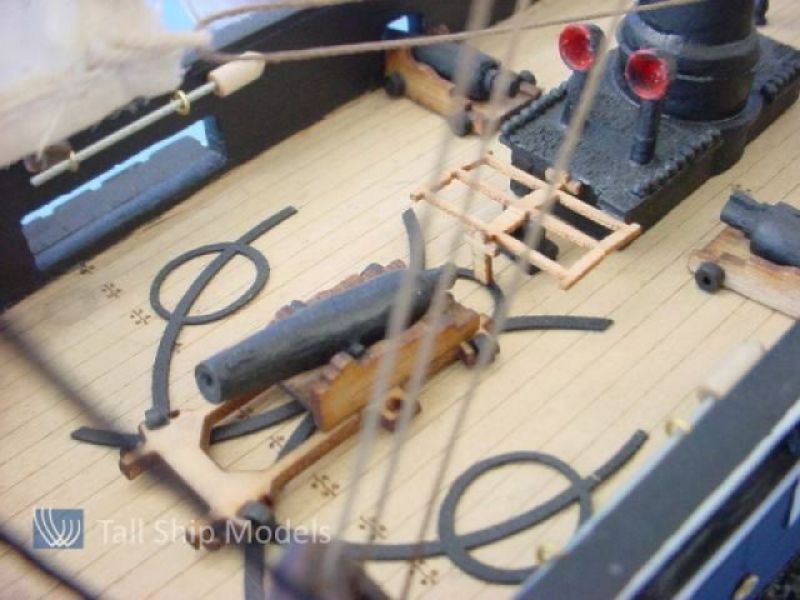
Over at Civil War Talk, there was an inquiry as to how the big, mounted artillery on ships like Alabama were moved about. When you look at a model or drawing of a CW-era ship, the deck often seems to be covered with metal arcs, obviously related to moving the gun, but in no clear pattern that’s easy to discern. (See this example on a model of U.S.S. Kearsarge.)Fortunately, Andrew Bowcock covers this procedure in some detail in his C.S.S. Alabama: Anatomy of a Confederate Raider. Although he described the procedure for a specific gun on that vessel, the process would be similar on other ships.
There are three basic components to the gun — the tube, the carriage on which the tube is mounted, and the slide in which the carriage was run forward and back (with recoil). It’s the arrangement of the slide here that’s important. The key to the whole process is that each end of the slide is fitted with a hole through which a brass pivot pin could be dropped, going through the carriage and into a matching, iron-reinforced hole in the deck. The key to shifting the gun from one position to another was to swing the slide on one pivot to line up the pivot hole at the other end with another point, put that pin in place, remove the first pin, and then swing the whole thing from the other end. It sounds complicated, but it is practical and (relatively) safe on a rolling deck, since the slide will (at worst) swing in an arc, rather than go barreling across the deck like a loose gun on trucks.
Here is a diagram of the eight pivot positions (marked in red) used for Alabama’s aft 8-inch smoothbore pivot — the one Captain Semmes was famously photographed with:
![[IMG]](https://deadconfederates.com/wp-content/uploads/2012/10/pivotpoints.jpg?w=720)
And this shows the pivot points on the slide for that gun:
![[IMG]](https://deadconfederates.com/wp-content/uploads/2012/10/pivots.jpg?w=720)
And here is that process illustrated on the digital model:
![[IMG]](https://deadconfederates.com/wp-content/uploads/2012/10/position-01.jpg?w=720)
Gun positioned on center-line of deck, normal stowed position.
![[IMG]](https://deadconfederates.com/wp-content/uploads/2012/10/position-02.jpg?w=720)
Back end of slide is swung to an intermediate pivot point on the port side and pinned there.
![[IMG]](https://deadconfederates.com/wp-content/uploads/2012/10/position-03.jpg?w=720)
Front end of the slide in unpinned and swung toward the port side.
![[IMG]](https://deadconfederates.com/wp-content/uploads/2012/10/position-04.jpg?w=720)
The swing complete, the forward end of the slide in pinned at the ship’s side, and the back end in unpinned to allow the back end of the slide to swing freely.
![[IMG]](https://deadconfederates.com/wp-content/uploads/2012/10/position-05.jpg?w=720)
The gun is now ready for action.
The model is simplified for clarity, and omits all the block-and-tackle, breeching ropes, and the dozen or more crew members required to provide the muscle power to do this. (Bowcock notes that the official complement to work this gun in action would be sixteen men.) Anyway, I hope this makes the process a little clearer.
____________

Will New Documents Prompt a Reappraisal of John Bell Hood?
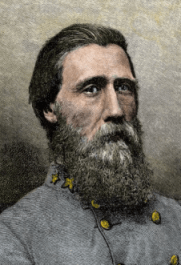 John Bell Hood is one of the most controversial Confederate generals of the war, particularly for his performance after losing a leg at Chickamauga. The disastrous Confederate losses by Hood’s Army of the Tennessee at the Battle of Franklin, at the end of November 1864, and its defeat at Nashville two weeks later, effectively destroyed it as a fighting force in the West. Much of the blame for this is usually laid squarely at the feet — er, foot — of John Bell Hood.
Now, via Kraig McNutt and the Battle of Franklin Blog, the discovery of a large collection of Hood documents, previously unknown to historians, promises to open up new insights into the general’s record and provide answers to long-standing questions.

The Battle of Franklin Trust Chief Operating Officer Eric A. Jacobson announced today at Carnton Plantation the discovery of several hundred documents, letter and orders of Confederate General John Bell Hood. While conducting research for an upcoming book on the general, West Virginia’s Sam Hood, a collateral descendent and student of the career of Hood, was invited to inspect a collection of the general’s papers, held by a descendent in Pennsylvania. In making the announcement, Sam Hood said, “I felt like the guy who found the Titanic, except for the fact everyone knew the Titanic was out there somewhere, while I had no clue that some of the stuff I found even existed.” Sam Hood added, “General Hood is certainly no stranger to controversy. During his colorful military career and with historians ever since, he has remained a controversial and tragic figure of the Civil War. Long noted for the loss of Atlanta and what some consider reckless behavior at the November 30, 1864 Battle of Franklin after a lost opportunity for possible victory at Spring Hill, he has often been the subject of ridicule and blame for the demise of the Confederacy in the West. Eric Jacobson, who has viewed a portion of the collection said, “This is one of the most significant Civil War discoveries in recent history. These documents also tell us as much by what they don’t say. One major example is the discovery of Hood’s medical journal, kept by his doctor, John T. Darby, during the war. There is no mention of the use of painkillers or laudanum by Hood at Spring Hill or any other time. Hood was much more multifaceted than how he has been portrayed by some as a simple minded and poorly equipped commander.” Jacobson has been one of only a few contemporary Army of Tennessee historians to give Hood the benefit of fatigue, fog of war and failures of subordinates as part of the breakdown of the Army of Tennessee in late 1864. Some of the items found include recommendations for promotion, handwritten by Stonewall Jackson and James Longstreet. Also uncovered was wartime correspondence between Hood and General R. E. Lee, Braxton Bragg, Louis T. Wigfall, and other senior commanders as well as his four general officer commission papers with signatures. Roughly seventy post-war letters from other Civil War notables were also discovered, mostly concerning the controversy with Confederate General Joseph E. Johnston and used to compose Hood’s memoir Advance & Retreat. Hood added, “This is just the tip of the iceberg on the expansive collection.” “I spent three days photocopying and inventorying,” added Hood. “I held in my hands documents signed by Jefferson Davis, Longstreet, Jackson and Lee.”

Seems to me that if Sam Hood, the general’s descendant who’s writing a biography of his ancestor, is smart he’ll start taking pre-orders for that book of his right now.
_______________

Stonewall Jackson Encounters the Texas Brigade
I never thought of Stephen Lang Stonewall Jackson as a particularly funny guy, but perhaps I misjudged him. Here’s an anecdote of his encounter with soldiers of the Texas Brigade about the time of the Valley Campaign in the spring of 1862:

We were all ignorant then about discipline in the army and thought that we had a right to know as much as the officers. But we soon found out differently. [Division commander] Gen. [William H.C.] Whiting was an old army officer, and a good one, and he said to Gen. Hood, that he had no doubt but what those Texas men would make good soldiers, “but you will have a hard time getting them down to army regulations.” Gen. Jackson was a good hand to execute and keep his own counsel, and about the first thing that he did was to give us to understand that we must know nothing but obey orders and if any citizen on the march should ask you where you are going, tell them that you “don’t know.” The next day he came along and noticed one of our men leave ranks for a cherry tree. Cherries were getting ripe. “Where are you going?” asked the General. “I don’t know, sir.” “What Regiment do you belong to?” “I don’t know sir.” “What do you know?” “I know that Gen. Jackson said that we must not know anything till after the fight was over.” “Is that all you know?” “I know that I want to go to that cherry tree.” “Well, go on.” _____________ The next day, he came along and one of our men said to him: “General, where are we going?” He turned around and looked at him a few minutes and said: “Are you a good hand to keep a secret?” “Yes, sir.” “Well, so am I,” and he rode on.

As told by former Private James M. Polk, Co. I, 4th Texas Infantry.
__________

Thanks to the Houston Archaeological Society
 I’d like to thank the good folks at the Houston Archaeological Society, and HAS President Linda Gorski in particular, for the hospitality they showed me at their meeting this evening at St. Thomas University in Houston. I know I had a great time talking about research on the archaeology of blockade runners on the Texas coast. There were lots of questions from the audience, which is usually a good sign.
Please also allow me to give a nod to the book Linda helped compile with Louis F. Aulbach, Buffalo Bayou: An Echo of Houston’s Wilderness Beginnings, that traces the development of Houston and the surrounding area as seen from the banks of the old Arroyo Cibilo. It’s a remarkable story, and this exhaustive collection of mini-histories really is a valuable addition to anyone’s library of local history.
____________

Parthena and George, Atheline and Dan

I talk about slavery and slaveholding a lot on this blog, for reasons that I hope should be obvious — because it was the issue central to secession and the war, because it formed the basis of capital and wealth in the slaveholding states, and because the standard Confederate “heritage” narrative routinely either diligently ignores the issue altogether, or depicts it as a benign or even positive condition for those held in bondage. And of course, the war culminated in the emancipation of roughly four million persons and made them citizens. I understand that it makes people uncomfortable; it does me, too, because it’s a hard subject. But it should be uncomfortable, and I don’t think one can talk seriously about the conflict without these issues coming up — a lot.
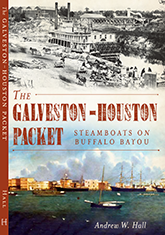
So today, on the official release date of The Galveston-Houston Packet: Steamboats on Buffalo Bayou, it seems like a good time to address the issue of slavery and slaveholding as it pertains to a man named John H. Sterrett (c. 1815-1879), who’s a central character in the book. Sterrett was a steamboat pilot and master who came to Texas from the Ohio River in the winter of 1838-39, and in the ensuing four decades became by far the best-known personage on the route between Galveston and Houston. In 1858 it was estimated that he’d made the 70-mile run between the two cities about 4,000 times — an accomplishment that is entirely plausible.[1] During the Civil War he served as Superintendent of Transports for the Texas Marine Department, a quasi-military organization that provided logistical and naval support for the Confederate army in Texas. After the war he played an active role in re-establishing the steamboat trade between the cities, and inaugurated the use of steam tugs by the Houston Direct Navigation Company, a transition that would allow the company to survive well into the 20th century. Sterrett retired from the boats in 1875, two years before the company abandoned passenger service on the route, and the same year dredging began on what would eventually become the Houston Ship Channel.[2] Sterrett’s story is, in a very real sense, the story of the steamboat trade on Buffalo Bayou.
Since submitting the final edits I realized that, although I mention slavery several times in the book — slave labor was a routinely used on steamboats in Texas and the deep South, and it comes up again and again in contemporary documents — I never really addressed it in connection with Sterrett. This post corrects that.
John Sterrett was a slaveholder. Period, full stop.
I have been unable to find documentation of Sterrett’s slaveholding up through the slave schedules of the 1850 U.S. Census, but it’s likely he was one prior to that time. The earliest documentation I’ve found to date is from the fall of 1851, when Sterrett sailed from Galveston to New Orleans aboard the steamer Mexico, Captain Henry Place. Upon arrival at New Orleans, Sterrett completed a required “Manifest of Slaves,” which described the enslaved persons he was traveling with, and attesting to their legal transport coastwise between states. In this case, the enslaved person was a nine-year-old child, a girl named Parthena, who was recorded as being four-feet-three, and “yellow” in complexion. It is not clear whether Parthena was accompanying Sterrett as a servant, or ended up in one of New Orleans’ large slave markets.[3]
The next piece of evidence is another manifest, again from Galveston to New Orleans, dated March 1856 aboard the steamship Louisiana, Captain John F. Lawless. In this case, the chattel were two men, George and Frank, their ages given as 32 and 34 respectively. Sterrett was not listed on the manifest as their owner, but as their shipper. Sterrett may have been traveling to New Orleans on other business — he frequently took personal charge of new steamboats brought out to Texas for the Buffalo Bayou route — and agreed to oversee the transportation of these two men either to their owner in New Orleans or to the slave market there. [4]
 The third manifest dates from late November 1858, and covers Sterrett’s voyage from New Orleans to Galveston with the new steamboat Diana. This boat, a 239-ton sidewheel steamboat built at Brownsville, Pennsylvania, would become one of the premier boats on the Buffalo Bayou route in the brief period remaining before the war. (A much larger postwar boat of the same name would become better known still.) This time, Sterrett brought with him two enslaved men — Mickly and Dan, ages 32 and 28, and a woman Atheline, aged about 40. These three were all listed as property of Captain Sterrett.[5]
The final snapshot we have of Sterrett’s slaveholding comes from the slave schedule of the 1860 U.S. Census. At that time, Sterrett and his wife, Susan, had six children, ranging in age from 1 to 14. The lived on the corner of San Jacinto and McKinney Streets, in what is now the heart of downtown Houston.[6] A contemporary newspaper account described his new residence as “quite an addition to the appearance of that neighborhood.”[7] At that time, on the eve of the war, Sterrett owned six slaves. As usual, no names are listed in the slave schedule, only sex, age and complexion. There was a ten-year-old girl in the group, but the rest — two women and three men — were between the ages of 20 and 40. It seems likely that two of the enslaved persons listed — a woman, age 40 and listed as “mulatto,” and a man, age 34, correspond to Mickly and Atheline, who had been carried to Texas two years before on Sterrett’s new boat, Diana.
That’s all the documentary record says (so far) about Sterrett’s slaveholding, but we can make some informed guesses about them and their roles. Sterrett does not seem to have invested heavily in land, or to have engaged in large-scale agriculture. The enslaved persons belonging to Sterrett were probably mostly household servants, although it’s almost certain that some of them, the men particularly, were put to work aboard Sterrett’s Buffalo Bayou steamboats at one time or another. Use of slave labor aboard riverboats in Texas appears to have been very common in the antebellum years, and the casualty lists of almost every steamboat disaster of the period includes at least one enslaved person. When the steamboat Farmer blew up in the early morning hours of March 22, 1853, killing at least 36 people, newspaper accounts indicated the boat had a crew of 27. Eight of these were identified by name and position (pilot, clerk, engineer, etc.). Of the remaining nineteen — almost all of whom must have been firemen, deckhands or cabin stewards — at least eleven were enslaved persons belonging to third parties apparently not connected to the boat’s officers or owners. Several years after the disaster, the prevailing rate for slaves to work as deckhands on the Houston-Galveston run was $480 per year—paid to their owner, of course. (Two other Farmer crewmen are listed as “German” and were probably recent immigrants from Europe.)[8] When Bayou City blew up her boilers on Buffalo Bayou on September 28, 1860, among the ten or more dead were two African American men among the crew who were property of that boat’s master, James Forrest.[9]
Although Sterrett clearly bought and sold a number of slaves, there’s nothing in the record suggesting that was a business venture of his. He was not a slave trader, nor did he speculate in the trade, as some prominent men in the South did. Sterrett seems to have been fairly typical for a man of his means in that time and place.
I’ve written before about one of my own ancestors who was a slaveholder – on about the same scale as Sterrett, it turns out – which is a fact I had suspected, but was left to find out on my own, fairly recently. That troubles me, because that’s so fundamentally antithetical to my own views and beliefs. It’s something that I just don’t like to think an ancestor of mine embraced.
Sterrett’s case feels the same. I’ve “known” Sterrett for almost 20 years, as well or better than many of my own relatives from that period, because (unlike them) the old steamboat captain left a long paper trail. He was praised frequently in the newspapers for four decades – a pretty sure sign he was well-liked by the traveling public. One paper in 1851 referred to him as “that prince of Steamboat Captains.” Another noted that he had a running gag he played habitually with the clerk of whatever boat he was on, theatrically ordering the man below decks to check the cargo again, so Sterrett could entertain the female cabin passengers himself. When he died, one obituary noted, he was relatively poor because, despite his gruff exterior, he was generous to a fault when it came to providing assistance to others. “No man,” another said, “had a kinder or warmer heart.”[10]
Pretty decent guy, seems like. But also a slaveholder. This stuff is hard.
Nearly fifty years ago Barbara Tuchman gave a talk at a professional conference called “The Historian’s Opportunity,” in which she argued that being perfectly objective and unbiased was neither desirable – “his work would be unreadable – like eating sawdust” – nor even really possible. “There are some people in history one simply dislikes.”[11] My situation with Sterrett is just the opposite; I’ve come to like him over the years, and it’s troubling to have to shade that image with a detailed and specific knowledge of his close and long-standing involvement with chattel bondage.
No heroes, only history.
[1] Galveston Civilian and Gazette, May 4, 1858, 1.
[2] Galveston Daily News, November 26, 1875, 4.
[3] John H. Sterrett, Slave Manifests of Coastwise Vessels Filed at New Orleans, Mexico, 1807-1860. Steamer Mexico, Galveston, Texas to New Orleans, Louisiana, November 4, 1851. National Archives and Records Administration (NARA), Microfilm Serial: M1895.
[4] John H. Sterrett, Slave Manifests of Coastwise Vessels Filed at New Orleans, Louisiana, 1807-1860. Steamer Mexico, Galveston, Texas to New Orleans, Louisiana, March 13, 1856. National Archives and Records Administration (NARA), Microfilm Serial: M1895.
[5] John H. Sterrett, Slave Manifests of Coastwise Vessels Filed at New Orleans, Louisiana, 1807-1860. Steamer Diana, New Orleans, Louisiana to Galveston, Texas, November 25, 1858. National Archives and Records Administration (NARA), Microfilm Serial: M1895.
[6] U.S. Census of 1860; Ward 4, Houston, Harris County, Texas, 151.
[7] Houston Republic, January 30, 1858
[8] Clipping from an unknown periodical, April, 23, 1853, Galveston and Texas History Center, Rosenberg Library, Galveston; Louis C. Hunter, Steamboats on the Western Rivers (New York: Dover, 1993), 448–50; Kenneth M. Stampp, The Peculiar Institution: Slavery in the AnteBellum South (New York: Alfred A. Knopf, 1972), 414–15. One of the slaves killed in the Farmer accident belonged to Capt. Delesdernier, himself an old Buffalo Bayou pilot.
[9] C. Bradford Mitchell, ed., Merchant Steam Vessels of the United States, 1790–1868 (The Lytle-Holdcamper List) (Staten Island, New York: Steamship Historical Society of America, 1975), 18; Frederick Way, Jr., Way’s Packet Directory, 1848–1983 (Athens: Ohio UniversityPress, 1984), 40; Galveston Civilian and Gazette Weekly, September 25, 1860, 3; Colorado Citizen, September 29, 1860, 2; Galveston Civilian and Gazette Weekly, October 2, 1860, 3.
[10] Austin South-Western American, July 30, 1851, 2; Galveston Daily News, June 19, 1927; Galveston Daily News, June 19, 1879; clipping from an unidentified Houston newspaper, June 19, 1879, author’s collection.
[11] Barbara W. Tuchman, “The Historian’s Opportunity.” In Practicing History: Selected Essays by Barbara W. Tuchman (New York: Ballantine, 1982), 59-60.
___________
Images: Top, firemen on a Mississippi steamboat, Every Saturday Magazine, 1871. Right, advertising broadside for Sterrett’s steamer Diana, c. 1859.
They Can’t Help Themselves, Can They?
Has anyone else noticed that the official blog of the Flagging movement, Southern Flaggers in Action, has at least temporarily abandoned its stated mission of “forwarding the colors” or honoring Confederate veterans or whatever, and is now a platform for straight-up race trolling the presidential election, ominously asking, “Are Whites Being Threatened If Obama Loses The Election?“:

There are several others mentioned in the article, most of the same literary caliber, all threatening general mayhem should Romney win the election. If some of these gentle folk make good their boasts it would give Comrade Obama a wonderful pretext to declare martial law and start the government crackdown on all those terrorist home schoolers, ex-veterans and Christians–you know–all those potential terrorists who cling to their Bibles and guns. He’d like nothing better and his core support just might be in the process of being programmed to do what he wants. They are what the Communists refer to as “useful idiots.” Who in his right mind can’t see the threat here? Do what we want and re-elect Obama–or else! These people have been progrrammed [sic.] into thinking that if Obama loses they will have to give up their “free” Obama cell phones, all the other freebies they’ve been promised, their food stamps and all the rest, all of which they obtain at the expense of us folks who are still willing to work for a living. No wonder the economy is terrible, when those of us who still work are forced to foot the bill for those who won’t. . . . In the event that such an occurrence does take place and Obama’s supporters decide to take to the streets to vent their racism (because that’s all it really is for most of them) then I think that those among the populace that share a determination to defend themselves and their property by exercising their Second Amendment rights will be pretty much left alone while the rioters go after easier victims. The only variable in that equation is–should he lose–will Obama then declare martial law and come for everyone’s guns so the rioters won’t have any opposition??
Nat Turner and Denmark Vesey may be dead and buried, but they still ride in the fever dreams of some people.
______________

Why is H. K. Edgerton Claiming Non-Profit Status?
Looks like some of the folks over at SHPG are questioning H. K. Edgerton’s stated appearance fee of $20,000. There seems to be some dispute over how much he actually collects, but twenty grand (plus mileage) is what he claims his services are worth. I happen to think it’s a pretty ridiculous amount for what he does, but that’s my opinion; you may feel otherwise. The bottom line is, Edgerton can ask for whatever he wants.
The far more important question, that his friends and supporters haven’t yet addressed, is why Edgerton continues to claim Southern Heritage 411 is a non-profit organization, and solicit donations with the claim that such contributions are tax-deductible:

To those of you who would like to make a tax deductible contribution to a non- profit organization and support H.K. Edgerton now, please make your checks payable to: Southern Heritage 411 and send it to:’ Southern Heritage 411, Inc.
P O Box 220
Odum GA 31555-0220 Dewey Barber
Owner, Dixie Outfitters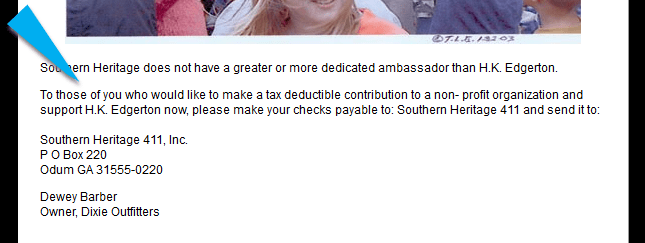

Neither of those things appear to be true now, or ever. I’m no attorney, but I have to think there are very serious legal ramifications in this for both Edgerton, who was listed as Chief Financial Officer for the for-profit company as late as 2010, and for Dewey Barber of Dixie Outfitters, who is the actual CEO and owner of the business, if the IRS ever takes an interest in this stuff.
____________

Did Jefferson Davis’ Son Serve in the U.S. Navy?
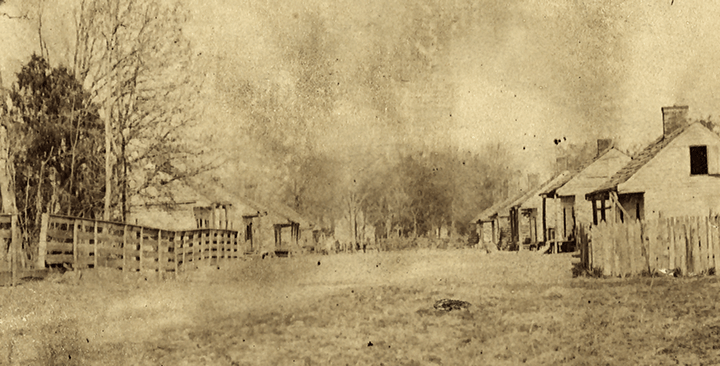
Slave quarters on Jefferson Davis’ plantation, Library of Congress.
Did Jeff Davis’ son by an enslaved woman serve in the U.S. Navy on the Mississippi?
Over at Civil War Talk we had a discussion over this item that appeared, almost word-for-word, in numerous Northern newspapers beginning in February 1864:
The London Star of January 15th says a letter from a gentleman occupying a high position in the United States, contains the following story: This reminds me says the writer, that Jeff. Davis’ son, by his slave girl Catherine, was in the Federal service on board of one of our gunboats, in the Mississippi, for several months—a likely mulatto. Among the letters of Jeff, taken at his house by our Illinois troops, there was a batch of quarrelsome epistles between Jeff. and Mrs Davis, touching his flame Catherine. Mrs. Davis upbraided her husband bitterly. I have this story from one of the highest officers in the squadron, who had the negro Jeff. on board his gunboat, and who himself read the letters and suppressed them.
It sounds exactly like the sort of scurrilous accusation that Northern readers would want to hear about Jeff Davis, like the story the following year about his being captured by Federal troops while wearing a dress. It has the ring of tabloid-y trash, and it’s easy to dismiss on that account.
However, there’s another, longer story from the Bedford, Indiana Independent of July 13, 1864 (p. 2, cols. 3 and 4) that, while differing in several details, largely supports the claim in the London Star, and provides substantial corroborative detail:
Jeff. Davis and His Mulatto Children — Abolitionists are constantly accused in copperhead papers of trying to bring about an amalgamation of whites and blacks; but those papers are very careful to conceal from their readers, as far as possible, such facts as those related in the following extract of a letter from an officer in the Army to a Senator in Washington: “While at Vicksburg, I resided opposite a house belonging to a negro [sic.] man who once belonged to Joe Davis, a brother of Jeff. Learning this, I happened one day to think that he perhaps would know something about the true story told in the London Times, that there was a son of Jeff. Davis, the mother of whom was a slave woman, in our navy. The next time I met the man I asked him if he had ever known Maria, who had belonged to Jeff. Davis, and was the mother of some of his children? He replied that he had not known Maria, but that he knew his Massa Joe Davis’ Eliza, who was the mother of some of Massa Jeff’s children. I then inquired if she had a son in the navy? He replied that she had — he knew him — they called him Purser Davis. He said that Eliza was down the river some thirty miles, at work on a plantation. The next day, as I was walking down the street, I met the man, who was driving his mule team, and he stopped to tell me that Eliza had returned. A few moments afterwards he came back, and pointing to one of two women who came walking along, he said she was the one of whom we had been talking. When she came up, I stopped her, and inquired whether she had not a son who would like to go North. She replied yes and added that she would like to go too. I told her that I only wanted a lad. She said that her son had gone up the Red River on board the gunboat Carondelet, but when he returned she would be pleased to have him go. ‘Well,’ said I, ‘some say that Jeff. Davis is your son’s father — do you suppose it’s so?’ ‘Suppose,’ she cried with offended pride, ‘I’s no right to suppose what I knows — am certain so. Massa Jeff. was the father of five of my children, but they are all dead but that boy, and then I had two that he wasn’t the father of. There’s no suppose about it.’ Perhaps if the boy gets back safe on the Carondelet, you may see him in Boston some of these days.”
Here’s where it gets interesting. The correspondent recorded the young Carondelet sailor’s name he was told as “Purser Davis.” There was, in fact, not a Purser Davis, but a Percy Davis in the crew of U.S.S. Carondelet at that very moment. According the NPS Soldiers and Sailors System, a fourteen-year-old named Percy Davis was enrolled for a term of one year as a First Class Boy on the ship at Palmyra, Mississippi on November 16, 1863 — almost exactly two months before the original news item appeared in London. He remained on board Carondelet at least through the muster dated January 1, 1865. Davis is described as being mulatto in complexion, and five-foot-one. Percy Davis gave his birthplace as Warren County, Mississippi — the county of Vicksburg, and where both Jefferson Davis and Joseph E. Davis were major slaveholders, with 113 and 365 slaves respectively at the time of the 1860 U.S. Census.
Does this prove the original story is true? No, but it does add considerable additional detail, some of which is corroborated. The first news item is vague, without any specifics, but the second is detailed and at least partly verifiable. There’s enough here that the claim of Davis’ natural son having served aboard a Union gunboat cannot, in my view, be dismissed out-of-hand as Civil War tabloid trash. The possibility of its truth merits further digging.
_____________

Canister!

Small stories that don’t merit individual posts of their own:
- The grave of former Confederate Private Hugh McLaughlin was recently marked in Spokane, Washington, thanks to sleuthing by his great-granddaughter, who started out not knowing anything about his wartime service. That’s neat.
- Are the Sons of Union Veterans of the Civil War actually agents of intolerance? Are they really as controversial as, say, the New Black Panthers or the American Communist Party? Clint Lacy seems to think so.
- In a whiplash-inducing, 48-hour turnaround, Lynyrd Skynyrd first rejects, then re-adopts, future use of the Confederate Battle Flag at their concerts. The only question remaining is, which are we supposed to assume was their “principled” position on it? I say, neither.
- If you missed my post the other day about the staff layoffs at the Theater at Lime Kiln in Lexington, it’s worth looking at the comments. Flagger extraordinaire Billy Bearden cites federal unemployment stats from Lexington to show the effectiveness of the Flagger-led boycott of local business, which actually show a slight improvement in employment there since before the boycott took effect. It’s episodes like this that explain why we can’t quit you, man.
- One of the first reviews of Spielberg’s film “Lincoln” is out. Ann DeWitt is unhappy because the movie almost certainly doesn’t include a cameo by Bill Yopp.
- A couple of years ago, we noted the discovery of Camp Lawton, a Confederate PoW camp that was the successor to Andersonville. Work at the site continues, with archaeologists now announcing the discovery of sections of the south and west stockade walls, which help define the exact placement of the compound.
- The odious Kirk Lyons is now yammering something about Lincoln “stealing” the election of 1864. I had no idea ACORN had been around that long.
-
 Five people (right) — and maybe more to come — are facing federal charges for vandalism to a Civil War cannon at the Cumberland Gap National Historical Park in Kentucky. Good.
-
I’ve been very critical of Gary Adams in the past (with good reason) but he does have his moments. Susan Hathaway of the Virginia
FraggersFlaggers posted a newspaper editorial letter written by a member of her group about Robert E. Lee that included some blatant untruths — e.g., that Lee “owned no slaves personally” and that he freed all his wife’s slaves when they married. Hathaway, of course, cheers this foolishness on, adding, “way to get in there and get the victory…FLAGGER STYLE!” Adams, in his own passive, long-winded and way-too-polite-to-get-through-their-thick-skulls way, at least tried to correct some of them. Well done, sir, but may I suggest including a selective use of profanity next time? It helps get your point across.
- In a related note, we now know that “FLAGGER STYLE” means getting coverage in the media without regard to the factual truth of one’s message. (But we already knew that, didn’t we?)
- Happy belated birthday wishes to Donnie and Ron Kennedy, who turned 65 a few days ago. Now the Kennedy Twins, Southern nationalist movement celebrities and authors of The South was Right!, can start collecting full retirement and health benefits from the socialist federal government they so despise.
- Dumbass BuzzFeed intern tweets, “Romney motorcade just passed a hill flying a large confederate [sic.] flag in rural SW VA,” as if that’s supposed to mean something. Doesn’t he know that Mitt dissed that symbol years ago?
- Speaking of the Confederate flag and presidential candidates, Green Party candidate Jill Stein goes the Full Godwin. If she keeps talking like that, the Greens might not carry a single Southern state next month.
- Monocracy Brewing Company in Frederick, Maryland has bottled its first batch of beer based on a Civil War-era recipe, the first of nine releases projected for the CW sesquicentennial. “Antietam Ale” is an English bitter, ruby-red in color and relatively low in alcohol content. It’s available on tap at Brewer’s Alley in Frederick; no word on when it will be available for retail sale.
-
 It’s not really CW-related, but Texas businessman John L. Nau (right) has pledged $8M to the creation of a Southeast Texas history museum in downtown Houston, within a stone’s throw of the George R. Brown Convention Center, the Toyota Center (where the Rockets play) and Minutemaid Park (where the Astros play, sort of). Nau has a long history of commitment to Texas history, having served (among other posts) as Chairman of the Texas Historical Commission from 1995 to 2009. Although I have my doubts about the approach — it sounds more like a Vegas-style theme attraction (above) than a museum — it’s great to see this kind of private-sector commitment to public history. Nau has one of the great personal collections of CW gear, as well, that was featured in the exhibit last winter at the Houston Museum of Natural Science.
- U.S.S. Texas (BB-35) is again offering “hard hat” tours of areas of the ship that are usually closed to the public; I highly recommend them. Here’s one I was able to take a few months back.
- And Spanish archaeologists working in Rome believe they’ve identified the exact spot where Julius Caesar was assassinated in the Curia of Pompey, where the Roman Senate was meeting. They believe they’ve uncovered a monument placed at the spot by his nephew and adopted son, Octavian, who went on to rule as the first Roman emperor, Augustus. That’s cool.
Got any other news? Drop it in the comments below.
_____________





 Dead Confederates, A Civil War Era Blog
21 comments