See Y’all at the Houston History Book Fair, November 10
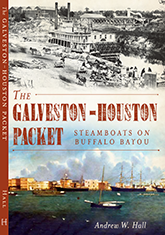
I’ll be speaking on my new book, The Galveston-Houston Packet: Steamboats on Buffalo Bayou, at the Houston History Book Fair and Symposium on November 10. It’s free and open to the public, so y’all have no excuse not to go. There will be some great presentations there by folks like my friends Ed Cotham, author of Battle on the Bay: The Civil War Struggle for Galveston and Sabine Pass: The Confederacy’s Thermopylae, and Jim Schmidt, author of the just-published Galveston and the Civil War: An Island City in the Maelstrom. It’s been a tremendous privilege to know these two men, and an honor to be included with them in this event.
The Galveston-Houston Packet is not a Civil War book per se, but the central (and longest) chapter in it deals with the Texas Marine Department, a unique organization within the Confederacy that used chartered civilian river steamers to create a logistical support and makeshift naval force, run by civilians, but all under the command of the Confederate army. It was a strange arrangement but, as at the Battle of Galveston on New Years Day 1863, it worked better than anyone should have expected it to.
More generally, the book tells the story of one of the vital early transportation routes that shaped the development of Texas. Most people imagine the settlement of the American West as signaled by the dust of the wagon train, or the whistle of a locomotive, but during the middle decades of the 19th century, though, the growth of Texas and points west centered around the 70-mile water route between Galveston and Houston. This single, vital link stood between the agricultural riches of the interior and the mercantile enterprises of the coast, with a round of operations that was as sophisticated and efficient as that of any large transport network today. At the same time, the packets on the overnight Houston-Galveston run earned a reputation as colorful as their Mississippi counterparts, complete with impromptu steamboat races, makeshift naval gunboats during the Civil War, professional gamblers and horrific accidents. The 143-page book includes endnotes, bibliography, rare photos, two original maps, and an index. It’s now available for pre-order at Amazon or Barnes & Noble at a great pre-publication price!
A few of the images included:
Sam Houston on Louis Trezevant Wigfall
 From Harper’s Magazine, August 1868:
The anecdotes of Ex-President Houston in the March Number of the Drawer remind a correspondent of a scene that occurred in the city of Houston in the summer of 1861. “I was wending my way,” says he, “from the Old Capitol down Main Street, when I learned that’ Old Sam’ had just come up from his plantation at the month of Cedar Bayou, and stopped at the Fannin House. Never having seen him I went there. He was seated on the veranda, surrounded by a crowd, who were listening eagerly to all he said. As I came up some one asked, ‘Well, Governor, what do you think of [Louis T.] Wigfall (right)?’ (then a Senator in the Confederate Congress, and Brigadier-General commanding the First Texas Brigade in Virginia, and very popular with Texans, notwithstanding the enmity between him and Houston.) ‘Wigfall,’ said Old Sam, ‘why, Wigfall has always been a good deal of a puppy, and if he continues on in his present course he will eventually become a good deal of a dog!'”
And this, from the April 1870 issue:
On the election of Mr. Wigfall to represent Texas in the United States Senate, Governor Houston was asked, in allusion to the excessively intemperate habits of the Senator-elect, whether he thought Wigfall would be able to make his way to Washington.
“I think he rather will,” replied Governor Houston, “if he avoids Cincinnati.”
“What do you mean, Governor, by avoiding Cincinnati?”
“Why, Sir, the strychnine in the whiskey there will kill any dog!”
___________

“Do you liquor, ma’am?”

In the late winter of 1843-44, an Englishwoman by the name of Matilda Charlotte Houstoun (pronounced “Haweston”) visited Galveston with her husband, a British cavalry officer. The Houstouns were making a tour of the Gulf of Mexico, with Captain Houstoun trying to drum up interest in an invention of his for preserving beef. During their visit, the Houstouns boarded the 111-ton steamer Dayton, Captain D. S. Kelsey, for the trip up Buffalo Bayou to Houston:
It was about two o’clock in the afternoon of a bright frosty day, that we put ourselves on board the Houston steamer – Captain Kelsey. She was a small vessel, and drew but little water, a circumstance very necessary in these small rivers. The American river steamers differ very much in appearance from those to which an European eye is accustomed. They have the appearance of wooden houses, built upon a large raft; there is a balcony or verandah, and on the roof is what is called the hurricane deck, where gentlemen passengers walk and smoke. On the occasion of our taking our passage both ladies and gentlemen’s cabin were quite full, and I therefore preferred spending the evening in the balcony in spite of the cold. I had many kind offers of civility, but I could not help being amused at the terms in which some of them were couched. The question addressed to me of “do you liquor, ma’am” was speedily followed by the production of a tumbler of egg-noggy, which seemed in great request, and I cannot deny its excellence; I believe the British Navy claims the merit of its invention, but this is matter of dispute.
“Mrs. Houstoun,” as she styled herself at the time, would publish her first novel, Recommended to Mercy, in 1862, and go on to become one of the best-known female novelists in 19th century Britain. This excerpt, and the image of Galveston above, is from her travelogue, Texas and the Gulf of Mexico, or Yachting in the New World, vol., II, published in 1844.
______________

Hood’s Texas Brigade Seminar, October 26-27 in Austin

The Hood’s Texas Brigade Association, Reactivated, will hold its sesquicentennial seminar at Camp Mabry, Austin, Texas on Friday, October 26 and Saturday, October 27. The program, “Plowshares Into Swords: Hood’s Texas Brigade in 1862,” includes:

6:00 Socializing, followed by 7:00 dinner
8:00 Speaker: Dr. Susannah Ural, “The Best Material on the Continent: The Rise of Hood’s Texans in 1862” Saturday 8:00-9:00 Registration, Vendors/Exhibitors
9:00-9:05 Welcome by Martha A. Hartzog, President, Hood’s Texas Brigade Assn., Re-activated (HTBAR)
9:05-9:15 Report on the Two New Texas Civil War Battlefield Monuments by William McWhorter, Texas Historical Commission
9:15-10:15 Jack Waugh, Historian, “Granny Lee and the General with ‘the Slows’: The War on the Peninsula”
10:15-10:45 Break: Time to Visit Vendors/Exhibitors 10:45-11:45 Danny W. Davis, Ph.D., “The Bloody 5th at Second Manassas”
11:45-1:00 Lunch, with Speakers’ Q&A & Fund Raising for Restoration of 1st National Banner
1:00-1:30 Time to Visit Vendors/Exhibitors
1:30-2:30 Rick Eiserman, Historian: “The Ragged 1st: The Savage Assaults of Sharpsburg/Antietam”
2:30-3:00 Time to Visit Vendors/Exhibitors
3:00-4:00 Richard McCaslin, PhD: “So Many Leaders Dead or Gone: Rapid & Dramatic Changes in Hood’s Brigade Leadership”

Visitors are reminded that Camp Mabry is an active military installation, and a valid driver’s license or other photo ID is required to enter. There will be signage directing visitors to the Museum and to Building 8, where the Seminar will be held. A flyer and registration form is available here (PDF). Registration deadline is October 19.
_____________

Stonewall Jackson Killed by His Own Troops (Again)


It’s been a little over a year since the Lexington, Virginia City Council voted to bar all but the U.S., Virginia and municipal flags from city-owned light poles in the town. The decision was met with protests then, but there have been relatively few developments since. There was a lawsuit, of course, that was tossed out by the judge in June, and if there have been any other major developments on the legal side of the dispute, I’m not aware of them.
So to keep stirring the pot, now local SCV Camp Commander Brandon Dorsey points to the closure and layoffs as a local tourist attraction the Theater at Lime Kiln. This, Dorsey, claims, is “thanks to Lexington City Council,” and somehow vaguely the result of political correctness. Dorsey doesn’t actually explain the connection, though, which is not really surprising, given that the attached news item about the closure makes no such inference. Indeed, the article makes it clear that the theater has been in dire straits financially for the better part of a decade:
When the theater launched the fund drive earlier this year, Russell said Lime Kiln “has been on life support for the past several seasons.” He said the theater has managed with a staff of three doing the work of 10, but that there were no more expenses that could be cut, while the theater’s facility continued to deteriorate and consume what little cash reserves exist. The theater has asked Lexington and Rockbridge County to make $200,000 in multiyear pledges by Dec. 31, in order to make needed repairs and build a new permanent rain structure. It also is seeking a $93,000 rural development loan from the U.S. Department of Agriculture. When it asked for that help earlier this year, Lime Kiln said it needed a total of $300,000 by the end of the year to do all the work it needed to do in order to present a 10-performance season in 2013. It hopes to grow to 15 performances in 2014 and to become self-supporting. The theater closed for a while in 2005, and now says its signature production, “Stonewall Country,” seriously overstretched its ability to operate, because of its high cost.
My emphasis. For the record, 2005 is SIX YEARS before the Lexington City Council took action on the flag ordinance.
What we have here is, pretty obviously, a case where a long-standing business that’s been teetering on the precipice for years eventually succumbs to hard economic times and competition for visitors’ entertainment dollars. Although the theater’s signature production, “Stonewall Country” (above), focuses on the life of Stonewall Jackson, there’s nothing in the news story that suggests that show, in particular, was struggling due to lack of attendance or a general antipathy toward Confederate subjects.
Dorsey offers no evidence supporting his suggestion that Lexington Mayor Mimi Elrod and her PC minions are the root cause of this event, or why, exactly, they would want the closure of a cultural venue that brings visitors and their dollars to town. And of course the ordinance passed had no bearing on the theater or any other business in Lexington. Dorsey’s claim doesn’t even make sense, frankly. But while we’re busy making unsubstantiated accusations, I’ll toss in one of my own, that at least has some logic to it.
Gary Adams claims that the SCV/Virginia Flagger boycott of Lexington has cost local merchants $633,271 in lost revenue already. Where that number comes from, I have no idea — citing the source of material he posts is not a big priority for him — and I’m dubious that it’s even a real number than can be attributed to the boycott.
But just for the moment, let’s assume this is a real number, and the boycott has cost local visitor-oriented businesses well over half a million dollars. It’s not hard to see that under those circumstances the boycott, cheered on by folks like Dorsey, Billy Bearden and Susan Hathaway, may have played a very direct role the demise of the Theater at Lime Kiln. I remain dubious that the boycott has had much real effect at all, but if it has, as its backers claim, then their fingerprints are all over the pink slips handed out to theater employees last week.
Once again, Stonewall Jackson has been killed by his own troops. Well done, asshats.
______________

“. . . how many may be of use without putting guns in their hands.”
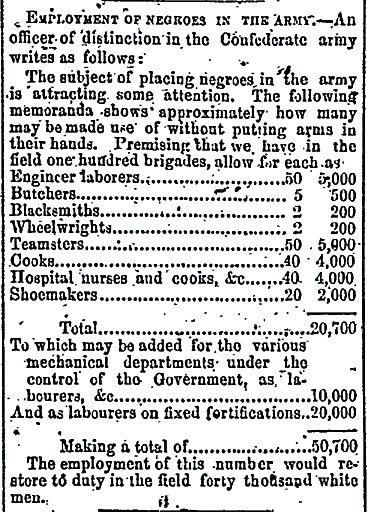
 While doing some research on another topic recently I came across a reference to this item from the Richmond, Virginia Examiner of January 13, 1864. In the third winter of the war, things were looking dim for the Confederacy — though not nearly as dim as they would eventually be — and there were already suggestions that African Americans be enlisted as soldiers in the Confederate army. In this piece, an anonymous “officer of distinction” in Confederate service rejects that idea, and instead argues that more extensive use of black laborers would “restore to duty in the field forty thousand white men.”
EMPLOYMENT OF NEGROES IN THE ARMY. — An officer of distinction in the Confederate army writes as follows: The subject of placing negroes [sic.] in the army is attracting some attention. The following memoranda shows approximately how many may be of use without putting guns in their hands. Premising that we have in the field one hundred brigades, allow for each as: Engineer laborers……………………….50……….5,000
Butchers……………………………………….5………….500
Blacksmiths………………………………….2………….200
Wheelwrights……………………………….2………….200
Teamsters……………………………………50………5,000
Cooks………………………………………….40………4,000
Hospital nurses and cooks & c………40………4,000
Shoemakers…………………………………20………2,000 Total…………………………………………………….20,700 [sic., 20,900] To which may be added for the various mechanical departments under the control of the Government, as labourers, & c………………………………………….10,000 And as labourers on fixed fortifications…….20,000 Making a total of……………………………………..50,700 [50,900] The employment of this number would restore to duty in the field forty thousand white men.
There are three things that are worth noting about this piece.
First, the writer is explicitly opposed to the idea of African Americans serving under arms. He makes no distinction between enslaved persons and free men of color — neither, in his view, is appropriate for service in the ranks as soldiers. Indeed, the writer’s stated intent is to show how these men may be used “without putting guns in their hands.”
Second, the author makes no mention whatever of personal servants to white soldiers, who even then must have numbered in the thousands. This is relevant, because this group includes a majority of individuals hailed as “black Confederates” today. This suggests that this “officer of distinction” in Confederate army did not view those servants as being part of the national government’s greater military effort, which indeed they are not — personal servants are personal servants, period, full stop.
Third, the citation to this news item was found in some handwritten notes from decades ago, taken from a thesis written decades before that. But the notes, and likely the thesis from which they’re taken, record it as a summary of “Negroes in employed in the Army (by the 100 brigades then in the field).” But that’s wrong; this is not a report of current status, but a prospective look at what might be done in the future. (The note-taker almost certainly did not have access to the original newspaper.) This underscores how easy it is to misconstrue an original source, which original error gets repeated by those who follow. It would be interesting to know if other secondary works report these numbers as an actual accounting, rather than a projection based on a proposed policy.
Above all, the author gives no recognition of the modern assertion that there were large numbers of African American men in the ranks, considered soldiers under arms. I’ve said it before, but it bears repeating: real Confederates didn’t know about black Confederates.
____________
Update: In the comments, Rob Baker makes a very important point — this newspaper item comes just days after Patrick Cleburne’s now-famous proposal that the Confederacy embrace emancipation and enlist large numbers of black troops. While no public acknowledgement was made of Cleburne’s proposal at the time, it seems possible that rumors of it were circulating in Richmond. Could this short piece, penned by an anonymous “officer of distinction,” be part of the Confederate government’s effort to quash the idea?
____________

The Passing of Marc Ferguson
 As other bloggers have noted, Marc Ferguson passed away recently. Marc was a regular commenter on this blog, and always willing to share his own experience or a new perspective on the topic at hand. As Kevin suggests, Marc was one of the good guys, who used the Internet to engage in serious and challenging discussion, who was committed to learning and extending knowledge to others. He’ll be missed by many of us.
_____________

Memo to the Union Pacific: You Didn’t Build That

Tuesday’s Houston Chronicle has a story about Navasota, a small town northwest of Houston, being listed in Union Pacific’s Train Town USA Registry. From the railroad:
Navasota will receive an official Train Town USA resolution signed by Union Pacific Chairman Jim Young, and Navasota’s historical connection with Union Pacific will be featured at www.up150.com. “We are proud to recognize Navasota as we commemorate our railroad’s sesquicentennial celebration and growing up together,” said Joe Adams, Union Pacific vice president – Public Affairs. “The bond between our railroad and early settlements continues to strengthen and grow. Today, Union Pacific serves nearly 7,300 communities where we live, our children grow up together and in which we recruit employees. “Our shared heritage with Navasota is a source of pride as we remember our past while serving and connecting our nation for years to come.” The railroad was essential to the birth of Navasota, which brought in major trade and market centers for cotton and livestock. Union Pacific laid 44 miles of track in 1902 to connect Navasota and Madisonville, Texas, and the town declared it a holiday when the first train departed to Madisonville. The line runs through historic downtown on Railroad Street and was added to the National Register of Historic Places in 1982. Today, Union Pacific works with the City of Navasota to create and maintain a landscaped area along Railroad Street, which brings heavy tourism, economic development and future infrastructure projects to the area.
Navasota absolutely is a railroad town, and I’m happy they were awarded this distinction. I hope Navasota Mayor Bert Miller, the city administration and the local chamber of commerce play this for all it’s worth, and can bring in a few extra tourist dollars as a result. That’s all to the good.
But contrary to the narrative suggested by the UP press release, that railroad had precious little to do with either Navasota’s creation or its establishment as a railroad town. Navasota was founded as a settlement in 1854, and in September 1859 was reached by the Houston & Texas Central, which extended just a few miles farther to Millican by the outbreak of the Civil War. The H&TC expanded rapidly after the war, north to the edge of Indian Territory and west to Austin. In 1876-77 the Morgan Line bought controlling interest in the H&TC, only to be itself absorbed into the Southern Pacific in the 1880s. The H&TC continued to operate under its own name until 1927, though — almost seventy years after it first put down rails in Navasota, and a full quarter-century after the UP completed its spur line to Navasota from Madisonville. The UP didn’t take over the Southern Pacific until 1998, fourteen years ago — less than one-tenth the time that Navasota has been a railroad town.
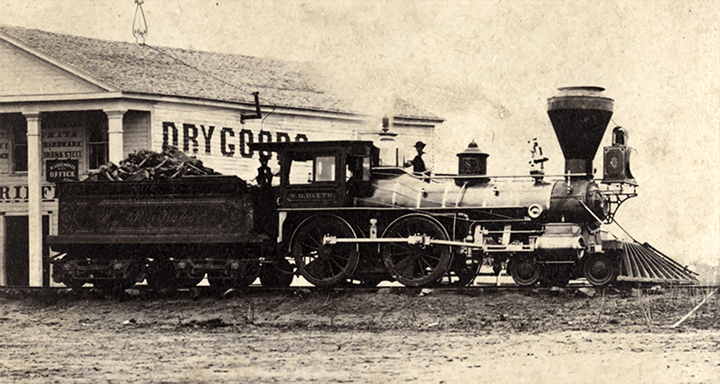
Houston & Texas Central locomotive W. R. Baker, c. 1868. Lawrence T. Jones III Collection of Texas Photographs, Southern Methodist University.

To be sure, I’m not a disinterested observer in this. My grandparents lived in Navasota for 40 years, and my father grew up there. When I was little, we lived nearby, and I spent a lot of time in Navasota. Even though I’ve never lived there myself, it’s a town I feel like I know, and feel a certain ownership in it. And on the other side of my family, I have a relative — a Confederate veteran, in fact — whose home was at Navasota during the war, and who took a job in 1865 as a brakeman on the H&TC. He eventually rose to be Superintendent of one of the railroad’s divisions, and finally, was General Agent for Transportation for the H&TC.
So it’s not for no reason that I find this award, ostensibly celebrating the rail history of Navasota, that doesn’t actually acknowledge the rail history of Navasota, just a little irksome.


Navasota mayor Bert Miller holds a sign announcing the city’s recent membership into Union Pacific’s Train Town USA Registry. Photo By Michael Paulsen/Houston Chronicle.
___________

“They lay as thick as autumn leaves”
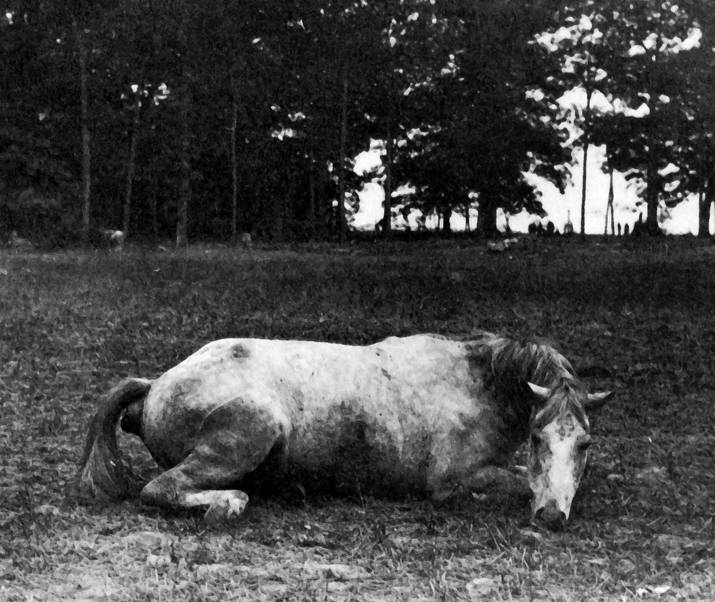
Friday, September 19, 1862, near Sharpsburg, Maryland:

I took the delay to ride over the field of battle. The Rebel dead, even in the woods last occupied by them, was very great. In one place, in front of the position of my corps, apparently a whole regiment had been cut down in line. They lay in two ranks, as straightly aligned as on a dress parade. There must have been a brigade, as part of the line on the left had been buried. I counted what appeared to be a single regiment and found 149 dead in the line and about 70 in front and rear, making over 200 dead in one Rebel regiment. In riding over the field I think I must have seen at least 3,000. In one place for nearly a mile they lay as thick as autumn leaves along a narrow lane cut below the natural surface, into which they seem to have tumbled. Eighty had been buried in one pit, and yet no impression had apparently been made on the unburied host. The cornfield beyond was dotted all over with those killed in retreat. The wounded Rebels had been carried away in great numbers and yet every farmyard and haystack seemed a large hospital. The number of dead horses was high. They lay, like the men, in all attitudes. One beautiful milk-white animal had died in so graceful a position that I wished for its photograph. Its legs were doubled under and its arched neck gracefully turned to one side, as if looking back to the ball-hole in its side. Until you got to it, it was hard to believe the horse was dead. Brigadier General Alpheus S. Williams,
Division Commander, Army of the Potomac

________________________
Alpheus S. Williams, Milo Milton Quaife (eds.), From the Cannon’s Mouth: The Civil War Letters of General Alpheus S. Williams (Detroit: Wayne State, 1959). Image: Library of Congress.
Why the South Lost, Explained in One Photo
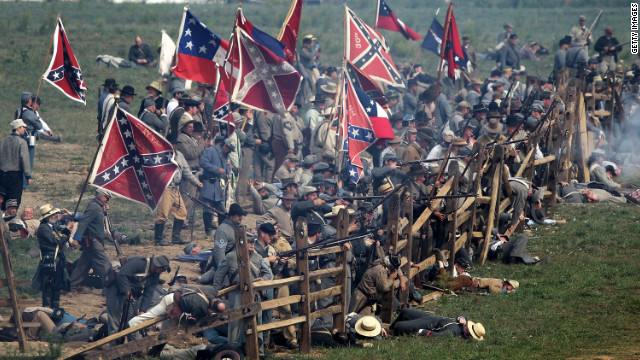
More dudes carrying flags than guns is no way to fight a war.
___________
Image: Confederate infantry re-enactors re-create the Battle of Bloody Lane on Saturday in Sharpsburg, Maryland. Via CNN.





 Dead Confederates, A Civil War Era Blog
5 comments