“The value of this communication destroyed can not be expressed in words or money”
UPDATE, August 21: A reader identifies both the location and elements of this image.


A discussion came up elsewhere of this image, of a burned-out bridge and locomotive in Virginia. The Library of Congress caption is “Petersburg, Virginia (vicinity). Ruins of locomotive and railroad bridge across the Appomattox River.” It would be nice to identify the exact location, though. The LoC’s caption identifying it as being in the Petersburg “vicinity” is of limited use.
Looking at period maps, I can only tell of one railroad bridge across the Appomattox, that of the Weldon & Petersburg Railroad, and that was actually at Petersburg:


Although a few maps, like this one from the OR Atlas, suggest there might have been two, connected:

There are several references to the Navy Department being anxious to destroy this bridge in the ORN, such as this June 1862 letter from Assistant Secretery of the Navy Gustavus Fox to Flag Officer Goldsborough:
G.V. FOX Flag-Officer GOLDSBOROUGH.
Gotta love that line, “provided it is done before McClellan fights.” Heh. No rush, dood.
Hindsight about McClellan’s aggressiveness notwithstanding, Fox’s letter is really interesting, because in it he not only urges destruction of the bridge, but commits the government to up to $50,000 in extra expenditures in order to accomplish it — I think that’s pretty rare.
Fox wanted John Rodgers to do the job, but Rodgers though it was simply not plausible as a naval exercise, and suggested instead it might be better to recruit saboteurs to do the job:
Off City Point, June 22, 1862. SIR: I have the honor to acknowledge the receipt of your letter of the 21st instant in regard to burning the railroad bridge at Petersburg, Va. The subject had already engaged my attention, and I met the following difficulties: The gunboats can not send a boat on shore without danger of an ambush. Every movement is carefully watched by armed men. We are not able to communicate with the inhabitants except with danger to them and to us. I have concluded that in Norfolk or at Fortress Monroe, where free intercourse can be had with Union men, citizens of Virginia, must be sought the agents for this work. The Appomattox, scarcely wider than a canal, has its channel obstructed by vessels and lighters sunk in the bottom of the river. It runs through banks which absolutely command any rowboats upon its waters. We can not approach by steamers, and rowboats would be destroyed. When I last heard from Petersburg, about a month ago, by two deserters, there were some 6,000 or 7,000 troops there under General Huger. If I see any opportunity of carrying out the subject of your letter, I shall zealously do so. Very respectfully, your obedient servant, JOHN RODGERS,
Commander. Flag-Officer LOUIS GOLDSBOROUGH,
Commanding North Atlantic Blockading Squadron.
Goldsborough, caught between a Navy Department that wanted it done, like, yesterday, and a respected and capable subordinate who said, in effect, “this is a terrible idea,” cast about for an alternative:
Flag-Officer.
The “submarine propeller” he refers to is the submersible Alligator (above), which has an interesting history of its own, but was unsuccessful in an attempt to destroy the bridge at Petersburg. Goldsborough subsequently followed Rodgers’ advice and recruited saboteurs to do the job:
Norfolk, Va., June 29, 1862. SIR: As the expedition up the Appomattox has not resulted favorably to the object it had in view, I have this day engaged two reliable persons, whose names I will give you hereafter, to proceed from this to the proper place and do the work. The men, I have every assurance, are entirely and thoroughly reliable. In the event of complete success each is to receive $25,000, and in case one of them should be taken and put to death for the destruction committed his brother in California is to receive $12,500, his sister in Richmond $6,250, and his stepsister, also in Richmond, $6,250. I have made confidential notes of the names, etc., of the parties, all of which will be duly forwarded when necessary. Commander Rodgers, as you will perceive by copies of communications from him which I forward by the mail of to-day, has, on finding the submarine propeller of no use to him, and for other reasons, sent it to Fort Monroe. Had I not better send it to Washington for safe keeping? At best it can only operate successfully in clear and tolerably deep water. All the experiments required by the Chief of the Bureau of Yards and Docks can be much better conducted at Washington than here, particularly at this very critical conjuncture of our affairs hereabouts. Very respectfully, your most obedient servant, L.M. GOLDSBOROUGH,
Flag-Officer. Hon. GIDEON WELLES,
Secretary of the Navy, Washington City.
I’m not sure what, if anything, became of this mission, or how the bridge in the photograph came to be destroyed.
______
The other thing that’s interesting is that in his memo of June 20, Fox mentions a second bridge, on the same north-south route, over Swift Creek, north of Petersburg, on the Richmond & Petersburg Railroad:

Given that LoC captions — usually based on notations that come with the image when they’re transferred to them — are oftentimes imprecise, I believe this image of the burned bridge and locomotive may not be on the Appomattox River at all, but may be of the remains of the bridge at Swift Creek. (The LoC has a bunch of images of Federal gunboats captioned as being on the Appomattox, while I feel sure they’re actually on the James.)
Rodgers complained about the hazards of navigating the Appomattox River to Petersburg, but the waterway shown here, even given the seasonal rise and fall of creeks and rivers, isn’t enough to run an aluminum john boat. The course of the river shown in the image — turning sharply left in the background — seems to be a better fit for the Swift Creek crossing than for Petersburg. Note also that the banks are low here, contra Rodgers’ description of the Appomattox River around Petersburg.
Thoughts?
___________


Stuck at Hanover Junction
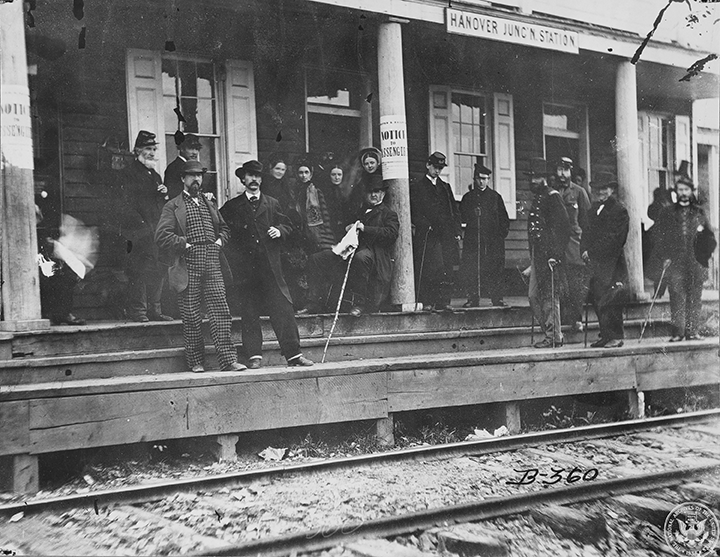
Passengers at Hanover Junction, Pennsylvania, one of several images in the Library of Congress collection. I believe these pictures were taken on November 18 or 19, 1863, and may depict passengers stuck at Hanover Junction, unable to continue on to their intended destination at the dedication of the new National Cemetery at Gettysburg. See an enlargement here.
UPDATE: Scott Mingus got there first.
We talked the other day about the logistical difficulties of rail travel through wartime Richmond, Virginia, which was served by fine railroads, none of which connected to any another. As I mentioned in the piece, that was a common situation in the 1860s, across the country. As Bob Huddleston mentioned in the comments on that post, it was exactly that sort of situation in Baltimore that required the 6th Massachusetts to march through the center of that city, exposing them to mob violence in April 1861.
There’s another example of how disjointed rail travel could be in those days.Hanover Junction, Pennsylvania was a stop on the Northern Central Railway, that ran north from Baltimore, Maryland, into the middle of the Keystone State. It was the connection point with the Hanover Branch Railroad (also known as the Hanover and Gettysburg), that ran the 25 miles or so west to Gettysburg. From a history of that little railroad:
This original trackage of the Hanover Branch Railroad became one of real historical interest. It carried the parties of President Abraham Lincoln and Pennsylvania Governor Andrew Curtin from Hanover Junction to Gettysburg on November 18, 1869, where on November 19, President Lincoln delivered his now famous “Gettysburg Address” at the dedication of the National Cemetery. The Northern Central trains carried President Lincoln from Baltimore and Governor Curtin from Harrisburg, the two groups meeting at Hanover Junction and proceeding together on the Hanover Branch to Gettysburg.
Simple enough, but there’s more to the goings-on at Hanover Junction during the Gettysburg dedication than that. It’s one of those stories that gets forgotten in the celebration, unless it happened to you. From the Harrisburg, Pennsylvania Patriot, November 26, 1863:
The Gettysburg Celebration. Dedication of the Great National Cemetery.In company with many others, we took the train for Gettysburg, via Hanover Junction, on Wednesday morning, to swell the ranks of the thronging thousands who, prompted by curiosity and patriotism or drawn by the tender ties of love for the dead, were gathering there to witness and participate in the the grand and solemn consecration of the burying place of the nation’s dead. . . .The train n which we rode was filled to its utmost capacity, many being forced to stand on the platform throughout the journey. The passengers were from all parts of the country, and almost every loyal State was represented in each car. The accommodation of the roads — the Northern Central and the Hanover and Gettysburg — were by no means sufficient for the occasion, and all persons going to or from the scene of interest were put to great inconvenience in consequence. Some were unable to get beyond Hanover Junction on Thursday. We saw a party of over fifty persons, who had journeyed over six hundred miles for the express purpose of attending the dedication, which party lay at the Junction from nine o’clock in the morning until ten at night, unable to get a step farther. Not a train was run over the Hanover road during that time, and this the pilgrims, after coming six hundred miles to see the battlefield, were defeated in their enterprise on the last twenty-five miles. It is a matter of wonder that, with such timely notice, this road failed to make proper arrangements, and suffered the spirit of mismanagement to paralyze its workings.
There are additional photos at the Library of Congress, apparently taken at the same time, of Hanover Junction. Some are attributed to Matthew Brady, and some assigned a date of 1863, but nothing more specific:
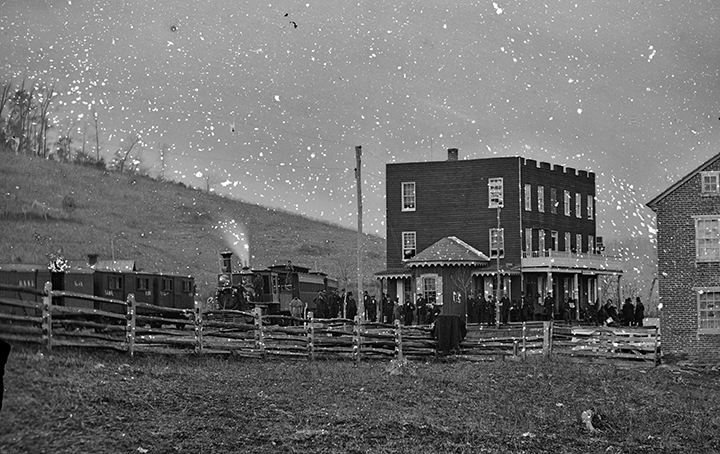 See an enlargement here.
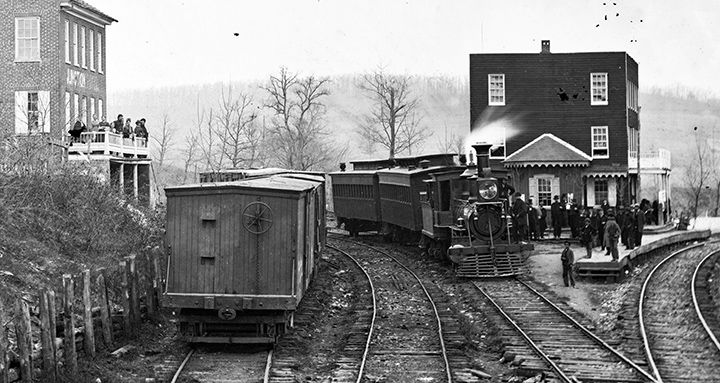 See an enlargement here.
The LoC catalog listing provides no additional information on the date or subject of these images, but there are clues. The lack of vegetation on the trees suggests the images were made either early or late in the year. The clothing of the civilians is uniformly heavy, and mostly formal — these are not locals hanging around the depot to see who gets off the train. The soldiers all seem to be using canes, suggesting the effect of wounds. To me, these factors all suggest a date in late 1863. More specifically, I believe all three images are of parties traveling to or from the dedication of the National Cemetery at Gettysburg on November 18 or 19, 1863 — maybe Governor Curtin’s party, or perhaps the delegation that had come 600 miles to witness the festivities, only to find themselves stuck in Hanover Junction. Either of those would be obvious subjects for a photographer. I don’t know if Brady traveled from Washington to Gettysburg, but Alexander Gardner was there. He had broken with Brady and had his own studio in Washington by the fall of 1863, and Gardner likely would have followed the same route by rail from Washington to Gettysburg, changing at Hanover Junction. Could these be Gardner photos from that event, misattributed (as much of his work was) to Brady? Or did Brady, coming up from Washington, also found himself stuck at Hanover Junction on the day of the dedication, and occupied his time shooting images of his fellow stranded passengers?
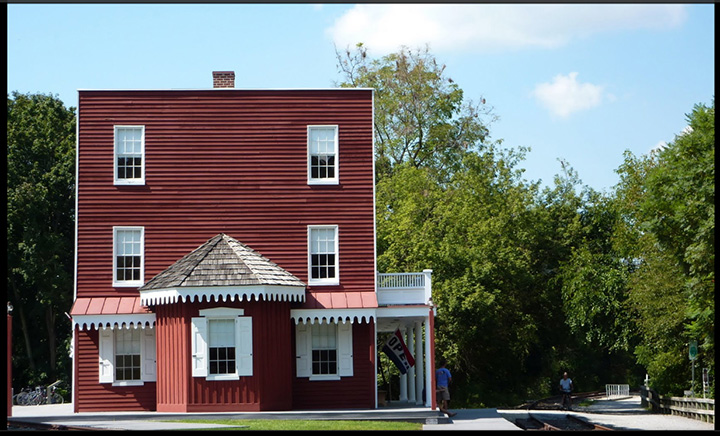
The 1863 station at Hanover Junction, by the way, still stands, apparently little changed from its appearance 150 years ago (via Google Maps):
“A quick connection between trains was by accident, not intent.”

An 1864 stock certificate for shares in the Richmond & York River Railroad Co., one of the five roads that converged at Richmond. From Dave Bright’s incomparable Confederate Railroads website.
The first chapters of Carl Park’s Ironclad Down: USS Merrimack-CSS Virginia from Design to Destruction set the historical context for the design, construction and deployment of that most famous Confederate ironclad, C.S.S. Virginia. Park summarizes the evolving technology of shell-firing naval artillery, screw propulsion, U.S. naval policy, and the early careers of men like Stephen Mallory, John Luke Porter, and John Mercer Brooke, before getting into the real heart of the book, which is the fine, granular detail of the ironclad’s construction. I may talk more about that later, but for now I want to highlight something that caught me a little by surprise.
In Chapter 10, “The Long Road to Portsmouth,” Park discusses the logistical challenges present in moving the iron plate armor for C.S.S. Virginia from the Tredegar Ironworks in Richmond, where it was rolled, to the (formerly U.S., now Confederate) navy yard at Gosport, where Virginia was being fitted out. In the process, he mentions an aspect of Richmond’s position as a railroad hub that had substantial implications for the large-scale movement of men and materiel through the city and the region that would see almost non-stop campaigning and fighting between two major armies for four long years:
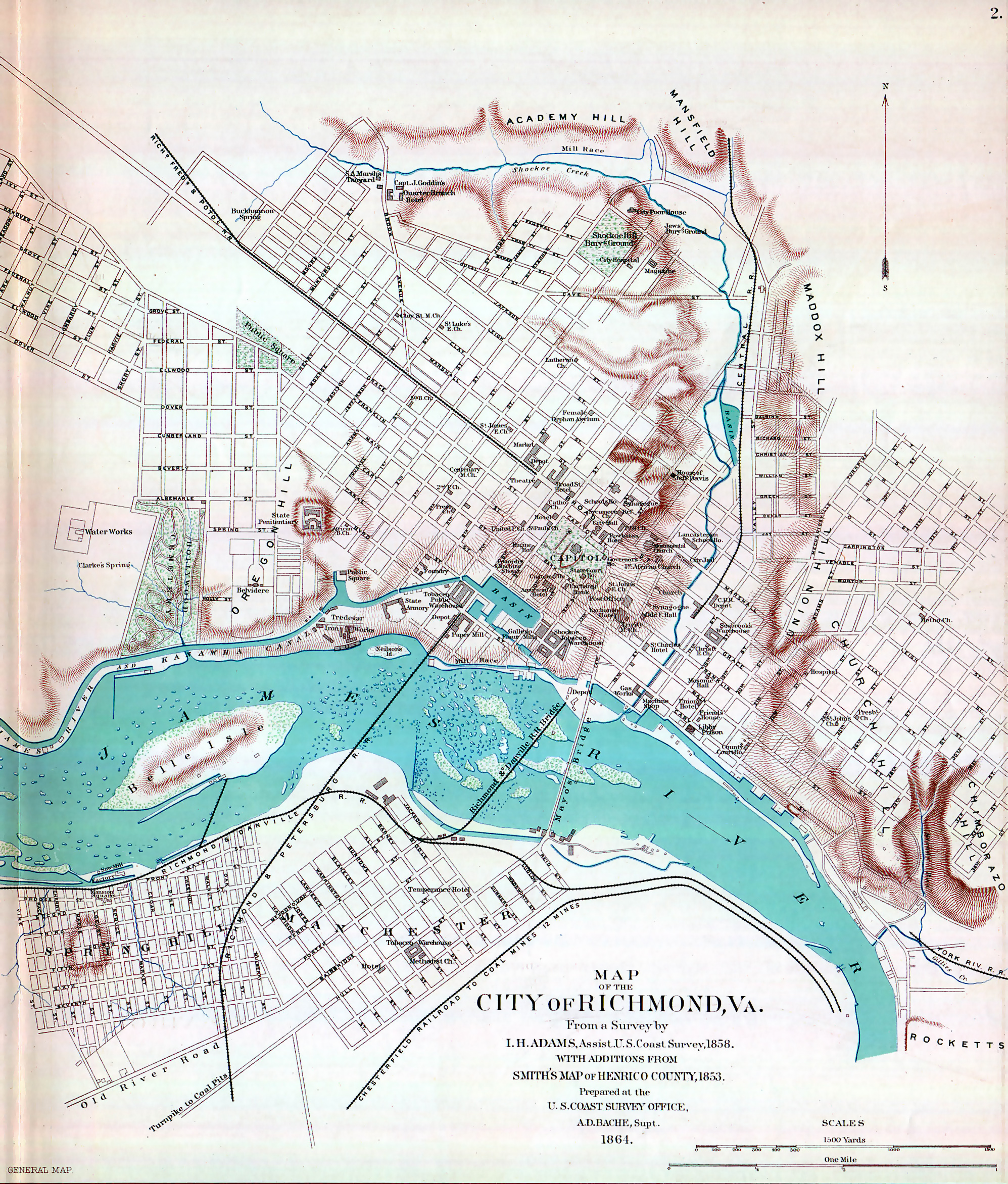
To illustrate this problem, Park includes a well-known map of Richmond, dated 1864 and published as part of the atlas accompanying the Official Records, but actually drawing on antebellum, civilian maps as its source material. I’d looked at this map many, many times, and even made note of the different rail lines and depots, but never thought about its significance in terms of military logistics. Here’s the map from the OR, showing the location of the terminals for four of the five railroads reaching Richmond:
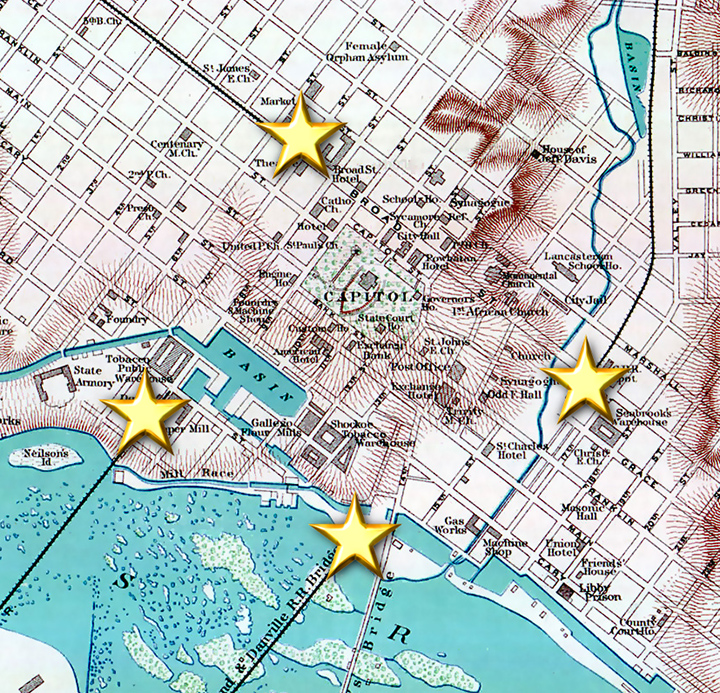
A fifth rail line, the Richmond & York River Railroad, came to an end southeast of town, between the base Chimborazo Hill and Rocketts. All the space in between the depots had to covered on foot, by carriage, or (in the case of cargo) by drays, all of which added time, inconvenience and expense — especially when you remember that everything in Richmond is uphill from everything else.
To be sure, situations like this were hardly limited to Richmond or the South. Railroads construction across the United States was a free-for-all in the decades before the war, with little standardization, and few incentives for railroad builders to find ways to interlock their roads. The primary only rail hub in Texas, Houston, was the terminus of five roads, all with their own depots and freight yards, running on at least two different gauges. It was a bigger problem for the Confederacy, of course, because the South lacked the industrial resources to expand its railroads quickly. Tredegar had enough trouble supplying armor and guns for ships like Virginia, let alone rolling out miles and miles of new, iron rail.
It’s also to the credit of Richmonders that they recognized this rail transfer problem early on, and took some measures to correct it. Just days after the fall of Fort Sumter in Charleston, the Richmond City Council voted to authorize the state to construct rail connections through the city streets to link different roads, “to be used only for the purposes of the State, or of the Confederate States, during the war, and to he removed when no longer required for these purposes.” Good progress was reported almost immediately, but at some point work stalled, to be picked up again in fits and starts through the remainder of the war. Most of the terminals remained isolated, leading to bizarre spectacles like this one from March 1862, with a steam locomotive being hauled through the streets by both mules and curious bystanders:
Allen’s locomotive ended up being dragged through the heart of Richmond’s commercial district, close by the Capitol; I wonder if the sight caused any Commonwealth or Confederate legislators to push harder for completion of the rail connections.
It seems that, for all their recognition of the problem and intentions on fixing it early on, Richmond’s success in linking its rail depots was limited. A map of Richmond (available here) dated 1867 but almost probably surveyed in mid- to late 1865, shows that only two railroads — the Richmond, Fredericksburg & Potomac, coming into town from the northwest, and the Richmond & Petersburg, coming up from the south — were eventually connected via 8th Street. A second line from the R.F. & P. depot ran east a short distance along Broad Street toward the Central Railroad depot on the east side of town, but never made it past the Capitol.

Richmond city plan, drawn by U.S. military engineers shortly after the war, showing (red) additional lines of track laid to connect the Richmond, Fredericksburg & Potomac Railroad depot (upper left), and the Richmond & Petersburg depot, lower left. Map from Civil War Richmond. The total length of new street rail laid appears to be only about two-thirds of a mile.
You can’t read much about the conflict of 1861-65 without getting a heavy dose of life in wartime Richmond, and one quickly comes to understand how it’s been rightfully called “one of the most heavily networked cities in the Confederacy.” [3] Nonetheless, its easy to forget how the little things in peacetime — like, say, an accommodation to the protectionist lobbying of draymen and carriage hacks, looking to maintain a demand for their trade — can complicate life tremendously during the stress of war.
And what I wouldn’t give tohave seen that big steam locomotive dragged through the streets of the Confederate capital by men and mules, for want of a mile or so of decent track.
__________
[1] Carl D. Park, Ironclad Down: USS Merrimack – CSS Virginia, from Construction to Destruction (Annapolis: U.S. Naval Institute, 2007), 127-30.
[2] Richmond Dispatch, March 8, 1862, 2.
[3] William G. Thomas, The Iron Way: Railroads, the Civil War, and the Making of Modern America (New Haven: Yale, 2011), 93.




 Dead Confederates, A Civil War Era Blog
11 comments