What Does Hannibal Alexander Tell Us About Black Confederate PoWs?

One of the things that’s often offered as evidence of African Americans serving as Confederate soldiers is the fact that some of these men were captured and held in Northern prison camps. Why would these men be held if they were not soldiers? goes the thinking, and there are PoW records that show them as soldiers. It’s a compelling rhetorical argument, but reality is oftentimes more complex than that. From the Confederate Veteran, January 1901:
Hannibal Alexander was a slave belonging to Parker Alexander. He went with his young master, Sidney Alexander, to the war, and did his duty faithfully. “Ham” died recently in Monroe County, Miss. He and his wife Delia by industry made a good living and accumulated a competence, ever having the confidence and friendship of the white people about their lifetime home. Writes W. A. Campbell, of Columbus :
In the army he was cook. He was in the siege of Fort Donelson. He was captured there, and went to Camp Douglass [sic.] as a Confederate prisoner. He answered roll call all the time as a white soldier. Being a bright [i.e., light-skinned] mulatto, he was brought to Vicksburg and exchanged with the others, and again went with his young master into service.
The Federal sergeant that called the roll was somewhat suspicious as to “Ham” (as he was called by the boys) being a slave, but he was told that living in Mississippi he was sunburned and that made him dark.
Hannibal was a very intelligent negro [sic.], and knew if he left his master he could go free, but he elected to stay with him among the white men he had been raised with, and preferred to suffer with them.
I knew Hannibal for more than forty years as slave and freeman, and he was ever polite and friendly to all his former owners. In the old days I went on many a hunting and fishing expedition with Sidney, with “Ham” to wait on us.
His old master with whom he went in the army is yet alive, but in poor health.
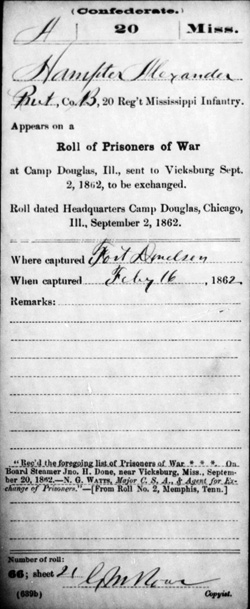 There are a number of examples of mixed-race men “passing” to enter Confederate military service, only to be discharged when found out; Alexander’s is a case of “passing” to remain with his master inside the confines of Camp Douglas.
There’s a lot to digest in Hannibal Alexander’s story. The Confederate Veteran story is framed, typically, as that of a slave’s lifelong fidelity to his master, and willingness to suffer the (very real) hardships of a Federal prison camp to do so. (This short piece is part of a section called, “Faithful Negroes Who Were Slaves.”) But it’s important to recognize that this story makes it clear that in remaining in the camp, Alexander consciously chose to represent himself as a white soldier, rather than his actual status as an enslaved cook. The article also argues that his decision to remain was one of personal loyalty to his master, not to the regiment or the Confederacy. As others have often pointed out, it’s not sufficient just to say a man “served” when talking about slaves and the Confederate army; it’s important to make a distinction about who or what he was in service to.
And of course, we have nothing at all from Alexander himself to explain his decision.
Alexander’s story is revealing because a number of “black Confederate solders” have been so identified on the basis of documents just like Alexander’s compiled service record (CSR, right) that record their presence in Union prison camps. Based on his assumed identity, Alexander’s card identifies him as a private in the 20th Mississippi Infantry, a rank he never actually held. Significantly, too, there are only two items in Alexander’s CSR folder, both relating to his parole, and originating from Camp Douglas (“roll dated Headquarters Camp Douglas, Chicago, Ill.”). There’s no Confederate record for him, dating from before or after Camp Douglas, because he wasn’t considered a soldier. By comparison, the CSR for the master he served, Sidney Alexander, contains nine separate cards detailing his career as a private in Co. B of that regiment.
Hannibal Alexander’s case is an intriguing one for a number of reasons. How valuable would it be to have Alexander’s own, unvarnished account of these events, rather than as told through the eyes of his former master’s old friend? It would be useful to know how many African American cooks and servants found themselves, like Hannibal Alexander, swept up by the Union army and made the decision to remain in the camp, passing themselves off as enlisted soldiers to do so. It’s also a good object lesson in how there might be a CSR in the National Archives for a man who was never actually recognized as a soldier by the Confederacy.
Oh, one other thing — the Confederate Veteran piece says that Sidney Alexander returned to military service, but his CSR notes that in March 1863, six months after his parole from Camp Douglas, Sidney received a discharge after hiring a substitute. Rich man’s war, poor man’s fight, y’all.
___________
Image: Camp Douglas, Chicago, c. 1863. Chicago Historical Society.

Aye Candy

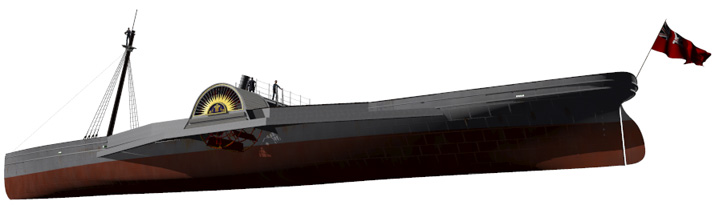
Some work-in-progress shots of my new digital model of Denbigh. The old model was OK a decade ago, but just not passable anymore. I want to at least get to the same complexity as my Will o’ the Wisp digital model. I’m using a few small bits from other models — one of the advantage of digital modeling, for sure — but the hull, sponsons and paddleboxes are entirely new. Retexturing will come near the end.
Anyway, it’s too damn hot to do much outside.


______________

Bleg
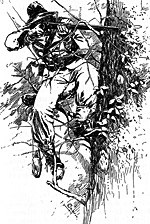 I’m working on something and I need a list of several Confederate regiments — mostly infantry, but maybe a handful of cavalry and artillery, across the war geographically and chronologically, to get a general sampling of the CS Army. Unfortunately, there seems to be no “Random Confederate Regiment Generator” out there. (Is there an iPhone app for that?)
Please use the full, formal name and drop ’em in the comments.
Thanks.

Update: Closing comments for now, as I think I have enough units to work with. Thanks for the suggestions.
_______________
Image: “Confederate Sharpshooter” by Walton Taber.

Soldiers All
Recently I’ve gotten the sense that, among those who are pushing broad, generalized assertions about the involvement of African Americans in the Confederate war effort, there’s been a notable tendency to back off the specific claim that they were recognized as soldiers at the time, opting instead for much more vague terms like “black Southern loyalist” that, having no clear objective standard to begin with, can also neither be directly refuted. Such language is warm and fuzzy, but has the great advantage that it can be applied to almost anyone, based on almost anything. It also tells us as much about the speaker as it does about the subject.
Nonetheless, one of the more prominent advocates on the subject of BCS continues to twist herself in rhetorical knots to demonstrate retroactively that African American cooks, body servants, teamsters and so forth should actually be considered Confederate soldiers, regardless of how they were viewed at the time. She recently proposed definitions of “Black Confederate” and “Black Confederate Soldier:”
A “Black Confederate” is an African-American who is acknowledged as serving with the Confederate States Army during the American Civil War (1861-1865).
A “Black Confederate Soldier” is (1) an enlisted African-American in the Confederate States Army, (2) an African-American acknowledged by Confederate Officer(s) as engaged in military service, and/or (3) an African-American approved by the Confederate Board of Pension Examiners to receive a Confederate Pension for military service during the American Civil War (1861-1865).
There are multiple problems with these definitions. The first is that there’s no practical difference between “acknowledged as serving with the Confederate States Army” (Definition 1) and “acknowledged by Confederate Officer(s) as engaged in military service” (Definition 2). A Venn diagram of these would be an almost perfect circle. In this suggested scheme, “Black Confederate” and “Black Confederate Soldier” are entirely equivalent. Anyone should be able to see that, even without knowing anything more about the subject.
Second, she defines a soldier as anyone acknowledged “as having engaged in military service,” which falls back on the never-defined, all-encompassing word “service.” This is a common technique — see the discussion thread here — which sounds simple enough, but conflates a whole range of activities that, at the time, fell into clearly-defined realms.
Third, she’s still hopelessly muddled on the subject of pensions — who awarded them, and what they were awarded for, and what classes of pensions were awarded. Some states awarded pensions explicitly for former slaves/servants (e.g., Mississippi), while others did not. There was no single, central body called the “Confederate Board of Pension Examiners;” pension programs were set up by individual states, each with their own rules and procedures. Individual applications were usually reviewed and endorsed by local boards, which introduces all sorts of unknown variables in procedure and documentation. In at least some cases, the state verified applicants’ service records with the War Department — these materials were later transferred to the National Archives — and even this verification process appears to have resulted in at least one error of mis-identification. The famous Holt Collier, who probably comes as close as anyone to having actually been a Confederate combatant in practice, received three pension awards from Mississippi in his old age — first as a personal body servant, then as a soldier, then again as a servant. In short, pension records tell us very little about the applicants’ status forty, fifty, sixty years before. (The basic primer to understanding the process for awarding Confederate pensions — and their limitations — remains James G. Hollandsworth, Jr.’s manuscript, “Looking for Bob: Black Confederate Pensioners After the Civil War,” in the Journal of Mississippi History.)

This particular researcher has a long track record of glossing over distinctions between slaves and free African Americans, personal servants, cooks, and enlisted soldiers under arms. In the interest of reconciliation and reunion, she consistently rejects the hard realities of race, law and society in the mid-19th century, and insists that all Confederates, writ broad, saw themselves as standing on an equal footing. In an effort to draw an equivalency between African American men employed as cook in the Confederate army with those in the Union, she latches onto a single, three-word notation in the record of one Private Lott Allen of the 21st USCT :
On the left, Lot Allen enlisted with the Union Army 21st United States Colored Troops (USCT) Company A as an “on order cook.” [sic., “in duty cook”] On the right, William Dove enlisted with the Confederate States Army North Carolina 5th Cavalry Company D as a “cook.” Both men contribute to United States Military history; and their soldier service records are each recorded in the National Archives and Records Administration (NARA).
Her statement about Private Allen is factually incorrect; as his compiled service record from NARA (14MB PDF) makes clear, Lott Allen enlisted as a U.S. soldier and, being 42 years old, was immediately assigned to work as a cook because he couldn’t keep up as an infantryman. His disability discharge from June 1865 says so explicitly: “Since his enlistment to the present date he has been Company Cook and is too old a man to perform the duty of a soldier.” The regimental surgeon, John M. Hawks, goes on to explain that Allen is unable to perform the duties of a soldier because of “old age; its consequent disability and infirmities. He has never been able to drill, or to march with the company, or do any military or fatigue duty; and he is too careless and slovenly for a cook.” Private Lott Allen didn’t enlist as a cook; he enlisted as a soldier, couldn’t cut it, and (it seems) wasn’t very good as a cook, either.
Posting elsewhere, the researcher takes her assumption about Private Allen and spins it off into a grand, sweeping claim encompassing thousands or tens of thousands of others:
The question is: Were there cooks, teamsters, laborers in the Union Army United States Colored Troops? The answer is yes. As an example in the image of this post, Private Allen Lot [sic.], a soldier with the Union Army 21st United States Colored Troops, served as an “On [sic.] Duty Cook.” See Private Allen Lot’s Union Soldier Service Record (NARA Catalog ID 300398).
Therefore, with this preponderance of the evidence, African-Americans on Confederate Soldier Service Records (muster rolls) who are listed as cooks, teamsters, laborers, etc. should likewise be called soldiers. The sun rises and it shines on us all.
She takes a single notation that this man was assigned as a cook and then extrapolates that to argue that all “who are listed as cooks, teamsters, laborers, etc. should likewise be called soldiers.” She makes what is formally known as a “converse accident,” but is a simple and obvious logical fallacy: she reasons that this soldier was a cook; therefore all cooks were soldiers. (And teamsters, and laborers. . . .)
It’s hard to know whether this researcher bothered to look at all of Allen’s CSR or just didn’t understand it, but it really doesn’t matter. Either way she misrepresents Allen’s actual situation, and then uses that flawed example to make a sweeping rhetorical argument applied to tens of thousands of men in an entirely different army.
This is, sadly, typical of most of the “research” that goes into BCS advocacy; it’s a mile wide and a half-inch deep. It’s pulling out a word here, a line there, and announcing it as “proof” with little consideration of the full record, even when, as in this case, it’s readily available. It’s about adding names to a list, with little or no real understanding of the larger story, or the historical context of the claim being made. It’s just unbelievably superficial.
There’s no question that tens of thousands of African Americans went into the field with the Confederate army as cooks, personal servants, teamsters, laborers, and so on. Some were free; most were slaves. Some undoubtedly went willingly, but far more went with with some degree of coercion (legal, economic, physical) guiding their steps. Some saw combat, even though very, very few were officially in a combat role. There is a tremendous, untapped resource there for serious research. But they were not formally considered soldiers at the time, by either the Confederate or Union army. Robert E. Lee didn’t recognize these men as soldiers; he thought such pretensions made a fine joke. Howell Cobb didn’t recognize these men as soldiers. Kirby Smith didn’t see these men as soldiers. So why do some people today, like this researcher, devote so much effort to retroactively designate them so? Why is “proving” that point so much more important than telling their actual stories as individuals? Sure, this researcher finds Lott Allen and William Dove useful for making an analogy, but does she offer any additional information about them? (Hint: if you’ve read this far, you already know more about Lott Allen than you’re ever likely to find on the researcher’s site.)
I regret feeling obligated to make this post at all, and have no doubt it will be framed as a personal attack on this particular researcher’s character. It’s not; I’ve repeatedly said before, and still believe, that she is sincere and well-intentioned in her efforts. But it’s also clear that she doesn’t understand the materials she’s working with, and has no sense of her own limitations in that regard. But she is viewed as a among BCS advocates as a leading researcher on the subject, and maintains an extensive website dedicated to it. If she is to be respected and valued as a researcher, she needs to be subject to the same fact-checking on her research and methodology that the rest of us are; she doesn’t get a pass because she’s not professionally trained, or because she’s well-intentioned.
There’s a saying, much quoted by True Southrons™, that “history is written by the winners.” This reflects their sincere belief that their own preferred historical narrative is somehow suppressed by professional historians and censored in academic curricula. That’s wrong; history is history, regardless of who writes it. But the work they do needs to stand up to scrutiny, and most of it just doesn’t.
_______________

Mail-Order Heroes
 Several heritage groups are teaming up to sell what they describe as a “Confederate PoW Medal.” It’s not, actually; it’s a descendant of a Confederate PoW medal, and says so right there on the badge: “Descendant of a Confederate POW, 1861-1865.”
One of my relatives spent a year and a half at Rock Island Barracks. Other Confederates imprisoned there described a terrible experience, and even four decades later my relative declined to discuss his confinement there in detail, even though he had lots to say about his other wartime adventures. He should’ve gotten a medal for it, to be sure. But the notion that, 150 years later, some collateral descendant he never imagined, much less actually knew, should be pinning such a medal on his own lapel is both asinine and deeply offensive.
Lookit — if I were to rummage through my late father-in-law’s stuff, and then step out wearing his old Purple Heart, I would be (1) possibly arrested, (2) probably punched in the face, and (3) certainly laughed at. And that’s as it should be.
This should be no different.
____________

Celebrating Independence Day in Vicksburg, 1877
It’s a common trope that the citizenry of Vicksburg, Mississippi, did not celebrate the Fourth of July until well into the 20th century. While it’s certainly true that the anniversary of the fall of that city to Grant in 1863 continued to resonate with Vicksburg residents down through the years, in fact the date was observed by plenty of local residents, white and black, even if the celebration was unofficial and somewhat more muted there than elsewhere. And they were celebrating it even when the war itself was a recent memory. From the Vicksburg Daily Commercial, July 3, 1877:
To-morrow being the anniversary of our Nations independence, all patriotic citizens of this great Republic are expected to observe it as a holiday. We desire to be reckoned among this class of patriotic citizens, consequently no paper will be issued from this office to-morrow. The glorious Fourth happens to come in hot weather this year, and we are glad to be able to observe it ‘neath the shade of country forests.
And a follow-up, on July 5:
The people of Vicksburg came nearer celebrating the glorious Fourth yesterday than they have done for several years. True, there was no general suspension of business, as indicated by closed doors, but so far as the profits of trade were concerned doors might as well have been closed, for the salesrooms were deserted almost entirely. Everybody was out of town, apparently, enjoying the holiday in some way. Several hundred people attended the Hibernian picnic at Newman’s Grove, and not withstanding the extreme heat, all seemed to enjoy the festivities of the day. The colored population turned out in large force, fully one thousand men of them going down the river on excursion bvoats to picnic-grounds, yet there were enough of them left in the city to form a very respectable procession of colored Masons, and a very large audience to listen to the oration of Judge J. S. Morris, and to assist in laying the corner-stone of King Solomon’s Church. There was no prolific display of fire-works on the streets, but occasional reports from fire-crackers and large torpedoes could be heard, accompanied now and then by a patriotic cry, “rah for the Fourth of July!” We do not wonder at the lack of patriotic enthusiasm displayed on our streets. No amount of patriotism could have induced any sane man to exert himself very considerably on such a day when the thermometer registered very nearly 100° Farenheit [sic.] in the shade. However, the observance of Independence Day yesterday, slight as some may have thought it, was yet sufficient to indicate the prevalence of a broader National sentiment and a determination to at least partially forget the past which renders the Fourth of July especially distasteful to Vicksburgers, and make it in future “The Day We Celebrate” as much as any other National holiday.
To be sure, the Fourth of July remained a bitter date for many Vicksburg citizens, for a long time. Undoubtedly there are some who still reject the date as one for celebration. But in this, as in so much else about the legacy of the war, the reality is more complex than the mythmakers would have one believe.
_____________

1865 Galveston in Google Earth

Google Earth is a pretty amazing tool, whose functionality is often limited only by the imagination of the user. One feature that I enjoy and use frequently, is to add an “image overlay,” which essentially allows the user to take maps and diagrams from other sources from other sources and lay them out on the modern, aerial views stored in Google. It takes practice, particularly in scaling the original image to match plot in Google Earth, but usually worth the effort. In doing the research on my post on the Henry Wirz execution photos, for example, I overlaid a diagram of the Old Capitol Prison to see how it fits on the site. While it’s usually state that the current Supreme Court building occupies that site, in fact most of the Old Capitol Prison stood in what is now the plaza in front of the Supreme Court, and the gallows were located about halfway between the front steps and of the present-day court and the curb:
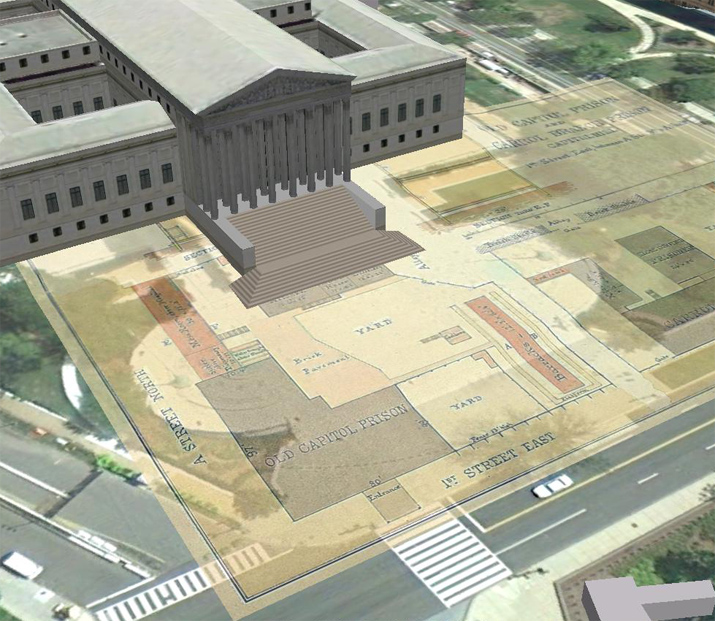
Is this information useful to anyone? Probably not, unless you happen to be a history-cartography-techo-dweeb, in which case it’s priceless.
Anyway, for those interested, here are the Google Earth files for Galveston in 1865, from Plate XXXVIII of the Atlas for the Official Records (2MB), and for the Old Capitol Prison (215K). Google Earth is required.
Are there any other good Civil War-related Google Earth applications I should know about?
______________

Yankees in the Attic
Not my attic, as it happens, but my wife’s. It’s hardly a surprise, but it’s good to be able to confirm specific names and dates, rather than some vague understanding passed down by oral history. It appears that her great-grandfather’s two older brothers, James Bradley Ridge and George B. Ridge, both fought for the Union during the Civil War. Bradley, aged about 17, enlisted in Co. K of the 5th Connecticut Volunteer Infantry on July 21, 1861, and served with the regiment until discharged on July 5, 1865. His older brother George, age about 19, enlisted in the same company in January 1862, and served through the end of the war. He was promoted to Corporal in June 1865, and mustered out of the regiment on July 19, 1865 at Alexandria, Virginia.
The 5th Connecticut Volunteer Infantry was originally composed of companies formed in response to that state’s governor’s call for volunteers in April 1861. These units were disbanded after Lincoln’s call for 75,000 troops in May 1861, and reorganized themselves as the First Regiment, Colt’s Revolving Rifles, with famed gun maker Samuel Colt as their prospective colonel. The new regiment was quartered on the grounds of the Colt Patent Fire Arms Company at Hartford, but when Colt determined that the regiment should enlist as regulars, the new recruits refused. So the First Regiment of Colt’s Revolving Rifles was disbanded (again) and immediately reformed (again) as the 5th Connecticut Volunteer Infantry. And they never did get their Colt Revolving Rifles.
As part of the Army of the Potomac, the 5th Connecticut took part in Pope’s campaign in northern Virginia, and were heavily engaged at the Battle of Cedar Mountain on August 9, 1862. On that day Pope’s army ran smack into that of Stonewall Jackson. After initially pushing back the Confederate line, a swift counterattack by A.P. Hill’s troops turned the course of the action late in the day. The 5th Connecticut, in the thick of the fighting near a local landmark known as “the cabin” (below), lost 48 men killed or mortally wounded, 67 wounded and 64 captured, or 179 of the 380 men present — 47.1% casualties. The regimental history notes ruefully that these losses were “as large as all the rest of its battle service put together,” and among the highest of any Connecticut regiment during the entire war.
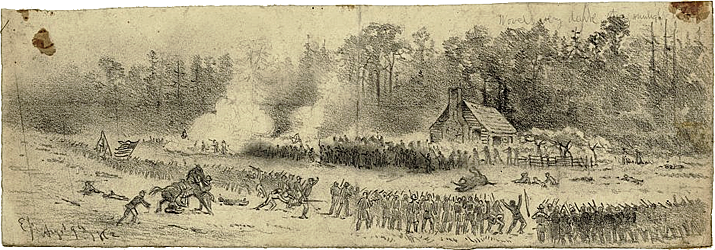
“Charge of Union troops of the left flank of the army commanded by Genl. Stonewall Jackson at Cedar Mountain,” by Edwin Forbes. Library of Congress.
The regiment was present at Second Manassas (Bull Run), and the following year in the Chancellorsville and Gettysburg campaigns. After Gettysburg, the regiment was transferred to the Army of the Cumberland, where in 1864 it participated in Sherman’s Atlanta campaign. According to its regimental history, the 5th Connecticut led the column of Sherman’s army that marched into Atlanta on September 2, 1864, after that city’s surrender:
September 2d. We all move forward toward the city of Atlanta, leaving our tents standing. Our regiment has the advance, and the Fifth Regiment Connecticut Veteran Volunteers have the honor of being the first Union regiment to march through the streets of the city of Atlanta. We have certainly earned the honor, for we have made a long and tedious campaign, having been 112 days and nights continually under fire, sleeping many nights in the trenches, fighting at every opportunity, always holding the ground and routing those opposed to us, and finishing the campaign with great honor to ourselves, to the State and to the General Government.
General Sherman says that we will rest in the city for thirty days, and I believe him.
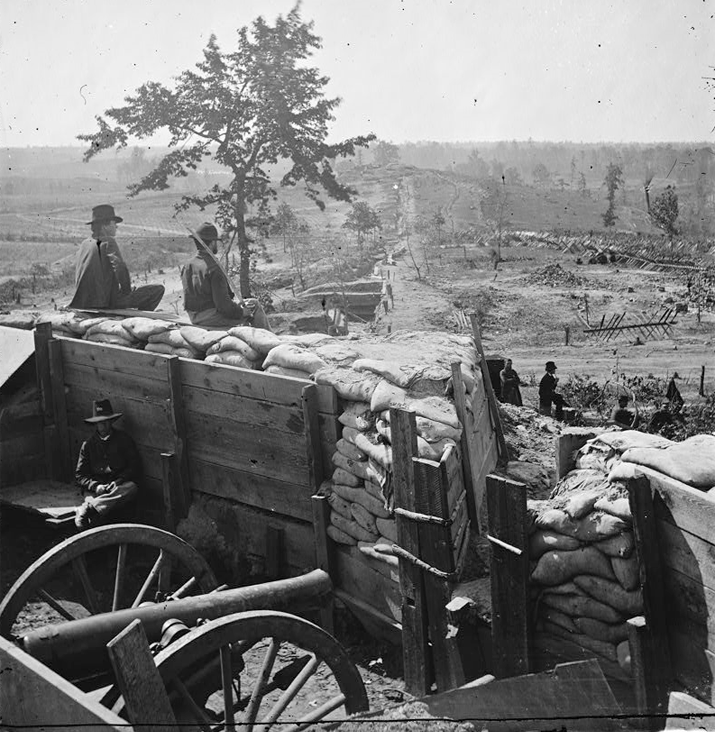
Federal troops occupy former Confederate defensive works at Atlanta. A diarist in the 5th Connecticut recorded on September 10, 1864, “have visited the lines of fortification built by ourselves and the rebels around this city, and also looked around the city. Terrible destruction by shot and shell everywhere.” Library of Congress.
The 5th Connecticut went on to participate in Sherman’s “March to the Sea,” and in fighting up through the Carolinas in 1865. Bradley Ridge was reported missing after the Battle of Averasboro in North Carolina in March 1865, but eventually returned to the regiment. (I have not yet received his CSR, so don’t know the specifics, or if he was captured by Confederate forces.)
That particular line of my wife’s family has a long tradition of military service — her grandfather was gassed with the AEF during World War I, her dad served in the wars in Korea and Vietnam, her brother flew on medical evacuation missions during Desert Storm, and so on. Now that list goes a little farther back, still.
_______





 Dead Confederates, A Civil War Era Blog


30 comments