Frederick Douglass and the “Negro Regiment” at First Manassas
From the Douglass Monthly, September 1861:
It is now pretty well established, that there are at the present moment many colored men in the Confederate army doing duty not only as cooks, servants and laborers, but as real soldiers, having muskets on their shoulders, and bullets in their pockets, ready to shoot down loyal troops, and do all that soldiers may to destroy the Federal Government and build up that of the traitors and rebels. There were such soldiers at Manassas, and they are probably there still. There is a Negro in the army as well as in the fence, and our Government is likely to find it out before the war comes to an end. That the Negroes are numerous in the rebel army, and do for that army its heaviest work, is beyond question. They have been the chief laborers upon those temporary defences in which the rebels have been able to mow down our men. Negroes helped to build the batteries at Charleston. They relieve their gentlemanly and military masters from the stiffening drudgery of the camp, and devote them to the nimble and dexterous use of arms. Rising above vulgar prejudice, the slaveholding rebel accepts the aid of the black man as readily as that of any other. If a bad cause can do this, why should a good cause be less wisely conducted? We insist upon it, that one black regiment in such a war as this is, without being any more brave and orderly, would be worth to the Government more than two of any other; and that, while the Government continues to refuse the aid of colored men, thus alienating them from the national cause, and giving the rebels the advantage of them, it will not deserve better fortunes than it has thus far experienced.–Men in earnest don’t fight with one hand, when they might fight with two, and a man drowning would not refuse to be saved even by a colored hand.
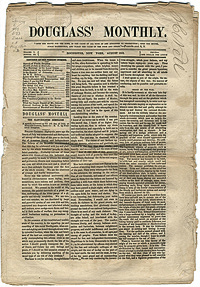
This quote, and most specifically the first part of it in bold above, is often waved triumphantly as an incontrovertible bit of evidence that the Confederacy did enlist African Americans as bona fide soldiers, “having muskets on their shoulders, and bullets in their pockets.” Those who advocate for the existence of large numbers of BCS seem to view Douglass’ quote as a sort of rhetorical trump card, as though the assertion of someone so genuinely revered could not possibly be questioned. If Frederick Douglass said so, the thinking seems to be, then even the most biased, politically-correct historian has to accept that.
The truth, of course, is that Frederick Douglass’ claims are subject to same scrutiny as anyone else’s. It’s worth remembering that Douglass was neither a reporter nor an historian; he was, by his own happy admission, an agitator, and is his September 1861 essay excerpted above he was again making the case for the enlistment of African American soldiers in the Union army. If there were reports that the Confederate army had used black troops at First Manassas — a battle that by September was well understood as an embarrassing setback for Union forces — then that made all the more compelling case for the Lincoln administration to respond in kind.
But why did Douglass believe that there were, or at least plausibly might be, such units in the Confederate army? He lived in upstate New York, in Rochester; he was nowhere near the battle and saw nothing of it at first hand. He might have spoken to someone who claimed first-hand knowledge of the event, but there’s no evidence that that’s the source of the claim. Indeed, the opening clause of the passage — “it is now pretty well established” — acknowledges that Douglass was not writing about something he knew to a certainty, but rather a conclusion based on what were likely numerous reports, rumors and press items.
Earlier this week Donald R. Shaffer looked at the evidence of black Confederate soldiers taking part in First Manassas, and argued that Douglass may have been basing his claim on an exchange in the Congressional Globe that took place soon after the battle, in which the involvement of African Americans in the Confederate army in a variety of capacities is discussed. Shaffer concludes, “it is apparent from the debate above that some servants and other African Americans attached to both armies were armed. This did not make them soldiers officially, but it does make murkier the line dividing soldiers and civilians attached to the armies in the Civil War.”
Dr. Shaffer, author of After the Glory: The Struggles of Black Civil War Veterans and Voices of Emancipation: Understanding Slavery, the Civil War, and Reconstruction through the U.S. Pension Bureau Files, makes a solid argument. Douglass closely followed the political debates of the day, and may well have followed the discussion in the Congressional Globe. But I would respectfully submit that it’s even more likely that he believed there were black Confederate troops at Manassas because he read it in the newspaper. From the New York Tribune, July 22, 1861, p. 5 col. 4:
A Mississippi soldier was taken prisoner by Hasbrouck of the Wisconsin Regiment. He turned out to be Brigadier Quartermaster Pryor, cousin to Roger A. Pryor. He was captured on his horse, as he by accident rode into our lines. He discovered himself by remarking to Hasbrouck, “we are getting badly cut to pieces.” What regiment do you belong to?” asked Hasbrouck. “The 19th Mississippi,” was the answer. “Then you are my prisoner,” said Hasbrouck.
From the statement of this prisoner it appears that our artillery had created great havoc among the rebels, of whom there are 30,000 to 40,000 in the field under command of Gen. Beauregard, while they have a reserve of 75,000 at the Junction.
He describes an officer most prominent in the fight, and distinguished from the rest by his white horse, as Jeff. Davis. He confirms previous reports of a regiment of negro [sic.] troops in the rebel forces, but says it is difficult to get them in proper discipline in battle array.
This account, with minor changes to the wording, appeared in newspapers all across the North, and even in Canada, in the days immediately following the battle. It was published in Batltimore, New York, Massachusetts, Albany and — yes — Rochester. A quick search of digitized newspapers suggests how far, and how often, the report of a back Confederate regiment in the field, seemingly confirmed by a captured Confederate officer, made it into print:
- St. John, New Brunswick Morning Freeman, July 25, 1861, p. 4, col. 3 (Google News)
- Baltimore American and Commercial Advertiser, July 22, 1861, p. 1 (Google News)
- Baltimore Sun, July 22, 1861, p. 2 (Google News)
- Lewiston, Maine Daily Evening Journal, p. 2, col. 2 (Google News)
- Springfield, Massachusetts Daily Republican, July 22, 1861, p. 4, col. 3 (GenealogyBank)
- Lowell Massachusetts Daily Citizen and News, July 22, 1861, p. 2 (GenealogyBank)
- Albany Evening Journal, July 22, 1861, p. 1. col. 6 (GenealogyBank)
- Jamestown, New York Journal, July 26, 1861, p. 2, col. 4 (GenealogyBank)
- Mineral Point, Wisconsin Tribune, July 26, 1861, p. 1, col 4 (NewspaperArchive)
- New York Daily Tribune, July 22, 1861, p. 5, col. 4 (Library of Congress)
- Moore’s Rural New Yorker, July 27, 1861, p. 6, col. 3 (Rochester Area Historic Newspapers)
As noted, these eleven citations are not an exhaustive list of papers that published this account in 1861; these are only examples that, 150 years later, survive in digitized, searchable form. The actual number of papers, large and small, across the country that repeated these short paragraphs may have counted in the dozens. Summaries based on Pryor’s account went even farther, with the British papers picking up and embellishing the claim. The Guardian was almost certainly rehashing Pryor’s account when it reported on August 7 that “Jefferson Davis was conspicuous on the field, on a white horse, in command of the centre of the army. A negro regiment fought on the same side.” The Illustrated London News went farther, claiming not only that such a unit went into action, but that “Northern troops found themselves opposed to a regiment of coloured men who fought with no want of zeal against them.”

I have no idea who “Brigadier Quartermaster Pryor” was; the 19th Mississippi had two Pryors, neither of which appear to be the man mentioned in the story. But who he was is less important here than assessing the reliability of his claims. I asked Harry Smeltzer of Bull Runnings for a quick assessment of Pryor’s report, as printed in the papers. Harry agreed, so long as I would indemnify him against getting dragged into the black Confederate discussion. (Done.) The Confederate numbers quoted are way off, he said, but then “numbers were wildly overstated by both sides, each being convinced they were outnumbered.” He continued:
OK – lots of [redacted barnyard term] in there, of course. The Federals did not move again on Manassas.
No 19th Mississippi at the battle: 2nd, 11th 13th, 17th, 18th. Last two were with Jones at McLean’s Ford. 2nd & 11th were with Bee and 13th with Early, so those three could have been where the 2nd Wisc was at some point. Pryor would have to have been very lost to wander from Jones to 2nd Wisc. Best bet to me is the 2nd or 11th. . . .
[Jeff Davis] arrived shortly after the fighting had stopped, during the retreat. . . .
Whoever “Brigadier Quartermaster Pryor” may have been, his claims about the battle and the Confederate army are a mess. Even allowing for the fog of war and the reality that no one, even the generals themselves, has a full and accurate picture of the fight in real time, Pryor’s claims are dubious and unreliable. It’s impossible to know, at this remove, what Pryor said on the battlefield, but what he’s quoted as saying in the newspaper is pretty worthless.
We’ll likely never know what caused Douglass to make his claim that the Confederacy had put African American soldiers on the field at Manassas. He may have heard about the battle from someone present, though Douglass’ passage doesn’t suggest that. He may well have followed the debate in the Congressional Globe, but at the same time he almost certainly was aware of the claims of “Brigadier Quartermaster Pryor,” printed in at least two papers likely to have crossed his cluttered desk in Rochester, Horace Greeley’s New York Daily Tribune and one of the local sheets, Moore’s Rural New Yorker. The presence of black men in Confederate uniform was an oft-repeated rumor that the time, and Douglass very likely saw “Brigadier Quartermaster Pryor’s” dubious account as further confirmation. Even an esteemed author like Frederick Douglass can only be a reliable as the material he has to work with.
_________________
Image: Issue of Douglass’ Monthly newspaper, via Division of Rare & Manuscript Collections, Carl A. Kroch Library, Cornell University.

37th Texas Cavalry Capitulates to Yankee Revisionism
I kid, I kid.
But I noticed recently a rather stark change that’s come over 37thTexas.org, which is (or perhaps was) the website of the reenactors of the 37th Texas (Terrell’s) Cavalry. It wasn’t exactly a favorite website of mine, but I found it extremely useful, collecting as it did in one place all sorts of cliched tropes and bad history. You can view the old website through the Internet Wayback Machine, but it has imbedded music so you may want to turn your speakers down. It was full of all sorts of useful stuff for a cynical blogger like me, with multiple sections on black Confederates, the Chandler Boys, Nathan Bedford Forrest at Fort Pillow, and that wicked old racist, Abraham Lincoln. That website was like an old friend — a drunk, belligerent, slightly-insane old friend.
So it came as a bit of a shock to see that the old website was gone, replaced by one (below) that’s infinitely tidier, easier to navigate, easier to read — and deadly dull. There’s hardly a controversial statement in the whole thing.


I don’t know what to make of this development. The new website is completely disorienting. Instead of a screed about Lincoln’s racism called, sarcastically, “The Great Emancipator,” there’s now a page of the same name describing the end of slavery without a trace of snark. Where there were once multiple pages about the supposed service of African Americans as soldiers in the Confederate Army, there’s now a page called “Blacks in the Civil War,” that describes the contribution of African Americans to the Union Army and Navy. And where there was once a long, tortured exoneration of Forrest’s actions at Fort Pillow, now there’s this:
General Forrest is largely known as a self-educated individual and a creative cavalry leader during the war and as a leading southern advocate after the war. He is foremost known as the Grand Wizard of the Ku Klux Klan, an organization with a secret character that launched a reign of terrorism against carpetbaggers, scalawags, Republicans and Afro-Americans.
Oh, my.
To be sure, there are a lot of small problems with the new content. The Emancipation Proclamation went into effect at the beginning of 1863, not 1963. Henry “Box” Brown, who famously escaped slavery in 1849 by having himself shipped north in a large crate, had no connection to the NAACP. And while I both (1) find figs to be “very delicious,” and (2) see the study of the war as a wide-ranging interdisciplinary effort, I have no idea what they have to do with the 37th Texas Cavalry.
I think I liked the old website better.
__________________

The Things I Do for You People. . . .
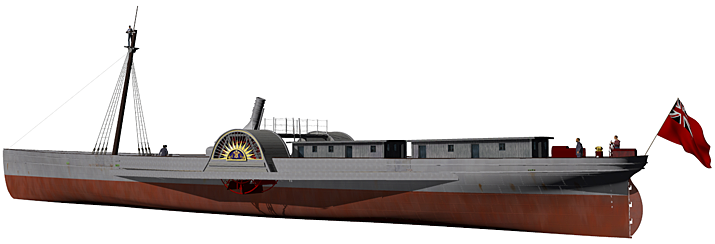
Couple days ago I posted some updated, work-in-progress images of my new digital model of Denbigh, one of the most successful blockade runners of the war, that completed eleven round voyages through the Union blockade between Havana, Mobile and Galveston. One of my regular readers asked, “no pintle on a rudder that large?” What cheek!
Except that my commenter was right — the model had a simple, stand-in rudder that just generally indicated its shape and position. I never got around to building a proper rudder for the old model, and hadn’t given it much thought on the new one. Well, now that’s fixed, with a new sternpost and rudder, based on the example in Captain Henry Paasch’s Illustrated Marine Dictionary.

Let’s Don’t Tell Rob Hodge About This, Okay?
Tim Smith is live-blogging (kinda-sorta) the Manassas reenactment over at A House Divided. It”s pretty good for a funny, not-at-all-serious take on the whole thing. This morning, “When Civil War reenactors go to Burger King:”
Derek Lanham, a Confederate cavalryman at Camp Manassas, has his horse saddled and he’s ready to ride for breakfast.
He’s getting a bite at Burger King.
“Where are you going to hitch up your horse there?”
“The drive thru,” he says.
With picture, FTW.
__________________

Texas Blue & Gray
 My colleague Ed Cotham, author of Battle on the Bay: The Civil War Struggle for Galveston, recently sent me a copy of Texas Blue & Gray, telling the story of the arrival of the Federal fleet off Galveston in July 1861 (1.0MB PDF). Ed sent it in plenty of time, but I got busy with other stuff and didn’t post it. Totally, completely mea culpa. So my sincere apologies to Ed for my letting this slip my attention.
_____________

Aye Candy
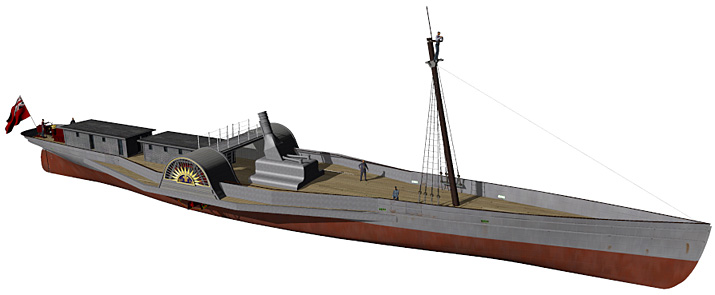
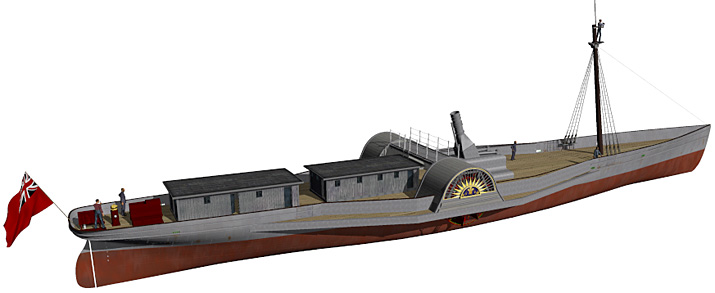
More work on the Denbigh model. The major changes from last time are the addition of the wheelbox, aft companion and deck houses. The latter are entirely new elements. And a new Red Duster, as well.
I tweaked the paddleboxes to get the emblem correct, and I’m happy with the result. (That was the biggest weak spot on the old model.) We’re fortunate to have an original 1864 portrait of the ship in her blockade-running guise (published in color here and here), that seems to show a fair amount of gilt on the paddleboxes, including the Prince of Wales feathers at the center. All that brightwork seems like an unlikely feature on a vessel intended to operate by stealth, and I don’t really know if the painting is (1) accurate, (2) depicting as gilt what was actually yellow paint, or (3) entirely fanciful on the part of the artist, Thomas Cantwell Healy (1820-89).
Fortunately, strict adherence to the primary source material coincides with good aesthetics — the paddleboxes add a much-needed splash of color to the vessel — so I’ve carried them over to the model, in all their ultramarine blue-and-gilt glory.


_______________

Museum of the Confederacy Debuts Online Chapman Collection

The Museum of the Confederacy in Richmond has debuted an online exhibition of 31 paintings by Conrad Wise Chapman, the famous Confederate soldier artist, depicting scenes around Charleston during the war. A handful of Chapman’s paintings are well-known to Civil War historians and buffs alike, such as his famous portrait of the submersible H. L. Hunley,but most in the collection are much less known. Best of all, the exhibit uses Zoomify, an online tool that lets the viewer zoom right into painting to see the finest detail. While nothing beats seeing an original work in person, it’s probably also true that this tool lets the viewer examine works more closely, and at their leisure, than would ever be possible in a museum gallery.
A number of Chapman’s works depict the fortifications and batteries around Charleston, including Sumter, Moultrie and Morris Island. They’re not battle scenes, but depict those places in their day-to-day form, with soldiers drilling, chatting with civilians, or laborers working to build or repair the fortifications. These are especially intriguing to me, given that they suggest the likely appearance of some of the Confederate batteries here, of which I don’t think there are any contemporary depictions.
Congratulations to the Museum of the Confederacy and its sponsors — including the SCV’s Chester Station Camp No. 1503 — for their foresight and effort in bringing these works to a wider audience. Well done.
____________
Image: Detail of “Fort Moultrie Interior,” by Conrad Wise Chapman. A mounted officer supervises soldiers working at the entrance to a bombproof. Museum of the Confederacy.
Were Cooks Enlisted in the Confederate Army?
 In a recent post, I took to task a well-known researcher on the subject of black Confederate soldiers, for her misrepresenting the case of a private in the 21st U.S. Colored Infantry, who upon enlistment was taken out of the ranks and assigned to work as a company cook. Although his subsequent disability discharge paperwork makes clear that the 42-year-old private’s reassignment as a cook was because “he has never been able to drill, or to march with the company, or do any military or fatigue duty,” the researcher stated, incorrectly, that he had enlisted specifically as a cook, and she then went on to argue that, because that man was a soldier in the Union army, all cooks in the Confederate army were soldiers, too.
In making her case, the researcher compared the USCT soldier to William H. Dove, an African American man who appears on the rolls of the 5th North Carolina Cavalry. In the comments that followed, one of my regular readers made a blunt point: “But if they were enlisted they were soldiers. William Dove, Cook, Co. E, 5th NC Cavalry was a soldier.”
That’s an entirely reasonable position to take. It’s simple, it’s logical, and it’s easily applied as a standard. But it also raises the question: were the cooks who accompanied and served the Confederate army actually enlisted?
[Before proceeding, let me clarify that in this post, I’m discussing men who worked full-time as unit cooks, not individual soldiers who took turns acting as “cook” for their messes.]

There are several ways to approach this question. A reasonable place to start would be the actual regulations for the Confederate States Army. Several editions of the regs were published from 1861 through 1864; I haven’t found an 1865 edition. But the wording in different editions of the regulations is so similar that I’ll take the mid-war edition of the Regulations for the Army of the Confederate States (“the only correct edition”), published in 1863, as representative. It also happens to be the edition in effect at the time William Dove joined the 5th North Carolina as a cook in December 1863.
While the Regulations go into considerable detail on the provision of cooks in military hospitals (see here and here and here), when it comes to field formations it’s almost completely silent. Article XLVI on the Confederate recruiting service, makes no mention of enlisting cooks in eighteen pages. Elsewhere the regulations are unclear, if not contradictory. They state, for example, that “as soldiers are expected to preserve, distribute, and cook their own subsistence, the hire of citizens for any of these duties is not allowed, except in extreme cases,” but elsewhere provide that each company would be allowed four cooks (as well as four washer-women) for distribution of rations, and that cooks of units embarked on military transports were exempted from one of the two required inspection formations daily. There were other arrangements, as well; in the closing days of the war, for example, Nathan Bedford Forrest issued general orders reorganizing and consolidating his command, instructing that “there will be allowed a negro cook to every mess of ten” troopers, a proportion more than double that allowed under army regulations for infantry units. There’s little clarity to be found in existing army policy and procedure. While the Regulations acknowledge the presence of, and make explicit allowance for, cooks in the Army, there’s no indication that the Richmond intended those men to be formally enlisted.

But regulations are one thing; practice is often another. Anyone who’s been part of a large organization knows that there’s often a wide divergence between policy — what’s supposed to be done — and what actually is done in the day-to-day operations of the group. Is there a way to get a rough estimate of how common it was for the Confederate Army to formally enlist cooks? Yes, there is.
The Data. The National Park Service developed its Civil War Soldiers & Sailors System (CWSSS), an online database, to include essential facts about servicemen who served on both sides during the war. It contains about 6.3 million names, which are themselves drawn from compiled service records (CSRs) held at the National Archives. CSRs are not regimental muster rolls, but are abstracted from them; long before they were transferred to NARA, file clerks at the War Department meticulously copied each man’s name, on each roll, to a long card along with other information about him drawn from the rolls. These, along with other paperwork — hospitalization records, receipts, requisitions, discharge papers and the like, were combined and filed in small folders, one for each man. (These are the documents, microfilmed and digitized, that are now available via commercial services like Footnote.) Because any given man might have his name listed differently on several documents, and because the clerks doing the work had no practical way to sort them out, there many duplications of names, alternate spellings, and so on. The end result of all this is that, while the CSRs and NPS database derived from them are not “clean” data — due in large part to the duplication of names — the CWSSS is a relatively comprehensive database.
It’s true that many contemporary records were lost, particularly Confederate unit records from the last months of the war, and so are not reflected in either the CSRs at the National Archives or the CWSSS. But while this poses a problem for researchers looking for a specific individual, it’s less a concern for the simple analysis offered here, which focuses on extant records only, to see how often cooks are reflected in the muster rolls of Confederate units. The fields available in the CWSSS include “Soldier’s Rank_In” and “Soldier’s Rank_Out,” which allow the researcher to quickly scroll through the names listed for each regiment, to identify men with the listing of “Cook” in either field.
Methods. I selected twenty Confederate regiments to look for men who appear in the CWSSS as “Cook,” either as their initial or final rank. Several regiments were ones that my own relatives had served in; others were suggested by readers of this blog. I tossed in a couple of other regiments on a whim, including the parent regiment of the famous companies of the (supposedly integrated) Richmond Howitzers, just for fun. I also included William Dove’s 5th North Carolina Cavalry, which was the only unit I knew going into the project that had at least one entry for a cook — the number of cooks in the other nineteen regiments were unknown to me at the time I began going through the lists.
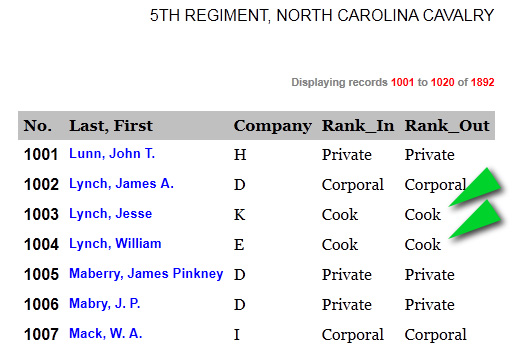
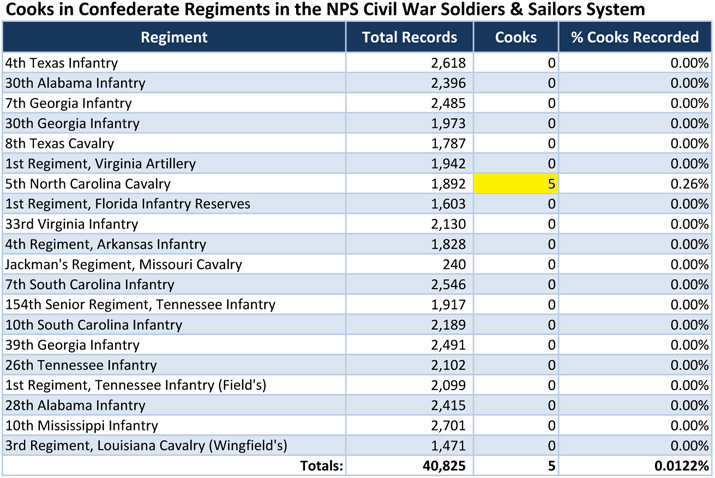
Results. There are five entries for cooks, in 40,825 names total — one one-hundredth of one percent, as opposed to a figure between 3% and 5%, based on the organization outlined by army regs, at four cooks per company, or 40-45 cooks per infantry regiment at full strength. It’s possible I missed a few cooks in skimming through the regiments listed here, but even a dozen more men would barely move the needle. But if this sampling is broadly indicative of the Confederate army as a whole — and I don’t know why it wouldn’t be — then the larger situation is clear, that cooks were almost never carried on the rolls as enlisted men. Certainly there are other examples than the five men in the 5th North Carolina Cavalry, but even if there are scores more, they much represent a very tiny fraction of the thousands of men who served as army cooks at one time or another during the war.
So why, in this sample of 20 regiments, are there only a handful of examples clustered in the 5th North Carolina Cavalry? The answer may lie in those five men’s CSRs — four of the five were carried on the rolls of Company E of that regiment, and were placed there by Captain Thomas W. Harris. (The fifth man, like Hannibal Alexander, has a CSR that reflects only his parole from a Federal prison camp; his presence with the 5th North Carolina is not recorded.) Why did Captain Harris, in particular, formally enter these men on his company’s rolls when the other officers of the regiment did not? It’s apparent that these men were not themselves cavalry troopers; each one’s CSR carries the notation, like William Dove’s, “has no horse.” Did he he misunderstand the regulations, or common practice, or was there a specific reason? Whatever the answer, Harris’ decision to enter these men on the roster of Company E clearly stands in stark contrast to common practice; it’s very much a one-off situation.

There’s no question that Confederate cooks, body servants and others considered non-combatant did sometimes find their way into action. Richard Quarls, for example, is reputed to have picked up his master’s rifle when the man was hit, and defended him until he could be removed from the field. There are many such anecdotes, but it’s useful to keep in mind why such incidents were recorded in the first place — because they were out of the ordinary, and beyond the expected scope of those mens’ stations.
But against this there are at least as many accounts from Confederate soldiers of African American cooks and servants that gently mock them for supposed dumb indifference to enemy fire, or for their alleged comical cowardice. Val Giles, describing how his company of the 4th Texas Infantry was pinned down at the foot of Little Round Top after the previous day’s assault, noted that “Uncle” John Price brought up the company’s rations under fire, and promptly lay down behind a boulder and went to sleep, even as Yankee Minié balls splatted against the rocks, “making lead prints half as big as a saucer.” The Rev. J. N. Crain, told of an incident in an 1898 issue of the Confederate Veteran, about an outdoor religious service held after the Battle of Chickamauga:
In the early part of the service a battery belonging to “out friends the enemy” sent a shell, which exploded some two or three hundred yards below our position. A negro [sic.] cook, who had his belongings just outside of the place occupied by the congregation, put them over his shoulder with the significant remark: “this nigger is gwine to git out o’ here.” That caused a ripple of laughter in the congregation, but all sat still. During the long prayer of our service another shell came much nearer. When the prayer was finished and the chaplain’s eyes were opened he saw that the congregation, with the exception of five or six, had followed the cook.
African American cooks and servants were often remembered in this way, as a sort of comic relief, and even so august a personage as Robert E. Lee joined in humor at the expense of the servants’ dignity. John Brown Gordon, a corps commander in the Army of Northern Virginia and later the first Commander of the United Confederate Veterans, wrote in his memoir that
General Lee used to tell with decided relish of the old negro [sic.] (a cook of one of his officers) who called to see him at his headquarters. He was shown into the general’s presence, and, pulling off his hat, he said, “General Lee, I been wanting to see you a long time. I ‘m a soldier.”
“Ah? To what army do you belong—to the Union army or to the Southern army ?”
“Oh, general, I belong to your army.”
“Well, have you been shot ?”
“No, sir; I ain’t been shot yet.”
“How is that? Nearly all of our men get shot.”
“Why, general, I ain’t been shot ’cause I stays back whar de generals stay.”
This anecdote reinforces Gordon’s (and Lee’s) dismissal of the idea that the service of black men like the cook should be considered soldiers; what made the story amusing to both generals is that the man’s claim to status as a soldier was, to their thinking, preposterous on its face, and (according to Gordon) thought by Lee himself to be worthy of telling and re-telling.
These men were also sometimes the direct target of ribald and occasionally dangerous pranks by bored soldiers, in ways that fellow soldiers likely would not be. Clement Saussy, a private in Wheaton’s Light Battery (Chatham Artillery), told of one such incident in a 1906 issue of the Confederate Veteran:
Of course we had to have some amusement as the time passed, and I decided to have some fun with a negro [sic.] named Joe, who was cook for the “Jeff Davis Mess.” He was ignorant and superstitious. I told him the Yankees were going to shell our camp. He lived in a small hut near the mess house, and every night held a solo prayer meeting. While on picket duty at the ordnance stores I had obtained the powder from an eight-inch shell, and then had removed the fuse. The powder I took to camp and made a bomb out of an old canteen, placed it behind Joe’s house, and lighted the fuse. A number of the boys stood by with bricks, so that when the bomb exploded they were to pelt the house. The fuse burned too slow, and one of the boys said: “Saussy, go look at the fuse.” I crept up. peeped in, and said : “It’s burning all right.” “Blow it,” my companion said, and, without thinking, I blew it and it blew me, for off it went, about two pounds of powder close to my face, blinding my sight for the instant and burning my eyebrows and eyelashes. I fell over, but this was not all. The boys began the brickbat bombardment, and I received my full share of the bricks. Joe was badly scared and ran from the hut. I was temporarily put out of service, but it was fun all the same.
Saussy doesn’t say whether Joe also found being scared and pelted with brickbats “fun all the same.”
These are not respectful accounts; these are not the way one speaks of, or remembers, a peer. Anecdotes like these make clear that, while they might occasionally be praised for noteworthy actions, more commonly army cooks were mocked and derided, the butt of jokes and pranks at their expense. (One should note that their treatment in the Union army was probably little better.)

While it does appear that at least a handful of African American men were carried on the rolls of Confederate regiments, it’s equally clear that the practice was not only not common, but exceedingly rare compared to their actual numbers. Formal regulation, personnel records from the National Archives, and anecdotal evidence all make clear that, while Confederate cooks were an indispensable part of the army, and part of soldiers’ daily lives, they were almost never formally enlisted or carried on military rolls. As a general rule with (it seems) very few exceptions, cooks in the Confederate were not enlisted, and though part of the army, were legally, socially and operationally fundamentally different from the privates, corporals and lieutenants they served.
____________
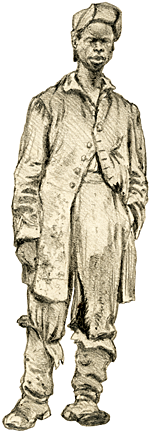
Image: “Dick, sketched on the 6th of May, on return to camp,” by Edwin Forbes. A Union Army cook from 1863. Library of Congress.

“The blockade at last.”
 On July 2, 1861, the U.S. Steamer South Carolina appeared off the bar at Galveston, the first Federal warship to be positioned on the Texas coast since the state declared its secession several months before. South Carolina‘s commander, Captain James Alden, Jr. (right, 1810-77), later summarized the event in three brief sentences in a dispatch to the Secretary of the Navy, Gideon Welles (ORN 16 576):
I have the honor to report that I arrived here on the 2d instant, and immediately hoisted a signal for a pilot for the purpose of communicating with the shore. In a short time a pilot boat came off, bearing a flag of truce and a document, a copy of which is herewith sent. In reply to it I enclosed a copy of your declaration of blockade, with a single remark that I was sent here to enforce it, which I should do to the best of my ability.
Fortunately we have a fuller picture of the events of that day. The war was a new, untested thing — the shocking casualties of First Manassas were still almost three weeks off — and both sides were still feeling each other out. From the Galveston Civilian and Gazette Weekly, July 9, 1861:
The Blockade at Last.
Yesterday forenoon the lookout on Hendley’s buildings ran up the red flag, signalizing war vessels, with the token for one sail and one steamer beneath, bringing groups of curious observers to the observatories with which Galveston is so well provided. In due time the dark hull of a large steam propeller loomed up above the waters, followed by a “low, black” but by no means “rakish looking schooner,” and approached the anchorage outside the bar.
By order of Capt. Moore, of the Confederate States Army, Capt. Thomas Chubb, with the pilot boar Royal Yacht, with our fellow citizen John S. Sydnor, proceeded to board the steamer, which proved to be the South Carolina, formerly in the New York and Savannah trade, but now converted into a war vessel.
The Royal Yacht, in answer to the pilot signal of the steamer, hoisted a flag; but the steamer evidently intended to force them to board the schooner; but this was not the intention. Capt. Chubb, on seeing the jack was down, put about for the city, being at the same time out of range, when the steamer hoisted a white flag. The Yacht then sent a boar alongside, bearing Col. Sydnor and Capt. Chubb. They were received with due ceremony and marked politeness. Col. Sydnor having delivered Capt. Moore’s letter, Capt., Alden gave him written notice of the blockade. A conversation of about an hour ensured, during which Capt. Alden was assured of the entire unity of our people in reference to resisting the oppression of the North. Capt. Alden expressed great regret that matters had reached such a pass, but said he was here to do his duty to his government, and that the intention was to enforce obedience to it. He gave no assurances as to the means which would be adopted to carry out his intentions as far as we are concerned.
The hatchways being closed and guns all covered, it was impossible to form any exact conclusions as to the strength of the steamer. She has six large guns, evidently 42 pounders, one large swivel near her bow, and at her stern two brass 6-pounders, all ready mounted for use as flying artillery. But a few men appeared on deck, and the only clue furnished as to her complement was in her clothing hanging up today. Capt. Chubb thinks there are about 150 on board.
Capt. Alden expressed the belief that his Government would soon be able to bring the Southern States into subjection, and, on being told that all classes of our people would suffer extermination first, seemed much surprised. He seemed disposed to converse freely in relation to our troubles, and received the plain talk and patriotic response on our two citizens on good humor. He said he was able to enforce the demands of his Government, and, if necessary, shell us out. He was assured that, whenever it came to that, we would give him a warm reception.
There was one feature in this affair worthy of note. Col. Sydnor is a native of the South, while Capt. Chubb was raised in the same town (Charleston, Mass.) with Capt. Alden. He was thus able to hear from his lips the unmistakable evidences that all our citizens of Southern, Northern, as well as foreign origin, are determined to fight to the last sooner than submit to the detestable rule of Lincoln.
The following is the reply of Capt. Alden to Capt. Moore’s note:
U.S. Steamer South Carolina
Off Galveston, July 2, 1861Capt. John O. Moore, C.S.A., & c.:
In answer to your communication of this date, I take the liberty of enclosing a declaration of blockade, which I am sent here to enforce, and amRespectfully your obedient servant,
James Alden, Com’r U.S. Steamer South Carolina____________
Declaration of Blockade
To all whom it may concern:
I, William Mervine, flag officer, commanding the United States naval forces comprising the Gulf squadron, give notice that, by virtue of the authority and power in me vested, and in pursuance of the proclamation of His Excellency the President of the United States, promulgated under date of April 19 and 27, 1861, respectively, that an effective blockade of the port of Galveston, Texas has been established, and will be rigidly enforced and maintained against all vessels (public armed vessels of foreign powers alone excepted) which attempt to enter or depart from said port.
Signed, William Mervine,
Flag Officer U.S. Flag Ship Mississippi, June 9, 1861.
I certify that the above is a true copy, James Alden, Com’r U.S. Navy.Neutral vessels will be allowed fifteen days to depart, from this date, viz., June [sic.] 2, 1861.
James Alden, Com’g.


The Hendley Buildings on Strand Street, Galveston, in the 1870s and in 2011. As one of the tallest commercial buildings in town at the time of the Civil War, the Hendley Buildings (or Hendley’s Row) were a natural lookout point for observers watching both the Gulf of Mexico and Galveston Bay. A red flag flown from this building on July 2, 1861 announced the much-anticipated arrival of the Federal blockade. Upper image: Rosenberg Library.
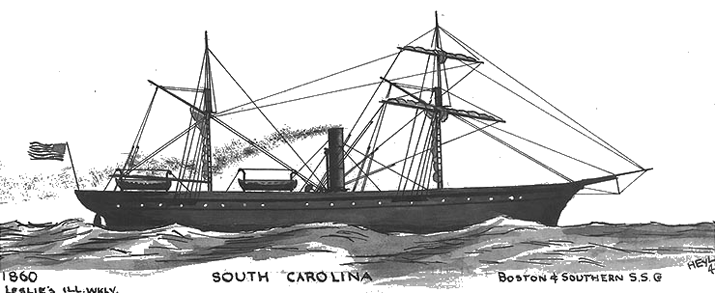
U.S.S. South Carolina, as drawn in 1948 by Eric Heyl. Via U.S. Naval Historical Center. South Carolina was built as a civilian packet steamer to operate on the Atlantic seaboard between Savannah, Charleston, Norfolk and Boston. She was iron-hulled, 217 feet long, 1,165 tons burthen. She served in the Gulf Blockading Squadron in 1861 and 1862, and spent the balance of the war with the South Atlantic Blockading Squadron. Sold out of the Navy after the end of hostilities, she became the civilian steamer Juanita in 1886. Her hull survived until 1902 when, as a barge, she foundered in a blizzard.
Additional details of the meeting between Alden, Chubb and Sydnor appeared in the New York Herald Tribune of July 31 quoting another Galveston paper:
In the course of the conversation, Capt. Alden expressed a desire to receive friendly visits from our citizens, and stated that he should especially be glad to have a visit from Gen. Houston. Col. Sydnor informed him, in reply, that though Gen. Houston had been a devoted Union man to the last, yet that now he had declared that he could no longer support the Stars and Stripes, but would fight to the last for the flag of the Confederate States. Capt. A. expressed his surprise and regret at this, and that his Government has no friends in Texas. But he said, nevertheless, he desired a friendly intercourse with our city, and hoped he might be hospitably received should he make us a visit.
Col. S. replied that he could not promise what kind of reception our authorities would give him. Capt. Alden inquired if there was not plenty of fish along our shore; he had heard there was, and he desired to catch some. He was informed that they were abundant along the beach, but that it might not be altogether prudent for his men to approach to near. Much of the conversation was in a jocular vein.

 For all the strained humor about Alden’s interest in catching “fish,” both sides were in deadly earnest. Alden and South Carolina‘s crew wasted no time, celebrating the Fourth of July by capturing six small schooners, Shark, Venus, Ann Ryan, McCanfield, Louisa, and Dart. After providing his unwilling guests a large dinner in honor of the date, he sent them into Galveston under a flag of truce on Venus, McCanfield and Louisa, after judging those vessels worthless as prizes. The others Alden retained in hopes of fitting them with armament and using them for work in shallow water, close inshore.
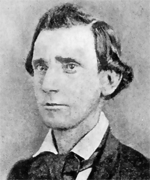
One of the freed passengers, curiously enough, was John A. Wharton (right, 1828-65), who would later command the 8th Texas Cavalry, Terry’s Rangers, and eventually rise to the rank of Major General in the Trans-Mississippi Department. According to the Herald Tribune, Wharton was allowed to keep his personal valise, but the military goods he was coming back to Texas with — two boxes of arms purchased for Brazoria County, ten gross of military buttons, cloth for military uniforms “and a six-shooter” — were all seized by Alden’s men as contraband.
But these initial moves were still just a prelude; a few weeks later, Captain Alden and South Carolina would open the war for real along the Texas coast.
______________





 Dead Confederates, A Civil War Era Blog

18 comments