Canister!
As a frequent Amazon customer, I get regular recommendations for books on subjects they think I might be interested in. Here’s the recommendation list I got last week:


I really cannot deny that those topics are of interest to me. Also this week I got a statement from the publisher on the steamboat book, that it’s crossed the threshold for generating royalties. Given the very narrow subject matter, I’m glad it’s officially in the black.
I also have three more speaking engagements lined up for the next few months, on Buffalo Bayou steamboats in Galveston on June 23 and in Liberty on July 15, and at the Brazoria County Historical Museum on October 17 for Texas Archaeology Month. Scheduling details to follow soon.
In other news, some of it CW-related and some not:
- Al Mackey has been doing a bang-up job at his blog, systematically knocking down cherished Southron myths about Fort Sumter. He’s cheating, of course, by using the contemporaneous words and actions of the participants themselves; he hasn’t cited Tom DiLorenzo once.
- Confirmed: Written accounts of cannibalism at Jamestown during the “starving winter” of 1609-10, thought by some modern scholars to be exaggerations, are now supported by archaeological evidence.
- David Rumsey is probably the world’s foremost private collector of historic maps. More important, he’s long been committed to sharing those with a wider audience through the Internet. A few of them can even be viewed here, overlaid in Google Maps. Even more gooder, Rumsey recently added more than 38,000 (!) items from his collection to the new Digital Public Library of America. There goes your afternoon.
- Along those same lines, blogger Brian Schrock hosts the Google Earth Time Machine, using that application’s historical imagery to track changes in human and natural geography over time. Schrock is originally from Houston, so Texas locations feature prominently in his posts.
- Corey Meyer continues to highlight the Southern nationalist movement’s recent infatuation with stickers. My own observation is that the compulsion to cover every flat surface with stickers is transitory, peaking at about age four or five. So maybe Cushman will start posting about his Barbies® soon. That’ll be fun.
- Art conservators at the Vatican believe they’ve discovered the oldest European depiction of Native Americans, dating to 1494. That’s cool.
- Over at Defending the Heritage, Robert Mestas takes the case of two Union sailors killed aboard U.S.S. Hatteras to argue that the men, both immigrants, “probably had no idea who they were fighting or what they were fighting for.” Neither Mestas nor anyone else has any idea what these individuals thought or believed, of course, but then consider the source — Mestas makes up fake quotes from Confederate veterans, too. Don’t get me wrong, I’m glad he follows my blog, I just wish he were a little more candid with his own readers about his sources when his lifts pictures from from it.
- A relatively new blog, The Freedmen’s Patrol, has been digging down into the weeds of secession and slavery since it debuted a few months back. I’ll have more to say later, but there’s some real education happening over there, and the blog deserves more attention. For now, check out the posts on some Americans’ fixation on taking over Cuba as an annexed slave territory, as outlined here, here and here. American designs on Cuba didn’t start when the battleship Maine went boom.
- Harper Lee, arguably the greatest living Southern writer, is suing the son-in-law of her former agent to recover the copyright to her 1961 Pulitzer Prize-winning novel, To Kill a Mockingbird.

Got any more? Put ’em in the comments below.
___________

Just Makin’ Stuff Up
This is (at least) the fourth time Gary’s posted this nonsense:
That’s not even remotely true; Hanger, Inc. dropped a not-insignificant amount of money a couple of years back on making this video (above). The company not only developed a webpage about its origins, they created a separate Internet domain for it, Hanger150.com. You go to main company website, click on “About Us,” then on “Hanger’s History.” Two clicks, that’s all. Hell, James Edward Hanger’s biography on the site begins with the sentence, “On June 1, 1861, 18-year-old engineering student James Edward Hanger left his family, forgoing his studies at Washington College. . . to join his brothers in the Confederate Army.”
Have any of the nearly 2,000 True Southrons™ over there ever nudged Gary on this foolishness? Not as far as I can tell. But then, it’s heritage: it doesn’t matter if it’s true, so long as it reaffirms your oppression under the boot heel of political correctness.
__________
Update, May 5: Gary clears up the confusion, while complaining about “bloggers who likes to fact check posts here and straigten [sic.] the wrongs of the world.” As usual, the true villain here is not the person who repeatedly posted something demonstrably untrue, but the person who publicly called him on it. Good times.
__________
Articles on U.S.S. Hatteras, U.S.S. Clifton
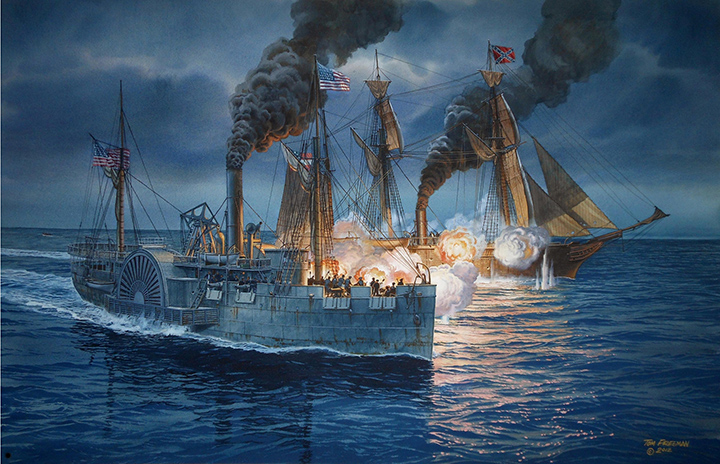
The new issue of the Texas Historical Commission’s newsletter, The Medallion, has articles on last fall’s expedition to the U.S.S. Hatteras wreck site (pp. 10-11), and the return of the restored “walking beam” from U.S.S. Clifton to the Battle of Sabine Pass site. The Hatteras article can be downloaded here (PDF).
Enjoy, y’all.
___________
Image: “The Fatal Chase” by Tom Freeman. Copyright © Tom Freeman 2012, all rights reserved. Used with permission.
Call for Historical Marker to Recognize Slave Labor

My friend and colleague Jim Schmidt had a great guest column in Saturday’s Galveston County Daily News:
150 Years Ago: Isle Needs marker to Honor Civil War Slaves
By JAMES M. SCHMIDT
The New Year’s Day 1863 Battle of Galveston was undoubtedly the zenith of the island’s Civil War story, but it was by no means the end.More than two years of fighting remained and in many ways they were the worst of the war for those who remained on the island: soldiers, the few remaining citizens, and hundreds of enslaved African-Americans, who worked — and died — building fortifications. That slaves did the lion’s share of the work in constructing the Galveston defenses was nothing new: slaves had actually built fortifications in the early days of Galveston during the Texas Revolution. The first call for slave labor on behalf of the Confederate forces in Galveston may have been as early as November 1861, when Gen. Paul Hebert authorized an aide on his staff to induce local planters “to assist in the erection of fortifications for the defense of the coast, in loaning their Negroes (sic) for that purpose.” Likewise, in April 1862, Gen. William R. Scurry declared that “it is absolutely necessary that every preparation for defense should be made to protect Texas from invasion. … In a short time, with Negroes to work on the fortifications, the Island can be made impregnable, and the State saved from the pol(l) uting tread of armed abolitionists.” To that end he called on planters in 20 counties to “send at once one-fourth of their male Negro population … with spades and shovels … to report to Galveston.” It was after the Battle of Galveston, though, that the work began in earnest. Indeed, only days later, a Confederate soldier wrote his wife that he expected that his unit would be permanently located in Galveston, and added with just confidence, “unless the Federals whip us out, which they are not likely to do.” His work was now devoted to securing the recaptured island, and he added: “In a few days we will have this place well-fortified. There are several hundred Negroes here at work building new fortifications and repairing those already built.” In April 1863, Col. Valery Sulakowski, the supervising engineer, reported that more than 600 enslaved African-Americans were engaged at the saw mills — carrying sod, timber and iron — and cooking or working on harbor and gulf defenses. The officer called for hundreds more, but getting additional slave labor was no easy task: Texas planters routinely volunteered insufficient numbers of their slaves to the periodic calls. It is no wonder they were reluctant: archival hospital records show that many slaves died from disease, exhaustion or injuries suffered while constructing the Galveston defenses. The slaves themselves did not leave a record of their toil, but the work left at least one young girl without a father. In a 1930s interview, Philles Thomas, born into slavery in Texas, explained, “I can’t ’member my daddy, but mammy told me him am sent to de ‘Federate Army an am kilt in Galveston.” Perhaps the time has come to install a historical marker to commemorate the slaves who labored — and died — on the island during the Civil War.
_______
James M. Schmidt is a research scientist with a biotech firm in The Woodlands. He is a contributor, editor or author of five books on the Civil War, including, most recently, Galveston and the Civil War: An Island City in the Maelstrom, The History Press, 2012.
___________
Image: Impressed slaves building fortifications at James Island, South Carolina. Schomburg Center for Research in Black Culture, New York Public Library.
Thank You, Burton!

I got to spend Saturday at the Burton Cotton Gin Festival, one of the big dates on the local calendar there. Although I’d visited the museum there many times, this was the first occasion to be there for the festival. Nothing says small-town Texas like hearing a polka cover of Hank Williams’ “Take These Chains from My Heart” by the Shiner, Texas Hobo Band (above). I missed the cotton ginning-and-baling demonstration — the gin’s 16-ton, 1925 Bessemer Type IV diesel oil engine, “Lady B,” is reportedly the largest internal combustion engine of its vintage still operating in the United States — but in all it was great fun!

As someone who’s spent a long time around small, local history museums, I must say I was genuinely impressed by the size of the event. There are only 350 people living in Burton, and I’m pretty sure at least half of them were volunteering at the event. Kudos to the Burton Cotton Gin Museum, its staff and volunteers, and the community, for putting on such an impressive event.
___________
Norris White, Black Confederate “Brothers” and the “Flipside” to Glory
A while back, Kevin highlighted a news item on Norris White, Jr., a graduate student at Stephen F. Austin State University who was making the rounds last year, doing presentations and generally talking up the subject of African American soldiers in the Confederate army. Norris White seems to be serious and well-intentioned, and (thankfully) he’s no stream-of-consciousness performance artist like Edgerton. But being sincere is not the same thing as being right. For all his insistence that he’s using primary sources, White’s interviews seem to be little more than reiterating black Confederate rhetoric that the SCV has been asserting for years. While he insists on the importance of primary source materials — “100 percent irrefutable evidence — letters, diaries, pension applications, photographs, newspaper accounts, county commission records and other evidence” — there’s little indication that he’s looked carefully at the materials, or understands them in the larger context of the war and the decades that followed. It’s very shallow stuff he’s doing, hand-waving at a pile of reunion photographs, pension records and loose anecdotes and saying, “see? Black Confederates!” Anyone can do that, and plenty of people do.
It says a lot about the depth of his research that in interviews, White has repeatedly singled out two Texas Historical Commission markers as evidence of his much larger claims about “Black Texans who served in the Confederate Army.” These markers, one to Randolph Vesey (Wise County) and the the other to Primus Kelly (Grimes County), are worth closer examination for what they say, and what they don’t. I obtained copies of the historical marker files for both markers, that you can dowload here (Vesey) and here (Kelly). Both men, as was usual at the time the markers were set up, were explicitly and effusively lauded for their loyalty and sacrifice not to the Confederacy but as (in the case of Kelly), “a faithful Negro slave,” right there in the very first line of the marker.
The files are thin — the THC was less diligent about documentation in past decades than they are now — but neither file contains any contemporary documentation of its subject at all. Both amount to a recording of local oral tradition, which is vivid not though always reliable. Both accounts make it explicitly clear that the two men went to war as personal servants, Vesey to General William Lewis Cabell, and Kelly to the West brothers, troopers in the Eighth Texas Cavalry. But it’s very thin stuff to spin into a claim that “the number of black Texans who participated in the Confederate Army in the War Between the States may have been as high as 50,000,” which would be a figure substantially higher than the entire male slave population of Texas between ages 15 and 50 in 1860, which was a bit under 44,000. Claims like that on White’s part seriously undermine his credibility.
Vesey’s and Kelly’s stories, as reflected in the marker files, are well worth reading, and telling. In Vesey’s case, his wartime experiences with General Cabell probably paled in comparison with his being captured by Indians a few years later and being held prisoner for three months, until his release was secured by one of the legendary characters of the Texas frontier during that time, Britt Johnson.

Primus Kelly’s marker file, though, is much more interesting from the perspective of the advocacy for black Confederates, because included in the file is a 1990 article by Jeff Carroll on Vesey from Confederate Veteran magazine, the official publication of the SCV. The magazine article is a reprint of an article that first appeared in the Midlothian, Texas Mirror on May 31, 1990. Kevin has often suggested that the Confederate Heritage™ groups’ push to find black Confederates in the 1990s was, in part, a reaction to the success of the film Glory (1989), and its depiction of both African American Union soldiers. In light of that, it’s significant that Carroll’s article was originally published just six weeks after Denzel Washington won an Oscar for his role as Private Trip in that film, and moreover, was explicitly framed by its author as the “flipside” to that work:
There’s no indication that Carroll referenced any materials on Kelly other than the text of the marker itself, but he embellishes that text with all sorts of assertions that are completely unsupported. Take, for example, this passage from the marker:
In Carroll’s retelling, this becomes:
There’s a world of difference between “West sent Kelly” and “Primus refused to stay at home,” but it’s entirely typical of the way advocates like Carroll depict African American men’s involvement with the Confederate army; it’s always shown as voluntary choice, motivated by noble intent, never out of legal obligation or against their wishes.
The is no evidence in the historical marker files of Kelly’s relationship with the West sons, much less the suggestion that they were “constant companions.” Carroll begins his essay by making the generalized claim that “custom often dictated that the sons of a slave owner received as their own property and slaves of their own age when they’ were children. They were daily and inseparable companions who shared the experience of growing up and became surrogate brothers,” and then paints that assertion right across Primus Kelly. He characterizes Kelly’s relationship with the Wests as that of “brothers” three more times in five short paragraphs, based (as far as I can tell) on no evidence whatsoever. We’ve seen claims like these made falsely before.
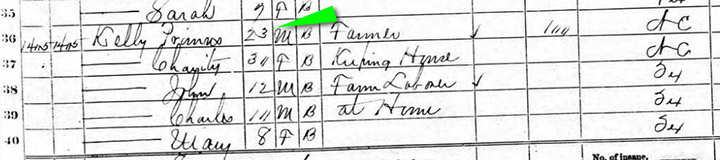
It’s also highly unlikely that Primus Kelly would have been an “inseparable companion” to any of the West brothers, given the difference in their ages. According to the 1870 U.S. Census (above), Primus Kelly was born about 1847, making him much younger than Robert (age 22 upon enlistment in 1861, giving him a birthdate of c. 1839), John (age 27 upon enlistment in 1861, birthdate c. 1834), or Richard (age 32 upon discharge in January 1863, birthdate c. 1831). Primus Kelly was about eight years younger than the youngest of the Wests, and in fact was barely into his teens when he accompanied the Wests off to war. He was not a childhood companion of any of these men, and the three brothers were living at Lynchburg in Harris County — almost 100 miles away from their father in Grimes County — at the time of the 1860 census.
Carroll’s description of the Wests is somewhat misleading, as well. According to the marker, Richard was reportedly wounded twice in battle and escorted all the way back to Texas by Kelly. Carroll repeats this claim, without question. But if this happened, neither wound is recorded in his compiled service record at NARA. What is recorded is that Richard was given a medical discharge for chronic illness not related to combat injuries in January 1863, nine months after enlisting. It seems very unlikely that during those nine months, Richard West would have been twice wounded so severely that he required an extended convalescence back home in Texas, and made the round journey twice, without there being a record of it in his file.
The three brothers did not enlist together, as Carroll suggests; Robert and John, ages 22 and 27 respectively, enlisted in September 1861, when the regiment was first being organized, while their older brother Richard, age 31 or 32, didn’t join the regiment until May of 1862. Carroll cites Chickamauga (September 1863) and Knoxville (November/December 1863) as fights in which Terry’s Rangers participated, but only Robert might have been present, as he was taken prisoner sometime during the latter part of 1863. Richard was medically discharged, and John was dead. Robert died in April 1905, his obituary appearing in the Confederate Veteran magazine in July of that year.
Kelly is said to have followed the Wests into action, “firing his own musket and cap and ball pistol.” There are many such anecdotes from the war, and they may well be true in Kelly’s case. There is a report in the OR (Series I, Vol. XVI, Part 1, p. 805) by a Union officer from the Battle of Murfreesboro, July 1862, that “The forces attacking my camp were the First [sic., Eighth] Regiment Texas Rangers, Colonel Wharton, and a battalion of the First Georgia Rangers. . . . There were also quite a number of negroes [sic.] attached to the Texas and Georgia troops, who were armed and equipped, and took part in the several engagements with my forces during the day.” But if this is one of the events that Kelly participated in, it underscores the argument that those men were camp servants following their troopers into action, rather than troopers in their own right.
Did Carroll set out to fictionalize Primus Kelly’s story? I don’t know, but to all intents and purposes that was the result. The end product is as much happy fantasy as fact. And even then, it wouldn’t matter so much were it not that other authors have gone on to cite Carroll, including Kelly Barrow’s Black Confederate. In fact, the article is a mess, in which even knowable, factual information is misrepresented. Under the circumstances, I actually think there is one other thing that this article could appropriately borrow from Glory, and it comes right at the very, very end of the movie:
This story is based upon actual events and persons.
However, some of the characters and incidents portrayed
and the names herein are fictitious, and any similarity
to the name, character, history of any person,
living or dead, or any actual event is entirely
coincidental and unintentional.

Like so much else that’s been written about black Confederates in the last 23 years, Jeff Carroll’s article takes a kernel of fact, churns it in a bucket with inaccurate or flat-out-false information and untethered speculation, to create a warm-and-fuzzy story that reassures the Confederate Heritage™ crowd that it was all good, and there’s nothing particularly troubling or complex about any of it — because, you know, they were like brothers. The thing that’s notable about it is that (1) it’s undoubtedly one of the earliest of its type, (2) it’s offered explicitly as a corrective to the narrative presented in Glory, and (3) it so fully expresses the modern talking points that define the push to relabel men who used to be called (as in Kelly’s case) “a faithful Negro slave,” into something far more palatable for modern audiences.
I understand why people want to believe this happy nonsense; it takes a raw, ugly edge off a time and place they have chosen to embrace tightly. What I don’t understand is how someone like Norris White would fall for it. Unlike most of the folks who peddle this stuff, White presumably has the academic background and the research skills to dig into the weeds of this stuff, and understand what the sources actually say. (A good place to start is acknowledging that an historical marker by the side of the highway is not a primary source.) He has the skills and resources to say something new, but instead repeats the same half-truths that have been circulating for decades.
Please, Mr. White, tell Randolph Vesey’s story, and Primus Kelly’s. But tell them fully and completely. Any damn fool can read off the text of a roadside marker and pretend that’s research. You’re better than that, Mr. White, so show us.
____________
Update:
Federal Court: State Acted Within Authority on SCV Plates
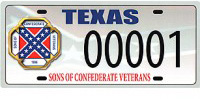 I was sure wrong about that one. While I thought the case would turn on the Equal Protection Clause (because the state issues specialty plates to everyone and their dog already), and thus go in the SCV’s favor, the court rejected that notion, in part because the SCV has recourse to other avenues (such as direct action by the Lege) to get that accomplished:

As it happens, the Lege is in session in Austin right now, so there’ s six weeks left to get some action on this, if the Texas SCV chooses to go that route.
I also thought this, from the ruling, was interesting:
This encapsulates what I was trying to get at when I wrote this post. Whether the SCV thinks that the Buffalo Soldiers “should” be viewed as offensive to Native Americans as the CBF is to some others, the evidence that that’s the case just isn’t there. It was a weak argument to begin with, and while I’m surprised at the court’s decision, I’m glad they saw that part of it the same way.
Still, it’s a surprising outcome I didn’t expect. On to the Fifth Circuit in New Orleans!
_____________
H/t Kevin.
VMFA Trespass Case (Mostly) Resolved
Tripp Lewis’ trespassing case at the VMFA appears to have been mostly resolved last week, with prosecutors and the VMFA reportedly agreeing to dismiss the case in exchange for community service and a few restrictions on Lewis’ future protesting activities. The agreement will become final in August. This seems to be a very good resolution for all concerned. Then there’s this:
We’ll see what happens, although I don’t see either of those claims getting much traction in a courtroom. “Violations,” really? Not in the video I saw. Regardless, the dispute over the VMFA always belonged in civil court, if they chose to go that route, in the first place.
On the other hand, Confederate activist/beard H. K. Edgerton recently announced plans team up with the odious Kirk Lyons to sue the U.S. government “over their complicity in the denigration of the Southern Cross.” Mere words cannot express how much I hope he follows through on this.
____________
Aye Candy: C.S.S. Richmond
![[IMG]](https://i0.wp.com/farm9.staticflickr.com/8528/8649710513_85afa8c710_b.jpg)
C.S.S. Richmond was one of the earliest Confederate ironclads, having been laid down at the Gosport Navy Yard at Norfolk, Virginia, in March 1862, immediately after the completion of the famous C.S.S. Virginia (ex-Merrimack). Richmond was designed by John Lucas Porter, who would go on to serve as the Chief Naval Constructor for the Confederacy, but completed under supervision of Chief Carpenter James Meads. Richmond embodied many of the basic design elements that be used, again and again, in other casemate ironclads built across the South in the following three years.
![[IMG]](https://i0.wp.com/farm9.staticflickr.com/8394/8649779153_94ebe92eae_b.jpg)
Richmond (red) along side C.S.S. Virginia, for scale.
When Union forces were on the verge of taking the Gosport Navy Yard, Richmond was hurriedly launched and towed up the James River, where she was completed at Richmond. Finally commissioned in July 1862, the ironclad served as a core element of the Confederate capital’s James River Squadron for the remainder of the war. Richmond, along with the other ironclads in the James, was destroyed to prevent her capture with the fall of her namesake city at the beginning of April 1865.
![[IMG]](https://i0.wp.com/farm9.staticflickr.com/8523/8649709571_a88a04298c_b.jpg)
This model is based on plans of the ironclad by David Meagher, published in John M. Coski’s book, Capital Navy: The Men, Ships and Operations of the James River Squadron, with modifications based on a profile of the ship by CWT user rebelatsea, particularly regarding the position of the ship’s funnel and pilot house. Hull lines are adapted from William E. Geoghagen’s plans for a later Porter design for an ironclad at Wilmington, that seems to have had an identical midship cross-section.
![[IMG]](https://i0.wp.com/farm9.staticflickr.com/8262/8649709355_a8269f760c_b.jpg)

![[IMG]](https://i0.wp.com/farm9.staticflickr.com/8106/8649709825_def971ea71_b.jpg)
![[IMG]](https://i0.wp.com/farm9.staticflickr.com/8522/8649710061_c8628c8415_b.jpg)
![[IMG]](https://i0.wp.com/farm9.staticflickr.com/8385/8649710347_f243898f9a_b.jpg)
![[IMG]](https://i0.wp.com/farm9.staticflickr.com/8528/8650809818_b75b3b888b_b.jpg)
As before, full-resolution images are available on Flickr. And here are two videos from the MoC featuring model builder Ozzie Raines, discussing the challenges of recreating this ship:

___________
Into Action Aboard a Monitor at Charleston

Crew members aboard U.S.S. Nahant, one of the last surviving Civil War monitors, pose on deck for a photograph during the Spanish-American War in 1898. The dents in the turret behind them were put there by Confederate shot off Charleston, thirty-five years before.
 One hundred fifty years ago Sunday afternoon, warships of the Union’s South Atlantic Blockading Squadron steamed into Charleston harbor, intent on pounding Fort Sumter into submission. The U.S. Navy’s commanding officer, Rear Admiral S. F. Du Pont (right), had at his disposal two full divisions of ironclad monitors that, he hoped, would be able to stand up against the Confederate batteries ringing the harbor. But the Confederate fire was too great, most of Du Pont’s ships were seriously damaged in the action. After about ninety minutes’ hard action, the Union fleet withdrew. In his report to the Navy Department, Du Pont described the event as a “failure,” but saw his withdrawal as one that had averted what otherwise would have been a “disaster.”[1]
Since we’ve talked a good bit about Civil War-era monitors here, I’d like to share an account of this action by Alvah Folsom Hunter (1846-1933), a sixteen-year-old ship’s boy aboard one of those monitors, U.S.S. Nahant. Hunter had been in the Navy only a few months, and recorded his experiences aboard Nahant in great detail. An annotated edition of Hunter’s diary was published in 1987, edited Craig Symonds.[2] Most of the drawings that accompany Hunter’s account here are by one of his shipmates aboard Nahant, Assistant Surgeon Charles Ellery Stedman.
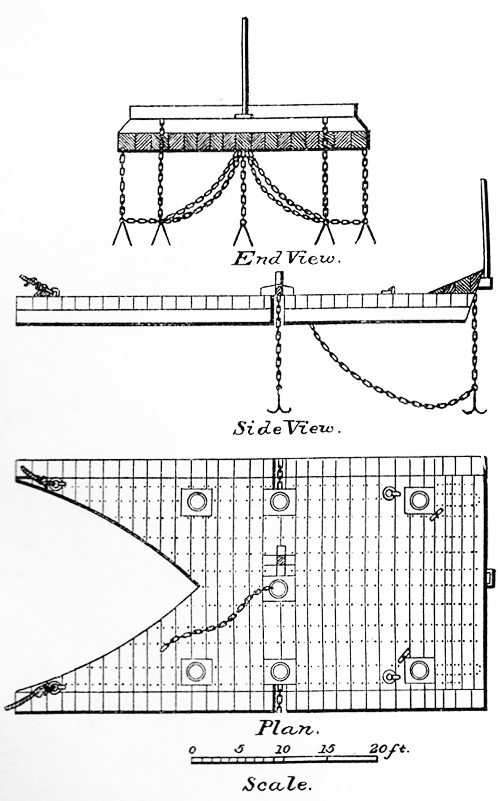 U.S.S. Weehawken’s “devil,” as depicted in the ORN.
 At noon signal was made from the Ironsides (the flagship) to get under way, and then another delay caught us. It had been ordered that the Weehawken should lead the line of monitors, and some over-wise individual had devised an apparatus for lifting or exploding any torpedoes which might be encountered in the advance. The Weehawken was encumbered with this device, which had been well named “a devil.” “It was formed of very heavy timbers crossing at right angles, bolted together, and was about fifty feet in length, shaped not unlike a boot-jack, the bows of the vessel propelling within the notch. The after-ends, or jaws, of the raft were secured by chains to the bows of the vessel”. There were grapnels to catch the torpedoes suspended beneath this cumbersome raft. When the Weehawken was hoisting her anchor, the chain became entangled with these grapnels, and caused over an hour’s delay before the chain was cleared and the anchor hoisted up. Not only that, but the encumbrance upon her bows made the naturally unwieldy monitor still more unwieldy and difficult to steer, and but for the tide having turned and begun to run flood again, it is doubtful if the Weehawken could have steamed up against the current so as to come within range of Fort Sumter. As the Weehawken was the appointed leader of the line, a delay to her held back the entire fleet.
The order of battle was that known as “line ahead,” or, as a soldier would state it, “single file.” The eight monitors were formed into two divisions, with the frigate Ironsides (flagship) between the first and second division. In the first division were the Weehawken, Passaic, Montauk, and Patapsco; in the second the Catskill, Nantucket, Nahant, and Keokuk.
The distance between the vessels was intended to be one hundred yards, but they steered so badly it was quite impossible to keep close to distance. The monitors were extremely heavy, unwieldy vessels, steering badly when conditions were at the best. Being in shallow water increased the difficulty of steering, and when steaming ahead very slowly, the difficulty was still further increased; the clumsy vessels were here pretty nearly unmanageable.
When the signal to get underway was made, our crew was called to quarters, and those of us who were stationed on the berth deck, where we could hear little and see nothing, found the long wait very trying to our nerves. We knew that the engine was frequently started and then stopped again, and supposed the starting and stopping were but incidents of getting the vessels into line formation, but why the long, long delay in opening fire, we did not know. It was nearly three hours after the call to quarters that we began faintly to hear the boom of the guns of some of the vessels, and it was ten minutes past three o’clock when our two guns were fired in quick succession.
The relief we all felt when at last our guns spoke out was very great, and we gladly hastened to such duties as came to us. Passing on to the door of the magazine the call for cartridges and shells, seeing these brought to and passed through the door to the turret chamber, shaking the inverted cartridge tub over the tub of water, and then returning it to the door of the magazine, didn’t call for furious activity on our part, but, it was something to do, and a great relief to our strained nerves.
At noon signal was made from the Ironsides (the flagship) to get under way, and then another delay caught us. It had been ordered that the Weehawken should lead the line of monitors, and some over-wise individual had devised an apparatus for lifting or exploding any torpedoes which might be encountered in the advance. The Weehawken was encumbered with this device, which had been well named “a devil.” “It was formed of very heavy timbers crossing at right angles, bolted together, and was about fifty feet in length, shaped not unlike a boot-jack, the bows of the vessel propelling within the notch. The after-ends, or jaws, of the raft were secured by chains to the bows of the vessel”. There were grapnels to catch the torpedoes suspended beneath this cumbersome raft. When the Weehawken was hoisting her anchor, the chain became entangled with these grapnels, and caused over an hour’s delay before the chain was cleared and the anchor hoisted up. Not only that, but the encumbrance upon her bows made the naturally unwieldy monitor still more unwieldy and difficult to steer, and but for the tide having turned and begun to run flood again, it is doubtful if the Weehawken could have steamed up against the current so as to come within range of Fort Sumter. As the Weehawken was the appointed leader of the line, a delay to her held back the entire fleet.
The order of battle was that known as “line ahead,” or, as a soldier would state it, “single file.” The eight monitors were formed into two divisions, with the frigate Ironsides (flagship) between the first and second division. In the first division were the Weehawken, Passaic, Montauk, and Patapsco; in the second the Catskill, Nantucket, Nahant, and Keokuk.
The distance between the vessels was intended to be one hundred yards, but they steered so badly it was quite impossible to keep close to distance. The monitors were extremely heavy, unwieldy vessels, steering badly when conditions were at the best. Being in shallow water increased the difficulty of steering, and when steaming ahead very slowly, the difficulty was still further increased; the clumsy vessels were here pretty nearly unmanageable.
When the signal to get underway was made, our crew was called to quarters, and those of us who were stationed on the berth deck, where we could hear little and see nothing, found the long wait very trying to our nerves. We knew that the engine was frequently started and then stopped again, and supposed the starting and stopping were but incidents of getting the vessels into line formation, but why the long, long delay in opening fire, we did not know. It was nearly three hours after the call to quarters that we began faintly to hear the boom of the guns of some of the vessels, and it was ten minutes past three o’clock when our two guns were fired in quick succession.
The relief we all felt when at last our guns spoke out was very great, and we gladly hastened to such duties as came to us. Passing on to the door of the magazine the call for cartridges and shells, seeing these brought to and passed through the door to the turret chamber, shaking the inverted cartridge tub over the tub of water, and then returning it to the door of the magazine, didn’t call for furious activity on our part, but, it was something to do, and a great relief to our strained nerves.
 Handling ammunition in the compartment below the turret, by Nahant’s Ship’s Surgeon, C. E. Stedman.
The leading division had come into action about three o’clock, and soon after that the Admiral, finding the Ironsides pretty nearly unmanageable in the shallow water and having had to anchor, ordered the signal: “Disregard the movements of the flagship” to be hoisted. This signal at once set free the vessels in the second division and they steamed past the flagship into close action. The Nahant was probably the fastest of the single-turreted monitors, and the Keokuk, next her in line, was even faster. These two vessels, the last in the line, steamed ahead at full speed and were quickly in the thickest of the fight.
“Four bells” sounding on the gong in the engine room, which ordered the engineer to go ahead at full speed, was distinctly heard by us on the berth deck, and in a few minutes cannon shot began to strike the Nahant. At first the hits were few and scattering, but, as we drew nearer to Sumter, they were more frequent. Captain Downes stated that we went up to within five-hundred yards of Sumter, nearer to that fort than any other vessel, and the shots came down upon us in an irregular staccato. There was about twenty-five minutes’ time when we were struck on an average about once a minute.
Handling ammunition in the compartment below the turret, by Nahant’s Ship’s Surgeon, C. E. Stedman.
The leading division had come into action about three o’clock, and soon after that the Admiral, finding the Ironsides pretty nearly unmanageable in the shallow water and having had to anchor, ordered the signal: “Disregard the movements of the flagship” to be hoisted. This signal at once set free the vessels in the second division and they steamed past the flagship into close action. The Nahant was probably the fastest of the single-turreted monitors, and the Keokuk, next her in line, was even faster. These two vessels, the last in the line, steamed ahead at full speed and were quickly in the thickest of the fight.
“Four bells” sounding on the gong in the engine room, which ordered the engineer to go ahead at full speed, was distinctly heard by us on the berth deck, and in a few minutes cannon shot began to strike the Nahant. At first the hits were few and scattering, but, as we drew nearer to Sumter, they were more frequent. Captain Downes stated that we went up to within five-hundred yards of Sumter, nearer to that fort than any other vessel, and the shots came down upon us in an irregular staccato. There was about twenty-five minutes’ time when we were struck on an average about once a minute.
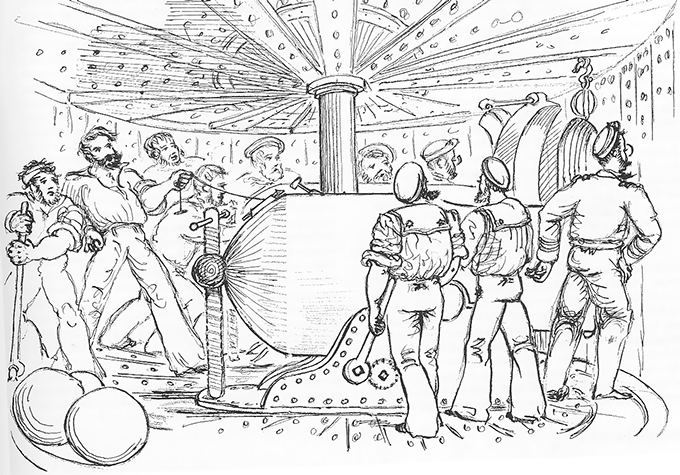 Stedman’s drawing of Nahant’s turret in action. Stedman omits much of the internal bracing used in the turret, but captures the action well.
One of the heavy shot struck our turret fairly, about two feet above the deck and just over the heads of the three of us boys who were standing near the turret-chamber door, and so tremendous was the impact, we all three instinctively ducked our heads. The solid shot was smashed and we clearly heard the pieces rattling down upon the deck above our heads.
While we were coming into close action, our guns were kept as busy as the difficulty of loading and firing them permitted. Both guns were fired seven times each, and a little later the XI-inch gun was brought to bear upon one of the forts and fired for the eighth time, making fifteen shots in all fired by the Nahant.
Stedman’s drawing of Nahant’s turret in action. Stedman omits much of the internal bracing used in the turret, but captures the action well.
One of the heavy shot struck our turret fairly, about two feet above the deck and just over the heads of the three of us boys who were standing near the turret-chamber door, and so tremendous was the impact, we all three instinctively ducked our heads. The solid shot was smashed and we clearly heard the pieces rattling down upon the deck above our heads.
While we were coming into close action, our guns were kept as busy as the difficulty of loading and firing them permitted. Both guns were fired seven times each, and a little later the XI-inch gun was brought to bear upon one of the forts and fired for the eighth time, making fifteen shots in all fired by the Nahant.
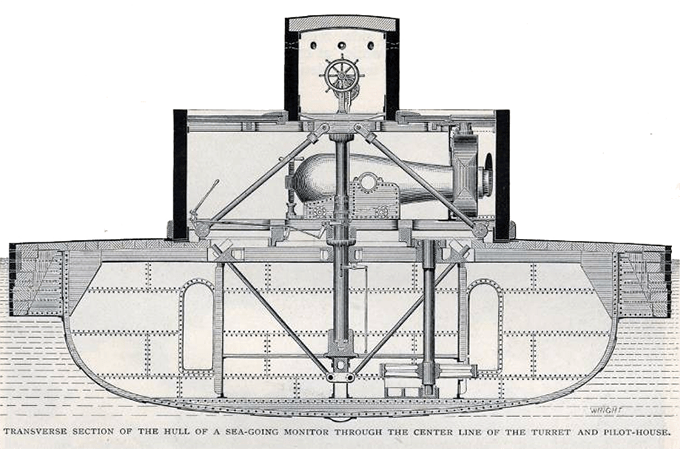 Cross-section through the hull, turret and pilothouse of a Civil War monitor similar to U.S.S. Nahant.
Just after we came under the terrific fire which rained down upon us, three heavy shots struck the pilot-house in quick succession. [Unlike the original Monitor, the pilot-house on Passaic Class ships was located atop the turret for maximum all-around visibility.] One of these shots struck just at the base of the pilot-house, where a massive iron ring, some four inches deep by a foot wide, rested upon the top of the turret. This ring was put there as a safeguard, to prevent a shot which might strike there from penetrating at the angle formed by the base of the wall of the pilot-house and top of the turret. The metal of this iron ring was bulged outward and upward, and the inch-thick plates of the pilot-house were bulged outward and downward around the deep dent made by the shot. The result was that the turret and pilot-house were tightly welded together; the turret was “jammed” and could not be revolved.
At almost the same instant, a shot struck the pilot-house close beside one of the peepholes which were cut through the walls to give those on duty inside some view of matters outside. The bolts which held the inch-thick plates together were countersunk into the plates on the outside, the nuts being on the inside. Heavy curtains made of two thicknesses of canvas with hair quilted in between hung around the inside of both turret and pilot-house to prevent the heavy nuts on these bolts from flying if the bolts were struck by a shot, but in the pilothouse there had to be holes cut through this curtain where it covered the peepholes. The shot which struck close beside a peephole struck squarely on one of the bolts, the bolt broke off close by the nut inside, the nut and bolt-end being driven across the inside of the pilot-house with the velocity of a solid shot.
Cross-section through the hull, turret and pilothouse of a Civil War monitor similar to U.S.S. Nahant.
Just after we came under the terrific fire which rained down upon us, three heavy shots struck the pilot-house in quick succession. [Unlike the original Monitor, the pilot-house on Passaic Class ships was located atop the turret for maximum all-around visibility.] One of these shots struck just at the base of the pilot-house, where a massive iron ring, some four inches deep by a foot wide, rested upon the top of the turret. This ring was put there as a safeguard, to prevent a shot which might strike there from penetrating at the angle formed by the base of the wall of the pilot-house and top of the turret. The metal of this iron ring was bulged outward and upward, and the inch-thick plates of the pilot-house were bulged outward and downward around the deep dent made by the shot. The result was that the turret and pilot-house were tightly welded together; the turret was “jammed” and could not be revolved.
At almost the same instant, a shot struck the pilot-house close beside one of the peepholes which were cut through the walls to give those on duty inside some view of matters outside. The bolts which held the inch-thick plates together were countersunk into the plates on the outside, the nuts being on the inside. Heavy curtains made of two thicknesses of canvas with hair quilted in between hung around the inside of both turret and pilot-house to prevent the heavy nuts on these bolts from flying if the bolts were struck by a shot, but in the pilothouse there had to be holes cut through this curtain where it covered the peepholes. The shot which struck close beside a peephole struck squarely on one of the bolts, the bolt broke off close by the nut inside, the nut and bolt-end being driven across the inside of the pilot-house with the velocity of a solid shot.
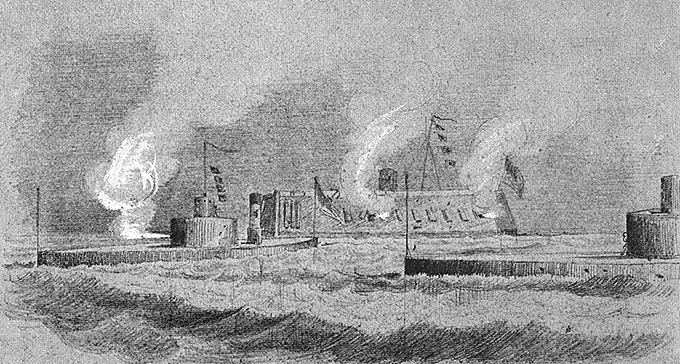 Stedman’s depiction of the action off Fort Sumter in April 1863, with (l. to r.) Nantucket, New Ironsides and Nahant. Stedman, as was his pratice at the time, gave the first and last of these vessels the fictional names of “Otternel” and Semantecook” in the caption of his drawing.
Quartermaster [Edward] Cobb was at the wheel, Pilot [Isaac] Sofield stood a little behind him and was stooping over a bit to observe what could be seen through a peephole on the other side, and Captain Downes was standing a little to one side of the pilot. The flying nut struck Cobb upon the side of his forehead, tearing off a piece of his skull about five inches long by three wide, inflicting a mortal wound. It next struck Pilot Sofield close beside the spinal column at the base of the neck making a deep cut nearly two inches in length and effecting a paralysis of the body because of the shock to the nerves, so that he dropped as though instantly killed. It then glanced upward and struck the top of the pilot-house, then re-bounded downward upon Captain Downes’ foot, inflicting a painful bruise which kept the Captain limping about with the aid of a stout cane for several days.
We on the berth deck knew nothing of this tragedy till the turret chamber door opened and three men came through bearing the body of poor Cobb, and my first sight of a wounded man was when I heard a gasping moan, turned around and looked directly down upon the gaping wound on the side of Cobb’s head. Then, for a few seconds, I wished I was back in Boston.
The wounded man was borne to the wardroom table, which was requisitioned for a surgery when we went into battle. It was quickly seen that the case was hopeless, the wound was mortal, and the unfortunate quartermaster was tenderly moved to his hammock, which was spread down on the berth deck for him.
Two or three mimutes after Cobb had been brought down, the inert body of Pilot Sofield was lowered down from the pilot-house to the turret, then lowered to the chamber below and borne to the wardroom table. I was summoned to make ready the berth in Mr. [Ensign Charles C.] Ricker’s stateroom for Pilot Sofield, and overheard Dr. Stedman[3] telling his assistant that if the blow had struck half-an-inch to the right, it would have killed the pilot, as it would have smashed the spinal column. Striking where it did it made only a deep and painful flesh wound, but the shock to the spinal cord had effected a paralysis.[4]
Stedman’s depiction of the action off Fort Sumter in April 1863, with (l. to r.) Nantucket, New Ironsides and Nahant. Stedman, as was his pratice at the time, gave the first and last of these vessels the fictional names of “Otternel” and Semantecook” in the caption of his drawing.
Quartermaster [Edward] Cobb was at the wheel, Pilot [Isaac] Sofield stood a little behind him and was stooping over a bit to observe what could be seen through a peephole on the other side, and Captain Downes was standing a little to one side of the pilot. The flying nut struck Cobb upon the side of his forehead, tearing off a piece of his skull about five inches long by three wide, inflicting a mortal wound. It next struck Pilot Sofield close beside the spinal column at the base of the neck making a deep cut nearly two inches in length and effecting a paralysis of the body because of the shock to the nerves, so that he dropped as though instantly killed. It then glanced upward and struck the top of the pilot-house, then re-bounded downward upon Captain Downes’ foot, inflicting a painful bruise which kept the Captain limping about with the aid of a stout cane for several days.
We on the berth deck knew nothing of this tragedy till the turret chamber door opened and three men came through bearing the body of poor Cobb, and my first sight of a wounded man was when I heard a gasping moan, turned around and looked directly down upon the gaping wound on the side of Cobb’s head. Then, for a few seconds, I wished I was back in Boston.
The wounded man was borne to the wardroom table, which was requisitioned for a surgery when we went into battle. It was quickly seen that the case was hopeless, the wound was mortal, and the unfortunate quartermaster was tenderly moved to his hammock, which was spread down on the berth deck for him.
Two or three mimutes after Cobb had been brought down, the inert body of Pilot Sofield was lowered down from the pilot-house to the turret, then lowered to the chamber below and borne to the wardroom table. I was summoned to make ready the berth in Mr. [Ensign Charles C.] Ricker’s stateroom for Pilot Sofield, and overheard Dr. Stedman[3] telling his assistant that if the blow had struck half-an-inch to the right, it would have killed the pilot, as it would have smashed the spinal column. Striking where it did it made only a deep and painful flesh wound, but the shock to the spinal cord had effected a paralysis.[4]
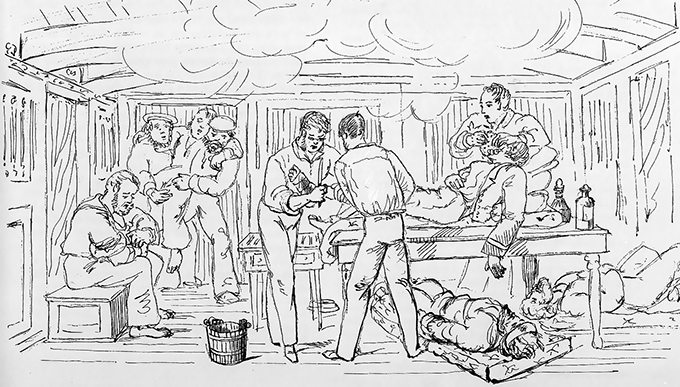
Treating casualties in action on the wardroom table, by Assistant Surgeon Stedman. This scene actually depicts his earlier ship, U.S.S. Huron.
Another man was quite badly wounded at just about the same moment as those in the pilot-house, a seaman named John McAllister. He was one of a gun’s crew and was standing beside his gun in the turret. One of the shots striking the turret broke off a piece of iron which weighed seventy-eight pounds. This piece of iron was thrown violently across the turret, in its course striking and bending the rod which operated the steering gear, and then struck down McAllister, injuring him severely.
The steering gear was put out of business by this accident, and there we were: helpless, drifting slowly up towards the obstructions and under the fire of a hundred heavy guns. It was fully ten minutes before the supplementary steering gear in the turret-chamber could be got into working condition. When it was working, efforts were made to so steer the ship that the guns could be again trained upon Fort Sumter, but these efforts were futile, and the Nahant was headed out just as the signal for the fleet to withdraw was hoisted on the flagship. The Nahant joined the other vessels and all moved down to the former anchorage.
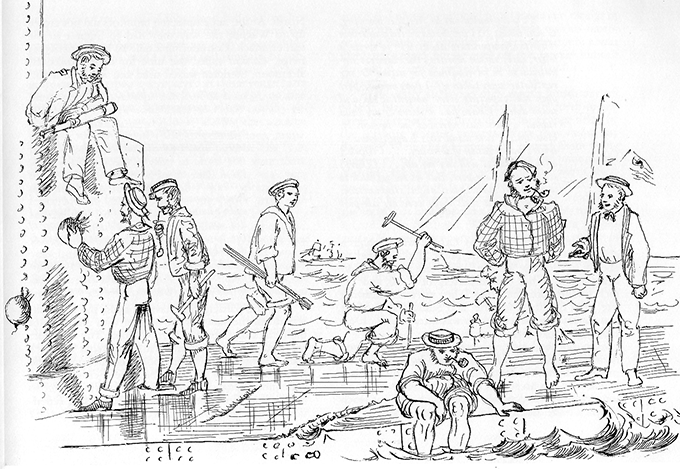 Stedman’s depiction of repairing battle damage on U.S.S. Nahant, this time after a subsequent “set-to” with Confederate gunners at Fort Wagner on Morris Island.
Du Pont had been reluctant to stage this attack with naval forces alone; he had urged a coordinated attack, using large numbers of land troops to help secure the batteries around the perimeter of the harbor. The events of April 7 vindicated Du Pont’s original position, as well as showing the limitations of the then-still-new armored ships in attacking heavy, well-trained shore batteries. After Du Pont’s failed attack, the Union strategy shifted to one that prioritized taking the forts on the outer periphery of Charleston Harbor, gradually working toward Sumter itself. If you’ve seen the great Civil War movie Glory, you have some familiarity with that part of the war.
Finally, if you haven’t seen his posts lately, my colleague Craig Swain has been doin’ the knowledge on the development of the Confederate defenses at Charleston over at his blog, To the Sound of the Guns. It’s fantastic stuff, in all its primary-source, granular detail. Great work, Craig — you’re showing how it’s done.
___________
[1] S. F. Du Pont to Gideon Welles, “Attack by Federal ironclads upon the defenses of Charleston, S. C., April 7, 1863,” April 8, 1863. ORN, vol 14, 3.
[2] Alvah F. Hunter, A Year on a Monitor and the Destruction of Fort Sumter, Craig L. Symonds, ed. (Columbia: University of South Carolina, 1987).
[3] “Dr. Stedman” was Assistant Surgeon Charles Ellery Stedman, ship’s surgeon aboard Nahant, whose sketches illustrate this post. Charles Ellery Stedman, The Civil War Sketchbook of Charles Ellery Stedman, Surgeon, United States Navy. Jim Dan Hill, ed. (San Rafael, California: Presidio Press, 1976).
[4] Sofield’s paralysis may have been temporary; Assistant Surgeon Stedman’s after-action casualty report does not mention the paralysis, and says that Sofield “is doing well.” Pilot Sofield was still on active duty with Nahant at the end of 1863. C. Ellery Stedman, “Report of casualties on the U. S. S. Nahant,” April 7, 1863. ORN, vol 14, 5; John J. Cornwell, “Report of Lieutenant-Commander Cornwell, U. S. Navy, regarding drifting timber from the harbor obstructions,” December 29, 1863. ORN, vol 15, 210-211.




 Dead Confederates, A Civil War Era Blog
23 comments