Memorial Day in Memphis, 1875
From the Memphis Daily Appeal, May 25, 1875:
Three generations of soldiers were of the long array — the men who fought with Jackson at New Orleans, those who braved the Indians in the Everglades, the later generation who followed Scott and [Jefferson] Davis and [Gideon Johnston] Pillow [a local hero] in Mexico, and the still later who had served with Grant or Lee, with Stonewall Jackson or Sherman, with Forrest or Sheridan, with Joe Johnston or Thomas. . . . These were the links that bound jubilee army to the past, blending with the younger soldiers whose battles were on a grander scale, but whose contests were no fiercer, illustrated for the multitude almost the whole history of the Republic. . . . In these gentlemen [Pillow and Davis] we had united the two later and grandest epochs in our history — the one by which we won an empire, and the other by which we sustained the shock of civil war and survived to enjoy and perpetuate a still more perfect Union. Forrest, the “terrible fighter” and always victorious cavalry raider, marched in the same column with the Federals who had fought him, and shared a seat on the same platform with our best representatives of the Union armies. . . . Mr. Davis, our foremost statesman, did not speak, but he was upon the platform, and by his presence gave indorsement [sic.] to the re-cementing of the bonds of brotherhood. Tribute was paid to the dead, a loving tribute in words and flower, but the Union was over it all — was uppermost in all minds — and the day was thus made sacred to the highest purpose, and the dead were made to serve the noblest use in a text and day on which to preach peace and love, and date the final close of the war and all its bitter dissensions and contentions. Looking back through the night into the day, and recalling the men who were principal actors in the play, the tone and temper of the audience and the drift of what was said and sung can reach but the conclusion impressed upon us when yet the parade was in the thought of its projectors, that it was to be as healing upon the waters, it was to be a proper supplement of our steady march toward complete restoration, the finale of all our efforts to be reconciled to to our brothers of the both, and to do our part toward the consummation of that perfect peace for which all men have longed since that day at Appomattox, when Lee sheathed his sword and bade his troops “good-bye.” It was a great popular upheaval. It was the bursting of a great pent-up feeling of joy and happiness upon the condition of the country, the overflowing of gratitude for the blessings we enjoy of civil and religious liberty, and the determination to to give unmistakable assurances of loyalty and fealty to the Union. . . . The Union was apparent in and over all. The battle-flags of both armies were placed side-by-side or in peaceful embrace, by request, too, of General Forrest, and the same hands draped the graves of the boys in blue and gray alike. The memory we revive of the day is this, and this its lesson. May it endure forever to animate us on each recurring anniversary, strengthening present resolution and and confirming us in our determination to labor hereafter in and for the Union, to make it more glorious and free, the first among the nations of the earth.

[This post originally appeared on Memorial Day weekend, 2012.]
_____________
Irony

A small U.S. flag marks the grave of fire-eating secessionist Louis T. Wigfall in Galveston, Texas on Memorial Day weekend, 2013. Local scouting groups place U.S. flags on the graves of Confederate veterans as well as U.S. military veterans in recognition of the holiday.
____________

The British Gun at Sullivan’s Island


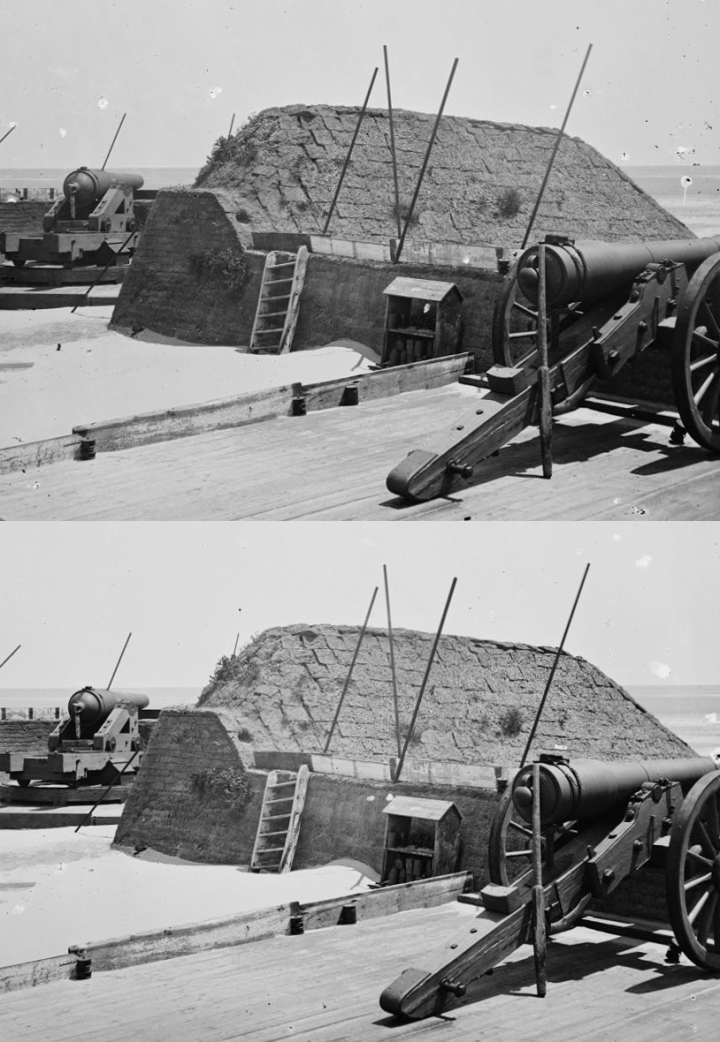
 The other day, over at To the Sound of the Guns, Craig Swain took a look at a very unusual piece of Confederate artillery, photographed at Fort Marshall on Sullivan’s Island, near Charleston. Looking closely at the image (available online at the Library of Congress), Craig noticed that cast into the upper side of the reinforce was a distinctive marking, almost certainly a British royal cipher. The gun in the Civil War era photo is very likely one of a handful of old British 12-pounders that, in the latter part of 1863, the Confederates had rifled and fitted with breech banding to further expand there defenses around Charleston. Those guns are marked with what looks like the monogram of George III (right, 1760-1820), which would presumably make them of Revolutionary War vintage.
There are a couple of other interesting things about this image. The first is that the gun is mounted on a field carriage, rather than a traditional seacoast mounting like the gun at left. Perhaps this was done because, as a relatively lightweight piece, the rifled 12-pounder was intended to be moved about to different positions as needed, which would be greatly facilitated by putting the gun on a field carriage.
The other thing that’s interesting is the clear view of the way the batteries themselves were covered with sod, to help maintain their shape. We’ve seen reference to this practice at Galveston, as well, and it would be essential, given that otherwise the loose sand would blow away as fast as it was piled up. The famous Confederate artist Conrad Wise Chapman completed a painting of the interior of Fort Marshall, that shows the green-sodded earthworks to good advantage:


And if you look closely, at left Chapman depicted two guns very similar to the one in the photograph, along with a tiny, house-shaped structure similar to the ready-ammunition storage seen in the 1860s photo:

Finally, since the image of the old ye olde British gun is part of a stereo pair, I would be remiss in not offering them in all their 3D glory, for for red/cyan viewing and as a wobbler:

_________
Florida to Dedicate CW Wreck as Underwater Archaeological Preserve
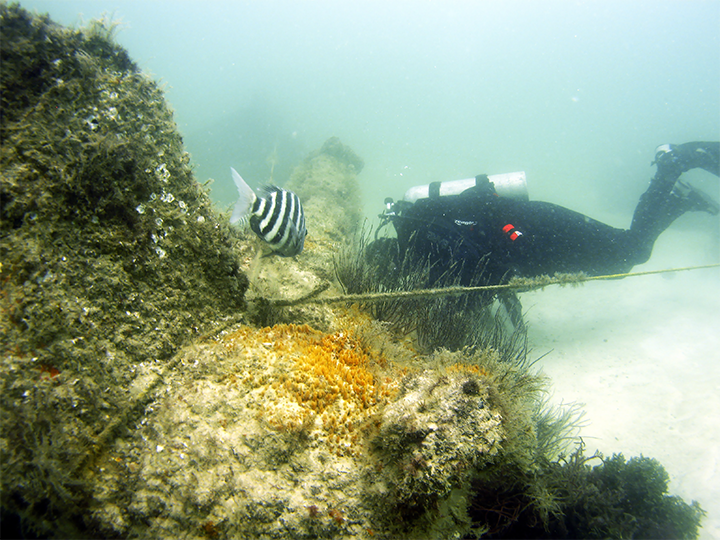
Divers from the Florida Aquarium’s Friends of the USS Narcissus group examine the wreck of the Civil War tugboat. Via TampaPlanet.com.
Sometime in the next several months, perhaps as early as late fall, the the State of Florida will dedicate the wreck of U.S.S. Narcissus, sunk in 1866 of Egmont Key, near Tampa, as the state’s 12th underwater archaeological preserve. I spoke recently to Roger C. Smith, Florida’s State Underwater Archaeologist, who confirmed that plans for the site are coming together for the formal dedication of the site. In this case, the process has been a long one due to the numerous agencies involved. Because the site lies at the edge of a commercial waterway, the project required the approval of the U.S. Army Corps of Engineers, the Tampa Port Authority, and the U.S. Navy, that still holds title to the wreck. Smith explained that, like so many historic wrecks in shallow water, this one was first located by fishermen, and then by sport divers. A number of small artifacts were picked up by people exploring the site, including a few Confederate buttons. These led some to believe that the wreck was that of a blockade runner, but an exhaustive review of the historical record revealed none of those vessels wrecked in the area. They did, however, identify a U.S. Navy steam tug that went aground and suffered a boiler explosion at that location just after the war, U.S.S. Narcissus.
Narcissus was launched as the 82-foot-long screw steamer Mary Cook at East Albany, New York, in July 1863 and purchased by the U.S. Navy a few weeks later as U.S.S. Narcissus. She was assigned to the West Gulf Blockading Squadron and assisted with operations after the Battle of Mobile Bay in August 1864. The following December, Narcissus was sunk in shallow water by a Confederate mine, without loss of life, and was subsequently raised and repaired. The 2011 proposal to turn the site into an archaeological preserve tells the rest of the story:
Florida’s “Museums in the Sea” network of marine archaeological sites may be the best program of its type in the country. It’s great public outreach and education effort, to encourage divers and snorkelers to visit and learn more about our shared maritime past. Interpretive materials include both general brochures and guides to the wrecks themselves (see this example, for the 1715 Spanish plate ship, Urca de Lima), so that divers can actually go beyond underwater sight-seeing, to have a better understanding of the site and its significance.
Here’s a big lot of images on Flicker of divers working to document the Narcissus wreck site in 2006. It can be slow and not-very-glamorous work. They even dragged Gordon Watts, the acknowledged dean of 19th century marine steam powerplants, in on the action. It’s wet work like this that goes into generating site plans and reports like the proposal excerpted above. Designation of the site as an archaeological preserve is the culmination of many hundreds of hours of work, often done by volunteers, in recording the site, doing historical and archival research, and many other activities. It’s diligent work, but tremendously rewarding for the folks who do it, who are making a major time commitment to bring this aspect of maritime history of a larger audience.
Hats off to them all.
_________
Talkin’ Blockade Runners — June 5 in Conroe

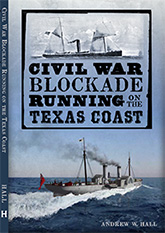
On Wednesday, June 5, I’ll be giving my talk, “For-Profit Patriots: Blockade Running on the Texas Coast” at the Woodlands Civil War Round Table in Conroe, north of Houston. My talk will be at 7 p.m. at the Windsor Hill Club House, 1 East Windsor Hills Circle. Visitors are welcome, although everyone attending must be 18 or older due to the rules of the community. As before, there will be particular emphasis on two vessels wrecked here in 1865, Will o’ the Wisp and Denbigh. The official blurb:
“Patriotism, avarice and daring”? Did I write that? Gack, what turgid over-selling!
Anyway, it should be fun and informative. Hope to see you there!
___________
Image: Me with nautical archaeologist Amy Borgens on the Will o’ the Wisp wreck site, July 2009.
“We don’t undertake many things which we don’t surpass in”
 Vince Columbo bats during a vintage base ball game between the Houston Babies and Katy Combines as part of the Galveston Island Beach Revue weekend on Saturday in Galveston. KEVIN M. COX/The Daily News.
On Saturday, two vintage baseball teams, the Houston Babies and Katy Combines, played a match as part of the Galveston Island Beach Revue, an annual kick-off to the summer beach season that’s been growing over the last few years. I didn’t make the game, but I wish I had, because it sounds like it was great fun.
Baseball has a long history in Texas, dating back before the Civil War. In March 1859, the Galveston Civilian and Gazette Weekly reported that “the Base Ball Club organized [at Richmond] on the 24th inst., numbers thirty-five members. . . . Friday has been selected as the regular practice day. We understand that the club has been organized under the same rules as govern the clubs at the North.” Even as the war was beginning in earnest, two days after the surrender of Fort Sumter, the Houston Weekly Telegraph reported that “a meeting for the purpose of organizing a Base Ball Club, was held over J. H. Evans’ store Thursday night. After the organization of the meeting, and the adoption of the name of “‘Houston Base Ball CLub,” a ballot for permanent officers was had.” By June 1861, the Galveston Weekly News noted that Houston now had two “base ball” teams taking the field. And just about exactly a year after Appomattox, the Houston Tri-Weekly Telegraph was calling for the reorganization of the sport:
I think Nolan Ryan would agree.
____________
The Politically-Correct Origin of the Confederate Battle Flag
 For many True Southrons™ today, the Confederate Battle Flag (or “Southern Cross”) has taken on a significance not only as a symbol of the Confederate military forces of 1861-65, but of the South as a whole. Some go farther still, insisting that the flag itself is a sacred Christian object, bearing the Cross of St. Andrew, reflecting the Confederate cause as explicitly Christian one.
While some folks choose to project their own religious interpretation onto the Confederate Battle Flag, the origin of the design was not only not sectarian, it was explicitly designed to avoid religious symbolism. As John Coski relates in his definitive study, The Confederate Battle Flag: America’s Most Embattled Emblem, the banner was designed by Confederate Congressman William Porcher Miles (right, 1822-1899), who set out in March 1861 to create a distinctive pattern for a national flag for the new Confederacy. Miles began with a familiar secessionist emblem, but subsequently modified his original layout with the intent to remove any overt Christian symbology:
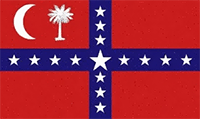 William Miles’s disappointment with the Stars and Bars [i.e., the “First National” flag of the Confederacy] went beyond his strong ideological objections to the Stars and Stripes. He had hoped that the Confederacy would adopt his own design for a national flag-the pattern that later generations mistakenly and ironically insisted on calling the Stars and Bars. The design that Miles championed was apparently inspired by one of the flags used at the South Carolina secession convention in December 1860. That flag featured a blue St. George’s (or upright) cross on a red field. Emblazoned on the cross were fifteen white stars representing the slaveholding states, and on the red field were two symbols of South Carolina: the palmetto tree and the crescent. Charles Moise, a self-described “southerner of Jewish persuasion,” wrote Miles and other members of the South Carolina delegation asking that “the symbol of a particular religion” not be made the symbol of the nation.
In adapting his flag to take these criticisms into account, Miles removed the palmetto tree and crescent and substituted a diagonal cross for the St. George’s cross. Recalling (and sketching) his proposal a few months later, Miles explained that the diagonal cross was preferable because “it avoided the religious objection about the cross (from the Jews & many Protestant sects), because it did not stand out so conspicuously as if the cross had been placed upright thus.” The diagonal cross was, Miles argued, “more Heraldric [sic] than Ecclesiastical, it being the ‘saltire’ of Heraldry, and significant of strength and progress (from the Latin salto, to leap).” [1]
William Miles’s disappointment with the Stars and Bars [i.e., the “First National” flag of the Confederacy] went beyond his strong ideological objections to the Stars and Stripes. He had hoped that the Confederacy would adopt his own design for a national flag-the pattern that later generations mistakenly and ironically insisted on calling the Stars and Bars. The design that Miles championed was apparently inspired by one of the flags used at the South Carolina secession convention in December 1860. That flag featured a blue St. George’s (or upright) cross on a red field. Emblazoned on the cross were fifteen white stars representing the slaveholding states, and on the red field were two symbols of South Carolina: the palmetto tree and the crescent. Charles Moise, a self-described “southerner of Jewish persuasion,” wrote Miles and other members of the South Carolina delegation asking that “the symbol of a particular religion” not be made the symbol of the nation.
In adapting his flag to take these criticisms into account, Miles removed the palmetto tree and crescent and substituted a diagonal cross for the St. George’s cross. Recalling (and sketching) his proposal a few months later, Miles explained that the diagonal cross was preferable because “it avoided the religious objection about the cross (from the Jews & many Protestant sects), because it did not stand out so conspicuously as if the cross had been placed upright thus.” The diagonal cross was, Miles argued, “more Heraldric [sic] than Ecclesiastical, it being the ‘saltire’ of Heraldry, and significant of strength and progress (from the Latin salto, to leap).” [1]
Miles’ design didn’t get much traction as a national flag in early 1861, but it was remembered by General P. G. T. Beauregard later that year, and was soon adopted as the Battle Flag of the Army of Northern Virginia. [2] In that capacity is gained wide popularity in the South, and eventually became the key element in both the Second National and Third National Flags of the Confederacy. Miles’s original design was ultimately vindicated, and remains today one of the most widely-recognized flags anywhere.
Miles had made a point of using the heraldic term “saltire” to describe the diagonal pattern he settled on, and explicitly distanced his design from any intent at religious symbolism – “more Heraldric [sic] than Ecclesiastical.” This may come as a shock to some present-day Confederate heritage activists, some of whom wield their own religious beliefs like a cudgel and project back onto the Confederacy their own brand of Christianism. Nonetheless, the reality is that the revered Battle Flag was the result of a conscious attempt by Miles and his collaborators to make its design less Christian, and so less offensive to people of other faiths. Miles rejected the notion that his flag was a religious symbol at all, and instead sought to make it an explicitly secular one. And he did so as a member of the congressional delegation from South Carolina, the fire-eating state that led the South into secession in the first place. To put it in terms familiar to those who follow debates about its use and meaning, the design of the Confederate Battle Flag was, in the context of its time and place, a cave-in to “political correctness.”
Furthermore, as Coski pointed out recently in an essay at the New York Times Opinionator blog, contemporary references to the design as the “Southern Cross” were allusions to the astronomical constellation, not the Cross of Calvary. For patriotic Southerners like George Bagby, editor of the Southern Literary Messenger, it was the constellation — usually invisible below the southern horizon to those in the northern hemisphere — that was a symbol of the Confederacy’s future greatness. Channeling the imperialistic ambitions shared by groups like the Knights of the Golden Circle, Bagby saw in the constellation the destiny of the Confederacy:
Anyone looking for the “Southern Cross” known to the Confederates of 1861 should look to the night sky, not the Holy Bible.
People can, and always will, find religious imagery and inspiration in all manner of temporal objects. That’s a matter of their particular belief, and they’re welcome to it. But neither should we confuse what people believe as a matter of faith, with the historical record. While symbols like the Confederate Battle Flag evolve through their use and association to have many different meanings to people, it’s also important to keep discussions about those meanings grounded in the words and actions of those associated with them, over the last 152 years. Open and frank discussion about those things will avail a far more comprehensive understanding of this symbol and its troubled past – and its future.
[1] John M. Coski, The Confederate Battle Flag: America’s Most Embattled Emblem (Cambridge: Harvard University Press, 2006), 5-6.
[2] Devereaux D. Cannon, Jr., The Flags of the Confederacy: An Illustrated History ( Memphis: St. Lukes Press, 1988), 58.
[3] George Bagby, “Editor’s Table,” Southern Literary Messenger, January 1862, 68.
__________
Image: William Porcher Miles, Library of Congress.
Lexington Flag Case, Reidsville Monument Updates
Oral arguments were held Wednesday in the Virginia SCV’s appeal to reinstate their lawsuit against the City of Lexington, that had been dismissed by the district court last year. There are several news items about this, but the only one I’ve seen that describes events in the courtroom is this item from the Washington Post and the AP:
My earlier thoughts on why the Virginia SCV is probably going to lose this one are here.
In other news, it looks like the Reidsville, North Carolina monument knocked down in an automobile accident two years ago is finally being restored, this time in the Confederate veterans’ plot at the local cemetery, owned by the UDC. The question of who owned the monument itself has been central in the dispute over whether to restore at its previous location or move it to the cemetery, as the UDC wanted to do. Over time, though, challenges to ownership of the monument seem to have fallen away:
Naturally, the usual crowd is furious about this development, in the comments section. But there’s also this little gem of information, that I hadn’t been aware of before:
You really can’t make this stuff up.
__________
2013 Menard Summer Lecture Series

The Galveston Historical Foundation has announced its lineup for the 2013 Menard Summer Lecture Series:
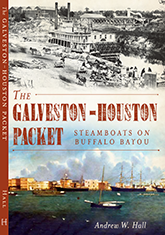
Presented by Edward T. Cotham, Jr. In the spring of 1880, former President and Union General Ulysses S. Grant made a visit to Texas. Fanned by unprecedented press speculation and coverage, huge crowds and celebrities turned out to greet Grant everywhere he went. This was particularly true of the general’s visit to Galveston, at that time the largest and most prosperous city in Texas. Where did Grant go and what did he do? What did he say? And most importantly, what did he eat? Respected historian Ed Cotham answers these questions and more as he chronicles the extensive newspaper coverage of Grant’s historic visit to the island city in his newest presentation for the Menard Summer Lecture Series. June 23 – The Galveston-Houston Packet; Steamships on Buffalo Bayou Presented by Andrew W. Hall Before the railroad, before the Interurban, before the scourge of construction detours on the Gulf Freeway, Galveston and Houston were first linked by steamboat. The water link between the two cities helped establish both towns as the fastest-growing, booming communities in the state of Texas during the 19th century. The tale, largely overlooked until now, is one of cut-throat competition, horrific accidents, hard-fought battles and more. Join Galveston author Andy Hall, to explore some of this forgotten history. July 14 – Historic Tales of the Texas Republic, A Glimpse of Texas Past
Presented by Jeffery Robenalt
Though the Republic of Texas existed as a sovereign nation for just nine years, the legacy lives on in the names that distinguish the landscape of the Lone Star State. Austin, Houston, Travis, Lamar, Seguin, Burnet, Bowie, Zavala and Crockett- these historical giants, often at odds, fought through their differences to achieve independence from Mexico and established a republic destined to become the twenty-eighth state in the Union. Author Jeffrey Robenalt chronicles the fight to define and defend the Republic of Texas, from revolutionary beginnings to annexation. August 4 – The First Texas Navy, 1835-1837 Presented by James P. Bevill This powerful presentation takes place in the throes of the Texas Revolution, as the provisional government of Texas scrambled to put together a naval force to wreak havoc upon the Mexican supply lines. Having first resorted to the use of privateers (state sponsored pirates), Texas was able to borrow money in New Orleans in early 1836, to secure the warships Liberty, Invincible, Independence and the Brutus. Author and historian James Bevill tells the story of those four ships and the significant contributions of men made on the high seas in the fight for Texas independence. This remarkable story is triumphant and tragic, and an entertaining finale to the 2013 Menard Summer Lecture Series.
Each talk takes place on Sunday afternoon at 2 pm, at Menard Hall, 33rd Street and Avenue O in Galveston. Tickets are $12 for each talk, or $40 for the series. Hope to see you there.
_________
MoC to Debut Gettysburg Exhibit
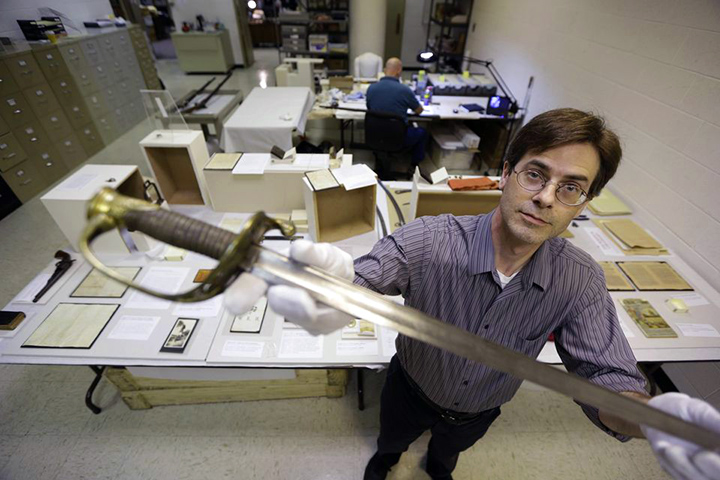
Senior curator for the Museum of the Confederacy, Robert Hancock, holds the sword carried by Confederate Brigadier General Lewis A. Armistead during the Battle of Gettysburg in a work room at the museum in Richmond, Va., Wednesday, May 1, 2013. The Museum of the Confederacy in Richmond, Va., will open the exhibit “Gettysburg: They walked through blood” on May 11 to commemorate the 150th anniversary of the Battle of Gettysburg. (AP Photo/Steve Helber)
The Museum of the Confederacy is about to open an exhibit that rivals the scope of the battle itself (h/t C.M. Winkler):
Wowsa!
________________




2 comments