Talkin’ Buffalo Bayou Steamboats
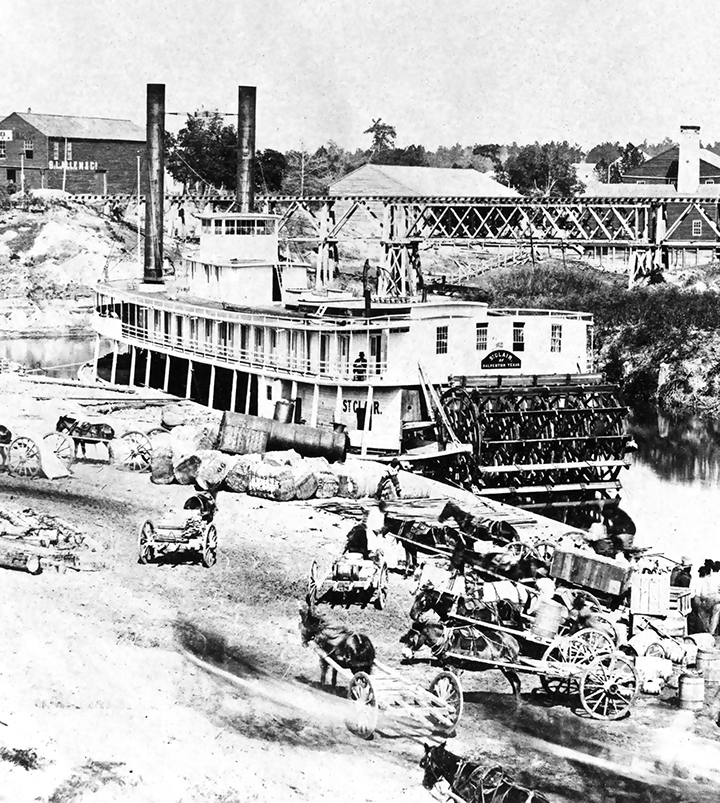

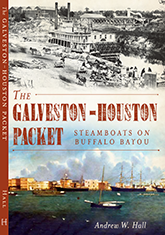
On Sunday afternoon I’ll be talking about one of my favorite topics again, Texas riverboats. Before the railroad, before the Interurban, before the scourge of construction detours on the Gulf Freeway, Galveston and Houston were first linked by steamboat. The water link between the two cities helped establish both towns as the fastest-growing, booming communities in the state of Texas during the 19th century. The tale, largely overlooked until now, is one of cut-throat competition, horrific accidents, hard-fought battles and more.
Sunday, June 23 at 2 p.m.
Menard Campus, 3302 Avenue O
Galveston, Texas
Admission is $10 for Galveston Historical Foundation members, $12 for non-members.
______________
Image: Sternwheeler St. Clair at the Houston landing, c. 1867. Houston Public Library.
Hari Jones Drops the Hammer on National Observance of Juneteenth
[This post originally appeared on June 20, 2011.]

Hari Jones, Curator of the African American Civil War Museum, drops the hammer on the movement to make Juneteenth a national holiday, and the organization behind it, the National Juneteenth Observance Foundation (NJoF). He argues that the narrative used to justify the propose holiday does little to credit African Americans with taking up their own struggle, and instead presents them as passive players in emancipation, waiting on the beneficence of the Union army to do it for them. Further, he presses, the standard Juneteenth narrative carries forward a long-standing, intentional effort to suppress the story of how African Americans, in ways large and small, worked to emancipate themselves, particularly by taking up arms for the Union. He wraps up a stem-winder:
Certainly, informed and knowledgeable people should not celebrate the suppression of their own history. Juneteenth day is a de facto celebration of such suppression. Americans, especially Americans of African descent, should not celebrate when the enslaved were freed by someone else, because that’s not the accurate story. They should celebrate when the enslaved freed themselves, by saving the Union. Such freedmen were heroes, not spectators, and their story is currently being suppressed by the advocates of the Juneteenth national holiday. The Emancipation Proclamation did not free the slaves; it made it legal for this disenfranchised, enslaved population to free themselves, while maintaining the supremacy of the Constitution, and preserving the Union. They became the heroes of the Republic. It is as Lincoln said: without the military help of the black freedman, the war against the South could not have been won. That’s worth celebrating. That’s worth telling. The story of how Americans of African descent helped save the Union, and freed themselves. Let’s celebrate the truth, a glorious history, a story of a glorious march to Liberty.

Jones makes a powerful argument, with solid points. But I think he misses something crucial, which is that in Texas, where Juneteenth originated, it’s been a regular celebration since 1866. It is not a modern holiday, established retroactively to commemorate an event in the long past; the celebration of Juneteenth is as old as emancipation itself. It was created and carried on by the freedmen and -women themselves:
Some of the early emancipation festivities were relegated by city authorities to a town’s outskirts; in time, however, black groups collected funds to purchase tracts of land for their celebrations, including Juneteenth. A common name for these sites was Emancipation Park. In Houston, for instance, a deed for a ten-acre site was signed in 1872, and in Austin the Travis County Emancipation Celebration Association acquired land for its Emancipation Park in the early 1900s; the Juneteenth event was later moved to Rosewood Park. In Limestone County the Nineteenth of June Association acquired thirty acres, which has since been reduced to twenty acres by the rising of Lake Mexia. Particular celebrations of Juneteenth have had unique beginnings or aspects. In the state capital Juneteenth was first celebrated in 1867 under the direction of the Freedmen’s Bureau and became part of the calendar of public events by 1872. Juneteenth in Limestone County has gathered “thousands” to be with families and friends. At one time 30,000 blacks gathered at Booker T. Washington Park, known more popularly as Comanche Crossing, for the event. One of the most important parts of the Limestone celebration is the recollection of family history, both under slavery and since. Another of the state’s memorable celebrations of Juneteenth occurred in Brenham, where large, racially mixed crowds witness the annual promenade through town. In Beeville, black, white, and brown residents have also joined together to commemorate the day with barbecue, picnics, and other festivities.

It’s one thing to argue with another historian or community leader about the the historical narrative represented by a public celebration (think Columbus Day), but it’s entirely another to — in effect — dismiss the understanding of the day as originally celebrated by the people who actually lived those events, and experienced them at first hand.
What do you think?
_____________
h/t Kevin. Image: Juneteenth celebration in Austin, June 19, 1900. PICA 05476, Austin History Center, Austin Public Library.

Juneteenth, History and Tradition
[This post originally appeared here on June 19, 2010.]
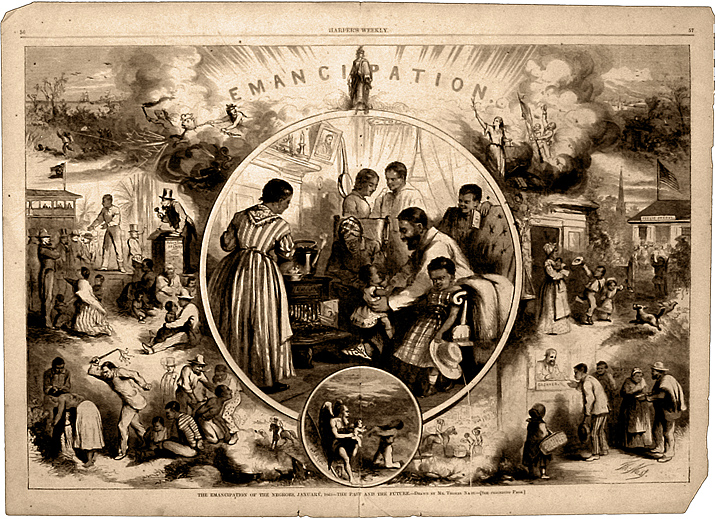
“Emancipation” by Thomas Nast. Ohio State University.

Juneteenth has come again, and (quite rightly) the Galveston County Daily News, the paper that first published General Granger’s order that forms the basis for the holiday, has again called for the day to be recognized as a national holiday:
Those who are lobbying for a national holiday are not asking for a paid day off. They are asking for a commemorative day, like Flag Day on June 14 or Patriot Day on Sept. 11. All that would take is a presidential proclamation. Both the U.S. House and Senate have endorsed the idea. Why is a national celebration for an event that occurred in Galveston and originally affected only those in a single state such a good idea? Because Juneteenth has become a symbol of the end of slavery. No matter how much we may regret the tragedy of slavery and wish it weren’t a part of this nation’s story, it is. Denying the truth about the past is always unwise. For those who don’t know, Juneteenth started in Galveston. On Jan. 1, 1863, the Emancipation Proclamation was issued. But the order was meaningless until it could be enforced. It wasn’t until June 19, 1865 — after the Confederacy had been defeated and Union troops landed in Galveston — that the slaves in Texas were told they were free. People all across the country get this story. That’s why Juneteenth celebrations have been growing all across the country. The celebration started in Galveston. But its significance has come to be understood far, far beyond the island, and far beyond Texas.
This is exactly right. Juneteenth is not just of relevance to African Americans or Texans, but for all who ascribe to the values of liberty and civic participation in this country. A victory for civil rights for any group is a victory for us all, and there is none bigger in this nation’s history than that transformation represented by Juneteenth.
But as widespread as Juneteenth celebrations have become — I was pleased and surprised, some years ago, to see Juneteenth celebration flyers pasted up in Minnesota — there’s an awful lot of confusion and misinformation about the specific events here, in Galveston, in June 1865 that gave birth to the holiday. The best published account of the period appears in Edward T. Cotham’s Battle on the Bay: The Civil War Struggle for Galveston, from which much of what follows is abstracted.
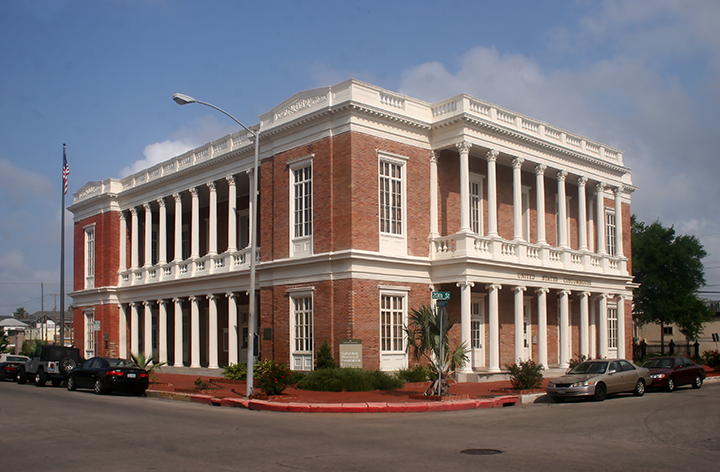
The United States Customs House, Galveston.
On June 5, Captain B. F. Sands entered Galveston harbor with the Union naval vessels Cornubia and Preston. Sands went ashore with a detachment and raised the United States flag over the federal customs house for about half an hour. Sands made a few comments to the largely silent crowd, saying that he saw this event as the closing chapter of the rebellion, and assuring the local citizens that he had only worn a sidearm that day as a gesture of respect for the mayor of the city.
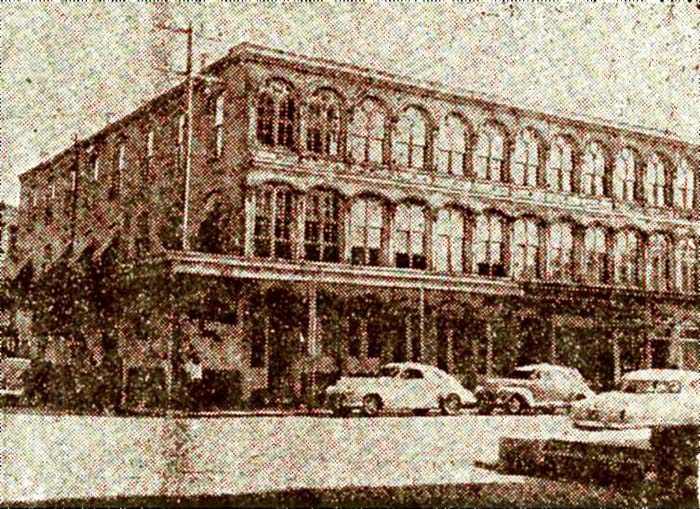
The 1857 Ostermann Building, site of General Granger’s headquarters, at the southwest corner of 22nd Street and Strand. Image via Galveston Historical Foundation.
A large number of Federal troops came ashore over the next two weeks, including detachments of the 76th Illinois Infantry. Union General Gordon Granger, newly-appointed as military governor for Texas, arrived on June 18, and established his headquarters in Ostermann Building (now gone) on the southwest corner of 22nd and Strand. The provost marshal, which acted largely as a military police force, set up in the Customs House. The next day, June 19, a Monday, Granger issued five general orders, establishing his authority over the rest of Texas and laying out the initial priorities of his administration. General Orders Nos. 1 and 2 asserted Granger’s authority over all Federal forces in Texas, and named the key department heads in his administration of the state for various responsibilities. General Order No. 4 voided all actions of the Texas government during the rebellion, and asserted Federal control over all public assets within the state. General Order No. 5 established the Army’s Quartermaster Department as sole authorized buyer for cotton, until such time as Treasury agents could arrive and take over those responsibilities.
It is General Order No. 3, however, that is remembered today. It was short and direct:
Headquarters, District of Texas
Galveston, Texas, June 19, 1865 General Orders, No. 3 The people are informed that, in accordance with a proclamation from the Executive of the United States, all slaves are free. This involves an absolute equality of personal rights and rights of property, between former masters and slaves, and the connection heretofore existing between them, becomes that between employer and hired labor. The Freedmen are advised to remain at their present homes, and work for wages. They are informed that they will not be allowed to collect at military posts; and that they will not be supported in idleness either there or elsewhere. By order of
Major-General Granger
F. W. Emery, Maj. & A.A.G.
What’s less clear is how this order was disseminated. It’s likely that printed copies were put up in public places. It was published on June 21 in the Galveston Daily News, but otherwise it is not known if it was ever given a formal, public and ceremonial reading. Although the symbolic significance of General Order No. 3 cannot be overstated, its main legal purpose was to reaffirm what was well-established and widely known throughout the South, that with the occupation of Federal forces came the emancipation of all slaves within the region now coming under Union control.
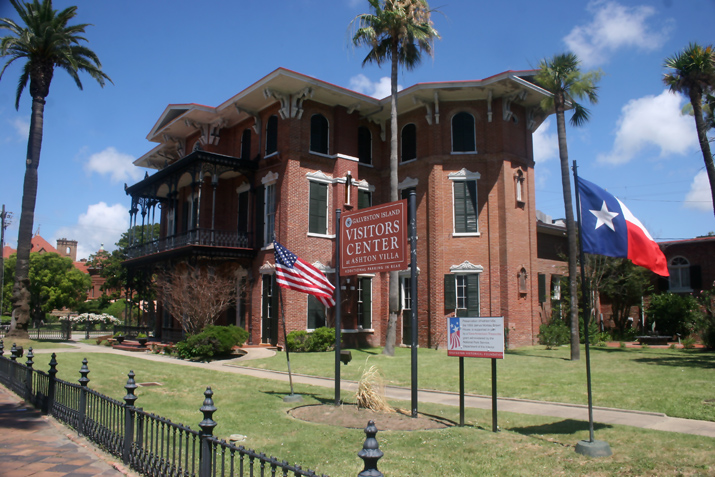
The James Moreau Brown residence, now known as Ashton Villa, at 24th & Broadway in Galveston. This site is well-established in recent local tradition as the site of the original Juneteenth proclamation, although direct evidence is lacking.
Local tradition has long held that General Granger took over James Moreau Brown’s home on Broadway, Ashton Villa, as a residence for himself and his staff. To my knowledge, there is no direct evidence for this. Along with this comes the tradition that the Ashton Villa was also the site where the Emancipation Proclamation was formally read out to the citizenry of Galveston. This belief has prevailed for many years, and is annually reinforced with events commemorating Juneteenth both at the site, and also citing the site. In years past, community groups have even staged “reenactments” of the reading of the Emancipation Proclamation from the second-floor balcony, something which must surely strain the limits of reasonable historical conjecture. As far as I know, the property’s operators, the Galveston Historical Foundation, have never taken an official stand on the interpretation that Juneteenth had its actual origins on the site. Although I myself have serious doubts about Ashton Villa having having any direct role in the original Juneteenth, I also appreciate that, as with the band playing “Nearer, My God, to Thee” as Titanic sank beneath the waves, arguing against this particular cherished belief is undoubtedly a losing battle.
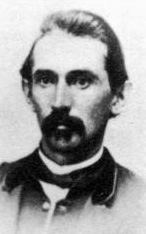 Assuming that either the Emancipation Proclamation (or alternately, Granger’s brief General Order No. 3) was formally, ceremonially read out to the populace, where did it happen? Charles Waldo Hayes, writing several years after the war, says General Order No. 3 was “issued from [Granger’s] headquarters,” but that sounds like a figurative description rather than a literal one. My bet would not be Ashton Villa, but one of two other sites downtown already mentioned: the Ostermann Building, where Granger’s headquarters was located and where the official business of the Federal occupation was done initially, or at the United States Customs House, which was the symbol of Federal property both in Galveston and the state as a whole, and (more important still) was the headquarters of Granger’s provost marshal, Lieutenant Colonel Rankin G. Laughlin (right, 1827-78) of the 94th Illinois Infantry. It’s easy to imagine Lt. Col. Laughlin dragging a crate out onto the sidewalk in front of the Customs House and barking out a brief, and somewhat perfunctory, read-through of all five of the general’s orders in quick succession. No flags, no bands, and probably not much of a crowd to witness the event. My personal suspicion is that, were we to travel back to June 1865 and witness the origin of this most remarkable and uniquely-American holiday, we’d find ourselves very disappointed in how the actual events played out at the time.
Maybe the Ashton Villa tradition is preferable, after all.

Update, June 19: Over at Our Special Artist, Michele Walfred takes a closer look at Nast’s illustration of emancipation.
Update 2, June 19: Via Keith Harris, it looks like retiring U.S. Senator Kay Bailey Hutchison supports a national Juneteenth holiday, too. Good for her.
Update 3, June 19, 2013: Freedmen’s Patrol nails the general public’s ambivalence about Juneteenth:
Exactly right.
______________

Three Years, 300K Views
 Today is the 3rd anniversary of Dead Confederates going online. We also just recently — on June 7, to be exact — crossed the mark of three hundred thousand pageviews. I hope this blog has been as enjoyable for my readers as it has been for me.
A while back I added a section to the right-hand sidebar, called “Top Posts & Pages.” It’s been interesting to watch. Naturally, the most recent posts are up there, but I’ve been very pleased at some of the older posts that show up there, that are still getting read months or years after they originally went up. These old posts include:
- “Ninety-eight percent of Texas Confederate soldiers never owned a slave,” April 28, 2011
- Non-Slaveholders’ Stake in Defending the “Peculiar Institution,” May 4, 2011
- Nathan Bedford Forrest Joins the Klan, December 11, 2011
- Oh, About that Black Confederate at Arlington. . . , October 23, 2010
- Old Pete, Slave Raids, and the Gettysburg Campaign, July 1, 2010
- How — And Why — Real Confederates Endorsed Slave Pensions, June 13, 2012
These are, from my perspective, some of the more substantive and worthwhile posts I’ve put down over the last three years. If Dead Confederates makes a real contribution at all to public understanding of the war, it’s posts like those that do the heavy lifting. I’m glad they’re still attracting eyeballs.
__________
The (Very) Posthumous Enlistment of “Private” Clark Lee
 Kevin and Brooks have been all over the Georgia Civil War Commission, and particularly of its handling of the case of Clark Lee, “Chickamauga’s Black Confederate Soldier.” I won’t rehash all of that, but there are a few points to add.
First, kudos to Eric Jacobson, who noticed that the modern painting of Lee used by the commission on its marker (right) is almost laughably tailored to affirm Lee’s status as a soldier, including the military coat with trim and brass buttons, rifle, cartridge box belt, military-issue “CS” belt buckle, and revolver, all backed by a Confederate Battle Flag — even though the Army of the Tennessee didn’t adopt that flag until the appointment of General Joseph E. Johnston, well after the Battle of Chickamauga.
It’s probably also worth noting that the man in the painting looks a lot older than 15, the age the Georgia Civil War Commission says Lee was at the time of the battle.
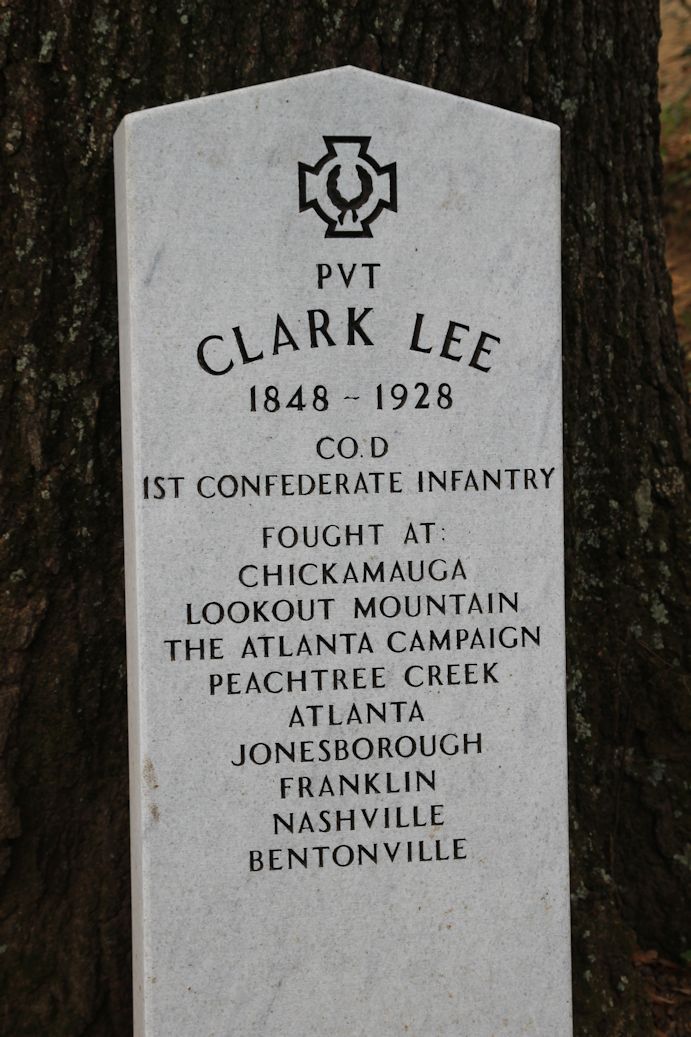
As it turns out, several weeks ago the SCV and other heritage folks installed and dedicated a new headstone for Lee, explicitly (and posthumously) giving him the military rank of Private. The stone also states that Lee “fought at” Chickamauga, Lookout Mountain, the Atlanta Campaign, and a host of other engagements by the Army of Tennessee. These are very specific claims, so it’s worth asking what the specific evidence for them is.
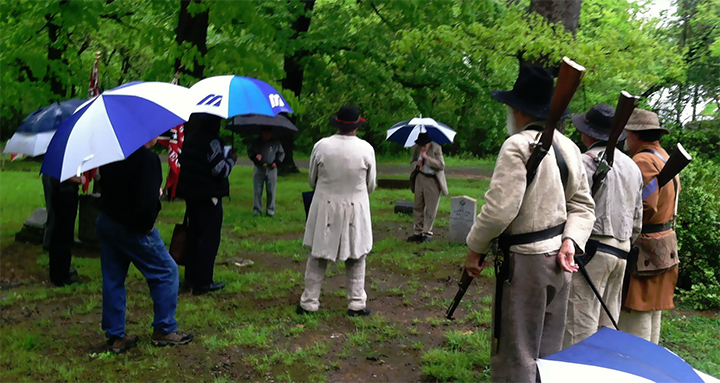
E. Raymond Evans (center, with umbrella), author of The Life and Times of Clark Lee: Chickamauga’s Black Confederate Soldier, speaking at an SCV memorial service for Clark Lee in April 2013. From here.
As is so often the case, there doesn’t appear to be any contemporary (1861-65) record of Lee’s service. There is no compiled service record (CSR) for him at the National Archives. Presumably the historical marker, the headstone, and a recent privately-published work on Clark Lee are all based on his 1921 application for a pension from the State of Tennessee, where he had moved in the years after the war. You can read Lee’s complete pension application here (29MB PDF). I cannot find a word in it that mentions or describes Clark Lee’s service under arms, or in combat. There is a general description of Lee’s wartime activities, but it’s quite different from what the Georgia Civil War Commission wants the rest of us to understand about him. I’ve put it below the jump because of some of the unpleasant themes expressed.
Grant Comes to Galveston
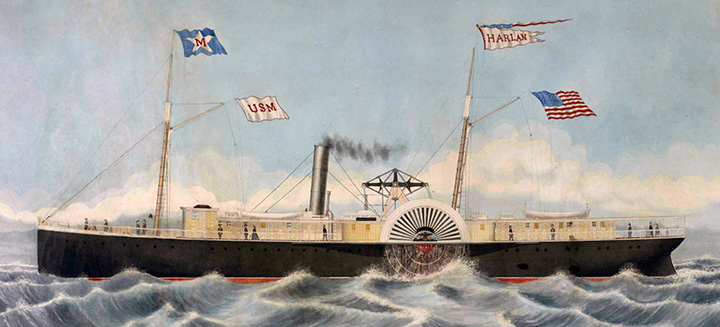
In the spring of 1880, former President and Union General Ulysses S. Grant made a visit to Texas. Fanned by unprecedented press speculation and coverage, huge crowds and celebrities turned out to greet Grant everywhere he went. This was particularly true of the general’s visit to Galveston, at that time the largest and most prosperous city in Texas. Where did Grant go and what did he do? What did he say? And most importantly, what did he eat? Respected historian Ed Cotham answers these questions and more as he chronicles the extensive newspaper coverage of Grant’s historic visit to the island city in his newest presentation for the Menard Summer Lecture Series.
Sunday, June 9 at 2 p.m.
Menard Campus, 3302 Avenue O
Galveston, Texas
Admission is $10 for Galveston Historical Foundation members, $12 for non-members.
_____________
Image: Morgan Line steamship Harlan, that carried the Grants from Clinton, Texas to Galveston and on to New Orleans in 1880. Museum of Fines Arts Houston/Bayou Bend Collection.
If You See Something, Say Something
On the other hand, misunderstandings of this sort have happened before. (H/t Kevin)
__________
Throwing Good Money After Bad
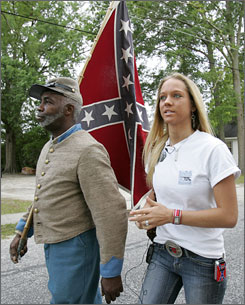 A few weeks ago, the Fourth U.S. Circuit Court of Appeals in Richmond declined to reinstate the lawsuit of Candice Hardwick, the former Latta, South Carolina high school student who spent years, starting in middle school, trying to get herself suspended for wearing Confederate flag t-shirts with captions like “Daddy’s Little Redneck” and “Southern Chick.” Another shirt in her wardrobe apparently featured that fraudulent “Louisiana Native Guards” image. There’s a good story providing the background of this seven-year-old case here.
As a practical matter, the Fourth Circuit’s ruling probably should have been the end of this case, but now the odious Kirk Lyons is soliciting $5,000 in donations to “help Candice get to the Supreme Court.” Lyons is certainly welcome to ask for money, and folks are welcome to contribute if they desire, but I do think Lyons should have been a bit more forthcoming in explaining the history of the case, and the likelihood of it getting a hearing before the Supremes.
In the first place, getting “cert,” as the saying goes, is a real longshot in almost any case. In any given term, the court is asked to hear thousands upon thousands of cases, but actually accepts only a few dozen — usually less than 1% of the total. There are exceptions, of course, when there are very fundamental and profound legislative questions at hand — the Affordable Healthcare Act and the Defense of Marriage Act are two of recent memory — but generally, the Supremes don’t take cases unless there are conflicting rulings at the lower court level, or the justices — specifically, any four of the nine — deem that the issues raised by the case are worth revisiting. I don’t think that latter circumstance is likely, particularly given that they will likely see this case as not about the Confederate flag per se, but about the broader authority of schools to regulate students’ speech or expression. The most important recent ruling on that subject, Morse v. Frederick (2007), is actually more recent than Hardwick’s original lawsuit, and at 6-3, wasn’t even a close decision. The six justices who voted against the student in that case (Roberts, Alito, Scalia, Kennedy, Breyer and Thomas) all remain on the bench.
Precedent aside, there’s also little other reason to expect Hardwick’s case to get a hearing at the Supreme Court. Best as I can tell, Hardwick’s has only been tried on its merits once, and she lost; everything else in the last seven years has been a round-robin of dismissals and appeals of said dismissals at the appellate level. There’s no particular reason to believe that four justices of the U.S. Supreme Court will see value in committing its resources to hearing a case that lower federal courts have deemed unworthy of their time.
Lyons really ought to be more forthright with prospective donors about the prospects in this case. The fiery rhetoric of his solicitation is calculated to inspire his supporters to open their wallets — “rotten & dishonest school tyranny,” “chicanery, hypocrisy and intellectual dishonesty of the 4th Circuit US Court of Appeals,” and so on — but it’s crafted to appeal to raw emotion, rather than than to cold reason. As is so often the case with “heritage” lawsuits, it’s woefully short on specific details that reflect the actual prospects of the case, or the legal framework within which arguments will be made. The odds against Hardwick’s case even being heard are extremely long, but Lyons’ appeal for cash makes it sound like it’s just a matter of raising the scratch. It’s not.
As I say, people are welcome to contribute if they want, but they should do so only with a clear vision of the return they’re likely to get on their investment.
_________
In Living Color

I want to like colorized images from the Civil War period, I really do. But the truth is that most of them are just bloody awful — either pastel fantasies, or garish monstrosities that look like they were done by someone whose parents never would spring for the big box of crayons — you know, the one with 64 colors and the sharpener in the back of the box.
One colorist whose work is consistently both realistic and of very good quality is Mads Madsen, of Hornsyld, Denmark. He has a passion for historical subjects, particularly the American Civil War, and it shows. You can see some of this other work here. I was particularly taken with his work on this image of four old Confederate veterans, taken in January 1922 on the occasion of the funeral of Captain Isaac J. Hamlett.

The man seated at left is Harry Rene Lee, who served as a Sergeant during the war with Co. K of the 34th Mississippi Infantry. Lee would go on to become first Adjutant General, then Commander-in-Chief of the United Confederate Veterans in 1935-36. Lee died in March 1938 at the age of 92. By then, he was universally known as “General” Harry Lee — you can see how that name would come naturally for old Confederates — and was so-listed on his death certificate, issued by the state of Tennessee.
_________
Frederick Douglass on Decoration Day, 1871
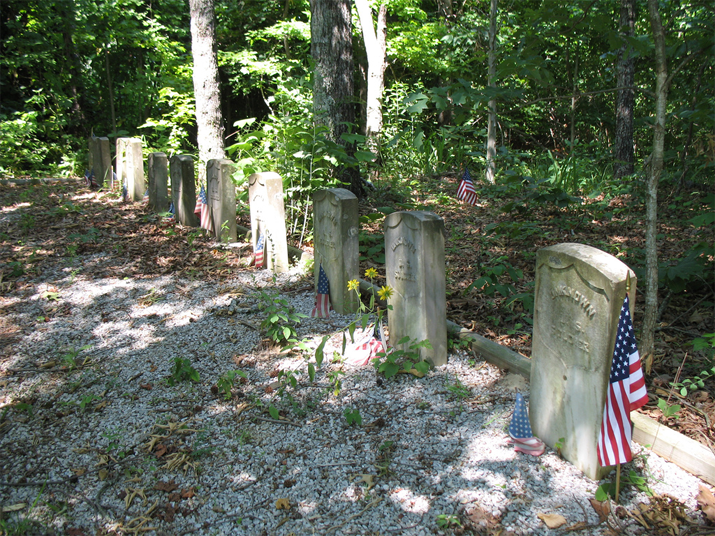
On Decoration Day, 1871, Frederick Douglass gave the following address at the monument to the Unknown Dead of the Civil War at Arlington National Cemetery. It is a short speech, but one of the best of its type I’ve ever encountered. I’ve posted it before, but it think it’s something worth re-reading and contemplating every Memorial Day.
The Unknown Loyal Dead
Arlington National Cemetery, Virginia, on Decoration Day, May 30, 1871 Friends and Fellow Citizens: Tarry here for a moment. My words shall be few and simple. The solemn rites of this hour and place call for no lengthened speech. There is, in the very air of this resting-ground of the unknown dead a silent, subtle and all-pervading eloquence, far more touching, impressive, and thrilling than living lips have ever uttered. Into the measureless depths of every loyal soul it is now whispering lessons of all that is precious, priceless, holiest, and most enduring in human existence. Dark and sad will be the hour to this nation when it forgets to pay grateful homage to its greatest benefactors. The offering we bring to-day is due alike to the patriot soldiers dead and their noble comrades who still live; for, whether living or dead, whether in time or eternity, the loyal soldiers who imperiled all for country and freedom are one and inseparable. Those unknown heroes whose whitened bones have been piously gathered here, and whose green graves we now strew with sweet and beautiful flowers, choice emblems alike of pure hearts and brave spirits, reached, in their glorious career that last highest point of nobleness beyond which human power cannot go. They died for their country. No loftier tribute can be paid to the most illustrious of all the benefactors of mankind than we pay to these unrecognized soldiers when we write above their graves this shining epitaph. When the dark and vengeful spirit of slavery, always ambitious, preferring to rule in hell than to serve in heaven, fired the Southern heart and stirred all the malign elements of discord, when our great Republic, the hope of freedom and self-government throughout the world, had reached the point of supreme peril, when the Union of these states was torn and rent asunder at the center, and the armies of a gigantic rebellion came forth with broad blades and bloody hands to destroy the very foundations of American society, the unknown braves who flung themselves into the yawning chasm, where cannon roared and bullets whistled, fought and fell. They died for their country. We are sometimes asked, in the name of patriotism, to forget the merits of this fearful struggle, and to remember with equal admiration those who struck at the nation’s life and those who struck to save it, those who fought for slavery and those who fought for liberty and justice. I am no minister of malice. I would not strike the fallen. I would not repel the repentant; but may my “right hand forget her cunning and my tongue cleave to the roof of my mouth,” if I forget the difference between the parties to hat terrible, protracted, and bloody conflict. If we ought to forget a war which has filled our land with widows and orphans; which has made stumps of men of the very flower of our youth; which has sent them on the journey of life armless, legless, maimed and mutilated; which has piled up a debt heavier than a mountain of gold, swept uncounted thousands of men into bloody graves and planted agony at a million hearthstones — I say, if this war is to be forgotten, I ask, in the name of all things sacred, what shall men remember? The essence and significance of our devotions here to-day are not to be found in the fact that the men whose remains fill these graves were brave in battle. If we met simply to show our sense of bravery, we should find enough on both sides to kindle admiration. In the raging storm of fire and blood, in the fierce torrent of shot and shell, of sword and bayonet, whether on foot or on horse, unflinching courage marked the rebel not less than the loyal soldier. But we are not here to applaud manly courage, save as it has been displayed in a noble cause. We must never forget that victory to the rebellion meant death to the republic. We must never forget that the loyal soldiers who rest beneath this sod flung themselves between the nation and the nation’s destroyers. If today we have a country not boiling in an agony of blood, like France, if now we have a united country, no longer cursed by the hell-black system of human bondage, if the American name is no longer a by-word and a hissing to a mocking earth, if the star-spangled banner floats only over free American citizens in every quarter of the land, and our country has before it a long and glorious career of justice, liberty, and civilization, we are indebted to the unselfish devotion of the noble army who rest in these honored graves all around us.
______________
Image: Graves of nine unknown Federal soldiers in Pontotoc County, Mississippi. Photo by Flickr user NatalieMaynor, used under Creative Commons license. Text of Douglass speech from Philip S. Foner and Yuval Taylor, Frederick Douglass: Selected Speeches and Writings.




 Dead Confederates, A Civil War Era Blog
2 comments