TSHA’s Handbook of Civil War Texas
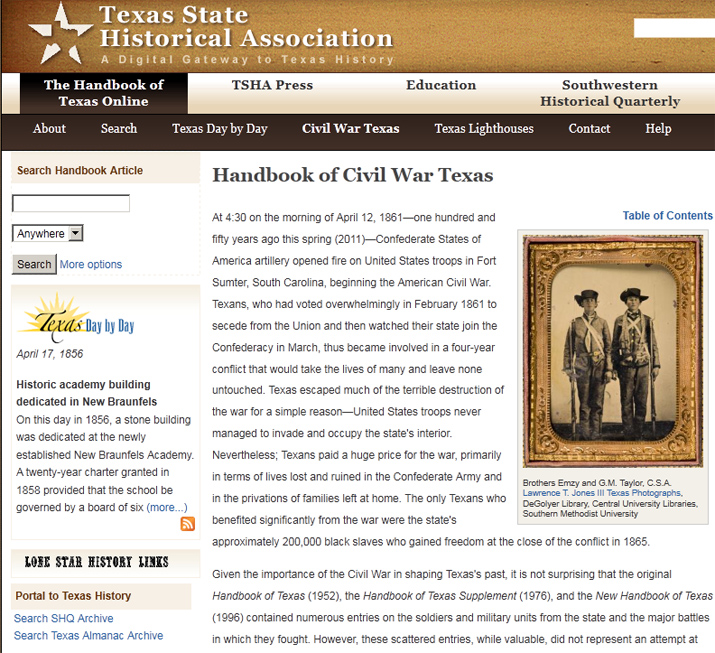
Regular commenter Dick Stanley, who blogs at the 13th Mississippi Infantry and Knoxville 1863, the Novel, points to a new resource available from the Texas State Historical Association, the online Handbook of Civil War Texas. It’s not a separate website, but rather an index to Civil War-related material already covered in the Handbook of Texas, which has for many years been a standard reference for anyone with a serious interest in Texas history. The Handbook began as an actual two-volume handbook, published in 1952; a supplementary volume was released in 1976. The New Handbook of Texas appeared in 1996 — six large volumes of around 1,200 pages each, and at several hundred dollars not a practical purchase for many — but the following year the TSHA began putting the Handbook online, opening up a valuable resource to all.
__________________

Ancestry Continues to Impress
I’ve been using Ancestry.com for a year or so now. While it’s been a tremendous help in tracing my own family lineage, it’s become invaluable in tracking some of the people I’ve discussed here on the blog. Even if I never looked up another family member again, I’d still consider it worthwhile. It’s not cheap, but for the blogging I do, access to online resources like Ancestry, Footnote and GenealogyBank are simply part of the price of admission.
But they continue to impress with new additions. Who would’ve though of this:
The Military Headstone Archive: a one-of-a-kind new collection
Ancestry.com has undertaken an ambitious project to chronicle military headstones, starting with 33 Civil War cemeteries. This interactive collection lets you search gravesites, attach headstone images to your tree and find GPS coordinates for your soldier ancestor’s final resting place. You’ll also get rich context about some of the Civil War’s most important battlefield cemeteries.
In practice, the system is a little dodgy. As a test, I looked up several headstone photos on Flickr, more-or-less- at random, and tried to find them in the new database. I couldn’t locate the first few, but did find that of David Mowery listed as below, at Shiloh:

. . . and this one for William E. Miller at Gettysburg:

One more tool in the collection, and a welcome one.
______________

North Carolina SCV Has Its Story; Is Sticking to It
 A couple of folks have pointed me toward a recent article in the Wall Street Journal, about efforts in Virginia and North Carolina, tied to the Civil War Sesquicentennial, to compile a more accurate count of each of those states’ war-related deaths. So far, researchers in North Carolina are estimating that state’s count as being roughly 20% less than the usually-accepted estimate of 40,000, while the total number of deaths now documented for Virginia troops is more than double an early count of around 15,000. (Be sure also to check out the additional features.)
It’s not surprising at all to me that modern researchers are coming up with different numbers than various compilers did 100+ years ago. What does surprise me is the disinterest in, or outright hostility to, the idea of doing such work in the first place:
With the 150th anniversary of the Civil War beginning in mid-April, that small number could spark a big controversy between two states with rivalries that date back to the great conflict. Some Civil War buffs in North Carolina have already accused Mr. Howard of attempting to diminish the state’s heroism and the hardship it suffered. “Records were a whole lot fresher 150 years ago,” says Thomas Smith Jr., commander of the North Carolina Sons of Confederate Veterans, who is suspicious of Mr. Howard’s new count.
“I don’t care if Virginia has two people more who died, or a hundred more,” says Michael Chapman, a 55-year-old videographer from Polkton, N.C., who used to head up the local Sons of Confederate Veterans camp. He calls the recounts “irrelevant.”
I don’t buy the “fresher” argument at all. A written record is a written record, and remains as accurate or reliable (or not) over the passage of time. They don’t go stale; that’s why we archive them.
Certainly it’s possible that some records available a century and more ago have since been lost or destroyed, but against that we now have easy access to electronic records, digital copies, online newspapers, easy cross-referencing, and indexed census rolls, which earlier generations never had access to. In my view, the benefits of the latter far outweigh the limitations of the former. No count will be absolutely accurate, of course, but there’s no question that researchers now have far better capability to do the work than did their predecessors in the 1860s. Unless there’s something very fundamentally flawed with the modern researchers’ methodology — which is not alleged — their work should be able to get us closer to the real answer, to the extent that it’s knowable at all.
Michael Chapman has weighed in on his state’s sesquicentennial program before, and shown himself to be somewhat less than even-tempered on the subject. (You really have to read through the whole comments thread to get the full effect.) But still, progress is progress, and this time he didn’t refer to those who have differing views as Nazis, or compare North Carolina Unionists to al Qaeda sleeper cells. Baby steps, Michael, baby steps.
What I don’t quite get is that these two men, one a current state commander in the SCV, and the other former local camp commander, are both dismissive (if not openly hostile) to this effort to get a more accurate count of their state’s war dead. To me, that’s a no-brainer. And while they may or may not be speaking officially for the North Carolina SCV, they do seem to offer their roles in that group as their authority on the subject. Their objections seem not to be methodological, but to the idea of doing the work at all.
Why would that be, exactly? And would they be opposed to this work if it were showing more North Carolina casualties, rather than fewer?
Update: The lead researcher on the North Carolina project, Josh Howard, notes in the comments below that the Leonidas L. Polk SCV Camp of Garner, North Carolina, and one of its members, Charles Purser, have actually provided substantial assistance in the effort to obtain an accurate count of North Carolina’s war dead. Credit where it’s due.
_________________
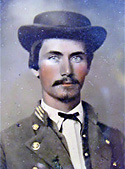
Image: Captain Jesse Sharpe Barnes, Co. F, 4th North Carolina Infantry, killed on May 31, 1862, at Seven Pines, Virginia. Library of Congress.

“So simple that any man able to read and write can work it”

Above, “the signal telegraph train as used at the battle of Fredericksburg,” by Alfred R. Waud. Below, the image as it appeared in Leslie’s Illustrated Newspaper in January 1863.The engravers have made the figures larger relative to the overall scene, making the image more compact, without changing its basic elements.
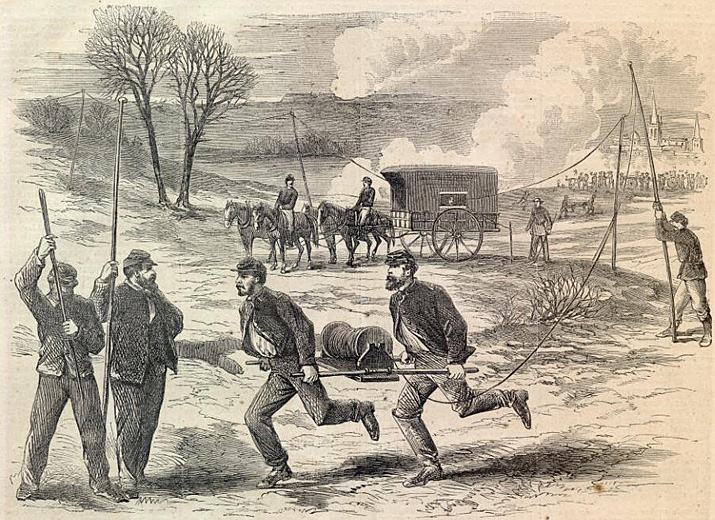
The paper noted that
on this page Mr. Waud has illustrated for us the Army telegraph. Of this important institution he says: “The army signal-telegraph has been so far perfected that in a few hours quite a large force can be in constant connection with head-quarters. This, while a battle is progressing, is a great convenience. The wire used is a copper one insulated, raised on light poles, made expressly for the purpose, on convenient trees, or trailed along fences. The wire and the instrument can be easily carried in a cart, which as it proceeds unwinds the wire, and, when a connection is made, becomes the telegraph-office. Where the cart can not go the men carry the drum of wire by hand. In the picture the cart has come to a halt, and the signal-men are hastening along—some with the drum, while others with crow-bars make the holes for the poles, upon which it is rapidly raised.
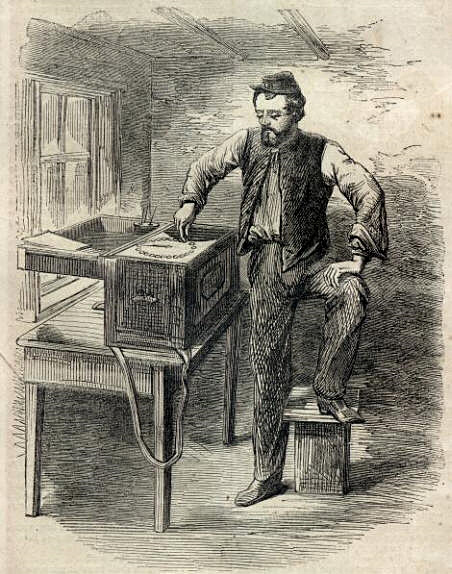
The machine is a simple one, worked by a handle, which is passed around a dial-plate marked with numerals and the alphabet. By stopping at the necessary letters a message is easily spelled out upon the instrument at the other end of the line, which repeats by a pointer every move on the dial-plate. The whole thing is so simple that any man able to read and write can work it with facility.”
This is a technology I didn’t think came until later — telegraphy without telegraphers having to know Morse. The device in question is a Beardslee Telegraph Machine, introduced in 1862. It was apparently not quite so simple to operate as Leslie’s claimed it to be, and had other disadvantages including a slow transmission rate compared to a traditional key, and a lack of power.
Nonetheless: remarkable!
_______________________
Waud illustration, Library of Congress. Leslie’s Illustrated News images via SonoftheSouth.





 Dead Confederates, A Civil War Era Blog
4 comments