A Hot Mess of Historiography
I haven’t written much here about the new book by Ann DeWitt and Kevin M. Weeks, Entangled in Freedom, a novel for young people. The book’s protagonist, Isaac Green, is a young black slave in Civil War Georgia who follows his master into the Confederate Army and, by virtue of having memorized the Bible, quickly finds himself voted by the white soldiers to be the regimental chaplain. I’ve tried to avoid the subject in part because Levin has been all over it since the book was announced, and partly because I had intended to publish here an e-mail interview with Ms. DeWitt, trying to get at some of her background and thinking in writing and publishing the work. I contacted her a couple of weeks ago asking if she’d be willing, and she promptly responded positively. But I got lazy and didn’t send her my questions and, in the meantime, the debate over the book has intensified considerably. Last month Mr. Weeks sent a copy of the book and an angry letter to Levin’s employer — very bad form, that — accusing Levin of “slander” and trying to have the book “silenced.” In the back-and-forth that’s followed, both on Levin’s site and Ms. DeWitt’s, both sides have laid out their cases (and likely will continue to do so), and I’m not sure that there’s any point now in doing the e-mail interview. I don’t think it will illuminate much, since neither “side” in the debate is even speaking the other’s language.
Here is what I mean about not speaking each other’s language: Levin’s (and others’) criticisms of the book — what’s known of it — revolved entirely around the historicity of it, how well the fictional story fits within the known historical framework of that time and place. In response, Ms. DeWitt counters with a response outlining her values and motivations in writing the book:
Imagine writing a novel for young adults which (1) espouses the sanctity of marriage, (2) does not contain profanity, (3) promotes earning ones way in America, (4) advocates true friendship, (5) demonstrates the positive progression of America over the last 150 years, and (6) highlights the strength of the family unit; yet, the novel is dubbed “nonsense” by a recognized Virginia Civil War journalist and historian.
The above six principles are the family narratives of Ann DeWitt. I have no 19th century written documentation of these six family values because they were passed down to me verbally by my ancestors. I do not secretly hide them but proudly share them with the world.
It’s clear that, far from defending the research and historical background presented in the novel, she doesn’t understand the criticism of it. None of those “principles” have anything to do with the historical accuracy of the setting or the plot. One could write such a work in any of a thousand settings, and and frame it in a way that is, if not historically documented, at least plausible. Laura Ingalls Wilder is the obvious example of doing this, although she had the advantage of having actually lived the life she described in her writing.
DeWitt asserts that “these six family values because they were passed down to me verbally by my ancestors.” Okay, fine, but no one’s asking for documentation of her family values. This statement reveals something much more essential here, specifically that, in Ms. DeWitt’s view, criticizing the historical accuracy of the book is criticizing her family, and her values. She sees it not as criticism of her work, but as a personal attack on her. It’s not the same thing at all. I don’t doubt that Ms. DeWitt is a very well-intentioned and sincere person, but having good intentions and a strong moral compass is not enough when it comes to presenting a believable and realistic picture of the past.
Ms. DeWitt and Mr. Weeks haven’t written an historical novel; they’ve written a moral allegory nominally set in the Civil War. But it’s not the South that existed in 1860s or, for that matter, the 1960s. Ms. DeWitt and Mr. Weeks have constructed a Confederacy where wise people “in the Deep South knew all the time that black people are cut from the same board of cloth as whites,” and “knew that slavery wasn’t going to last always.” Alexander Stephens and George Wallace never existed in this version of the American South. Ms. DeWitt and Mr. Weeks have the notion of historical fiction exactly backwards; the goal is to tell a story that fits within the larger, factual context of its setting, not to create a fictional history that supports the particular story one wants to tell for other reasons.
The passage Levin posted recently shows that the historical framework for the novel is based largely on Black Confederate factoids and memes culled from the web. Just that one short passage — 648 words — crams in multiple Black Confederate bullet points, strung together by stilted dialogue. Only a tiny percentage of Confederate soldiers owned slaves? Check. Harper’s Weekly reference to black soldiers at Manassas? Check. Loyal slaves will be delivered “a great prize?” Check. Slaves and owners who “get along fine?” Check.
In defending her book and its thesis, Ms. DeWitt has made some extremely odd arguments — so odd or tangential that one might guess that they were meant in jest, though I don’t think they were. She argues — in all sincerity, it seems — that the slaves who went to war with their masters as body servants were the historical equivalent of present-day, college-educated executive assistant, and then extends that analogy further to the entourage that a modern-day U.S. president travels with. She openly wonders why “mark-and-capture,” a technique used to estimate wildlife populations that involves trapping animals, tagging them and releasing them back into the wild to be recaptured and counted at a later date, hasn’t been used to calculate the numbers of Black Confederates. DeWitt does an online search of Confederate pension records from Alabama’s state archives under the surname “Slave” (!), but says cryptically that the archive “does not document if these African-Americans fought for the Union or the Confederate States Army.” DeWitt lists over two hundred men who received “colored” pensions from the State of Tennessee, helpfully adding that “Colored = Black = African-American,” but omits the fact that Tennessee differentiated these from “S” pensions, issued to soldiers. She hints — both on her website and in the novel — that enlistment or service records that do not explicitly identify the subject as white should be taken as de facto evidence of prospective Black Confederates: “CSA enlistment forms and pension applications did not include race, so . . . the world may never know the total number of African-Americans (Blacks) who served in any and all capacities of the American Civil War.” And then there are explanations that are just odd non-sequiturs:
African-Americans want to know their family history for personal as well as medical reasons. We have turned to scientific DNA testing in order to trace our family lineage. As a human being, it is offensive when historians overall imply that my ancestors in South Carolina were not smart enough to band together and run across a field of dying Confederate soldiers to join the Union Army.
As historiography, this is a hot mess. I don’t know Ms. DeWitt; she seems like a very nice, well-intentioned person who’s deeply devoted to her family and its traditions. That’s a good thing, but I fear that she assumes oral tradition, passed from generation to generation, to be sufficient in not only interpreting her own family’s history — I’ve addressed this before with regard to my own Confederate ancestors — but also in understanding the South, the Confederacy and the fundamental nature of the white supremacist slave society the Confederacy was established to protect and promote. The historical world she presents in Entangled in Freedom isn’t based on research or academic study; it’s the product of intuition and her own, deeply-held faith. But those things are not enough, and to frame what’s intended as an uplifting and inspiring personal story within such a farcical historical context does a real disservice to the public generally, and to students particularly.
It’s a missed opportunity.

Nothing to Bragg About
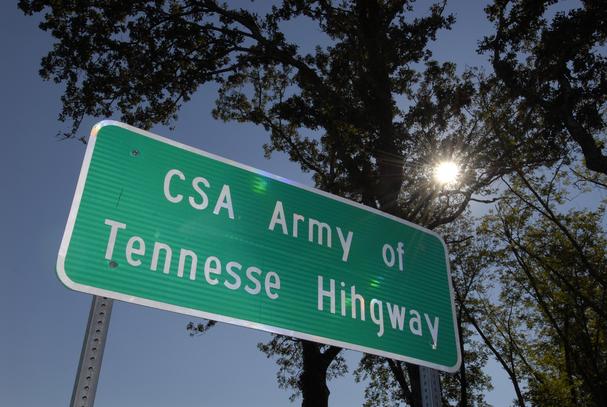
David Woodbury at of Battlefields and Bibliophiles notes some problems with spelling down at the Georgia Department of Transportation’s sign shop.
________________________________
Image: AP Photo/Chattanooga Times Free Press, Laura-Chase McGehee.

Old Dominion Shows the Way

Bloggers Ta-Nehisi Coates and Kevin Levin both call attention to Virginia Governor Bob McDonnell’s announcement Friday that next spring, Confederate History Month will be replaced by Civil War in Virginia Month. This is not only good news, but the governor also chose to make his announcement at the highest-profile venue possible, the 2010 Signature Conference of the Virginia Sesquicentennial of the American Civil War Commission.
The legacies of the Civil War still have the potential to divide us. But there is a central lesson of that conflict that must bond us together today. Until the Civil War, the founding principle that all people are created equal and endowed by their Creator with unalienable rights was dishonored by slavery. Slavery was an evil and inhumane practice which degraded people to property, defied the eternal truth that all people are created in the image and likeness of God, and left a stain on the soul of this state and nation. For this to be truly one nation under God required the abolition of slavery from our soil. Until the Emancipation Proclamation was issued and the Civil War ended, our needed national reconciliation could not begin. It is still a work in progress.
150 years is long enough for Virginia to fight the Civil War.
“Now, on the eve of this anniversary, is a time for us to approach this period with a renewed spirit of goodwill, reverently recalling its losses, eagerly embracing its lessons, and celebrating the measure of unity we have achieved as a diverse nation united by the powerful idea of human freedom.
A modern Virginia has emerged from her past strong, vibrant and diverse. Now, a modern Virginia will remember that past with candor, courage and conciliation. . . .
It’s time to discuss openly how we as Americans, black, white and brown can promote greater reconciliation and trust and greater access to the American Dream for all, so that there is more peace in our hearts and homes, schools and neighborhoods.
This speech is direct, comprehensive, and eloquent. In this address, Bob McDonnell acknowledges and embraces the fundamental truth that so many are unwilling to — that one cannot separate Confederate history from the Civil War, nor the Civil War from this nation’s long, dark legacy of slavery. They are all aspects of the same heritage we share, inextricably intertwined and knotted together.
I have been critical of McDonnell’s original Confederate History Month proclamation — “tone deaf” is about the most charitable thing one can say about it — but today’s remarks really do clean the slate. And while the governor certainly caught a lot of (well-deserved) hell for that earlier document, I’m not going to take a cynical view of his motivations in reversing course here. As Coates said, “You can not ask politicians to do the right thing, and then attack them for doing it.” Amen.
Good for Bob McDonnell. Good for Virginia. Good for the South, and good for our nation. I hope that in this area, has it has so often throughout American history, Virginia sets an example for others to follow.
Added Monday, September 27: Via TPMMuckraker, the SCV responds to McDonnell’s move:
“Our organization is terribly disappointed by this action,” [Virginia SCV Division Commander Brag] Bowling told TPMmuckraker. “[McDonnell] succumbed to his critics, people who don’t support him anyway. And the vast majority of citizens of Virginia support Confederate History Month.”
He said he had spoken with the governor’s office and told them the same thing. He said “Civil War In Virginia Month” is a poor substitute.
“Nobody’s ever been able to reason with me and tell me why we’re honoring Yankees in Virginia,” Bowling said. “The only northerners in Virginia were the ones that came to Virginia and killed thousands of Virginia citizens when they invaded.”
I suppose it’s too much to ask for the SCV to actually respond to the detailed and specific content of McDonnell’s address; instead Bowling drags out the same tired dog-whistles about Yankees and “invasion.” Seriously, folks: get yourselves some new talking points.
Full text of the governor’s address after the jump.
“Possessed of an irascible temper, and naturally disputatious.”

Over at KNOXVILLE 1863, the novel, Dick Stanley has a couple of posts up on Confederate General Braxton Bragg. They paint a picture of a man who was decidedly not popular, either with his men or with his fellow senior officers. He was a prickly man, very much caught up in protocol and form. In his own memoir, Ulysses S. Grant echoes some of their impressions of the man — honest, industrious, and decidedly formal with colleagues. Grant goes on to repeat an anecdote about Bragg from the prewar Army which, accurate or not, vividly captures Bragg’s obsession with procedure:
Bragg was a remarkably intelligent and well-informed man, professionally and otherwise. He was also thoroughly upright. But he was possessed of an irascible temper, and was naturally disputatious. A man of the highest moral character and the most correct habits, yet in the old army he was in frequent trouble. As a subordinate he was always on the lookout to catch his commanding officer infringing his prerogatives; as a post commander he was equally vigilant to detect the slightest neglect, even of the most trivial order.
I have heard in the old army an anecdote very characteristic of Bragg. On one occasion, when stationed at a post of several companies commanded by a field officer, he was himself commanding one of the companies and at the same time acting as post quartermaster and commissary. He was first lieutenant at the time, but his captain was detached on other duty. As commander of the company he made a requisition upon the quartermaster–himself–for something he wanted.
As quartermaster he declined to fill the requisition, and endorsed on the back of it his reasons for so doing. As company commander he responded to this, urging that his requisition called for nothing but what he was entitled to, and that it was the duty of the quartermaster to fill it. As quartermaster he still persisted that he was right. In this condition of affairs Bragg referred the whole matter to the commanding officer of the post. The latter, when he saw the nature of the matter referred, exclaimed: “My God, Mr. Bragg, you have quarreled with every officer in the army, and now you are quarreling with yourself!”
_____________________________

“He died without a struggle.”

Army of the Potomac
October 6th, 1862Dear Brother — I was surprised to hear of the death of Henry. I had heard that he was wounded, and got a furlough of two days to go and find him. Starting when your letter came to me, I wandered all day over the field at Antietam. I kept going for miles and miles, looking at every grave I saw, and was about to give up the search from fatigue and hunger (for I had already gone over twenty five miles), but I kept on till dark, and just as I was about to lie down for the night, I saw a few graves under an apple tree, a few rods off, and there I found the grave of our dear brother. It was a solemn time for me as I sat by the grave.
I found a person who watched with him, and was present at his burial. He was shot in the early part of the action. He died without a struggle. It will be a hard struggle for mother. To think he was taken away in so short a time after leaving home, while I have been engaged in six or seven battles! But the thought of his dying so peacefully (and no one can doubt his Christian character or fitness to meet his Maker) will lessen the grief of our mother, and brothers, and sisters. We have lost him; but this we know, he was a Christian, and showed a Christian spirit in all his actions. It seems like a dream. As I look from the “Heights” (Bolivar) [near Harper’s Ferry], I can see the rebel army, and a battle is expected in a few days. I am willing to meet them, no matter how hard the battle, or how long and forced the marches are, if we can only finish the war, or make a beginning of the end. I may too, like Henry, be shot down. If I die, I die in the faith of Christ, and have no fears as to what awaits me. I am happy wherever I am. I can lie down with as much ease, and rest for the night within range of the enemy’s guns, knowing that at dawn we may meet face to face, as I could at home upon my bed. It is near midnight, and I must close.
Sergeant S. P. Keeler
Corporal Henry Keeler enlisted in Company C of the 14th Connecticut Infantry on August 20, 1862. He died four weeks later when the 14th charged Confederate positions along a road later called “Bloody Lane.” Corporal Keeler’s remains were later returned for burial at Ridgefield, Connecticut.
The author, Silas P. Keeler of Waterbury, Connecticut, was a twenty-one-year-old sergeant in Company E, 8th Connecticut Infantry. He had originally enlisted in the 1st Connecticut Infantry in April 1861, mustered out a few months later, and re-enlisted in the Eighth in September 1861. He mustered out of the service in February 1865.
Although the addressee of Sergeant Keeler’s letter is unknown, it seems clear it was written to a family member, with the intent that it would be shared. In addition to assuring that Henry had died “without a struggle ” and the typical assurances of religious faith and comfort in the face of danger, Keeler also mentions that “I found a person who watched with him, and was present at his burial.” This was an important consideration in the 19th century, that even when nothing could be done for the man, he did not die alone, and had a mourner at his interment. Sergeant Keeler was making sure that his family knew that Henry had died a “good” death, as it was understood at the time. Even in his own circumstances, the writer was focused entirely on assuaging the fears and unease of his family in Connecticut.
Letter from Soldier’s Letters from Camp, Battlefield and Prison, ed. by Lydia Minturn Post (New York: Bunce & Huntinton, 1865). Image: “Looking for a Friend,” by Walton Taber.

“They lay as thick as autumn leaves”
Friday, September 19, 1862, near Sharpsburg, Maryland:
I took the delay to ride over the field of battle. The Rebel dead, even in the woods last occupied by them, was very great. In one place, in front of the position of my corps, apparently a whole regiment had been cut down in line. They lay in two ranks, as straightly aligned as on a dress parade. There must have been a brigade, as part of the line on the left had been buried. I counted what appeared to be a single regiment and found 149 dead in the line and about 70 in front and rear, making over 200 dead in one Rebel regiment. In riding over the field I think I must have seen at least 3,000. In one place for nearly a mile they lay as thick as autumn leaves along a narrow lane cut below the natural surface, into which they seem to have tumbled. Eighty had been buried in one pit, and yet no impression had apparently been made on the unburied host. The cornfield beyond was dotted all over with those killed in retreat.
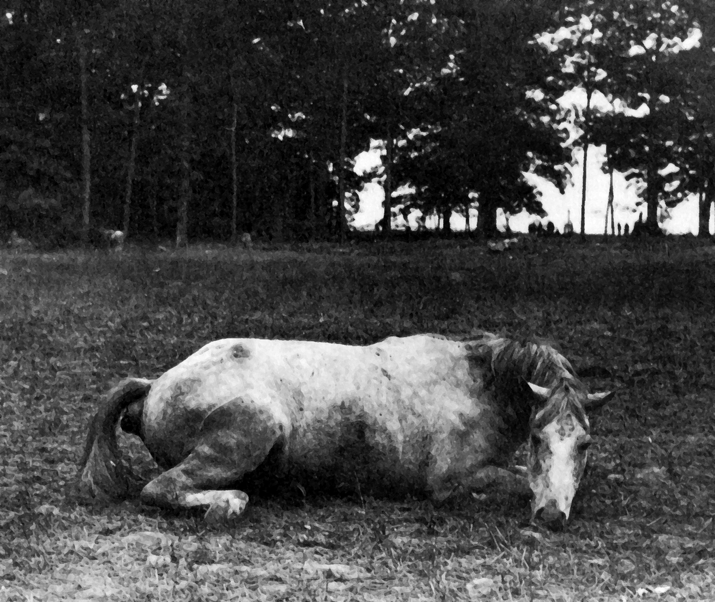
The wounded Rebels had been carried away in great numbers and yet every farmyard and haystack seemed a large hospital. The number of dead horses was high. They lay, like the men, in all attitudes. One beautiful milk-white animal had died in so graceful a position that I wished for its photograph. Its legs were doubled under and its arched neck gracefully turned to one side, as if looking back to the ball-hole in its side. Until you got to it, it was hard to believe the horse was dead.
Brigadier General Alpheus S. Williams,
Division Commander, Army of the Potomac
Alpheus S. Williams, Milo Milton Quaife (eds.), From the Cannon’s Mouth: The Civil War Letters of General Alpheus S. Williams (Detroit: Wayne State, 1959). Image: Library of Congress.
________________________

“Sympathies and antipathies are disabilities in an historian.”
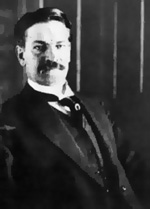 Archibald Gracie IV (1859-1912, left) is today remembered primarily as a survivor of the Titanic disaster, who wrote one of the better first-person accounts of the sinking. Gracie, who had attended (but not graduated from) West Point, was an energetic amateur historian, and was particularly obsessed with the Battle of Chickamauga, in which his father, Archibald Gracie III (1832-1864), had served as a Confederate brigade commander. The younger Gracie spent years researching the battle, work which culminated in his December 1911 publication, The Truth About Chickamauga. Gracie took an extended trip to Europe after completing the volume, booking return passage on the soon-to-be-infamous White Star liner. He apparently hadn’t quite gotten Chickamauga out of his system for, as the late Walter Lord wrote in The Night Lives On, “he cornered Isidor Straus, on whom he had foisted a copy of The Truth About Chickamauga. The book strikes one reader as 462 pages of labored minutiae, but Mr. Straus was famous for his tact; he assured the colonel that he had read it with ‘intense interest.'”
Also not a fan of The Truth About Chickamauga: Ambrose Bierce. The famous writer had served at Chickamauga on the staff of Brigadier General William Babcock Hazen (1830-1887), personally witnessed several key events in the battle, had published several pieces on the action, and apparently gave Gracie at least one face-to-face interview. But Bierce found Gracie’s efforts at telling the truth about Chickamauga to be badly and willfully biased. Here is the opening paragraph of a letter Bierce wrote to Gracie in March 1911, several months before the latter’s book went to press:
March 9, 1911
From the trouble that you took to consult me regarding certain phases of the battle of Chickamauga I infer that you are really desirous of the truth, and that your book is not to belong to that unhappily too large class of books written by “bad losers” for disparagement of antagonists. Sympathies and antipathies are disabilities in an historian that are hard to overcome. That you believe yourself devoid of this disability I do not doubt; yet your strange views of Thomas, Granger and Brannan, and some of the events in which they figured, are (to me) so obviously erroneous that I find myself unable to account for them on the hypothesis of an entirely open mind. All defeated peoples are “bad losers” – history supplies no examples to the contrary, though there are always individual exceptions. (General D. H. Hill is an example of the “good loser,” and, with reference to the battle of Chickamauga, the good winner. I assume your familiarity with his account of that action, and his fine tribute of admiration to some of the men whom he fought — Thomas and others.) The historians who have found, and will indubitably continue to find, general acceptance are those who have most generously affirmed the good faith and valor of their enemies. All this, however, you have of course considered. But consider it again.
Ouch.
______________________
Letter from Phantoms of a Blood-Stained Period: The Complete Civil War Writings of Ambrose Bierce (Russell Duncan and David J. Klooster, eds.)

Spoons Butler, Yellow Jack and the Crescent City
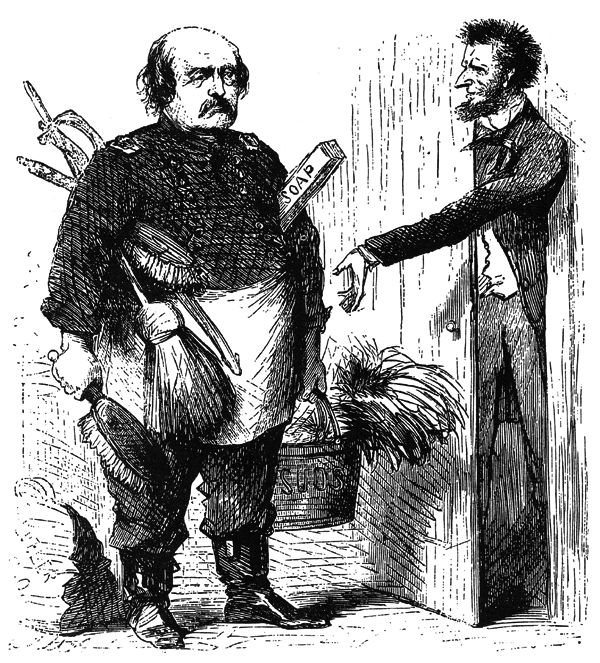
Uncle Abe: “Hell! Ben, is that you? Glad to see you!’
Butler: “Yes, Uncle Abe. Got through with that New Orleans Job. Cleaned them out and scrubbed them up! Any more scrubbing to give out?
_____________
Ron Coddington, blogger and author of the Faces of the Civil War series, has a new post up on Union General Benjamin Franklin Butler. Coddington rightly notes that the general “is not remembered especially well by history.” That’s certainly true. Between his ineptitude as a field commander and the vilification of him resulting from the sharp hand he used in the occupation of New Orleans, Butler gets pretty short shrift in most popular accounts. But as Ron points out, Butler — a former Democrat who at that party’s national convention in 1860 supported Jefferson Davis for president of the United States — was transformed by his war experience into a radical Republican and an ardent champion of civil rights for African Americans. He drafted the Ku Klux Klan Act, signed into law by President Grant in 1871, and (with Charles Sumner) wrote the Civil Rights Act of 1875. The latter legislation was subsequently struck down by the Supreme Court, and many of its key provisions were never enacted until the Civil Rights Act of 1964 — nearly eighty years after they were first set out. As Ron observes, “Butler was a man ahead of his time.”
Butler is often cited as the most infamous example of the Union’s “political” generals, men with little or no military experience who were appointed to senior commands based on their political influence in civilian life. His reputation, at least in the South, is defined by his tenure in New Orleans, where he attained the sobriquet “Beast” Butler for his intolerance of any show of disrespect for his occupying soldiers, and his vigorous enforcement of the rules of occupation. (He infamously hanged a Confederate sympathizer for tearing down the Federal flag from the U.S. Mint.) What’s less known, unfortunately, is the remarkable success Butler’s administration of the city had in reducing its infamously-high toll from that scourge of the South, yellow fever. As Andrew McIlwaine Bell explains in Mosquito Soldiers: Malaria, Yellow Fever and the Course of the American Civil War, New Orleans had a long and horrific history with the disease in the decades before the war, particularly in the 1850s, resulting in the deaths of over eighteen thousand people. The vomito negro was particularly hard on immigrants and visitors to the cities from Northern states; the illness was often referred to as the “strangers’ disease.” Butler was well aware of New Orleans’ reputation as a sickly city, and immediately set out to do something about it.
After consulting with his medical staff and a few local doctors (some of whom were openly hostile), Butler decided that yellow fever was an imported malady that required local unsanitary conditions to survive. As a result, he chose to implement simultaneously the two strategies best known at the time for preventing the spread of the disease-a strict quarantine and fastidious sanitation measures. A quarantine station was set up seventy miles below the city and its officers given firm orders to detain any potentially infected vessels for forty days. In addition, a local physician was appointed to inspect incoming ships at the station and was threatened with execution if any vessels known to be carrying yellow fever were allowed to proceed upriver. These new rules caused a minor diplomatic row with the Spanish; who believed that their ships arriving from Cuba (where yellow fever was endemic) were being unfairly targeted for lengthy detentions. Butler assured Senor Juan Callejon, Her Catholic Majesty’s consul in New Orleans, that he was not imposing “any different quarantine upon Spanish vessels sailing from Havana.” To the relief of the State Department, Spain eventually dropped the matter but not before firing off a few strongly worded communiques.
In town Butler put an army of laborers to work round the clock flushing gutters, sweeping debris, and inspecting sites thought to be unclean such as stables, “butcheries;’ and New Orleans’s many “haunts of vice and debauchery.” Steam-powered pumps siphoned stagnant water from basins and canals into nearby bayous. The northern press picked up the story and ran articles praising Butler’s methods. “He will probably demonstrate before the year is out that yellow fever, which has been the scourge of New Orleans, has been merely the fruit of native dirt, and that a little Northern cleanliness is an effectual guarantee against it,” predicted the editors at Harper’s Weekly. The magazine published a cartoon five months later which featured the general holding a soap bucket and scrub brushes in front of an approving Abraham Lincoln.
In addition to cleaning up the place, Butler also imposed a strict quarantine. How effective were Butler’s efforts? According to Bell, during the fever season of 1862 — the hottest months of late summer and early fall, ending with the first cold front — the number of fatalities to yellow fever in the Crescent City were two.
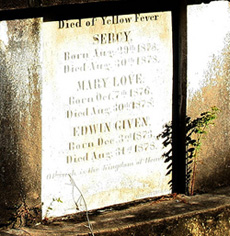 Such a small number is hard to credit, but it appears to be true. Furthermore, deaths remained astonishingly low during the next three years of Federal military occupation. A total of eleven New Orleanians died of yellow fever between 1862 and 1865. The year following the war, when the city was reopened to trade and immigration and local control was returned to civilian authorities under Reconstruction, 185 died. The following year, 3,107. New Orleans quickly slipped back into its old, antebellum pattern of mild years punctuated by terrible epidemics; over four thousand died in 1878, and the following year the disease famously claimed the life of former General John Bell Hood, his wife and one of his eleven children.
Today, Ben Butler is too often viewed as a curious admixture of ogre and buffoon, something of a cross between William Tecumseh Sherman and Oliver Hardy. But the reality is, as always, more complex. Whatever else one may say about his hard-handed rule in New Orleans, there’s little doubt that his efforts in both enforcing a quarantine and cleaning up the city made a tremendous difference, and saved many lives that would have a been lost otherwise even in a “mild” year.
____________________
Image: Harper’s Weekly, 1863, via Abraham Lincoln’s classroom; tomb of Sercy (newborn), Mary Love (22 months) and Edwin Given Ferguson (4 years), who died of yellow fever in New Orleans on August 30 and 31, 1878, via NOLA Graveyard Rabbit.

The Gettysburg Casino
This is a great video, and hits exactly the right chord. For what it’s worth, Matthew Broderick’s g-g-grandfather fought on Culp’s Hill with the 20th Connecticut Infantry. Not sure why this wasn’t mentioned in the video; it’s one of those small details that mean a lot when it comes to making the case for the preservation of Gettysburg.
___________
h/t Kevin Levin.

Great Dialogue Makes Great Writing
In the modern world of DVD, TiVo and streaming online video, there’s increasingly a premium on television and film that has great replay value, something you want to see not just once, but again and again over a long period. More often than not great television shows and movies aren’t driven as much fast-paced action or spectacular scenery, but by the interplay between the characters, usually by dialogue. Dialogue has to to be crisp, it has to be tight, and it has to be believable. Great dialogue makes for great writing, great television, great film, and the best writers, regardless of their medium, have to master it.
Eighteen-year-old Ambrose Gwinett Bierce signed on for a 90-day hitch in the 9th Indiana Infantry in April 1861, and in September that year later re-enlisted as a sergeant. He was promoted to full sergeant major in mid-1862, to second lieutenant in late November, and finally to first lieutenant in February 1863. He was discharged on January 25, 1865. In almost four years of service — all with Company C of the 9th Indiana — he saw heavy fighting at Shiloh, Chickamauga, Stones River, Resaca, and Pickett’s Mill. Bierce received a severe head wound at Kenensaw Mountain in June 1864, and spent several months on medical furlough. Bierce was one of the few American writers of the late 19th century who had experienced combat, and perhaps as a result, he tackled the Civil War both in prose and poetry without the maudlin, romantic lens through which most of his peer viewed the conflict. His “An Occurrence at Owl Creek Bridge,” first published in 1890, is today considered one of the classic short stories of American literature. But in this Civil War story, “Parker Adderson, Philospoher,” Bierce opens the story with dialogue that almost instantly sets the scene, and establishes the characters:
“Prisoner, what is your name?”
“As I am to lose it at daylight tomorrow morning it is hardly worth while concealing it. Parker Adderson.”
“Your rank?”
“A somewhat humble one; commissioned officers are too precious to be risked in the perilous business of a spy. I am a sergeant.”
“Of what regiment?”
“You must excuse me; my answer might, for anything I know, give you an idea of whose forces are in your front. Such knowledge as that is what I came into your lines to obtain, not to impart.”
“You are not without wit.”
“If you have the patience to wait you will find me dull enough to-morrow.”
“How do you know that you are to die to-morrow morning?”
“Among spies captured by night that is the custom. It is one of the nice observances of the profession.”
The general so far laid aside the dignity appropriate to a Confederate officer of high rank and wide renown as to smile. But no one in his power and out of his favor would have drawn any happy augury from that outward and visible sign of approval. It was neither genial nor infectious; it did not communicate itself to the other persons exposed to it–the caught spy who had provoked it and the armed guard who had brought him into the tent and now stood a little apart, watching his prisoner in the yellow candle-light. It was no part of that warrior’s duty to smile; he had been detailed for another purpose. The conversation was resumed; it was in character a trial for a captial offense.
“You admit, then, that you are a spy–that you came into my camp, disguised as you are in the uniform of a Confederate soldier, to obtain information secretly regarding the numbers and disposition of my troops.”
“Regarding, particularly, their numbers. Their disposition I already knew. It is morose.”

Good stuff here. The full text of “Parker Adderson, Philospher” below the fold:




5 comments