“I know of no other way for us to end the war than to retaliate”
Running through the 1865 compilation, Soldiers’ Letters from Camp, Battlefield and Prison, I was struck by this letter’s clarity and direct, matter-of-fact language.
Vidalia, La.
May 17th, 1864There has been a party of guerrillas prowling about here, stealing horses and mules from the leased plantations. A scouting party was sent out from here, in which was a company of colored cavalry, commanded by the colonel of a colored regiment. After marching some distance, they came upon the party of whom they were in pursuit. There were seventeen prisoners captured and shot by the colored soldiers. When the guerrillas were first seen, the colonel told them in a loud tone of voice to “Remember Fort Pillow.” And they did: all honor to them for it.
If the Confederacy wish to fight us on these terms, we are glad to know it, and will try and do our part in the contest. I do not admire the mode of warfare, but know of no other way for us to end the war than to retaliate.
Lieut. Anson T. Hemingway
70th U.S. Col. Regiment
I’ve seen no better example of the way one atrocity is used to justify another in wartime, fueling an endless, violent spiral of reprisal and revenge. And yet, knowing what happened at Fort Pillow, I cannot be sure I’d have tried to stop those cavalrymen. The desire for retribution is very strong, and very human.
 Anson Tyler Hemingway was born in East Plymouth, Connecticut in 1844. He moved to Chicago with his family at age ten. Hemingway enlisted in Company D of the 72nd Illinois Infantry and served with that regiment at Vicksburg. Mustered out of the service, he later joined Company H, 70th USCT as 1st Lieutenant and also served as provost martial of the Freedman’s Bureau in Natchez. Hemingway was mustered out of the service in March 1866, after which he attended Wheaton College. Two of Hemingway’s brothers had died in the war. After two years at Wheaton, Hemingway took a position as general secretary of the Chicago YMCA. He later established a real estate business in Oak Park. He died in 1926 at the age of 82.
Anson Hemingway’s grandson Ernest also enjoyed some success as a writer.
__________
Image: Wheaton College Archives and Special Collections
Lincoln Derangement Syndrome
New vocabulary word, boys and girls. Try to use it once a day:
Lincoln Derangement Syndrome (n): A deeply-embedded psychosis held by some Lost Causers and defenders of Southern Heritage™, indicated by the reflexive, knee-jerk response to any criticism of the Confederacy, by pointing out that (1) Abraham Lincoln held personal views about African Americans that were racist, (2) the Emancipation Proclamation didn’t free any slaves, or (3) that Lincoln’s public policy position toward the institution of slavery changed over time. There is no known cure.
Now We’re Finally Getting Somewhere.

Over the last few weeks there’s been a good bit of discussion about Ann DeWitt and her website on Black Confederates, particularly since the announcement of a new novel for young adults, written by her and Kevin M. Weeks, Entangled in Freedom. The discussion has been pretty volatile over at Levin’s place — who coulda’ seen that coming? — but I’ve tried to steer a little clear of criticizing Ms. DeWitt personally, because she seems a sincere, if ill-informed, advocate for the idea, and because at this point anything else will be perceived as “piling on.” But now, I think, she’s actually (and unwittingly) done us all a favor, by acknowledging explicitly what skeptics have been saying for a long time: that at the core of Black Confederate lies a definition of the word “soldier” that is so broad, so vague and nebulous that the word can be taken to mean virtually anything, and is applied to any person who had even the remotest connection to the Confederate army.
This morning, I noticed her project home page now opens with a definition:
Merriam Webster Dictionary defines a soldier as a militant leader, follower, or worker.
If we’re going to quote the dictionary, let’s be clear: she’s quoting the secondary, alternate definition. By citing it, Ms. DeWitt tacitly acknowledges that the primary definition of the word — “a: one engaged in military service and especially in the army b : an enlisted man or woman c : a skilled warrior” — does not generally apply, or is at least too narrow to describe, Black Confederates as she identifies them. It is not too much to say, I think, that in citing such a broad definition, Ms. DeWitt just knocked over the whole house of cards that comprises most of the “evidence” for Black Confederates.
There’s an old saying that a “gaffe” is what happens when a politician accidentally speaks the truth. This is a gaffe. This is the truth that forms the foundation of most Black Confederate advocacy. To qualify as a Black Confederate, one needs only to qualify as a follower or a worker. In short, the term “soldier” applies to anyone — enlisted man, musician, teamster, body servant, cook, hospital orderly, laundress, sutler, drover, laborer, anyone — involved with the army in any capacity.
A long time ago, I learned a rule that has stood me in good stead ever since: any time a writer or public speaker starts off his or her essay by quoting a definition from the dictionary, you can safely stop reading or listening, because nothing worthwhile or new is likely to follow. That’s still true, but it this case Ms. DeWitt’s use of the technique does do us all a genuine service, by admitting what Black Confederate skeptics have been saying all along — that the movement’s advocates are so loose with the their definitions, so willing to conflate service as a volunteer, enlisted soldier under arms with a slave’s compelled service as a cook and body servant to his owner and master, that the narratives they offer cannot stand close historiographical scrutiny at all. To borrow an analogy allegedly coined by Lincoln himself, Black Confederate advocacy is like shoveling fleas across the barnyard — you start with what seems to be a shovelful, but by the time you get to the other side, there’s very little actually there.
Update, August 22: I just noticed this on the website, as well:
Another challenge is the fact that 19th century CSA enlistment forms and pension applications did not include race, so unless all current SCV members come forward with more historical accounts, the world may never know the total number of African-Americans (Blacks) who served in any and all capacities of the American Civil War.
If I’m reading this correctly, Ms. DeWitt views any Confederate enlistment or pension document that doesn’t explicitly state otherwise to be potential evidence of a Black Confederate. Wowza!
Not sure what the call for “all current SCV members come forward with more historical accounts” means.
David Blight’s “The Civil War and Reconstruction Era, 1845-1877”
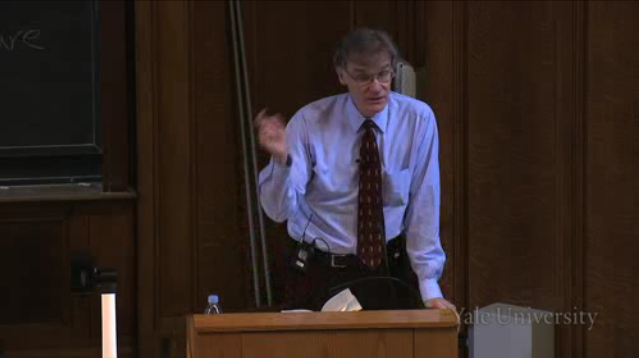
For anyone not familiar with the work of David Blight, you could do worse than to spend some time in the audience for his undergraduate course, recorded during the spring semester of 2008. I had some great instructors — Roger Bilstein, Maury Darst and Alex Pratt, I’m lookin’ at y’all — but none like this. If you watch the entire series, you won’t get academic credit, but you’ll sure get an education.
“We are all officers now!”
Almost a hundred years ago, an old Texas veteran with the improbable name of Valerius Cincinnatus Giles passed away, leaving a sprawling, fragmentary memoir of his Civil War service. A half-century and a lot of editing later, it was finally compiled and published as Rags and Hope, a volume that has since become a classic among Civil War enlisted soldiers’ autobiographies. In closing Giles wrote:
It is over, and we are all officers now!
It’s General That and Colonel This
And Captain So and So.
There’s not a private in the list
No matter where you go.The men who fought the battles then,
Who burned the powder and lead,
And lived on hardtack made of beans
Are promoted now—or dead.
I suspect that, in writing these lines, Giles may have been thinking of a relative of mine, Lawrence Daffan. They must have known each other well. Both served in the Fourth Texas Infantry (Giles in Co. B; Daffan in Co. G), both were captured within a few weeks of each other in late 1863 during the Chattanooga Campaign, and both were active in veterans’ organizations after the war. Lawrence’s daughter Katie, who was prominent in UDC activities and served at the time as superintendent of the Confederate Woman’s Home in Austin, made a big show at Giles’ funeral of placing a small Confederate flag in the dead man’s hands. Cou’n Katie always did have a flair for dramatic gestures.
But beyond Giles’ amusing (and somewhat poignant) rhyme, Daffan is a perfect example of the pitfalls that await the modern researcher, and it underscores the importance of searching out contemporary records. In Lawrence Daffan’s case, everyone in the family “knew” that he had served as an officer, and even his obituary gave his name as “Col. L. A. Daffan.”
But he was never actually an officer. In fact, he wasn’t even a non-com. He was a buck private from the day he enlisted in March 1862 to the day he was released from the PoW camp at Rock Island, Illinois in 1865. He came to be known as “Colonel” Daffan because he was active in veterans’ groups after the war, and the UDC gave him that as an honorary title. He apparently liked it, and used it, to the extent that by the time he died in 1907, everyone in town as well as his family “knew” that he’d served as an officer. Lots of contemporary publications repeat the title. That was accepted as a given for over a century until, just recently, I bothered to look up his actual service record and discovered it wasn’t true.
This is important to would-be researchers because in Daffan’s case, because family oral tradition, Daffan’s obituary and other postwar sources all confirm one another, that he was a former officer. But he wasn’t, and one has to go back to the original records to determine that.
So genealogists and would-be historians, perform due diligence. Don’t assume you “know” something about your ancestor unless you can document it, because there’s a good chance you’re wrong. Do the research. Your work will be better for it when you do.
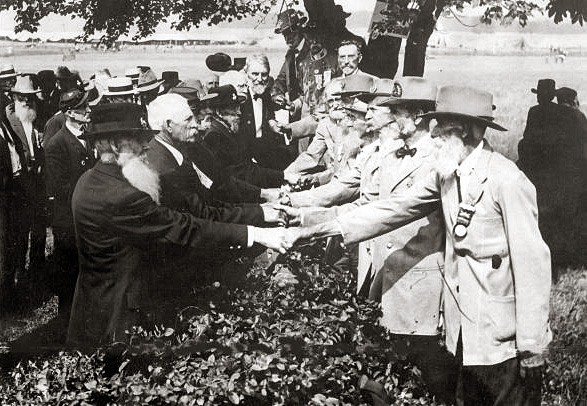
Image: Veterans of the Philadelphia Brigade Association and the Pickett’s Division Association shake hands across the stone wall over which they’d fought fifty years before, July 3, 1913. Pennsylvania State Archives.
United States Colored Troops Support Amendment 62

Company E, 4th U.S. Colored Infantry. Library of Congress.
I don’t like to get too much into present-day politics on this blog, but when folks drag historical figures (real or imagined) into the fray, it becomes fair game for commentary. Personhood Colorado, an anti-abortion group looking to amend that state’s constitution to designate a fetus a “person” under law, has a new radio ad in which an actor portrays a runaway slave who joins the Union Army to fight in the Civil War:
I’m George Stevens and I’m a person. I was held as property as a child. Even before my birth I was called a slave in an America you wouldn’t recognize. But folks like you helped me escape North to freedom and in 1864, I joined the infantry to fight for my country. I fought so all slaves would be recognized as persons, not property. And we won. But today in Colorado, there are still people called property – children – just like I was. And that America you thought you wouldn’t recognize is all around you and these children are being killed. This November, vote “yes” on Amendment 62. Amendment 62 declares unborn children persons, not property. And that’s the America I fought for. . . .
I’m sure “George Stevens” was chosen as a sufficiently common name to allow the producers to avoid having to answer for pinning any specific individual, even a long-dead one, to this cause. According to the National Park Service’s Civil War Soldiers and Sailors System, there were at least ten “George Stevens” serving in black U.S. regiments during the war, and at least one more among state troops, in the 55th Massachusetts Infantry.
There seems to be a lot of this going on lately, latching on to specific historical figures for a sort of endorsement-from-beyond-the-grave. I’m not talking about your run-of-the-mill, homage to leaders of the past in a gauzy, feel-good sort of way, but taking actual (or in “George Stevens” case, fictional) historical figures and presenting them as explicitly endorsing a particular candidate or position. In many of these cases, it seems, the pairing of the candidate and known, established positions of the historical figure are dubious, or even amusing. Rand Paul, the GOP Senate candidate in Kentucky who has questioned the propriety of the Civil Rights Act and has defended the right of private businesses to discriminate based on race — though he’s also said “it’s bad for business” if they do — published an editorial in the Bowling Green Daily News in which he wrote that “when I read history I side with abolitionists such as William Lloyd Garrison and Frederick Douglas,” apparently forgetting the spelling of “Douglass.” Rick Barber, running in the GOP primary for a congressional seat in Alabama, famously ran an ad where he sits in a bar, surrounded by colonial revolutionaries like Sam Adams and Ben Franklin and asserts that the American Revolution began as a protest over taxes, seemingly unaware that it was about taxation without representation, a legitimate problem that Barber’s own candidacy would seem to disprove on its face. Not quite satisfied with that bit of whiplash-inducing logic, Barber followed up with an ad in which he asked Abraham Lincoln (“Hey, Abe!”) the Great Emancipator’s view on federal income taxes, to which the sixteenth president ominously intones, “slavery!” As with his previous ad, Barber’s history here is a little off, given that the Lincoln administration imposed the first income tax in U.S. history. Oops.
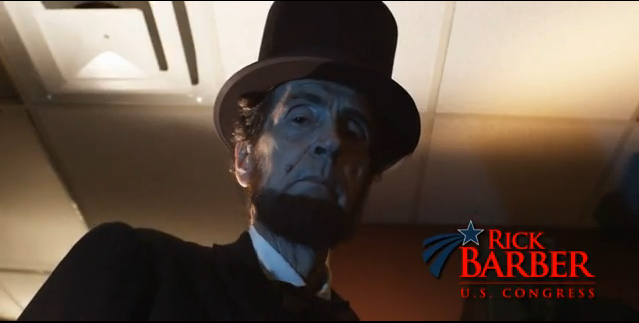
I don’t mind it so much when modern politicians make reference to historical figures, when the parallels actually, you know, make sense, when the current issue or policy position shows a clear and logical lineage. But these recent examples are just silly, made more so by the dissonance between the positions actually taken by the historical figures whose mantles they claim and the modern-day political positions they’ve been exhumed to endorse. Does anyone actually believe that, in their own day, Franklin and Adams would have been considered to stand on the “conservative” side of the political spectrum, or that Douglass favored the federal government keeping out of civil rights issues? Did George Washington really support the idea of violent overthrow of a republic’s elected government? (“Gather your armies!”) And remind me again — what does the historical record say about Private Stevens’ (Stevenses?) position on abortion? I hate to generalize, but I’ve never got the idea that the political forebears of the Tea Party movement — prime backers of both Rand Paul and Rick Barber — were big fans of either Lincoln or strident abolitionists like Douglass, neither of whom were shy about using the force of the U.S. government to pursue their objectives. Is it worth noting that at the same time Personhood Colorado is making a direct and explicit parallel between itself and the abolitionists of 150 years ago, its allies in Washington D.C. are lynching their opponents in effigy?
This is all pretty ridiculous, over-the-top political theater, and I suspect that the vast majority of people see it that way, including those who happen to agree with the candidate in question on the issues. But I’m skeptical that it wins elections. There’s some evidence of that; for all the cable-news airtime and YouTube play Barber’s ads got — over 380,000 views and counting for the “gather your armies!” spot — he got a thumpin‘ a couple of weeks ago in the primary runoff with Montgomery City Councilwoman Martha Roby. And Personhood Colorado may need an entire regiment of “George Stevenses” to pass their constitutional amendment — the last time it came up for a vote, in 2008, it got crushed almost three-to-one.
How to Make a Black Confederate from Nothing at All
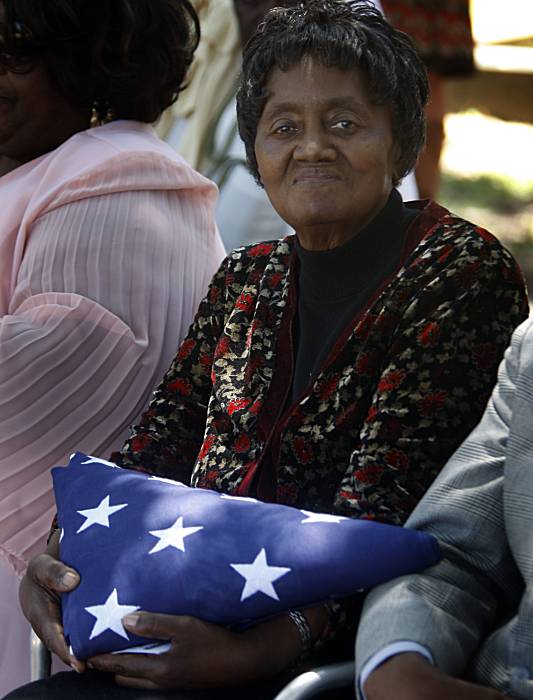
Mary Johnson, granddaughter of Pvt. Samuel Brown, holds an American flag presented to her at the event. Paul Chinn/SF Chronicle
Over the weekend, David Woodbury of Battlefields and Bibliophiles and Kevin Levin at Civil War Memory highlighted a story in the San Fransisco Chronicle, about Samuel Brown, an African American Civil War veteran whose grave in Vallejo, California, was recently marked with a stone commemorating his service with the 137th United States Colored Troops. The event came about because the original stone, which had been on Brown’s gravesite since shortly after his death, designated him as a Confederate veteran. Via the CBS teevee affiliate in San Fransisco, Brown’s grave had originally been marked with a stone that read, contradictorily,

So it was a fnckup at the engravers, simple as that. Someone assumed that a Civil War soldier from Georgia must’ve been a Confederate. Nothing nefarious or conspiratorial. Mistakes like this are unfortunate, but certainly not unheard of. Read the full article here.
What’s most remarkable about this story, though, is not the story itself, but the reaction to it. Corey Meyer, posting at Blood of My Kindred, asks, “is this how Black Confederates are created?”
Why yes, Corey. Yes it is.
As Corey points out, the comments section of the original story is already filling with posters who, based on nothing at all, are accusing the ceremony’s organizers with changing Pvt. Brown’s history to conform to modern-day political correctness, and to cover up the fact that Brown was really a Confederate soldier. Commenter levesque writes, “my uninformed guess is that Mr. Brown was a black Confederate soldier who surrendered to occupying Union Army forces in Georgia.” He continues, “As anyone who has seen Gone With the Wind knows. . . .”
An “uninformed guess,” based on watching Gone with the Wind. There’s some scholarship. Watch out, Blight, you effete liberal hack, levesque is gunnin’ for your endowed chair.
Someone calling him- or herself whiteheat uses Brown as a jumping-off point for a Beckian rant about Lincoln and how he started the long, slow destruction of Real America™:
What this article does not mention is that many African slaves did indeed fight for the Confederacy. Lincoln’s ‘Emancipation Proclamation’ was issued two years into the civil war, and was mostly for propaganda purposes, since Lincoln said repeatedly that he would be willing to retain slavery if it would preserve the Union. Lincoln was all about Federal power and Big government. He also believed that whites and “negros” could not live together as equals.
After presiding over America’s most destructive war (quite a feat) Lincoln’s additional legacy is that he got us lurching towards Empire. America’s decline can (in part) be attributed to this magnificent war-maker.
Yet another commenter, blogorama, brings the snark:
How is this a positive story? For almost 100 years this man was laid to rest under a head stone that identified him as an ignorant buffoon instead of a hero. And his family never noticed. Gee, that’s heart warming.
Enfield53 — get it? — also jumps to the defense of the idea of Black Confederates, saying
Thousands of slaves and free blacks did serve with honor in the Confederate Army. Indeed, twenty percent of the Confederate Navy was black as well. There are hundreds of photographs taken of black Confederates taken with their white mess-mates at reunions held decades after the war. . . .
Dead Confederates regulars are already familiar with the pitfalls of relying on Confederate reunion photographs.
It doesn’t look like Private Brown has been credited as a Black Confederate up to now, but I wouldn’t be surprised if that changes. The claims made for Black Confederates are often based on the flimsiest of evidence, and a headstone reading “CONFEDERATE STATES ARMY” is undoubtedly sufficient in this case, especially if one overlooks that the original stone correctly identified Brown’s regiment. That last part is a detail that, I suspect, will get overlooked in the clamor about “political correctness” and denial of Brown’s “true” Confederate heritage. After all, it is the Bay Area. I’m sure somehow this whole thing is Nancy Pelosi’s fault.
Update: The Sacramento Bee has nice coverage of the story with additional details, and the Long Beach Press-Telegram has a story from last March on Brown’s family in the Vallejo area. Below: One of Private Brown’s pension application index cards, dated January 6, 1894, via Footnote.

War So Terrible: A Civil War Combat Film

Kevin Levin at Civil War Memory recently highlighted a short film produced by Pamplin Park (Virginia) and the National Museum of the Civil War Soldier, War So Terrible: A Civil War Combat Film. It’s a most unusual piece of film-making, and now that I’ve seen it, I can second Kevin’s endorsement.
 War So Terrible follows two fictional soldiers, one Union and one Confederate, who both enlist early in the war as enthusiastic recruits. They each survive a bloody encounter between their units early in the war, and then come face-to-face in a Federal assault on Confederate earthworks in the closing days of the war, when both men have become older, wiser, more jaded. The Civil War sequences are told as flashbacks in the memory of these two men, who are meeting for a third and final time in 1895 at a commemoration ceremony led by an unctuous local official determined on warm reconciliation and treacly sentiment. Neither of the old soldiers have any use for those notions; after three decades, the bitterness still remains.
Aside from presenting a much more realistic view of soldiers’ attitudes — both as young men and old — War So Terrible is far more honest than anything I’ve seen in its depiction of the carnage on the battlefield and the psychological trauma these men endured. The footage is, an many places, as explicit as any image by Brady or Gardner, but in color and live-action. It’s not fun to watch. Documentaries, aiming for as wide an audience as possible, generally avoid recreating such scenes; feature films like Gettysburg and Gods and Generals, for all the effort that went into historical verisimilitude and sweeping battle scenes, are almost entirely sanitized for the same reason.
There are two versions of War So Terrible on the disk; the full (and fully graphic) 48-minute version, and an edited, 23-minute educational version more appropriate for students.
The film is not perfect. The plot is a bit contrived and the acting is stiff. But it’s a brave departure from the norm in both concept and execution, and should be required viewing for anyone prone to romanticizing this country’s most horrific conflict.
War So Terrible can be ordered through the Civil War Store at Pamplin Park (US$9.95 plus shipping).

William Stewart Simkins, the Klan and the Law School
On Friday, University of Texas at Austin President William Powers Jr. issued a statement calling on the university’s Board of Regents to change the name of Simkins Hall, a dorm for graduate and law students. The dorm, built in the 1950s, is named for a famed UT law professor who was a Confederate officer and, as a recent publication points out, a senior leader of the Ku Klux Klan in Florida during Reconstruction and a lifelong, unabashed defender of the “Invisible Empire” throughout his later tenure at the university. The Board of Regents is likely to consider the president’s recommendation at a meeting this week.
 William Stewart Simkins (1842-1929) was a well-known member of the faculty at the University of Texas, teaching there from 1899 to 1929. Although he officially attained emeritus status in 1923, he continued to lecture weekly until his death. “Colonel Simkins,” as he was sometimes called, was a memorable teacher, and something of a character. He was grumpy and irritable. He drank whiskey and once got into a famous argument with the temperance leader Carrie Nation. “Many students were scared of him,” one old alum wrote, “but I always got on well with him and did well in his class.”
Simkins was a South Carolinian by birth, and enrolled at the Citadel in the years just before the outbreak of the Civil War. In January 1861, it was Cadet Simkins who sounded the alarm when lookouts sighted Star of the West, a civilian steamer sent by the Buchanan administration to bring supplies to the Federal garrison at Fort Sumter. (Some contemporary accounts credit Simkins with firing the initial gun, widely recognized as the first shot of the Civil War.) Simkins was subsequently commissioned as an artillery officer in a South Carolina battery, participated in the defense of Charleston Harbor in 1863, and ended the war in 1865 as a colonel.
After the war, Simkins settled in Florida, where he and his older brother, Eldred James Simkins (1838-1903), soon helped organize that state’s Ku Klux Klan. By his own admission, William Stewart Simkins played a central role in coordinating that organization’s violence and intimidation against both white “carpetbaggers” and African Americans who challenged the prewar social or political order. Simkins not only acknowledged his role in the Klan’s violent activities, he fairly bragged about his own deeds. In an infamous speech he gave fifteen years after joining the UT faculty — and a half-century after the war — Simkins told of how he ambushed an African American state senator who had spoken out publicly against Simkins’ and his friends’ publication of a anti-Reconstructionist newspaper:
Now in the same town there was a negro [sic.] by the name of Robert Meacham who was. . . brought up as a domestic servant in a refined Southern family and absorbed much of the courteous manner of the old regime. He had been highly honored by the Republican party; in fact, had been made temporary chairman of the so-called Constitutional Convention heretofore referred to. He was at the time of which I am now speaking State Senator and Postmaster in the town. I could hardly exaggerate his influence among the negroes; glib of tongue, he swayed them to his purpose whether for good or evil; in a word, he was their idol. On one occasion he was delivering a very radical speech in which he referred to the paper which we were editing as that “dirty little sheet.” He was correct as to the word “little,” for it was not much larger than a good size pocket handkerchief; but it was exceedingly warm, a fact which had excited his ire. The next day, being informed by a friend who was present of Meacham’s remark, I called upon him at the post-office and asked an interview. With his usual courtesy he bowed and said he would come over to my office as soon as he had distributed the mail. I cut a stick, carried it up to the office and hid it under my desk. Within an hour he appeared. I told him to take a seat, but I could see that he suspected something unusual as he began to back towards the door. I saw that I was going to lose the opportunity of an interview, so I grabbed the stick and made for him. Now, my office was the upper story of a merchandise building approached on the side by wooden stairs. I hardly think that he touched one of those steps going down; it was a case of aerial navigation to the ground. This gave him the start of me. He was pursued up to the postoffice door and through a street filled with negroes and yet not a hand was raised or word said in his defense, nor was the incident ever noticed by the authorities. The unseen power was behind me. Had I attempted anything of the kind a year before I would have been mobbed or suffered the penalties of the law.
In modern-day Texas, this would be considered aggravated assault — a first-degree felony when committed against a public servant.
Simkins’ active involvement with the Klan may have ended when he and his brother came to Texas and began practicing law in Corsicana in the early 1870s, but his open admiration and promotion of the Klan did not. He continued to be an outspoken champion of the “Invisible Empire” throughout his decades on the faculty in Austin. Simkins’ 1914 Thanksgiving Day speech, excerpted above, was so popular that he gave it again on Thanksgiving the following year, 1915, a date which is widely accepted as the rebirth of the Klan in the 20th century. The speech was subsquently published in the UT alumni magazine, The Alcade.
Professor Simkins’ role as a founder of the Ku Klux Klan in Florida had largely been forgotten until this past spring, when Tom Russell, a law professor at the University of Denver, published a paper (PDF download) on the Klan and its sympathizers as a force that had worked steadily behind the scenes at UT to exclude African American students. Russell had first encountered Simkins’ history when Russell himself had been a faculty member in Austin in the 1990s. Russell presented his paper in March at a conference on the UT campus on the history on integration of the school, and publicly called for Simkins Hall to be renamed. The story was quickly picked up in blogs and editorials, and coverage in the Wall Street Journal and on television news soon followed.
It’s important to remember the time at which the decision was made to name the new dormitory after Professor Simkins. An editorial in the campus newspaper, the Daily Texan, points out that the 1954 decision came just weeks after the Supreme Court issued its famous Brown v. Board of Education ruling. But it’s likely that the regents who considered and approved the move were thinking at least as much about an earlier decision, Sweatt v. Painter (1950), in which a unanimous Supreme Court had rejected Texas’ refusal to admit an African American man, Heman Marion Sweatt, to the University of Texas School of Law on the grounds that there was no other public law school in the state of similar caliber open to African Americans. The Sweatt case was another nail in the coffin of separate-but-equal as enshrined in Plessy, and the State of Texas fought hard against it, going so far as to secure a six-month delay in state court quickly to establish a blacks-only law school at Texas Southern University in Houston — now the Thurgood Marshall School of Law. Considering the rancor that surrounded the Sweatt case — a cross was burned in front of the law school during Sweatt’s first semester — it’s hard to believe that just four years later, when it came time to name the new law school dormitory building, old Professor Simkins’ infamous Thanksgiving lectures, attended by hundreds of enthusiastic and applauding students, had been forgotten.
Russell’s call to remove Simkins’ name from the dorm has generated a lot of interest, and much controversy. Russell has continued to be a strong and steadfast advocate for the change, reminding critics that the issue here is not Simkins’ service as a Confederate officer during the war, but his active involvement with the Klan in the years following, and his enthusiastic support of the violence and intimidation they employed. “Please note that I have no problem with Colonel Simkinsʼs service as a Confederate soldier,” Russell wrote in an opinion piece in The Horn, the UT online news site. “Confederate and Union soldiers alike fought with honor. No one should confuse Confederate soldiers with Klansman. Doing so dishonors the soldiers by equating them with criminals.” I’m not certain, based on his manuscript, that Professor Russell is entirely sincere in drawing a bright line between the conduct of klansmen and wartime Confederates more generally; it may be more of a calculation than a conviction.
Nonetheless, Simkins Hall has got to go.
The Board of Regents is widely expected to accept President Powers’ recommendation to rename Simkins Hall this week. The facility’s new name would be “Creekside Dormitory.”
Additional: At the end of the third-to-last paragraph above, I observed that Professor Russell’s distinction between the action of klansmen like Simkins and Confederate soldiers as a whole was “more of a calculation than a conviction.” After thinking about it a little more, I’m convinced of it, but my comment was somewhat flip and unduly harsh. It’s effective strategy. In adding that short paragraph to his op-ed, Professor Russell takes a necessary and practical step to narrow the focus of his campaign. I have no idea what Russell’s views on the Civil War or the Confederacy are generally, but he very wisely keeps the focus here on Simkins, both his actions as a klansman during Reconstruction and his advocacy for the Klan in the decades that followed. The removal of Simkins’ name from the dorm is an easy case to make, on its own merits; allowing others to redirect the debate into one about the Confederacy (or “political correctness,” or the late Senator Robert Byrd, etc.) is wrong. In three sentences, Russell keeps the focus exactly where it should be in this case, on whether or not a major university should retain the name on one of its dormitories of a man whose explicit and enthusiastically-held actions and attitudes are so entirely out of line with the values the institution stands for. By excluding the Confederacy and the war from his central argument, Russell pares his campaign to its central and essential element, reducing it to a core that is effectively impossible to argue against on its own merits. That’s good lawyering.
Additional, Pt. 2: Tom Russell has a column on this case at the Huffington Post.
Houston City Marshal

Shannon Perich, Associate Curator for the Photographic History Collection at the National Museum of American History in Washington, is looking to identify this man, photographed at the Barr & Wright studio in Houston, probably in the 1870s. A note scratched into the emulsion on the edge of the plate suggests he ordered a “½ dozen plain” cartes-de-visite. On his vest he wears a badge reading, “City Marshal.” Perich suggests this may be R. Van Patton, who was appointed City Marshal in 1873, but there were others who served in that role during that decade as well. And it may not even be a Houston official — perhaps a lawman from another city who happened to sit for a portrait while visiting the Bayou City. In any case, it’s a great photo.




6 comments