
Paroled at Vicksburg

Sunday marked the 147th anniversary of the end of the siege of Vicksburg. One of the Confederate soldiers taken prisoner that day was 26-year-old William C. Denman (1836-1906), a private in Company B, 30th Alabama Infantry. William Denman grew up with four younger siblings in Calhoun County, Alabama, where his widower father, Blake Denman, was a well-to-do farmer. The elder Denman was a slaveholder. William enlisted in the 30th Alabama on March 5, 1862. The regiment served in the western theater and, as part of S. D. Lee’s Brigade, saw action in several skirmishes. It suffered heavy casualties at Champion’s Hill (May 16, 1863), where it suffered 229 killed, wounded and missing — roughly half its numbers. Retreating in the face of Union General Grant’s army, Confederate forces including the 30th Alabama withdrew into Vicksburg, where they were quickly trapped between the Federal army to the east and the Federal Navy on the Mississippi. As part of S. D. Lee’s brigade, the 30th Alabama was assigned the defense of the Railroad Redoubt, one of the strong points in the Vicksburg defenses. The fort was overrun in a bloody assault on May 22, but eventually recaptured after Confederate troops regrouped and counterattacked.
After a hard siege lasting several weeks, the Confederate general commanding at Vicksburg, John C. Pembeton, surrendered his force to Grant on July 4. Private Denman, along with about 18,000 other Confederate soldiers, was paroled a few days later.Grant described this process in his memoir:
Pemberton and his army were kept in Vicksburg until the whole could be paroled. The paroles were in duplicate, by organization (one copy for each, Federals and Confederates), and signed by the commanding officers of the companies or regiments. Duplicates were also made for each soldier and signed by each individually, one to be retained by the soldier signing and one to be retained by us. Several hundred refused to sign their paroles, preferring to be sent to the North as prisoners to being sent back to fight again. Others again kept out of the way, hoping to escape either alternative. . . .
As soon as our troops took possession of the city guards were established along the whole line of parapet, from the river above to the river below. The prisoners were allowed to occupy their old camps behind the intrenchments. No restraint was put upon them, except by their own commanders. They were rationed about as our own men, and from our supplies. The men of the two armies fraternized as if they had been fighting for the same cause. When they passed out of the works they had so long and so gallantly defended, between lines of their late antagonists, not a cheer went up, not a remark was made that would give pain. Really, I believe there was a feeling of sadness just then in the breasts of most of the Union soldiers at seeing the dejection of their late antagonists.
The 30th Alabama, like several other surrendered units from Vicksburg, was reorganized a short while later, and it appears that Denman continued with this reconstituted regiment. (The reorganization of these units using men who had been paroled became a subject of dispute between Union and Confederate forces, which the following year caused the Union to suspend almost all parole for captured Confederate soldiers.) In January 1864, Denman transferred to a cavalry regiment, in which he remained to the end of the war.
After the war Denman married Sarah Crankfield (1847-1932), of South Carolina. They lived in Alabama and Louisiana before settling in Marion County, Florida in 1875. There they farmed and, in their later years, operated a boarding house. They had ten children together, but only two survived to adulthood. In 1900 Denman applied for a pension based on injuries received in the war, claiming he was “incapacitated for manual labor” as a result of eating pea bread, an ersatz bread made of ground stock peas and cornmeal, during the siege of Vicksburg. It resulted, Denman claimed, in chronic gastritis and bilious dyspepsia. He died in 1906.
The Irresistible Appeal of Black Confederates

Photo by JimmyWayne, via Creative Commons License.
Over at Civil War Memory, Kevin highlights photos by Robert Pomerenk of an exhibit on “Blacks Who Wore Gray” at the Old Court House Museum in Vicksburg. The display features an original document, the 1914 pension application for former slave Ephram Roberson — the document explicitly asks for “the number of the regiment. . . in which your owner served” — but is otherwise composed of nothing but printouts of various quotes and well-known photographs of African American men in the field with Confederate troops, or (decades later) participating in reunion activities. At least one of the latter photos is credited to the neoconfederate publication Southern Partisan. The “Chandler Boys” are included, of course, though no one else whose image is displayed in the exhibit is fully identified by name and unit. One old African American man is listed only as “Uncle Lewis,” and others are not identified at all.
In terms of presenting or explaining history, the exhibit is a hopeless mess. Its organization — there actually is no organization or structure to it — is exactly the same as many Black Confederate websites, which amount to nothing more than a hodgepodge of quotes and images, unconnected either to each other or to any larger context, that make reference to African Americans in connection with Confederate troops. Like the typical Black Confederate website, there’s no distinction at all made between men who went to war as slaves and those who might have been free; one wonders if those who compile and present this material before the public have any real sense of the most basic elements of the “peculiar institution.” Several of the men shown in the Old Court House exhibit are explicitly identified as servants; there is no recognition — or at least public acknowledgment — that these men were almost certainly slaves, and had no say in whether they went off to war with their masters or not. There’s virtually no information offered about these men that would allow the visitor to get any sort of understanding of these men’s lives, either in the 1860s or in the early 20th century, as old men. There’s no attempt to flesh out their stories, to understand the details of their experiences either during the war, or after; instead, one is left with random quotes from Nathan Bedford Forrest and paeans “to the faithful slaves, who loyal to a sacred trust, toiled for the support of the Army, with matchless devotion and sterling fidelity guarded our defenseless homes, women and children, during the struggle for the principles of our Confederate States of America.” These men were soldiers, we’re asked to believe, volunteering and fighting for their homes and way of life, but they are never allowed to speak for themselves — the only ones allowed to speak on their behalf are white, and even then only to praise their loyalty and fidelity to the Confederacy.
This effort does nothing to honor these men as men. It is simply an extension of the time-honored “faithful slave” narrative, updated to make it more palatable to a modern audience. The Old Court House Museum differs from other efforts to push the case for Black Confederates only in that they actually go so far as to describe them explicitly as “faithful slaves.”
This exhibit would do far more to further the case for Black Confederates as a group if it proved the case of even a single man — Ephram Roberson, perhaps — and really provided in-depth coverage and explication of his life and role during the war and after, and proved his case as a soldier. Show us his service records, if such exist. Show us his listing in the census. Show us his property records, if there are any, or his obituary. If he was a slave, did he talk to the WPA in the 1930s? Are there contemporaneous letters or diaries from his fellow soldiers that describe his service? Track down his descendants living today and interview them. That is how history is done, through dogged research and building a case from the ground up.
But none of that is present at the Old Court House. There is no discussion of these mens’ supposed military service in the larger context of the war, no discussion of the actions they each fought in, and — most significantly — no firsthand accounts by white soldiers within those same units of their African American comrades’ service. What the Old Court House exhibit (and a hundred others on the web and in print) does is just the opposite; it takes a dozen or fifty or a hundred different, unconnected and disparate snapshots and claims that they form a larger, coherent picture. They don’t. They’re like items pulled from a dozen different families’ albums, scattered and mixed into a single pile on the floor; they do not, can not, tell anything approaching a single, cohesive story, no matter how many times they’re rearranged, e-mailed or Xeroxed.
I want to give the Old Court House Museum a pass on this exhibit, which contributes nothing at all to the making the case for Black Confederates. I began my professional career in small, local history museums not unlike this one. I spent six years, starting as an undergrad and continuing after graduation, part- and full-time, researching, writing, designing and setting up exhibits on local history. After that, I spent two years in grad school getting a masters in the field. I’m trained as a museum professional, though I haven’t worked in one for years. So I don’t walk into any museum as a purely blank slate. I even visited the Old Court House Museum once, years ago, although at the time I paid more attention to the steamboat material on display. And while I don’t know much about the specific resources available to the Old Court House — their administration and staff page is blank — I’ve got a good idea of what their situation is like, and it ain’t pretty. Small history museums like the Old Court House often get little or no direct support from local government, apart from in-kind provision of space and utilities; they have minimal paid staff, and cannot afford to hire people with significant experience or training in the field; they get by hand-to-mouth, year after year, trying to squeak by on a few thousand visitors paying a couple of bucks for admission. They are eager to give space to almost any group or person with a new or provocative idea for an exhibit, particularly if it fits well with the museum’s own preferred image of itself and the community it documents. And, as an organization dependent on the good will of the local business community — think of the chamber of commerce crowd — they’re heavily and inevitably influenced by the wishes of a small number of local patrons who may not know the first thing about history, but have very strong ideas about what they do and do not want showcased in their local museum. You’re welcome to make your own speculation who those folks are in Vicksburg.
Vicksburg looms large in the memory of the Civil War; it has been argued that the Vicksburg campaign, which cemented effective Union control of the Mississippi, was the true turning point of the war. But among the moonlight-and-magnolias image the community likes to present to tourists, it’s easy to forget that Vicksburg remains a small, poor town in a small, poor state. Fewer than 25,000 people live there; they are, on the whole, older and less-educated than the rest of the country. The median household income in Vicksburg is a little over half that of the rest of the United States; one in four families live below the poverty level, compared to one in ten nationally. Three-fifths of Vicksburg’s population is African American, a proportion that is exactly the reverse of Mississippi as a whole. Like many cities in the South, it has an ugly postwar history of racial violence and intimidation.
One might assume that the presence of the Vicksburg National Military Park would reinforce the efforts of local museums like the Old Court House; in fact, I think presence of a major Civil War site in town actually (and inadvertently) undermines the efforts of the local museum in developing a strong historical interpretive program of its own, in two ways. First, the national military park is the heavy hitter in terms of history; those in the area who have the educational background or experience are naturally drawn to the park, whether to work as administrators, guides or volunteers. Second, with the National Park Service providing a solid, but conventional, interpretation of the city’s role in the Civil War, the Old Court House Museum would naturally be drawn into serving as an “alternative” museum, presenting material and ideas that, for whatever reason, the NPS won’t touch. That’s where Black Confederates come in.
The idea of Black Confederates has a ready-made appeal. The contribution of African Americans to military service in this country has often been overlooked by both historians and popular culture. On its face, demanding recognition for African American soldiers who fought for the Confederacy sounds not unlike recognizing the achievements of the Tuskegee Airmen of World War II or the 54th Massachusetts Volunteer Infantry — both groups of African American soldiers who had to fight bigotry and doubt even to win the chance to prove themselves against the enemy. The notion of the existence of Black Confederates, while seeming contradict everything most people remember from school about the South, the war and the institution of slavery, also carries with it a certain conspiratorial appeal as well — this is the secret that Northern history books don’t want you to know. Who wouldn’t want to get let in on something like that? Recognizing African Americans serving in butternut uniforms seems like the right and just thing to do; conversely, those who express skepticism (or reject the notion outright) are easily portrayed as being motivated by elitism, prejudice or other ulterior motives to keep these mens’ service quiet, as has supposedly been done these last hundred and fifty years. They want to deny African Americans in the South their heritage. The Black Confederate narrative has a strong element of conspiracy about it, attributed to those who reject it, and like all good conspiracy theories this one is self-affirming: of course they deny these men’s existence, just like they always have. But we know better, don’t we?
I don’t know how many subscribers to the narrative of African Americans in the Confederate ranks are genuinely sincere but ill-informed and unable to recognize an historiographical con game when it’s foisted on them, and how many are willfully, cynically, spinning a line of “evidence” that they know to be composed of smoke and mirrors. As I said before, I want to give the Old Court House Museum a pass on this exhibit, because I know (or think I do) how vulnerable they are to the whims of a few well-heeled patrons, and how poorly-positioned they are to push back. But it’s hard to give them that pass. They may not know better, but they damn surely ought to.
At the Seige of Vicksburg, They Were Forced to Eat Haggis
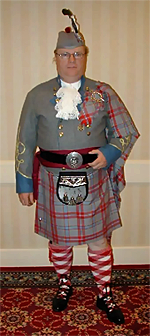 As a Southerner of Scots descent, and a descendant of Confederate veterans, and the descendant of a Confederate veteran of Scots descent, I speak from authority in saying that this is the most ridiculous development in celebrating Confederate heritage since, maybe, forever. This is definitive proof that nothing, nothing, is so ill-conceived that it cannot be successfully marketed as a means of “honoring” the Confederacy.
Does it come in butternut?
The whole point of a kilt is to identify with one’s clan — that’s clan with a C, for my League of the South visitors — and if you can’t trace your lineage back to a specific clan, you don’t effing wear a tartan. You don’t show respect for your ethnic heritage by faking it. Or at least, have the initiative to create your own from scratch. The latter option doesn’t carry any historical authority, but at least it’s yours.
It is true that at least one Civil War regiment marched off to war in tartan, the 79th New York Highlanders, a prewar militia unit composed mainly of Scots immigrants. But even they dropped the fancy duds after a few months. My intent here isn’t to mock anyone’s heritage — to restate, this is a dual heritage I happen to share — but dropping a bunch of money on a “Confederate Memorial Tartan” does credit to neither one’s Confederate nor Scots forebears. It’s not based on any actual historical example I can see; it’s playing dress-up, and so has more in common with those green, plastic bowler hats that street vendors sell on St. Patrick’s Day than it does with anything that happened in the 1860s.
Celebrate your Scottish heritage, people. Celebrate your Confederate relatives, if you feel you need to. But for the love of all things Caledonian, don’t just make stuff up and pretend it’s historical.
Update: Corey already covered this, last summer. As Harry Truman said, “the only thing new in the world is the blogs you haven’t read.”
Q. How Old was General Hood at Gettysburg?
A. Thirty-two.

Hood as portrayed by (l. to r.) Patrick Gorman in Gettysburg (1993) and Gods and Generals (2003), Levon Helm in In the Electric Mist (2009) and himself in real life (c. 1865).
Picking up a thread of an idea from David Woodbury at Of Battlefields and Bibliophiles, I’ve been thinking about how film and television typically portrays Civil War figures. Most often they’re depicted substantially older than they really were. I’m not necessarily speaking of the actor’s actual age versus character’s (because actors routinely play much younger characters), but more generally his apparent age — how he’s made to look. It’s easy to see why this would be the case. When an actor portraying a Civil War figures actually is about the right age for the character, it’s often jarring for the viewer, to whom it doesn’t “feel” right even if, in fact, it is. Matthew Broderick was 25 or 26 when he shot Glory; his character, Robert Gould Shaw, was exactly that age at the time of the events depicted in the film. Nonetheless, although the actor and the role were perfectly matched for age, it still didn’t “look right” for a lot of people, and probably harmed the overall public reception of the movie. People just couldn’t see someone that young, in that role. (Being known at the time primarily for his role as as Ferris Bueller didn’t help.)
But this just highlights something that we might easily forget — the vast majority of these men, from private to general, were very young by modern standards. At the beginning of the war, Ulysses S. Grant was 39. George Meade was 45. George McClellan was 36. George Pickett was 36. James Longstreet was 40, as was John George Walker. Stonewall Jackson was 37. William Tecumseh Sherman was 41, and so on. Robert E. Lee was 54, the “old man,” not just because of the senior position he held, but because he was, by the standard of the day, objectively and factually old.
There are lots of exceptions, of course — Albert Sidney Johnston was nearly 60 when he got plinked at Shiloh — but still it amazes me how young these men were when so much rested on their shoulders.
Update: Argghh! Dimitri Rotov has stolen a march on me on this very topic over at Civil War Bookshelf.
In Which I Make the Neoconfederates Cry
“Old Rebel,” writing at the League of the South’s Rebellion blog, highlights Dead Confederates along with Kevin’s Civil War Memory, Corey Meyer’s Blood of My Kindred and Edward Sebesta as “anti-Southern cyberstalkers” who hold a “seething hatred against an entire people and their culture” and who lead a “a shallow, unfulfilled life.”
These people remind me of the creepy serial killers from a Patricia Cornwell thriller. Cornwell’s villains can’t have meaningful human relationships, so they stalk and murder those who do. Young couples are the usual victims of these ghouls because the couples possess something the stalkers can’t have. My guess is that anti-Southern cyber-stalkers resent a living, vibrant culture with rich traditions and a sense of belonging and meaning that’s been denied them, so they snipe at those who do. If they can’t have cultural moorings, no one else can, either.
There’s no point in trying to refute this sort of name-calling, since there’s no actual substance to it. But I would like to make a few points of my own.
- Getting denounced by the official blog of the League of the South after being online for only nine days is indescribably awesome.
- That my dinky little blog should be mentioned in the same breath as Kevin’s, Corey’s and Ed Sebesta’s work is just staggering. I am genuinely humbled.
- Getting linked by the League of the South’s blog has really bounced my web traffic over the last couple of days — Dead Confederates isn’t exactly burnin’ up the Intertubes (yet), but I’m getting more referrals from Rebellion than from all other sources combined. Thanks, Old Rebel!
Kidding aside, Corey Meyer highlights a much more serious problem, one that speaks to the lengths some people will go to denounce their detractors. Some time back, Corey sent the Rebellion blog a photo he’d found online of someone wiping a commode with a Confederate Battle Flag. Snarky? Yep. And in retrospect, probably not a good idea, because instead of ignoring it — which Old Rebel argues that “that’s what the “Delete” key is for” — it seems Old Rebel or one of his/her confederates subsequently Photoshopped a p*rn magazine into the picture, and is now distributing the altered image as actually having originated with Corey.
This is dishonest. This is lying.
Old Rebel — who unlike Corey, Kevin, Ed Sebesta and me, seems unwilling to blog under his or her real name — and the League of the South are welcome to their views, both of current politics and historical events. They’re welcome to express those views, and have proved to be passionate and energetic in doing so. But neither they nor anyone else has the right to use this sort of dishonest, childish and shameful tactic to smear those they perceive as their opponents. In doing so, they forfeit the right to be taken seriously, about this or anything else.
Bobby Lee Has Left the Building. . . .
The Associated Press asks its readers to be on the lookout for a figure of the general that was stolen — 35 years ago:
A bronze statue of the Confederate general was taken from the grounds of Midland Lee High in 1975, a decade after the class of 1965 gave the statue to the school.
With Midland Lee’s 50th anniversary approaching later this year, an event organizer hopes someone will return the statue. Maridell Fryar told the Odessa American that no one would be prosecuted; the statute of limitations on the theft has run out.
She says the statue swiping may have started a prank. She [is] hoping someone from the West Texas community will offer information that might recover the stolen Lee in time for the anniversary celebrations.
Just a little prank, right? Sure, it’s all fun and games until someone loses an eye a statue.
Fun Fact: The Associated Press was organized in 1846 by five New York dailies to share the cost of reporting on the Mexican War.
“I’m a Son of Confederate Veterans as well as a son of slavery.”
Cary Clack, a columnist for San Antonio Life and a descendant of both a Confederate cavalry officer and a slave, attends an SCV meeting and finds it to be an odd, but not-entirely-unpleasant experience:
I’d written a column sarcastically dismissive of Virginia Gov. Bob McDonnell and Texas Gov. Rick Perry. While proclaiming my pride in being a child of the South and Southwest, I took issue with McDonnell’s initial declaration of Confederate History Month — on behalf of the Sons of Confederate Veterans — which ignored slavery, and with Perry’s earlier suggestion of secession.
The Heritage of Honor page on the SCV website didn’t mention the word “slavery” either, but I saw that membership is open to “all male descendants of any veteran who served honorably in the Confederate armed services” and that I qualified.
I wrote, “I’m a Son of Confederate Veterans as well as a son of slavery” and expected an application.
I got one, as well as an invitation to attend the May meeting, from Russ Lane, the affable head of Alamo Camp #1325. I never doubted I’d go, just as I never doubted I would be treated kindly.
Including wives, there were about 30 people in the meeting that began with “the Pledge of Allegiance” to “the United States of America,” which heartened me to know I wasn’t in the presence of secessionists.
Mr. Clack’s take on the encounter is interesting, and doesn’t easily fit into preconceived notions. It’s complicated, that’s for sure, and I hope he continues to write on this particular journey of his. It’s challenging enough thinking about one’s Confederate ancestors, who marched and fought and sometimes died in the uniform of a nation established to preserve and expand the institution of slavery; I can’t even imagine how to begin approaching the knowledge that one of your ancestors considered another to be his personal property.
But Aren’t They All Dead?
Cousin Katie‘s gonna haunt me for being flip about Confederate widows.
The new 2010 Texas GOP platform calls for (PDF, p. 6), among other things, “restoration of plaques honoring the Confederate Widow’s Pension Fund contribution that were removed from the Texas Supreme Court building.” That short sentence, of course, leaves out an embarrassing part of the backstory, and lies about another, much more important fact. First, the plaques were removed in 2000 by order of then-Governor George W. Bush, who is widely reported to be a Republican himself, and second, the bronze plaques do not “honor the Confederate Widow’s Pension Fund.” They are actually paeans to the Confederacy and Texas’s role in it, complete with the Confederate Battle Flag and national seal. They have nothing to do with Confederate widows; they’re classic Lost Cause memorials.
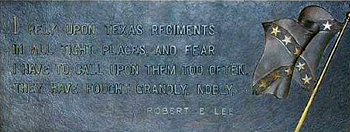
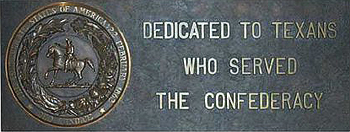
I honestly was, and still am, conflicted about the removal of these plaques a decade ago. They’re offensive to many Texans, but I also dislike the idea of removing established monuments, even when they reflect sentiments that are badly, badly out of touch with current values and history. (Better, I think, to acknowledge that they are themselves artifacts of their time, and interpret them in that way in situ.) I also understand that these were located in not just a public building, but in the state friggin’ Supreme Court — you know, where all people are equal in the eyes of the law, and so on. That latter point, I think, raises the stakes in this dispute for all sides.
I would almost certainly be against the original removal of these plaques had they been as represented by the Texas GOP — “honoring the Confederate Widow’s Pension Fund contribution.” But that’s not what they are. They’re definitely better gone, and placed in a state history museum where they can be both preserved and interpreted as artifacts of their day. As it happens, there’s a pretty good one just up the street. But the question is no longer whether they should stay; the question is, should they be brought back?
And the answer is, “no.” Let them go, folks — we’ve all got more important things to deal with.
Bonus Fun Fact: The Texas Supreme Court Building is so fugly that the Texas Supreme Court Historical Society uses a picture of the Capitol on its website.
“America’s most persecuted minority”
African Americans? Muslims? LGBT folks? Nope, nope and nope.
Confederates.
Seriously.
Kevin Levin over at Civil War Memory highlights North Texas, where the Sons of Confederate Veterans has opened a summer camp for youth ages 12-20.
This summer, you can help turn the tide. For one week, our Southern young men and ladies (ages 12-20) will gather to hear the truths about the War for Southern Independence. This camp (named for the great young Confederate Sam Davis) will combine fun and recreation with thoughtful instruction in Southern history, the War Between the States, the theology of the South during the War, lessons on Southern heroes, examples of great men of the Faith, and for the first year, special programs and sessions for our Southern ladies!
In addition to conventional summer camp activities like riding horses, firing percussion-cap muskets and shooting off field artillery, campers will take classes in “The Theology of the South During the War” and “Lessons on Southern Heroes.” A key theme, according to SCV Texas Division Commander Ray W. James, is the belief that
the Civil War was not about slavery, James said. Too many people have bought into that notion, he said, and wrongly exalt then-President Abraham Lincoln as wanting to end slavery.
Lincoln was “a bigger racist than I ever knew,” James said.
Naturally, one of the instructors is the Odious Kirk Lyons.
The Southern Poverty Law Center describes him as a “darling of the neo-Confederate world,” in part because of his work as an attorney representing white supremacists.
Lyons’ current job is chief trial counsel for the Southern Legal Resource Center. The North Carolina-based group says it exists to preserve the “dwindling rights” of the Confederate community, referring to it as “America’s most persecuted minority.”
One of Lyons’ latest efforts was to urge people to answer the race question on the U.S. Census by writing in that they are “Confederate Southern American.” It was part of a larger push by his center to have Confederate descendants recognized as an ethnic minority.
Lyons is also infamous for his marriage to the daughter of a top Aryan Nations official, [the SPLC’s Heidi] Beirich said. The ceremony was held at an Aryan Nations church and was officiated by its longtime leader.
“I think it’s concerning to have extremists like Kirk Lyons teaching kids the South was right,” Beirich said.
James responded by saying Lyons’ “baggage is a problem” but that it’s unfair to cast him as a racist.
Thanks for clearing up that it’s “unfair” to characterize someone, based on a mere twenty-five years of their public, professional conduct and close personal associations.
For myself, I’m just glad to know that Lyons, with whom I share a vague physical resemblance, is only carrying the ‘stache these days. Looks like I’ll be keeping the beard a while longer.
Update: Nat Turner’s Son provides a link to a camp photo album. This one made me shoot Diet Coke out through my nostrils.





1 comment