Are Pardoned Confederates Still Confederates?
If a Confederate officer takes an oath of allegiance to the United States and the Union, has he forfeited his status as a Confederate?
That’s not a snarky comment or a rhetorical question — I’m entirely serious in asking it.
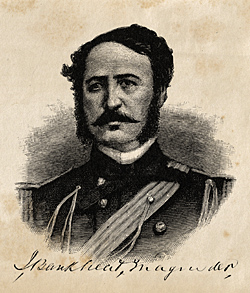 Not far from my home is the grave of Major General John Bankhead Magruder, a well-known Confederate officer and a local hero who commanded the Department of Texas during the middle of the war and organized the naval and land attack that retook Galveston from Union forces on New Years Day, 1863. After the war, and a brief stint in the service of Maximilian’s army in Mexico, Magruder settled in Houston, where he died in 1871. He was initially buried in there, but his remains were subsequently re-interred in Galveston’s Episcopal Cemetery.
At the end of May 1865, President Andrew Johnson issued a general amnesty for those who had served the Confederacy; under this amnesty, all rights and property (except for slaves) were to be restored upon taking the oath to support and defend the Constitution of the United States. Fourteen categories of persons were explicitly excluded from this blanket amnesty, including army officers above the rank of colonel. These excluded persons were required to submit a formal application for pardon, “and so realize the enormity of their crime.” While there was never any real doubt that the vast majority of former Confederates would eventually be eligible for pardon, Johnson was determined to use the pardon process to make manifest a point he mentioned often: “treason is a crime and must be made odious.” Over the next three years, the Johnson administration issued about 13,500 individual pardons.
Magruder applied for his pardon in November 1867, and included a letter of from Union Major General Carl Schurz, attesting to his loyalty. Magruder’s application was approved by Attorney General Henry Stanbery on December 9.
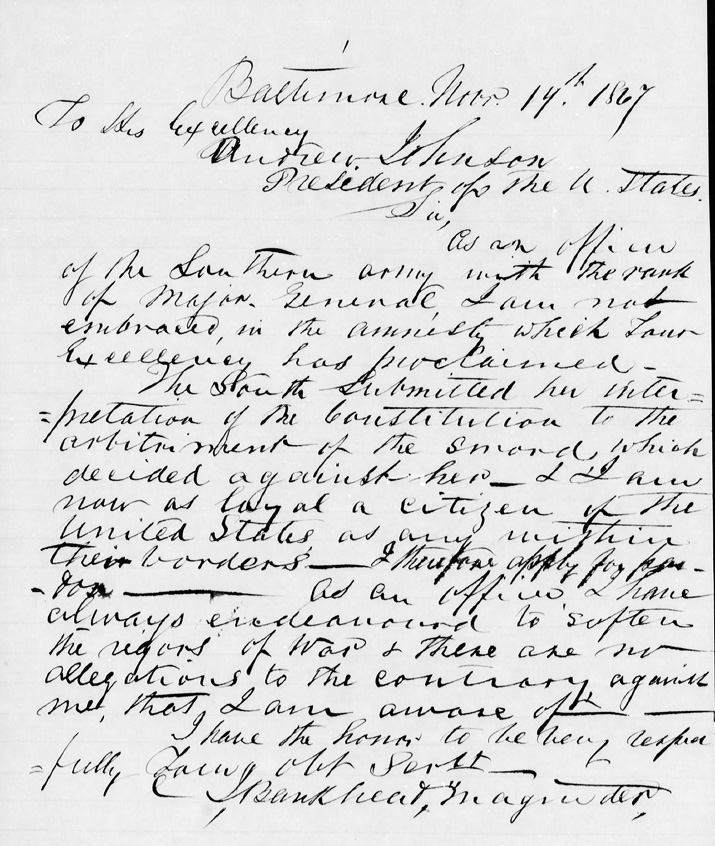
National archives, Case Files of Applications from Former Confederates for Presidential Pardons (“Amnesty Papers”), 1865-67, via Footnote.com
Baltimore, Novr. 14th, 1867
To His Excellency
Andrew Johnson
President of the United StatesSir, as an officer of the Southern army with the rank of Major General, I am not embraced in the amnesty which Your Excellency has proclaimed.
The South submitted her interpretation of the Constitution to the arbitrament of the sword which decided against her — an I am now as loyal a citizen of the United States as any within their borders — I therefore apply for a pardon — As an officer, I have always endeavored to softne the rigors of War & there are no allegations to the contrary, against me, that I am aware of.
I have the honor to be very respectfully Your Obt Servt,
J. Bankhead Magruder
A pardon is not a small thing. A petition for pardon acknowledges and admits a serious legal or moral transgression on the part of the applicant; issuance of a pardon is a formal act of forgiveness, with the implicit understanding that the offense being pardoned is real, is ended and will not be repeated.
There’s no way to parse or explain away Magruder’s declaratory statement, written in his own hand, that “I am now as loyal a citizen of the United States as any within their borders.” Major General Walker signed an even more explicit statement, that he would “henceforth faithfully support, protect and defend the Constitution of the United States and the Union of the States thereunder,” closing with, “so help me God.”
Are these pledges of loyalty to be taken seriously? It would seem they must be; after all, the core values of loyalty, devotion and personal honor are some of the very things that motivate the desire to recognize these men in the first place. But they voluntarily, formally and explicitly rejected any allegiance to the Confederacy; it’s hard to see how they can still be legitimately considered Confederates. Certainly most Americans today would hesitate to honor an American soldier who formally renounced his American citizenship in favor of another nation’s.
Or should we assume that applying for a pardon and swearing ongoing allegiance to the United States — “in the presence of ALMIGHTY GOD” — was something they simply had to do to get along, and they never really meant it? That it was just what they had to do to get on with their lives? Path of least resistance? Doubtful.
So we’re back to the first option: that these men willingly, voluntarily rejected any further allegiance to the Confederacy. How, then, can they now logically be honored for their loyalty to that defunct nation? There’s not an easy answer to this question; I don’t even think there is an answer that makes any objective sense. But that doesn’t mean we shouldn’t ask the question.
The Grand Review in Harrisburg
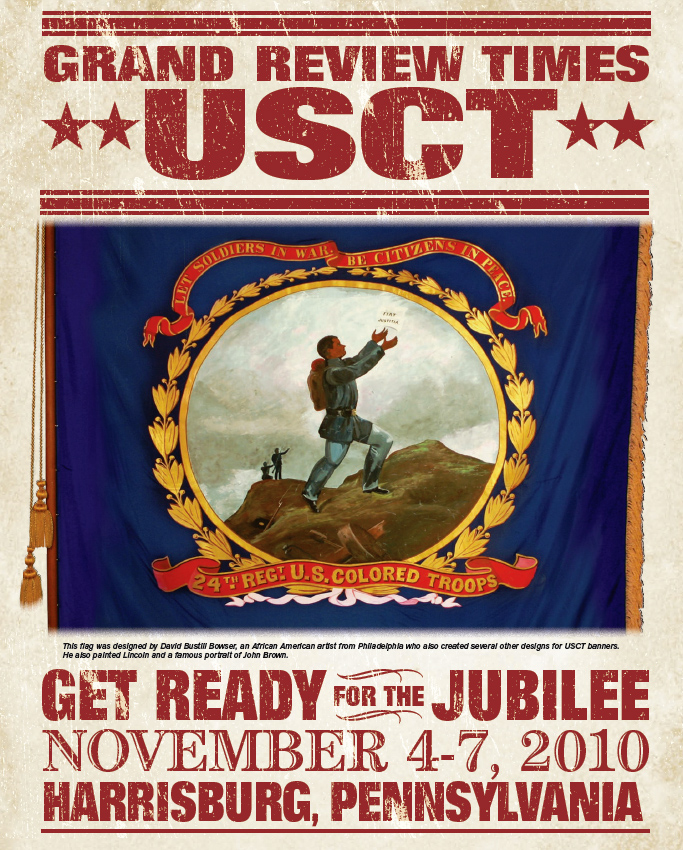
Commenter David Cassatt points out that this coming weekend in Harrisburg, Pennsylvania is the Grand Review, a celebration of the service of USCT during the Civil War. The program of scheduled activities is lengthy (PDF), with something for everyone. The Grand Review commemorates the November 1865 event of the same name organized by the women of Harrisburg to honor the United States Colored Troops from 25 states who were not permitted to participate in the Grand Review of the Armies, a military procession and celebration held May 23-24, 1865 in Washington, D.C., following the end of the Civil War.
This looks like a great event. Sorry for the short notice. Additional information here.
Ambrose Bierce “On Black Soldiering”

A skeptical correspondent asks me for an opinion of the fighting qualities of our colored regiments. Really I had thought the question settled long ago. The Negro will fight and fight well. From the time when we began to use him in civil war, through all his service against Indians on the frontier, to this day he has not failed to acquit himself acceptably to his White officers. I the more cheerfully testify to this because I was at one time a doubter. Under a general order from the headquarters of the Army, or possibly from the War Department, I once in a burst of ambition applied for rank as a field officer of colored troops, being then a line officer of white troops. Before my application was acted on I had repented and persuaded myself that the darkies would not fight; so when ordered to report to the proper board of officers, with a view to gratification of my wish, I “backed out” and secured “influence” which enabled me to remain in my humbler station.
But at the battle of Nashville it was borne in upon me that I had made a fool of myself. During the two days of that memorable engagement the only reverse sustained by our arms was in an assault upon Overton Hill, a fortified salient of the Confederate line on the second day. The troops repulsed were a brigade of Beatty’s division and a colored brigade of raw troops which had been brought up from a camp of instruction at Chattanooga. I was serving on Gen. Beatty’s staff, but was not doing duty that day, being disabled by a wound — just sitting in the saddle and looking on. Seeing the darkies going in on our left I was naturally interested and observed them closely. Better fighting was never done. The front of the enemy’s earthworks was protected by an intricate abatis of felled trees denuded of their foliage and twigs. Through this obstacle a cat would have made slow progress; its passage by troops under fire was hopeless from the first — even the inexperienced black chaps must have known that. They did not hesitate a moment: their long lines swept into that fatal obstruction in perfect order and remained there as long as those of the white veterans on their right. And as many of them in proportion remained until borne away and buried after the action. It was as pretty an example of courage and discipline as one could wish to see. In order that my discomfiture and humiliation might lack nothing of completeness I was told afterward that one of their field officers succeeded in forcing his horse through a break in the abatis and was shot to rags on the slope on the parapet. But for my abjuration of faith in the Negroes’ fighting qualities I might perhaps have been so fortunate as to be that man!

San Fransisco Examiner, June 5, 1898. From Russell Duncan and David Klooster, Phantoms of a Blood-Stained Period: The Complete Civil War Writings of Ambrose Bierce. Image: “Battle of Nashville,” Kutz & Allison Lithograph, Library of Congress.

Fisking Fremantle
Recently I uploaded a post in which I characterized Dr. Steiner’s famous account of Confederate troops entering Frederick, Maryland in 1862 as being unreliable, because (among other things) it was uncorroborated by other witnesses to the same event. The credibility of Steiner’s account is important, as it’s one of the references often cited as evidence of large formations of black soldiers serving in the Confederate Army. Steiner estimates their number as “over 3,000 Negroes” — an enormous number, something approaching the size of a full-strength brigade.
One of my commenters took me to task, saying that Steiner’s account is corroborated by the Fremantle Diary, an account of a British 0fficer’s travels across the Confederacy in the spring and early summer of 1863, and culminating with his witnessing the Battle of Gettysburg. I pointed out that Fremantle didn’t witness the Confederates’ entry into Frederick the previous fall, but my commenter assured me, “it’s the same army.”
This struck me as odd. Fremantle and I are old friends, as it were, since I first read his account years back while working on an archaeology project. I thought I was familiar with Fremantle’s account, but I sure couldn’t recall any references to Black Confederates in it. Furthermore, any reference to Black Confederates in “the same army” would be restricted to a relatively small part of the book, that covered Fremantle’s time with the Army of Northern Virginia — Chapters 10 through 13. I skimmed those chapters, and then the entire text, and came up empty.
So I did some Googling and came up with two brief passages that are cited over and over again on Black Confederate sites, such as this one. Fremantle’s texts are rarely quoted in full, but are most often summarized, which is the crux of the problem. More about that in a moment.
The first passage in Fremantle comes in a description of McLaws’ Division, marching north toward Pennsylvania, on June 25, 1863:
The weather was cool and showery, and all went swimmingly for the first fourteen miles, when we caught up M’Laws’s division, which belongs to Longstreet’s corps. As my horse about this time began to show signs of fatigue, and as Lawley’s pickaxed most alarmingly, we turned them in to some clover to graze, whilst we watched two brigades pass along the road. They were commanded, I think, by Semmes and Barksdale, and were composed of Georgians, Mississippians, and South Carolinians. They marched very well, and there was no attempt at straggling; quite a different state of things from Johnston’s men in Mississippi. All were well shod and efficiently clothed.
In the rear of each regiment were from twenty to thirty Negro slaves, and a certain number of unarmed men carrying stretchers and wearing in their hats the red badges of the’ ambulance corps; this is an excellent institution, for it prevents unwounded men falling out on pretense of taking wounded to the rear. The knapsacks of the men still bear the names of the Massachusetts, Vermont, New Jersey, or other regiments to which they originally be tonged. There were about twenty wagons to each brigade, most of which were marked U. S., and each of these brigades was about 2,800 strong. There are four brigades in M’Laws’s division. All the men seem in the highest spirits, and were cheering and yelling most vociferously·
Fremantle explicitly identifies the African American men as slaves. He makes no mention of arms or weapons, but does describe them as being “in the rear” of each regiment — i.e., not actually part of the formation of companies, along with the stretcher-bearers. There’s no suggestion that Fremantle viewed these men as soldiers. Nonetheless, some authors have written secondary accounts describing Fremantle’s observations, with some careful rephrasing that changes the the meaning entirely. An example of this is a post by James Durney over at the TOCWOC Blog:
[Fremantle] states that every regiment and battery has from 20 to 40 [sic.] black men traveling with it. His description of their dress and arms is similar to the description of Jackson’s command in 1862. This indicates that Lee’s army had not changed any policies and still contained a substantial number of black men. Longstreet had 72 regiments and batteries with just under 21,000 men carried on the rolls. If we use 20 black men with each battery and 30 with each regiment Longstreet’s Corps in July 1863 had just under 2,000 black men embedded in the units, an additional 9.4% above the official muster rolls.
Fremantle does not, in fact, make a blanket statement that “every regiment and battery” has a similar number of men traveling with it; he only describes the regiments he saw, those of Semmes’ and Barksdale’s Brigades, eight infantry regiments in all. Fremantle makes no mention of batteries in this context. He gives no description of these black mens’ dress. And significantly, Mr. Durney never uses the term Fremantle openly did — slaves — to describe the men traveling with each regiment, which further clouds their actual status and makes it possible for the reader to come away thinking they are soldiers. This summary is misleading and attributes to Fremantle claims that, in fact, the Englishman never made.
The second passage from Fremantle dates from July 6, the third day after the battle, during the Confederate retreat along the Hagerstown Pike, somewhere northeast of that town:
At 12 o’clock we halted again, and all set to work to eat cherries, which was the only food we got between 5 A. M. and 11 P. M.
I saw a most laughable spectacle this afternoon – a Negro dressed in full Yankee uniform, with a rifle at full cock, leading long a barefooted white man, with whom he had evidently changed clothes. General Longstreet stopped the pair, and asked the black man what it meant. He replied, “The two soldiers in charge of this here Yank have got drunk, so for fear he should escape I have took care of him, and brought him through that little town.” The consequential manner of the Negro, and the supreme contempt with which he spoke to his prisoner, were most amusing.
This little episode of a Southern slave leading a white Yankee soldier through a Northern village, alone and of his own accord, would not have been gratifying to an abolitionist. Nor would the sympathizers both in England and in the North feel encouraged if they could hear the language of detestation and contempt with which the numerous Negroes with the Southern armies speak of their liberators.
The man is explicitly identified as being a slave; there’s nothing to indicate he’s a soldier, no reference to his own uniform, or even specifically that the weapon he carried was his own. There’s simply the explanation that the two Confederate soldiers who were supposed to guard the prisoner were drunk, so this man took over their job that they were incapable of, rather than let the Union man escape.
Further, Fremantle’s observation that “the consequential manner of the Negro, and the supreme contempt with which he spoke to his prisoner, were most amusing” is a dead giveaway that the black man’s ordinary status is far lower than his prisoner’s; that’s what makes it funny. A Confederate soldier heaping verbal abuse on a Federal isn’t noteworthy; in the context of the time and place, a slave holding a Yankee at gunpoint and giving him what for most certainly would have been seen as comical. It’s a joke not unlike the famous incident where a former slave, now in the USCT, chided a group of sulking Southern civilians standing by the roadside: “bottom rail on top, now.”
This passage of Fremantle’s has also been misrepresented. Again, Durney:
Fremantle recounts an incident where an armed black man, dressed in Confederate and Union uniform items, escorts Union prisoners of war to the rear.
In fact Fremantle makes no mention whatever of Confederate “uniform items,” and the black man is escorting a solitary prisoner. Again Mr. Durney omits Fremantle’s explicit identification of the black man as a slave. He omits too the black man’s explanation of taking charge of the prisoner on his own initiative, leaving the reader with the impression that prisoner escort was his assigned duty.
But wait, there’s more. As a footnote to that last paragraph, Fremantle adds this:
From what I have seen of the Southern Negroes, I am of opinion that the Confederates could, if they chose, convert a great number into soldiers; and from the affection which undoubtedly exists as a general rule between the Slaves and their masters, I think that they would prove more efficient than black troops under any other circumstances. But I do not imagine that such an experiment will be tried, except as a very last resort. . . .
So Fremantle takes the example of the slave taking charge of the Union prisoner and uses it as an opportunity to give his thoughts on the viability of enlisting blacks as soldiers, “if they chose.” He’s not discussing the success or advantages of a system that he’s seen, but describing what he thinks the prospects for it are if they chose. But Fremantle is resigned that “such an experiment will [not] be tried, except as a very last resort.” Far from documenting an example of African Americans serving as Confederate soldiers, Fremantle uses the case of the man in the blue uniform to argue that they would make acceptable soldiers if the Confederacy would allow it. Fremantle’s footnote, in particular, completely undermines the notion that his anecdote describes an actual Confederate soldier.
The title of this post is “Fisking Fremantle” because I like alliteration. But in truth, Fremantle’s not the problem. He reported what he saw and, despite his obvious sympathies with the Confederates he met, is generally considered a fair and reliable observer. The problem lies with the folks who (1) have read Fremantle’s observations and, through carelessness or intent, misrepresent them, and (2) those who repeat those same misrepresentations over and over again without checking them. It’s a shame, because what Fremantle actually wrote is fascinating on its own, and his speculation that “such an experiment will [not] be tried, except as a very last resort” is prescient. The folks who pull this example out of the Englishman’s book and cite it as evidence of Black Confederates are putting forward an account that doesn’t provide evidence of Black Confederates. Do these folks ever read the texts they’re so good at citing as proof of their case?
Yeah, don’t answer that.
________________
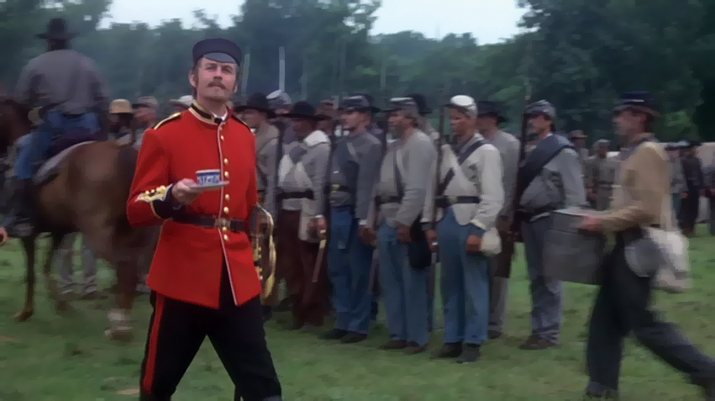
Image: James Lancaster as Lieutenant Colonel Arthur Fremantle in Gettysburg (1993).

“The negro has no qualities out of which a soldier can be manufactured”
On June 15, 1864, the Galveston Daily News reprinted this brief editorial from the Richmond Whig & Public Advertiser, excoriating the value of slaves as soldiers, and boasting that the Federal army’s “unnatural and diabolical” enlistment of black troops “renders their overthrow more certain and speedy.”
NEGRO TROOPS. — The catastrophe of the Yankees at Fort Pillow, like their rout at Ocean Pond [Olustee, Florida], and other mishaps that have befallen them of late, is attributed by themselves to the cowardice of their negro [sic.] allies. We are well satisfied that the result in each of the cases would have been the same, if the places of the negroes had been held by Yankees. But at the same time we believe that the presence of the negroes hastened our victories and made them easier. We need not say to Southern readers that the negro has no qualities out of which a soldier can be manufactured. Any reliance on him in that way is sure to bring disappointment and disaster. An army composed in any degree of such troops is an army with a weak point, that may always be beaten through by an adversary who knows how to use his opportunities. Hence it is that we hold that the enrollment of negro troops has brought into their armies an element of positive weakness, and given us a great advantage. The unnatural and diabolical attempt to turn slaves against their own masters reacts upon those who conceived the villany, and renders their overthrow more certain and speedy. In this as in other ways, the institution of slavery is being miraculously vindicated by the events of the war.
It would seem that the Richmond Whig was unfamiliar with that famous “integrated” local militia unit, the Richmond Howitzers. It’s another case where real Confederates didn’t know about Black Confederates.
It’s worth noting, too, that the writer makes a distinction (second sentence) between “Yankees” and “negroes” [sic.] — revealing quite clearly that, in his view, U.S. Colored Troops are not just inferior to, but completely different from, conventional, white Federal troops; the color of their uniform is not what defines them. Black Confederate orthodoxy requires one to believe that large numbers of African Americans were enlisted into Confederate service, and that their race was considered irrelevant to their skill as soldiers. It’s hard to imagine the author of this editorial being convinced of either premise.
Real Confederates Didn’t Know About Black Confederates
Lots of folks are familiar with Howell Cobb’s famous line, offered in response to the Confederacy’s efforts to enlist African American slaves as soldiers in the closing days of the war: “if slaves make good soldiers our whole theory of slavery is wrong.” It was part of a letter sent to Confederate Secretary of War James A. Seddon, in January 1865:
The proposition to make soldiers of our slaves is the most pernicious idea that has been suggested since the war began. It is to me a source of deep mortification and regret to see the name of that good and great man and soldier, General R. E. Lee, given as authority for such a policy. My first hour of despondency will be the one in which that policy shall be adopted. You cannot make soldiers of slaves, nor slaves of soldiers. The moment you resort to negro [sic.] soldiers your white soldiers will be lost to you; and one secret of the favor With which the proposition is received in portions of the Army is the hope that when negroes go into the Army they will be permitted to retire. It is simply a proposition to fight the balance of the war with negro troops. You can’t keep white and black troops together, and you can’t trust negroes by themselves. It is difficult to get negroes enough for the purpose indicated in the President’s message, much less enough for an Army. Use all the negroes you can get, for all the purposes for which you need them, but don’t arm them. The day you make soldiers of them is the beginning of the end of the revolution. If slaves make good soldiers our whole theory of slavery is wrong — but they won’t make soldiers. As a class they are wanting in every qualification of a soldier. Better by far to yield to the demands of England and France and abolish slavery and thereby purchase their aid, than resort to this policy, which leads as certainly to ruin and subjugation as it is adopted; you want more soldiers, and hence the proposition to take negroes into the Army. Before resorting to it, at least try every reasonable mode of getting white soldiers. I do not entertain a doubt that you can, by the volunteering policy, get more men into the service than you can arm. I have more fears about arms than about men, For Heaven’s sake, try it before you fill with gloom and despondency the hearts of many of our truest and most devoted men, by resort to the suicidal policy of arming our slaves.
No great surprise here; earnest and vituperative opposition to the enlistment of slaves in Confederate service was widespread, even as the concussion of Federal artillery rattled the panes in the windows of the capitol in Richmond.
What’s passing strange, as Molly Ivins used to say, is that Howell Cobb is a central figure in one of the canonical sources in Black Confederate “scholarship,” the description of the capture of Frederick, Maryland in 1862, published by Dr. Lewis H. Steiner of the U.S. Sanitary Commission. In his account of the capture and occupation of the town, Steiner makes mention of
Over 3,000 Negroes must be included in this number [of Confederate troops]. These were clad in all kinds of uniforms, not only in cast-off or captured United States uniforms, but in coats with Southern buttons, State buttons, etc. These were shabby, but not shabbier or seedier than those worn by white men in the rebel ranks. Most of the Negroes had arms, rifles, muskets, sabers, bowie-knives, dirks, etc. . . and were manifestly an integral portion of the Southern Confederate Army.
This passage is often repeated without critique or analysis, and offered as eyewitness evidence of the widespread use of African American soldiers by the Confederate Army. Indeed, Steiner’s figure is sometimes extrapolation to derrive an estimate of black soldiers in the whole of the Confederate Army, to number in the tens of thousands.
But, as history blogger Aporetic points out, Steiner’s observation is included in a larger work that mocks the Confederates generally, is full of obvious exaggerations and caricatures, and is clearly written — like Frederick Douglass’ well-known evocation of Black Confederates “with bullets in their pockets” — to rally support in the North to the Union cause. It is propaganda. Most important, Steiner’s account of Black Confederates under arms is entirely unsupported by other eyewitnesses to this event, North or South. Aporetic goes on to point out the apparent incongruity of Steiner’s description of this horde being led by none other than Howell Cobb:
A drunken, bloated blackguard on horseback, for instance, with the badge of a Major General on his collar, understood to be one Howell Cobb, formerly Secretary of the United States Treasury, on passing the house of a prominent sympathizer with the rebellion, removed his hat in answer to the waving of handkerchiefs, and reining his horse up, called on “his boys” to give three cheers. “Three more, my boys!” and “three more!” Then, looking at the silent crowd of Union men on the pavement, he shook his fist at them, saying, “Oh, you d—d long-faced Yankees! Ladies, take down their names and I will attend to them personally when I return.” In view of the fact that this was addressed to a crowd of unarmed citizens, in the presence of a large body of armed soldiery flushed with success, the prudence — to say nothing of the bravery — of these remarks, may be judged of by any man of common sense.
The Black Confederate crowd doesn’t usually include this second passage describing the same event, or explain Cobb’s apparent profound amnesia when it comes to the employment of African Americans in Confederate ranks. How is it, one wonders, that the same Howell Cobb who supposedly led thousands of black Confederate soldiers into Frederick in 1862 found the very notion of enlisting African Americans into the Confederate military a “most pernicious idea” just twenty-seven months later? How is it that the general who called on his black troops to give three cheers, then “three more, my boys!” came to believe that “the day you make soldiers of them is the beginning of the end of the revolution?” How is it that the commander of successful black soldiers felt that “as a class they are wanting in every qualification of a soldier?”
But set aside Dr. Steiner’s propogandist account for the moment; it’s unreliable and unsupported by other sources. Events at Frederick aside, how is that Howell Cobb, in January 1865, was unaware of the thousands, or tens of thousands, of African Americans soldiers supposedly serving in Confederate ranks across the South?
 Howell Cobb’s Confederate bona fides are unimpeachable, and throughout the war he was irrevocably tied in to both political and military affairs. In his career he was, in turn, a five-term U.S. Representative from Gerogia, Speaker of the U.S. House Representatives, Governor of Georgia, U.S. Secretary of the Treasury, Speaker of the Provisional Confederate Congress, and Major General in the Confederate Army. He was a leader of the secession movement, and was elected president of the Montgomery convention that drafted a constitution for the new Confederacy. For a brief period in 1861, between the establishment of the Confederate States and the election of Jefferson Davis as its president, Speaker Cobb served as the new nation’s effective head of state. In his military career, Cobb held commands in the Army of Northern Virginia and the District of Georgia and Florida. He scouted and recommended a site for a prisoner-of-war camp that eventually became known as Andersonville; his Georgia Reserve Corps fought against Sherman in his infamous “March to the Sea.” Cobb commanded Confederate forces in a doomed defense of Columbus, Georgia in the last major land battle of the war, on Easter Sunday, April 16, 1865, the day after Abraham Lincoln died in Washington, D.C. Perhaps more than any other man, Howell Cobb’s career followed the fortunes of Confederacy — civil, political and military — from beginning to end.
And yet, after almost four years of war and almost three years of commanding large formations of Confederate troops in the field, in January 1865 Howell Cobb seemingly remained unaware of the thousands, or tens of thousands, of African Americans now claimed to have been serving in Southern ranks throughout the war.
It is passing strange, is it not?

Oh, About that Black Confederate at Arlington. . . .
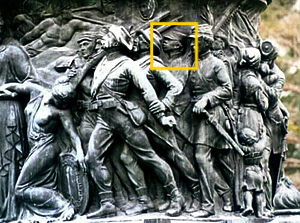 One of the oft-cited elements in discussion of Black Confederates is the inclusion of an African American figure (left) in the frieze encircling the Confederate Monument at Arlington National Cemetery. The monument, funded by the United Daughters of the Confederacy and dedicated in 1914, includes around its base a bronze tableau of Confederate soldiers marching off to war, answering their nation’s call. The young black man, wearing a kepi, marches alongside a group of soldiers; the others are armed but the African American carries no visible weapon. Nonetheless, his presence among the soldiers is usually presented as prima facie evidence that African Americans, too, were enlisted as soldiers in the Confederate Army. He’s cited on multiple websites, such as here, here, here, here and here; a web search on the phrases “Black Confederate” and “Arlington” generates several thousand hits. This descripti0n, on the blog of the California Division of the SCV is typical:
Black Confederate soldier depicted marching in rank with white Confederate soldiers. This is taken from the Confederate monument at Arlington National Cemetery. Designed by Moses Ezekiel, a Jewish Confederate, and erected in 1914. Ezekiel depicted the Confederate Army as he himself witnessed. As such, it is perhaps the first monument honoring a black American soldier.
Sounds pretty convincing. Too bad it’s not, you know, true. As James W. Loewen and Edward H. Sebesta point out in their recent anthology, The Confederate and Neo-Confederate Reader, the booklet published by the United Daughters of the Confederacy at the time of the monument’s dedication gives an entirely different identification. Going back to that original text, it is detailed and explicit:
But our sculptor, who is writing history in bronze, also pictures the South in another attitude, the South as she was in 1861-1865. For decades she had been contending for her constitutional rights, before popular assemblies, in Congress, and in the courts. Here in the forefront of the memorial she is depicted as a beautiful woman, sinking down almost helpless, still holding her shield with “The Constitution” written upon it, the full-panoplied Minerva, the Goddess of War and of Wisdom, compassionately upholding her. In the rear, and beyond the mountains, the Spirits of Avar are blowing their trumpets, turning them in every direction to call the sons and daughters of the South to the aid of their struggling mother. The Furies of War also appear in the background, one with the terrific hair of a Gordon, another in funereal drapery upholding a cinerary urn.
Then the sons and daughters of the South are seen coming from every direction. The manner in which they crowd enthusiastically upon each other is one of the most impressive features of this colossal work. There they come, representing every branch of the service, and in proper garb; soldiers, sailors, sappers and miners, all typified. On the right is a faithful negro body-servant following his young master, Mr. Thomas Nelson Page’s realistic “Marse Chan” over again.
The artist had grown up, like Page, in that embattled old Virginia where “Marse Chan” was so often enacted.
And there is another story told here, illustrating the kindly relations that existed all over the South between the master and the slave — a story that can not be too often repeated to generations in which “Uncle Tom’s Cabin” survives and is still manufacturing false ideas as to the South and slavery in the “fifties.” The astonishing fidelity of the slaves everywhere during the war to the wives and children of those who were absent in the army was convincing proof of the kindly relations between master and slave in the old South. One leading purpose of the U. D. C. is to correct history. Ezekiel is here writing it for them, in characters that will tell their story to generation after generation. Still to the right of the young soldier and his body-servant is an officer, kissing his child in the arms of an old negro “mammy.” Another child holds on to the skirts of “mammy” and is crying, perhaps without knowing why.
My emphasis. “Faithful negro [sic.] body servant” is not a soldier under arms. But it is consistent with the “loyal slave” meme — or “astonishing fidelity,” as the monument’s description calls it — so central to the Lost Cause during those years; similar sentiments appeared on monuments throughout the South.
The comparison to “Marse Chan” further reinforces the theme. “Marse Chan” was a short story by Thomas Nelson Page (1853-1922), that first appeared in Century Magazine in 1884. Nominally set in 1872, “Marse Chan” is told in flashback through the eyes of Sam, a young slave in antebellum Virginia who is assigned as body servant to his master’s son, Tom Channing. Tom grows up and, when the war comes, Sam follows his young master into the army, describing his assignment in the dialect-style of writing commonly used by white authors of the period when writing dialogue for black characters: “an’ I went wid Marse Chan an’ clean he boots, an’ look arfter de tent, an’ tek keer o’ him an’ de hosses.” A contemporary classic of Lost Cause fiction, “Marse Chan” was Page’s best-known work. It would have been familiar to those attending the dedication, who would have understood exactly how its protagonist was the literary parallel of the figure in bronze.
The figure on the monument doesn’t represent a soldier, but it wouldn’t matter much as historical documentation if it did; had the sculptor, Moses Ezekiel, depicted the man explicitly as a soldier, it would reveal only that thought it important to include as part of the story he wanted to present — not necessarily that such men were commonplace. Those claiming the figure as “evidence” of African American soldiers in Confederate ranks a half-century prior to the monument’s unveiling make the common era of assuming that the memorial represents history as it actually was. In fact, no memorial does that; rather, they reflect the story and impressions that their sponsors and artisans want to be remembered, and depict the past in a particular way. Some monuments are more objectively accurate than others, but none is without its bias.
The rush to point to the figure on the Arlington memorial is, sadly, typical of the “scholarship” that informs much of the advocacy for Black Confederates. It reflects a sort of grade-school literalism; there’s a black figure in among the soldiers, therefore this man was a soldier, therefore this is proof of African Americans in the ranks of the Confederate Army more generally. The truth, of course, is not quite so obvious, but revealing it requires taking time to go back to the primary sources and giving some consideration to the context of the time of the monument — 1914, that is, not 1861-65 — and the preferred interpretation of the monument’s sponsors, the UDC. Once you understand those things, and not before, you can start looking for meanings and evidence contained within.
_____________
Additional, October 28: Stan Cohen and Keith Gibson’s Moses Ezekiel: Civil War Soldier, Renowned Sculptor reveals no further information about his design process or his own views on the Confederate Monument at Arlington; it simply repeats the description in the official UDC booklet. Ezekiel also completed statues of Thomas Jefferson for the University of Virginia and of Stonewall Jackson on the parade ground at VMI. It’s beautiful little book, highly recommended.

The Nazi Fanboys
There are exactly four blogs on the intertubes that haven’t addressed the recent revelation that a candidate for the U.S. House of Representatives in Ohio is a military reenactor. Specifically, a World War II German reenactor. More specifically still, an S-freaking-S reenactor, from a unit that has been implicated in serious war crimes. Make that three blogs, because I’m now putting down some of my own thoughts on the matter.
 Not long ago, Josh Green of The Atlantic broke a story that Rich Iott (left), the GOP nominee for Ohio’s 9th Congressional District (Toledo), was for three years (2004-07) a reenactor with Wiking Division, a group of World War II reenactors based in the Upper Midwest. Iott is a long-time reenactor, but the fact that he spent a few years play-acting a Nazi is, understandably, a political bombshell. Though he was always a long-shot in the general election — he’s running against a long-time Democratic incumbent, Marcy Kaptur, in a deep-blue district — the Wiking revelation effectively puts paid to this and any future campaign Mr. Iott may be considering.
In the political scheißesturm that followed, the Wiking group rallied some support from other reenactor groups, including this statement from the Mid-Michigan Chapter of the 82nd Airborne Division Association, which accuses Iott’s critics as playing a “twisted political game” and perpetrating a “blatant lie:”
Reenactors reflect every nation involved in WWII. We have seen not only American and German reenactors, but British, Dutch, French, Polish, Russian, Japanese, Italian and a host of others. To use an educational hobby which provides a teaching tool for all Americans in some twisted political game is not only omitting the true facts, but a blatant lie by conversion of the truth.
They doth protest too much. One of my uncles was a member of the 101st Airborne Division during World War II. I don’t know many details of his service; he died when I was little and he didn’t talk to other family members about those parts of the war. But I know that he witnessed the liberation of some of the concentration camps they discovered at the end of the war. (It may have been a situation like that depicted in Band of Brothers; I don’t really know.) I have no idea how he would’ve viewed modern hobbyists recreating American airborne troops, but it’s impossible for me to believe that he would’ve had any use at all for Rich Iott and his Wiking reenactor buddies.
Rich Iott is not a Nazi. But the objective evidence is that, as a practical matter, he is an imbecile, ein schwachkopf, and that he and his Wiking kameraden are willfully ignoring the very ugly history of the unit they model themselves after. It’s a degree of intentional compartmentalization that’s just staggering. They aren’t Holocaust deniers, who are (for better or worse) straight up about their beliefs; they’re something more insidious, folks for whom it just doesn’t much register. Of all the World War II German military formations, these guys have chosen to recreate the SS, and specifically a unit, the Wiking Division, that was recruited in the occupied countries in the West — Norway, Belgium, the Netherlands — to be composed of men of similar Aryan characteristics to the German SS, or “related stock,” as Himmler put it. The division was explicitly recruited to serve in the East; the antisemitic underpinnings of the SS are explicit in the division’s recruiting materials. Recruiting posters, printed in the local language, sought volunteers to join the fight against Bolshevism, which — inevitably — the Nazis intentionally conflated with Judaism. It’s very ugly stuff, and the Wiking Division was in the center of it, including putting down the Warsaw Uprising in the fall of 1944.
Just last year, a former member of the Wiking Division was charged with atrocities:
A 90-year-old former member of an elite Waffen SS unit has been charged with killing 58 Hungarian Jews who were forced to kneel beside an open pit before being shot and tumbling into their mass grave.
The man, named in the German press as Adolf Storms, becomes the latest pensioner to be prosecuted for alleged Nazi war crimes as courts rush to secure convictions before the defendants become too infirm and the witness testimony too unreliable.
Mr Storms was found by accident last year, as part of a research project by Andreas Forster, a 28-year-old student at the University of Vienna. . . .
Mr Storms was a member of the 5th Panzer Wiking Division which fought on the Eastern Front, moving through Ukraine into the Caucasus, taking part in a bloody fight for Grozny and the tank battles of Kharkov and Kursk before wheeling back through Eastern Europe. By most accounts it left a trail of bodies behind.
By the spring of 1945 the unit was heading to Austria with the intention of surrendering to the Americans rather than to the Red Army.
But first the Wiking Division, led in the early days by General Felix Steiner, who is still revered among neo-Nazis, decided to clean up the evidence against it and eliminate the slave labourers who had dug its fortifications and defensive lines.
According to a statement issued by the regional court in Duisburg, where Mr Storms has spent most of his retirement, 57 of the 58 victims were killed near the Austrian village of Deutsch Schuetzen. The mass grave there was excavated in 1995 by the Austrian Jewish association and the bodies given proper funerals.
Storms died in June 2010, before he could go to trial.
Robert M. Citino of the Military History Center at the University of North Texas, hit the nail on the head when he pointed to what he sees as “an adolescent crush” on Nazi history. He goes on to summarize it nicely in a short essay on HistoryNet:
What you often hear is that the [Wiking] division was never formally accused of anything, but that’s kind of a dodge. The entire German war effort in the East was a racial crusade to rid the world of ‘subhumans,’ Slavs were going to be enslaved in numbers of tens of millions. And of course the multimillion Jewish population of Eastern Europe was going to be exterminated altogether. That’s what all these folks were doing in the East. It sends a shiver up my spine to think that people want to dress up and play SS on the weekend.
I don’t buy for a moment that these reenactors are naive innocents who had no idea that their weekend warrior games were simply beyond the pale of polite company; their reenactor website clearly shows otherwise. It’s been heavily scrubbed in the last few days — including removal of event pictures dating back to Iott’s time with them — but archived copies are still available, including this one from August 2007, the year Iott reportedly was last a participant. None of the reenactors are identified by their real names, including the Wiking group’s public contacts. Iott is included as “Reinhard Pferdmann,” and all the other group member identify only under similar alter-ego names. They are hiding, because they know, they understand, how offensive their identification with the Wiking Division is, and they don’t want to have to answer for it. I’ve known a lot of reenactors, and visited lots of reenactor websites, and never encountered one (including Confederate reenactors) who didn’t identify at least the key members of the group publicly. To me, that’s prima facie evidence that these guys knew very well how their hobby was perceived by the public at large, and (unlike most reenactors) very clearly didn’t want to be publicly associated with it. Iott and his buddies know damn well what they’re doing, and why it’s deeply offensive to so many; that’s why they cower behind names like “Reinhard Pferdmann.” Unlike the Waffen-SS men they so admire, these modern reenactors clearly lack the courage of their convictions.
Twenty-some years ago a Civil War reenactor I knew– he was part of a Union artillery battery — cautioned me that “Civil War reenacting is the lunatic fringe of living history.” His observation was tongue-in-cheek, but endearing. I’ve known a lot of reenactors over the years, and often toyed with the idea of diving into the hobby myself. (Much to the relief of both my wife and my wallet, the feeling passes after a few days.) Reenacting has a lot of appeal, and I think it lends itself well to helping educate the public in certain areas. Reenactors particularly excel in explaining the details of daily life, civilian and military, in earlier times. While it seems unlikely that I’ll be putting on a period uniform myself, I get the appeal, and I understand how folks become so devoted to it.
But there’s something fundamentally different about what Iott and his buddies are up to. They are not exploring their own nation’s history, or their family’s, as many Civil War reenactors are. Their open admiration for the Waffen SS — specifically, a Waffen SS division composed of men who betrayed their own fellow Dutch, Belgian, Norwegian citizens and went over to the enemy — is simply unfathomable. (Later in the war, from 1943 on, some Waffen SS men were conscripted from the occupied countries.) It is reprehensible, and they know it; that’s why they hide behind character names. There are thousands of survivors of the Holocaust and Nazi atrocities on the Eastern Front still living, and millions more of their relatives and friends who have heard firsthand of their experiences and the hands of the Waffen SS and others like them. The Wiking reenactors don’t particularly care about those things, or even acknowledge them; they want to focus entirely on their ehrfurcht gebietend MG42 machine guns — “we also have full automatic weapons for rent!” — and downloadable food tin labels. The people aren’t doing history, or education; they’re getting their jollies at playing at being Nazis. They give living history and historical reenacting a bad name. That they don’t own up to their identities online shows that, on some level, they’re embarrassed by what they do. As they should be.
If Rich Iott wants to play dress-up as a member of the Waffen SS, an organization that was declared criminal at the Nuremberg Trials, and simulate a unit that has been implicated in numerous war crimes, then he is free to do so. The rest of us are free to call him out for it. They want to run around playing Waffen-SS, but not be held accountable for it, individually or as a group. Note to the Wiking kameraden; if your hobby is such an embarrassment that you don’t want others to know about it, do us all a favor and get another damned hobby.

Coates’ Civil War
 As some of you are aware, over the last several months we’ve had long, intricate discussions of the Civil War and the Civil War period over at Ta-Nehisi Coates’ blog at The Atlantic. These have dealt with diverse subjects, from current-events issues like the Virginia Confederate History Month debacle last spring, to an ongoing group-read of MacPherson’s Battle Cry of Freedom. It’s a discussion that I’ve had the chance to contribute to in a small way, and it’s helped to both challenge and clarify my own thinking about the war and its continuing legacy.
Now, one of the regulars there who goes by the handle Absurdbeats has assembled a compliation of Civil War related posts from Coates’ place, going back over two years. Both the posts themselves and the discussions that follow are often both fascinating and illuminating. I’m also adding this listing in the links at right.
Happy reading, folks.





4 comments