Missing the Forest for the Trees
 While going through microfilm looking for something else, I came across this editorial in the Galveston Weekly News, published on September 3, 1862 — several months after the Confederacy’s first Conscription Act, and shortly before passage of the second.
Conscripting Slaves. — The Telegraph of this city [Houston] is advocating the policy of conscripting slaves, to be employed in throwing up entrenchments and performing the other duties of soldiers. We think there are some very serious objections to such a policy. We do not propose to enter upon the discussion of the subject, but would here simply remark that by adopting such a policy we would seem to be following the example of the enemy, and they would not fail to justify the course they are now pursuing in filling up their armies with negro [sic.] recruits, by referring to the fact that we make conscripts of our slaves in order to strengthen our armies against them. The fact of our not putting arms in the hands of slaves, would not deprive their argument of its force, so long as the slaves are employed to the usual duties of soldiers, so that the 100,000 of them the Telegraph proposes to raise, will have the same effect as increasing our military force by just that number of white conscripts. We fear the argument would, at least, be sufficient with foreign nations, to justify the Federals in employing negroes in their armies, in the way they are now doing.
We also think the policy proposed would be seriously objectionable on the ground of its taking the slave out of his proper position, and the only position he can safely occupy in a slave country. We are moreover of the opinion that we have white men enough to achieve our independence without conscripting slaves to help us. And we further believe that our slaves can be much more profitably employed in agricultural, mechanical and manufacturing pursuits, under the supervision f white men. In these pursuits, their labor, if properly directed, will add more military strength to the country, by keeping our armies properly supplied, than by conscripting them.
My emphasis. Note that the editorial here objects to the formal enlistment of slaves even in non-combatant roles — “the fact of our not putting arms in the hands of slaves, would not deprive [the Federals’] argument of its force.” In the back-and-forth about this or that bit of “evidence” for the widespread enlistment of large numbers of African Americans as soldiers in the Confederate Army — much of which is either fundamentally misunderstood, self-contradictory, willfully misrepresented or flat-out fabricated — it’s easy to miss the forest for the trees. The very idea of organizing slaves into military formations, under arms, was antithetical to the legal, social and racial fabric that defined the Confederacy and that put the Southern states on the path to secession. There were dissenting voices, to be sure, particularly as the war dragged on and the Confederacy’s military position became increasing perilous. But even in the closing weeks of the war, the very notion of enlisting slaves into combat service remained deeply, fundamentally offensive to many whose devotion to the Confederacy was without question. “Use all the negroes you can get,” Howell Cobb advised the Confederate Secretary of War in January 1865, “for all the purposes for which you need them, but don’t arm them. The day you make soldiers of them is the beginning of the end of the revolution.”
One sometimes hears, when skeptics point out the dearth of contemporary primary sources from the Confederate side that describe African Americans serving in the ranks, under arms, recognized as soldiers by their officers and their peers, that the practice was so commonplace, so unremarkable, that it simply wasn’t commented upon. It’s suggested that the Confederate Army was racially integrated to such a degree no one thought to mention it. Such a claim reflects a deep ignorance — or deep dishonesty — about the most basic reality the Confederate States: it was a nation succinctly, accurately and unabashedly described in the Weekly News‘ editorial as “a slave country.”
This Harshes My Mellow.

I’ve seen the elements of the Lost Cause used to sell all kinds of crazy stuff, but weed “the ganja pride of Dixie?”
Since the strain was developed by a Southern history buff who loved the South, lived in the South, and used “Dixie” cups for germination; it felt only natural to name the strain based on its origin. And because the Federal Government forced the label of “criminal” upon Mike as per the failed “War on Drugs,” Michael decided to defend his rights against Federal tyranny in true Southern tradition; rebellion.
The second part of our strain’s name comes from the Lord Almighty Himself. We wanted to express our deep feelings for the huge role that God and Jesus both play in our lives and for the great many things that we are all blessed with because of it. Our crop is intended in every way to honour the Lord and it’s done so tactfully and with good reason.
We live in a time where some individuals wish to take the name of “God” out of everything in America (removal of 10 commandants and crosses from public places, etc.) Political correctness has run amok and now, for no apparent reason, it’s not OK to wish someone a “Merry Christmas” anymore during December. Why is it that we’ve strayed so far from our roots?
This is America! This whole entire “New World Experiment” was founded upon religion. We can say “Merry Christmas” if we want to. Likewise, we can name pot strains after our Savior if we deem appropriate. That’s just how it is. We are unapologetic.
Finally, we believe that by placing the name of Jesus back into the people’s hands we are providing a positive step. We deliver the message and the Lord will work out the details.
Take a stand for the right to preserve Southern tradition while keeping God first.
With God Our Vindicator….Deo Vindice!
I wonder if H. K. Edgerton knows these fools are using his image for this, er, endeavor.

Civil War Portraits from the Library of Congress
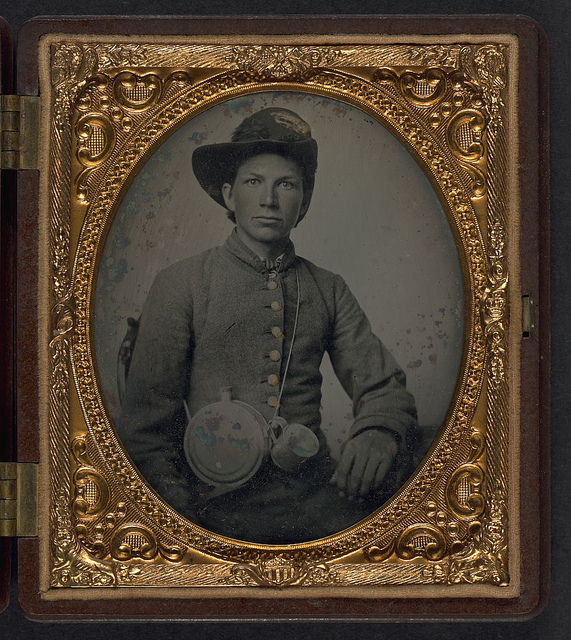
The Library of Congress has put online a collection of almost 700 Civil War era photographic portraits, donated by the Liljenquist Family. Most of the images are of soldiers, and most are unidentified. But the Library of Congress is seeking the public’s help in identifying both the subjects and the photographers:
Most of the people and photographers are unidentified, and we’d love to learn more about them. Please let us know if you recognize a face from your family, a regiment, or a photographer’s painted studio backdrop! You can read some of the personal stories that did survive in notes found with the photo cases.
The images are remarkable, and often haunting. One wonders what happened to these men and boys, all trying to look so brave.
____________________________
Image: Unidentified young soldier in Confederate shell jacket, Hardee hat with Mounted Rifles insignia and plume with canteen and cup, Library of Congress.

Confederate Reunions: Simple Images, Complex Realities

About a year ago the blog Confederate Digest posted an image from the Alabama Department of Archives and History, showing participants at what was billed as the “Last Confederate Reunion,” held at Montgomery, Alabama in September 1944. The African American man at center is identified, from the archives’ catalog description, as Dr. R. A. Gwynne of Birmingham, Alabama. No additional information about Dr. Gwynne is provided, and there seems to be an unspoken assertion that his presence is evidence of his service as a soldier, and there is an implicit assumption that he was viewed at the time as a co-equal peer of the white veterans. But as with Crock Davis and the Eighth Texas Cavalry, the reality is more complex, and reflects the social and cultural minefield of both the antebellum and Jim Crow South.
As it happens, the Alabama archive website also includes a copy of the issue of the Alabama Historical Quarterly (Vol. 06, No. 01, Spring Issue 1944) containing a detailed description of the event. The attendees are described thus:
Commander-in-Chief of the Confederate Veterans, Homer L. Atkinson, of Petersburg, Va., was unable to attend on account of illness. The first Veteran to arrive was Brigadier-General W. M. Buck, of Muscogee, Oklahoma, who has already reached the age of 93 but is remarkably active and came from Muscogee to Montgomery unescorted. The Georgia delegation was sent through the courtesy of Governor Ellis Arnall in a beautiful car escorted by the Georgia State Highway Patrol in charge of Corp. Paul Smith. In the delegation were Col. W. H. Culpepper, 96 years of age and Gen. W. L. Bowling, 97. Other Veterans present were: Gen. J. W. Moore, of Selma, 93 years of age, who was elected at the close of the Reunion to be Commander-in-Chief of the Veterans; J. D. Ford, Marshall, Texas, 95 years of age; W. W. Alexander, Rock Hill, S. C., 98; Gen. William Banks, Houston, Texas, 98; J. A. Davidson, Troy, 100 years of age. All Veterans except Gen. Buch were accompanied by attendants.
There’s no mention of Dr. Gwynne, only the seven white veterans. There follows a long description of the various activities at the reunion, speeches, musical performances and so on (“Mrs. Thomas wore a Scarlett O’Hara dress and received vociferous applause when she sang ‘Shortenin’ Bread'”), and then, tacked on at the end of the piece, is a brief note:
In the group of seven Veterans [sic., eight men total, seven white and one black] that posed for a photograph was one Negro man slave 90 years of age who served in the war as a body guard to his master. This man, Dr. R. A. Gwynne, lives in Birmingham where he is a well known character.
This, along with the caption accompanying the photo, is the only mention of Dr. Gwynne in the account of the reunion. It seems clear from the context that Dr. Gwynne was, even in 1944, considered separate and apart from the white veterans. He’s almost literally an afterthought. As I said, we’ve seen this before.
In the comments section of the original post, blogger Corey Meyer pointed out — with more than a little snark — that Dr. Gwynne’s seated position may indicate his status was considered different than that of the others in the photo. The blog host fired back with speculation that Dr. Gwynne may have had an infirmity that kept him from standing, suggested that Meyer was arguing that Dr. Gwynne was somehow forced to participate in the reunion “against his will,” and repeated the standard tropes about the “indisputable fact that thousands of blacks, both slave and free, willingly served in the Confederate armed forces, defending their homeland against a brutal, invading northern army.” Another commenter, well-known on Confederate heritage sites, chimed in with some gratuitous name-calling directed against Meyer.
This is, sadly, the way online “discussions” about “black Confederates” generally go — lots of sarcasm, rancor and name-calling, with little or no attention paid to the individual subject, and no acknowledgment or understanding of the larger context of the periods under discussion, either the 1860s or early 20th century South. In this case, Dr. Gwynne gets completely overlooked, because his only role here is to serve as a convenient example of the “thousands of blacks, both slave and free, willingly served in the Confederate armed forces, defending their homeland against a brutal, invading northern army.” (Entirely disregarded is the fact that, if Dr. Gwynne was indeed 90 years old in September 1944, he could not have been more than eleven at the end of the Civil War, a child even by 19th century standards.)
This, too, is entirely typical of the way images of old African American men at Confederate reunions are used as “evidence” of those men having been considered soldiers. Most of the time, these images are splashed out on a website without any further explanation and without full identification of the men involved, the units they were affiliated with, or even the date and location of the reunion. This 1944 example is better in that the man in question is identified, but the intended point is still the same — that Dr. Gwynne’s presence is proof “that thousands of blacks, both slave and free, willingly served in the Confederate armed forces, defending their homeland against a brutal, invading northern army.” It’s not; it’s only evidence that Dr. Gwynne attended the event, and posed for a photo with the white veterans. The photos says nothing conclusive about his status during the war, how he was viewed by those same white veterans, or what his motivations or beliefs were when, as an enslaved child, he was taken off to war to serve as a “body guard” to an unknown master.
I haven’t been able to find much on Dr. Gwynne in the usual online sources for contemporary newspapers, census records and the like. I suspect that he may have been a clergyman, rather than a physician, but I don’t know. I’ll keep looking. It remains an open question how much, and in what role, Dr. Gwynne participated in the reunion festivities; we know that in Crock Davis’ case thirty years previous, he was silent spectator at the veterans’ business meeting, and did not eat at the same banquet table with the white veterans. Did a similar, Jim Crow standard apply to Dr. Gwynne at the “Last Confederate Reunion” in Jackson in 1944, or to other Confederate reunions across the South in the decades previous? It sure seems like a mistake to assume that it didn’t, or that views on race and social position of black servants held by the white soldiers of 1861-65 had completely disappeared in the intervening decades.
No serious historian has ever, to my knowledge, questioned that black men, most of the them former slaves and personal servants, participated in Confederate reunions from the 1890s onward. It would be surprising if at least some men didn’t, given the social pressures of the time and the pervasiveness of the “faithful slave” meme that helped define the Lost Cause. John Brown Gordon, commander of the United Confederate Veterans, described it at the time, observing that “these faithful servants at that time boasted of being Confederates, and many of them meet now with the veterans in their reunions, and, pointing to their Confederate badges, relate with great satisfaction and pride their experiences and services during the war. One of them, who attends nearly all the reunions, can, after a lapse of nearly forty years, repeat from memory the roll call of the company to which his master belonged.” The great Southern historian Bell Irvin Wiley, writing just a few years before the “Last Confederate Reunion,” devoted an entire chapter of his classic Southern Negroes, 1861-1865 to black body servants and their complex and (often distinctly unfaithful) relationship with their masters. It’s a very complex business, as Wiley relates, but even he noted that “even now [1938], gray-haired Negroes, dressed in ‘Confederate Gray,’ are among the most honored veterans in attendance at soldier’s reunions.” They were honored by white Confederate veterans explicitly because they embodied the “faithful slave” meme that was central to the way the Confederacy was consistently portrayed by most Southerners at the time, and by some right up to today. I don’t doubt that Dr. Gwynne (and Crock Davis, and Bill Yopp and. . . .) gladly took part in these events, and took a measure of pride in their involvement in the war. But at the same time, their professed pride in the Confederate cause served a larger purpose for white Southerners, and (knowingly or not) those black men took on a role carefully crafted as part of the Lost Cause tradition, that of the loyal slave, still faithful to both his master and to the cause, decades later. They were honored and valued because they did this, as much as for their service to their masters decades before.
People are complicated, and often their true motivations and beliefs are impossible to know. But we do a real disservice to the past to use the sort of historical shorthand offered in the case of Dr. Gwynne or dozens of other unnamed black men photographed at Confederate reunions, that their presence is prima facie evidence of the their having been soldiers, and accepted as co-equal peers by the white veterans. That is, to borrow a line commonly used as a cudgel by Southern heritage groups on those who disagree with them, a singularly bad case of “presentism,” using fragments of the historical record to make the case for an entirely modern and self-serving interpretation. The actual contemporary evidence, when available, suggests otherwise. It does not honor these men to present them as something they were not, nor does it credit the research skill or integrity of the person making the claim.

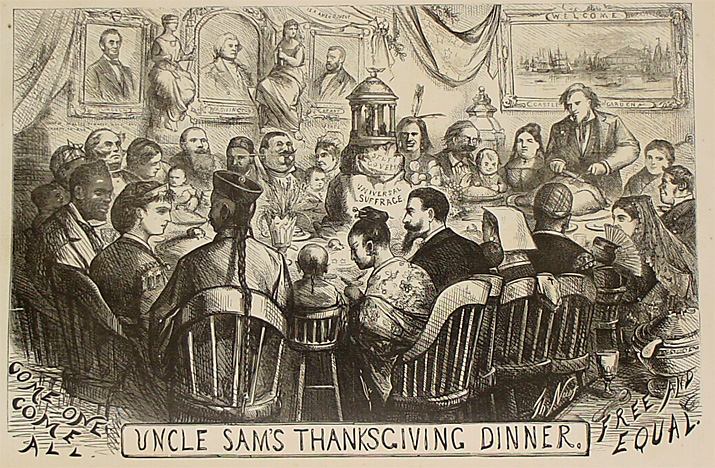

Against the “What-If” Approach to History
 Civil War historian Glenn LaFantasie has a column out today at Salon, in which he poses a typical “what-if” question: what if Robert E. Lee hadn’t publicly and persistently repudiated the idea of the Confederacy engaging in long-running guerrilla warfare, an insurrection, in the months and years after Appomattox? LaFantasie then goes on to spin a wild tale of a resurgent Confederacy, which finally wins recognition by the United States in 1881. After decades of bloody slave revolts, the Confederacy amends its constitution to abolish the institution of slavery in 1938. Confederate ships lie at anchor alongside U.S. vessels at Pearl Harbor in 1941, and the two nations eventually reunite in the late 1940s. LaFantasie’s fantasy finally ends up with the re-established United States being today, more-or-less where where we actually are.
I suspect a lot of folks stopped reading about halfway through (as I did at first), put off by LaFantasie’s apparent effort to out-do Harry Turtledove. But that’s a mistake, because if you give up halfway through, you miss his real point: “what-ifs” are fun as a party game, but have little real bearing on the study of history:
But wait, you cry, that’s not fair! You’ve got the nation following the same track after 1952 that it actually took in its real history!
I suppose you have every right to be upset, to feel like I’ve rigged the game, which, of course, I have. The fact is: You can’t change history, no matter how many times history buffs play counterfactual parlor games or politicians try to alter it by dictating what should be in textbooks or by wishing they could take back something they’ve said that’s now plastered all over the Internet.
In my counterfactual history of the Civil War and its aftermath, I’ve manipulated facts and events so that everything would lead us precisely and purposely to where we already are. Maybe that’s because for all my flights of fancy, I can’t stop being a historian. In my less-than-fertile imagination, the United States ends up precisely where it’s supposed to be, with the American people standing exactly where we are now, for better or for worse. And having reached this place, we are as confused as we’ve ever been about what we’re supposed to do next.
American history has followed roads that are not necessarily inevitable or predictable. But our path as a country has been, I believe, both dogged and implacable. History is not fungible. The facts of history cannot be changed. Nor should we want to change them. We have much to learn from the past if we are to understand properly how the nation has wound up where it is now. In the end, the American people in 2010 have reached a crossroads of their own making, forged in the fires of their past. We have arrived at the place we are supposed to be. Now it behooves us to mind very carefully where we go from here.
Well played, sir, and well put.

“The domned skillipins skeddaddle extinsively — extinsively, sir!”
One of the great firsthand accounts of Texas troops in the Civil War is Val C. Giles’ Rags and Hope: Four Years with Hood’s Brigade, Fourth Texas Infantry, 1861-1865 (Mary Lasswell, ed.). The book was originally published in 1961, at the time of the Civil War Centennial, and (to my knowledge) has never been reprinted. Copies are hard to find, and correspondingly expensive. That’s a shame, because Giles’ narrative is poignant, vivid, and often very funny.
Giles’ accoun t of Second Manassas shares much with that of his postwar friend and fellow 4th Texas veteran, Lawrence Daffan of Company G.* It’s a harrowing description, and Giles (Company B) was much shaken by the carnage he saw around him within the regiment. That’s for a later time, though; for now, I want to follow-up Daffan’s dramatic description of Captain James Reilly’s Battery D of the 1st North Carolina Artillery with Giles’ description of the same event. As always, Giles (left, in a studio portrait taken in Austin at the time of his enlistment in 1861) has a keen ear for vivid characters and humorous spectacle:
When I say the greatest battles of the world have been fought by the infantry, I don’t mean to reflect on the artillery or cavalry, or intimate that they have ever failed to do their duty. Stuart’s Cavalry was always vigilant. They were the eyes and ears of the army, and while the infantry slept, these gallant fellows were far away on the flanks, watching the enemy, guarding the fords, bridges and crossroads, escorting supply trains, and, for weeks at a time, fighting every day. During the war I used to think that the artillerymen were the bravest men on earth. They could pull through deeper mud, ford. deeper streams, shoot faster, swear louder, and stand more hard pounding than any other class of men in the service. . . .
Attached to the Texas Brigade was a fine battery of six Napoleon guns, commanded by Captain Reilly. Reilly had been an artillery sergeant in the old Army, and when the trouble began in 1861, he cast his lot with the Confederacy. He was an Irishman, rough, gruff, grizzly, and brave. He loved his profession and knew his business.
In this battle of Second Manassas, we witnessed a fine display of his skill and courage. General Hood instructed his colonels to halt their regiments when they reached Young Branch, which ran parallel with our line of battle, but when the Brigade reached the branch, the enemy was falling back, all along the line, and many of our field officers were killed or wounded. Colonel J. B. Robertson, Lieutenant Colonel J. C. Upton, Major Bryant, Captain J. D. Roberdeau, and Adjutant Campbell Woods of the Fifth Texas Regiment had all fallen before they reached the branch. The regiment was left without field officers, so the men pressed over the Zouaves, across the stream, and up the hill beyond.
Lieutenant Colonel [S. Z.] Ruff, Majors [John C.] Griffis, [John B.] O’Neill, [D. L.] Jarrett, and [Joel C.] Roper of the Eighteenth Georgia had gone down. Majors [William P.] Townsend, [D. U.] Barziza, and [James T.] Hunter of the Fourth had also fallen. Colonel [William T.] Wofford of the Eighteenth Georgia, Colonel [Benjamin F.] Carter of the Fourth Texas, Lieutenant Colonel P. A. Work of the First Texas, and Colonel [W. M.] Gary of Hampton’s South Carolina Legion finally succeeded in checking our men and bringing them back under the crest of the hill.
It was then that “Old Tarantula,” Captain Reilly, made his appearance on the field. He turned a point of timber to our left and came toward us in a sweeping run. Every horse in the battery carried a rider and the caissons and gun carriages were covered with red caps holding on like monkeys as they thundered over gullies, rocks, even over dead and wounded soldiers.
“Old Tarantula” rode fifty yards in front of his battery. He hurriedly selected an elevation, and at the wave of his hand, the guns were whirled into position and every artilleryman appeared to hit the ground at once. He threw his field glass to his eye, swept the horizon at one glance, then sang out: “Six hundred yards — shrapnel!”’
The guns bellowed and roared, the shells passing ten feet over our heads. Many of .the men sprang to the top of the hill to see the effect of Reilly’s shells. He was accurate in distance, for every shell exploded right in the midst of the confused and retreating enemy. He sat on his horse, calmly giving his commands, increasing the distance as the broken columns retired.
Major [William] Harvey Sellers, General Hood’s Assistant Adjutant General, rode up to the battery on his wounded gray horse to deliver some order. Old Reilly greeted him with a grand flourish and gleefully said, pointing in the direction of the bursting shells, “See, Major, see! The domned skillipins skeddaddle extinsively — extinsively, sir!”

I have no idea what “skillipins” is a phonetic spelling of, but they skeddaddled — extinsively!
___________________________
* As with Daffan’s account, I’ve corrected spellings of proper names without further note. Image: Reilly’s Battery in action at Gettysburg, by Dale Gallon.

Lights! Camera! Secession!
 It looks like things are falling into place for Steven Spielberg’s long-awaited project Lincoln, with the announcement that two-time Oscar-winner Daniel Day-Lewis will take the title role. The film is based on the book Team of Rivals by Doris Kearns Goodwin, with a screenplay by Tony Kushner. Both writers are Pulitzer Prize winners, Goodwin for No Ordinary Time: Franklin and Eleanor Roosevelt: The Home Front in World War II, and Kushner for the play, Angels in America. Spielberg will co-produce with Kathleen Kennedy, who’s taken that role with Spielberg on films including E.T. – The Extra-Terrestrial, Jurassic Park, Schindler’s List and Munich. Filming is planned to start in the fall of 2011, with a projected release in late 2012.
I don’t know if this film will be a hit or not, but if it flops, it won’t be for lack of talent — on either side of the camera.

“This was the grandest thing I saw during the war.”
This year marks the 100th anniversary of the dedication of the Hood’s Texas Brigade Monument on the grounds of the Texas State Capitol in Austin. The following year the Brigade Association published a commemorative book, Unveiling and Dedication of Monument to Hood’s Texas Brigade on the Capitol Grounds at Austin, Texas. It contains a wealth of information about the famous brigade, collected from wartime records and surviving veterans.
 One of the remarkable accounts in the book is this description of the brigade’s advance during the Second Battle of Manassas, late on the afternoon of August 30, 1862. The author is Lawrence Daffan (left), then a seventeen-year-old private from Montgomery County, Texas, assigned to Company G of the Fourth Texas Infantry. Years later, Daffan dictated his account to his daughter Katie, who was herself secretary of the Brigade Association, active in UDC affairs and, the following year, would be named superintendent of the Texas Confederate Woman’s Home.
On that August afternoon, Daffan and his comrades witnessed what later came to be known as “the very vortex of Hell.” At the center of that conflagration stood the famous Fifth New York Volunteers, Duryée’s Zouaves. They took the full brunt of the attack by Daffan’s counterparts in the Fifth Texas, and Hampton’s Legion of South Carolinians, and the Eighteenth Georgia. The Zouaves held on as long as they could, and were effectively wiped out as a fighting unit. Of 525 “redlegs” who marched into the fight that day, 332 were killed or wounded, a casualty rate of 63%.
Note: the original work as published, linked in the first paragraph above, has numerous small errors in dates, spelling of names, and so on. It’s impossible at this point to know if these were errors made by Lawrence Daffan, Katie Daffan, or the typesetter. I’ve corrected (or tried to) all those in the text below, without noting individual instances. Those wishing to see the uncorrected text can click the first link above to read the original, beginning on p. 187 of the original book, or n218 in the electronic version.

On Thursday evening, August 28, 1862, marching through the foothills of the Blue Ridge Mountains, we heard the sound and echo of artillery, which was familiar to us, and we knew that we were approaching the enemy.
Just before sundown we entered Thoroughfare Gap. We could hear musketry and artillery at the opposite side of the gap. Anderson’s Brigade had engaged the enemy, who was holding the gap, to keep us from forming a junction with Jackson at Manassas.
Hood’s Brigade filed out of the road and started right over the top of the mountain, which was very steep climbing. By the time we were at the top we received word that Anderson had routed the enemy. We returned to the road and continued that night and marched through the gap and camped right on the ground where Anderson had driven them away. We were ordered to be ready to move at a moment’s warning. We started at 6 o’clock Friday morning, August 29.
I speak of Hood’s division in this, which consisted of Benning’s Brigade and Anderson’s Georgia Brigade, Law’s Alabama Brigade and Hood’s Texas Brigade. Hood was, at this time, Brigadier General, but acting in the capacity of Major General for this division.
We marched along in ordinary time to Manassas, until 9 or 10 o’clock. At this time we began to hear very heavy cannonade. In an hour we were in the hearing of very heavy artillery and musketry, fierce and violent. Jackson had engaged Pope and his corps. The sound of the firing continued to grow more violent. We received orders to quickstep and shortly afterward received orders to double quickstep. We were all young and stout, and it seemed to me this kept up about two hours. Pope was pressing Jackson very hard at this point. We joined Jackson and formed at his right and double-quicked into line of battle and threw out skirmishers.
At this time, as we arrived there, the firing all along Jackson’s line ceased at once. We took position Friday evening, and Friday night we had a night attack. This and the attack at Raccoon Mountain, Tennessee, were the only night attacks that I know of made by the Confederates. This attack caused great confusion, and I could never understand what benefit it was. We slept that night very close to the enemy, in fact could not speak aloud or above a whisper. I had a very bad cold at this time, contracted on the retreat from Yorktown, and an officer was sent from headquarters “to tell than man who was constantly coughing to go from the front to the rear, where he could not be heard.” I went back, near half a mile, with my blanket and accouterments. I slept alone, under a large oak tree, coughing all night. I didn’t know the maneuvers of our regiment between this [time] and day[light], but I joined them early Saturday morning [August 30]. We formed in perfect order early in the day. Jackson brought on the attack on our left about noon and pressed the enemy until they began to give way in front of him. This drew a number of troops from in front of us to support those Jackson, was driving back on our left.
General Lee’s headquarters were in sight of where I was. About 4 o’clock in the afternoon I saw a considerable commotion in General Lee’s headquarters; he, his staff officers and couriers. The couriers darted off with their instructions to different commanders of divisions, in a few minutes a courier dashed up to General [Jerome B.] Robertson, commanding the Texas Brigade. These couriers and orderlies notified the respective Colonels. The order “attention” was given, then the order “to load,” then “forward,” “guide center.” We went through the heavy timber and emerged into an open field. We had a famous battery with us, [Captain James] Reilly’s Battery [Rowan Artillery], with six guns, four Napoleon and two six-p0und rifles.
Captain Reilly had always promised us that if the location of the company permitted, he would charge with us. We opened and made room between the Fourth and Fifth Texas for Reilly’s Battery to come in. As we started, the battery started.
Young’s Branch was between us and a hill on the other side, which was occupied by a Federal Battery [Curran’s Battery], which was playing on us. This turned into a charge as soon as we emerged from the timber. We had gone a short distance when Reilly unlimbered two of his guns and opened on the Federals. We moved past these guns while they were firing. As we passed on the other two guns came in some distance ahead of those that were firing, swung into position and unlimbered. It seemed to me by the time the first two had stopped, the second two opened fire. This was done remarkably quick. They charged with us in this charge until we arrived at Young’s Branch ; two sections, two Napoleon guns each, two firing while the other two would limber up and run past them, swing into position and open fire.
This was the grandest thing I saw during the war — the charge of Reilly’s Battery with the Texas Brigade. I don’t know whether they shot accurately or not, it was done so fast. But I do know that it attracted the attention of the Yankee battery on the hill, diverting their attention from us.
Reilly’s Battery were North Carolinians and were with us all during the war and they never lost a gun.
In this charge at Manassas we saw a Zouave regiment [5th New York Volunteers, Duryée’s Zouaves]. It stood immediately in front of the Fifth Texas to our right. It was a very fine regiment. As the Fifth Texas approached, it checked the speed of the Fifth in its quick charge. The Fifth Texas, Hampton Legion and the Fourth Texas had a tendency to swing around them. As the Fifth Texas approached them, I saw the blaze of their rifles reached nearly from one to the other.
The First Texas, Hampton’s Legion and Fourth Texas from their position gave the Zouaves an enfilading fire, which virtually wiped them off the face of the earth. I never could understand why this fine Zouave regiment would make the stand they did in front of the brigade until nearly every one was killed.
We rallied at Young’s Branch. I looked up the hill which we had descended and the hill was red with uniforms of the Zouaves. They were from New York.
We ascended the hill out of Young’s branch, charged a battery of six guns [Curran’s], supported by a line of Pennsylvania infantry. This battery was near enough to use on us grapeshot and canister. As we came near to it one of the guns was pointed directly at my company and lanyard strung. Our Captain commanded Company G to right and left oblique from it. I was on the right and with a few others went into Company H. At this time one of the artillerymen threw the main beam, and this threw the cannon directly on Company H. Company H received a load of canister which killed four or five men.
I was immediately with Lieutenant [C. E.] Jones and [Private R. W.] Ransom of that company, who were both killed right at my feet. I stepped over both of them. Captain [James T.] Hunter, now living, was also shot down at that time. Most of the company were my schoolmates.
This last shot threw smoke and dust all over me, and the shot whizzed on both sides of me. Lieutenant Jones was shot in the head and feet, but I was not touched, When the smoke cleared away we had these guns, and they were so hot I couldn’t bear my hands on them. I then fired one shot at this retreating infantry which the rest of the brigade had been engaged with. This wound up that day’s engagement for us, except the Fifth Texas. A part of their regiment and their colors were carried about five miles after the retreating enemy.
We returned to Young’s branch and my attention was attracted to our support coming down the same hill that we had come down.
There were four lines of battle of Longstreet’s Corps in perfect order, which passed us and took up the fight with the retreating enemy where we left it off. This battle was fought on the 30th and 31st of August, 1863.
I can’t understand why the Federals have always attached so little importance to this battle, as they lost many gallant men there. They were terribly defeated, and may have been ashamed of their commanding general.

Image: 5th New York Zouaves, by Don Troiani

John B. Gordon, “Faithful Servants,” and Veterans’ Reunions
Recently I came across a passage in General John B. Gordon’s Reminiscences of the Civil War (1903, pp. 382-84) that, while discussing the eleventh-hour decision of the Confederate government to enlist slaves as soldiers in the final weeks of the conflict, reveals a great deal about the nature of slaves’ other service in the Confederate army, and how they themselves sometimes presented themselves both during the war and decades later.
 John Brown Gordon (1832-1904) was an attorney with no military experience when the war began, but he was elected captain of a company he raised, and by late 1862 had been promoted to the rank of brigadier general. He quickly became famous for his bravery under fire, and was wounded numerous times. He served throughout the war with the Army of Northern Virginia, eventually rising to the rank of major general (he claimed lieutenant general), and commanding the Second Corps of that army. Gordon saw action at most of the Army of Northern Virginia’s major engagements, including First Manassas, Malvern Hill, Sharpsburg, Gettysburg, the Wilderness, Spotsylvania Court House and the Siege of Petersburg. Gordon surrendered his command to another famous civilian-turned-general, Joshua Lawrence Chamberlain, in April 1865. After the war, he fought against Reconstruction policies — allegedly as a leader of the Klan — and later served as a U.S. senator and as governor of Georgia. In 1890 he was elected first Commander-in-Chief of the United Confederate Veterans, a post he held until his death.
In his memoir, Gordon describes the debate surrounding the proposed enlistment of slaves in the Confederate army in the closing weeks of the war:
Again, it was argued in favor of the proposition that the loyalty and proven devotion of the Southern negroes [sic.] to their owners would make them serviceable and reliable as fighters, while their inherited habits of obedience would make it easy to drill and discipline them. The fidelity of the race during the past years of the war, their refusal to strike for their freedom in any organized movement that would involve the peace and safety of the communities where they largely outnumbered the whites, and the innumerable instances of individual devotion to masters and their families, which have never been equaled in any servile race, were all considered as arguments for the enlistment of slaves as Confederate soldiers. Indeed, many of them who were with the army as body-servants repeatedly risked their lives in following their young masters and bringing them off the battlefield when wounded or dead. These faithful servants at that time boasted of being Confederates, and many of them meet now with the veterans in their reunions, and, pointing to their Confederate badges, relate with great satisfaction and pride their experiences and services during the war. One of them, who attends nearly all the reunions, can, after a lapse of nearly forty years, repeat from memory the roll call of the company to which his master belonged.
My emphasis. Like another dyed-in-the-wool, senior and well-connected Confederate general, Howell Cobb, Gordon discusses the proposal to enroll slaves as soldiers without making any mention of the supposedly-widespread practice of African Americans serving in exactly that capacity.
Far more important, though, is what he does say. Gordon’s description of enslaved body servants, and their ongoing attachment to the Confederacy, is essential. He notes that they “boasted of being Confederates, and many of them meet now with the veterans in their reunions, and, pointing to their Confederate badges, relate with great satisfaction and pride their experiences and services during the war.” This is a critical observation, and explains much of what is now taken as “evidence” of African American men serving as soldiers during the war. Advocates for the notion that large numbers of black men served as soldiers in the Confederate army routinely point to images of elderly African American men at veterans’ reunions and argue that those men wouldn’t have been present had they not been seen as co-equal soldiers themselves. As we’ve seen, the historical record, when available, can disprove that assumption. And now we have General John B. Gordon, Commander-in-Chief of the United Confederate Veterans, writing exactly the same thing about what he saw around him, as the popularity of veterans’ reunions reached its peak. Gordon clearly takes pride in the former slaves’ commitment to the memory of the Confederacy — again, “faithful servants” — but he never credits any greater wartime service to them. Indeed, Gordon continues with an anecdote mocking the idea of such men being considered soldiers:
General Lee used to tell with decided relish of the old negro (a cook of one of his officers) who called to see him at his headquarters. He was shown into the general’s presence, and, pulling off his hat, he said, “General Lee, I been wanting to see you a long time. I ‘m a soldier.”
“Ah? To what army do you belong—to the Union army or to the Southern army ?”
“Oh, general, I belong to your army.”
“Well, have you been shot ?”
“No, sir; I ain’t been shot yet.”
“How is that? Nearly all of our men get shot.”
“Why, general, I ain’t been shot ’cause I stays back whar de generals stay.”
This anecdote reinforces Gordon’s (and Lee’s) dismissal of the idea that the service of black men like the cook should be considered soldiers; what made the story amusing to both generals is that the man’s claim to status as a soldier was, to their thinking, preposterous on its face. To be sure, Gordon shows real affection for these old African American men who, in his view, remain loyal to the cause. Nonetheless, he can’t help but make gentle mockery of their pretensions to be soldiers. He never considered them to be soldiers in their own right, which is the point of heaping praise on them as “faithful servants.” Lee understood that, Gordon understood that, and Gordon counted on his readers in 1903 to understand that.
So why is that so hard to understand now?





5 comments