A New President, and an Ambivalent Abolitionist
The fire-eaters across the South saw the election of Abraham Lincoln as the beginning of the end of slavery in the United States. Although the Republicans were careful not to challenge the institution where it already existed, for many in the South, the new administration was seen as a harbinger all the slaveholding class’ worst fears — economic turmoil, political upheaval and collapse of a carefully-crafted legal and social structure centered on race. The fire-eaters worked themselves up into a fury, convincing themselves and many of their contemporaries that Lincoln himself was a radical abolitionist, bent on nothing less than the complete and utter eradication of slavery and establishing full social and racial equality between blacks and whites.
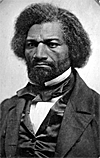 Actual abolitionists knew better, and were largely ambivalent about Lincoln’s candidacy in 1860. Some supported it, reluctantly, as the best practical alternative, while others held a convention that summer to nominate their own presidential candidate as a show of protest. Frederick Douglass eventually came to embrace Lincoln as an ally, but even after the election, Douglass still considered the Republicans a sort of least-bad option, and expressed concern that the Republicans’ tolerance of slavery where it already existed would undermine, and possibly destroy, the movement to eliminate slavery everywhere in the country:
Nevertheless, this very victory threatens and may be the death of the modern Abolition movement, and finally bring back the country to the same, or a worse state, than Benj. Lundy and Wm. Lloyd Garrison found it thirty years ago. The Republican party does not propose to abolish slavery anywhere, and is decidedly opposed to Abolition agitation. It is not even, by the confession of its President elect, in favor of the repeal of that thrice-accursed and flagrantly unconstitutional Fugitive Slave Bill of 1850. It is plain to see, that once in power, the policy of the party will be only to seem a little less yielding to the demands of slavery than the Democratic or Fusion party, and thus render ineffective and pointless the whole Abolition movement of the North. The safety of our movement will be found only by a return to all the agencies and appliances, such as writing, publishing, organizing, lecturing, holding meetings, with the earnest aim not to prevent the extension of slavery, but to abolish the system altogether.
It was as true one hundred fifty years ago as it is today; we have an unfortunate tendency to reduce those movements and political figures we oppose to simplistic caricatures, and to assume that all those actors share similar motivations and goals. They don’t, and sometimes they don’t even fully trust each other.
___________
Update: Though Douglass worried about the victory of Lincoln and the Republicans, he welcomed South Carolina’s secession, bringing with it as it did a constitutional crisis that, in his view, must ultimately decide the matter of slavery. As historian David Blight points out in a new editorial in the New York Times, “Cup of Wrath and Fire,” Douglass “heaped scorn on the Palmetto State’s rash act, but he also relished it as an opportunity. He all but thanked the secessionists for ‘preferring to be a large piece of nothing, to being any longer a small piece of something.'”

“to distance oneself and one’s ‘tribe’ from atrocity and indelible shame”
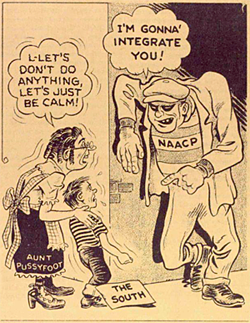 Guest-blogging for Andrew Sullivan at the Atlantic, Conor Friedersdorf highlights a reader’s e-mail that seeks to explain Mississippi Governor Haley Barbour’s praise of the Citizen’s Council in his hometown of Yazoo, Mississippi, during the civil rights struggles of the 1960s. (Within 24 hours, Barbour had issued a whiplash-inducing refutation of his previous comments, describing council as “indefensible.”) The Citizen’s Council (originally known as the White Citizens’ Council) was a white supremacist organization that, while stopping just short of advocating violence, worked to isolate and intimidate African Americans and others working in pursuit of voting rights, fair housing rules, and school desegregation (left). (The first known chapter of the White Citizen’s Council was organized in Mississippi in July 1954, less than two months after the Brown v. Board of Education decision was handed down by the Supreme Court.) While Barbour sought to portray the virulently-segregationist Citizen’s Council as an opponent of the Ku Klux Klan the two organization were, in fact, working toward the same goal by different means, and even had overlapping membership; this was evident even at the time, when the Citizen’s Council was variously known as “the uptown Klan” or “the country club Klan.” Local councils were, in effect, a more reputable alternative to the Klan, and included in their membership many local political leaders and businessmen, which enabled the councils to legitimize their discriminatory practices and wield a range of economic and legal tools to intimidate their opponents.
The reader writes:
As a Southerner born in the late 1960s, I’ve always struggled to understand what happened in the civil rights era back home. To be precise, I’ve struggled to grasp how my people — white people — understood events. I’m from an extremely minor part of the Deep South, so insignificant that to my knowledge, it hasn’t been accounted for in the major histories of the era. The thing is, you can’t really ask older white folks what happened. If they’re willing to talk about it at all — which most aren’t, a reticence that may come from a reasonable certainty that they will be judged unfavorably by their children and grandchildren — it’s usually in a defensive, dismissive way. When Haley Barbour said the other day that he doesn’t remember things being all that bad in Yazoo City, where he grew up, I heard the voice of my parents’ generation. How many times in childhood did I overhear those people talking about how decently “we” treated “our nigras.” It may be hard for people not raised in this culture to understand it when I say that this kind of thing was not said with conscious malice (though it was obviously malicious in its content, not only because it constituted a denial of history, but shows the lingering sense of white paternalism and indeed ownership of black folks). When I was younger, I used to think this was evil, uncut. I don’t think that anymore. I think it instead speaks to the human capacity to distance oneself and one’s “tribe” from atrocity and indelible shame. . . .
My point, re: Barbour’s controversial remarks, is that I am neither surprised by them, nor do I hold him in as much contempt for them as many pundits seem to. I don’t mean to defend his remarks, but for me, I can place them in context. I don’t think he’s bullshitting, frankly. I think he’s wrong, absolutely; but I’d bet money that Haley Barbour is just like his contemporaries in my hometown, including my parents: they have genuinely convinced themselves that things were Just Fine Here, because it’s a way of dealing with extremely painful history without having to deal with it. And it’s a way of being able to look on all the nice older folks you grew up loving and respecting without having to reckon with the fact that they did horrible things to their black neighbors, either actively or by standing passively by. I remember what a shock it was to me as a teenager who was starting to read about the Civil Rights movement, to look upon the faces of older white people in church, men and women I had grown up loving and respecting, and to know (because I had been told) that that kindly gentleman there had been a Klansman back in the day, and that this one in the third pew on the right had participated in a lynch mob decades earlier. You think: “These are not the kind of people who do things like that.” But they did! Yet it’s easy to follow this emotional logic: “I wouldn’t be friendly with people guilty of such moral horrors, but obviously I am friends with these people (and even love and respect them) — therefore, things couldn’t have been as bad as the history books say, at least not here.”
It’s worth reading the whole thing. This writer’s perspective rings very true, and in some ways reflects my own experience. I also think it goes far to explain the willful blindness of the Southron Heritage™ movement, that vigorously denies, minimizes or rejects any historical interpretation that suggests a moral censure on the Confederacy, either collectively or on individual soldiers. It’s exactly the same mindset; Haley Barbour’s re-imagining of the 1960s is the same sort of rationalization modern-day Confederate apologists apply to the 1860s. They will acknowledge the evil of slavery in the abstract, but (1) quickly assert that their particular ancestors didn’t own slaves, and so have no personal connection to it (or responsibility for it), and (2) attempt to deflect or diffuse censure for the “peculiar institution” by pointing to New England’s historic involvement in the transatlantic slave trade, the mistreatment of immigrants and others in Northern factories, the role of Africans themselves in the slave trade in Africa, and so on. Above all, they will contort themselves into knots to claim secession and the war was about anything — tariffs, some vague philosophical argument for states’ rights, anything — other than what the secessionists themselves explicitly said it was.
Neither will modern-day Confederate apologists acknowledge any responsibility — not even a shared responsibility, much less being a prime mover — in the war itself. That, too, was all the North’s fault; it is a matter of faith that the armed conflict that followed South Carolina’s secession was “forced” or “tricked” on the South by Lincoln — even though the shooting actually started almost two months before he took office. The twists of logic here are remarkable as well; I saw it recently asserted that Major Anderson’s evacuation of his command to the still-unfinished Fort Sumter, a few days after South Carolina’s secession, was “the first act of aggression,” even though he did so to avoid a direct, military confrontation with the armed secessionists and, in the process, ceded to them the complete, well-stocked coastal battery of Fort Moultrie, the South’s first military “victory.” (While the notion that Lincoln “forced” or “tricked” the South into firing on Fort Sumter may seem to mitigate the South’s responsibility for it, and all that followed, it’s also an insult to those Southern military and political leaders behind it — Ruffin, Beauregard, Pickens, Wigfall, et al. — because it credits them with neither the ability to recognize they were being “tricked” by a supposedly bumpkin, backwoods lawyer from Illinois, nor for having the free will and agency to refuse to walk into that devil Lincoln’s “trap.” Seriously — the Sumter “crisis” played out over more than three months, so it’s not like anyone involved didn’t have time to think about the consequences of his chosen course of action. But I digress. . . .)
Friedersdorf’s correspondent goes on to argue that “one way to deal with one’s personal, or communal guilt, in the face of collective moral collapse, is to claim victimhood, displacing the blame onto others and renouncing one’s moral agency.” This, too, is readily apparent in the Southron Heritage™ movement; they wallow in being the victim. A hundred fifty years ago they were the innocent victims of radical abolitionists, the Black Republicans, “Beast” Butler and William Tecumseh Sherman; now they’re the innocent victims of politically-correct bloggers, weak-kneed politicians, liberal academics and “racist” organizations like the NAACP. The tenacity with which they cling to this victimhood is made all the more stark by their assertion, in almost the same breath, of their ancestors’ uniquely-Southern combination of courage, rugged individuality, determination and strength. They were strong, but nonetheless remain perpetually defeated; they were morally righteous, but removed themselves from the Union to protect the institution of slavery; they stand for the rights of the states and the individual, but revere a national government that claimed its own supremacy over the member states and imposed on its citizens the heavy hand of the national government sooner than did the Union. It’s victimology of the highest order, one that gains its resilience more from emotion and resentment than logic or historical evidence.
As a Southerner, and a descendant of Confederate soldiers, of slaveholders and at least one elected official who supported secession, I understand the gut-level desire to distance oneself and one’s ancestors from the undeniable sins of the past, and to take comfort from the notion that while someone, somewhere was guilty of those things, my relatives weren’t. But it’s a comforting self-delusion; as Ta-Nehisi Coates once observed, it’s like the abandoned child who imagines his absent parent is actually an astronaut, off on some exciting, secret mission to outer space. It’s comforting, maybe psychologically necessary, but a lie just the same. It’s not history — either collective or individual — which is often very ugly, and involves people doing things, saying things, and fighting for things their descendants really would rather not be forced to acknowledge. It’s a hard thing, but we have to do it. As I’ve said before, were owe it to those men and women to acknowledge and recognize them as they were, not as we’d like them to have been. To acknowledge with candor their failings, limitations and misdeeds is difficult, but to my thinking, it’s preferable to creating an alternate fantasy. That’s no way to honor one’s ancestors.
______________________________
Image: Cartoon from the December 1955 issue of The Citizens’ Council, Jackson, Mississippi, via here.

“You can expect no help from this side of the river.”

The Museum of the Confederacy recently announced the discovery of a coded message enclosed in a tiny bottle that’s been sitting, unopened, in the museum’s collection for over a century. The decoded text of the message reads:
Gen’l Pemberton: You can expect no help from this side of the river. Let Gen’l Johnston know, if possible, when you can attack the same point on the enemy’s lines. Inform me also and I will endeavor to make a diversion. I have sent some caps [i.e., percussion caps]. I subjoin a despatch from General Johnston.
The message is dated July 4, 1863, the same day that Pemberton surrendered Vicksburg to General Grant. Pemberton never got the message, and it would not have mattered if he had.
 The message is unsigned, but the author, who clearly was unaware of Pemberton’s true situation in Vicksburg, may have been Major General John George Walker (l.), at that time commanding a division in the Confederacy’s Trans-Mississippi Department, and operating in western Louisiana. The message was encoded using the “Vigenère cipher,” in which the letters of the original message are shifted so many spaces over, so that A becomes M, B becomes N, and so forth, based on a key word or phrase known to both the sender and the recipient. Although ciphers of this type had a reputation of being unbreakable, most of the Confederate messages sent in this way that were intercepted by the Federals were quickly decoded. The fact that most Confederate messages used one of only three key phrases, “Manchester Bluff,” “Complete Victory,” and “Come Retribution,” made them more vulnerable than they should have been. (After tinkering with this Vigenère cipher generator, it seems this message used “Manchester Bluff” as its key, at least for the first few words.) As so often with cryptanalysis throughout history, the key to breaking a code often comes from mistakes on the part of the sender.
The message was decoded and its contented confirmed by a retired CIA cryptanalist, David Gaddy, and an active-duty U.S. Navy intelligence officer, Cmdr. John B. Hunter.
______________________
Image: This Jan. 14, 2009 image shows a Civil War bottle with a message that was tucked inside at the Museum of the Confederacy in Richmond, Va. The message to Lt. Gen. John C. Pemberton says reinforcements will not be arriving. The encrypted dispatch was dated July 4, 1863 — the date of Pemberton’s surrender to Union forces led by Ulysses S. Grant in what historians say was a turning point in the war. (AP Photo/Museum of the Confederacy)

Merry Christmas!
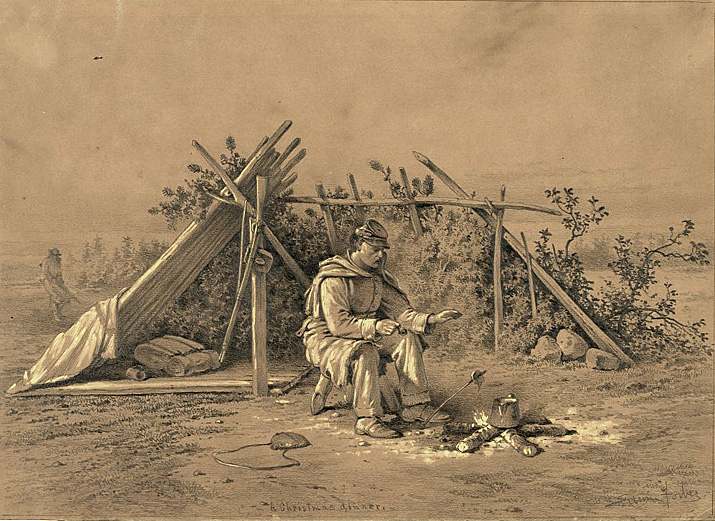
“A Christmas dinner. A scene on the outer picket line” by Edwin Forbes (1839-1895). Library of Congress.

Wordled
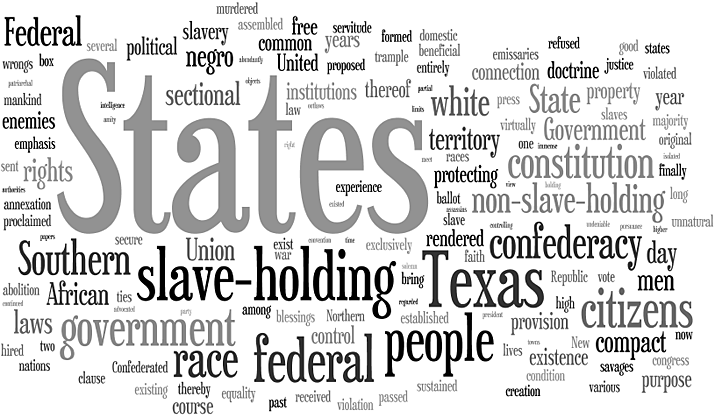
Stealing an idea from Levin, here’s a Wordle on the “Declaration of the Causes which Impel the State of Texas to Secede from the Federal Union.”
_______________

Gritty
The new Coen Brothers’ film True Grit opened today, and it looks to be worth the wait. The film is not a remake of the 1969 John Wayne classic, but a new telling of the story that is reportedly closer to the 1968 Charles Portis novel (read: darker). I saw the original film as a kid, but it doesn’t especially wear well; given the Coen Brothers’ track record of creating worlds populated by vivid — if not entirely likable — characters, this is a movie to see.
Last month Jennifer Bouldin, who lives and works in Fort Smith, Arkansas, posted a great article about the fact and fiction of that town as depicted in the film. The Coens and their production team seem to have taken considerable liberties with their depiction, but Dr. Bouldin nonetheless is excited about the film, as it’s likely to be a significant driver of local tourism just as its predecessor was. In the process of separating myth from truth, Bouldin corrects some misconceptions about both Fort Smith and its most infamous 19th century resident, Isaac Parker, the “Hanging Judge of Indian Territory:”
Parker is infamously known as “The Hangin’ Judge” because he sentenced 160 men and women to hang during his 21 years on the bench. Of those, 79 men were indeed executed in Fort Smith, more than by any other judge in American history.
Despite his moniker, Parker personally was against the death penalty. Instead he favored sending prisoners for rehabilitation back into society to a progressive detention center in Detroit. Considering that he heard 13,490 cases in 21 years, holding court six days a week for up to 10 hours a day, 160 death sentences is a small percentage of the total. His original jurisdiction was larger than the entirety of New England. Parker also did not decide the criminals’ fate—the jury decided the verdict and federal law determined the penalty, yet his is the name associated with the 79 men who were hanged in Fort Smith.
Bum rap.
Seventy-nine executed over the space of 21 years is about four per year, a rate that doesn’t quite justify Judge Parker’s morbid reputation. Go read the whole thing.
_____________________________

To Remember is Not to Celebrate
Gettysburg Ranger and Civil War blogger John David Hoptak’s thoughts on Monday’s anniversary of South Carolina’s secession are right on the money:
The secession of South Carolina was the culmination of decades’ long sectional strife and tension, at the root of which was slavery. I have no patience for those who deny slavery as the principal cause of secession, since one need only examine all the national debates and tensions in the years leading up to South Carolina’s departure from the Union. From the debate in the Philadelphia’s Carpenter’s Hall in the Summer of 1787 over the three-fifth clause, to the Missouri Compromise of 1820, the annexation of Texas, the Mexican War & Wilmot Proviso, the admission of California into statehood in 1850, the Fugitive Slave Act, the Kansas-Nebraska Act, Bleeding Kansas, the Ostend Manifesto, Dred Scott, John Brown’s Raid on Harpers Ferry, and finally the presidential election of 1860, it is clear the nation faced serious challenges in its first eighty years. And those challenges and all the national crises listed above had one thing in common. . . at the root of them all was the issue of slavery and its expansion. Neither do I have patience for those who claim slavery was a dying instituion; quite the contrary: in the 1840, there was just over two million enslaved persons in the United States; twenty years later, there was four million.
Considering all that transpired before the secession of South Carolina and claiming it had nothing to do with slavery is just plain wrong and essentially ignores the first eighty years of America’s history.
Now, this is not to be confused over why a particular soldier–whether North or South–fought. Motivations behind an individual’s enlistment should not be lumped into a discussion of why a state decided to leave the United States.
While the secession of South Carolina was the culmination of decades’ long tensions over the issue of slavery and its expansion into new lands and territories, it was also the spark that lit the powder keg of the Civil War, a devastating war and one of the most tragic episodes in American history. For this reason, today we should by no means celebrate the secession of South Carolina. We should simply reflect upon what it meant to a nation and its peoples.
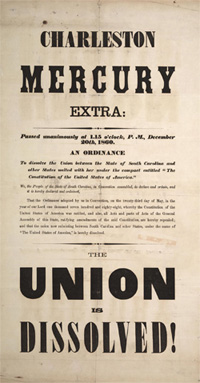
Well put. (h/t Eric Wittenberg)
_______________________

” . . . the complete absence of any other causes.”

Via Michael Rodgers, the South Carolina State achieves clarity on the issue — one issue, singular — behind that state’s secession, 150 years ago next Monday:
The language of the S.C. Declaration is so straightforward, so unambiguous that it is difficult to comprehend that there ever could have been any disagreement over what drove South Carolina to secede. So before any more breath is wasted in arguing about just what our state will be commemorating on Monday, we are reprinting the Declaration on this page. We would urge anyone who doubts that our state seceded in order to preserve slavery — or, for that matter, anyone who has come to accept the fiction that slavery was merely one of several cumulative causes — to read this document.
What we found most striking in rereading the Declaration was the complete absence of any other causes. After laying out the argument that the states retained a right to secede if the Union did not fulfill its constitutional and contractual obligations, the document cited the one failing of the United States: its refusal to enforce the constitutional provision requiring states to return escaped slaves to their owners. “This stipulation was so material to the compact,” the document declares, “that without it that compact would not have been made.”
There is room for disagreement over whether we can fairly judge the morality of the secessionists by the standards of 2010. There is room to debate whether the men who fought for the Confederacy believed they were simply fighting to defend their state, without regard to why their state needed defending, or to what role slavery played in the social order. There might even be room to debate what motivated other states to leave the Union.
But those are debates that need to be had honestly, based on what really happened 150 years ago. Pretending that anything other than slavery played a significant role in South Carolina’s secession is not honest, as the secessionists themselves made a point of telling the world with such abundant clarity.
Too small for a republic. . . .

Decoration Day at Arlington, 1871
As many readers will know, the practice of setting aside a specific day to honor fallen soldiers sprung up spontaneously across the country, North and South, in the years following the Civil War. One of the earliest — perhaps the earliest — of these events was the ceremony held on May 1, 1865 in newly-occupied Charleston, South Carolina, by that community’s African American population, honoring the Union prisoners buried at the site of the city’s old fairgrounds and racecourse, as described in David Blight’s Race and Reunion: The Civil War in American Memory.
Over the years, “Decoration Day” events gradually coalesced around late May, particularly after 1868, when General John A. Logan, commander-in-chief of the Grand Army of the Republic, called for a day of remembrance on May 30 of that year. It was a date chosen specifically not to coincide with the anniversary of any major action of the war, to be an occasion in its own right. While Memorial Day is now observed nationwide, parallel observances throughout the South honor the Confederate dead, and still hold official or semi-official recognition by the former states of the Confederacy.
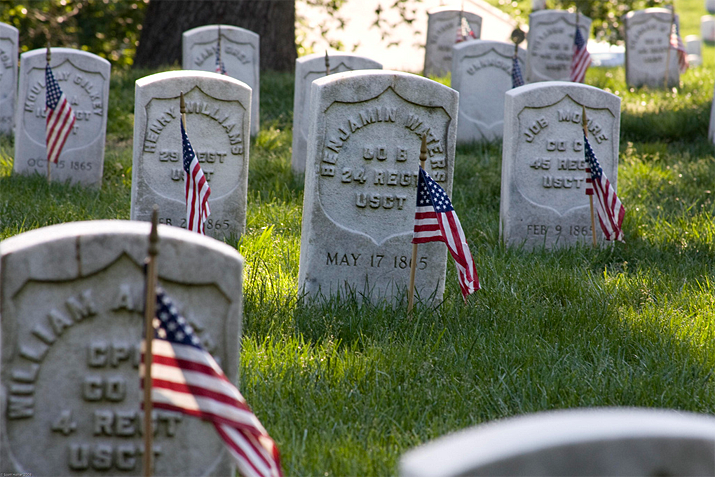
Recently while researching the life of a particular Union soldier, I came across a story from a black newspaper, the New Orleans Semi-Weekly Louisianan dated June 15, 1871. It describes an event that occurred at the then-newly-established Arlington National Cemetery. Like the U.S. Colored Troops who’d been denied a place in the grand victory parade in Washington in May 1865, the black veterans discovered that segregation and exclusion within the military continued even after death:
DECORATION DAY AND HYPOCRISY.
The custom of decorating the graves of soldiers who fell in the late war, seems to be doing more harm to the living than it does to honor the dead. In every Southern State there are not only separate localities where the respective defendants of Unionism and Secession lie buried, but there are different days of observance, a rivalry in the ostentatious parade for floral wealth and variety, and a competition in extravagant eulogy, more calculated to inflame the passions than to soften and purify the affections, which ought to be the result of all funeral rights.
Besides this bad effect among the whites there comes a still more evil influence from the dastardly discriminations made by the professedly union [sic.] people themselves.
Read this extract from the Washington Chronicle:
AT THE COLORED CEMETERY
While services were in progress at the tomb of the “Unknown” Comrade Charles Guthridge, John S. Brent, and Beverly Tucker, of Thomas R. Hawkins Post, No. 14 G.A.R., followed by Greene’s Brass Band, Colonel Perry Carson’s Pioneer Corps of the 17th District, Butler Zouaves, under the command of Charles B. Fisher, and a large number of colored persons proceeded to the cemetery on the colored soldiers to the north of the mansion, and on arriving there they found no stand erected, no orator or speaker selected, not a single flag placed on high, not even a paper flag at the head boards of these loyal but ignored dead, not even a drop of water to quench the thirst of the humble patriots after their toilsome march from the beautifully decorated grand stand above to this barren neglected spot below. At 2 ½ o’clock P.M., no flowers or other articles coming for decorative purposes, messengers were dispatched to the officers of the day for them; they in time returned with a half dozen (perhaps more) rosettes, and a basket of flower leaves. Deep was the indignation and disappointment of the people. A volley of musketry was fired over the graves by Col. Fisher’s company. An indignation meeting was improvised, Col. Fisher acting president. A short but eloquent address was made by George Hatton, who was followed by F. G. Barbadoes, who concluded his remarks by offering the followign resolutions, which were unanimously adopted:
Resolved, that the colored citizens of the District of Columbia hereby respectfully request the proper authorities to remove the remains of all loyal soldiers now interred at the north end of the Arlington cemetery, among paupers and rebels, to the main body of the grounds at the earliest possible moment.
Resolved, that the following named gentlemen are hereby created a committee to proffer our request and to take such further action in the matter as may be deemed necessary to a successful accomplishment of our wishes: Frederick Douglass, John M. Langston, Rev. Dr. Anderson, William J. Wilson, Col. Charles B. Fisher, William Wormley, Perry Carson, Dr. A. T. Augusta, F. G. Barbadoes.
If any event in the whole history of our connection with the late war embodied more features of disgraceful neglect, or exhibited more clearly the necessity of protecting ourselves from insult, than this behavior at Arlington heights, we at least acknowledge ignorance of it.
We say again that no good, but only harm can result from keeping up the recollection of the bitter strife and bloodshed between North and South, and worse still, in furnishing occasion to white Unionists of proving their hypocrisy towards the negro in the very presence of our dead.
 The black soldiers’ graves were never moved; rather, the boundaries of Arlington were gradually expanded to encompass them, in what is now known as Section 27. Most of the graves, originally marked with simple wooden boards, were subsequently marked with proper headstones, though many are listed as “unknown.” In addition to the black Union soldiers interred there, roughly 3,800 civilians, mostly freedmen, lie there as well, many under stones with the simple, but profoundly important, designation of “citizen.” The remains of Confederate prisoners buried there were removed in the early 1900s to a new plot on the western edge of the cemetery complex, where the Confederate Monument would be dedicated in 1914.
Unfortunately, the more things change, the more. . . well, you know. In part because that segment of the cemetery began as a burial ground for blacks, prisoners and others of lesser status, the records for Section 27 are fragmentary. Further, Section 27 has — whether by design or happenstance — suffered an alarming amount of negligence and lack of attention over the years. The Army has promised, and continues to promise, that these problems will be corrected.
As Americans, North and South, we should all expect nothing less.
____________________________________
Images of Section 27, Arlington National Cemetery, © Scott Holter, all rights reserved. Used with permission. Thanks to Coatesian commenter KewHall (no relation) for the research tip.

Missing the Forest for the Trees
 While going through microfilm looking for something else, I came across this editorial in the Galveston Weekly News, published on September 3, 1862 — several months after the Confederacy’s first Conscription Act, and shortly before passage of the second.
Conscripting Slaves. — The Telegraph of this city [Houston] is advocating the policy of conscripting slaves, to be employed in throwing up entrenchments and performing the other duties of soldiers. We think there are some very serious objections to such a policy. We do not propose to enter upon the discussion of the subject, but would here simply remark that by adopting such a policy we would seem to be following the example of the enemy, and they would not fail to justify the course they are now pursuing in filling up their armies with negro [sic.] recruits, by referring to the fact that we make conscripts of our slaves in order to strengthen our armies against them. The fact of our not putting arms in the hands of slaves, would not deprive their argument of its force, so long as the slaves are employed to the usual duties of soldiers, so that the 100,000 of them the Telegraph proposes to raise, will have the same effect as increasing our military force by just that number of white conscripts. We fear the argument would, at least, be sufficient with foreign nations, to justify the Federals in employing negroes in their armies, in the way they are now doing.
We also think the policy proposed would be seriously objectionable on the ground of its taking the slave out of his proper position, and the only position he can safely occupy in a slave country. We are moreover of the opinion that we have white men enough to achieve our independence without conscripting slaves to help us. And we further believe that our slaves can be much more profitably employed in agricultural, mechanical and manufacturing pursuits, under the supervision f white men. In these pursuits, their labor, if properly directed, will add more military strength to the country, by keeping our armies properly supplied, than by conscripting them.
My emphasis. Note that the editorial here objects to the formal enlistment of slaves even in non-combatant roles — “the fact of our not putting arms in the hands of slaves, would not deprive [the Federals’] argument of its force.” In the back-and-forth about this or that bit of “evidence” for the widespread enlistment of large numbers of African Americans as soldiers in the Confederate Army — much of which is either fundamentally misunderstood, self-contradictory, willfully misrepresented or flat-out fabricated — it’s easy to miss the forest for the trees. The very idea of organizing slaves into military formations, under arms, was antithetical to the legal, social and racial fabric that defined the Confederacy and that put the Southern states on the path to secession. There were dissenting voices, to be sure, particularly as the war dragged on and the Confederacy’s military position became increasing perilous. But even in the closing weeks of the war, the very notion of enlisting slaves into combat service remained deeply, fundamentally offensive to many whose devotion to the Confederacy was without question. “Use all the negroes you can get,” Howell Cobb advised the Confederate Secretary of War in January 1865, “for all the purposes for which you need them, but don’t arm them. The day you make soldiers of them is the beginning of the end of the revolution.”
One sometimes hears, when skeptics point out the dearth of contemporary primary sources from the Confederate side that describe African Americans serving in the ranks, under arms, recognized as soldiers by their officers and their peers, that the practice was so commonplace, so unremarkable, that it simply wasn’t commented upon. It’s suggested that the Confederate Army was racially integrated to such a degree no one thought to mention it. Such a claim reflects a deep ignorance — or deep dishonesty — about the most basic reality the Confederate States: it was a nation succinctly, accurately and unabashedly described in the Weekly News‘ editorial as “a slave country.”




3 comments