Talkin’ Buffalo Bayou Steamboats


I’ve recently scheduled a couple of more public talks for the spring. These have proved to be a lot of fun, and (I hope) informative, too. Maybe I’ll see you there!
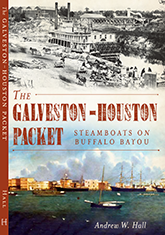
Buffalo Bayou Steamboats
Book Talk and Signing
Jean Laffite Society
April 9, 2013 (Time TBA)
Meridian Towers Retirement Center
23rd Street and Seawall Boulevard
Galveston, Texas
Cotton by Rail to the SeaBook Talk and Signing, Burton Cotton Gin Museum 24th Annual Cotton Gin Festival
April 20, 2013 (Time TBA) 307 North Main Burton, Texas Buffalo Bayou Steamboats Book Talk and Signing Galveston Historical Foundation Menard Summer Lecture Series Sunday, June 23, 2013 at 2 p.m. Tickets required. Menard Hall, 33rd and Avenue Galveston, Texas 77550
_____________
Image: Volunteers from the Southwest Underwater Archaeological Society examine the remains of the former Buffalo Bayou steamboat A. S. Ruthven, near Parker’s Bluff on the Trinity River, 1997.

Visualizing Tariff Revenues
Earlier today my Austin colleague Eric Calistri shared a link to an Excel spreadsheet, distributed by the Economic History Association (download at your own risk), that detailed gross revenues, expenses and net revenues for ports of entry around the United States in the late 1850s. The data is abstracted from a report from the Secretary of the Treasury to the 36th Congress, 1st Session, Senate Executive Document No. 33.
To help visualize that, I’ve taken the gross revenue data for selected ports for FY 1859, and shown how those various ports stack up (ahem!) against one another:
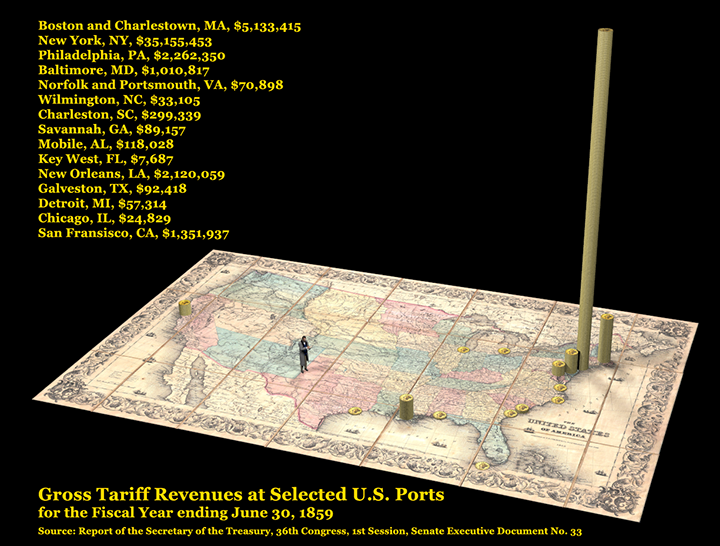
Recall that Professor Williams said that “Southern ports paid 75 percent of tariffs in 1859.″ Sure doesn’t look like it to me. Tariff revenues at New Orleans are similar to those at Philadelphia, but no other Southern port comes anywhere close. Even the second Southern port, Charleston, is only about a tenth the size.
Sometimes it helps to see a thing to really understand it. Full-size image here.
___________
Walter E. Williams Polishes the Turd on Tariffs

Canal boats (foreground) and blue-water sailing ships crowd the waterfront near South Street in lower Manhattan in this 1858 view by Franklin White of Lancaster, New Hampshire. In that year, customs duties collected at the Port of New York alone provided nearly half of all federal revenue. When foreign trade rebounded the next year after the Panic of 1857, customs duties collected at the Port of New York accounted for almost two-thirds of federal revenue. From Johnson and Lightfoot, Maritime New York in Nineteenth-Century Photographs.

The other day, George Mason University economist Walter E. Williams published an opinion piece in the Washington Examiner, asking in the title, “was the Civil War about tariff revenue?” Like many of his columns that deal with that conflict, he tosses in all sorts of obfuscatory boilerplate about Lincoln not liking black folks much, how the Emancipation Proclamation didn’t actually free all the slaves, and how Lincoln, more than a decade before the war began, had made some general comments about the inherent right of revolution. Williams doesn’t get around to discussing, you know, tariff revenue, until the very end, more than nine-tenths of the way through the 657-word piece, when he says (my emphasis),
I want to focus on that line about Southern ports paying 75% of import tariffs, because it’s the core of his entire argument. He’s playing an classic trick, throwing out some impressive factoid, and then asking a rhetorical question based on it, that seemingly has an obvious answer. The problem is that, in this case, his devastating “fact” — “Southern ports paid 75 percent of tariffs in 1859” — isn’t even close to being true.
The first red flag here is that annual tariff data was not collected and reported by the Treasury Department based on calendar years, but by fiscal years that ran from July 1 to June 30. So when Williams says “in 1859,” it’s unclear whether he’s talking about the reporting year that ended in 1859 (FY 1859), or the reporting year that began in 1859 (FY 1860). That’s a revealing slip-up, but it’s also one that doesn’t matter, because the claim is demonstrably untrue for both fiscal years, and so for the calendar year of 1859, as well.
Data for imports and tariffs collected for the year just prior to secession (July 1, 1859 to June 30, 1860, inclusive) is provided in the Annual Report of the Chamber of Commerce of the State of New York, for the Year 1860-61 (New York: John Amerman, 1861), 57-66. I’ve uploaded a PDF copy of the relevant pages here. The first two pages include imports that were not tariffed; in case anyone was wondering, manures and guano were duty-free.
In summary, during that year the Port of New York took in $233.7M, of which $203.4M were subject to tariffs ranging from 4 to 30%. During that same period, all other U.S. ports combined received $128.5M in imports, of which $76.5M was subject to tariff. So the Port of New York, by itself, handled almost two-thirds (64.5%) of the value of all U.S. imports, and almost three-quarters (72.7%) of the value of all tariffed imports:

What about earlier years? The previous year’s report from the New York State Chamber of Commerce carries a table (p. 2) that breaks out imports clearing customs in all of New York State for the previous four fiscal years:

A glance at these numbers makes clear that in spite of some year-to-year variation in import volumes — there was an economic crash in 1857 — the share of imports coming into New York remained remarkably stable, at around two-thirds of all imports coming into the United States. (And this isn’t even including other major ports like Boston and Philadelphia.)
What about customs revenues, specifically? The Chamber of Commerce from 1860 reports — on the very first page — customs revenue for Port of New York for 1859 at $38,834,212, or about 63.5% of the $61.1M in federal revenue that year. The Port of New York, alone, accounted for nearly two-thirds of U.S. Government revenue in 1859. Williams’ assertion that “Southern ports paid 75 percent of tariffs in 1859” isn’t a case of “lying with statistics,” because the statistics don’t actually say anything remotely like that. It’s a case of lying, period.
So where does this made-up-from-whole-cloth assertion come from? Williams’ column has been splattered all over the Internet in the last few days, no doubt because it seemingly affirms modern cultural/political fears about big gubmint avarice. But the idea that Lincoln refused to accede to the Southern states’ secession because they represented the large majority of federal government’s revenue has been percolating around for a while. Thomas DiLorenzo — who Williams cites in the first graf of the piece — made a related and equally implausible claim in his 2002 book, (The Real Lincoln, pp. 125-26) that “in 1860 the Southern states were paying in excess of 80 percent of all tariffs. . . .” People who’d looked at the actual numbers, including friend-of-this-blog Jim Epperson, called him out on that claim, which DiLorenzo eventually (and quietly) revised in his most recent edition to a somewhat more vague “were paying the Lion’s share of all tariffs.” DiLorenzo, not surprisingly, provides no citation to back this claim. But it’s and old turd of a notion that’s been around a long time, that Walter Williams has pulled out, polished off, and given new life on the interwebs.
(DiLorenzo’s wording is a little different, saying that the “Southern states” were paying tariffs. It’s a strange construction, given that the states weren’t paying tariffs at all, and the tariffs were paid by the merchants doing the importing — who were generally Northerners. Even if DiLorenzo were to argue that it was the end-of-the-line consumer who “paid” the tarfiff through higher costs for goods, it’s a claim that defies credulity, as it would require the eleven states that ultimately seceded, with less than a third of the nation’s population, to be consuming more than four-fifths of all the tariffed good brought into the entire county. It’s a ludicrous notion, which is probably why DiLorenzo doesn’t even pretend to offer a source for it.)
Williams and DiLorenzo have both made a good living writing books and essays and giving speeches that are full of half-truths, selective quotes, and (as in this case) outright fabrications, all directed to a narrow but extremely-loyal audience of people who are primed to believe anything bad about the federal government (then or now). Both men hold endowed academic appointments, which means they cost their respective institutions relatively little, and in return are free of heavy teaching loads and the imperative of generating peer-reviewed publications that stalk most faculty members through much of their careers. Fair enough, but Williams’ assertion that “Southern ports paid 75 percent of tariffs” is surely in a league by itself. On its face it strains credulity; one needs only a basic understanding of American history to know how overwhelmingly the Northern Atlantic states and New England dominated this country’s maritime trade through the end of the 19th century. True Southrons™ often cite the heavy involvement of Northern shipping interests in the transatlantic slave trade, but that’s a selective and self-serving focus; that same region overwhelmingly dominated every other aspect of American maritime enterprise, from shipbuilding to whaling to the China trade to the nascent practice of marine engineering.
Williams surely knows this, and knows his assertion about the share of import tariffs paid through Southern ports is preposterous. If he doesn’t know it, he’s unworthy of his credentials, and if he does and asserts it anyway because that’s what his audience wants to hear, then he’s a charlatan on the order of someone like David Barton. I really can’t imagine what’s worse — the idea that he doesn’t actually know he’s wrong, or the idea that he doesn’t give a damn.
____________
UPDATE, February 25: In the comments, Craig Swain points out that he covered this same ground two years ago, over at Robert Moore’s place. I owe Craig an apology, because I not only read that post of his at the time, I also commented on it. I’d completely forgotten about that, at least consciously. Craig does a particularly good job of showing how those same tariff laws, which supposedly were so beneficial to Northern industries, also protected Southerners’ production of things like cotton, tobacco and sugar from competition from overseas.
Given the way spurious claims about tariffs are made over and over again by folks like Williams, naturally they’ve been exposed by others before. But it’s hard to use evidence to counter a belief that’s not based on evidence to begin with.
____________
Aye Candy: David-Class Torpedo Boat
Test renders of a new work-in-progress, a Confederate David-class torpedo boat like those used at Charleston, 1863-65. (The rig that suspended the torpedo spar on the bow, in particular, is missing from this incarnation.) The model incorporates features from a variety of sources, so is intended to show the general appearance of the type, as opposed to any specific, individual craft. At some point I will provide an interior for it, but as only rudimentary diagrams of the boats’ internal layout exist, the interior of the model will be even more speculative than the exterior.


And finally, one of the torpedo boat alongside the submersible H. L. Hunley. The Davids were often used to tow Hunley in and out of the harbor, to save the strength of the hand-powered submarine’s crew:

Full-size images can be seen on Flickr.
______________
The Attack on U.S.S. New Ironsides
 Virginia native William Thornton Glassell (right, 1831-1879) was a Lieutenant aboard U.S.S. Hartford in Chinese waters when the Civil War broke out. When the ship returned to Philadelphia on December 2, 1861, Glassell refused to take the oath to the United States. He was formally dismissed from the U.S. Navy on December 6, and so was arrested and imprisoned at Fort Warren. In time he was issued a commission by the Confederate government and, now being considered a prisoner of war, Glassell was eventually exchanged. Once in Confederate service, Lieutenant Glassell, C.S.N. assigned to the ironclad Chicora at Charleston.
Chafing for the opportunity to strike more directly at the Federal blockading fleet offshore, Glassell volunteered for duty in one of the more unconventional programs then being organized at Charleston, and took command of the little steam torpedo launch David. These cigar-shaped torpedo boats — the name of the first boat was an allusion to the biblical story of David and Goliath — had ballast tanks that allowed them to run almost completely submerged. They were fitted with a fixed torpedo on the end of a long spar, that could be rammed into the side of an enemy ship. It was a dangerous tactic, as much for the attacker as for the target, but the Confederates at Charleston were increasingly anxious to strike a real blow at the Union Navy. On the evening of October 5, 1863, Lieutenant Glassell and his three-man crew set out to attack the most prominent of the blockading ships offshore, U.S.S. New Ironsides.
 U.S.S. New Ironsides (center) on blockade duty.
The admiral s ship, “New Ironsides,” (the most powerful vessel in the world), lay in the midst of the fleet, her starboard side presented to my view. I determined to pay her the highest compliment. I had been informed, through prisoners lately captured from the fleet, that they were expecting an attack from torpedo boats, and were prepared for it. I could, therefore, hardly expect to accomplish my object without encountering some danger from riflemen, and perhaps a discharge of grape or canister from the howitzers. My guns were loaded with buckshot. I knew that if the officer of the deck could be disabled to begin with, it would cause them some confusion and increase our chance for escape, so I determined that if the occasion offered, I would commence by firing the first shot. Accordingly, having on a full head of steam, I took charge of the helm, it being so arranged that I could sit on deck and work the wheel with my feet. Then directing the engineer and firemen to keep below and give me all the speed possible, I gave a double barrel gun to the pilot, with instructions not to fire until I should do so, and steered directly for the monitor. I intended to strike her just under the gangway, but the tide still running out, carried us to a point nearer the quarter. Thus we rapidly approached the enemy. When within about 300 yards of her a sentinel hailed us: Boat ahoy! boat ahoy! repeating the hail several times very rapidly. We were coming towards them with all speed, and I made no answer, but cocked both barrels of my gun. The officer of the deck next made his appearance, and loudly demanded, “What boat is that?” Being now within forty yards of the ship, and plenty of headway to carry us on, I thought it about time the fight should commence, and fired my gun. The officer of the deck fell back mortally wounded (poor fellow), and I ordered the engine stopped. The next moment the torpedo struck the vessel and exploded. What amount of direct damage the enemy received I will not attempt to say. My little boat plunged violently, and a large body of water which had been thrown up descended upon her deck, and down the smokestack and hatchway.
U.S.S. New Ironsides (center) on blockade duty.
The admiral s ship, “New Ironsides,” (the most powerful vessel in the world), lay in the midst of the fleet, her starboard side presented to my view. I determined to pay her the highest compliment. I had been informed, through prisoners lately captured from the fleet, that they were expecting an attack from torpedo boats, and were prepared for it. I could, therefore, hardly expect to accomplish my object without encountering some danger from riflemen, and perhaps a discharge of grape or canister from the howitzers. My guns were loaded with buckshot. I knew that if the officer of the deck could be disabled to begin with, it would cause them some confusion and increase our chance for escape, so I determined that if the occasion offered, I would commence by firing the first shot. Accordingly, having on a full head of steam, I took charge of the helm, it being so arranged that I could sit on deck and work the wheel with my feet. Then directing the engineer and firemen to keep below and give me all the speed possible, I gave a double barrel gun to the pilot, with instructions not to fire until I should do so, and steered directly for the monitor. I intended to strike her just under the gangway, but the tide still running out, carried us to a point nearer the quarter. Thus we rapidly approached the enemy. When within about 300 yards of her a sentinel hailed us: Boat ahoy! boat ahoy! repeating the hail several times very rapidly. We were coming towards them with all speed, and I made no answer, but cocked both barrels of my gun. The officer of the deck next made his appearance, and loudly demanded, “What boat is that?” Being now within forty yards of the ship, and plenty of headway to carry us on, I thought it about time the fight should commence, and fired my gun. The officer of the deck fell back mortally wounded (poor fellow), and I ordered the engine stopped. The next moment the torpedo struck the vessel and exploded. What amount of direct damage the enemy received I will not attempt to say. My little boat plunged violently, and a large body of water which had been thrown up descended upon her deck, and down the smokestack and hatchway.

The torpedo goes off. I immediately gave orders to reverse the engine and back off. Mr. Toombs informed me then that the fires were put out, and something had become jammed in the machinery so that it would not move. What could be done in this situation? In the mean time, the enemy recovering from the shock, beat to quarters, and general alarm spread through the fleet. I told my men I thought our only chance to escape was by swimming, and I think I told Mr. Toombs to cut the water pipes and let the boat sink. Then taking one of the cork floats, I got into the water and swam off as fast as I could. The enemy, in no amiable mood, poured down upon the bubbling water a hailstorm of rifle and pistol shots from the deck of the Ironsides, and from the nearest monitor. Sometimes they struck very close to my head, but swimming for life, I soon disappeared from their sight, and found myself all alone in the water. I hoped that, with the assistance of flood tide, I might be able to reach Fort Sumter, but a north wind was against me, and after I had been in the water more than an hour, I became numb with cold, and was nearly exhausted. Just then the boat of a transport schooner picked me up, and found, to their surprise, that they had captured a rebel.
Fireman James Sullivan and Engineer Toombs dived overboard with Glassell, as well. Pilot J. Walker Cannon remained with the boat because, some sources say, he could not swim — a remarkable fact, if true, given the semi-submerged nature of his craft, even in the best conditions. Glassell and Sullivan were picked up by Federal picket boats; Toombs scrambled back aboard David and, with Cannon guiding him, managed to return safely to Charleston. In his follow-up report to Confederate authorities, Toombs recounted that “the conduct of Lieutenant Glassell was as cool and collected as if he had been on an excursion of pleasure, and the hope of all is that he may yet be in safety.” Toombs reserrved his highest praise for Cannon, though, who in the engineer’s’ view “has won for himself a reputation that time cannot efface, and deserves well of his country, as, without his valuable aid, I could not have reached the city.” Engineer Toombs succeeded to command of the torpedo boat David.
U.S. Navy Acting Ensign Charles W. Howard, the officer of the deck of U.S.S. New Ironsides who was shot by Glassell, died of his wound on October 10. After Howard’s injury, Admiral Dahlgren had recommended him for promotion to Acting Master, which was formally granted on October 16, 1863, in recognition of his “gallant conduct in face of enemy.” Howard’s remains were subsequently buried in Beaufort National Cemetery. A Wickes Class destroyer, DD-179, was later named for him.
Glassell remained in Union hands until the last few months of the war, when he was again exchanged. This time he was assigned to the naval defenses of Richmond, commanding the ironclad Fredericksburg in the James River Squadron.
After the war, Glassell traveled to California, where his brother Andrew was active in land speculation. The Glassell brothers surveyed much of central and southern California, and Andrew Glassell helped establish the city of Orange, California. William Thornton Glassell died in Los Angeles in January 1879, leaving neither a wife nor children. He is buried in Angelus Rosedale Cemetery in Los Angeles.

Fun fact: William Thornton Glassell’s younger sister, Sarah Thornton Glassell, married George Smith Patton, a Confederate officer killed at the Third Battle of Winchester. The Confederate naval officer who very nearly sank U.S.S. New Ironsides was the grand-uncle of the famous World War II General, George S. Patton, Jr.
_____________
Monitor Sailors to be Interred at Arlington
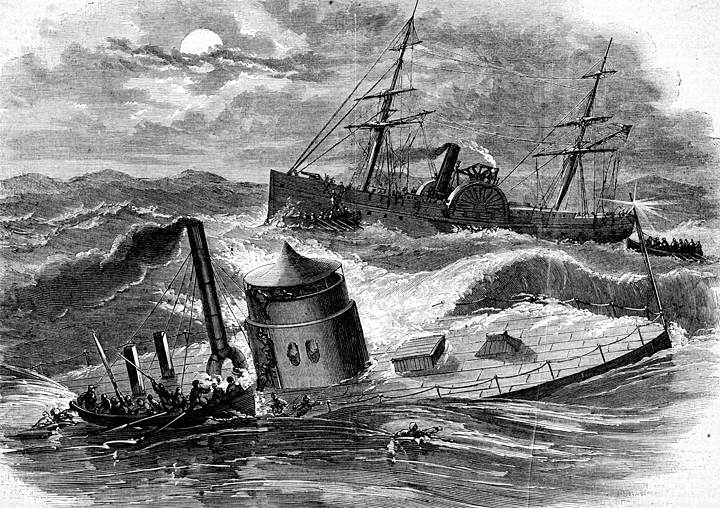
Via Mark Jenkins at CWT, word comes today that the two sailors whose remains were found in the turret of U.S.S. Monitor will be buried on March 8 at Arlington National Cemetery. Although there has been public speculation about their possible identities, those cannot be confirmed, so they will be buried as “unknowns.” Research will continue in an effort to identify them at some future date.
March 8 will be the 151st anniversary of the arrival of Monitor at Newport News, the evening before her famous battle with the Confederate ironclad Virginia. This year also marks mark the 40th anniversary of the 1973 discovery of the Monitor wreck site off Cape Hatteras, and the beginning of an unprecedented series of archaeological and historical studies on the naval history of the Civil War. The work on Monitor provided a template for later investigations on the Confederate submersible H. L. Hunley, located off Charleston more than two decades later.
Earlier posts about Monitor:
___________

Mississippi Supreme Court Flags Itself


Can’t make this stuff up:

The approximately 10 x 15-foot flag was up for a couple of hours before anyone noticed. Because, you know, Mississippi.
______________
Original image via Cottonmouthblog.
“I suppose I am politically ruined. . . .”


U.S. Representative Joe Coutrtney (D-Connecticut) is very unhappy that Spielberg’s film depicts one of his state’s House delegation as voting against the 13th Amendment. All four House members from that state voted in favor of the measure, so he’s right on the facts. But his argument is silly:
We need to get beyond visions of the past based on what seems obvious or logical or rational in hindsight, and take time to look at what people actually did and and said at the time, which often turns out to be irrational, illogical, self-defeating, and completely out of touch with modern values. In fact, almost five dozen members of the House of Representatives, every one from a Union state, voted “on the wrong side of history” that day. Connecticut was hardly a hotbed of abolitionist sentiment, either; it had hung on to the institution until 1848, and there was great apprehension there about the impact universal emancipation would have on white labor in the state’s cotton mills. These are aspects of Connecticut’s history in the 19th century that Rep. Courtney may not know, but they were very real parts of the political landscape in 1865.
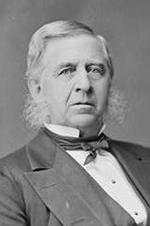 Courtney would have done better to tell the story of Rep. James E. English (right, 1812-90), the lame-duck Democrat who had voted against the measure when it first came up the previous year, but went to rather extraordinary lengths to help pass it when it came up for a vote again in January 1865:

That’s one helluva story, right there. And English was not politically ruined; he went on to serve two terms as the Governor of Connecticut, and served briefly in the U.S. Senate as an interim appointment in 1875-76.
As many folks have pointed out, much of the criticism of Spielberg’s film from historians has amounted to the latter whinging that he and Tony Kushner didn’t make the movie they themselves would have made. Fine, whatever. Rep. Courtney’s criticism is much more valid, even if it’s motivated as much by home-state boosterism as it is by an interest in historical accuracy. Spielberg and Kushner could have — should have — avoided this business altogether by simply depicting the “nay” votes in the House as they really were, explicitly by name, without worrying about what their great-great-great-grandkids might think.

Private Hobbs’ Diary: “We found in the harbour three Gun boats. . . .”
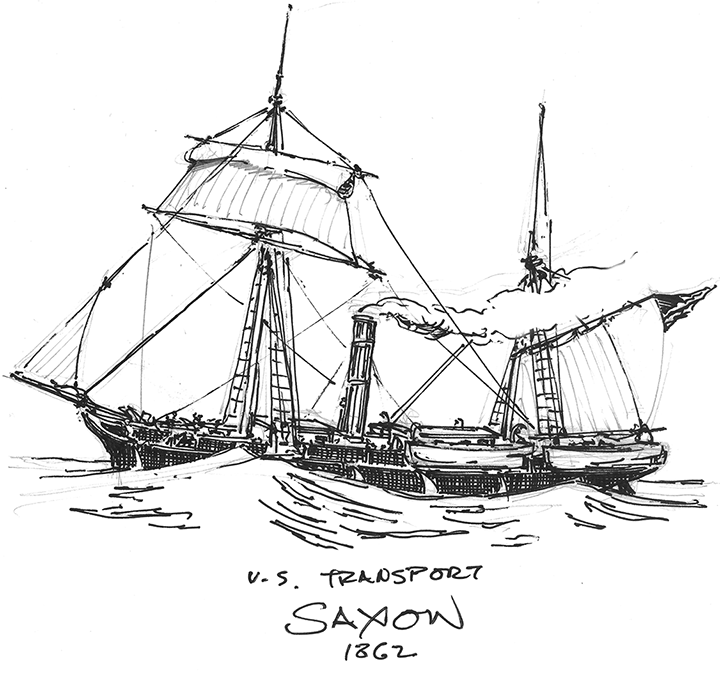
U.S. Army chartered transport Saxon, 1862.
Alexander Hobbs was a private in Company I of the 42nd Massachusetts Infantry. It would be Hobbs’ and his messmates’ misfortune that Company I was one of the three companies of that regiment that eventually occupied Kuhn’s Wharf on the Galveston waterfront, and came under attack by Confederate forces in the early morning hours of New Years Day, 1863. Hobbs kept a diary that encompassed his experiences, which is now part of the collection at the Woodson Research Center at Rice University.
In an earlier post, we traveled along with Hobbs as he and his messmates boarded the chartered transport Saxon [1] at Brooklyn, and made the rough passage down the eastern seaboard, around the Florida Reef, and into the Gulf of Mexico to Ship Island, Mississippi. After a brief stop there for coal, Saxon continues on to the mouth of the Mississippi:
December 16
7 A.M. arrived at the entrance of the Mississippi after a very stormy and disagreeable night back lay-too for some hours waiting for day light to take a pilot the entrance of the river is through low marchy land which extends for (I think) twenty miles from the entrance the river is about three quarters of a mile wide and is very hansome
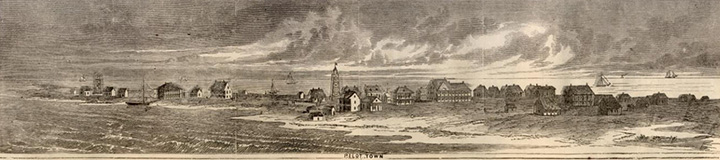
Pilot Town at the mouth of the Southwest Pass of the Mississippi. Harper’s Weekly via SonoftheSouth.net.
We see the remains of many of the few rafts sent down by the rebels to burn Gen Butler [‘s] fleet passed forts St Phillips & Jackson which our gun boats took on thair way too New Orleans the marks of our shot could be plainly seen on the [fort’s] walls it is now garrisoned by a Massachusetts Regt [2] [and we] stopped their untill the medical officer came on bord he found us all well and allowed us to proceed came to anchor at dark within twenty yards of the bank and within twenty miles of the city of New Orleans the scenery on the banks of the river for the most part has been delightful beautifull groves of orange trees which hung full of the golden fruit looked to us very inviting
December 17
Started this morning and arrived at the city at day-light we was all eager to see the “Cresent City”and enjoyed a fine viewfrom the deck of our vessail thare is little to see however as thare is but little business done now we had scarcely anchored before boats came off with fruit, pies, cake & bread the city is under Marsall Law but the poor are much better off than before it was taken by the Federals Flour which than sold for forty five dollars now sells from seven too ten dollars and others then as in proportion we expected to land here but orders came for us to go up the river nine miles to a town called Carrelton [3] accordingly in the evening we ran up the river but not knowing when to stop we went two miles further than we intended and stopped for the night beside a river Steamboat made to carry cotton with a saloon for passengers in the second story She is now laid up to dry and is used as a hospital
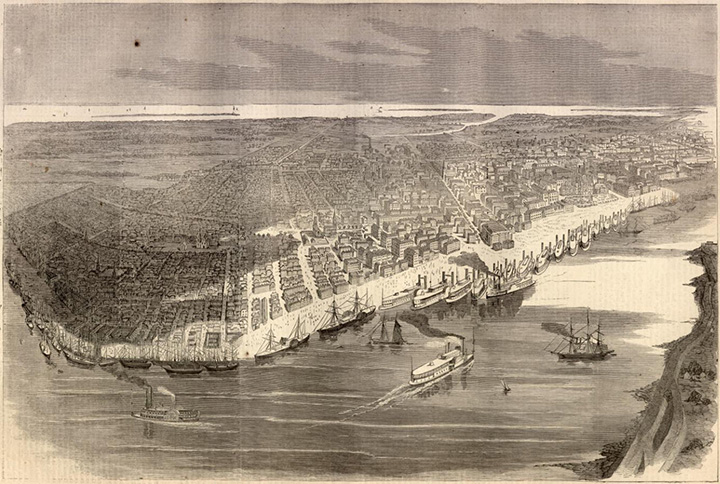
New Orleans, 1862
December 18
Left and steamed down the river two miles and landed at Carrelton at 12 N. marched half a mile and piched our tents on a low wet pieces of land bounded on two sides by grave–yards one a rebel and the other the last resting place of Union Soldiers who had been camped in that vicinity thare was near four hundred from Maine, Mass, Vermt, New York, New Hampshire and some other states thare were two hospitals in the town, full of sick soldiers and it was a sad sight to see some each day carried to the grave without a friend to shed a tear over thair remains doubtless many tears will be shed when the sad tidings are wafted across the ocean to the home they left so lately I have wandered through grave yards before but never see so sad a place as this the graves are onely dug two or three feet deep and immediately fill with water the poor people praise Gen Butler and well they may some of the Ladies say all manner of bitter things about us “Yankees” and scoff at the idea of the Union ever being restored
December 19
Friday gave all our clothes to the Washer women not expecting to leave here soon a few hours afterward the order came to strike our tents and go again on bord the transport we did not know where to find our clothes butafter hunting all over the town we returned to camp in dispare the order was countermandand we again piched our tents afterward some of our boys found thair clothes and before we left they were all recovered
December 21
Broke camp at day light and marched to the bank and embarked on bord the good ship Saxon who was hawled along side the bank stopped a few hours at New Orleans and than proceeded down the river on our way to Taxes the day was verry fine and we had a fine view of the twenty miles passed in the night time on our way up a anchored at night in the river and proceeded toward and morning on our voyage after three days sail with a fair wind and a smooth sea
We arrived off Galveston [December 24] and was brought too by a shot across our bow from a United States Gun boat who spoke us and than signaled for a pilot At 2 P.M. The pilot came on bord but we were obliged to wait two or three hours for the tide to rise toward night we stood in across the bar and struck several times but got across in safety we found in the harbour three Gun boats the largest of which was the Harriet Lane who carried six guns also two Ferry boats [Westfield and Clifton] fitted up with some heavy guns and calculated for the harbour service as she drew only six or seven feet of water
The town is built on an Island connected to the main land by a bridg about two miles long the town form only contained about fifteen thousand inhabitants but nine out of evry ten have gone away since it has been occupied by by [Illegible: hily] by our gun boats
[1] Saxon was a relatively small, 413-ton screw steamer, built at Brewer, Maine, opposite Bangor on the Penobscot River in 1861. She was first registered at Boston, but would spend much of the Civil War under charter to the U.S. Army as a transport. She would continue in civilian for almost three decades after the war, before being abandoned in 1892. Mitchell, C. Bradford, ed. Merchant Steam Vessels of the United States, 1790–1868 (The Lytle-Holdcamper List), (Staten Island, New York: Steamship Historical Society of America, 1975), 196. [2] Probably the 31st Massachusetts Volunteer Infantry. [3] Carrolton was a town upriver from New Orleans from 1833 to 1874, when it was annexed to become part of New Orleans. During the Civil War, Carrolton was somewhat infamous for its various forms of vice, particularly liquor, that caused ongoing discipline problems for the Union military governor, Benjamin Butler. The general’s civilian brother, Andrew, was widely believed to be engaging in all manner of shady business dealings, operating mostly out of Carrolton.
____________Saxon illustration by Andy Hall





4 comments