Kerosene Billy in Fact and Fiction
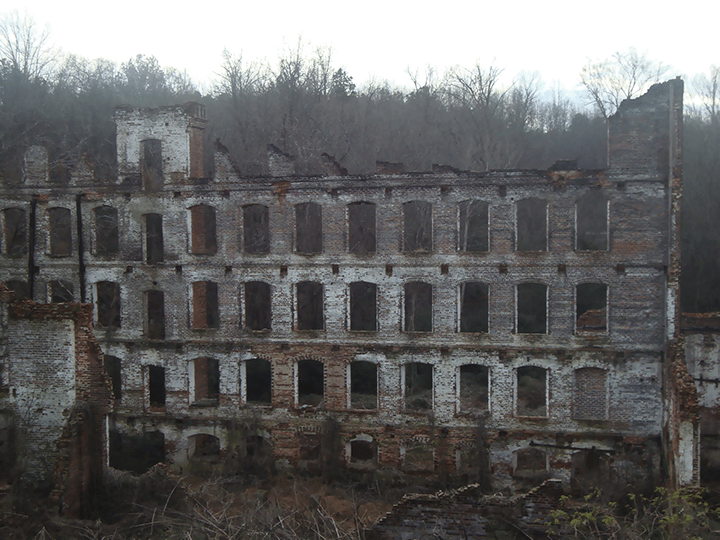

This image, posted recently at SHPG, caught my eye, particularly given its description:

It’s a dramatic and potent symbol of the ravages of the war on the South. Or it would be, if it were true.
The ruins in question are those of the Great Falls Cotton Mill in Rockingham, built in 1869, that were destroyed in a fire in October 1972. It’s a well-known local landmark, and is even included in the Historic American Buildings Survey. As near as I can tell, Uncle Billy’s bummers were not suspected in the 1972 conflagration.
Now, there was a large mill on (or near) this site that was reportedly burned by Sherman’s troops, but this one ain’t it, and ninety seconds with “teh Google” would have made that clear. This misattribution is not a huge, hairy deal, but is it too much to ask for folks to expend a little effort — just a little — in getting this stuff right?
__________

Confederate Flag Cases at the Fourth Circuit
Quick updates on two Confederate flag cases covered previously here:
 The United States Court of Appeals for the Fourth Circuit in Richmond declined to reinstate the case of Candice Hardwick of Latta, South Carolina, who was twice suspended from school for wearing a Confederate flag t-shirt back in 2006. The case was dismissed by a (federal?) court in South Carolina in 2009, and subsequently reinstated. She initially lost her case in 2010, and the case was dismissed again just about exactly a year ago. Federal case law, particularly in the wake of Morse v. Frederick (the infamous 2007 “Bong Hits 4 Jesus” case), gives school administrators very wide latitude in restricting student speech. Lots of folks across the political spectrum have deep reservations about the Supremes’ ruling in Morse, but that’s where we are right now.
That same Fourth Circuit recently rescheduled a hearing to reinstate the SCV’s lawsuit against the City of Lexington over its 2011 ordinance barring all but official, government flags from its light poles and other public fixtures. The hearing was originally scheduled for March 20, but at the last minute the court pushed it back to May 15. The change was not requested by either party. The U.S. District Court had dismissed the case last June, calling the ordinance on its face to be “reasonable, nondiscriminatory, [and] content-neutral.” If the plaintiff, the SCV’s Stonewall Brigade, wins reinstatement of the case, it will presumably go back for trial to the same district court that dismissed it in the first place.
The United States Court of Appeals for the Fourth Circuit in Richmond declined to reinstate the case of Candice Hardwick of Latta, South Carolina, who was twice suspended from school for wearing a Confederate flag t-shirt back in 2006. The case was dismissed by a (federal?) court in South Carolina in 2009, and subsequently reinstated. She initially lost her case in 2010, and the case was dismissed again just about exactly a year ago. Federal case law, particularly in the wake of Morse v. Frederick (the infamous 2007 “Bong Hits 4 Jesus” case), gives school administrators very wide latitude in restricting student speech. Lots of folks across the political spectrum have deep reservations about the Supremes’ ruling in Morse, but that’s where we are right now.
That same Fourth Circuit recently rescheduled a hearing to reinstate the SCV’s lawsuit against the City of Lexington over its 2011 ordinance barring all but official, government flags from its light poles and other public fixtures. The hearing was originally scheduled for March 20, but at the last minute the court pushed it back to May 15. The change was not requested by either party. The U.S. District Court had dismissed the case last June, calling the ordinance on its face to be “reasonable, nondiscriminatory, [and] content-neutral.” If the plaintiff, the SCV’s Stonewall Brigade, wins reinstatement of the case, it will presumably go back for trial to the same district court that dismissed it in the first place.
Update, March 28: This story from the Courthouse News Service provides much more background on the Candice Hardwick case than I’ve seen in other news reports. Disputes with the school over her flag attire go back to early 2003, at least three years before the suspension that resulted in the lawsuit, when she insisted on wearing a “Southern Chicks” shirt with a Confederate Battle Flag. In middle school. Subsequent attire included the legends, “Offended by School Censorship of Southern Heritage,” “Daddy’s Little Redneck,” “Jesus and the Confederate Battle Flag: Banned from Our Schools, but Forever in Our Hearts,” a black Confederates shirt, and one with a picture of the U.S. flag with the caption, “Flew over legalized slavery for 90 years!” This is less a case of a naive kid wanting to honor her ancestors, than a deliberate and years-long intent to force a showdown. And she got it.
__________
Privates Wyatt and John W. Vaughan, Texas State Troops

A brief ceremony was held on Saturday morning in Galveston to recognize the memory of two Confederate soldiers who died here 149 years ago this month. Privates Wyatt and John Vaughan were father and son, respectively, serving with a regiment of state troops stationed here during the latter part of the war. Both contract typhoid fever. Eighteen-year-old John died on March 25, 1864; his 44-year-old father died three days later. Both were buried in graves in the city’s old potter’s field, which lies about 100 yards west of the site of today’s ceremony.
The old UCV plot where the Vaughans’ memorial stones were placed today contains several modern stones, but as far as I know none of the men so memorialized are actually interred there. At least one, H. R. Ostermeyer, survived the war, only to die in the hurricane that swept Galveston in September 1900.
Today’s service was sponsored by the Veuve Jefferson Davis Chapter No. 7 of the UDC, with support and assistance by the John Bell Hood Camp of the SCV, which also provided the color guard. Several Vaughan descendants attended the event.


____________

Aye Candy: C.S.S. Virginia

Updated renders of C.S.S. Virginia (formerly U.S.S. Merrimack), showing revisions done last year for an illustration in the Civil War Monitor magazine. Special thanks to Anna Holloway of the Mariners Museum for providing guidance on the model. Full-sized renders on Flickr.


____________
Sabine Pass Update

My colleague Ed Cotham shares the latest issue of the Sabine Pass Beacon (PDF), the newsletter of the Friends of Sabine Pass Battleground. This issue includes important information about sesquicentennial events planned for September, and the recent installation at the park of the walking beam (above) from the Union gunboat U.S.S. Clifton.
____________
So Much for “Boot Elrod” and the Lexington Boycott
Not sure how I missed this, but Lexington Mayor Mimi Elrod was re-elected to another four-year term last November with a vigorous 63% of the vote. That was Elrod’s second electoral win against her opponent, Council Member Mary Harvey-Halseth, whom she defeated for mayor in 2008, with 59%. (Harvey-Halseth’s term on council is staggered with the mayor’s, so she retains her council seat.) Harvey-Halseth voted against the ordinance barring non-governmental flags on city-owned poles back in 2011, but I don’t get the impression that the dispute over the Confederate flag played much of a role in the 2012 mayoral race. There seems to be much more focus on efforts to revitalize the downtown area of Lexington.
 “Boot Elrod” has been a watchword of the Flaggers practically since the flag ordinance was passed in 2011; even then, a change in the composition of the city government offered the best hope for reversing the ordinance. A court challenge has always been a long shot, as Susan Hathaway acknowledged at the time. But I’ve never been convinced that the ordinance has been a particularly important issue for more than a handful of Lexingtonians, and the results of November’s city election there seem to bear that out.
After the election, Billy Bearden complained that the “Boot Elrod Campaign so gloriously began was allowed to die an inglorious death by the people in and around Lexington that should have kept it alive.” My guess is that “the people in and around Lexington,” as a whole, aren’t nearly so torqued about Confederate flags as Bearden, Hathaway and others think they ought to be. The make-believe Confederates should know better; the News-Gazette noted at the time of the ordinance vote that opposition to it came overwhelmingly from people — like Bearden, Hathaway, and peripatetic Confederate beard H. K. Edgerton — who don’t actually live in Lexington:
One factor in Elrod’s re-election may be that things are looking up economically in Lexington, as in most other parts of the country. Unemployment remains high compared to the state and national averages, at 9.8% in December 2012, but still lower than at the time of the ordinance in September 2011 (11.3%), and well below its Great Recession peak of 14.0% in June 2010.
By contrast, the Flaggers have been working against economic recovery in Lexington, in a way that undoubtedly caught the attention of many residents. Along with the “Boot Elrod” campaign, Hathaway, Bearden, and folks like local SCV leader Brandon Dorsey have been pushing a campaign to boycott Lexington businesses, in the hopes of pressuring them to get the city council to reverse its position. That effort, too, appears to have accomplished little or nothing. The City of Lexington recently released its financial report for FY 2012, covering the period from July 1, 2011 to June 30, 2012, ten months of which fell after the adoption of the flag ordinance and during the period of the boycott. In the three categories of city revenue that directly reflect business activity and tourism — sales taxes, restaurant taxes and hotel/motel taxes — revenues all increased:
From the City of Lexington’s Comprehensive Annual Financial Report for FY2011, p. 32:

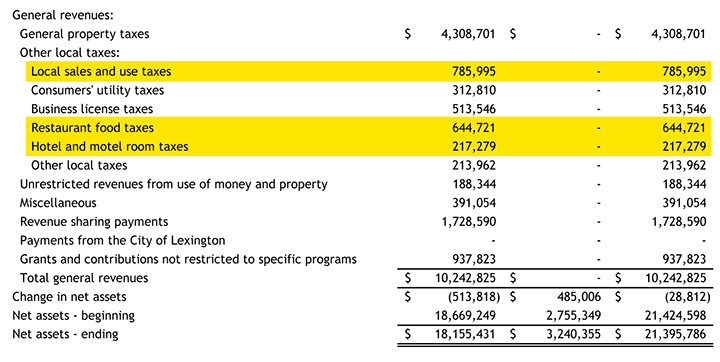
And from the Comprehensive Annual Financial Report for FY2012, p. 32:

And in summary:

Last month I contacted Lexington’s Director of Finance, who confirmed that the rates in these categories did not change from FY2011 to FY2012, meaning that these numbers reflect an actual increase in relevant business activity. These are strong numbers — substantially stronger than current national GDP, which is dragging along at an anemic 2% annual growth rate. Business in Lexington is looking up. To be sure, not every business in Lexington is doing well — some businesses will go bust, even in boom years — but overall, local business activity in Lexington is trending up, not down.
The Flaggers aren’t likely to give up their boycott or the campaign to “Boot Elrod” anytime soon, and that’s their prerogative. But it’s hard to see any substantive effect of either initiative, any more than they’ve restored the flags to the exterior of the Pelham Chapel. They’ll continue to stir the pot — “Are YOU mad enough yet? RISE UP, VIRGINIA!”, etc., etc. — and keep the faith.
After all, November 2016 is just around the corner!
___________
UPDATE, March 20: I almost forgot — a big thank-you goes out to Billy Bearden, who was the first to point me to the city’s annual financial report as a source of economic data for Lexington. Couldn’t have done this post without you, my friend!
___________

Additional Monitor Funeral Photos

Talking Points Memo serves up a slide show of last week’s funeral for the Monitor sailors at Arlington.
____________Photo by Jeff Malet, MaletPhoto.com.

U.S.S. Monitor Sailors Laid to Rest at Arlington
 Diana Rambo, and her husband Lorin Rambo, from Fresno, Calif., pause at a casket of unidentified remains after services to honor two sailors from the Civil War ship, the USS Monitor, at Arlington National Cemetery, Friday, March 8, 2013 in Arlington, Va. Mrs. Rambo is related to USS Monitor crew member Jacob Nicklis. A century and a half after the Civil War ship the USS Monitor sank, two unknown crewmen found in the ironclad’s turret were buried at Arlington National Cemetery. Friday’s burial may be the last time Civil War soldiers are buried at the cemetery. (AP Photo/Alex Brandon)
Over the last year or so we’ve covered the story of the two members of Monitor‘s crew that were found inside the ship’s turret after it was recovered from the floor of the Atlantic off Cape Hatteras in 2002. Officials had hoped to be able to positively identify them from among the sixteen men known to have been lost with the ship, but have so far been unable to, despite efforts through genealogical research, DNA testing and creating facial reconstructions. On Friday, those two men were buried at Arlington National Cemetery.
A marker dedicated to all 16 men lost with the ship will be placed over the grave site. Efforts to identify the men interred there will continue.
Additional photos of the service after the jump, by Associated Press photographer Alex Brandon.
Palestine, Texas Chamber of Commerce Invites a Lawsuit
Palestine, a town in East Texas, has an annual event in the spring, put on by the Palestine Area Chamber of Commerce, called the Dogwood Trails Festival. For a number of years, the local John H. Reagan Camp of the SCV has participated with a booth on the event grounds, explaining their organization and looking to recruit new members. Not this year:
This is a pretty familiar story these days. Even in places like East Texas, there’s a lot of ambivalence about Confederate Heritage™, especially when (as in the case of the SCV) it’s represented by a Confederate Battle Flag. The CBF is “divisive,” for good reason, and other Confederate symbols have been the subject of considerable controversy there in recent years. I can understand Chamber of Commerce’s desire to avoid the issue altogether. Unfortunately, the board’s prepared statement explaining their decision makes their position much more difficult to defend:
 My emphasis. While the board members — who count among their number at least one attorney — may have meant the larger Palestine community, their statement suggests they’re operating as an extension of the city government, in which case they’re sunk, legally. As I outlined earlier, governmental entities can’t really pick and choose who they affiliate with in the same way that private groups can, and issuing a formal statement that you’re operating “on behalf of the city” is a good way to get yourself sued.
The Reagan Camp is one of the highest-profile, most active camps in the state, and it will be interesting to watch this case play out. #HeritageViolation is trending on Twitter, even as I type. Pass the popcorn.
_________





32 comments