


Friday Night Concert: “Kindom Come” with Pokey LaFarge

 A cut from the new album, Divided and United: The Songs of the Civil War, produced by Randall Poster. Divided and United offers more than 30 (!) tracks of period songs, re-interpreted by modern artists, including well-known performers like Loretta Lynn, Ricky Skaggs, Taj Mahal, Lee Ann Womack and Dolly Parton. Some of the best, though, are from less-familiar artists like Shovels & Rope and Pokey LaFarge (right). There’s a neat NPR story on the new album here.
From the interview:
I’ve known this song for years, but I never heard this verse:
- The overseer he makes us trouble, and drive us ’round a spell, We locked him in the smokehouse cellar, with the key thrown down the well. The whip is lost, the handcuffs broken, but the massa’ll have his pay, He’s old enough, big enough, ought to known better than to try an’ run away!
Enjoy.
______________

Mandela and the Complexity of Righteousness

Amid the tributes and commentary on the passing of Nelson Mandela, I didn’t have anything particular to add. But then I read this, by my friend Emily L. Hauser, that cuts like a clarion bell through all the well-intentioned hagiography that’s filling the airwaves right now. I hope she will forgive me for repeating it here in toto:
_____________
Nelson Mandela in 2009 Photo by Media24/Gallo Images/Getty Images.“Too much d—d science on board”
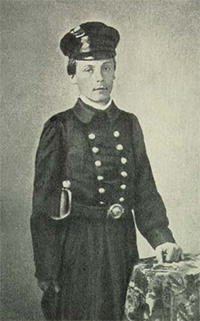 James Morris Morgan (right, 1845-1928) was a 17-year-old Acting Midshipman in the Confederate Navy, serving aboard the ironclad Chicora at Charleston, when he received orders sending him abroad, where he would later join the crew of the commerce raider C.S.S. Georgia. First, though, he had to get safely out of the Confederacy. One of his fellow passengers on the run to Bermuda was the celebrated naval officer and oceanographer, Matthew Fontaine Maury (1806-73). As Morgan would recall decades later in his memoir, Recollections of a Rebel Reefer, Maury’s presence aboard the runner would prove to be a fortuitous circumstance.
[1] Stephen R. Wise’s Lifeline of the Confederacy identifies Herald as a 222-foot-longh iron-hulled sidewheeler built on the Clyde in 1858. Herald was an extremely successful runner, making twelve successful round voyages before being lost trying to run into Old Inlet, near Wilmington, at the end of 1863.
[2] Wise gives this date as October 12.
[3] This is sarcastic.

Winter 2013 in the Civil War Monitor
 The new issue of the Civil War Monitor magazine went out to subscribers this week, and is available online now. In this issue:
- Travels: “Destination: Boston” by Kevin M. Levin
- Voices: “Homesick”
- Preservation: “Thank a Teacher” by O. James Lighthizer
- Disunion: “From Battlefield to Ballfield,” by George B. Kirsch
- Salvo: “Revisiting Confederate in the Attic,” by Jenny Johnston
- In Focus: “Christmas in Camp,” by Bob Zeller
- “Laurence Massillon Keitt,” by Stephen Berry
- “The 25 Most Influential Politicians, Civilians, Inventors, Spies & Soldiers of the Civil War (That You’ve Probably Never Heard Of)”
- “Mystery of the Confederate Deep” by Andrew W. Hall with Michael Crisafulli, Kimble Johnson, Barry Rogoff and Cary Mock
- “War at the Door,” by John C. Inscoe
- Books and Authors: “The Best Civil War Books of 2013,” with Kenneth W. Noe, Andrew Wagenhoffer, Robert K. Krick, Ethan S. Rafuse, Brooks D. Simpson, Harry Smeltzer and Kevin M. Levin
Through the generosity of the Monitor‘s editor, Terry Johnston, blog readers can access the entire Winter 2013 issue online for the next few days:
It’s a great magazine. Remember, the holidays are just around the corner, and you know at least one person who’d love to have a subscription!
_________
The Lost Texts of Gettysburg
I meant to post this back in July, when user Shadow9216 over at CWT put up a series of posts (in sesquicentennial real-time!) of long-lost text-messages sent between military commanders during the Battle of Gettysburg. You can read the series here. Here’s the chatter between the Confederate high command on the evening of July 1:
 BobLee: : -)
 Longstrt: srsly tho, how U fight in morning?
 BobLee: dunno, but best men scouting now
 Longstrt: Stuart back? Didn't kno that...
 BobLee: Not Stuart.
 Longstrt: cuz U sed best so I guess that wuz Stuart
 BobLee: Give it a rest dude
 Longstrt: U shud like totes courtmartial his srry @zz
 BobLee: ZZZZ
 Longstrt: fine do wat u want. Picketts here
 Longstrt: later boss dude.
 BobLee: l8r P33T. C U in morning.
 Salliesboy1863: PICKETT IN DA HOUSE!
 Salliesboy1863: Rollin up w/my boyz from viginia
 Lo: There's an R george.
 Salliesboy1863: do wut now?
 Lo: There's an R in Virginia
 Salliesboy1863: wut-evr dude. thats why i hav U.
 Lo: um hmm. btw, salliesboy1863= srsly lame
 jimkemper_spkr.va: srsly Lo, U tell him
 Salliesboy1863: riiiiight Jim URs is soooo better
 fremantle_a_mil.uk: I say what is the proper format for
 fremantle_a_mil.uk: one who wishes to have a decent, that is
 fremantle_a_mil.uk: an acceptable means of identifying oneself
 fremantle_a_mil.uk: on these devices?
 Salliesboy1863: OMFG!
 Lo: dude, R U ever a n00b!
 jimkemper_spkr.va: WTF? Who brought in this l00zr?
 Longstrt: dudes, chillax. he's a bro from the UK aight?
 BobLee: anyone seen my cavalry?
The Slow, Deliberate Suicide of Confederate Heritage™
Other bloggers have mentioned the dispute over a proposed monument to the Union soldiers that fought at the Battle of Olustee in 1864. There are three Confederate monuments on the site, but none that memorialize as a group the Federal troops that fought there. (There is, apparently, a marker where Union troops who fell were buried in a mass grave.) Initially I though that this was strictly a local issue, then Simpson posted a call to action sent out nearly a month ago on the official SCV blog, by that group’s commander-in-chief, Michael Givens. Typeface and spelling (“Darth Vadar,” “hallowed grown”) are as in the original:
Rational people can have legitimate disagreement on the design or placement of this new monument, but labeling the the SUVCW’s desire to put up a monument as an “attack” on “the hallowed grown where Southern blood was spilled” makes clear the intent is to prevent any monument being placed at all.
Then comes Tim Manning, a well-known figure in the Confederate heritage/Southern nationalist/secessionist movement, pouring gasoline on the fire as only he can. His post is nominally about Vicksburg, but it’s done in response to a news story about the Olustee dispute, in which the local SCV camp commander, Jim Shillinglaw, compares Union soldiers to fanatical jihadists. Manning describes Shillinglaw as “a personal friend of mine” whose “message [should] go viral to every Southerner.” Here are some excerpts:
He goes on to compare the Union to Nazis (and not favorably). It’s funny how they scream in righteous indignation when anyone makes a Nazi analogy to the Confederacy, while doing the reverse is a routine part of defending Confederate heritage. (“Abraham Hitler,” really?)
These people are clowns. Under their leadership, the Confederate heritage movement is marginalizing itself as fast as it possibly can, and it’s words and positions like these that lie at the core of the problem. Shillinglaw, Givens, and Manning would, I’m sure, gets lots of applause for saying this stuff at an SCV meeting, but most other folks will read posts like that and ask, “what the fnck is the matter with you people?” They can run their movement however they want to, but from where I sit it looks like they’re doing more harm to their own cause than all the shadowy, conspiratorial forces of “political correctness” they’re always carping about ever could hope to.
The other day, Kevin asked if the Lost Cause had actually been lost. It’s a fair question. If people like Shillinglaw, Givens and Manning are going to be the face of what passes for Confederate heritage, it’s doomed, and the cause of death will be suicide.
___________
UPDATE, November 13. The current talking point of SCV opposition to the proposed SUVCW monument is that the latter would be placed “in front of” existing Confederate monuments. At the same time, there is general carping that the SUVCW hasn’t been open enough in publicly sharing the details of its plan with the SCV. The Confederate heritage group seems to be saying, in effect, “we are opposed to the specific details of the plan for which we don’t know the specific details.”
In fact, suggestion that the SCV is merely objecting to the placement “in front of” the existing Confederate monuments is a red herring. As Michael Givens’ public call to action above makes clear, the SCV is opposing placement of the marker anywhere near the others. Now comes a statement from the Florida SCV Division Commander, Jim Davis, arguing explitly that it should be nowhere on the 3-acre tract originally deeded to the state for a battlefield park by the UDC. Instead, he argues, it should be on the opposite side of the road, in an uncleared area off by itself. This is Davis’ proposal:

You know, separate but equal.
Davis also tells a flat-out falsehood, saying that “the 1912 monument is dedicated to the memory of the men who fought for the Union and the Confederacy.” The is a blatant untruth; this is the text of the dedication on the monument:
Triumphed here in defense
of their homes and firesides.
This monument is erected
by the United Daughters
of the Confederacy aided
by the State of Florida.
In commemoration of their
devotion to the cause of
Liberty and State Sovereignty
MCMXII
This is not a dedication to the memory of any soldier in a blue uniform.
Davis’ assertion is not a mistake; it’s flat-out misrepresentation. As I said in the original post, reasonable can have a rational disagreement over the position of an historical marker. But if you need to resort blatant falsehoods to make your case, as the Florida Division of the SCV does here, you damn well deserve to lose.
____________
“With one hand behind its back. . . .”
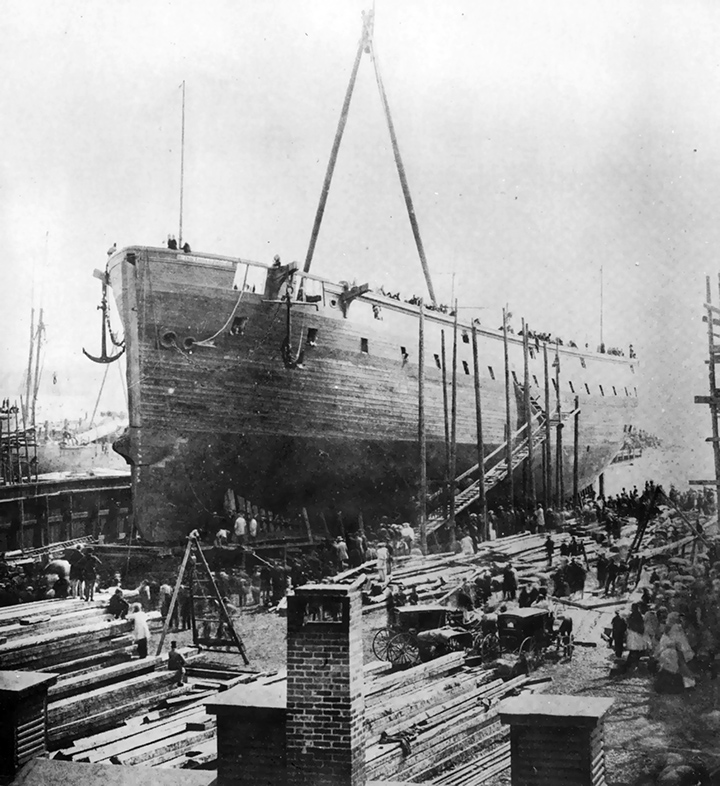
It’s August 29, 1863. At the shipyard of William Webb, on the East River in Manhattan, an enormous, state-of-the-art ironclad towers over top-hatted shipyard officials and dignitaries who’ve come to witness her launch. The new ship — her wood hull soon to be sheathed with iron plate armor — would be over 325 feet long overall, displacing nearly 5,800 tons, much heavier than the famous Confederate ironclad Virginia. Behind 4½ inches of armor plate, she would ultimately carry two 10-inch rifles and twenty-six 6.3-inch smoothbore guns. Unlike Virginia and most other Confederate ironclads, this new seagoing behemoth was capable of considerable speed, up to 12 knots. Her speed and mass, in fact, were themselves weapons, directed through the heavy iron ram affixed to her stem. This new ironclad would easily dominate any Southern warship sent against her.
Would, that is, if she’d ever encountered one. The ship launched at Webb’s yard on August 29, 1863 was not a Union warship, though. She was built for the Italian navy and commissioned into that service as Re de Portogallo (King of Portugal). She was one of the major Italian ships at the Battle of Lissa in 1866, where the Italians were beaten by a smaller-but-better-handled squadron of Austro-Hungarian warships.
I came across this image while going through Harry Johnson and Frederick S. Lightfoot’s Maritime New York in Nineteenth Century Photographs. (The original is in the King’s Point Museum.) I’d never looked closely at this photograph before, but it immediately captured the enormous industrial capacity of the North. sufficient not only to build its own warships, but those of other countries at the same time. It also brought to mind Shelby Foote’s observation:
Margaret Mitchell expressed a very similar idea, through Rhett Butler, in Gone with the Wind:
Butler’s timetable (“they’d lick us in a month”) was badly off, but what about his larger point? True?
__________
Canister!
Small stories that don’t warrant posts of their own:
- When my colleague Rob Baker questioned Monticello’s reference to the American Revolution as secession, one of their staff replied that the American Colonies were part of “a federal union,” and were “semi-sovereign polities who agreed to offer loyalty to the British crown in exchange for protection from the British king.” That’s just nuckin’ futs.
- David Barton, Glenn Beck’s favorite historian, is telling friends he doesn’t really want to run for office, but may be “drafted” to primary “Big John” Cornyn in 2014. Pass the popcorn.
- Scott Manning gives us a tour of a much older battlefield — Agincourt.
- U.S.S. Forrestal, the first of the U.S. Navy’s “supercarriers,” was sold to a Brownsville scrapping yard for 1¢.
- Couple weeks back, Buncombe, County, North Carolina precinct chairman Don Yelton got thoroughly skewered by The Daily Show after giving an interview in which he said that newly-passed voter ID laws would primarily impact “a bunch of lazy blacks that want the government to give them everything.” You’ll never guess in a million years who’s now come to Yelton’s defense. (OK, you probably guessed already.)
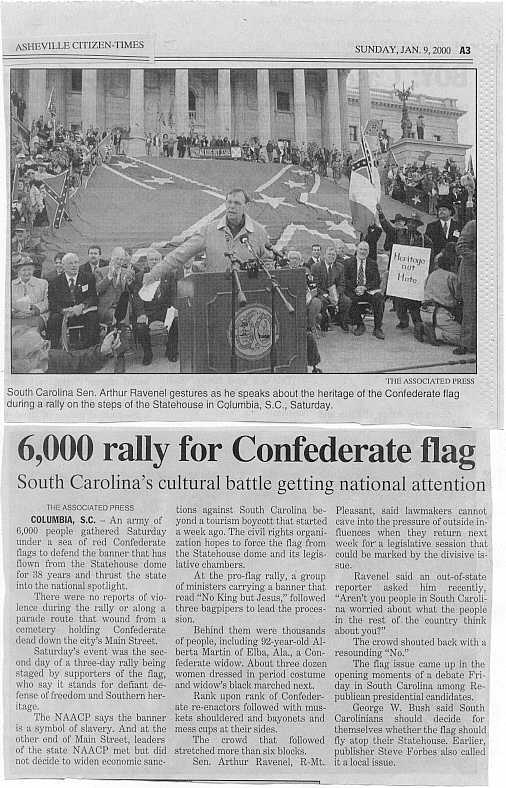
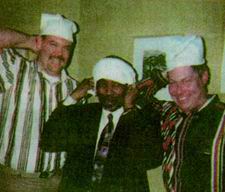 Speaking of Edgerton, I recently came across an image I’d read about, but never seen. It shows Edgerton, the odious Kirk Lyons and his brother-in-law, Neill Payne, at a restaurant wearing napkins on their heads and hamming it up as klansmen (right). Edgerton was president of the local NAACP chapter at the time, and its publication in the Asheville Citizen-Times in March 1998 apparently raised serious doubts about his judgement. Lyons and Payne were at that time principals in the soon-to-be-shuttered white-identity CAUSE Foundation (Canada, Australia, United States, South Africa, Europe). The restautant photo was one of a number of issues that caused the state NAACP organization to push Edgerton out the next year. By January 2000, under Lyons’ and Payne’s mentoring, Edgerton was appearing at rallies with his Confederate flag shtick. I suppose you might say this photo represents the birth of H. K. Edgerton, Confederate activist/performance artist/beard.
- You’d think that the guy who used to run the National Security Agency would be smart enough not to give a telephone interview to a reporter as an anonymous source (“on background,” as they say), while riding on a crowded commuter train. You’d be wrong.
- A well-known CW shop in Gettysburg has recovered $28,000 in merchandise allegedly stolen by a former employee. Unfortunately, that’s only a fraction of what may have been taken.
- In New Orleans, the U.S. Fifth Circuit Court of Appeals heard the SCV’s appeal of an earlier district court ruling, that backed Texas’ denial of the group’s request for specialty license plates. I still think the SCV’s going to win this one.
- I’m looking forward to reading Robert Hilburn’s Johnny Cash: The Life. It sounds fantastic.
Got anything else? Put it in the comments.
_____________
Monterrey Shipwrecks Presentation


My friend and colleague Amy Borgens of the Texas Historical Commission, and Fritz Hanselmann of Texas State University, are presenting a free public talk on the Monterrey Shipwrecks in Galveston at Moody Gardens on Galveston on November 14 at 7:00 pm. This presentation will discuss the three early nineteenth-century shipwrecks off the Texas-Louisiana coast that were investigated this past July. This ROV investigation and artifact recovery project was broadcast live on the internet. The public event was coordinated in response to all of the interest in the project from regional historical and archeological groups in the Galveston-Houston area. These and other participating groups have been invited to host respective educational tables from 6:30 — 7:00 pm in advance of the presentation.
In July 2013, a team of scientists investigated three early 19th-century shipwrecks 170 miles off the Texas-Louisiana coast at a depth of 4,500 feet. This unique expedition, the deepest of its kind in the United States, documented the shipwrecks and recovered a small collection of artifacts. Team members will present the initial findings that suggest these archeological sites may be a privateer and two prizes. Supporting groups such as the Houston Archeological Society and Galveston Historical Foundation will be present to provide insight and information on regional history and archeology.
___________




1 comment