The Other Speech on Decoration Day

In my last post on George Hatton, I included a newspaper account of his participation in a Decoration Day ceremony at Arlington National Cemetery. The story noted that Hatton made “a short but eloquent address” that has, apparently, been lost. Sharp-eyed readers may have also noticed that, buried in the text of the article, was a passing reference to the presence there of one Frederick Douglass. You may have heard of him.
Oddly, the newspaper makes no reference to the speech Douglass gave that day, at the memorial to the Unknown Union Dead (above), which must surely rank as one of the most compelling of its type ever offered there. It’s a short address, worth reproducing in full.
The Unknown Loyal Dead
Arlington National Cemetery, Virginia, on Decoration Day, May 30, 1871
Friends and Fellow Citizens:
Tarry here for a moment. My words shall be few and simple. The solemn rites of this hour and place call for no lengthened speech. There is, in the very air of this resting-ground of the unknown dead a silent, subtle and all-pervading eloquence, far more touching, impressive, and thrilling than living lips have ever uttered. Into the measureless depths of every loyal soul it is now whispering lessons of all that is precious, priceless, holiest, and most enduring in human existence.
Dark and sad will be the hour to this nation when it forgets to pay grateful homage to its greatest benefactors. The offering we bring to-day is due alike to the patriot soldiers dead and their noble comrades who still live; for, whether living or dead, whether in time or eternity, the loyal soldiers who imperiled all for country and freedom are one and inseparable.
Those unknown heroes whose whitened bones have been piously gathered here, and whose green graves we now strew with sweet and beautiful flowers, choice emblems alike of pure hearts and brave spirits, reached, in their glorious career that last highest point of nobleness beyond which human power cannot go. They died for their country.
No loftier tribute can be paid to the most illustrious of all the benefactors of mankind than we pay to these unrecognized soldiers when we write above their graves this shining epitaph.
When the dark and vengeful spirit of slavery, always ambitious, preferring to rule in hell than to serve in heaven, fired the Southern heart and stirred all the malign elements of discord, when our great Republic, the hope of freedom and self-government throughout the world, had reached the point of supreme peril, when the Union of these states was torn and rent asunder at the center, and the armies of a gigantic rebellion came forth with broad blades and bloody hands to destroy the very foundations of American society, the unknown braves who flung themselves into the yawning chasm, where cannon roared and bullets whistled, fought and fell. They died for their country.
We are sometimes asked, in the name of patriotism, to forget the merits of this fearful struggle, and to remember with equal admiration those who struck at the nation’s life and those who struck to save it, those who fought for slavery and those who fought for liberty and justice.
I am no minister of malice. I would not strike the fallen. I would not repel the repentant; but may my “right hand forget her cunning and my tongue cleave to the roof of my mouth,” if I forget the difference between the parties to that terrible, protracted, and bloody conflict.
If we ought to forget a war which has filled our land with widows and orphans; which has made stumps of men of the very flower of our youth; which has sent them on the journey of life armless, legless, maimed and mutilated; which has piled up a debt heavier than a mountain of gold, swept uncounted thousands of men into bloody graves and planted agony at a million hearthstones — I say, if this war is to be forgotten, I ask, in the name of all things sacred, what shall men remember?
The essence and significance of our devotions here to-day are not to be found in the fact that the men whose remains fill these graves were brave in battle. If we met simply to show our sense of bravery, we should find enough on both sides to kindle admiration. In the raging storm of fire and blood, in the fierce torrent of shot and shell, of sword and bayonet, whether on foot or on horse, unflinching courage marked the rebel not less than the loyal soldier.
But we are not here to applaud manly courage, save as it has been displayed in a noble cause. We must never forget that victory to the rebellion meant death to the republic. We must never forget that the loyal soldiers who rest beneath this sod flung themselves between the nation and the nation’s destroyers. If today we have a country not boiling in an agony of blood, like France, if now we have a united country, no longer cursed by the hell-black system of human bondage, if the American name is no longer a by-word and a hissing to a mocking earth, if the star-spangled banner floats only over free American citizens in every quarter of the land, and our country has before it a long and glorious career of justice, liberty, and civilization, we are indebted to the unselfish devotion of the noble army who rest in these honored graves all around us.
The remarkable thing about this text is how well it resonates, how well it presages the ongoing arguments about how we remember the war even today, almost a century and a half after the guns fell silent. Douglass’ admonition — “we are not here to applaud manly courage, save as it has been displayed in a noble cause. We must never forget that victory to the rebellion meant death to the republic” — must necessarily ring as true today as it did then. This is what Confederate apologists do not, can not, accept: that regardless of their ancestors’ courage and sacrifice, and regardless of their individual beliefs and motivations, at the end of the day they fought for a nation founded on a terrible premise. To honor our ancestors demands that first we see them as they were, not as we’d wish they’d been.
______________________
Text of Douglass speech from Philip S. Foner and Yuval Taylor, Frederick Douglass: Selected Speeches and Writings. Image: Monument to the Unknown Dead f the Civil War, Arlington National Cemetery. Library of Congress.

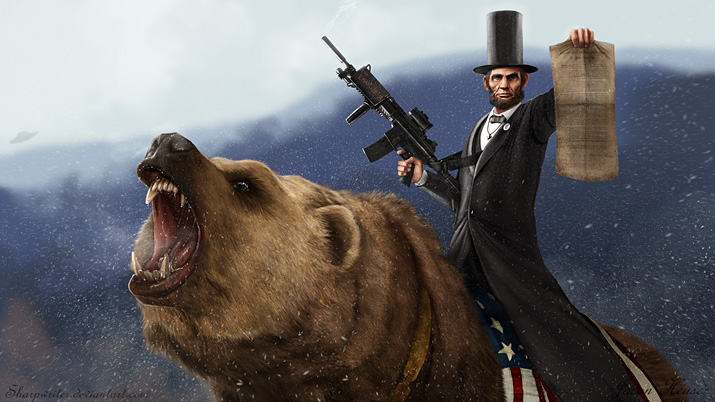

“Every company passing through this place has more or less negroes”
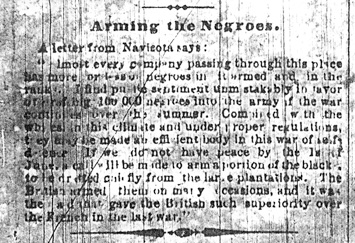 On Friday Kevin posted three wartime news items, provided by Vicki Betts, each relating to African Americans serving in different roles in the Confederate Army. Along with the news clips, Kevin issued a simple challenge: “you interpret.”
This reminded me of a similar news item I found recently in the local paper. From the Galveston Weekly News, April 29, 1862:
Arming the Negroes.
A letter from Navasota says:
Almost every company passing through this place has more or less negroes [sic.] in it armed and in the ranks. I find public sentiment unmistakably in favor of drafting 100,000 negroes into the army if the war continues over this summer. Combined with the white men in this climate and under proper regulations, they may be made an efficient body in this war of self-defence. If we do not have peace by the 1st of June, a call will be made to arm a portion of of the blacks to be drafted chiefly from the large plantations. The British armed them on many occasions, and it was the [ad?] that gave the British such superiority over the French in the last war.
So how should the historian handle this document? How much credence should be put to it? Are there any hard data in this short passage? “Almost every company” equates to how many, exactly? “More or less” means, what? What companies are these? Who are the officers? Can these claims be corroborated somewhere?
And that’s just the first sentence.
Looking at the whole passage, what’s its purpose? Why was it written and published? Why is it offered anonymously? What other events were going on just then that might have influenced the writer? Is the writer’s intent to report the composition of Texas military units, or to make a case for something else? Is this reporting, or advocacy? If the latter, does that cause concern about the accuracy of the description of black troops “armed and in the ranks?” Does it play to any particular beliefs or biases in the reader? Can any larger conclusions about BCS be drawn from this single document?
Have at it.

Hey, Mississippi SCV: This is How It’s Done
There didn’t seem to be much else to be said about the Mississippi SCV’s Nathan Bedford Forrest commemorative license plate proposal, but Robert Moore suggested Wednesday that a better choice would be to put a generic Confederate soldier on it. This seems appropriate for several reasons, among others that there are a helluva lot more SCV members (and well as Mississippians generally) related to rank-and-file soldiers than there are descendants of cavalry generals. Such a plate might also serve as a point to generate constructive conversations with the public, including:
“Who was that man in the uniform?”
“What made-up the Confederate soldier, who, in turn, became the Confederate veteran?”
“How was the individual man part of the Confederate story?”
“Was he willing, unwilling?”
“Was he enthusiastic for ‘the cause’… for ‘a cause’?”
And so on. One of Robert’s commenters suggested the plates feature some of Don Troiani’s uniform studies. It’s a capital idea.
The SCV could issue five plates, one for each year of the war, each celebrating a “common man” (or woman) from the conflict. An early-war infantryman for 2011 (below). A civilian woman from Vicksburg in 2013. A former slave in the USCT for 2015. (Well, maybe that last one wouldn’t go over so well with the SCV. But it would sure work for a state-sponsored plate.) There are lots of other possibilities.
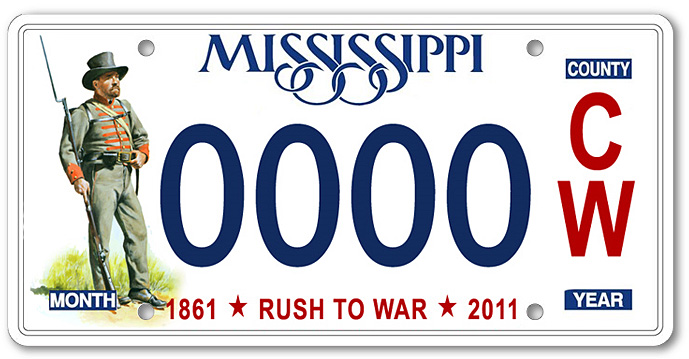
It’s colorful, it carries a bit of history, and it certainly comes closer to reflecting the Civil War experience of typical Mississippians better than one bearing the picture of a millionaire slave trader from Memphis. Granted, it doesn’t have quite the in-your-face impact of a big-ass flag out on the interstate, but sometimes less is more, ya know?
_________________________
Image: Soldier of the 17th Mississippi Infantry, Company I, Pettus Rifles by Don Troiani.

“Mr. Holland of Grimes”
Update, October 15, 2011: In the comments, Lynna Kay Shuffield provides an update on the death of Holland’s first wife, Samuella, and two of their children in October 1865. This profile has been updated to reflect that new information, as indicated in blue text — thanks!

If you type James Kemp Holland’s name into a search engine, you’ll quickly discover that he “became the highest ranking black, rising to the rank of Colonel and served on the staff of Governor Pendleton Murrah of Texas.” This story has been picked up a number of places, including on H. K. Edgerton’s SouthernHeritage411 website.
Except that Colonel Holland wasn’t black, or of mixed race. James Kemp Holland is a case study of how well-intentioned but lax research can go very, very wrong.

 James Kemp Holland (left, in later life) was born in 1822 in Tennessee. His family emigrated to the Republic of Texas in 1842 and settled in east Texas, what is now Panola County. In fact, family tradition holds that James Kemp Holland’s father, Spearman Holland, named Panola County, using a Native American word of cotton. The extended Holland family were planters, with large holdings in land and slaves.
Spearman Holland (1802-1872) was heavily involved in local and state politics. He was serving in the Texas Legislature when the Mexican War began, and returned to East Texas from Austin with orders from the governor to raise a raise a company of mounted rangers. James Kemp Holland, at 24, was deemed too young to command the company, so his uncle Bird Holland was appointed captain. James Kemp Holland was subsequently elected lieutenant “by acclamation.”
At the opening of the Battle of Monterrey, Holland’s company was assigned to accompany a battery of the U.S. 3rd Artillery, commanded by Captain Braxton Bragg, positioned opposite the city’s main gate. When the Mexicans fell back, the Texans moved into the city proper where the fighting became close and heated:
Captain Bird Holland, having become disabled, it was here that Lieutenant Holland won his spurs when he made his dash into the city, gallantly leading the Second battalion of the Second Texas Mounted Volunteers under a galling fire from the Old Moor Fort and all the guns along the city’s fortification. Upon dismounting and scaling the walls of the city, the Seventeenth Rangers were again thrown with Captain Bragg on one of the main thoroughfares. And now the Battle of House-tops began, and from every roof and cross street came leaden hail.
The rangers were driven within, where they fought through the houses and walls. Later upon the house-tops the fight went bravely on, the Mexican soldiers disputing every inch of ground.
While this was going on, Bragg was sweeping the streets, and General Ampudia, who was present with the flower of the army, was driven pell mell towards the main plaza, where they intended making a last stand, but with a “little more grape” from Captain Bragg the white flag soon went up.
During the house to house and hand to hand conflict. Lieutenant Holland saw that across the street Texas Rangers were firing from the lower door and windows at the retreating Mexicans down the street, and Mexican soldiers on the top of the parapetted roofs of the same houses, were firing back at the Texans, neither knowing of the proximity of the other!
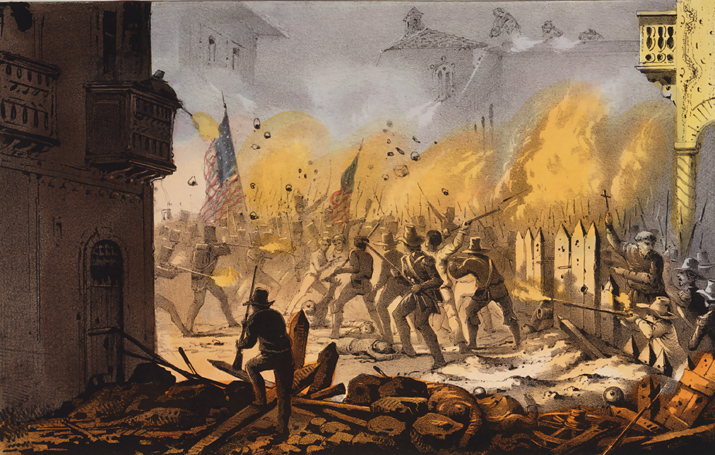
House-to-house fighting during the Battle of Monterrey. Library of Congress.
Lieutenant Holland’s uncle, U.S. Commissary Captain Kemp S. Holland, later died in camp before the Battle of Buena Vista, and Lieutenant Holland was assigned to bring his body back to Texas for burial. This appears to be the end of James Kemp Holland’s military experience until sometime during the Civil War.
James Kemp Holland soon followed his father into politics, serving in the Texas House of Representatives in the Third Legislature (November 1849 to December 1850). He was appointed U.S. Marshal for Eastern Texas in 1851, but successfully ran for state senator and served in the Fifth Legislature (November 1853 to February 1854). Sometime after that he relocated to Grimes County, northwest of Houston. He returned to the Texas House in late 1861, where he served alongside his father, who was referred to in the House Journal as “Mr. Holland of Panola,” while James Kemp Holland was known as “Mr. Holland of Grimes.”

James Kemp Holland in the 1850 U.S. Census for Panola County. His occupation is listed as “Representative.”
In early 1854 James Kemp Holland married Samuella Andrews in Houston. At this time James Kemp Holland was thirty-two, and Samuella about eighteen. By the time of the 1860 census, James Kemp and Samuella Holland had three children — Bettie, age 6, Lilly, age 4, and a son, J. D. A. Holland, age 2.

Holland’s property (lower left) just before the Civil War, located just northeast of present-day Navasota, along the Brazos River. The county seat, Anderson, appears at upper right. Texas General Land Office.
At the time of the 1860 census, Holland was a wealthy planter along the western border of Grimes County, just northeast of present-day Navasota. The census that year valued his land holdings at $15,000, and his personal property at $25,000. Holland does not appear in that year’s slave schedules, although $25,000 in that time and place would usually indicate property in slaves.
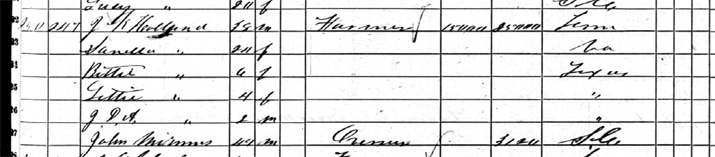
Holland in the 1860 U.S. Census for Grimes County.
 During the early part of the Civil War, James Kemp Holland served in the Texas House of Representatives. He reportedly declined a nomination to the Texas Secession Convention, but was elected to serve in the the Ninth Legislature, November 1861 to March 1863. In 1863 he was appointed aide-de-camp to Governor Pendleton Murrah (left). A letter survives from the spring of 1864 in which the governor, writing to the Confederate general commanding the District of Texas, introduces Colonel Holland and asks that he not be interfered with in his travels around the state:
Executive Department
Austin 13th April 1864Maj Genl
J. B. Magruder
Sir:Col. J. K. Holland is aid de camp to the executive of Texas appointed and commissioned by authority of her Laws — I need his services and [ask] that he may not be annoyed in his movements — you will do me a favor by endorsing this statement [and issuing] an order — that he shall not be interfered with by any military officers & that his commission shall be respected by those under your command. He is a planter of Grimes County.
I have the honor to be
Your Obt Svt,
P. Murrah

Governor Murrah’s letter of introduction for Col. Holland. Footnote.com
Based on the letter, it seems likely that Colonel Holland served at the governor’s liaison for military affairs around the state. Murrah was not in good health — he died in Mexico of tuberculosis shortly after the end of the war — and may not have traveled as much as a healthier man might be able to.

Early mention of Holland’s title of “colonel,” Texas State Gazette, April 4, 1854.
It’s not clear what sort of formal commission Holland held as colonel, apart from Governor Murrah’s assertion that it was “by authority of her Laws.” He almost certainly didn’t “rise” to the rank of colonel in any conventional sense; he undoubtedly was appointed at that rank. It’s also worth mentioning that, while his only previous known military experience was as a very junior officer in the Mexican War, he was already being addressed as “Colonel James K. Holland” a full decade before Murrah’s letter, when the Texas State Gazette used the title in announcing his marriage to Samuella Andrews. It was a tradition of sorts in Texas and across the South in the 19th century to address prominent men with a military background — almost any military background — by an inflated military title. It was such a common practice that it was even joked about, as when one old Hood’s Brigade veteran composed a ditty,
It’s General That and Colonel This
And Captain So and So.
There’s not a private in the list
No matter where you go.
After the war, James Kemp Holland returned Grimes County. There, Holland soon suffered great personal tragedy, the deaths of his wife Samuella and two of their young children John D. A. Holland, age 7, and Nannie Hicks Holland, age 5. The Houston Telegraph carried the following obituary on October 18, 1865:
DIED – At Farmingdale, Grimes county, on the 2nd October, John D. A., and Nannie Hicks, only son and youngest daughter of Col J. K. and Samuella Holland. They died almost at the same moment of Congestion, and on the 5th instant, Mrs. Samuella Holland, after forty-one days of suffering – disease, Gastro Interetis.
“Leaves have their time to fall,
And flowers to wither in the night-wind’s breath;
But all – thou hast all
Seasons for thine own! O, Death!”The fairest picture of happiness on earth, “the only bliss that has survived the fall,” is an unbroken family household, where love and peace and harmony reign. Such was this domestic circle until the angle Death came and bore away one half of its number to their heavenly home.
Mrs. Holland was the daughter of Col L. D. and Eugenia Andrews, of this city, and one of the loveliest daughters of Texas; as pure and excellent in character, as she was fair and beautiful in person. She was a true woman, having all those feminine qualities which call forth admiration and affection from all classes. Although possessing intellectual culture, and those accomplishments which adorn society, the pomp and pleasure of life had no adornments for her. Her only happiness was in her home, where she was enshrined the idol of an adoring husband – the guide and companion of her children, and all that was perfect in the eyes of her faithful and devoted servants.
She had long been a conscientious Christian, and when our Heavenly Father called her she was ready, and the stream of her life passed away calmly and peacefully into the great ocean of eternity.
“So beautiful, she well might grace,
The bowers where angles dwell;
And waft their fragrance to His throne
Who “doeth all things well.”
 Though he had served as an aide to Confederate Governor Murrah — and his uncle Bird Holland had been killed in action leading his Confederate regiment during the war — James Kemp Holland appears to have been committed to the smooth reunification of North and South, and a supporter of President Andrew Johnson’s relatively lenient Reconstruction policies. Along with Andrew Jackson Hamilton (left), a prewar U.S. Representative from Texas and the state’s first military governor under Reconstruction, Holland was a delegate representing Texas at the National Union Convention (also known as the Southern Loyalist Convention) in Philadelphia in August 1866.
Around 1867 he married Annie W. Jefferson, and together they had four children — daughters Ella, Louise, and Jessie, and one son, Earnest. In the 1870 U.S. Census, Holland’s property was valued at $1,800, and his personal property at $1,100. Unusually, his daughters from his first marriage, Betty and Lilly, ages 13 and 12 respectively, are each listed as holding $9,000 in real estate. Presumably this was being held in trust for them by their father.
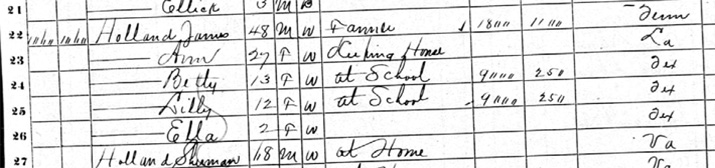
The Holland family in the 1870 U.S. Census.
By 1880, Holland and his family had moved one county over, to Washington County, where they’d settled at Chappel Hill. It was a large household; in addition to Annie and four children, Annie’s mother and the mother’s sister were living with James Kemp Holland, along with another middle-aged widow, Susan Pierce, of unknown relationship to the family.

Holland and his family, residing in Chappel Hill, Washington County, in the 1880 U.S. Census.
In his later years, James Kemp Holland worked as a real estate agent in Austin, both on his own and with partners. He died after a carriage accident in 1898 in Tehuacana, Texas, east of Waco in Limestone County.

Obviously the foregoing is not a full-length biography of James Kemp Holland, nor does it represent exhaustive research incorporating all possible sources. But nowhere in the primary source materials available did I find anything that indicated James Kemp Holland was black, or of mixed race.
There are four available census rolls for Holland, spanning 1850 to 1880. (The 1890 U.S. Census was destroyed in a fire.) Of those four, none designate him black or “mulatto.” The 1850 censuses uses a tick mark ( – ) that continues uninterrupted for page after page of the enumeration, apparently as a sort of “ditto;” the 1860 census carries no notation for anyone for several pages; the 1870 and 1880 censuses explicitly designate each member of the Holland household as white.
None of the mentions I found of James Kemp Holland in a variety of sources published during his lifetime or soon after his death carried any suggestion that he was of mixed race or black. I saw no instance of “colored” or “mulatto” or “Negro” appended to his name in newspaper articles, directories, or official documents like the Texas House Journal, compiled and printed at a time when such notations were almost universal. There’s no mention of it in any biographical sketch I’ve seen, such as that published in the print edition of the Handbook of Texas.
Nor, frankly, is it especially plausible that a black or mixed-race man could hold a series of high elected and appointed offices in a state as virulently white supremacist as antebellum Texas. Free persons of color were an extreme rarity in Texas. Their presence was actually outlawed in the republic at the time the Hollands immigrated to Texas, and they were prohibited from owning land; there was a famous case in which a free black who had aided the Texas Revolution required — literally — an act of Congress to retain title to the land grant he’d been awarded for his services. Even after statehood, laws restricting the activities and rights of free persons of color were among the most repressive in the South. The free population of black and mixed-race persons in antebellum Texas was vanishingly small, and shrinking: 397 in 1850, and just 355 a decade later. (There were more than ten times that number of free colored persons in 1860 in Charleston County, South Carolina, alone.) During that same period, the slave population exploded, from 58,161 to 182,566, an increase of more than 200%. The free black population of Panola (1850) and Grimes (1860) Counties, where James Kemp Holland lived at the time of those censuses, were 2 and 1, respectively.
In short, the only place I find even a suggestion that James Kemp Holland was black or of mixed race is online, when he’s identified as a “black Confederate.” It is neither evidenced in primary sources, nor plausible in the context of the time and place.

Where did the notion come from that James Kemp Holland was black, or of mixed race? I’m not certain, but there are two possible sources I’ve found that may be the source of confusion.
The first is this webpage on the early history of the black community in Panola County. The page — and several others that repeat the same information — goes into considerable detail on the Holland family, including James Kemp Holland, because they were among the first large-scale planters in the area and their bondsmen formed the initial black community there, Holland Quarters. It doesn’t make the claim that James Kemp Holland was black, or of mixed race, but the page is such a poorly-organized mishmash of history, genealogy and commentary that it’s easy to be confused. A casual read of the page could easily lead one to believe that James Kemp Holland was himself a man of color.
The second possible source is the famous Handbook of Texas, the standard, quick-reference guide to the region’s history. Both the online and final print versions of the Handbook include biographies of Bird Holland that mention that he fathered three sons by a slave woman, one of whom was named James. It seems possible that this James Holland was confused for his first cousin, James Kemp Holland, leading one to believe that the latter was a man of mixed race.
Using either of these resources, it would be easy to get the impression that James Kemp Holland was black, or of mixed race. But — and this is important — it’s equally easy to correct. Even a little digging in readily-available, online sources would cast doubt on that notion of James Kemp Holland’s race. But as so often happens with men identified as “black Confederates,” it would seem that little other digging was done to actually establish much at all about his life or career.
It’s all very sloppy, and very misleading. It doesn’t have to be this way, and shouldn’t. A little due diligence, a little more digging, would have completely avoided this misrepresentation.
___________________________________
James Kemp Holland portrait from the Texas House Journal of the Ninth Legislature, First Called Session. Pendleton Murrah portrait from the Texas State Preservation Board.

Grant on PBS
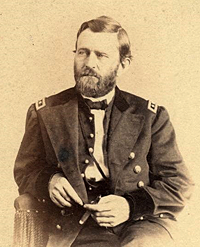 As a companion piece to last week’s film on Lee, American Experience will tonight air a similar documentary on Ulysses S. Grant.
Also: Last week I called out Washington Times Civil War blogger Martha Boltz for posting a tired, cliché-driven critique of American Experience‘s biography of Robert E. Lee, before she’d even seen it. On Saturday, she posted an update, and acknowledged that “the folks at PBS did a fairly decent job of presenting the man.” She noted, as well, that she’d gotten a number of messages from others via e-mail and Facebook that she should give the episode a fair hearing.
Her review still has an unforced error or two, such as her assertion that Lee “grew up in Arlington House,” and that the show avoided the “typical overbearing slave-owner depiction [of Lee] with which we are frequently presented,” which was in the show and which is, in my experience, anything but “typical” in popular depictions of Lee, but — whatever. Progress is progress.
WashTimes Civil War Blogger Soooo Tried of the Slavery Thing
Martha Boltz, the Civil War blogger at the Washington Times, hasn’t seen the new PBS biography of Robert E. Lee. But she read a review of it, and that’s enough for her:
To no one’s surprise, the specter of slavery comes through his review loud and clear. And to be sure slavery was a major cause of the civil war, but it was not the only or sole cause. Yet it is dragged up at every occasion. We seem to forget – or find recontextualizing too difficult for modern day brains – the fact that it was entirely legal then, and that the majority of (white) leaders of the day were slaveholders. Even George Washington owned slaves, unless you want to think that those white wigged gents with the long stockings and silver buckles on their shoes did all the laboring and building. Ditto with Jefferson Davis and scads of others.
If you were an average landholder then, had 50 acres of cotton or tobacco, someone had to work those fields and bring out a crop. It was that simple.
What on earth were Frederick Douglass, William Lloyd Garrison and Charles Sumner so uptight about? Didn’t they know slavery “was entirely legal then?” Jefferson Davis wore knee-britches and a powdered wig, too.
I know that the qualifications for being a blogger are low, and that the Unification Church-owned Washington Times has always been a bit of a joke. But seriously, this is the sort of nonsensical gobbledygook I’d expect to find in the unmoderated comments section of a newspaper’s blog post, not at the top, under the masthead. It reads like a kid in history class who’s been called on unexpectedly, and in desperation strings together a bunch of words and names he’s heard to give some sort of answer. It’s embarrassing. The Times has been circling the drain for a while now; with regular contributors like this, it’s not hard to see why.

Update: Now having seen the show, I think Ms. Boltz’ complaint that the issue of slavery “is dragged up at every occasion” in the show is ludicrous. It is brought up — explicitly and succinctly — where necessary in Lee’s biography. These are both appropriate and necessary to telling the story; the suggestion that these constitute some sort of heavy-handed harangue on the subject is bizarre. Unless, of course, any mention of the “peculiar institution” is just too much. . . .

Gritty
The new Coen Brothers’ film True Grit opened today, and it looks to be worth the wait. The film is not a remake of the 1969 John Wayne classic, but a new telling of the story that is reportedly closer to the 1968 Charles Portis novel (read: darker). I saw the original film as a kid, but it doesn’t especially wear well; given the Coen Brothers’ track record of creating worlds populated by vivid — if not entirely likable — characters, this is a movie to see.
Last month Jennifer Bouldin, who lives and works in Fort Smith, Arkansas, posted a great article about the fact and fiction of that town as depicted in the film. The Coens and their production team seem to have taken considerable liberties with their depiction, but Dr. Bouldin nonetheless is excited about the film, as it’s likely to be a significant driver of local tourism just as its predecessor was. In the process of separating myth from truth, Bouldin corrects some misconceptions about both Fort Smith and its most infamous 19th century resident, Isaac Parker, the “Hanging Judge of Indian Territory:”
Parker is infamously known as “The Hangin’ Judge” because he sentenced 160 men and women to hang during his 21 years on the bench. Of those, 79 men were indeed executed in Fort Smith, more than by any other judge in American history.
Despite his moniker, Parker personally was against the death penalty. Instead he favored sending prisoners for rehabilitation back into society to a progressive detention center in Detroit. Considering that he heard 13,490 cases in 21 years, holding court six days a week for up to 10 hours a day, 160 death sentences is a small percentage of the total. His original jurisdiction was larger than the entirety of New England. Parker also did not decide the criminals’ fate—the jury decided the verdict and federal law determined the penalty, yet his is the name associated with the 79 men who were hanged in Fort Smith.
Bum rap.
Seventy-nine executed over the space of 21 years is about four per year, a rate that doesn’t quite justify Judge Parker’s morbid reputation. Go read the whole thing.
_____________________________

“Havana segars — a few thousand for sale”
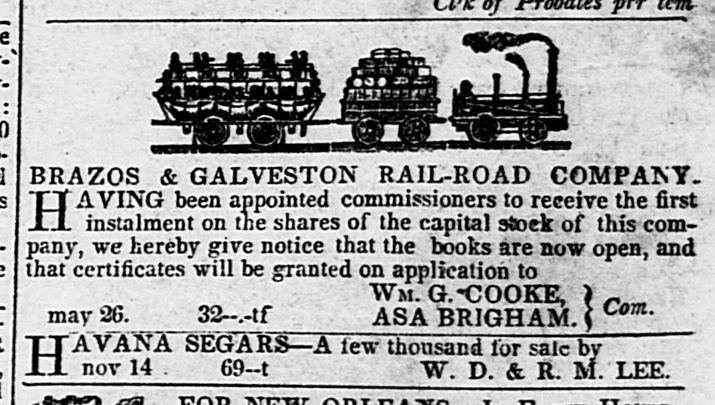
The Portal to Texas History now has copies of the Houston Telegraph and Texas Register available online, with full word-search capabilities. The Telegraph was the first newspaper to gain real prominence in the Texas Republic, and this addition offers researchers a great window into that period, previously available only through microfilm. The online collection for this particular paper covers the period from 1835 to 1846.
The extension of traditional archival materials into publicly-accessible, digital format is tremendously exciting, and makes research possible for many folks who otherwise face obstacles that make conventional research a challenge of both timing and logistics. In my case, looking up something in the Telegraph meant devoting a Saturday to microfilm at the Metropolitan Research Center at the Houston Public Library — often rewarding, but nonetheless a headache. The appearance of easily-accessed, online sources from both non-profits like Portal to Texas History and Open Library commercial vendors like Footnote and NewspaperArchive.com really are changing the face of research.
Great stuff.
____________________________
Image: Advertisements from the Telegraph and Texas Register, January 16, 1839.

Civil War Portraits from the Library of Congress
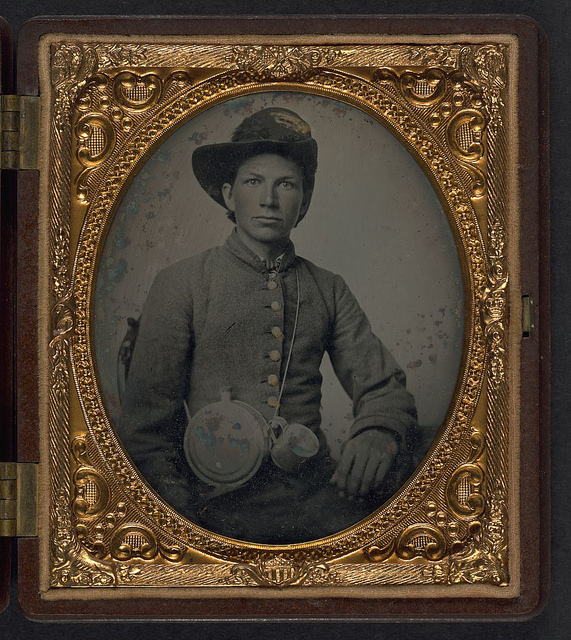
The Library of Congress has put online a collection of almost 700 Civil War era photographic portraits, donated by the Liljenquist Family. Most of the images are of soldiers, and most are unidentified. But the Library of Congress is seeking the public’s help in identifying both the subjects and the photographers:
Most of the people and photographers are unidentified, and we’d love to learn more about them. Please let us know if you recognize a face from your family, a regiment, or a photographer’s painted studio backdrop! You can read some of the personal stories that did survive in notes found with the photo cases.
The images are remarkable, and often haunting. One wonders what happened to these men and boys, all trying to look so brave.
____________________________
Image: Unidentified young soldier in Confederate shell jacket, Hardee hat with Mounted Rifles insignia and plume with canteen and cup, Library of Congress.




 Dead Confederates, A Civil War Era Blog
10 comments