The NYT Visits the Museum of the Confederacy
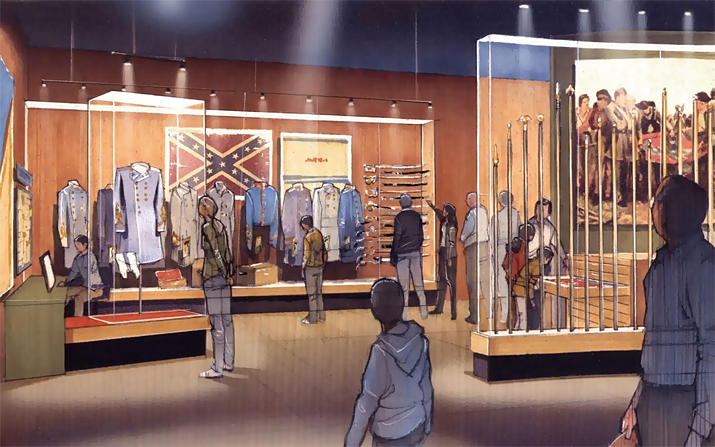
On of my readers, PH, passes along this recent review in the New York Times of the Museum of the Confederacy, and its ongoing effort to chart a new course, away from its founding as a shrine to the Lost Cause, to a more comprehensive, balanced view of the conflict, its origins and its legacy. (Kevin has blogged on it as well.) Edward Rothstein makes a second visit to the MoC, and notes the shifting tenor of the institution’s public exhibitions and programs.
The Museum of the Confederacy embodies the conflict in its very origins; its artifacts were accumulated in the midst of grief. The museum’s first solicitation for donations, in 1892, four years before its opening, is telling: “The glory, the hardships, the heroism of the war were a noble heritage for our children. To keep green such memories and to commemorate such virtues, it is our purpose to gather together and preserve in the Executive Mansion of the Confederacy the sacred relics of those glorious days. We appeal to our sisters throughout the South to help us secure these invaluable mementoes before it’s too late.”
That heritage casts a long shadow over the institution. When I visited in 2008, slavery still seemed an inconsequential part of Southern history. And Southern suffering loomed large.
But changes have been taking place. Several tendentious text panels (in one, Lincoln was portrayed as having manipulated the South into starting the war) have been removed. And gradually, under the presidency of S. Waite Rawls III, the museum, while keeping its name, has been expanding its ambitions, trying to turn its specialization into a strength instead of a burden.
Nonetheless, Rothstein comes away feeling that, while the worst examples of the MoC’s old historical narrative are gone, there’s nothing yet that has taken their place:
The delicacy is strange. There is so much in the exhibition [“The War Comes Home”] that is illuminating about the war. And it isn’t that the Virginia Historical Society is embracing the Lost Cause. Far from it. But the institution is trying to take a path that will least offend those who do. Or is it suggesting with its questions that it would be callous to continue with finger pointing? After all, isn’t one man’s traitor another’s patriot?
The problem, though, is that the Civil War then becomes merely a tragic clash of two sides, each convinced of its virtue and fidelity to national ideals. That is not an embrace of the Lost Cause, but it leaves us a war with no higher cause at all.
Rothstein should be patient, I think. Museums are not shrines; they exist for education and research, and unquestioning hagiography is best left to others. The MoC in particular, with its unsurpassed collection of Civil War artifacts, documents, and images, is far too valuable a resource to give itself over to a fixed story of parochial, navel-gazing victimhood. Like every institution of its type, the Museum of the Confederacy is, and should be, always a work in progress.
______________
Image: “Museum of the Confederacy CEO Waite Rawls announced on Thursday [April 14, 2011] the museum’s plans for interior exhibits. Part of the plan includes bringing the uniform won by Gen. Robert E. Lee, of the Army of Northern Virginia, at the Appomattox surrender in April of 1865 (pictured at left). Also included will be the sword Lee brought to the surrender.” Via Lynchburg, Virginia News & Advance.

Stagecoach
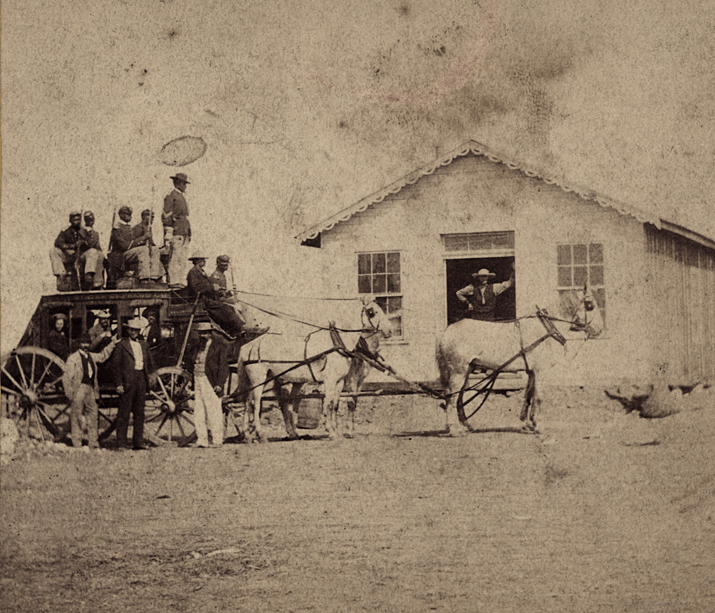
I came across this Alexander Gardner image recently while looking for something else. (That seems to happen a lot.) It’s a remarkable image in a number of ways. I don’t recall ever seeing a photograph of a gen-yew-wine Western stagecoach going back to the 1860s, for a start. In movies and teevee, sure, but not many photos from a time when the vehicle was a common form of transportation. It’s from the Library of Congress, and carries the original caption, “United States Express overland stage, starting for Denver from Hays City, Kansas, 580 miles west of St. Louis, Mo.” The listed date is c. 1867. This is the right-hand image of what was sold at the time as a stereo pair, but is actually a single image.
This website has an almost identical image, obviously taken at the same time, identified as being at Fort Harker.
The stereoview is part of a series, “Across the Continent on the Union Pacific Railway, Eastern Division.” Neither Fort Harker nor Fort Hays/Hays City were on the main line of the UP, which ran much farther to the north, westward from Omaha. The Eastern Division of the UP, originally known as the Kansas Pacific Railroad, reached Fort Harker in July 1867, and connected to Fort Hays in October of that year. The Butterfield Overland Despatch (not to be confused with the earlier, larger, and more famous Butterfield Overland Mail) operated both a stage line and wagon trains stopping at both forts, maintaining connections between the Missouri River and Denver.
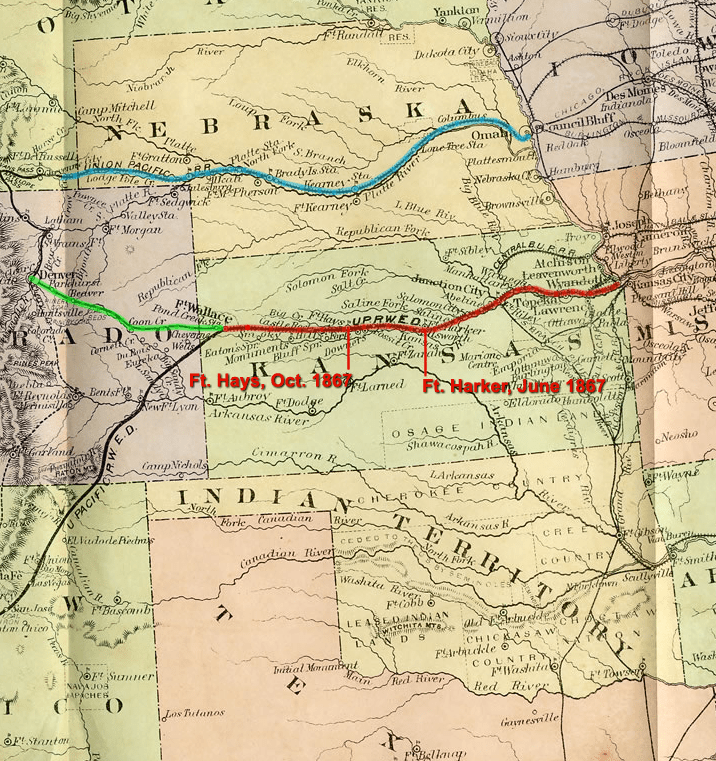
This detail from an 1868 Union Pacific Railroad map, from Kansas State University, shows the main line of the Union Pacific running west from Omaha along the Platte River (top, highlighted in blue), and the Eastern Division of the UP running a parallel course through Kansas (in red). The road route beyond Fort Wallace, to Denver, is shown in green. At the time of the map’s creation, the main line of the UP had just crossed the western boundary of Nebraska into the Dakota Territory — present-day Wyoming.
So much for the context. A closer look at elements in the image:
Canister!

Items that don’t warrant separate posts on their own, but are of interest and worth mentioning:
 The saga of the Texas SCV license plates continues. Texas Land Commissioner Jerry Patterson, the lead advocate for the effort, published editorials in newspapers around the state (like this one) making an analogy between the proposed SCV plate and one previously approved honoring the Buffalo Soldiers. It’s now become a talking point, even popping up in the comment threads here. (It’s funny how the heritage-not-hate crowd always insists it’s never about race, but invariably and immediately falls back on the but-you-did-it-for-the-black-folks argument, instead of being considered on its own merit.) Sure enough, pounding that particular analogy has made a convoluted and unpleasant argument even more convoluted and unpleasant. Mission accomplished!
- Kevin reminds us that the bromide that slavery was on its way out, and would have died a natural, peaceful death without bloodshed within a generation or two, is an assumption that only came later. It was not something the secessionists believed in 1860. It’s certainly not something believed at the time by Confederate officials and various secession conventions, much less folks like the Knights of the Golden Circle.
- Jimmy Price, who blogs about the USCT at The Sable Arm, has a profile up of Milton M. Holland, the mixed-race son of a white slaveholder from Texas. Freed by his father before the war and sent to Ohio, he eventually enlisted in the 5th USCT and earned the Medal of Honor at New Market. For those keeping score at home, First Sergeant Holland was first cousin to James Kemp Holland, a Confederate military aide during the war to Governor Murrah of Texas. It’s a small damn world.
- The Texas State Library and Archives Commission recently changed its policy on ordering copies of Texas Confederate pensions, and now requires payment up-front before the order is filled. You can still request up to ten records by e-mail, but they’ll now e-mail back with the fee required, before making and mailing the copies. (Previously they had send an invoice with the requested copies, and relied on users to follow up with payment.) They also announced that their Confederate pension holdings are in the process of being digitized by Ancestry, which will make all those documents available online to subscribers. The materials are expected to be online by February 2012.
_____________
Image: Captain Paul J. Matthews, Founder of the Buffalo Soldiers National Museum in Houston, appeared in Austin on Thursday, Nov. 10, as the board discussed the Confederate plates. Photo: Associated Press, Ralph Barrera/Austin American-Statesman.

Friday Night Concert: “Freight Train”

Elizabeth Cotten (1895-1987) learned to play her older brother’s banjo at age seven, and soon moved on to the guitar. With no formal instruction, she taught herself to play left-handed, on a right-handed guitar strung for a right-handed player. She essentially played the guitar upside-down, plucking the strings with her left thumb and forefinger.
When she was about eleven or twelve, she wrote what would become her best-known work, “Freight Train.” In this interview, recorded two years before her death, she describes the genesis of the song:
I laid in bed at night and hear it stewing on the track, trying to come in. It said, choo-choo-chukachukachukachuka, and I’d go to sleep hearing that, the rest of the night. I guess that gave me a mind to write something about a freight train.
When she grew up, though, she put music aside and worked in a variety of jobs. In the 1950s, a chance encounter in a Washington, D.C. department store with Ruth Crawford Seeger led to her being hired as a domestic by the Seeger family. The Seegers, a fiercely musical family, quickly recognized Cotten’s musical talents, which led her — forty years after she’d mostly abandoned performing — to record for the then-burgeoning folk music market. She toured and performed frequently through the 1960s and 1970s, making regular appearances well into her ninth decade.
“Freight Train,” with its intricate melody, was an immediate hit among folk musicians (including this early, frenetic British skiffle version, turned into an outlaw ballad), and was covered by many other artists including Pete Seeger, Joan Baez, and the ’80s alternative band Opal. It’s a great favorite among amateurs, as well, including this young performer who’s about the same age as Elizabeth Cotten was when she composed the song. “Freight Train” is, in fact, such a great melody, even this Duane Eddy abomination can’t quite kill it. For my money, the simplest version of the song, played by Cotten herself on a single, acoustic guitar, remains the gold standard.
___________

Happy Thanksgiving, Everyone!

It’s probably a little late to go turkey-shopping for this holiday, but Nicolette Hahn Niman at The Atlantic has a neat piece on the history of the turkey, and so-called “heritage” birds that are so popular these days. I knew, of course, that turkeys were native to the Americas, but had no idea about this:
European explorers transported turkeys back to their homelands and domesticated turkeys soon became widely disseminated in Spain, Germany, France, Italy, and England. Some were eventually transported back to the colonies; the Mayflower is believed to have carried some domesticated turkeys. Early settlers commonly raised them on American farms.
From this complicated past, several varieties have emerged, although there is understandable uncertainty about their precise origins. (Note that the American Poultry Association, the official arbiter of poultry breeds, currently does not recognize the various types as distinct breeds, recognizing only turkey “varieties.”) The most successful have been the Bourbon Red, Standard Bronze, and Narragansett. The latter two are believed to descend from a strain developed in Rhode Island’s Narragansett Bay region. The line was probably a cross between turkeys brought from Europe and wild American turkeys. Narragansetts and Standard Bronze turkeys, even more so, closely resemble wild turkeys, with Narragansetts being slightly smaller with feathers lighter and grayer in color.
Neat, huh? Even the “classic” American poultry, reportedly advocated by Ben Franklin as a truer symbol of the United States than the bald eagle, is an immigrant. Heh.
__________________
Image: “Thanksgiving in camp sketched Thursday 28th 1861,” by Alfred R. Waud. Library of Congress.



Steve Perry and “Uncle Steve Eberhart”
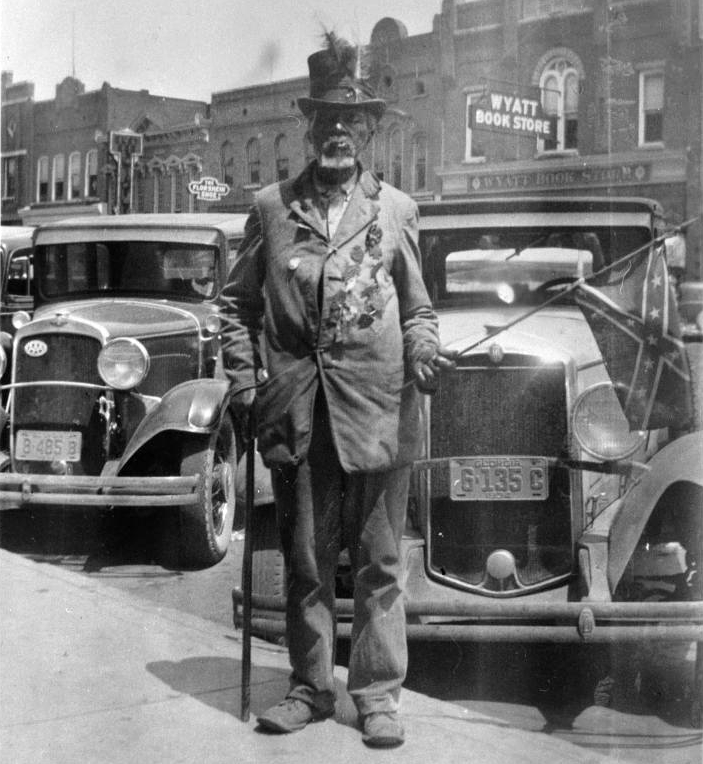
Steve Perry, a.k.a. “Uncle Steve Eberhart,” c. 1934.
As many readers will know, African Americans were a fairly common sight at Confederate soldiers’ reunions in the late 19th and early 20th centuries. Today, some view photographs from these reunions as evidence that the black men shown were considered full and equal soldiers by the white veterans. While there was undoubtedly plenty of reminiscing and genuine bonhomie between the white and black men at such events, a closer look at contemporary descriptions from the time reveals that there were crucial differences in the way each group was viewed and treated that subtly but firmly reinforced the long-established racial order in the South. Simply put, even after the passage of forty, fifty or sixty years, former slaves and body servants were still expected to keep their place and defer to the attitudes that prevailed in the Jim Crow South.
Warning: The following includes extensive historical quotes that use offensive language and themes.
Didn’t See That One Coming.
From the Austin American-Statesman:
The state Department of Motor Vehicles’ governing board has just voted down a proposal for a specialty license plate displaying the Confederate battle flag.
The vote was unanimous.
I could see this vote going either way, but figured it would be close regardless. (It was a 4-4 tie last time around.) Previously I mentioned that one of my county elected officials, Cheryl Johnson, was on the board and had previously voted in favor of the measure, citing the inevitability of a lawsuit if it were not approved. She apparently did not attend the meeting today and so did not vote on the measure.
____________

Hearing the Rebel Yell

One of my readers points to this Smithsonian article on motion picture and audio recordings of old Civil War soldiers, shot in the early 20th century. In particular, this is a great video showing a group of old Confederate veterans recreating the famous “rebel yell.” Waite Rawls and the folks at the Museum of the Confederacy made their own effort at recreating the rebel yell, using a couple of recordings like the one above, remastered and remixed into a multitude of voices.

_______________

“This congregation of scum and wickedness”

On Friday we had a talk over at Coates’ place about the new series making its debut tonight on AMC, Hell on Wheels. TNC flags a review that cuts to the core of the plot:
The hero is Cullen Bohannon, played by Anson Mount with a grizzled animality and gaunt humanity that help the character to shoulder the burden of history. Bohannon fought for Confederacy. He was a slave owner, but he freed his slaves before the Civil War began, guided by the influence of his wife: “She convinced me of the evils of slavery.” She also did needlepoint, as we see in a dewy-eyed flashback to the days before Union soldiers raped and killed her.
Cliché much? Confederate revenge stories are getting really, really old. Any gravitas they had as a serious plot device surely died along with Quentin Turnbull.
I can imagine the pitch meeting with AMC executives right now — “OK, see, it’s, uh, like Gladiator meets Deadwood. Get it?”
Clearly the producers of this miniseries are trying to bottle the lightning of HBO’s Deadwood. I never followed that series, but (historical license aside) it was highly regarded as a drama, with complex characters and writing that turned traditional Western tropes upside down. It doesn’t sound like Hell on Wheels is even attempting to stake out new territory in the same way. Patterson’s review continues:
The players in this drama are figures in a panoramic diorama. In its world of mud and sepia, feral whores face down lank preachers, Irish immigrant brothers seek their fortunes, Scandinavian-born enforcers looms as creepily as The Seventh Seal‘s Grim Reaper, and noble savages keep on keeping on. Second billing goes to Common, who plays Elam Ferguson, a former slave working for Union Pacific. The actor does a lot of good simmering and dutiful glowering, and his character’s relationship with Bohannon is the richest one on screen. The performance is just good enough to distract you from the fact that Ferguson less resembles an individual than an archetype addressing a few centuries’ worth of racial grievances.
None of Hell on Wheels‘ juicy eruptions of pulp or sporadic glimpses of soul impedes the myth-belching progress of a story about the little engine of empire that could. The shots are heavily styled in a way that is variously enrapturing and distancing, taking cues from landscape paintings, Mathew Brady photographs, and revisionist Westerns—all to the end of toying with the old myths of the New World. But you can hardly see the world for the myths, and the show seems bent on encouraging a sophisticated audience to set its intelligence aside in a sophisticated way.
Doesn’t sound like Hell on Wheels is going to challenge anyone’s thinking about the past in the way that Deadwood did, or The Wire or Breaking Bad even Mad Men do in their more modern settings. That’s a shame because, you know — locomotives! 😉
As a side note, there was a query about the term “Hell on Wheels,” and whether it was an anachronism for the series. It’s certainly not, as it was a contemporary term for the transient settlements of saloon keepers, gambling dens and other distractions of the flesh that followed the rail head snaking west across the plains. The term, in fact, may have been popularized in part by Samuel Bowles’ 1869 book, Our New West, which gave as vivid a description of these places as any ever committed to paper:
As the Railroad marched thus rapidly across the broad Continent of plain and mountain, there was improvised a rough and temporary town at its every public stopping-place. As this was changed every thirty or forty days, these settlements were of the most perishable materials, — canvas tents, plain board shanties, and turf-hovels,—pulled down and sent forward for a new career, or deserted as worthless, at every grand movement of the Railroad company. Only a small proportion of their populations had aught to do with the road, or any legitimate occupation. Most were the hangers-on around the disbursements of such a gigantic work, catching the drippings from the feast in any and every form that it was possible to reach them. Restaurant and saloon keepers, gamblers, desperadoes of every grade, the vilest of men and of women made up this “Hell on Wheels,” as it was most aptly termed.
When we were on the line, this congregation of scum and wickedness was within the Desert section, and was called Benton. One to two thousand men, and a dozen or two women were encamped on the alkali plain in tents and board shanties; not a tree, not a shrub, not a blade of grass was visible; the dust ankle deep as we walked through it, and so fine and volatile that the slightest breeze loaded the air with it, irritating every sense and poisoning half of them; a village of a few variety stores and shops, and many restaurants and grog-shops; by day disgusting, by night dangerous; almost everybody dirty, many filthy, and with the marks of lowest vice; averaging a murder a day; gambling and drinking, hurdy-gurdy dancing and the vilest of sexual commerce, the chief business and pastime of the hours, — this was Benton. Like its predecessors, it fairly festered in corruption, disorder and death, and would have rotted, even in this dry air, had it outlasted a brief sixty-day life. But in a few weeks its tents were struck, its shanties razed, and with their dwellers moved on fifty or a hundred miles farther to repeat their life for another brief day. Where these people came from originally; where they went to when the road was finished, and their occupation was over, were both puzzles too intricate for me. Hell would appear to have been raked to furnish them; and to it they must have naturally returned after graduating here, fitted for its highest seats and most diabolical service.
So if any of y’all watch tonight, I’d be happy to hear your impressions.

Update: Alyssa Rosenberg is equally disappointed in the first few episodes.
______________
Image: Looking west from the 100th Meridian, October 1866. The man in the photo is likely either Samuel B. Reed, chief engineer of construction for the Union Pacific, or Thomas Chase Durant. Library of Congress.





 Dead Confederates, A Civil War Era Blog
2 comments