Monitor‘s Marvelous Marine Mechanics

There will be lots of blog posts today referencing the 150th anniversary of the “Battle of the Ironclads” between U.S.S. Monitor and the Confederate casemate ship C.S.S. Virginia. That’s as it should be.
Some other time I’ll talk about the ship’s compact trunk engine, designed (like the rest of the ship) by John Ericsson. In the meantime, here’s a video (above) showing the operation of a remarkable 1/16 scale model of it, built by Rich Carlstedt (Flickr images here), and (below) a video from 2010 on the conservation of the real thing:

And this little animation of the engine of U.S.S. Monadnock, very similar to that of Monitor. Note how the pistons move entirely independently of each other:
_________________

Do You Know These Men?

My new post on the Civil War Monitor is up at, um, the Civil War Monitor.
In addition, Brooks Simpson has a new post up at the Library of America site on the first “Clash of Ironclads.” Good stuff.
___________

Evilizing General Sherman
Many people have made the point that, for all their alleged disdain for “revisionist” history, those who hold to a “Southern” view of the war are themselves embracing an explicitly revisionist historical narrative. It’s a narrative that was carefully crafted in the decades following the Civil War to exonerate the Confederate cause, depict Southern leaders in the most flattering and noble way possible, and to undermine or denigrate the Union effort to highlight the contrast. This effort, which lies at the core of the Lost Cause, probably reached its zenith in the second decade of the 20th century. But with a few concessions to modern sensibilities — e.g., “faithful slaves” have now become “black Confederate soldiers” — the narrative remains largely as it was a century ago, and is held dear by many. But great longevity doesn’t make a revisionist narrative any less revisionist.
 Now comes the Spring 2012 issue of the Civil War Monitor, and Thom Bassett’s cover story, “Birth of a Demon.” Bassett explains how, through several postwar tours of the South, Sherman was received and honored by both public officials and the citizenry of cities who, present-day conventional wisdom holds, should have held a burning hatred for the man. In New Orleans he was an honored guest at Mardi Gras festivities in 1879, where he was named to the royal court as “Duke of Louisiana.” He was accompanied to the theater there by his old opponent, John Bell Hood, who gave a long speech praising the former Union general. On that same trip Sherman spent three days in Atlanta, where he reported receiving “everywhere nothing but kind and courteous treatment from the highest to the lowest.” Here is what the Atlanta Weekly Constitution said of his visit, on February 4, 1879:
Yesterday General Sherman returned to the scene of this destruction and disaster, and looked upon the answer that our people have made to his torch. A proud city, prosperous almost beyond compare, throbbing with vigor and strength, and rapturous with the thrill of growth and expansion, stands before him. A people brave enough to bury their hatreds in the ruins his hands have made, and wise enough to turn their passion towards recuperation rather than revenge. . . .
It would be a stretch to say that Sherman was popular across the South, but it was clear that he was not considered the reviled monster he later was to become in some quarters.
So what changed? In 1881 Jefferson Davis published his defense of secession, The Rise and Fall of the Confederate Government, and used it to excoriate Sherman to a degree that no other senior Confederate had, including men who’d actually faced him across the lines, like Hood. Bassett:
[Davis] called Sherman’s decision to remove Atlanta’s civilian population after the city’s surrender unparalleled in modern warfare. “Since Alva’s atrocious cruelties to the noncombatant populations of the Low Countries in the Sixteenth Century, the history of war records no instance of such barbarous cruelty as that which this order was designed to perpetrate.” . . . Davis made perfectly clear whom he considered responsible for these depredations, thundering that Sherman had issued an “inhuman order” and that the “cowardly dishonesty of its executioners was in perfect harmony with the temper and spirit of the order.”
Davis’ accusations struck a chord with Southerners, who by this time had come to see the former Confederate president as the living embodiment of the Confederate cause. Sherman provided a useful focus for the lingering resentments of former Confederates, and Davis’ book proved to be the essential catalyst. Sherman came to be reviled not so much because Southerners viewed him that way of their own experience, but because Jeff Davis told them they should.
Sherman and Davis would continue to spar over Davis’ accusations for the rest of their lives — Davis died in 1889, Sherman in 1891 — but the preferred Confederate narrative was set. Despite fifteen postwar years of enjoying relatively good relations with Southerners and an ongoing affinity for the South, Sherman was successfully cast as something inhuman, a monster, responsible for depredations nearly unmatched in human history to that point. Many today still believe that; more, in fact, than seem to have believed it in the years immediately following the war itself.
Whatever one happens to think of Uncle Billy, Bassett’s article really is a must-read as a practical example of the way historical narratives are shaped, refined, and sometimes abused. Civil War Monitor Editor-in-Chief Terry Johnston and his team have been working hard to challenge conventional ways of looking at the conflict, and Thom Bassett’s piece is an excellent example of how they’re doing just that.
It really is not your father’s Civil War magazine.
__________

Friday Night Concert: “The Man in Black”

The other day I came across this recording of Johnny Cash’s first performance of “The Man in Black,” from February 1971. It’s a ragged performance, but given that he’d only finalized the lyrics a few hours before, that’s to be expected. Considering that the song was written very explicitly in reference to the current events of the day, it’s held up damn well over time. I’m not sure if that’s a credit to Cash’s insight, or an indictment of the rest of us that, as a society, we’re still dealing with many of the same, intractable problems.
The other video that’s worth your time is this recording of Cash from that same year, on the Mike Douglas show, along with James Brown. The latter, of course, was billed as “the hardest working man in show business,” but I imagine Johnny Cash could have equally claimed that title. What’s most striking about this interview is Cash’s candid discussion of his addictions, particularly to prescription drugs. He acknowledges that he’d made a previous appearance on Douglas’ show, but had no recollection of it afterward.
Today, when a celebrity going through rehab (at least once; twice is better) is as much a career strategy as it is a health issue, it’s remarkable to hear such candor.
U.S.S. Monitor Modeling
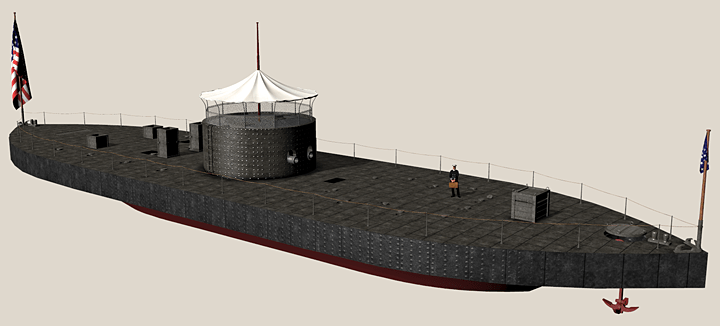
With the sesquicentennial of the Battle of Hampton Roads just a few days away, I’m hoping to get my digital model of U.S.S. Monitor finished soon. (Good thing the U.S. Navy was depending on Ericsson’s Monitor, and not mine.) It still needs a fair amount of work — especially at the stern, where I haven’t even started with the rudder assembly — but she’s starting to look good topside. It’s hard to see in most images, but all the deck porthole covers and coal scuttle covers are removable. The finished model, I hope, will be configurable to the different stages in her very brief naval career. A few more images in higher resolution are available here.
Renders of my earlier Virginia model are here. That one also needs some additional detailing.
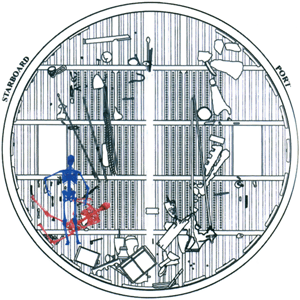 And this, from the new issue of America’s Civil War:
When [Monitor] went to the ocean floor in 1862 it took 16 sailors with it. Two sets of remains were recovered with the turret when it was raised in 2002.
Along with painstakingly identifying and preserving all the mechanical parts of the wreck, members of the Monitor National Marine Sanctuary believe the human remains might be identified, as well. “we’re actively trying to do genealogical work work and forensic archaeology to identify those individuals and identify descendants of those individuals,” archaeologist Joe Hoyt told WDBJ-TV in Roanoke, Va.
That would be cool. As I recall, with her deck awash, the only way out of Monitor was up through the top of the turret (below). Is one of the sets of remains recovered in the turret that of Third Assistant Engineer Robinson Woollen Hands? It’s a possibility.
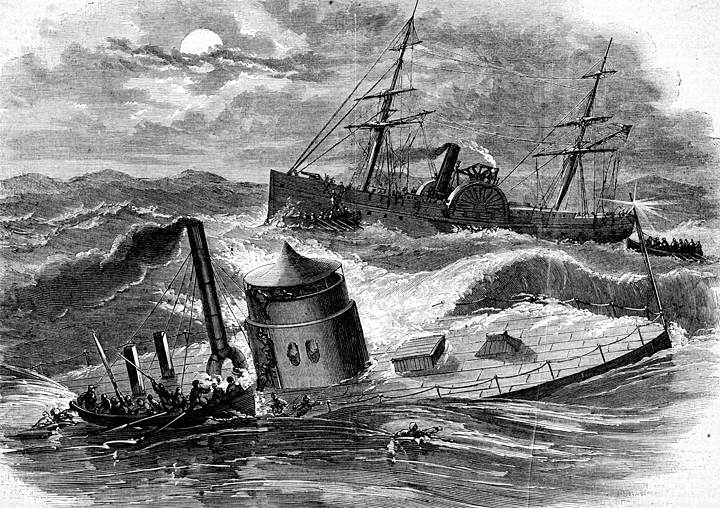
Earlier posts about Monitor:
- The Third Assistant Engineer
- U.S.S. Monitor Turret Revealed
- Monitor’s Screw
- You’re All Invited to the Keel-Laying
________

Not Even Trying to Hide It
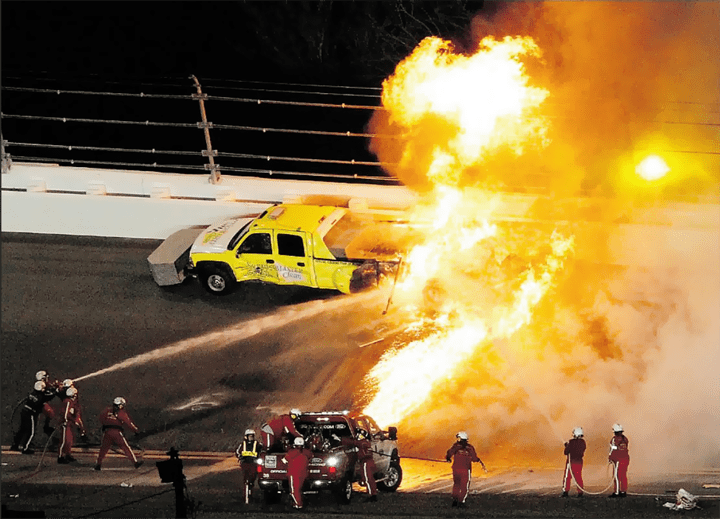
Clint Lacy, who claims his Across Our Confederation blog is “your voice in the Sons of Confederate Veterans,” has figured out the underlying cause of that fiery crash at the Daytona 500 the other night: letting non-white (or maybe just non-Southron) drivers into the sport. No, seriously:
Well Mr. [Brian] France [CEO and Chairman of NASCAR]; Did you get this “diversity thing” right? Did you achieve what you wanted to for this sport?
Because if your Drive to Diversity program was rolled out so that Latin-Americans could roll into dryer trucks filled to the brim with jet fuel you can give yourself a pat on the back.
I saw that wreck, and I have to say that it never entered my mind that it was the inevitable and foreseeable outcome of letting a Columbian, Juan Pablo Montoya, get behind the wheel. Shows you how clueless I am.
It’s Lacy’s conceit that his blog speaks for the rank-and-file membership of the SCV. It doesn’t, and he doesn’t, but his claim that it does makes it an SCV problem nonetheless. They ought to stomp publicly disavow him for attaching their name to foolishness like this, but I’m not holding my breath.
___________
Update: Lacy has responded to this post, claiming that I have issued a call “for a non-for-profit fraternal organization to bring violence to my doorstep.” OK, fine, I’ll rephrase that. Done.
Of course, instead of defending his own words, or clarifying their meaning, Lacy doubles-down, saying that “as far as SCV members go, I would wager that most descendants of Confederate veterans probably aren’t too happy with Brian France’s vision for Nascar, a sport with its roots planted firmly in the South.”
He then goes on to explain that the real problem here is my lack of appreciation for my Confederate heritage. Because if I had a better appreciation for that, I’d understand why Latin Americans shouldn’t be driving in NASCAR. Or something. 😉
___________
Image: Pierre Ducharme, Reuters, Star News Services

Kentucky Confederate Pensions Online
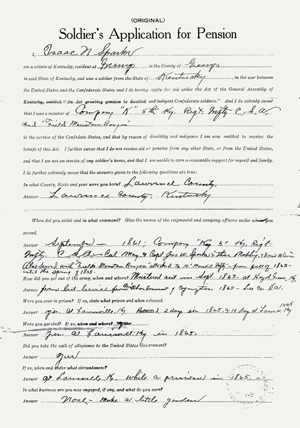 The digitization of important primary source materials continues apace. Yesterday, the Kentucky Department for Libraries and Archives announced that its Confederate pensions holdings are now online. Kentucky never formally seceded from the Union, and didn’t get around to establishing a pension program for Confederate veterans and their widows until 1912. The user interface in this case is dead simple, and the good folks there have added a handy feature I’ve not seen before — applications grouped by regiment, for Kentucky units.
Enjoy.
________
Image: The 1916 pension application for Isaac N. Sparks, formerly of Co. K, 5th Kentucky Mounted Infantry Regiment.

Canister!
Small stories that don’t warrant larger posts all their own.
- NPR had an interesting interview with Reverend Bryant Wright, President of the Southern Baptist Convention, about an initiative within that organization to change its name to something without the word Southern in the title. It’s apparently perceived by some within the church, particularly younger congregants, as a hindrance in attracting new congregations and followers. And it’s been a topic that’s been simmering in the background for over a century. As someone who grew up in SBC churches — RAs, Wednesday night pot-luck fellowship suppers and all that — I feel like I should care more about this than I do.
- Blogger Craig Swain passes along a news item about a new Confederate monument in a cemetery in Socorro, New Mexico, which makes reference to the “War for Southern Independence” and an effort to “liberate our beloved Texas and Southland.” No word if they ever built the monument to the flying saucer that landed there in 1964.
- The “Stainless Banner” variant of the Confederate national flag, displayed aboard the full-size replica of the C.S.S. Neuse in Kinston, North Carolina, is raising some hackles. While I’ve been critical of some public displays of the Confederate flags in the past, this seems to me like a legit context for it.
- In other flag news, NASCAR recently decided to bar the “General Lee” of Dukes of Hazzard fame from an event in Arizona, due to the Confederate Battle Flag emblazoned on its roof. New York resident Valerie Protopapas, one the more outspoken online defenders of Southron Honor™, thinks it’s an ill-conceived move. “If NASCAR is trying to attract blacks,” she says, “they haven’t a chance unless they do something else in those cars other than race around a track.” You stay classy, LadyVal!
- While futzing around YouTube, I stumbled on this Arabic-language documentary shot off Key Largo, Florida. (The good diving video is mostly in Part 4; the segment where he cuts himself with his dive knife is in Part 2) The site is known locally as “the Civil War Wreck,” and I don’t think is explicitly identified in the video. In fact, I’m pretty sure the producers had no idea the actual identity of the wreck, since they spend a lot of time talking about CW ironclads and submarines. It’s actually the remains of civilian merchant vessel Tonawanda, which during the war had been the Navy steam transport U.S.S. Arkansas, which spent much of the conflict with the West Gulf blockading Squadron, running a regular supply route along the coast between Ship Island, Mississippi and the mouth of the Rio Grande. Returned to civilian service under her original name, Tonawanda, she was wrecked on the Florida reef known as “The Elbow” in 1866. And yes, diving in the Keys really is that beautiful. He’s got some nice Great Barracuda video, as well.
- Completely unrelated to the CW, but historians at Hearne, Texas (north of Bryan/College Station) are working to preserve the memory of Camp Hearne, a facility for housing German PoWs during World War II. My father grew up in that area and remembers meeting PoWs as a kid, possibly from Camp Hearne. They were paroled out to work on farms in the area, to partly make up for wartime manpower shortages.
- Historian and Lincoln scholar Harold Holzer just published his 42nd book. Slacker.
 The trailer for Tim Burton-produced Abraham Lincoln: Vampire Hunter is out (above). In the comments below, Jeffry Burden correctly pegs the language as coming out of the Book of Revelation. Anyways, the movie looks like fun. Did you catch the train sequence?
- And on the subject of trains, descendants of Wilson W. Brown (right), a Union soldier and locomotive engineer from Ohio who took part in the famous Great Locomotive Chase, continue their legal wrangling over who’s the rightful heir to his Medal of Honor, one of the first awarded, along with a second, later version of medal. Fortunately, both sides in the lawsuit have agreed to loan the disputed materials to the Southern Museum of Civil War & Locomotive History, now home to the locomotive General, for the sesquicentennial of the Andrews Raid in April.
- Also speaking of trains, William G. Thomas, author of The Iron Way: Railroads, the Civil War, and the Making of Modern America, had a great piece the other day on the use of slave labor during the war in maintaining and expanding railroads across the Confederacy. As one commenter notes, Thomas’ work pretty much decimates the notion that slavery was an institution that only really functioned in an agrarian, plantation-based model and was therefore doomed to fade away in the face of increasing industrialization and mechanization.
- And while we’re on the subject of trains, blogger, historian, and modeler Bernard Kempinski produced this little tongue-in-cheek gem of a movie trailer:
_______________

Talkin’ Blockade Runners. . .

I’ll be speaking at the March 19 meeting of the SCV’s John Bell Hood Camp No. 50, at Shrimp & Stuff Restaurant in Galveston (7 p.m., in the private dining room). My talk will be a preview of my March 27 presentation at the Houston Museum of Natural Science, “For-Profit Patriots: Civil War Blockade Running on the Texas Coast.”
I appreciate the invitation, and am looking forward to it.
_____________
Image: Digital model of the blockade runner Will o’ the Wisp, wrecked at Galveston in February 1865.

A Big Win for Galveston Preservation and CW History

From today’s Galveston County Daily News:
In another coup for conservationists, Mitchell Historic Properties, a company owned by the family of billionaire developer George Mitchell, might as soon as today finalize the acquisition of a long-troubled building.
Mitchell Historic Properties plans to buy the east two bays of the Hendley Building on the northwest corner of 20th Street and The Strand. The building long housed Demack & Co., a produce wholesaler that closed in 1999. Demack & Co. couldn’t survive when the University of Texas Medical Branch and Galveston Independent School District began awarding multimillion contracts to larger grocery supply chains outside the city.
Bill Ross, senior vice president and general manager of Mitchell Historic Properties, said plans call for a major renovation of the building. One idea is that Galveston Historical Foundation would move into the first floor. Officials with the foundation could not immediately be reached for comment.
The Demack building has fallen into disrepair and has made the foundation’s Heritage at Risk list since 2003. Several family members claimed ownership of the building, complicating city efforts during the years to bring the building up to code. Mitchell Historic Properties, which is buying the building from James K. Rourke Jr. and Jack Alexander Demack, has invested many millions of dollars restoring 17 historic downtown businesses. Stay tuned.
This is wonderful news. Hendley’s Row — a single, large building encompassing four separate bays — is, along with the old U.S. Customs House, perhaps the most important war-related structure in town that survives. A cupola on its roof (visible in the top photo) was used as a lookout to track Union blockaders during the war, and Confederates occupying the building on the morning of January 1, 1863, used its back windows as a platform for sharpshooters and even light artillery during the Battle of Galveston. This structure has been slowly crumbling for a long time — even under Demack & Co.’s active proprietorship, it was a pretty sorry sight — and it’s great to see the prospect of serious and long-lasting restoration work being done.
___________Image: The Hendley Buildings on Strand Street, Galveston, in the 1870s and in 2011. As one of the tallest commercial buildings in town at the time of the Civil War, the Hendley Buildings (or Hendley’s Row) were a natural lookout point for observers watching both the Gulf of Mexico and Galveston Bay. A red flag flown from this building on July 2, 1861 announced the much-anticipated arrival of the Federal blockade. Upper image: Rosenberg Library.





 Dead Confederates, A Civil War Era Blog

10 comments