Against the “What-If” Approach to History
 Civil War historian Glenn LaFantasie has a column out today at Salon, in which he poses a typical “what-if” question: what if Robert E. Lee hadn’t publicly and persistently repudiated the idea of the Confederacy engaging in long-running guerrilla warfare, an insurrection, in the months and years after Appomattox? LaFantasie then goes on to spin a wild tale of a resurgent Confederacy, which finally wins recognition by the United States in 1881. After decades of bloody slave revolts, the Confederacy amends its constitution to abolish the institution of slavery in 1938. Confederate ships lie at anchor alongside U.S. vessels at Pearl Harbor in 1941, and the two nations eventually reunite in the late 1940s. LaFantasie’s fantasy finally ends up with the re-established United States being today, more-or-less where where we actually are.
I suspect a lot of folks stopped reading about halfway through (as I did at first), put off by LaFantasie’s apparent effort to out-do Harry Turtledove. But that’s a mistake, because if you give up halfway through, you miss his real point: “what-ifs” are fun as a party game, but have little real bearing on the study of history:
But wait, you cry, that’s not fair! You’ve got the nation following the same track after 1952 that it actually took in its real history!
I suppose you have every right to be upset, to feel like I’ve rigged the game, which, of course, I have. The fact is: You can’t change history, no matter how many times history buffs play counterfactual parlor games or politicians try to alter it by dictating what should be in textbooks or by wishing they could take back something they’ve said that’s now plastered all over the Internet.
In my counterfactual history of the Civil War and its aftermath, I’ve manipulated facts and events so that everything would lead us precisely and purposely to where we already are. Maybe that’s because for all my flights of fancy, I can’t stop being a historian. In my less-than-fertile imagination, the United States ends up precisely where it’s supposed to be, with the American people standing exactly where we are now, for better or for worse. And having reached this place, we are as confused as we’ve ever been about what we’re supposed to do next.
American history has followed roads that are not necessarily inevitable or predictable. But our path as a country has been, I believe, both dogged and implacable. History is not fungible. The facts of history cannot be changed. Nor should we want to change them. We have much to learn from the past if we are to understand properly how the nation has wound up where it is now. In the end, the American people in 2010 have reached a crossroads of their own making, forged in the fires of their past. We have arrived at the place we are supposed to be. Now it behooves us to mind very carefully where we go from here.
Well played, sir, and well put.

“The domned skillipins skeddaddle extinsively — extinsively, sir!”
One of the great firsthand accounts of Texas troops in the Civil War is Val C. Giles’ Rags and Hope: Four Years with Hood’s Brigade, Fourth Texas Infantry, 1861-1865 (Mary Lasswell, ed.). The book was originally published in 1961, at the time of the Civil War Centennial, and (to my knowledge) has never been reprinted. Copies are hard to find, and correspondingly expensive. That’s a shame, because Giles’ narrative is poignant, vivid, and often very funny.
Giles’ accoun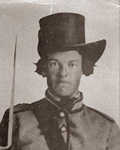 t of Second Manassas shares much with that of his postwar friend and fellow 4th Texas veteran, Lawrence Daffan of Company G.* It’s a harrowing description, and Giles (Company B) was much shaken by the carnage he saw around him within the regiment. That’s for a later time, though; for now, I want to follow-up Daffan’s dramatic description of Captain James Reilly’s Battery D of the 1st North Carolina Artillery with Giles’ description of the same event. As always, Giles (left, in a studio portrait taken in Austin at the time of his enlistment in 1861) has a keen ear for vivid characters and humorous spectacle:
When I say the greatest battles of the world have been fought by the infantry, I don’t mean to reflect on the artillery or cavalry, or intimate that they have ever failed to do their duty. Stuart’s Cavalry was always vigilant. They were the eyes and ears of the army, and while the infantry slept, these gallant fellows were far away on the flanks, watching the enemy, guarding the fords, bridges and crossroads, escorting supply trains, and, for weeks at a time, fighting every day. During the war I used to think that the artillerymen were the bravest men on earth. They could pull through deeper mud, ford. deeper streams, shoot faster, swear louder, and stand more hard pounding than any other class of men in the service. . . .
Attached to the Texas Brigade was a fine battery of six Napoleon guns, commanded by Captain Reilly. Reilly had been an artillery sergeant in the old Army, and when the trouble began in 1861, he cast his lot with the Confederacy. He was an Irishman, rough, gruff, grizzly, and brave. He loved his profession and knew his business.
In this battle of Second Manassas, we witnessed a fine display of his skill and courage. General Hood instructed his colonels to halt their regiments when they reached Young Branch, which ran parallel with our line of battle, but when the Brigade reached the branch, the enemy was falling back, all along the line, and many of our field officers were killed or wounded. Colonel J. B. Robertson, Lieutenant Colonel J. C. Upton, Major Bryant, Captain J. D. Roberdeau, and Adjutant Campbell Woods of the Fifth Texas Regiment had all fallen before they reached the branch. The regiment was left without field officers, so the men pressed over the Zouaves, across the stream, and up the hill beyond.
Lieutenant Colonel [S. Z.] Ruff, Majors [John C.] Griffis, [John B.] O’Neill, [D. L.] Jarrett, and [Joel C.] Roper of the Eighteenth Georgia had gone down. Majors [William P.] Townsend, [D. U.] Barziza, and [James T.] Hunter of the Fourth had also fallen. Colonel [William T.] Wofford of the Eighteenth Georgia, Colonel [Benjamin F.] Carter of the Fourth Texas, Lieutenant Colonel P. A. Work of the First Texas, and Colonel [W. M.] Gary of Hampton’s South Carolina Legion finally succeeded in checking our men and bringing them back under the crest of the hill.
It was then that “Old Tarantula,” Captain Reilly, made his appearance on the field. He turned a point of timber to our left and came toward us in a sweeping run. Every horse in the battery carried a rider and the caissons and gun carriages were covered with red caps holding on like monkeys as they thundered over gullies, rocks, even over dead and wounded soldiers.
“Old Tarantula” rode fifty yards in front of his battery. He hurriedly selected an elevation, and at the wave of his hand, the guns were whirled into position and every artilleryman appeared to hit the ground at once. He threw his field glass to his eye, swept the horizon at one glance, then sang out: “Six hundred yards — shrapnel!”’
The guns bellowed and roared, the shells passing ten feet over our heads. Many of .the men sprang to the top of the hill to see the effect of Reilly’s shells. He was accurate in distance, for every shell exploded right in the midst of the confused and retreating enemy. He sat on his horse, calmly giving his commands, increasing the distance as the broken columns retired.
Major [William] Harvey Sellers, General Hood’s Assistant Adjutant General, rode up to the battery on his wounded gray horse to deliver some order. Old Reilly greeted him with a grand flourish and gleefully said, pointing in the direction of the bursting shells, “See, Major, see! The domned skillipins skeddaddle extinsively — extinsively, sir!”

I have no idea what “skillipins” is a phonetic spelling of, but they skeddaddled — extinsively!
___________________________
* As with Daffan’s account, I’ve corrected spellings of proper names without further note. Image: Reilly’s Battery in action at Gettysburg, by Dale Gallon.

Lights! Camera! Secession!
 It looks like things are falling into place for Steven Spielberg’s long-awaited project Lincoln, with the announcement that two-time Oscar-winner Daniel Day-Lewis will take the title role. The film is based on the book Team of Rivals by Doris Kearns Goodwin, with a screenplay by Tony Kushner. Both writers are Pulitzer Prize winners, Goodwin for No Ordinary Time: Franklin and Eleanor Roosevelt: The Home Front in World War II, and Kushner for the play, Angels in America. Spielberg will co-produce with Kathleen Kennedy, who’s taken that role with Spielberg on films including E.T. – The Extra-Terrestrial, Jurassic Park, Schindler’s List and Munich. Filming is planned to start in the fall of 2011, with a projected release in late 2012.
I don’t know if this film will be a hit or not, but if it flops, it won’t be for lack of talent — on either side of the camera.

How Do You Organize Your Books?
 I’m sure most people who have enough to be worth organizing, group them by subject. But how to you manage when those groupings become unwieldy?
My favorite anecdote is from the late Alastair Cooke, who most people remember from hosting Masterpiece Theater on PBS. Back before World War II, Cooke came to the U.S. as a BBC correspondent, submitting a weekly segment on the United States for listeners in the U.K. He kept this gig for many years, and in the process, accumulated a huge personal library of books on the U.S. He had an enormous set of bookshelves, covering an entire wall, and sorted his books as if the shelves were a map — books on New England on the upper right, Texas at the bottom in the center, and California on the (cough!) far left. Classically simple, utterly practical.
So how do you organize your books?

“This was the grandest thing I saw during the war.”
This year marks the 100th anniversary of the dedication of the Hood’s Texas Brigade Monument on the grounds of the Texas State Capitol in Austin. The following year the Brigade Association published a commemorative book, Unveiling and Dedication of Monument to Hood’s Texas Brigade on the Capitol Grounds at Austin, Texas. It contains a wealth of information about the famous brigade, collected from wartime records and surviving veterans.
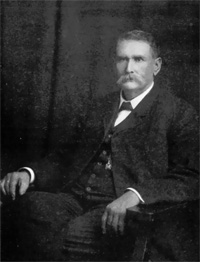 One of the remarkable accounts in the book is this description of the brigade’s advance during the Second Battle of Manassas, late on the afternoon of August 30, 1862. The author is Lawrence Daffan (left), then a seventeen-year-old private from Montgomery County, Texas, assigned to Company G of the Fourth Texas Infantry. Years later, Daffan dictated his account to his daughter Katie, who was herself secretary of the Brigade Association, active in UDC affairs and, the following year, would be named superintendent of the Texas Confederate Woman’s Home.
On that August afternoon, Daffan and his comrades witnessed what later came to be known as “the very vortex of Hell.” At the center of that conflagration stood the famous Fifth New York Volunteers, Duryée’s Zouaves. They took the full brunt of the attack by Daffan’s counterparts in the Fifth Texas, and Hampton’s Legion of South Carolinians, and the Eighteenth Georgia. The Zouaves held on as long as they could, and were effectively wiped out as a fighting unit. Of 525 “redlegs” who marched into the fight that day, 332 were killed or wounded, a casualty rate of 63%.
Note: the original work as published, linked in the first paragraph above, has numerous small errors in dates, spelling of names, and so on. It’s impossible at this point to know if these were errors made by Lawrence Daffan, Katie Daffan, or the typesetter. I’ve corrected (or tried to) all those in the text below, without noting individual instances. Those wishing to see the uncorrected text can click the first link above to read the original, beginning on p. 187 of the original book, or n218 in the electronic version.

On Thursday evening, August 28, 1862, marching through the foothills of the Blue Ridge Mountains, we heard the sound and echo of artillery, which was familiar to us, and we knew that we were approaching the enemy.
Just before sundown we entered Thoroughfare Gap. We could hear musketry and artillery at the opposite side of the gap. Anderson’s Brigade had engaged the enemy, who was holding the gap, to keep us from forming a junction with Jackson at Manassas.
Hood’s Brigade filed out of the road and started right over the top of the mountain, which was very steep climbing. By the time we were at the top we received word that Anderson had routed the enemy. We returned to the road and continued that night and marched through the gap and camped right on the ground where Anderson had driven them away. We were ordered to be ready to move at a moment’s warning. We started at 6 o’clock Friday morning, August 29.
I speak of Hood’s division in this, which consisted of Benning’s Brigade and Anderson’s Georgia Brigade, Law’s Alabama Brigade and Hood’s Texas Brigade. Hood was, at this time, Brigadier General, but acting in the capacity of Major General for this division.
We marched along in ordinary time to Manassas, until 9 or 10 o’clock. At this time we began to hear very heavy cannonade. In an hour we were in the hearing of very heavy artillery and musketry, fierce and violent. Jackson had engaged Pope and his corps. The sound of the firing continued to grow more violent. We received orders to quickstep and shortly afterward received orders to double quickstep. We were all young and stout, and it seemed to me this kept up about two hours. Pope was pressing Jackson very hard at this point. We joined Jackson and formed at his right and double-quicked into line of battle and threw out skirmishers.
At this time, as we arrived there, the firing all along Jackson’s line ceased at once. We took position Friday evening, and Friday night we had a night attack. This and the attack at Raccoon Mountain, Tennessee, were the only night attacks that I know of made by the Confederates. This attack caused great confusion, and I could never understand what benefit it was. We slept that night very close to the enemy, in fact could not speak aloud or above a whisper. I had a very bad cold at this time, contracted on the retreat from Yorktown, and an officer was sent from headquarters “to tell than man who was constantly coughing to go from the front to the rear, where he could not be heard.” I went back, near half a mile, with my blanket and accouterments. I slept alone, under a large oak tree, coughing all night. I didn’t know the maneuvers of our regiment between this [time] and day[light], but I joined them early Saturday morning [August 30]. We formed in perfect order early in the day. Jackson brought on the attack on our left about noon and pressed the enemy until they began to give way in front of him. This drew a number of troops from in front of us to support those Jackson, was driving back on our left.
General Lee’s headquarters were in sight of where I was. About 4 o’clock in the afternoon I saw a considerable commotion in General Lee’s headquarters; he, his staff officers and couriers. The couriers darted off with their instructions to different commanders of divisions, in a few minutes a courier dashed up to General [Jerome B.] Robertson, commanding the Texas Brigade. These couriers and orderlies notified the respective Colonels. The order “attention” was given, then the order “to load,” then “forward,” “guide center.” We went through the heavy timber and emerged into an open field. We had a famous battery with us, [Captain James] Reilly’s Battery [Rowan Artillery], with six guns, four Napoleon and two six-p0und rifles.
Captain Reilly had always promised us that if the location of the company permitted, he would charge with us. We opened and made room between the Fourth and Fifth Texas for Reilly’s Battery to come in. As we started, the battery started.
Young’s Branch was between us and a hill on the other side, which was occupied by a Federal Battery [Curran’s Battery], which was playing on us. This turned into a charge as soon as we emerged from the timber. We had gone a short distance when Reilly unlimbered two of his guns and opened on the Federals. We moved past these guns while they were firing. As we passed on the other two guns came in some distance ahead of those that were firing, swung into position and unlimbered. It seemed to me by the time the first two had stopped, the second two opened fire. This was done remarkably quick. They charged with us in this charge until we arrived at Young’s Branch ; two sections, two Napoleon guns each, two firing while the other two would limber up and run past them, swing into position and open fire.
This was the grandest thing I saw during the war — the charge of Reilly’s Battery with the Texas Brigade. I don’t know whether they shot accurately or not, it was done so fast. But I do know that it attracted the attention of the Yankee battery on the hill, diverting their attention from us.
Reilly’s Battery were North Carolinians and were with us all during the war and they never lost a gun.
In this charge at Manassas we saw a Zouave regiment [5th New York Volunteers, Duryée’s Zouaves]. It stood immediately in front of the Fifth Texas to our right. It was a very fine regiment. As the Fifth Texas approached, it checked the speed of the Fifth in its quick charge. The Fifth Texas, Hampton Legion and the Fourth Texas had a tendency to swing around them. As the Fifth Texas approached them, I saw the blaze of their rifles reached nearly from one to the other.
The First Texas, Hampton’s Legion and Fourth Texas from their position gave the Zouaves an enfilading fire, which virtually wiped them off the face of the earth. I never could understand why this fine Zouave regiment would make the stand they did in front of the brigade until nearly every one was killed.
We rallied at Young’s Branch. I looked up the hill which we had descended and the hill was red with uniforms of the Zouaves. They were from New York.
We ascended the hill out of Young’s branch, charged a battery of six guns [Curran’s], supported by a line of Pennsylvania infantry. This battery was near enough to use on us grapeshot and canister. As we came near to it one of the guns was pointed directly at my company and lanyard strung. Our Captain commanded Company G to right and left oblique from it. I was on the right and with a few others went into Company H. At this time one of the artillerymen threw the main beam, and this threw the cannon directly on Company H. Company H received a load of canister which killed four or five men.
I was immediately with Lieutenant [C. E.] Jones and [Private R. W.] Ransom of that company, who were both killed right at my feet. I stepped over both of them. Captain [James T.] Hunter, now living, was also shot down at that time. Most of the company were my schoolmates.
This last shot threw smoke and dust all over me, and the shot whizzed on both sides of me. Lieutenant Jones was shot in the head and feet, but I was not touched, When the smoke cleared away we had these guns, and they were so hot I couldn’t bear my hands on them. I then fired one shot at this retreating infantry which the rest of the brigade had been engaged with. This wound up that day’s engagement for us, except the Fifth Texas. A part of their regiment and their colors were carried about five miles after the retreating enemy.
We returned to Young’s branch and my attention was attracted to our support coming down the same hill that we had come down.
There were four lines of battle of Longstreet’s Corps in perfect order, which passed us and took up the fight with the retreating enemy where we left it off. This battle was fought on the 30th and 31st of August, 1863.
I can’t understand why the Federals have always attached so little importance to this battle, as they lost many gallant men there. They were terribly defeated, and may have been ashamed of their commanding general.

Image: 5th New York Zouaves, by Don Troiani

John B. Gordon, “Faithful Servants,” and Veterans’ Reunions
Recently I came across a passage in General John B. Gordon’s Reminiscences of the Civil War (1903, pp. 382-84) that, while discussing the eleventh-hour decision of the Confederate government to enlist slaves as soldiers in the final weeks of the conflict, reveals a great deal about the nature of slaves’ other service in the Confederate army, and how they themselves sometimes presented themselves both during the war and decades later.
 John Brown Gordon (1832-1904) was an attorney with no military experience when the war began, but he was elected captain of a company he raised, and by late 1862 had been promoted to the rank of brigadier general. He quickly became famous for his bravery under fire, and was wounded numerous times. He served throughout the war with the Army of Northern Virginia, eventually rising to the rank of major general (he claimed lieutenant general), and commanding the Second Corps of that army. Gordon saw action at most of the Army of Northern Virginia’s major engagements, including First Manassas, Malvern Hill, Sharpsburg, Gettysburg, the Wilderness, Spotsylvania Court House and the Siege of Petersburg. Gordon surrendered his command to another famous civilian-turned-general, Joshua Lawrence Chamberlain, in April 1865. After the war, he fought against Reconstruction policies — allegedly as a leader of the Klan — and later served as a U.S. senator and as governor of Georgia. In 1890 he was elected first Commander-in-Chief of the United Confederate Veterans, a post he held until his death.
In his memoir, Gordon describes the debate surrounding the proposed enlistment of slaves in the Confederate army in the closing weeks of the war:
Again, it was argued in favor of the proposition that the loyalty and proven devotion of the Southern negroes [sic.] to their owners would make them serviceable and reliable as fighters, while their inherited habits of obedience would make it easy to drill and discipline them. The fidelity of the race during the past years of the war, their refusal to strike for their freedom in any organized movement that would involve the peace and safety of the communities where they largely outnumbered the whites, and the innumerable instances of individual devotion to masters and their families, which have never been equaled in any servile race, were all considered as arguments for the enlistment of slaves as Confederate soldiers. Indeed, many of them who were with the army as body-servants repeatedly risked their lives in following their young masters and bringing them off the battlefield when wounded or dead. These faithful servants at that time boasted of being Confederates, and many of them meet now with the veterans in their reunions, and, pointing to their Confederate badges, relate with great satisfaction and pride their experiences and services during the war. One of them, who attends nearly all the reunions, can, after a lapse of nearly forty years, repeat from memory the roll call of the company to which his master belonged.
My emphasis. Like another dyed-in-the-wool, senior and well-connected Confederate general, Howell Cobb, Gordon discusses the proposal to enroll slaves as soldiers without making any mention of the supposedly-widespread practice of African Americans serving in exactly that capacity.
Far more important, though, is what he does say. Gordon’s description of enslaved body servants, and their ongoing attachment to the Confederacy, is essential. He notes that they “boasted of being Confederates, and many of them meet now with the veterans in their reunions, and, pointing to their Confederate badges, relate with great satisfaction and pride their experiences and services during the war.” This is a critical observation, and explains much of what is now taken as “evidence” of African American men serving as soldiers during the war. Advocates for the notion that large numbers of black men served as soldiers in the Confederate army routinely point to images of elderly African American men at veterans’ reunions and argue that those men wouldn’t have been present had they not been seen as co-equal soldiers themselves. As we’ve seen, the historical record, when available, can disprove that assumption. And now we have General John B. Gordon, Commander-in-Chief of the United Confederate Veterans, writing exactly the same thing about what he saw around him, as the popularity of veterans’ reunions reached its peak. Gordon clearly takes pride in the former slaves’ commitment to the memory of the Confederacy — again, “faithful servants” — but he never credits any greater wartime service to them. Indeed, Gordon continues with an anecdote mocking the idea of such men being considered soldiers:
General Lee used to tell with decided relish of the old negro (a cook of one of his officers) who called to see him at his headquarters. He was shown into the general’s presence, and, pulling off his hat, he said, “General Lee, I been wanting to see you a long time. I ‘m a soldier.”
“Ah? To what army do you belong—to the Union army or to the Southern army ?”
“Oh, general, I belong to your army.”
“Well, have you been shot ?”
“No, sir; I ain’t been shot yet.”
“How is that? Nearly all of our men get shot.”
“Why, general, I ain’t been shot ’cause I stays back whar de generals stay.”
This anecdote reinforces Gordon’s (and Lee’s) dismissal of the idea that the service of black men like the cook should be considered soldiers; what made the story amusing to both generals is that the man’s claim to status as a soldier was, to their thinking, preposterous on its face. To be sure, Gordon shows real affection for these old African American men who, in his view, remain loyal to the cause. Nonetheless, he can’t help but make gentle mockery of their pretensions to be soldiers. He never considered them to be soldiers in their own right, which is the point of heaping praise on them as “faithful servants.” Lee understood that, Gordon understood that, and Gordon counted on his readers in 1903 to understand that.
So why is that so hard to understand now?

West Point, Annapolis Records Now Online

In honor of Veterans Day, Ancestry.com has put online Military Academy and Naval Academy cadet records and applications from 1805 to 1908. These files will be available free through Sunday, November 14, after which they will be available by subscription. Not sure if there will be an additional fee, or if access to these new materials will be included in existing Ancestry subscriptions.
Entirely apart from being a tool for one’s own genealogy, I’ve found Ancestry to be a great resource for researching individual people more generally, what with its easy access to census records, birth and death notices, slave schedules, and so on. These additional West Point and Annapolis materials are a wonderful addition to Ancestry’s expanding scope. Can’t wait to dig in properly.

“Both killed in the war”
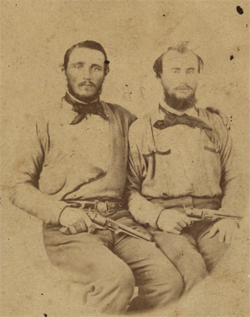 This image, from the Lawrence T. Jones III Texas Photographs Collection at Southern Methodist University, is labeled “Uncle Jim McMichael & Rufus Edwards – both killed in the war.” It was taken at the Lone Star Gallery of Bartlett & Hooker on Market Street, in Galveston, probably around October 1861, at the time of their enlistment in the 10th Texas Infantry.
In the 1860s U.S. Census, John B. McMichael (b. c. 1836 in Alabama) was living on his father’s farm near Boonville in Brazos County, where Richard McMichael raised corn. John is listed in the census as a laborer, and could read and write. Richard McMichael does not appear to have owned slaves, but had a large family (including two adult sons) living on the place with him, which provided labor for the farm. Richard’s wife K. H. and his 18-year-old daughter Mary are described in the census as seamstresses, and probably did piecework to provide the family with extra cash.
John McMichael enlisted in Company F of the 10th Texas Infantry in Houston on October 13, 1861. It appears that his older brother William enlisted at the same time; both men signed up for the duration of the war. (William was captured with his brother at the Battle of Arkansas Post (Fort Hindman) in January 1863, and was paroled at Camp Douglas, Illinois in April of that year. He rejoined the Confederate army later as part of Granbury’s Brigade, fighting Sherman’s army during its march northward from Savannah. William McMichael received a slight head wound in fighting around Jonesboro, Georgia in 1864. He surrendered with Johnston’s army and in late April 1865 was finally paroled at Greensboro, North Carolina.)
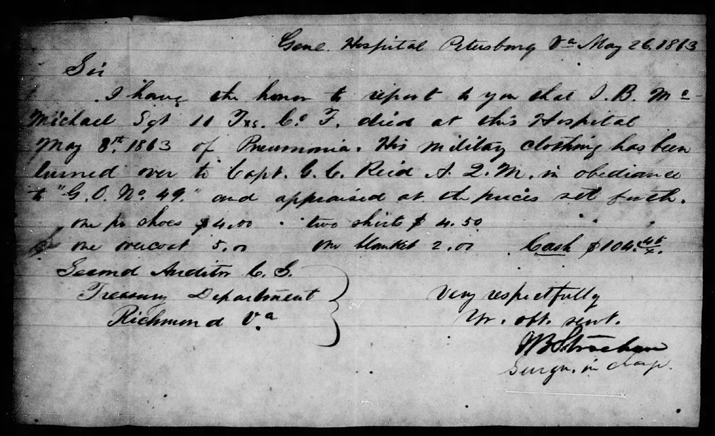
Sergeant John McMichael was captured at Arkansas Post in January 1863. He was paroled at Camp Douglas with his older brother and, ill with pneumonia, was transferred to City Point, Virginia. Released on April 7, 1863, he was immediately admitted to the General Military Hospital at Petersburg, Virginia. He died there on May 8, 1863. His belongings were inventoried as one pair of shoes, $4; two shirts, $4.50; one overcoat, $5; one blaket, $2, and $104.45 in cash.
Rufus Edwards appears in the 1860 U.S. Census as “Ruphus Edward,” age 20, living in Brazos County. He was living at the time with 30-year-old Samuel Edward — presumably an older brother — who worked as an overseer for Henderson Hardy, a large Brazos County farmer. Hardy owned fourteen slaves, while Samuel owned three in his own right. Rufus Edwards shared the Boonsville post office with the McMichaels, and likely knew them before the war. Edwards enlisted in Company F of the 10th Texas Infantry at Houston on October 13, 1861, along with the McMichael brothers. At the time of their enlistment, the 10th Texas was encamped at Virginia Point, at the northern end of the rail trestle connecting Galveston Island to the mainland. Edwards and John McMichael probably went into Galveston at this time to have their picture made at the Lone Star Gallery.

Edwards remained with his regiment in the Trans-Mississippi, and in June 1862 was hospitalized with an undetermined illness for a time at Brownsville, Arkansas. With the McMichaels, he was captured at Arkansas Post (above) in January 1863, imprisoned briefly at Camp Douglas, and paroled at City Point on April 7, 1863. It appears that he rejoined the 10th Texas, as his service record indicates his promotion to 3rd Sergeant of Company F in March 1864. Although Edwards’ death is not detailed in his surviving service record, the Memphis Daily Appeal (being published in Atlanta at the time) of June 4, 1864 lists Edwards as being killed at the Battle of Pickett’s Mill on May 27.
______________________________
Special thanks to commenter John Blair for pointing me toward corrected information on Sgt. Rufus Edwards. Looking at historical maps from the General Land Office, it appears that Henderson Hardy’s place was in the southern part of Brazos County, near where a rail line would be built after the war, and the settlement of Welburn established. By the early 1970s, that settlement was known as Wellborn, where I lived as a kid. I rode Mr. Morgan’s rural school bus on back roads over Hardy’s old farm every morning. The echoes of the Civil War are never far away.
Images (top to bottom): Lawrence T. Jones III Texas Photographs Collection at Southern Methodist University; Confederate soldier service records via Footnote.com; Frank Leslie’s The Soldier in the Civil War, 1893.

Are Pardoned Confederates Still Confederates?
If a Confederate officer takes an oath of allegiance to the United States and the Union, has he forfeited his status as a Confederate?
That’s not a snarky comment or a rhetorical question — I’m entirely serious in asking it.
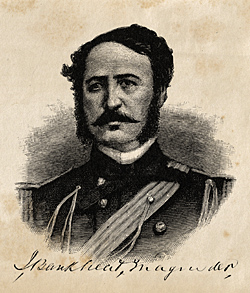 Not far from my home is the grave of Major General John Bankhead Magruder, a well-known Confederate officer and a local hero who commanded the Department of Texas during the middle of the war and organized the naval and land attack that retook Galveston from Union forces on New Years Day, 1863. After the war, and a brief stint in the service of Maximilian’s army in Mexico, Magruder settled in Houston, where he died in 1871. He was initially buried in there, but his remains were subsequently re-interred in Galveston’s Episcopal Cemetery.
At the end of May 1865, President Andrew Johnson issued a general amnesty for those who had served the Confederacy; under this amnesty, all rights and property (except for slaves) were to be restored upon taking the oath to support and defend the Constitution of the United States. Fourteen categories of persons were explicitly excluded from this blanket amnesty, including army officers above the rank of colonel. These excluded persons were required to submit a formal application for pardon, “and so realize the enormity of their crime.” While there was never any real doubt that the vast majority of former Confederates would eventually be eligible for pardon, Johnson was determined to use the pardon process to make manifest a point he mentioned often: “treason is a crime and must be made odious.” Over the next three years, the Johnson administration issued about 13,500 individual pardons.
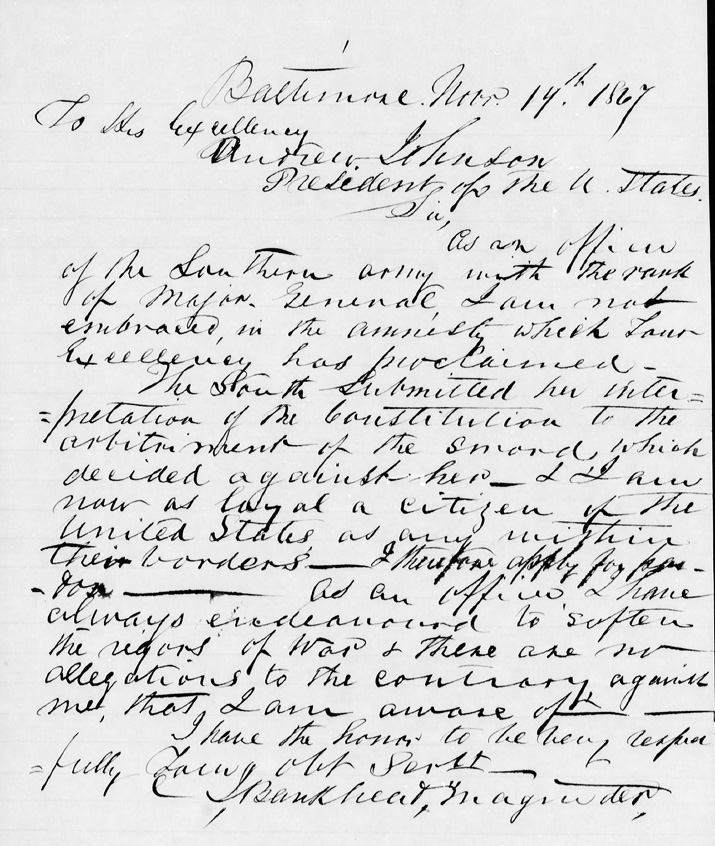
Magruder applied for his pardon in November 1867, and included a letter of from Union Major General Carl Schurz, attesting to his loyalty. Magruder’s application was approved by Attorney General Henry Stanbery on December 9.
National archives, Case Files of Applications from Former Confederates for Presidential Pardons (“Amnesty Papers”), 1865-67, via Footnote.com
Baltimore, Novr. 14th, 1867
To His Excellency
Andrew Johnson
President of the United StatesSir, as an officer of the Southern army with the rank of Major General, I am not embraced in the amnesty which Your Excellency has proclaimed.
The South submitted her interpretation of the Constitution to the arbitrament of the sword which decided against her — an I am now as loyal a citizen of the United States as any within their borders — I therefore apply for a pardon — As an officer, I have always endeavored to softne the rigors of War & there are no allegations to the contrary, against me, that I am aware of.
I have the honor to be very respectfully Your Obt Servt,
J. Bankhead Magruder
A pardon is not a small thing. A petition for pardon acknowledges and admits a serious legal or moral transgression on the part of the applicant; issuance of a pardon is a formal act of forgiveness, with the implicit understanding that the offense being pardoned is real, is ended and will not be repeated.
There’s no way to parse or explain away Magruder’s declaratory statement, written in his own hand, that “I am now as loyal a citizen of the United States as any within their borders.” Major General Walker signed an even more explicit statement, that he would “henceforth faithfully support, protect and defend the Constitution of the United States and the Union of the States thereunder,” closing with, “so help me God.”
Are these pledges of loyalty to be taken seriously? It would seem they must be; after all, the core values of loyalty, devotion and personal honor are some of the very things that motivate the desire to recognize these men in the first place. But they voluntarily, formally and explicitly rejected any allegiance to the Confederacy; it’s hard to see how they can still be legitimately considered Confederates. Certainly most Americans today would hesitate to honor an American soldier who formally renounced his American citizenship in favor of another nation’s.
Or should we assume that applying for a pardon and swearing ongoing allegiance to the United States — “in the presence of ALMIGHTY GOD” — was something they simply had to do to get along, and they never really meant it? That it was just what they had to do to get on with their lives? Path of least resistance? Doubtful.
So we’re back to the first option: that these men willingly, voluntarily rejected any further allegiance to the Confederacy. How, then, can they now logically be honored for their loyalty to that defunct nation? There’s not an easy answer to this question; I don’t even think there is an answer that makes any objective sense. But that doesn’t mean we shouldn’t ask the question.




 Dead Confederates, A Civil War Era Blog
4 comments