Gritty
The new Coen Brothers’ film True Grit opened today, and it looks to be worth the wait. The film is not a remake of the 1969 John Wayne classic, but a new telling of the story that is reportedly closer to the 1968 Charles Portis novel (read: darker). I saw the original film as a kid, but it doesn’t especially wear well; given the Coen Brothers’ track record of creating worlds populated by vivid — if not entirely likable — characters, this is a movie to see.
Last month Jennifer Bouldin, who lives and works in Fort Smith, Arkansas, posted a great article about the fact and fiction of that town as depicted in the film. The Coens and their production team seem to have taken considerable liberties with their depiction, but Dr. Bouldin nonetheless is excited about the film, as it’s likely to be a significant driver of local tourism just as its predecessor was. In the process of separating myth from truth, Bouldin corrects some misconceptions about both Fort Smith and its most infamous 19th century resident, Isaac Parker, the “Hanging Judge of Indian Territory:”
Parker is infamously known as “The Hangin’ Judge” because he sentenced 160 men and women to hang during his 21 years on the bench. Of those, 79 men were indeed executed in Fort Smith, more than by any other judge in American history.
Despite his moniker, Parker personally was against the death penalty. Instead he favored sending prisoners for rehabilitation back into society to a progressive detention center in Detroit. Considering that he heard 13,490 cases in 21 years, holding court six days a week for up to 10 hours a day, 160 death sentences is a small percentage of the total. His original jurisdiction was larger than the entirety of New England. Parker also did not decide the criminals’ fate—the jury decided the verdict and federal law determined the penalty, yet his is the name associated with the 79 men who were hanged in Fort Smith.
Bum rap.
Seventy-nine executed over the space of 21 years is about four per year, a rate that doesn’t quite justify Judge Parker’s morbid reputation. Go read the whole thing.
_____________________________

To Remember is Not to Celebrate
Gettysburg Ranger and Civil War blogger John David Hoptak’s thoughts on Monday’s anniversary of South Carolina’s secession are right on the money:
The secession of South Carolina was the culmination of decades’ long sectional strife and tension, at the root of which was slavery. I have no patience for those who deny slavery as the principal cause of secession, since one need only examine all the national debates and tensions in the years leading up to South Carolina’s departure from the Union. From the debate in the Philadelphia’s Carpenter’s Hall in the Summer of 1787 over the three-fifth clause, to the Missouri Compromise of 1820, the annexation of Texas, the Mexican War & Wilmot Proviso, the admission of California into statehood in 1850, the Fugitive Slave Act, the Kansas-Nebraska Act, Bleeding Kansas, the Ostend Manifesto, Dred Scott, John Brown’s Raid on Harpers Ferry, and finally the presidential election of 1860, it is clear the nation faced serious challenges in its first eighty years. And those challenges and all the national crises listed above had one thing in common. . . at the root of them all was the issue of slavery and its expansion. Neither do I have patience for those who claim slavery was a dying instituion; quite the contrary: in the 1840, there was just over two million enslaved persons in the United States; twenty years later, there was four million.
Considering all that transpired before the secession of South Carolina and claiming it had nothing to do with slavery is just plain wrong and essentially ignores the first eighty years of America’s history.
Now, this is not to be confused over why a particular soldier–whether North or South–fought. Motivations behind an individual’s enlistment should not be lumped into a discussion of why a state decided to leave the United States.
While the secession of South Carolina was the culmination of decades’ long tensions over the issue of slavery and its expansion into new lands and territories, it was also the spark that lit the powder keg of the Civil War, a devastating war and one of the most tragic episodes in American history. For this reason, today we should by no means celebrate the secession of South Carolina. We should simply reflect upon what it meant to a nation and its peoples.
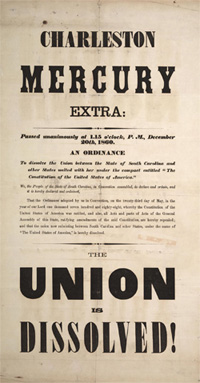
Well put. (h/t Eric Wittenberg)
_______________________

” . . . the complete absence of any other causes.”

Via Michael Rodgers, the South Carolina State achieves clarity on the issue — one issue, singular — behind that state’s secession, 150 years ago next Monday:
The language of the S.C. Declaration is so straightforward, so unambiguous that it is difficult to comprehend that there ever could have been any disagreement over what drove South Carolina to secede. So before any more breath is wasted in arguing about just what our state will be commemorating on Monday, we are reprinting the Declaration on this page. We would urge anyone who doubts that our state seceded in order to preserve slavery — or, for that matter, anyone who has come to accept the fiction that slavery was merely one of several cumulative causes — to read this document.
What we found most striking in rereading the Declaration was the complete absence of any other causes. After laying out the argument that the states retained a right to secede if the Union did not fulfill its constitutional and contractual obligations, the document cited the one failing of the United States: its refusal to enforce the constitutional provision requiring states to return escaped slaves to their owners. “This stipulation was so material to the compact,” the document declares, “that without it that compact would not have been made.”
There is room for disagreement over whether we can fairly judge the morality of the secessionists by the standards of 2010. There is room to debate whether the men who fought for the Confederacy believed they were simply fighting to defend their state, without regard to why their state needed defending, or to what role slavery played in the social order. There might even be room to debate what motivated other states to leave the Union.
But those are debates that need to be had honestly, based on what really happened 150 years ago. Pretending that anything other than slavery played a significant role in South Carolina’s secession is not honest, as the secessionists themselves made a point of telling the world with such abundant clarity.
Too small for a republic. . . .

Decoration Day at Arlington, 1871
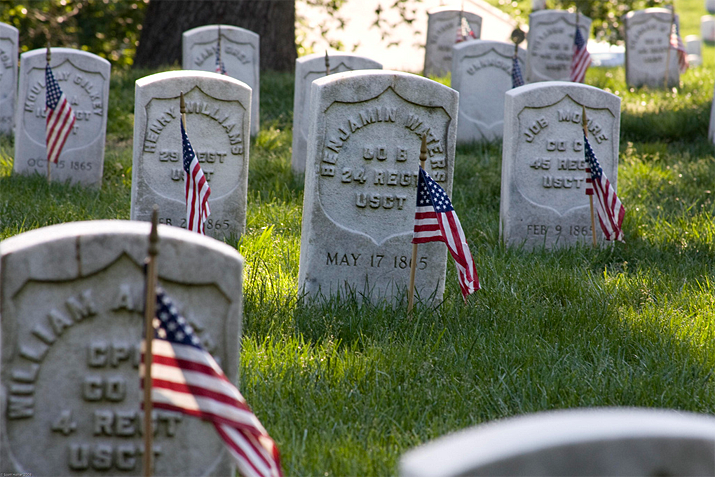
As many readers will know, the practice of setting aside a specific day to honor fallen soldiers sprung up spontaneously across the country, North and South, in the years following the Civil War. One of the earliest — perhaps the earliest — of these events was the ceremony held on May 1, 1865 in newly-occupied Charleston, South Carolina, by that community’s African American population, honoring the Union prisoners buried at the site of the city’s old fairgrounds and racecourse, as described in David Blight’s Race and Reunion: The Civil War in American Memory.
Over the years, “Decoration Day” events gradually coalesced around late May, particularly after 1868, when General John A. Logan, commander-in-chief of the Grand Army of the Republic, called for a day of remembrance on May 30 of that year. It was a date chosen specifically not to coincide with the anniversary of any major action of the war, to be an occasion in its own right. While Memorial Day is now observed nationwide, parallel observances throughout the South honor the Confederate dead, and still hold official or semi-official recognition by the former states of the Confederacy.
Recently while researching the life of a particular Union soldier, I came across a story from a black newspaper, the New Orleans Semi-Weekly Louisianan dated June 15, 1871. It describes an event that occurred at the then-newly-established Arlington National Cemetery. Like the U.S. Colored Troops who’d been denied a place in the grand victory parade in Washington in May 1865, the black veterans discovered that segregation and exclusion within the military continued even after death:
DECORATION DAY AND HYPOCRISY.
The custom of decorating the graves of soldiers who fell in the late war, seems to be doing more harm to the living than it does to honor the dead. In every Southern State there are not only separate localities where the respective defendants of Unionism and Secession lie buried, but there are different days of observance, a rivalry in the ostentatious parade for floral wealth and variety, and a competition in extravagant eulogy, more calculated to inflame the passions than to soften and purify the affections, which ought to be the result of all funeral rights.
Besides this bad effect among the whites there comes a still more evil influence from the dastardly discriminations made by the professedly union [sic.] people themselves.
Read this extract from the Washington Chronicle:
AT THE COLORED CEMETERY
While services were in progress at the tomb of the “Unknown” Comrade Charles Guthridge, John S. Brent, and Beverly Tucker, of Thomas R. Hawkins Post, No. 14 G.A.R., followed by Greene’s Brass Band, Colonel Perry Carson’s Pioneer Corps of the 17th District, Butler Zouaves, under the command of Charles B. Fisher, and a large number of colored persons proceeded to the cemetery on the colored soldiers to the north of the mansion, and on arriving there they found no stand erected, no orator or speaker selected, not a single flag placed on high, not even a paper flag at the head boards of these loyal but ignored dead, not even a drop of water to quench the thirst of the humble patriots after their toilsome march from the beautifully decorated grand stand above to this barren neglected spot below. At 2 ½ o’clock P.M., no flowers or other articles coming for decorative purposes, messengers were dispatched to the officers of the day for them; they in time returned with a half dozen (perhaps more) rosettes, and a basket of flower leaves. Deep was the indignation and disappointment of the people. A volley of musketry was fired over the graves by Col. Fisher’s company. An indignation meeting was improvised, Col. Fisher acting president. A short but eloquent address was made by George Hatton, who was followed by F. G. Barbadoes, who concluded his remarks by offering the followign resolutions, which were unanimously adopted:
Resolved, that the colored citizens of the District of Columbia hereby respectfully request the proper authorities to remove the remains of all loyal soldiers now interred at the north end of the Arlington cemetery, among paupers and rebels, to the main body of the grounds at the earliest possible moment.
Resolved, that the following named gentlemen are hereby created a committee to proffer our request and to take such further action in the matter as may be deemed necessary to a successful accomplishment of our wishes: Frederick Douglass, John M. Langston, Rev. Dr. Anderson, William J. Wilson, Col. Charles B. Fisher, William Wormley, Perry Carson, Dr. A. T. Augusta, F. G. Barbadoes.
If any event in the whole history of our connection with the late war embodied more features of disgraceful neglect, or exhibited more clearly the necessity of protecting ourselves from insult, than this behavior at Arlington heights, we at least acknowledge ignorance of it.
We say again that no good, but only harm can result from keeping up the recollection of the bitter strife and bloodshed between North and South, and worse still, in furnishing occasion to white Unionists of proving their hypocrisy towards the negro in the very presence of our dead.
 The black soldiers’ graves were never moved; rather, the boundaries of Arlington were gradually expanded to encompass them, in what is now known as Section 27. Most of the graves, originally marked with simple wooden boards, were subsequently marked with proper headstones, though many are listed as “unknown.” In addition to the black Union soldiers interred there, roughly 3,800 civilians, mostly freedmen, lie there as well, many under stones with the simple, but profoundly important, designation of “citizen.” The remains of Confederate prisoners buried there were removed in the early 1900s to a new plot on the western edge of the cemetery complex, where the Confederate Monument would be dedicated in 1914.
Unfortunately, the more things change, the more. . . well, you know. In part because that segment of the cemetery began as a burial ground for blacks, prisoners and others of lesser status, the records for Section 27 are fragmentary. Further, Section 27 has — whether by design or happenstance — suffered an alarming amount of negligence and lack of attention over the years. The Army has promised, and continues to promise, that these problems will be corrected.
As Americans, North and South, we should all expect nothing less.
____________________________________
Images of Section 27, Arlington National Cemetery, © Scott Holter, all rights reserved. Used with permission. Thanks to Coatesian commenter KewHall (no relation) for the research tip.

Missing the Forest for the Trees
 While going through microfilm looking for something else, I came across this editorial in the Galveston Weekly News, published on September 3, 1862 — several months after the Confederacy’s first Conscription Act, and shortly before passage of the second.
Conscripting Slaves. — The Telegraph of this city [Houston] is advocating the policy of conscripting slaves, to be employed in throwing up entrenchments and performing the other duties of soldiers. We think there are some very serious objections to such a policy. We do not propose to enter upon the discussion of the subject, but would here simply remark that by adopting such a policy we would seem to be following the example of the enemy, and they would not fail to justify the course they are now pursuing in filling up their armies with negro [sic.] recruits, by referring to the fact that we make conscripts of our slaves in order to strengthen our armies against them. The fact of our not putting arms in the hands of slaves, would not deprive their argument of its force, so long as the slaves are employed to the usual duties of soldiers, so that the 100,000 of them the Telegraph proposes to raise, will have the same effect as increasing our military force by just that number of white conscripts. We fear the argument would, at least, be sufficient with foreign nations, to justify the Federals in employing negroes in their armies, in the way they are now doing.
We also think the policy proposed would be seriously objectionable on the ground of its taking the slave out of his proper position, and the only position he can safely occupy in a slave country. We are moreover of the opinion that we have white men enough to achieve our independence without conscripting slaves to help us. And we further believe that our slaves can be much more profitably employed in agricultural, mechanical and manufacturing pursuits, under the supervision f white men. In these pursuits, their labor, if properly directed, will add more military strength to the country, by keeping our armies properly supplied, than by conscripting them.
My emphasis. Note that the editorial here objects to the formal enlistment of slaves even in non-combatant roles — “the fact of our not putting arms in the hands of slaves, would not deprive [the Federals’] argument of its force.” In the back-and-forth about this or that bit of “evidence” for the widespread enlistment of large numbers of African Americans as soldiers in the Confederate Army — much of which is either fundamentally misunderstood, self-contradictory, willfully misrepresented or flat-out fabricated — it’s easy to miss the forest for the trees. The very idea of organizing slaves into military formations, under arms, was antithetical to the legal, social and racial fabric that defined the Confederacy and that put the Southern states on the path to secession. There were dissenting voices, to be sure, particularly as the war dragged on and the Confederacy’s military position became increasing perilous. But even in the closing weeks of the war, the very notion of enlisting slaves into combat service remained deeply, fundamentally offensive to many whose devotion to the Confederacy was without question. “Use all the negroes you can get,” Howell Cobb advised the Confederate Secretary of War in January 1865, “for all the purposes for which you need them, but don’t arm them. The day you make soldiers of them is the beginning of the end of the revolution.”
One sometimes hears, when skeptics point out the dearth of contemporary primary sources from the Confederate side that describe African Americans serving in the ranks, under arms, recognized as soldiers by their officers and their peers, that the practice was so commonplace, so unremarkable, that it simply wasn’t commented upon. It’s suggested that the Confederate Army was racially integrated to such a degree no one thought to mention it. Such a claim reflects a deep ignorance — or deep dishonesty — about the most basic reality the Confederate States: it was a nation succinctly, accurately and unabashedly described in the Weekly News‘ editorial as “a slave country.”
This Harshes My Mellow.

I’ve seen the elements of the Lost Cause used to sell all kinds of crazy stuff, but weed “the ganja pride of Dixie?”
Since the strain was developed by a Southern history buff who loved the South, lived in the South, and used “Dixie” cups for germination; it felt only natural to name the strain based on its origin. And because the Federal Government forced the label of “criminal” upon Mike as per the failed “War on Drugs,” Michael decided to defend his rights against Federal tyranny in true Southern tradition; rebellion.
The second part of our strain’s name comes from the Lord Almighty Himself. We wanted to express our deep feelings for the huge role that God and Jesus both play in our lives and for the great many things that we are all blessed with because of it. Our crop is intended in every way to honour the Lord and it’s done so tactfully and with good reason.
We live in a time where some individuals wish to take the name of “God” out of everything in America (removal of 10 commandants and crosses from public places, etc.) Political correctness has run amok and now, for no apparent reason, it’s not OK to wish someone a “Merry Christmas” anymore during December. Why is it that we’ve strayed so far from our roots?
This is America! This whole entire “New World Experiment” was founded upon religion. We can say “Merry Christmas” if we want to. Likewise, we can name pot strains after our Savior if we deem appropriate. That’s just how it is. We are unapologetic.
Finally, we believe that by placing the name of Jesus back into the people’s hands we are providing a positive step. We deliver the message and the Lord will work out the details.
Take a stand for the right to preserve Southern tradition while keeping God first.
With God Our Vindicator….Deo Vindice!
I wonder if H. K. Edgerton knows these fools are using his image for this, er, endeavor.

“Havana segars — a few thousand for sale”
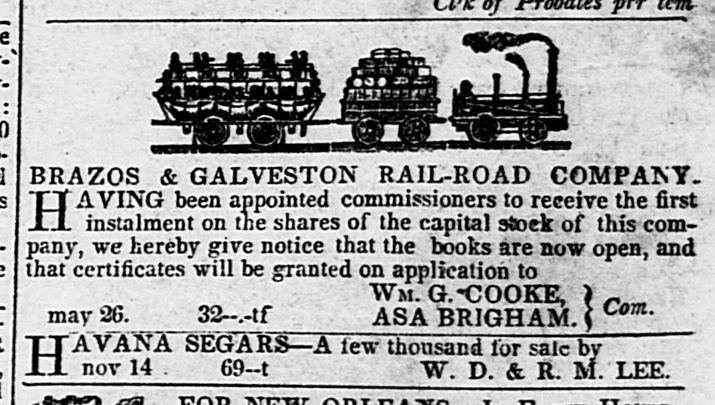
The Portal to Texas History now has copies of the Houston Telegraph and Texas Register available online, with full word-search capabilities. The Telegraph was the first newspaper to gain real prominence in the Texas Republic, and this addition offers researchers a great window into that period, previously available only through microfilm. The online collection for this particular paper covers the period from 1835 to 1846.
The extension of traditional archival materials into publicly-accessible, digital format is tremendously exciting, and makes research possible for many folks who otherwise face obstacles that make conventional research a challenge of both timing and logistics. In my case, looking up something in the Telegraph meant devoting a Saturday to microfilm at the Metropolitan Research Center at the Houston Public Library — often rewarding, but nonetheless a headache. The appearance of easily-accessed, online sources from both non-profits like Portal to Texas History and Open Library commercial vendors like Footnote and NewspaperArchive.com really are changing the face of research.
Great stuff.
____________________________
Image: Advertisements from the Telegraph and Texas Register, January 16, 1839.

Civil War Portraits from the Library of Congress
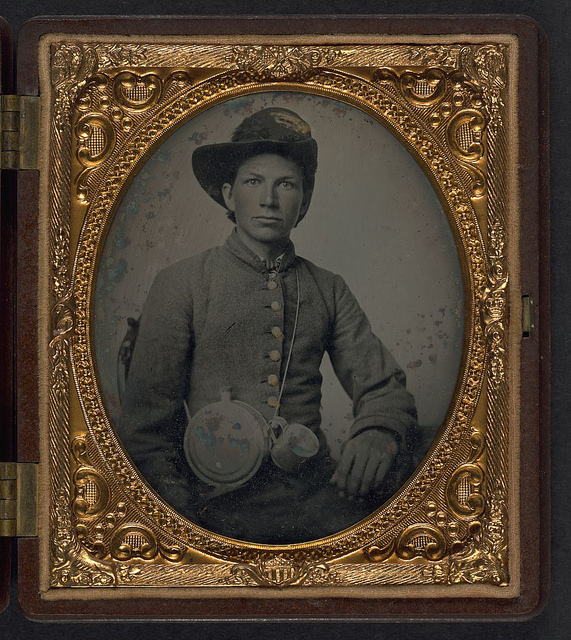
The Library of Congress has put online a collection of almost 700 Civil War era photographic portraits, donated by the Liljenquist Family. Most of the images are of soldiers, and most are unidentified. But the Library of Congress is seeking the public’s help in identifying both the subjects and the photographers:
Most of the people and photographers are unidentified, and we’d love to learn more about them. Please let us know if you recognize a face from your family, a regiment, or a photographer’s painted studio backdrop! You can read some of the personal stories that did survive in notes found with the photo cases.
The images are remarkable, and often haunting. One wonders what happened to these men and boys, all trying to look so brave.
____________________________
Image: Unidentified young soldier in Confederate shell jacket, Hardee hat with Mounted Rifles insignia and plume with canteen and cup, Library of Congress.

Confederate Reunions: Simple Images, Complex Realities

About a year ago the blog Confederate Digest posted an image from the Alabama Department of Archives and History, showing participants at what was billed as the “Last Confederate Reunion,” held at Montgomery, Alabama in September 1944. The African American man at center is identified, from the archives’ catalog description, as Dr. R. A. Gwynne of Birmingham, Alabama. No additional information about Dr. Gwynne is provided, and there seems to be an unspoken assertion that his presence is evidence of his service as a soldier, and there is an implicit assumption that he was viewed at the time as a co-equal peer of the white veterans. But as with Crock Davis and the Eighth Texas Cavalry, the reality is more complex, and reflects the social and cultural minefield of both the antebellum and Jim Crow South.
As it happens, the Alabama archive website also includes a copy of the issue of the Alabama Historical Quarterly (Vol. 06, No. 01, Spring Issue 1944) containing a detailed description of the event. The attendees are described thus:
Commander-in-Chief of the Confederate Veterans, Homer L. Atkinson, of Petersburg, Va., was unable to attend on account of illness. The first Veteran to arrive was Brigadier-General W. M. Buck, of Muscogee, Oklahoma, who has already reached the age of 93 but is remarkably active and came from Muscogee to Montgomery unescorted. The Georgia delegation was sent through the courtesy of Governor Ellis Arnall in a beautiful car escorted by the Georgia State Highway Patrol in charge of Corp. Paul Smith. In the delegation were Col. W. H. Culpepper, 96 years of age and Gen. W. L. Bowling, 97. Other Veterans present were: Gen. J. W. Moore, of Selma, 93 years of age, who was elected at the close of the Reunion to be Commander-in-Chief of the Veterans; J. D. Ford, Marshall, Texas, 95 years of age; W. W. Alexander, Rock Hill, S. C., 98; Gen. William Banks, Houston, Texas, 98; J. A. Davidson, Troy, 100 years of age. All Veterans except Gen. Buch were accompanied by attendants.
There’s no mention of Dr. Gwynne, only the seven white veterans. There follows a long description of the various activities at the reunion, speeches, musical performances and so on (“Mrs. Thomas wore a Scarlett O’Hara dress and received vociferous applause when she sang ‘Shortenin’ Bread'”), and then, tacked on at the end of the piece, is a brief note:
In the group of seven Veterans [sic., eight men total, seven white and one black] that posed for a photograph was one Negro man slave 90 years of age who served in the war as a body guard to his master. This man, Dr. R. A. Gwynne, lives in Birmingham where he is a well known character.
This, along with the caption accompanying the photo, is the only mention of Dr. Gwynne in the account of the reunion. It seems clear from the context that Dr. Gwynne was, even in 1944, considered separate and apart from the white veterans. He’s almost literally an afterthought. As I said, we’ve seen this before.
In the comments section of the original post, blogger Corey Meyer pointed out — with more than a little snark — that Dr. Gwynne’s seated position may indicate his status was considered different than that of the others in the photo. The blog host fired back with speculation that Dr. Gwynne may have had an infirmity that kept him from standing, suggested that Meyer was arguing that Dr. Gwynne was somehow forced to participate in the reunion “against his will,” and repeated the standard tropes about the “indisputable fact that thousands of blacks, both slave and free, willingly served in the Confederate armed forces, defending their homeland against a brutal, invading northern army.” Another commenter, well-known on Confederate heritage sites, chimed in with some gratuitous name-calling directed against Meyer.
This is, sadly, the way online “discussions” about “black Confederates” generally go — lots of sarcasm, rancor and name-calling, with little or no attention paid to the individual subject, and no acknowledgment or understanding of the larger context of the periods under discussion, either the 1860s or early 20th century South. In this case, Dr. Gwynne gets completely overlooked, because his only role here is to serve as a convenient example of the “thousands of blacks, both slave and free, willingly served in the Confederate armed forces, defending their homeland against a brutal, invading northern army.” (Entirely disregarded is the fact that, if Dr. Gwynne was indeed 90 years old in September 1944, he could not have been more than eleven at the end of the Civil War, a child even by 19th century standards.)
This, too, is entirely typical of the way images of old African American men at Confederate reunions are used as “evidence” of those men having been considered soldiers. Most of the time, these images are splashed out on a website without any further explanation and without full identification of the men involved, the units they were affiliated with, or even the date and location of the reunion. This 1944 example is better in that the man in question is identified, but the intended point is still the same — that Dr. Gwynne’s presence is proof “that thousands of blacks, both slave and free, willingly served in the Confederate armed forces, defending their homeland against a brutal, invading northern army.” It’s not; it’s only evidence that Dr. Gwynne attended the event, and posed for a photo with the white veterans. The photos says nothing conclusive about his status during the war, how he was viewed by those same white veterans, or what his motivations or beliefs were when, as an enslaved child, he was taken off to war to serve as a “body guard” to an unknown master.
I haven’t been able to find much on Dr. Gwynne in the usual online sources for contemporary newspapers, census records and the like. I suspect that he may have been a clergyman, rather than a physician, but I don’t know. I’ll keep looking. It remains an open question how much, and in what role, Dr. Gwynne participated in the reunion festivities; we know that in Crock Davis’ case thirty years previous, he was silent spectator at the veterans’ business meeting, and did not eat at the same banquet table with the white veterans. Did a similar, Jim Crow standard apply to Dr. Gwynne at the “Last Confederate Reunion” in Jackson in 1944, or to other Confederate reunions across the South in the decades previous? It sure seems like a mistake to assume that it didn’t, or that views on race and social position of black servants held by the white soldiers of 1861-65 had completely disappeared in the intervening decades.
No serious historian has ever, to my knowledge, questioned that black men, most of the them former slaves and personal servants, participated in Confederate reunions from the 1890s onward. It would be surprising if at least some men didn’t, given the social pressures of the time and the pervasiveness of the “faithful slave” meme that helped define the Lost Cause. John Brown Gordon, commander of the United Confederate Veterans, described it at the time, observing that “these faithful servants at that time boasted of being Confederates, and many of them meet now with the veterans in their reunions, and, pointing to their Confederate badges, relate with great satisfaction and pride their experiences and services during the war. One of them, who attends nearly all the reunions, can, after a lapse of nearly forty years, repeat from memory the roll call of the company to which his master belonged.” The great Southern historian Bell Irvin Wiley, writing just a few years before the “Last Confederate Reunion,” devoted an entire chapter of his classic Southern Negroes, 1861-1865 to black body servants and their complex and (often distinctly unfaithful) relationship with their masters. It’s a very complex business, as Wiley relates, but even he noted that “even now [1938], gray-haired Negroes, dressed in ‘Confederate Gray,’ are among the most honored veterans in attendance at soldier’s reunions.” They were honored by white Confederate veterans explicitly because they embodied the “faithful slave” meme that was central to the way the Confederacy was consistently portrayed by most Southerners at the time, and by some right up to today. I don’t doubt that Dr. Gwynne (and Crock Davis, and Bill Yopp and. . . .) gladly took part in these events, and took a measure of pride in their involvement in the war. But at the same time, their professed pride in the Confederate cause served a larger purpose for white Southerners, and (knowingly or not) those black men took on a role carefully crafted as part of the Lost Cause tradition, that of the loyal slave, still faithful to both his master and to the cause, decades later. They were honored and valued because they did this, as much as for their service to their masters decades before.
People are complicated, and often their true motivations and beliefs are impossible to know. But we do a real disservice to the past to use the sort of historical shorthand offered in the case of Dr. Gwynne or dozens of other unnamed black men photographed at Confederate reunions, that their presence is prima facie evidence of the their having been soldiers, and accepted as co-equal peers by the white veterans. That is, to borrow a line commonly used as a cudgel by Southern heritage groups on those who disagree with them, a singularly bad case of “presentism,” using fragments of the historical record to make the case for an entirely modern and self-serving interpretation. The actual contemporary evidence, when available, suggests otherwise. It does not honor these men to present them as something they were not, nor does it credit the research skill or integrity of the person making the claim.






 Dead Confederates, A Civil War Era Blog
5 comments