Battle of Galveston Weekend
This weekend Galveston will be holding a commemoration of the January 1, 1863 Battle of Galveston, which recaptured the city and island from Federal forces. Galveston remained in Confederate hands — though closely blockaded — through the end of the war, setting the stage for its reoccupation the formal emancipation of slaves in Texas (Juneteenth) in 1865. This weekend:
Living history encampments will be established by the 19th- Century Living History Association, Inc. and the 1st Texas Infantry. The public is invited free of charge to visit the encampments from 10 a.m. to 6 p.m. Saturday and 10 a.m. to 5 p.m. Sunday. The Union encampment will be located on Postoffice Street at 19th Street. The Confederate encampment will be located on Santa Fe Place and 26th Street. Reenactors participating in the event are required to pre-register before January 3, 2011. For reenactor registration, click here.
Also free to the public, a reenactment of the battle will occur on Strand Street, between 23rd and 20th streets, at 2 p.m. on Saturday, January 8 and 1 p.m. Sunday, January 9.
Photographer Bruce Schultz will demonstrate wet-plate collodian photography. Using the same chemicals and methods utilized by 19th-century photographers, Schultz will offer visitors the rare opportunity to preserve their image on a tin-type photograph. For more information on this historic method of photography, click here. If you would like assistance ordering your tickets please call (888)305-7627.
Galveston Historical Foundation’s series of commemorative tours will offer full details and descriptions of many aspects of the battle by several experts in the field.
Civil War walking tours will be led by noted author and Civil War historian Edward T. Cotham, Jr., visiting the sites of the battle. Cotham’s books, including “Battle on the Bay: The Civil War Struggle for Galveston,” will be available for purchase and signing. The tour begins at the Peanut Butter Warehouse and ends at Custom House, where Cotham’s books will be on sale. Cotham will be available to sign copies.
More details here. The photography demonstration sounds great — I think if I had a decent period costume I’d pose myself, just for the fun of it.
I’d particularly like to recommend Ed’s walking tour. He’s an indefatigable researcher, a fine writer, and a helluva good guy.

WashTimes Civil War Blogger Soooo Tried of the Slavery Thing
Martha Boltz, the Civil War blogger at the Washington Times, hasn’t seen the new PBS biography of Robert E. Lee. But she read a review of it, and that’s enough for her:
To no one’s surprise, the specter of slavery comes through his review loud and clear. And to be sure slavery was a major cause of the civil war, but it was not the only or sole cause. Yet it is dragged up at every occasion. We seem to forget – or find recontextualizing too difficult for modern day brains – the fact that it was entirely legal then, and that the majority of (white) leaders of the day were slaveholders. Even George Washington owned slaves, unless you want to think that those white wigged gents with the long stockings and silver buckles on their shoes did all the laboring and building. Ditto with Jefferson Davis and scads of others.
If you were an average landholder then, had 50 acres of cotton or tobacco, someone had to work those fields and bring out a crop. It was that simple.
What on earth were Frederick Douglass, William Lloyd Garrison and Charles Sumner so uptight about? Didn’t they know slavery “was entirely legal then?” Jefferson Davis wore knee-britches and a powdered wig, too.
I know that the qualifications for being a blogger are low, and that the Unification Church-owned Washington Times has always been a bit of a joke. But seriously, this is the sort of nonsensical gobbledygook I’d expect to find in the unmoderated comments section of a newspaper’s blog post, not at the top, under the masthead. It reads like a kid in history class who’s been called on unexpectedly, and in desperation strings together a bunch of words and names he’s heard to give some sort of answer. It’s embarrassing. The Times has been circling the drain for a while now; with regular contributors like this, it’s not hard to see why.

Update: Now having seen the show, I think Ms. Boltz’ complaint that the issue of slavery “is dragged up at every occasion” in the show is ludicrous. It is brought up — explicitly and succinctly — where necessary in Lee’s biography. These are both appropriate and necessary to telling the story; the suggestion that these constitute some sort of heavy-handed harangue on the subject is bizarre. Unless, of course, any mention of the “peculiar institution” is just too much. . . .

Thomas Tobe and the Limits of Confederate Pension Records


Note: This post has been updated since it originally went online, to reflect Tobe’s service at a Confederate military hospital. Major changes from the original are marked in blue.
_______________
Corey Meyer, who blogs at The Blood of My Kindred, has been taking a closer look at pension records of individuals who have been claimed to be African Americans who served as soldiers in the Confederate Army. I think this is the right approach, for two reasons. First, it’s a rational way to cut through the routine (and unproductive) back-and-forth shouting of, “no, you’re wrong!”, to get at the actual evidence in specific cases. Second, this sort of methodical, “micro” approach to the evidence is much more likely to identify and confirm the existence of actual, verifiable African Americans who may have served as soldiers. Establishing a half-dozen solid, ironclad examples of such men that can be fully documented in contemporary records will do a better service to Civil War historiography that a thousand unidentified, undated photos of old black men at Confederate veterans’ reunions — let alone the outright frauds that occasionally turn up. It’s hard to find the proverbial needle in the haystack when someone’s throwing fistfuls of straw at you.
Recently, Corey took up the case of one Thomas Tobe (c. 1839 – 1922), a free African American man from Newberry County, South Carolina, who reportedly went to war with Company G of the 7th South Carolina Cavalry, Holcombe’s Legion. Tobe has been identified as a soldier based, it seems, entirely on the content of a 1919 South Carolina pension application where the local board ruled that Tobe had served as a soldier, and includes the notation that Tobe “was a free Negro who volunteered in this company and served to the end of war.” While the claim here is specific, the document (like all Confederate pension records) remains problematic, for reasons I’ll get to shortly.
Before getting into Thomas Tobe’s case in more detail, it’s important to look at Civil War pensions generally and remember how they were handled. This will be familiar ground to some readers, but it bears repeating, because it underscores why Confederate pension applications are not especially reliable sources for determining a man’s status in 1861-65.

Pensions for Union soldiers was handled by a central office within the federal government, where each claimant’s service was checked against official records compiled by the War Department. It was a centralized operation, with objective standards of service verification, with relatively little opportunity for personal influence i determining whether a man’s application was approved.
The situation was very different in the South, where pensions were set up by the individual states. Some states allowed pensions for black servants and other non-combatants, while others did not. Pensions were set authorized at different times, and so on. Generally speaking, each county or district was set up with its own pension board to evaluate and decide local cases. Because Confederate service records were somewhat fragmentary, and were not readily available to the local boards in any case, pensions were generally awarded based on the affidavit of witnesses to the man’s claimed service. Ideally these witnesses were other soldiers who had served in the same unit as the applicant, but often they were not. It was a system inherently weak on verification, capable of being manipulated for both good and ill purposes, with local political appointees issuing state pensions based on the affidavits of men who may or may not have actual first-hand knowledge of the applicants’ claims. Confederate pension records, absent corroborating documentation, cannot by themselves be considered definitive proof of the enlistment status of any individual veteran, white or black.
I should add that the basic primer to understanding the process for awarding Confederate pensions — and their limitations — remains James G. Hollandsworth, Jr.’s manuscript, “Looking for Bob: Black Confederate Pensioners After the Civil War,” in the Journal of Mississippi History.

Thomas Tobe’s name has been cited before as a “black Confederate” in several places, including in the comments section over at Kevin’s place. In every case I can find, the claim directs back to these same pension documents without reference to any other evidence or, for that matter, providing any other information about Tobe at all. Tobe applied for a pension in 1919, under that year’s South Carolina Confederate Pension Act of 1919. Earlier South Carolina pensions had been issued primarily to men disabled by the war, or widows of men who died in Confederate service. The 1919 program included all veterans and widows over the age of sixty who had married veterans before 1890. But it did not include African Americans who had served as cooks, servants or in other non-combatant support roles; those men did not become eligible for pensions until 1923. Note that when one runs the search of South Carolina pensions as Ms. DeWitt suggests, the applications are listed in chronological order; Tobe’s name and 1919 application appear at the head of the list, with the next-earliest that of Wash Stenhouse, dated 1923.
I have been unable to find any contemporary (i.e., generated in 1861-65) military records for Thomas Tobe in the usual places, including the NPS Soldiers & Sailors Database or in the service record files via Footnote. Edit: However, as commenter BorderRuffian notes below, he does appear employed as a nurse on the roster of General Hospital No. 1 at Columbia, South Carolina for July and August 1864, having been attached to the hospital on June 30 of that year. Under “remarks,” the he entry carries the notation of “conscript Negro.” (There are also single-entry mentions of a black man named “Tobe” employed as a laborer in June 1863 at Meridian, Mississippi, and someone with the surname “Tobbe,” raced unknown, on the rolls of Co. C, 17th Regiment of South Carolina Volunteers. It’s not clear whether either of these refer to the Thomas Tobe discussed here; Tobe was a common 19th century nickname for Thomas.)
The term “nurse” here may encompass a wide range of duties. Bell Irvin Wiley, in Southern Negroes, 1861-1865, discusses the role of African Americans in Confederate hospitals during the war:
Slaves and free Negroes were employed as hospital attendants, ambulance drivers, and stretcher bearers. Their duties in the hospitals were the cleaning of wards, cooking, serving, washing, and, sometimes, attending the patients. In some hospitals all this work was done by convalescent soldiers. As the need f men became more acute in the later part of the war, Negroes were used more extensively, that the white men, convalescents included, might be available for fighting.
Wiley goes on to note that in 1864, the year Tobe is carried on the roster of the military hospital at Columbia, black hospital workers (or their masters, in the case of slaves) were authorized $400 annually in compensation.
The hospital roster also contradicts the assertion on Tobe’s pension claim that he served continuously with Holcombe’s Legion from 1861 through the end of the war.
The other factor that must be taken into account, of course, is that most all of the tens of thousands of African American men, slave and free, who were involved in one capacity or another with the Confederate Army served in non-combatant roles, as personal servants, cooks, teamsters, laborers, and so on. This is true for vast majority of men now publicly identified as “black Confederates,” as well, for whom detailed documentation exists. Based on the General Hospital No. 1 roster, I believe this is likely true for Thomas Tobe as well. Indeed, he may have also gone along with the 7th South Carolina as a civilian worker, in any number of roles. Although corroboration is lacking, I can easily see that happening. If this were the case — and it’s a speculative scenario — it would neatly explain both his absence from the regiment’s military roster and his claim, 55 years later, to have served with that regiment.
There are documented cases where African American men used different pension forms at different times to describe their wartime roles. The famous Holt Collier, for example, applied for a servant’s pension in Mississippi in 1906, and again in 1916, before applying as a soldier in 1924 and 1928. That, combined with the wide discretion given to local political appointees in determining who would qualify for a pension, it should be considered at least a possibility that the board in his case did not exercise particular rigor in his case to verify the claim made in the old man’s application. So it’s possible that Tobe, perhaps with the encouragement of someone with influence on the local pension board, encouraged him to apply for a pension. Having served as a nurse, and perhaps with other units as a civilian laborer or conscript, it’s easy to see how he and the pension board might both view him as being entitled to the meagre support it provided, whether he was technically eligible or not.
So was Thomas Tobe an honest-to-goodness Confederate soldier? The vocabulary here is important. I believe very much in keeping definitions as narrow as possible; otherwise terms get tossed around loosely to the point at which they have no real meaning. There’s a real tendency to conflate terms in this area of research so that historically-important distinctions between military and civilian personnel are blurred and confused. To me, the definition of “soldier” that matters in this discussion is that used at the time: carried on the muster rolls, with military rank and recognized as such by his peers. And while in-the-ranks Confederate solders were sometimes detailed off from their units to work in hospitals, there’s no indication that that’s the case here. By those lights, then, and based on this evidence, I’d argue that the evidence does not fully confirm Thomas Tobe’s claim as a Confederate soldier, but clearly did serve as a nurse in a military hospital, most likely as a civilian but under military orders. Confederate service? Yes. As a soldier? I’m dubious, but open to further research findings.

As Kevin often points out, the lives of alleged “black Confederates” rarely get any attention at all apart from their supposed status as Confederate soldiers; those who cite them typically don’t dig much further beyond the one document that, to them, makes their chosen point. So while I retain some skepticism about whether Thomas Tobe was recognized as a soldier in the 7th South Carolina Cavalry during the war, I would like to share what else I have found out about him.
I was able to trace Thomas Tobe through most of the U.S. Censuses from 1850 to 1920. I could not find him in the 1860 Census, and the 1890 Census was destroyed in a fire, but he shows up in the others. The pension record gives his birth date as 1835, but various censuses indicate a birth date as late as 1839. His gravesite gives a birthdate of February 6, 1833, but I’m more inclined to trust the the early censuses, including the 1850 census, that reflect a birthdate of around 1839. It appears that, apart from the war years, he spent his entire life in central South Carolina, in Newberry and Lexington Counties, just west of Columbia.
In 1850 Tobe is lasted as being age 11, the son of William and Mary Tobe of Hellers (now Hellers Creek?), Newberry County, ages 50 and 35 respectively. William Tobe is listed as a farmer. Thomas has three siblings — Mary (15), Young W. (5) and Lucy (3). Thomas Tobe is described here as “Mulatto,” while in all following censuses he’s described as “Black.”
In 1870 Thomas Tobe is listed as a farm laborer in Newberry County, his age given as 31 He is married to Elizabeth, age 25, and they have four children residing with them — Delia (12), Thomas Jr. (9), William (7), John ( 4), and Samuel (1). Also living with them is a black farm laborer, George Wadsworth, age 23. Other records indicate Elizabeth’s maiden name was Wadsworth.
In 1880, Thomas is still in Hellers, now giving his age as 44. Elizabeth — giving her name as Betty — gave her age again as 25. Living with them are their children Thomas (17), William(15), John(14), Samuel (13), Garibaldi (12), Julius (10), Ebenezer (9), Hayes (8), and Florence (6). In that year’s agricultural census, Tobe is a renter on a 64-acre farm.
In 1900, Tobe is still in Hellers, giving his age as 60. He provides his birth date as July 1839. Elizabeth, given as Bettie, gives her age as 55, with a birth date of January 1845. They indicate they’ve been married 35 years. Living with them are two grandsons, their names listed as Lon (12) and Kite (10). He is still renting a farmstead.
In 1910, Thomas and Elizabeth Tobe are still in Hellers, giving their ages as 75 and 68, respectively. Living with them is a grandson, Thomas, age 21. The elder Tobe now owns his farmstead, with a mortgage. Elizabeth reports that she is the mother of 17 children, 10 of whom are still living. (It’s not clear how many of their children died young, and were not noted by the census, but at least one died as an adult during Thomas and Elizabeth’s lifetimes — Delia in 1915, of unknown causes — and their sons Julius (1898) and Hayes (1904) were critically injured in violent encounters; it’s not clear if either son survived.
In 1920, Thomas and Elizabeth Tobe are living in Broad River, Lexington County, with their ages given as 84 and 73 respectively. Although the two of them comprise a single household, the next household in the census is their son John, age 52, and his family, so it appears the elder Tobes either lived next door, or perhaps in an apartment adjacent to John.
Thomas Tobe died on August 1, 1922, and Elizabeth followed on March 29, 1923. Both are reportedly buried in the cemetery at Fairview Baptist Church, near Newberry.
Taken together, these decennial snapshots suggest a man whose life was stable but very linear. He and Elizabeth never learned to read or write, but were married for at least 55 years and raised a large family. He was, in his last years, able to purchase his own farm. It’s possible that, apart from his travels during the war, Thomas Tobe did not travel much beyond the region of central South Carolina where he grew up.

Thomas Tobe’s case is a fascinating one. It warrants further research, both to further illuminate Tobe’s specific circumstances and, more broadly, to illustrate the complexities of the role the African Americans played in the Confederate military effort. While there’s still no separate documentation to confirm Tobe’s service in the 7th South Carolina Cavalry, a little digging (in this case by commenter BorderRuffian) does reveal Tobe’s service as a nurse at a military hospital, and perhaps may even hint that he went with them into the field as a civilian laborer with the Seventh. It’s a complex story, one that doesn’t fit easily into simple interpretations of the conflict.
________________________

Robert E. Lee on American Experience
Happy New Year to all from Dead Confederates blog. Now’s a good time mention that Monday evening, January 3, is the premier of a new biographical film on Robert E. Lee, broadcast on PBS’ American Expereince. I haven’t seen the film, but I’ve heard from those who have that it’s very good, and shows some of the real complexity of the man. I’m looking forward to it.
Update: Here’s Harry Smeltzer’s review at Bull Runnings.
A New President, and an Ambivalent Abolitionist
The fire-eaters across the South saw the election of Abraham Lincoln as the beginning of the end of slavery in the United States. Although the Republicans were careful not to challenge the institution where it already existed, for many in the South, the new administration was seen as a harbinger all the slaveholding class’ worst fears — economic turmoil, political upheaval and collapse of a carefully-crafted legal and social structure centered on race. The fire-eaters worked themselves up into a fury, convincing themselves and many of their contemporaries that Lincoln himself was a radical abolitionist, bent on nothing less than the complete and utter eradication of slavery and establishing full social and racial equality between blacks and whites.
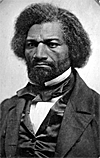 Actual abolitionists knew better, and were largely ambivalent about Lincoln’s candidacy in 1860. Some supported it, reluctantly, as the best practical alternative, while others held a convention that summer to nominate their own presidential candidate as a show of protest. Frederick Douglass eventually came to embrace Lincoln as an ally, but even after the election, Douglass still considered the Republicans a sort of least-bad option, and expressed concern that the Republicans’ tolerance of slavery where it already existed would undermine, and possibly destroy, the movement to eliminate slavery everywhere in the country:
Nevertheless, this very victory threatens and may be the death of the modern Abolition movement, and finally bring back the country to the same, or a worse state, than Benj. Lundy and Wm. Lloyd Garrison found it thirty years ago. The Republican party does not propose to abolish slavery anywhere, and is decidedly opposed to Abolition agitation. It is not even, by the confession of its President elect, in favor of the repeal of that thrice-accursed and flagrantly unconstitutional Fugitive Slave Bill of 1850. It is plain to see, that once in power, the policy of the party will be only to seem a little less yielding to the demands of slavery than the Democratic or Fusion party, and thus render ineffective and pointless the whole Abolition movement of the North. The safety of our movement will be found only by a return to all the agencies and appliances, such as writing, publishing, organizing, lecturing, holding meetings, with the earnest aim not to prevent the extension of slavery, but to abolish the system altogether.
It was as true one hundred fifty years ago as it is today; we have an unfortunate tendency to reduce those movements and political figures we oppose to simplistic caricatures, and to assume that all those actors share similar motivations and goals. They don’t, and sometimes they don’t even fully trust each other.
___________
Update: Though Douglass worried about the victory of Lincoln and the Republicans, he welcomed South Carolina’s secession, bringing with it as it did a constitutional crisis that, in his view, must ultimately decide the matter of slavery. As historian David Blight points out in a new editorial in the New York Times, “Cup of Wrath and Fire,” Douglass “heaped scorn on the Palmetto State’s rash act, but he also relished it as an opportunity. He all but thanked the secessionists for ‘preferring to be a large piece of nothing, to being any longer a small piece of something.'”

“The whole country, North and South, should thank Him for this step.”
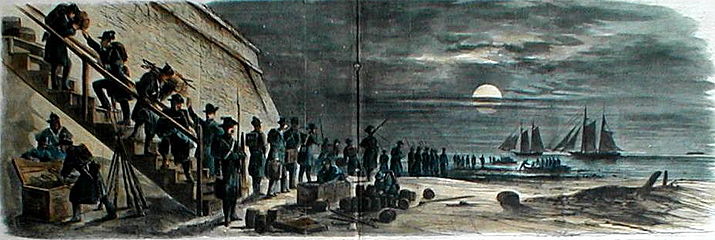
A hundred fifty years (and a few days) ago, Major Robert Anderson quietly evacuated his command at Fort Moultrie, South Carolina, to Fort Sumter, an unfinished installation in Charleston Harbor. In doing so, he ceded the indefensible Moultrie to the South Carolina secessionists, and set the stage for the “Sumter crisis” that would play out over the next several weeks.
In the wake of South Carolina’s secession on December 20, Anderson’s orders from the Secretary of War, dated December 21, were somewhat contradictory. In the two-page memo, he is first enjoined, if attacked, to “defend yourself to the last extremity.” Then, he is reminded that “it is neither expected nor desired that you should expose your own life or that of your men in a hopeless conflict in defense of the Forts. If they are invested or attacked by a force so superior that resistance would in you judgment be a useless waste of life it would be your duty to yield to necessity and make the best terms in your power.”
Even as the War Department sent those orders, a delegation from South Carolina was en route to Washington to demand the surrender of Moultrie and the other U.S. military installations around Charleston Harbor. Both sides expected the Buchanan administration to refuse, and both sides then expected Moultrie to be overrun by South Carolina militia called up in response to that state’s withdrawal from the Union. The outcome seemed pre-ordained.
What Anderson did on December 26, on his own initiative, was change the game from the way both Washington and the secessionists expected it eventually to play out. Between six and eight p.m., Anderson spiked Moultrie’s guns, burned their carriages, cut down the flagpole and transferred his entire command to Sumter. The next day, in response to an incredulous telegram from a War Department caught blindsided by his action, Anderson wired back:
The telegram is correct. I abandoned Fort Moultrie because I was certain that, if attacked, my men must have been sacrificed and the command of the harbor lost. I spiked the guns and destroyed the carriages to keep the guns from being used against us. If attacked, the garrison would never have surrendered without a fight.
Anderson speaks here explicitly to his commitment to both the men of his command and to his mission as a soldier — had he waited for the expected assault on Moultrie, “my men must have been sacrificed and the command of the harbor lost.” In a letter to his wife, dated at the time for their arrival at Sumter, Anderson (like many of his contemporaries) credits God with guiding the wisdom of his action:
Fort Sumter, S. C.,
8 P. M., Dec. 26, 1860.Thanks be to God. I give them with my whole heart for His having given me the will, and shewn me the way to bring my command to this Fort. I can now breathe freely. The whole force of S. Carolina would not venture to attack us. Our crossing was accomplished between six and eight o’clock. I am satisfied that there was no suspicion of what we were going to do. I have no doubt that the news of what I have done will be telegraphed to New York this night. We saw signal rockets thrown up all around just as our last boat came over. I have not time to write more—as I must make my report to the Ad. Genl. . . . Praise be to God for His merciful kindness to us. I think that the whole country North and South should thank Him for this step.
I like that last line, “I think that the whole country North and South should thank Him for this step.” I doubt either side did at the time, but I think Anderson was right — he thought (to use a bad, modern cliche) “outside the box” and pushed back the direct, armed conflict for more than three months.
In its ongoing Civil War series, “A House Divided,” the Washington Post asks several prominent historians whether evacuating Moultrie was Anderson’s best option. So far Joan Waugh, Frank J. Williams, and Scott Hartwig all agree: Major Anderson had no alternative, short of outright capitulation. Hartwig:
Anderson had 74 officers and men in two artillery companies at Ft. Moultrie, but after deducting the noncombatants – musicians, sick and those under arrest for various reasons – his effective strength was about half that. Moultrie’s purpose was for its guns to cover the channel leading from the open sea into Charleston harbor, not defend against an attack from the rear. The fort’s defenses were so vulnerable to land attack that no competent army officer would have considered attempting to defend it. Wind had blown sand up so high against the fort’s walls that cattle could climb up, walk through the embrasures and onto the parapet. Sand dunes east of the fort rose higher than the fort’s walls and provided excellent firing positions for an attacker. All of the buildings in the fort except for the fortifications were wood and easily burned. There were private houses on the east side of the fort and cottages on the west side, which could provide additional cover for an attacker. But a competent attacker did not need to assault the fort. Sitting on a peninsula of Sullivan’s Island it could easily be cut off and the garrison starved into surrender.
Following the December 20 secession of South Carolina, Anderson learned that preparations were underway to attack Moultrie if the negotiations between South Carolina’s commissioners and the Buchanan administration failed to secure its surrender. Anderson already knew that Buchanan probably would not surrender the fort so it was necessary to act quickly. Fort Sumter was the only defensible point available to Anderson and his small garrison. It could not be attacked by land and could be reinforced and resupplied by water. On the evening of December 26, in a cleverly planned and executed operation, the garrison made the transfer from Moultrie to Sumter without incident.
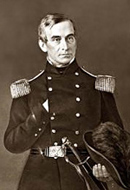 Though it infuriated the secessionists at the time, who thought they’d been played (they had), it seems clear now that Anderson’s move was the correct one, both politically and militarily. It held off direct, armed conflict, maintained a symbolic U.S. military presence at Charleston, and bought both sides more than three months’ time to reach a peaceful resolution to the dispute. In modern parlance, Anderson “dialed it back” by evacuating Moultrie and removing his men to Sumter. More to the point, it’s hard to see why Anderson would do anything else; although a pro-slavery Kentuckian and a former slaveholder himself, he saw his first allegiance to his assignment, and to his immediate command. Anderson couldn’t control events outside Moultrie’s walls, but he recognized that both Washington and the secessionists had effectively locked themselves into courses of action that would have destroyed his command and yielded any U.S. control over the harbor. In the absence of clear directives from Washington, he responded to them as a professional soldier should, with careful deliberation and planning, followed by decisive execution, in a way that gave the government — both governments — time and options to avert the looming crisis.
Robert E. Lee famously cast his lot with Virginia and the Confederacy, but that only came months later, when he felt his own, home state was threatened. Had Lee been in command at Moultrie in December 1860, I suspect he would have done exactly the same thing.
____________________
Ed. Note: The post has been extensively rewritten in response to a reader’s inquiry in the comments, below. Thanks to him for providing the impetus for this. Image: Evacuation of Fort Moultrie by W. R. Waud, Frank Leslie’s Illustrated Newspaper.

“to distance oneself and one’s ‘tribe’ from atrocity and indelible shame”
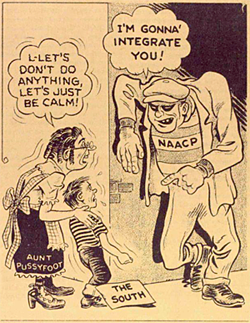 Guest-blogging for Andrew Sullivan at the Atlantic, Conor Friedersdorf highlights a reader’s e-mail that seeks to explain Mississippi Governor Haley Barbour’s praise of the Citizen’s Council in his hometown of Yazoo, Mississippi, during the civil rights struggles of the 1960s. (Within 24 hours, Barbour had issued a whiplash-inducing refutation of his previous comments, describing council as “indefensible.”) The Citizen’s Council (originally known as the White Citizens’ Council) was a white supremacist organization that, while stopping just short of advocating violence, worked to isolate and intimidate African Americans and others working in pursuit of voting rights, fair housing rules, and school desegregation (left). (The first known chapter of the White Citizen’s Council was organized in Mississippi in July 1954, less than two months after the Brown v. Board of Education decision was handed down by the Supreme Court.) While Barbour sought to portray the virulently-segregationist Citizen’s Council as an opponent of the Ku Klux Klan the two organization were, in fact, working toward the same goal by different means, and even had overlapping membership; this was evident even at the time, when the Citizen’s Council was variously known as “the uptown Klan” or “the country club Klan.” Local councils were, in effect, a more reputable alternative to the Klan, and included in their membership many local political leaders and businessmen, which enabled the councils to legitimize their discriminatory practices and wield a range of economic and legal tools to intimidate their opponents.
The reader writes:
As a Southerner born in the late 1960s, I’ve always struggled to understand what happened in the civil rights era back home. To be precise, I’ve struggled to grasp how my people — white people — understood events. I’m from an extremely minor part of the Deep South, so insignificant that to my knowledge, it hasn’t been accounted for in the major histories of the era. The thing is, you can’t really ask older white folks what happened. If they’re willing to talk about it at all — which most aren’t, a reticence that may come from a reasonable certainty that they will be judged unfavorably by their children and grandchildren — it’s usually in a defensive, dismissive way. When Haley Barbour said the other day that he doesn’t remember things being all that bad in Yazoo City, where he grew up, I heard the voice of my parents’ generation. How many times in childhood did I overhear those people talking about how decently “we” treated “our nigras.” It may be hard for people not raised in this culture to understand it when I say that this kind of thing was not said with conscious malice (though it was obviously malicious in its content, not only because it constituted a denial of history, but shows the lingering sense of white paternalism and indeed ownership of black folks). When I was younger, I used to think this was evil, uncut. I don’t think that anymore. I think it instead speaks to the human capacity to distance oneself and one’s “tribe” from atrocity and indelible shame. . . .
My point, re: Barbour’s controversial remarks, is that I am neither surprised by them, nor do I hold him in as much contempt for them as many pundits seem to. I don’t mean to defend his remarks, but for me, I can place them in context. I don’t think he’s bullshitting, frankly. I think he’s wrong, absolutely; but I’d bet money that Haley Barbour is just like his contemporaries in my hometown, including my parents: they have genuinely convinced themselves that things were Just Fine Here, because it’s a way of dealing with extremely painful history without having to deal with it. And it’s a way of being able to look on all the nice older folks you grew up loving and respecting without having to reckon with the fact that they did horrible things to their black neighbors, either actively or by standing passively by. I remember what a shock it was to me as a teenager who was starting to read about the Civil Rights movement, to look upon the faces of older white people in church, men and women I had grown up loving and respecting, and to know (because I had been told) that that kindly gentleman there had been a Klansman back in the day, and that this one in the third pew on the right had participated in a lynch mob decades earlier. You think: “These are not the kind of people who do things like that.” But they did! Yet it’s easy to follow this emotional logic: “I wouldn’t be friendly with people guilty of such moral horrors, but obviously I am friends with these people (and even love and respect them) — therefore, things couldn’t have been as bad as the history books say, at least not here.”
It’s worth reading the whole thing. This writer’s perspective rings very true, and in some ways reflects my own experience. I also think it goes far to explain the willful blindness of the Southron Heritage™ movement, that vigorously denies, minimizes or rejects any historical interpretation that suggests a moral censure on the Confederacy, either collectively or on individual soldiers. It’s exactly the same mindset; Haley Barbour’s re-imagining of the 1960s is the same sort of rationalization modern-day Confederate apologists apply to the 1860s. They will acknowledge the evil of slavery in the abstract, but (1) quickly assert that their particular ancestors didn’t own slaves, and so have no personal connection to it (or responsibility for it), and (2) attempt to deflect or diffuse censure for the “peculiar institution” by pointing to New England’s historic involvement in the transatlantic slave trade, the mistreatment of immigrants and others in Northern factories, the role of Africans themselves in the slave trade in Africa, and so on. Above all, they will contort themselves into knots to claim secession and the war was about anything — tariffs, some vague philosophical argument for states’ rights, anything — other than what the secessionists themselves explicitly said it was.
Neither will modern-day Confederate apologists acknowledge any responsibility — not even a shared responsibility, much less being a prime mover — in the war itself. That, too, was all the North’s fault; it is a matter of faith that the armed conflict that followed South Carolina’s secession was “forced” or “tricked” on the South by Lincoln — even though the shooting actually started almost two months before he took office. The twists of logic here are remarkable as well; I saw it recently asserted that Major Anderson’s evacuation of his command to the still-unfinished Fort Sumter, a few days after South Carolina’s secession, was “the first act of aggression,” even though he did so to avoid a direct, military confrontation with the armed secessionists and, in the process, ceded to them the complete, well-stocked coastal battery of Fort Moultrie, the South’s first military “victory.” (While the notion that Lincoln “forced” or “tricked” the South into firing on Fort Sumter may seem to mitigate the South’s responsibility for it, and all that followed, it’s also an insult to those Southern military and political leaders behind it — Ruffin, Beauregard, Pickens, Wigfall, et al. — because it credits them with neither the ability to recognize they were being “tricked” by a supposedly bumpkin, backwoods lawyer from Illinois, nor for having the free will and agency to refuse to walk into that devil Lincoln’s “trap.” Seriously — the Sumter “crisis” played out over more than three months, so it’s not like anyone involved didn’t have time to think about the consequences of his chosen course of action. But I digress. . . .)
Friedersdorf’s correspondent goes on to argue that “one way to deal with one’s personal, or communal guilt, in the face of collective moral collapse, is to claim victimhood, displacing the blame onto others and renouncing one’s moral agency.” This, too, is readily apparent in the Southron Heritage™ movement; they wallow in being the victim. A hundred fifty years ago they were the innocent victims of radical abolitionists, the Black Republicans, “Beast” Butler and William Tecumseh Sherman; now they’re the innocent victims of politically-correct bloggers, weak-kneed politicians, liberal academics and “racist” organizations like the NAACP. The tenacity with which they cling to this victimhood is made all the more stark by their assertion, in almost the same breath, of their ancestors’ uniquely-Southern combination of courage, rugged individuality, determination and strength. They were strong, but nonetheless remain perpetually defeated; they were morally righteous, but removed themselves from the Union to protect the institution of slavery; they stand for the rights of the states and the individual, but revere a national government that claimed its own supremacy over the member states and imposed on its citizens the heavy hand of the national government sooner than did the Union. It’s victimology of the highest order, one that gains its resilience more from emotion and resentment than logic or historical evidence.
As a Southerner, and a descendant of Confederate soldiers, of slaveholders and at least one elected official who supported secession, I understand the gut-level desire to distance oneself and one’s ancestors from the undeniable sins of the past, and to take comfort from the notion that while someone, somewhere was guilty of those things, my relatives weren’t. But it’s a comforting self-delusion; as Ta-Nehisi Coates once observed, it’s like the abandoned child who imagines his absent parent is actually an astronaut, off on some exciting, secret mission to outer space. It’s comforting, maybe psychologically necessary, but a lie just the same. It’s not history — either collective or individual — which is often very ugly, and involves people doing things, saying things, and fighting for things their descendants really would rather not be forced to acknowledge. It’s a hard thing, but we have to do it. As I’ve said before, were owe it to those men and women to acknowledge and recognize them as they were, not as we’d like them to have been. To acknowledge with candor their failings, limitations and misdeeds is difficult, but to my thinking, it’s preferable to creating an alternate fantasy. That’s no way to honor one’s ancestors.
______________________________
Image: Cartoon from the December 1955 issue of The Citizens’ Council, Jackson, Mississippi, via here.

“You can expect no help from this side of the river.”

The Museum of the Confederacy recently announced the discovery of a coded message enclosed in a tiny bottle that’s been sitting, unopened, in the museum’s collection for over a century. The decoded text of the message reads:
Gen’l Pemberton: You can expect no help from this side of the river. Let Gen’l Johnston know, if possible, when you can attack the same point on the enemy’s lines. Inform me also and I will endeavor to make a diversion. I have sent some caps [i.e., percussion caps]. I subjoin a despatch from General Johnston.
The message is dated July 4, 1863, the same day that Pemberton surrendered Vicksburg to General Grant. Pemberton never got the message, and it would not have mattered if he had.
 The message is unsigned, but the author, who clearly was unaware of Pemberton’s true situation in Vicksburg, may have been Major General John George Walker (l.), at that time commanding a division in the Confederacy’s Trans-Mississippi Department, and operating in western Louisiana. The message was encoded using the “Vigenère cipher,” in which the letters of the original message are shifted so many spaces over, so that A becomes M, B becomes N, and so forth, based on a key word or phrase known to both the sender and the recipient. Although ciphers of this type had a reputation of being unbreakable, most of the Confederate messages sent in this way that were intercepted by the Federals were quickly decoded. The fact that most Confederate messages used one of only three key phrases, “Manchester Bluff,” “Complete Victory,” and “Come Retribution,” made them more vulnerable than they should have been. (After tinkering with this Vigenère cipher generator, it seems this message used “Manchester Bluff” as its key, at least for the first few words.) As so often with cryptanalysis throughout history, the key to breaking a code often comes from mistakes on the part of the sender.
The message was decoded and its contented confirmed by a retired CIA cryptanalist, David Gaddy, and an active-duty U.S. Navy intelligence officer, Cmdr. John B. Hunter.
______________________
Image: This Jan. 14, 2009 image shows a Civil War bottle with a message that was tucked inside at the Museum of the Confederacy in Richmond, Va. The message to Lt. Gen. John C. Pemberton says reinforcements will not be arriving. The encrypted dispatch was dated July 4, 1863 — the date of Pemberton’s surrender to Union forces led by Ulysses S. Grant in what historians say was a turning point in the war. (AP Photo/Museum of the Confederacy)

Merry Christmas!
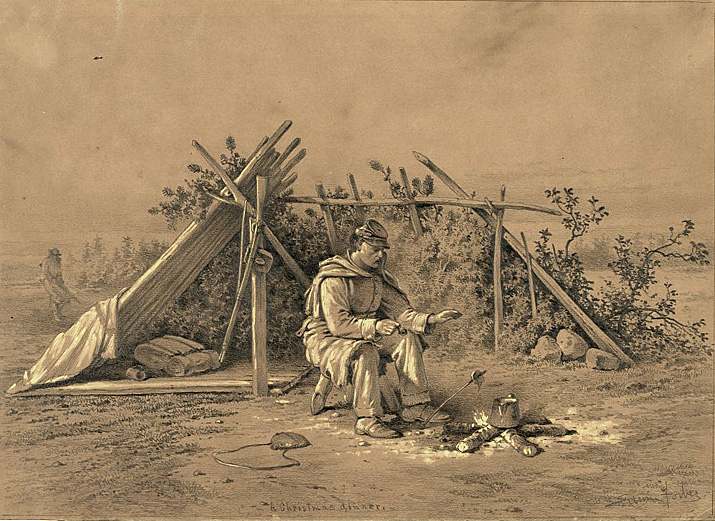
“A Christmas dinner. A scene on the outer picket line” by Edwin Forbes (1839-1895). Library of Congress.

Wordled
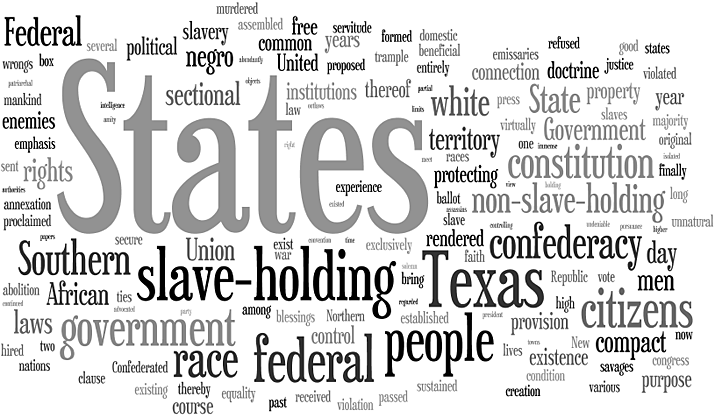
Stealing an idea from Levin, here’s a Wordle on the “Declaration of the Causes which Impel the State of Texas to Secede from the Federal Union.”
_______________





 Dead Confederates, A Civil War Era Blog
leave a comment