The Lege Thinks About Secession
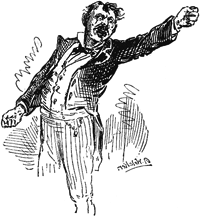 The secession crisis of the winter of 1860-61 didn’t pop up overnight; it was a long time a-building, and it moved forward with what, to many at the time, must have seemed a slow, inexorable process. But there were many points along that way where the key issues at hand, including the right of secession and the validity of nullification, were discussed, dissected, and debated.
During the Eighth Texas Legislature (1859-61), increasing tensions between the states and the federal government were becoming increasingly distracting. Inevitably, the Texas House of Representatives dealt with this in the way every legislative body does, by forming a committee. The House Committee on Federal Relations ended up with a stack of motions, reports and correspondence to deal with. One of these was a letter to Texas Governor Sam Houston from his counterpart in South Carolina, William Henry Gist, accompanied by resolutions from that state’s House of Representatives and Senate, reasserting South Carolina’s “right to secede whenever she may think it expedient to do so” and calling on other Southern states to reciprocate with similar resolutions of their own.
Governor Gist’s message was handed off to the House Committee on Federal Relations, which reviewed it for several weeks. Finally, in an evening session on February 8, 1860, in the closing days of the legislative session, the committee returned to the House membership two reports (34MB PDF, beginning p. 634), one expressing the views of the majority of the committee, and other a “minority report,” prepared by committee members who dissented from the majority view. The majority report called for emphatic support for South Carolina, and embraced secession as an option:
The “preamble and resolutions” passed by the Legislature of the State of South Carolina, and submitted for our consideration, have been deliberated upon by the committee on Federal Relations, and your committee respectfully submit to the House for its action the following resolutions:
1st. Resolved, That the State of Texas declare, that “whenever one section of the Union presumes upon its strength for the oppression of the other then will our Constitution be a mockery, and it would not matter how soon the Union was severed into a thousand atoms, and scattered to the four winds.”
2d. Resolved, “If the principles” of confederation upon which the American Union “was consummated, are disregarded,” there will be for Texas neither honor nor interest in the Union; if the mighty, in the face of written law, can place with impunity an iron yoke upon the neck of the weak, Texas will be at no loss how to act or where to go before the blow aimed at her vitals is inflicted. “In a spirit of good faith” Texas “entered the Federal fold. By that spirit she will continue to be influenced to make her the victim of Federal wrong. As she will violate no Federal right, so will she submit to no violation of her rights by Federal authority.”
3rd. Resolved, That the Legislature of Texas assure South Carolina and all her sister States, that “she will not submit to the degradation threatened by the Black Republican party, for sooner than subject herself to “ignominy ensuing from sectional dictation, she would prefer restoration to that independence which she once enjoyed. Sorrowing for the mistake which she has committed in sacrificing her independence upon the altar of her patriotism, she would,” if there were none others to act with her, “unfurl again the banner of the lone star [sic.], and re-enter upon a national career, where if no glory awaited her, she would at least be free from a subjection by might, to wrong and to shame.”
4th. Resolved, That we pledge ourselves to any one or more of the States to co-operate with them, should it become necessary, to resist Federal wrong, and claim that it is not only our right, but imperative duty, at all times to aid any member of this confederacy, in protection of property, in preserving the lives of women and children, and in resisting fanaticism and treason.
Sec.__. And that the Governor is hereby requested to transmit a copy of the above preamble and resolutions to the Governor of South Carolina, and to the Executive of various States of the Union, and to our Representatives and Senators in Congress.
M. S. Munson, One of the Committee
The minority report, naturally, rejected both secession and nullification:
1st. That the Constitution of the United States is the fundamental basis of our Federal Union; that the laws and treaties made in pursuance thereof, are with the Constitution itself, the supreme law of the land, by which the Judges in every State are bound; anything in the Constitution or laws of our State to the contrary notwithstanding; that the decisions of the Supreme Court of the United States are conclusive and binding upon every citizen. And obedience to the Constitution, Laws and authorities of the Federal Government, is the only condition upon which the Union can be maintained.
2d. That none of the alleged evils which have ever, or are now disturbing the harmony of the confederacy are ascribable to the legitimate operations of the Federal Government, but are justly chargeable to the disloyalty of those, who in obstructing the laws and authorities are themselves designedly or undesignedly enemies of the Union, and so far from considering these troubles a pretext for unfriendly demonstrations against it, we regard them as a fit occasion for summoning every patriot to its defence against all assaults, front whatever quarter, or on whatever pretence.
3rd. That a dissolution of the Union would cure no evil — repel no aggression — right no wrong — diminish no alarm — indemnify no damage; but on the contrary, would be the source of unnumbered evils. If wrongs are inflicted they can better be righted in the Union than out of it. And it behooves those who have been faithful to the Constitution to maintain the government, and not surrender to the enemies of the Constitution.
4th. That we dissent from the doctrine that a State has a right to secede from the Union at its pleasure.
5th. That we in like manner dissent from the doctrine of Nullification.
6th. That we deem it inexpedient to send deputies to a convention of the shareholding States, as invited to do by South Carolina.
7th. That in our opinion there is no sufficient cause to justify us in taking the incipient steps for a dissolution of the Union
8th. That the Governor be requested to cause a copy of these resolutions, under the seal of the State, to be transmitted to the Governor of South Carolina, and to each of the Governors of the other States.
John H. Manly, One of the Committee
The House ordered 200 copies of the two resolutions printed, and placed consideration of them on the schedule twice more. Both times consideration of the two resolutions was set aside in favor of more immediate legislation, and they died with the adjournment of the Legislature on February 13, 1860.
There’s nothing really new in either of these reports; the rhetoric, particularly in the pro-secession majority report, is familiar to anyone who’s looked at the secession crisis. What’s striking to me — but again, not really surprising — is the difference in tone. The majority report frames its argument on language that’s both grandiose and inflammatory: “severed into a thousand atoms, and scattered to the four winds,” “fanaticism and treason,” “an iron yoke upon the neck of the weak,” “unfurl again the banner of the lone star,” and so on. Its appeal is almost purely emotional and impulsive, heavily skewed toward the listener’s affective domain.
The minority report, by comparison, is almost wholly cognitive; it appeals to a much more deliberative and (in my view) rational way of thinking. It rejects the validity of secession or nullification, and argues against rash and irrevocable action: “a dissolution of the Union would cure no evil — repel no aggression — right no wrong — diminish no alarm — indemnify no damage; but on the contrary, would be the source of unnumbered evils. If wrongs are inflicted they can better be righted in the Union than out of it.” The tone is measured, almost quiet: “no sufficient cause” and so forth. Rhetorically it’s weak — very weak. Phrases like “we deem it expedient” just don’t raise the ire of the listener.
In the end, of course, secession won out and Texas herself would leave the Union almost exactly a year later. But it’s interesting to see how, in the runup to that momentus act, each side framed its argument.
__________________

An Update on the “Last Confederate Reunion”
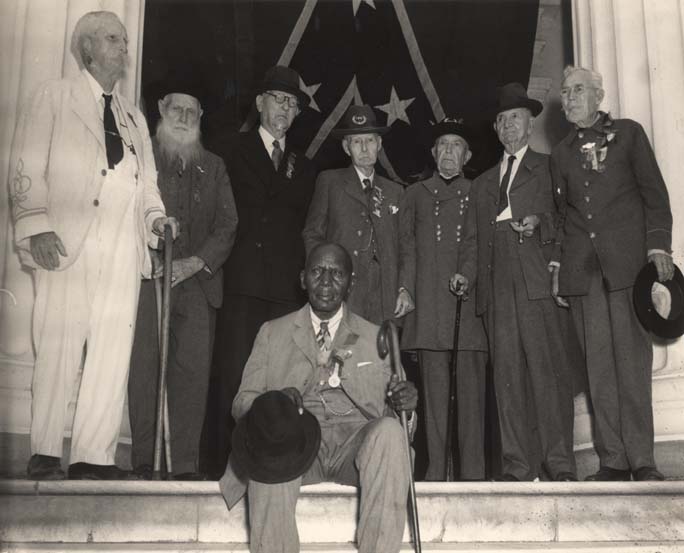
A couple of months ago I did a post on a 1944 event in Montgomery, Alabama that was billed as the “Last Confederate Reunion.” In late 2009, the blog Confederate Digest had posted the image above, under the triumphant headline “Black Confederate, Dr. R. A. Gwynne, among the last Confederate Veterans of Alabama.” As I posted in November, it’s a dubious claim. A long, contemporary account of the reunion in the Alabama Historical Quarterly (Vol. 06, No. 01, Spring Issue 1944) mostly ignores Gwynne’s presence relative to the seven white attendees, but also mentions that he was 90 years old at the time. If that were true, he could not have been more than 11 at the end of the war — an child even by 19th century standards. Confederate Digest apparently overlooked this detail, in its intent to establish what one commenter referred to as “the indisputable fact that thousands of blacks, both slave and free, willingly served in the Confederate armed forces, defending their homeland against a brutal, invading northern army.”
I couldn’t find much more about R. A. Gwynne at the time, but last week I reposted my November piece at The Atlantic, and in response got a lot of very interesting and helpful comments. One regular commenter there, Alabama_Girl, noted that Guinn was a common name in north-central Alabama, and asked if I’d tried alternate spellings for the name. I hadn’t, but having now done so, I think we may know considerably more about Gwynne’s personal history. It also casts further doubt on Gwynne serving in any military capacity, given that he may in fact have been even younger at the time than previously suggested. He likely had not seen his tenth birthday by the time the war ended.
This is My Rifle; This is My Gun. . . .
 I’m in the middle of Benton McAdams’ Rebels at Rock Island: The Story of a Civil War Prison. It’s a good read, and reinforces what I’ve long understood: there’s nothing funny about Civil War military prisons, North or South.
But I did laugh out loud at this passage, describing the tenure of one of the Union units assigned as guards at Rock Island, the 133rd Illinois. The 133rd was a regiment of “hundred dazers,” men who’d enlisted for a short, 100-day term, had little training, and still less interest in becoming professional soldiers. An inordinate proportion of them were teenagers, which compounded the discipline problems within the regiment. Here, after discussing the very real, and very serious, problem of guards from the 133rd firing into the prison compound with little (or often no) provocation, McAdams continues:
When no other targets presented themselves, the soldiers in the 133rd shot each other. William Sutton accidentally shot off two of his own fingers. He was luckier than George Lowe. While going on guard one morning, one of the men being relieved engaged in a bit of horseplay, bringing up his musket and making as if to attack his relief. Unfortunately, the hammer of his weapon caught on the strap of his cartridge box, cocking the weapon, and when the man untangled it the musket discharged, killing Lowe. In light of these activities, it had been wise of [Commissary General of Prisoners William] Hoffman to deny [Camp Commandant Colonel Adolphus ] Johnson artillery.
The men had other bad habits as well. One of them was losing their equipment. The regimental files show a phenomenal number of pay stoppages for lost haversacks, gun tools, canteens, and other equipment. To replace at least some of this equipment the men turned to theft, raiding the hospital for whatever they needed. Colonel Phillips despaired of apprehending the offenders because, as he told Surgeon Watson, “of the difficulty which generally attends the ferreting-out of the parties perpetrating these depredations.” Phillips also tried to ferret out the men stealing commissary, stores and selling them to citizens, but he could conclude only that it must be enlisted men, not officers, and they were probably not aware it was illegal.
Women were another hobby of the hundred dazers. Although Johnson had ordered all laundresses to live in Laundressville, a set of buildings erected especially for them, at least some of the 133rd’s women moved into the men’s quarters with them, prompting an order sending the women to their proper place. Shortly after being deprived of the women’s company, Corporal George Brown was reduced to the ranks for “committing an offense calculated to bring infamy and disrepute upon the command.” Corporal Francis Woodcock was also reduced, not for masturbating, but for persuading another man “through misrepresentation to engage in an unlawful act which would and did result in pollution, disease, and misery.”
What a bunch of fools. But pity the unfortunate descendant of Corporal Woodcock, hot on the genealogy trail, jumping at the discovery of his or her ancestor’s name in McAdams’ index. . . .

This Should be the Last Word. . . but Probably Won’t Be
On his blog Crossroads, Brooks Simpson has what really ought to be the last word on the common arguing tactic of deflecting an historical focus on slavery in the South, and its central role in both Southern society and in the coming of the war, by pointing to racism that existed in the North:
Responsible scholars recognize the persistence and depth of racism among white northerners during the Civil War period. It’s a key component in constructing the narrative of the sectional crisis, the war, and Reconstruction. One of the reasons Lincoln hesitated in issuing a proclamation of emancipation was because he knew it would arouse opposition in the free North among Democrats. None of that, however, has anything to do with the centrality of slavery in southern society or the reasons why secessionists advocated separation and independence: to protect slavery from the threat posed by Lincoln’s election and the long term implications of the Republican triumph in 1860. Moreover, pointing to the existence of northern racism does not make it disappear from southern society. Nor does it necessarily follow that because in 1861 most white northerners did not support going to war to destroy slavery (let alone to secure black equality) that white southerners did not go to war to protect a society and a way of life that was ultimately grounded upon and supported by the enslavement of several million human beings. To deny that is to deny historical reality.
Go read the whole thing, then print out a copy to carry in your wallet.

Quit Digging
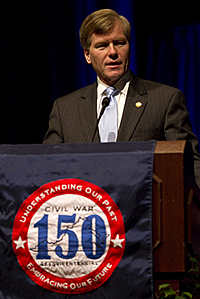 Last spring, the then-new governor of Virginia, Bob McDonnell (left), issued a Confederate History Month proclamation that had been prepared and urged on him by the Sons of Confederate Veterans. The proclamation, unlike others that had preceded it, omitted any reference to the institution of slavery as a factor in the coming of the war. Criticism of the proclamation was swift and loud, and Governor McDonnell quickly withdrew the first one and replaced it with another, one that recognized the role slavery played in the war and referred to the practice as an “abomination.” Perhaps more important, McDonnell later announced that, in 2011, Confederate History Month will be replaced with a wider-reaching, more inclusive effort, dubbed Civil War in Virginia Month.
Now Brag Bowling, spokesman for the Sons of Confederate Veterans, has announced that the SCV will hold a press conference Tuesday “to outline the ‘ongoing failures’ ” of the governor “to deal with a variety of history and heritage issues in Virginia.” B. Frank Earnest, the commander of the Army of Northern Virginia, went further:
The Civil War was a defining moment in our history and, as we enter its sesquicentennial year, it is fitting we honor the memories of the men and women on both sides whose sacrifices are part of our heritage. However, to put it candidly, under Governor Bob McDonnell, Virginia’s history has become political football.
We call on Governor McDonnell to remember that he is the governor of all Virginians, that he honor the memory of those who died in defense of our commonwealth, and that he rethink … his position and honor the forthcoming petition which will begin today.
The SCV will also use the press conference to call out former Governor George Allen (of “macaca” infamy), a likely 2012 Senate candidate, for distancing himself from them while serving in the Senate. Allen’s actions have been a sore point for Bowling and Earnest for years, as noted in this 2006 Washington Post story:
“What I was slow to appreciate and wish I had understood much sooner,” Allen told a black audience last month, “is that [the Confederate Battle Flag] . . . is, for black Americans, an emblem of hate and terror, an emblem of intolerance and intimidation.”
“He’s apologizing to others, certainly he should apologize to us as well,” said B. Frank Earnest Sr., the Virginia commander of the confederate group at a news conference. “We’re all aware, ourselves included, of the statements that got him into this. The infamous macaca statement. He’s using our flag to wipe the muck from his shoes that he’s now stepped in.”
Over the years, Allen has been a darling of the confederate group. As governor, he designated April as Confederate History Month. He has displayed the battle flag in his home as part of what he said is a flag collection. And his high school yearbook picture shows him wearing a Confederate flag pin.
But the senator has been distancing himself from those symbols as he pursues reelection and considers a bid for the presidency in 2008.
In the past several years, he has co-sponsored legislation condemning the lynching of blacks and has promised to work on similar legislation apologizing for slavery. He recently said of the Confederate flag that “the symbols you use matter because of how others may take them.”
Allen’s recent statements didn’t sit well with the SCV. They accused him yesterday of trying to appeal to liberal voters with his new position.
“The denunciation of the flag to score political points is anathema to our organization,” said Brag Bowling, a former past commander of the group.
I have no idea how Bowling and Earnest can argue that Bob McDonnell “is the governor of all Virginians,” while at the same time being opposed to his decision to expand his state’s commemoration of the war to encompass all Virginians — descendants of Confederate veterans, Virginians loyal to the Union, enslaved African Americans, free blacks, and the millions of modern-day Virginians who have no Civil War connection to that state at all. Nor do I see why they want to go after George Allen, unless their long-simmering disdain for the man outweighs their presumed desire to oust the incumbent, Jim Webb (D). Tuesday’s press conference sounds less like a well-considered statement of policy than the latest tantrum of an increasingly insular group, one focused so closely on its own resentments and perceived insults that it’s lost touch with the wider, general public it seeks to reach out to.
Quit digging, folks.

On the Block
On Saturday, a group in St. Louis, Missouri re-enacted an antebellum slave auction on the steps of the city’s old courthouse. There are more photos here, and a news story about the planned event from KSDK Channel 5. From Channel 5:
Angela deSilva takes her history seriously — as an adjunct professor of American Studies and as a Civil War era re-enactor of American slave history, based on a knowledge that began with stories from her grandmother.
“I can remember being very, very young and listening to her talk about her grandmother who had been a slave,” says deSilva. “And I remember asking her what a slave was.”
A frequent slave re-enactor at the Daniel Boone Home, deSilva is bringing her history lesson to the steps of the Old Courthouse in downtown St. Louis Saturday, staging a mock slave auction with the help of dozens of historical re-enactors from across the region. DeSilva says it the 150th anniversary of the Civil War this year that prompted her to recreate such a dark scene in St. Louis history.
“You need to remember that there was another aspect to this. That a whole race of people was freed as a result there of,” she says of America’s deadliest war.
The National Parks Service oversees the Old Courthouse and as far as anyone there knows this will be the first event of its kind since the real thing back in the 1860’s. And organizers are aware it will be disturbing for some.
“It’s not that it’s glorifying it,” says deSilva defending the idea. “Not at all. I have relatives that could have been sold on those very steps.”
“When you talk about the Holocaust everyone says, ‘don’t forget us, never let them forget.’ But sometimes in slavery we want to bury it. I personally, I can’t do it. I cannot do it. I guess because the slaves in my past have names.”
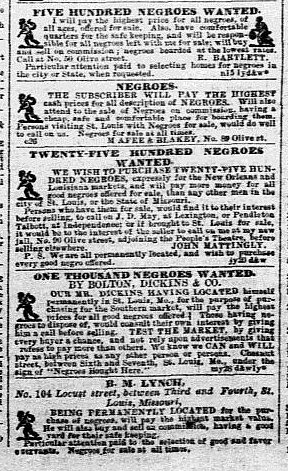 This is a bold effort that pushes back — hard — against so much of what’s being done in the way of reenactments as part of the Civil War Sesquicentennial, such as the SCV-sponsored reenactment of the inauguration of Jefferson Davis next week. The “auction” held today in St. Louis is itself a deeply controversial event, even among African American groups, and that’s to be expected. It recalls a demeaning and ugly part of our shared history, and it’s something that a great many people would simply like to relegate to books and museum exhibits. St. Louis is a particularly important place to recognize this aspect of antebellum history, as it was one of the main centers of the domestic slave trade, with dealers buying and selling wholesale, in enormous quantities (left, advertisements in the Daily Missouri Republican, December 18, 1853).
I’m really undecided about reenactments in general as a means of teaching history and, more than a conventional battle reenactment, this event in particular is fraught with opportunity for misinterpretation and misunderstanding. I just don’t know how well it works. But if it keeps the conversation going about the underlying issues of the war, how we interpret the conflict, and the myriad of perspectives involved, then that’s all to the good.
Update: Kevin has a long and thoughtful post on this event here; Bob Pollock has photos and comments here. And Abbi Telander has more reflections on it here:
This is part of our shared heritage. Whether or not your descendants [sic.] were involved does not negate the fact that we all share this history as Americans. We share the agonies of the enslaved as well as the fight of the abolitionist and the responsibility of the owners. We have a responsibility to our past to understand it and a responsibility to our future to do better. Our nation, forged under the debate over the rights of man, went to war in an attempt to determine whether we could be one country with this shared past. Our nation has been fighting ever since over who was right and who was wrong, who deserves the glory and who deserves the blame, who deserves the benefits of citizenship, and who needs to be remembered in the annals of history.
I dare anyone who stood in the cold this morning and watched as the story of buying and selling other people unfolded to say that our sins need to be forgotten. I dare anyone present to forget this day. As my baby kicked inside me, innocent and pure, I promised her that I would someday tell her what she couldn’t see today, and that she would know why it was important that she know, and why I cried when those little girls stood up to be sold.
_____________________________

“Mr. Holland of Grimes”
Update, October 15, 2011: In the comments, Lynna Kay Shuffield provides an update on the death of Holland’s first wife, Samuella, and two of their children in October 1865. This profile has been updated to reflect that new information, as indicated in blue text — thanks!

If you type James Kemp Holland’s name into a search engine, you’ll quickly discover that he “became the highest ranking black, rising to the rank of Colonel and served on the staff of Governor Pendleton Murrah of Texas.” This story has been picked up a number of places, including on H. K. Edgerton’s SouthernHeritage411 website.
Except that Colonel Holland wasn’t black, or of mixed race. James Kemp Holland is a case study of how well-intentioned but lax research can go very, very wrong.

 James Kemp Holland (left, in later life) was born in 1822 in Tennessee. His family emigrated to the Republic of Texas in 1842 and settled in east Texas, what is now Panola County. In fact, family tradition holds that James Kemp Holland’s father, Spearman Holland, named Panola County, using a Native American word of cotton. The extended Holland family were planters, with large holdings in land and slaves.
Spearman Holland (1802-1872) was heavily involved in local and state politics. He was serving in the Texas Legislature when the Mexican War began, and returned to East Texas from Austin with orders from the governor to raise a raise a company of mounted rangers. James Kemp Holland, at 24, was deemed too young to command the company, so his uncle Bird Holland was appointed captain. James Kemp Holland was subsequently elected lieutenant “by acclamation.”
At the opening of the Battle of Monterrey, Holland’s company was assigned to accompany a battery of the U.S. 3rd Artillery, commanded by Captain Braxton Bragg, positioned opposite the city’s main gate. When the Mexicans fell back, the Texans moved into the city proper where the fighting became close and heated:
Captain Bird Holland, having become disabled, it was here that Lieutenant Holland won his spurs when he made his dash into the city, gallantly leading the Second battalion of the Second Texas Mounted Volunteers under a galling fire from the Old Moor Fort and all the guns along the city’s fortification. Upon dismounting and scaling the walls of the city, the Seventeenth Rangers were again thrown with Captain Bragg on one of the main thoroughfares. And now the Battle of House-tops began, and from every roof and cross street came leaden hail.
The rangers were driven within, where they fought through the houses and walls. Later upon the house-tops the fight went bravely on, the Mexican soldiers disputing every inch of ground.
While this was going on, Bragg was sweeping the streets, and General Ampudia, who was present with the flower of the army, was driven pell mell towards the main plaza, where they intended making a last stand, but with a “little more grape” from Captain Bragg the white flag soon went up.
During the house to house and hand to hand conflict. Lieutenant Holland saw that across the street Texas Rangers were firing from the lower door and windows at the retreating Mexicans down the street, and Mexican soldiers on the top of the parapetted roofs of the same houses, were firing back at the Texans, neither knowing of the proximity of the other!
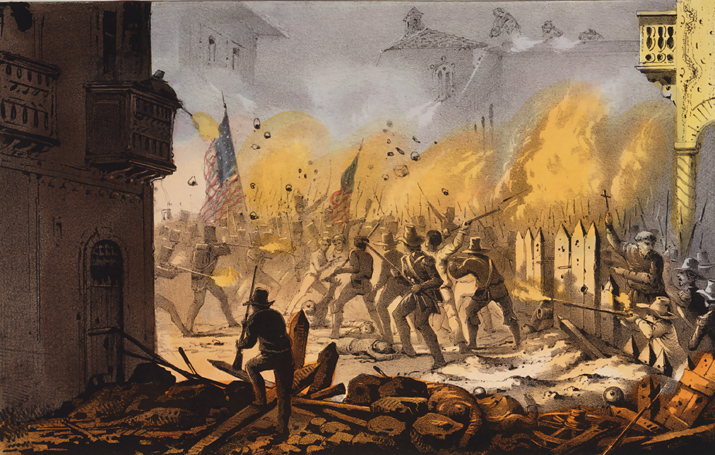
House-to-house fighting during the Battle of Monterrey. Library of Congress.
Lieutenant Holland’s uncle, U.S. Commissary Captain Kemp S. Holland, later died in camp before the Battle of Buena Vista, and Lieutenant Holland was assigned to bring his body back to Texas for burial. This appears to be the end of James Kemp Holland’s military experience until sometime during the Civil War.
James Kemp Holland soon followed his father into politics, serving in the Texas House of Representatives in the Third Legislature (November 1849 to December 1850). He was appointed U.S. Marshal for Eastern Texas in 1851, but successfully ran for state senator and served in the Fifth Legislature (November 1853 to February 1854). Sometime after that he relocated to Grimes County, northwest of Houston. He returned to the Texas House in late 1861, where he served alongside his father, who was referred to in the House Journal as “Mr. Holland of Panola,” while James Kemp Holland was known as “Mr. Holland of Grimes.”

James Kemp Holland in the 1850 U.S. Census for Panola County. His occupation is listed as “Representative.”
In early 1854 James Kemp Holland married Samuella Andrews in Houston. At this time James Kemp Holland was thirty-two, and Samuella about eighteen. By the time of the 1860 census, James Kemp and Samuella Holland had three children — Bettie, age 6, Lilly, age 4, and a son, J. D. A. Holland, age 2.

Holland’s property (lower left) just before the Civil War, located just northeast of present-day Navasota, along the Brazos River. The county seat, Anderson, appears at upper right. Texas General Land Office.
At the time of the 1860 census, Holland was a wealthy planter along the western border of Grimes County, just northeast of present-day Navasota. The census that year valued his land holdings at $15,000, and his personal property at $25,000. Holland does not appear in that year’s slave schedules, although $25,000 in that time and place would usually indicate property in slaves.
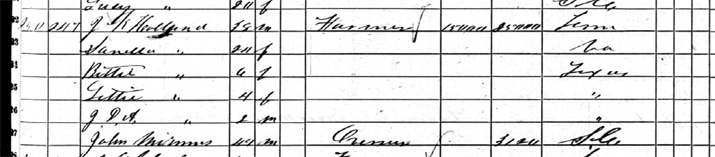
Holland in the 1860 U.S. Census for Grimes County.
 During the early part of the Civil War, James Kemp Holland served in the Texas House of Representatives. He reportedly declined a nomination to the Texas Secession Convention, but was elected to serve in the the Ninth Legislature, November 1861 to March 1863. In 1863 he was appointed aide-de-camp to Governor Pendleton Murrah (left). A letter survives from the spring of 1864 in which the governor, writing to the Confederate general commanding the District of Texas, introduces Colonel Holland and asks that he not be interfered with in his travels around the state:
Executive Department
Austin 13th April 1864Maj Genl
J. B. Magruder
Sir:Col. J. K. Holland is aid de camp to the executive of Texas appointed and commissioned by authority of her Laws — I need his services and [ask] that he may not be annoyed in his movements — you will do me a favor by endorsing this statement [and issuing] an order — that he shall not be interfered with by any military officers & that his commission shall be respected by those under your command. He is a planter of Grimes County.
I have the honor to be
Your Obt Svt,
P. Murrah

Governor Murrah’s letter of introduction for Col. Holland. Footnote.com
Based on the letter, it seems likely that Colonel Holland served at the governor’s liaison for military affairs around the state. Murrah was not in good health — he died in Mexico of tuberculosis shortly after the end of the war — and may not have traveled as much as a healthier man might be able to.

Early mention of Holland’s title of “colonel,” Texas State Gazette, April 4, 1854.
It’s not clear what sort of formal commission Holland held as colonel, apart from Governor Murrah’s assertion that it was “by authority of her Laws.” He almost certainly didn’t “rise” to the rank of colonel in any conventional sense; he undoubtedly was appointed at that rank. It’s also worth mentioning that, while his only previous known military experience was as a very junior officer in the Mexican War, he was already being addressed as “Colonel James K. Holland” a full decade before Murrah’s letter, when the Texas State Gazette used the title in announcing his marriage to Samuella Andrews. It was a tradition of sorts in Texas and across the South in the 19th century to address prominent men with a military background — almost any military background — by an inflated military title. It was such a common practice that it was even joked about, as when one old Hood’s Brigade veteran composed a ditty,
It’s General That and Colonel This
And Captain So and So.
There’s not a private in the list
No matter where you go.
After the war, James Kemp Holland returned Grimes County. There, Holland soon suffered great personal tragedy, the deaths of his wife Samuella and two of their young children John D. A. Holland, age 7, and Nannie Hicks Holland, age 5. The Houston Telegraph carried the following obituary on October 18, 1865:
DIED – At Farmingdale, Grimes county, on the 2nd October, John D. A., and Nannie Hicks, only son and youngest daughter of Col J. K. and Samuella Holland. They died almost at the same moment of Congestion, and on the 5th instant, Mrs. Samuella Holland, after forty-one days of suffering – disease, Gastro Interetis.
“Leaves have their time to fall,
And flowers to wither in the night-wind’s breath;
But all – thou hast all
Seasons for thine own! O, Death!”The fairest picture of happiness on earth, “the only bliss that has survived the fall,” is an unbroken family household, where love and peace and harmony reign. Such was this domestic circle until the angle Death came and bore away one half of its number to their heavenly home.
Mrs. Holland was the daughter of Col L. D. and Eugenia Andrews, of this city, and one of the loveliest daughters of Texas; as pure and excellent in character, as she was fair and beautiful in person. She was a true woman, having all those feminine qualities which call forth admiration and affection from all classes. Although possessing intellectual culture, and those accomplishments which adorn society, the pomp and pleasure of life had no adornments for her. Her only happiness was in her home, where she was enshrined the idol of an adoring husband – the guide and companion of her children, and all that was perfect in the eyes of her faithful and devoted servants.
She had long been a conscientious Christian, and when our Heavenly Father called her she was ready, and the stream of her life passed away calmly and peacefully into the great ocean of eternity.
“So beautiful, she well might grace,
The bowers where angles dwell;
And waft their fragrance to His throne
Who “doeth all things well.”
 Though he had served as an aide to Confederate Governor Murrah — and his uncle Bird Holland had been killed in action leading his Confederate regiment during the war — James Kemp Holland appears to have been committed to the smooth reunification of North and South, and a supporter of President Andrew Johnson’s relatively lenient Reconstruction policies. Along with Andrew Jackson Hamilton (left), a prewar U.S. Representative from Texas and the state’s first military governor under Reconstruction, Holland was a delegate representing Texas at the National Union Convention (also known as the Southern Loyalist Convention) in Philadelphia in August 1866.
Around 1867 he married Annie W. Jefferson, and together they had four children — daughters Ella, Louise, and Jessie, and one son, Earnest. In the 1870 U.S. Census, Holland’s property was valued at $1,800, and his personal property at $1,100. Unusually, his daughters from his first marriage, Betty and Lilly, ages 13 and 12 respectively, are each listed as holding $9,000 in real estate. Presumably this was being held in trust for them by their father.
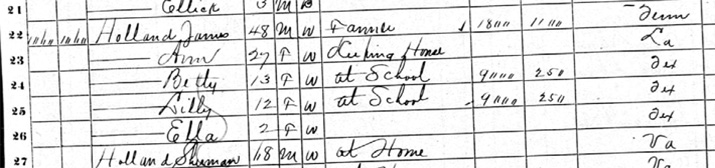
The Holland family in the 1870 U.S. Census.
By 1880, Holland and his family had moved one county over, to Washington County, where they’d settled at Chappel Hill. It was a large household; in addition to Annie and four children, Annie’s mother and the mother’s sister were living with James Kemp Holland, along with another middle-aged widow, Susan Pierce, of unknown relationship to the family.

Holland and his family, residing in Chappel Hill, Washington County, in the 1880 U.S. Census.
In his later years, James Kemp Holland worked as a real estate agent in Austin, both on his own and with partners. He died after a carriage accident in 1898 in Tehuacana, Texas, east of Waco in Limestone County.

Obviously the foregoing is not a full-length biography of James Kemp Holland, nor does it represent exhaustive research incorporating all possible sources. But nowhere in the primary source materials available did I find anything that indicated James Kemp Holland was black, or of mixed race.
There are four available census rolls for Holland, spanning 1850 to 1880. (The 1890 U.S. Census was destroyed in a fire.) Of those four, none designate him black or “mulatto.” The 1850 censuses uses a tick mark ( – ) that continues uninterrupted for page after page of the enumeration, apparently as a sort of “ditto;” the 1860 census carries no notation for anyone for several pages; the 1870 and 1880 censuses explicitly designate each member of the Holland household as white.
None of the mentions I found of James Kemp Holland in a variety of sources published during his lifetime or soon after his death carried any suggestion that he was of mixed race or black. I saw no instance of “colored” or “mulatto” or “Negro” appended to his name in newspaper articles, directories, or official documents like the Texas House Journal, compiled and printed at a time when such notations were almost universal. There’s no mention of it in any biographical sketch I’ve seen, such as that published in the print edition of the Handbook of Texas.
Nor, frankly, is it especially plausible that a black or mixed-race man could hold a series of high elected and appointed offices in a state as virulently white supremacist as antebellum Texas. Free persons of color were an extreme rarity in Texas. Their presence was actually outlawed in the republic at the time the Hollands immigrated to Texas, and they were prohibited from owning land; there was a famous case in which a free black who had aided the Texas Revolution required — literally — an act of Congress to retain title to the land grant he’d been awarded for his services. Even after statehood, laws restricting the activities and rights of free persons of color were among the most repressive in the South. The free population of black and mixed-race persons in antebellum Texas was vanishingly small, and shrinking: 397 in 1850, and just 355 a decade later. (There were more than ten times that number of free colored persons in 1860 in Charleston County, South Carolina, alone.) During that same period, the slave population exploded, from 58,161 to 182,566, an increase of more than 200%. The free black population of Panola (1850) and Grimes (1860) Counties, where James Kemp Holland lived at the time of those censuses, were 2 and 1, respectively.
In short, the only place I find even a suggestion that James Kemp Holland was black or of mixed race is online, when he’s identified as a “black Confederate.” It is neither evidenced in primary sources, nor plausible in the context of the time and place.

Where did the notion come from that James Kemp Holland was black, or of mixed race? I’m not certain, but there are two possible sources I’ve found that may be the source of confusion.
The first is this webpage on the early history of the black community in Panola County. The page — and several others that repeat the same information — goes into considerable detail on the Holland family, including James Kemp Holland, because they were among the first large-scale planters in the area and their bondsmen formed the initial black community there, Holland Quarters. It doesn’t make the claim that James Kemp Holland was black, or of mixed race, but the page is such a poorly-organized mishmash of history, genealogy and commentary that it’s easy to be confused. A casual read of the page could easily lead one to believe that James Kemp Holland was himself a man of color.
The second possible source is the famous Handbook of Texas, the standard, quick-reference guide to the region’s history. Both the online and final print versions of the Handbook include biographies of Bird Holland that mention that he fathered three sons by a slave woman, one of whom was named James. It seems possible that this James Holland was confused for his first cousin, James Kemp Holland, leading one to believe that the latter was a man of mixed race.
Using either of these resources, it would be easy to get the impression that James Kemp Holland was black, or of mixed race. But — and this is important — it’s equally easy to correct. Even a little digging in readily-available, online sources would cast doubt on that notion of James Kemp Holland’s race. But as so often happens with men identified as “black Confederates,” it would seem that little other digging was done to actually establish much at all about his life or career.
It’s all very sloppy, and very misleading. It doesn’t have to be this way, and shouldn’t. A little due diligence, a little more digging, would have completely avoided this misrepresentation.
___________________________________
James Kemp Holland portrait from the Texas House Journal of the Ninth Legislature, First Called Session. Pendleton Murrah portrait from the Texas State Preservation Board.

Grant on PBS
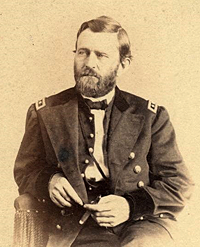 As a companion piece to last week’s film on Lee, American Experience will tonight air a similar documentary on Ulysses S. Grant.
Also: Last week I called out Washington Times Civil War blogger Martha Boltz for posting a tired, cliché-driven critique of American Experience‘s biography of Robert E. Lee, before she’d even seen it. On Saturday, she posted an update, and acknowledged that “the folks at PBS did a fairly decent job of presenting the man.” She noted, as well, that she’d gotten a number of messages from others via e-mail and Facebook that she should give the episode a fair hearing.
Her review still has an unforced error or two, such as her assertion that Lee “grew up in Arlington House,” and that the show avoided the “typical overbearing slave-owner depiction [of Lee] with which we are frequently presented,” which was in the show and which is, in my experience, anything but “typical” in popular depictions of Lee, but — whatever. Progress is progress.
Remembrance, Entertainment and History
This weekend was the 148th anniversary commemoration of the Battle of Galveston. Events continue Sunday, January 9, but the weather’s supposed to be uncooperative, so I went today.
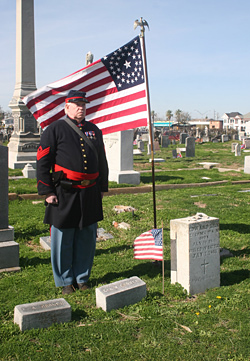 I started out on the cemetery tour (left, the grave of Lieutenant Commander Edward Lea, U.S.N.). The tour got off to a late start, due to the prior commemoration ceremony running over-schedule. The ceremony was well done, and commendably non-partisan, with a C.S. reenactor color guard and a U.S. firing party. The cemetery tour itself was led by Linda McBee, who is rightly famous here for her unflagging work in documenting cemeteries around the county. It’s a personal labor for her; she’s a sixth-or seventh generation islander in some branches, and counts seventeen direct ancestors buried in just the one cemetery complex on the tour. I don’t know her personally, but I think I’d like her; I laughed a little at her no-nonsense, pragmatic approach to the subject. Asked if burials still occurred in the cemetery, she replied that they did, but rarely, when someone is interred in a plot still owned by the family. She added that her family is one of those that has a plot with spaces available, so if the need arose, “we’d stick ’em in there.”
Ed’s tour of Civil War Galveston was first-rate, as usual; he added some large-scale maps and photos to his interpretation that help a great deal in visualizing the city in 1861-65 generally, and the Battle of Galveston specifically.
 I wasn’t sure what to expect from the reenactment, really. There were some efforts at re-enacting the Battle of Galveston thirty years ago, but I didn’t see those. This one was impressive, if for no other reason than it was necessarily up-close and personal. The reenactment was done more-or-less on the site of the actual fighting, which means smack in the middle of town, on a public street and adjacent parking lot. As you can see in the photos, it was all very up-close. There were some professional photographers who put themselves in the middle of it, and a few clueless tourists, but as far as I know the only injury was to the ego of a Confederate soldier who face-planted himself tripping over a curb. He quickly rejoined the fight.
On thing I noticed was that although the battle reenactment attracted a big crowd, it didn’t have a particularly partisan feel. (One old guy, trying to be clever, shouted “blue-bellies go home!” No one else in the crowd even seemed to hear it.) There wasn’t much chest-thumping on either side, and examples of the Confederate Battle Flag — a hot-button point of contention if there ever was one — was not much in evidence. As at past events in which they participate, the Confederate reenactors didn’t carry it, I think by prior arrangement with the sponsors. There was no shortage of Confederate reenactors, either — they outnumbered the bluecoats four- or five-to-one — so if any declined to participate on that account, they weren’t missed. (And I honestly don’t whether it was present at the historical Battle of Galveston in any case.) There were fewer CBFs in the crowd than I might have expected, as well — I noticed three: one on a stick waved by some kid, a Dixie Outfitters shopper, and a biker from the SCV’s “mechanized cavalry.” But that was it. (Ed didn’t get any interruptions from his audience who set out to harangue him on some obscure point with him, either, which all of us on the tour greatly appreciated.)
Certainly the organizer of the event didn’t want anything controversial in this event, and I suspect has eased into commemoration of the Battle of Galveston very carefully over a period of years. There’s always a fine line to be drawn between history-as-it-was, and history-as-entertainment. The reenactment today was fun to watch, and I’m sure today’s events will be marked as a popular and fiscal success. But it’s good to keep in mind that it’s an entirely different animal from history.
More photos after the jump, approximately in order.
“Else you will be dealt with according to Mob law.”

One of the canon beliefs of the modern Southron Heritage™ movement is that blame for all the violence and bloodshed that followed the Southern states’ secession lies, solely and completely, at the feet of Abraham Lincoln and his administration. Had the Southern states been allowed to “peacefully secede,” none of the “late unpleasantness” would have happened.
The actions or missteps of the major players in the path to secession are always open to historical discussion and analysis. What’s invariably missing from the arguments of those who now actively defend the secession of South Carolina and the states that followed is a recognition that, at the time, the conflict over slavery and secession was anything but peaceful. It was often direct, personal, and angry, and sometimes led to violence and murder. Supporters of secession across the South organized local vigilante committees to root out those they thought disloyal to the cause, and silence them one way or another, either through intimidation or violence. Years of inflammatory speeches, editorials and demagoguery by the fire-eaters created an environment across the South where dissent — or even suspicion of dissent — was often met with threats and violence.
This letter, included in the Texas State Library’s online exhibit, “Under the Rebel Flag: Life in Texas During the Civil War,” is an example of the tactics employed by the secessionist vigilante committees. It was written a few weeks after Texas’ secession, to a man named A. Newman, suspected by the committee of having abolitionist sympathies:
May 28th 1861.
Mr. A. Newman.
Sir
It has been reported to the Committee of safety of this County that you have expressed abolition sentiments before truthful and trust-worthy citizens living in our midst and as the present crisis will admit of no such expressions we are authorised [sic] to advise you to leave our Country at once, or at least within thirty days from this time. Else you will be dealt with according to Mob law. The excellency of your family against whom no one can say ought is the only reason of the above extension of time.
We sincerely hope you will not put us to the painful necessity of putting our designs into execution.
Prepare therefore and leave as you will be carefully watched and should you heedlessly disregard the above warning, your friends if you have any, will deeply regret your folly.
By order of the secret
Committee of Safety
There’s nothing peaceful, or particularly honorable, about that. This letter, and the tactics it represents, is the ugly, dark side of lofty arguments about “states’ rights” and the Bonnie Blue Flag. Today’s self-described “Southern Confederate Americans” will happily count off the ways the Lincoln administration worked to silence its critics in the North, but remain curiously silent about the threats and violence used by dozens or hundreds of local “committees of safety” formed across the South.





 Dead Confederates, A Civil War Era Blog
2 comments