The Grand Review in Harrisburg
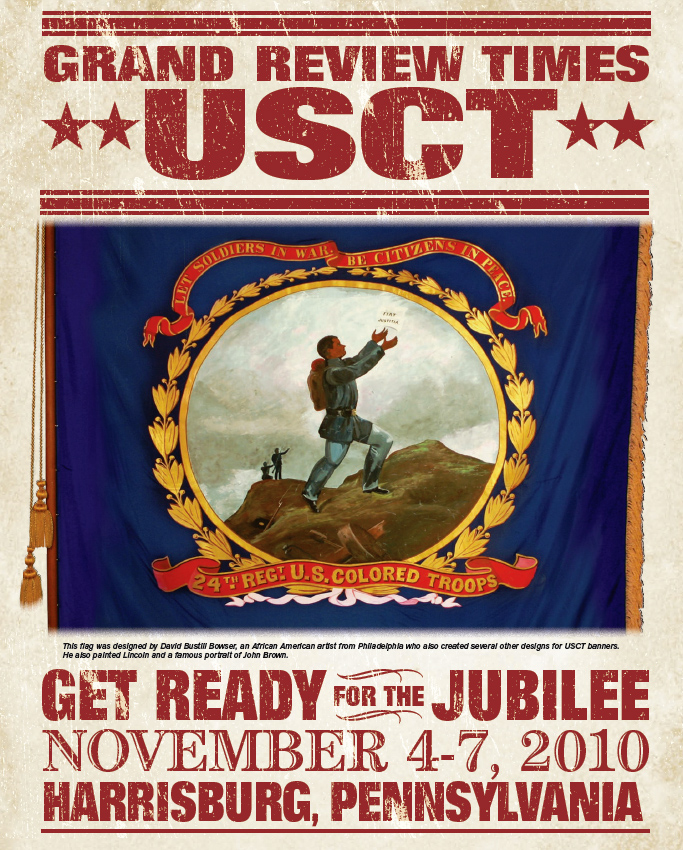
Commenter David Cassatt points out that this coming weekend in Harrisburg, Pennsylvania is the Grand Review, a celebration of the service of USCT during the Civil War. The program of scheduled activities is lengthy (PDF), with something for everyone. The Grand Review commemorates the November 1865 event of the same name organized by the women of Harrisburg to honor the United States Colored Troops from 25 states who were not permitted to participate in the Grand Review of the Armies, a military procession and celebration held May 23-24, 1865 in Washington, D.C., following the end of the Civil War.
This looks like a great event. Sorry for the short notice. Additional information here.
Ambrose Bierce “On Black Soldiering”

A skeptical correspondent asks me for an opinion of the fighting qualities of our colored regiments. Really I had thought the question settled long ago. The Negro will fight and fight well. From the time when we began to use him in civil war, through all his service against Indians on the frontier, to this day he has not failed to acquit himself acceptably to his White officers. I the more cheerfully testify to this because I was at one time a doubter. Under a general order from the headquarters of the Army, or possibly from the War Department, I once in a burst of ambition applied for rank as a field officer of colored troops, being then a line officer of white troops. Before my application was acted on I had repented and persuaded myself that the darkies would not fight; so when ordered to report to the proper board of officers, with a view to gratification of my wish, I “backed out” and secured “influence” which enabled me to remain in my humbler station.
But at the battle of Nashville it was borne in upon me that I had made a fool of myself. During the two days of that memorable engagement the only reverse sustained by our arms was in an assault upon Overton Hill, a fortified salient of the Confederate line on the second day. The troops repulsed were a brigade of Beatty’s division and a colored brigade of raw troops which had been brought up from a camp of instruction at Chattanooga. I was serving on Gen. Beatty’s staff, but was not doing duty that day, being disabled by a wound — just sitting in the saddle and looking on. Seeing the darkies going in on our left I was naturally interested and observed them closely. Better fighting was never done. The front of the enemy’s earthworks was protected by an intricate abatis of felled trees denuded of their foliage and twigs. Through this obstacle a cat would have made slow progress; its passage by troops under fire was hopeless from the first — even the inexperienced black chaps must have known that. They did not hesitate a moment: their long lines swept into that fatal obstruction in perfect order and remained there as long as those of the white veterans on their right. And as many of them in proportion remained until borne away and buried after the action. It was as pretty an example of courage and discipline as one could wish to see. In order that my discomfiture and humiliation might lack nothing of completeness I was told afterward that one of their field officers succeeded in forcing his horse through a break in the abatis and was shot to rags on the slope on the parapet. But for my abjuration of faith in the Negroes’ fighting qualities I might perhaps have been so fortunate as to be that man!

San Fransisco Examiner, June 5, 1898. From Russell Duncan and David Klooster, Phantoms of a Blood-Stained Period: The Complete Civil War Writings of Ambrose Bierce. Image: “Battle of Nashville,” Kutz & Allison Lithograph, Library of Congress.

Fisking Fremantle
Recently I uploaded a post in which I characterized Dr. Steiner’s famous account of Confederate troops entering Frederick, Maryland in 1862 as being unreliable, because (among other things) it was uncorroborated by other witnesses to the same event. The credibility of Steiner’s account is important, as it’s one of the references often cited as evidence of large formations of black soldiers serving in the Confederate Army. Steiner estimates their number as “over 3,000 Negroes” — an enormous number, something approaching the size of a full-strength brigade.
One of my commenters took me to task, saying that Steiner’s account is corroborated by the Fremantle Diary, an account of a British 0fficer’s travels across the Confederacy in the spring and early summer of 1863, and culminating with his witnessing the Battle of Gettysburg. I pointed out that Fremantle didn’t witness the Confederates’ entry into Frederick the previous fall, but my commenter assured me, “it’s the same army.”
This struck me as odd. Fremantle and I are old friends, as it were, since I first read his account years back while working on an archaeology project. I thought I was familiar with Fremantle’s account, but I sure couldn’t recall any references to Black Confederates in it. Furthermore, any reference to Black Confederates in “the same army” would be restricted to a relatively small part of the book, that covered Fremantle’s time with the Army of Northern Virginia — Chapters 10 through 13. I skimmed those chapters, and then the entire text, and came up empty.
So I did some Googling and came up with two brief passages that are cited over and over again on Black Confederate sites, such as this one. Fremantle’s texts are rarely quoted in full, but are most often summarized, which is the crux of the problem. More about that in a moment.
The first passage in Fremantle comes in a description of McLaws’ Division, marching north toward Pennsylvania, on June 25, 1863:
The weather was cool and showery, and all went swimmingly for the first fourteen miles, when we caught up M’Laws’s division, which belongs to Longstreet’s corps. As my horse about this time began to show signs of fatigue, and as Lawley’s pickaxed most alarmingly, we turned them in to some clover to graze, whilst we watched two brigades pass along the road. They were commanded, I think, by Semmes and Barksdale, and were composed of Georgians, Mississippians, and South Carolinians. They marched very well, and there was no attempt at straggling; quite a different state of things from Johnston’s men in Mississippi. All were well shod and efficiently clothed.
In the rear of each regiment were from twenty to thirty Negro slaves, and a certain number of unarmed men carrying stretchers and wearing in their hats the red badges of the’ ambulance corps; this is an excellent institution, for it prevents unwounded men falling out on pretense of taking wounded to the rear. The knapsacks of the men still bear the names of the Massachusetts, Vermont, New Jersey, or other regiments to which they originally be tonged. There were about twenty wagons to each brigade, most of which were marked U. S., and each of these brigades was about 2,800 strong. There are four brigades in M’Laws’s division. All the men seem in the highest spirits, and were cheering and yelling most vociferously·
Fremantle explicitly identifies the African American men as slaves. He makes no mention of arms or weapons, but does describe them as being “in the rear” of each regiment — i.e., not actually part of the formation of companies, along with the stretcher-bearers. There’s no suggestion that Fremantle viewed these men as soldiers. Nonetheless, some authors have written secondary accounts describing Fremantle’s observations, with some careful rephrasing that changes the the meaning entirely. An example of this is a post by James Durney over at the TOCWOC Blog:
[Fremantle] states that every regiment and battery has from 20 to 40 [sic.] black men traveling with it. His description of their dress and arms is similar to the description of Jackson’s command in 1862. This indicates that Lee’s army had not changed any policies and still contained a substantial number of black men. Longstreet had 72 regiments and batteries with just under 21,000 men carried on the rolls. If we use 20 black men with each battery and 30 with each regiment Longstreet’s Corps in July 1863 had just under 2,000 black men embedded in the units, an additional 9.4% above the official muster rolls.
Fremantle does not, in fact, make a blanket statement that “every regiment and battery” has a similar number of men traveling with it; he only describes the regiments he saw, those of Semmes’ and Barksdale’s Brigades, eight infantry regiments in all. Fremantle makes no mention of batteries in this context. He gives no description of these black mens’ dress. And significantly, Mr. Durney never uses the term Fremantle openly did — slaves — to describe the men traveling with each regiment, which further clouds their actual status and makes it possible for the reader to come away thinking they are soldiers. This summary is misleading and attributes to Fremantle claims that, in fact, the Englishman never made.
The second passage from Fremantle dates from July 6, the third day after the battle, during the Confederate retreat along the Hagerstown Pike, somewhere northeast of that town:
At 12 o’clock we halted again, and all set to work to eat cherries, which was the only food we got between 5 A. M. and 11 P. M.
I saw a most laughable spectacle this afternoon – a Negro dressed in full Yankee uniform, with a rifle at full cock, leading long a barefooted white man, with whom he had evidently changed clothes. General Longstreet stopped the pair, and asked the black man what it meant. He replied, “The two soldiers in charge of this here Yank have got drunk, so for fear he should escape I have took care of him, and brought him through that little town.” The consequential manner of the Negro, and the supreme contempt with which he spoke to his prisoner, were most amusing.
This little episode of a Southern slave leading a white Yankee soldier through a Northern village, alone and of his own accord, would not have been gratifying to an abolitionist. Nor would the sympathizers both in England and in the North feel encouraged if they could hear the language of detestation and contempt with which the numerous Negroes with the Southern armies speak of their liberators.
The man is explicitly identified as being a slave; there’s nothing to indicate he’s a soldier, no reference to his own uniform, or even specifically that the weapon he carried was his own. There’s simply the explanation that the two Confederate soldiers who were supposed to guard the prisoner were drunk, so this man took over their job that they were incapable of, rather than let the Union man escape.
Further, Fremantle’s observation that “the consequential manner of the Negro, and the supreme contempt with which he spoke to his prisoner, were most amusing” is a dead giveaway that the black man’s ordinary status is far lower than his prisoner’s; that’s what makes it funny. A Confederate soldier heaping verbal abuse on a Federal isn’t noteworthy; in the context of the time and place, a slave holding a Yankee at gunpoint and giving him what for most certainly would have been seen as comical. It’s a joke not unlike the famous incident where a former slave, now in the USCT, chided a group of sulking Southern civilians standing by the roadside: “bottom rail on top, now.”
This passage of Fremantle’s has also been misrepresented. Again, Durney:
Fremantle recounts an incident where an armed black man, dressed in Confederate and Union uniform items, escorts Union prisoners of war to the rear.
In fact Fremantle makes no mention whatever of Confederate “uniform items,” and the black man is escorting a solitary prisoner. Again Mr. Durney omits Fremantle’s explicit identification of the black man as a slave. He omits too the black man’s explanation of taking charge of the prisoner on his own initiative, leaving the reader with the impression that prisoner escort was his assigned duty.
But wait, there’s more. As a footnote to that last paragraph, Fremantle adds this:
From what I have seen of the Southern Negroes, I am of opinion that the Confederates could, if they chose, convert a great number into soldiers; and from the affection which undoubtedly exists as a general rule between the Slaves and their masters, I think that they would prove more efficient than black troops under any other circumstances. But I do not imagine that such an experiment will be tried, except as a very last resort. . . .
So Fremantle takes the example of the slave taking charge of the Union prisoner and uses it as an opportunity to give his thoughts on the viability of enlisting blacks as soldiers, “if they chose.” He’s not discussing the success or advantages of a system that he’s seen, but describing what he thinks the prospects for it are if they chose. But Fremantle is resigned that “such an experiment will [not] be tried, except as a very last resort.” Far from documenting an example of African Americans serving as Confederate soldiers, Fremantle uses the case of the man in the blue uniform to argue that they would make acceptable soldiers if the Confederacy would allow it. Fremantle’s footnote, in particular, completely undermines the notion that his anecdote describes an actual Confederate soldier.
The title of this post is “Fisking Fremantle” because I like alliteration. But in truth, Fremantle’s not the problem. He reported what he saw and, despite his obvious sympathies with the Confederates he met, is generally considered a fair and reliable observer. The problem lies with the folks who (1) have read Fremantle’s observations and, through carelessness or intent, misrepresent them, and (2) those who repeat those same misrepresentations over and over again without checking them. It’s a shame, because what Fremantle actually wrote is fascinating on its own, and his speculation that “such an experiment will [not] be tried, except as a very last resort” is prescient. The folks who pull this example out of the Englishman’s book and cite it as evidence of Black Confederates are putting forward an account that doesn’t provide evidence of Black Confederates. Do these folks ever read the texts they’re so good at citing as proof of their case?
Yeah, don’t answer that.
________________
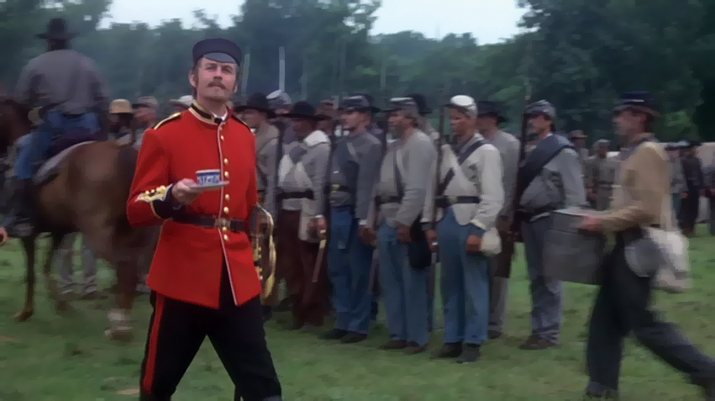
Image: James Lancaster as Lieutenant Colonel Arthur Fremantle in Gettysburg (1993).

“The negro has no qualities out of which a soldier can be manufactured”
On June 15, 1864, the Galveston Daily News reprinted this brief editorial from the Richmond Whig & Public Advertiser, excoriating the value of slaves as soldiers, and boasting that the Federal army’s “unnatural and diabolical” enlistment of black troops “renders their overthrow more certain and speedy.”
NEGRO TROOPS. — The catastrophe of the Yankees at Fort Pillow, like their rout at Ocean Pond [Olustee, Florida], and other mishaps that have befallen them of late, is attributed by themselves to the cowardice of their negro [sic.] allies. We are well satisfied that the result in each of the cases would have been the same, if the places of the negroes had been held by Yankees. But at the same time we believe that the presence of the negroes hastened our victories and made them easier. We need not say to Southern readers that the negro has no qualities out of which a soldier can be manufactured. Any reliance on him in that way is sure to bring disappointment and disaster. An army composed in any degree of such troops is an army with a weak point, that may always be beaten through by an adversary who knows how to use his opportunities. Hence it is that we hold that the enrollment of negro troops has brought into their armies an element of positive weakness, and given us a great advantage. The unnatural and diabolical attempt to turn slaves against their own masters reacts upon those who conceived the villany, and renders their overthrow more certain and speedy. In this as in other ways, the institution of slavery is being miraculously vindicated by the events of the war.
It would seem that the Richmond Whig was unfamiliar with that famous “integrated” local militia unit, the Richmond Howitzers. It’s another case where real Confederates didn’t know about Black Confederates.
It’s worth noting, too, that the writer makes a distinction (second sentence) between “Yankees” and “negroes” [sic.] — revealing quite clearly that, in his view, U.S. Colored Troops are not just inferior to, but completely different from, conventional, white Federal troops; the color of their uniform is not what defines them. Black Confederate orthodoxy requires one to believe that large numbers of African Americans were enlisted into Confederate service, and that their race was considered irrelevant to their skill as soldiers. It’s hard to imagine the author of this editorial being convinced of either premise.
Real Confederates Didn’t Know About Black Confederates
Lots of folks are familiar with Howell Cobb’s famous line, offered in response to the Confederacy’s efforts to enlist African American slaves as soldiers in the closing days of the war: “if slaves make good soldiers our whole theory of slavery is wrong.” It was part of a letter sent to Confederate Secretary of War James A. Seddon, in January 1865:
The proposition to make soldiers of our slaves is the most pernicious idea that has been suggested since the war began. It is to me a source of deep mortification and regret to see the name of that good and great man and soldier, General R. E. Lee, given as authority for such a policy. My first hour of despondency will be the one in which that policy shall be adopted. You cannot make soldiers of slaves, nor slaves of soldiers. The moment you resort to negro [sic.] soldiers your white soldiers will be lost to you; and one secret of the favor With which the proposition is received in portions of the Army is the hope that when negroes go into the Army they will be permitted to retire. It is simply a proposition to fight the balance of the war with negro troops. You can’t keep white and black troops together, and you can’t trust negroes by themselves. It is difficult to get negroes enough for the purpose indicated in the President’s message, much less enough for an Army. Use all the negroes you can get, for all the purposes for which you need them, but don’t arm them. The day you make soldiers of them is the beginning of the end of the revolution. If slaves make good soldiers our whole theory of slavery is wrong — but they won’t make soldiers. As a class they are wanting in every qualification of a soldier. Better by far to yield to the demands of England and France and abolish slavery and thereby purchase their aid, than resort to this policy, which leads as certainly to ruin and subjugation as it is adopted; you want more soldiers, and hence the proposition to take negroes into the Army. Before resorting to it, at least try every reasonable mode of getting white soldiers. I do not entertain a doubt that you can, by the volunteering policy, get more men into the service than you can arm. I have more fears about arms than about men, For Heaven’s sake, try it before you fill with gloom and despondency the hearts of many of our truest and most devoted men, by resort to the suicidal policy of arming our slaves.
No great surprise here; earnest and vituperative opposition to the enlistment of slaves in Confederate service was widespread, even as the concussion of Federal artillery rattled the panes in the windows of the capitol in Richmond.
What’s passing strange, as Molly Ivins used to say, is that Howell Cobb is a central figure in one of the canonical sources in Black Confederate “scholarship,” the description of the capture of Frederick, Maryland in 1862, published by Dr. Lewis H. Steiner of the U.S. Sanitary Commission. In his account of the capture and occupation of the town, Steiner makes mention of
Over 3,000 Negroes must be included in this number [of Confederate troops]. These were clad in all kinds of uniforms, not only in cast-off or captured United States uniforms, but in coats with Southern buttons, State buttons, etc. These were shabby, but not shabbier or seedier than those worn by white men in the rebel ranks. Most of the Negroes had arms, rifles, muskets, sabers, bowie-knives, dirks, etc. . . and were manifestly an integral portion of the Southern Confederate Army.
This passage is often repeated without critique or analysis, and offered as eyewitness evidence of the widespread use of African American soldiers by the Confederate Army. Indeed, Steiner’s figure is sometimes extrapolation to derrive an estimate of black soldiers in the whole of the Confederate Army, to number in the tens of thousands.
But, as history blogger Aporetic points out, Steiner’s observation is included in a larger work that mocks the Confederates generally, is full of obvious exaggerations and caricatures, and is clearly written — like Frederick Douglass’ well-known evocation of Black Confederates “with bullets in their pockets” — to rally support in the North to the Union cause. It is propaganda. Most important, Steiner’s account of Black Confederates under arms is entirely unsupported by other eyewitnesses to this event, North or South. Aporetic goes on to point out the apparent incongruity of Steiner’s description of this horde being led by none other than Howell Cobb:
A drunken, bloated blackguard on horseback, for instance, with the badge of a Major General on his collar, understood to be one Howell Cobb, formerly Secretary of the United States Treasury, on passing the house of a prominent sympathizer with the rebellion, removed his hat in answer to the waving of handkerchiefs, and reining his horse up, called on “his boys” to give three cheers. “Three more, my boys!” and “three more!” Then, looking at the silent crowd of Union men on the pavement, he shook his fist at them, saying, “Oh, you d—d long-faced Yankees! Ladies, take down their names and I will attend to them personally when I return.” In view of the fact that this was addressed to a crowd of unarmed citizens, in the presence of a large body of armed soldiery flushed with success, the prudence — to say nothing of the bravery — of these remarks, may be judged of by any man of common sense.
The Black Confederate crowd doesn’t usually include this second passage describing the same event, or explain Cobb’s apparent profound amnesia when it comes to the employment of African Americans in Confederate ranks. How is it, one wonders, that the same Howell Cobb who supposedly led thousands of black Confederate soldiers into Frederick in 1862 found the very notion of enlisting African Americans into the Confederate military a “most pernicious idea” just twenty-seven months later? How is it that the general who called on his black troops to give three cheers, then “three more, my boys!” came to believe that “the day you make soldiers of them is the beginning of the end of the revolution?” How is it that the commander of successful black soldiers felt that “as a class they are wanting in every qualification of a soldier?”
But set aside Dr. Steiner’s propogandist account for the moment; it’s unreliable and unsupported by other sources. Events at Frederick aside, how is that Howell Cobb, in January 1865, was unaware of the thousands, or tens of thousands, of African Americans soldiers supposedly serving in Confederate ranks across the South?
 Howell Cobb’s Confederate bona fides are unimpeachable, and throughout the war he was irrevocably tied in to both political and military affairs. In his career he was, in turn, a five-term U.S. Representative from Gerogia, Speaker of the U.S. House Representatives, Governor of Georgia, U.S. Secretary of the Treasury, Speaker of the Provisional Confederate Congress, and Major General in the Confederate Army. He was a leader of the secession movement, and was elected president of the Montgomery convention that drafted a constitution for the new Confederacy. For a brief period in 1861, between the establishment of the Confederate States and the election of Jefferson Davis as its president, Speaker Cobb served as the new nation’s effective head of state. In his military career, Cobb held commands in the Army of Northern Virginia and the District of Georgia and Florida. He scouted and recommended a site for a prisoner-of-war camp that eventually became known as Andersonville; his Georgia Reserve Corps fought against Sherman in his infamous “March to the Sea.” Cobb commanded Confederate forces in a doomed defense of Columbus, Georgia in the last major land battle of the war, on Easter Sunday, April 16, 1865, the day after Abraham Lincoln died in Washington, D.C. Perhaps more than any other man, Howell Cobb’s career followed the fortunes of Confederacy — civil, political and military — from beginning to end.
And yet, after almost four years of war and almost three years of commanding large formations of Confederate troops in the field, in January 1865 Howell Cobb seemingly remained unaware of the thousands, or tens of thousands, of African Americans now claimed to have been serving in Southern ranks throughout the war.
It is passing strange, is it not?

“. . . and make our slaves fight for Southern slavery”
 In late March 1865 — a little over a week before Lee surrendered the Army of Northern Virginia at Appomattox — the Galveston Daily News ran a long column by an editorialist calling himself “Scipio Africanus,” who argued that the Confederacy’s situation was so dire, so bleak, that there was only one sure way to save it — by invading the North. Again.
Scipio Africanus argues that “the states to be made to suffer first and most severely are Illinois, Indiana and Ohio,” and from there the massed Confederate armies should march east, sweeping across the Upper Midwest, the Great Lakes and into Pennsylvania. There is no doubt in the writer’s mind that, if executed properly, it cannot but be successful: “The Northern people will witness and feel the display of our strength and dread the renewal of such invasions. They will experience the horrors of war; become disgusted with the strife and yield us what we ask, our independence and peace.” Given the actual state of the Confederate military in the spring of 1865, the detachment from reality present in Scipio’s writing seems not so much disturbing as it is laughable. On that level, Scipio Africanus comes across as a butternut version of “Comical Ali.”
On a more serious note, though, Scipio suggests newly-enlisted slaves should form the backbone of this invading army, which itself would be several times the size of that which Lee took north into Pennsylvania in June 1863. Picking up on the Confederate government’s eleventh-hour efforts to enlist African American slaves, and the discussion about whether such service should bring with it it emancipation — either immediately or upon completion of military service — Scipio argues that such a move “would be rewarding them with poverty, vice and starvation.” Rather, he argues, slaves should be made to fight to preserve their permanent status as slaves, because God wills it:
To make this invasion efficient, 200,000 able-bodied negroes [sic.] ought immediately to be conscripted and drilled as soldiers, and put under the command of veteran officers.
But it is painful to me to hear the doctrine urged that, for such service as they may render they ought hereafter to be emancipated. If it is right to emancipate them for performing military duty, then they ought to be emancipated for making corn. In raising bread by working the soil for us, they fight for our freedom as efficiently as they will do in throwing up earthworks or firing muskets at our foe. The work they now do with the axe and hoe, is as deserving of emancipation as any they can perform with the spade or sword. I am sick of the philanthropy taught in Wayland’s Moral Science, and learned by our people from other Yankee schoolbooks. The Bible should be our moral guide. If it is right for us to hold slaves, we have the same right to make them fight the Yankees for us, as to kill the grass, snakes and wolves on our farms. Abraham, the father of the faithful, the father of the faithful, made 318 of his slaves fight for him; but he did not set them free after the campaign was over. Freedom would be but a poor compensation to our negroes for any service. It would be rewarding them with poverty, vice and starvation. I am willing that the Government should pension and place in asylums all of them who may be maimed and crippled in this war.
The argument of those who contend that, those we enlist should be emancipated after the war, have reference to the opinions of foreign Governments, and the sentiments of the abolitionists everywhere. But we should base our action upon the word of God, and make Him the arbiter of our cause. England and France are not hostile to us because. we are a negro slave people; for they are, and have been, not only friendly, but often in Alliance with Turkey, Spain, Portugal and Brazil — governments owning millions of African slaves. I base my hopes of success upon this foundation; God recognizes in His word our right to our slaves. He has commanded the Yankees and all others: “Thou shall not covet thy neighbor’s man servant nor his maid servant.” They are permitted to buy “bondmen and bondmaids” of the heathen round about; but if they steal ours, and we find them in their hands, He commands us to put them to death. If we admit that, emancipation is right, we confess that our cause is wrong. We should fight, and make our slaves fight for Southern slavery, knowing that in this contest God is on our side. It is only one of our rights. The Yankees covet all that we possess, and we are not fighting for all. Let us invade them with our slaves, not to conquer or enslave them; not to rob them of an acre; but to get back our own property, to force them to make with us an honorable and permanent peace.
As sure as the sun shines, unless we do, they will continue the war while we have anything in our possession to excite their avarice. They will capture all our cities and desolate all our homes.
If we invade them as I propose, we will secure our independence in one year from the date of the entrance of our grand armies into their land.
Galveston Daily News, March 30, 1865
“Freedom would be but a poor compensation to our negroes [sic.] for any service.” Wow. There’s much underlying context in that assertion, but it does show a prevalent line of thinking in the Confederacy at the time. Just as there were some, like Lee, who argued for emancipation in return for military service, there just as many, and perhaps many more, unwilling to allow African Americans into military service at all under any circumstances, and those like Scipio who advocating forcing slaves into direct combat to preserve their own status as slaves, in perpetuity. When modern-day Confederate apologists argue speculative nonsense that the institution of slavery would have gone away on its own in a short time, they ignore the existence of people like Scipio Africanus, who argued that “God recognizes in His word our right to our slaves,” and continued to rationalize their vehement, Bible-driven opposition to emancipation even as the walls crumbled around them.

Prayer in Battle
If a man is good he thinks all men are more or less worthy; if bad he makes all mankind co-defendants. That comes of looking into his own heart and fancying that he surveys the world. Naturally the Rev. W. S. Hubbell, Chaplain in the Loyal Legion, is a praying man, as befits him. When in trouble he asks God to help him out. So he assumes that all others do the same. At a recent meeting of a Congregational Club to do honor to General Howard on that gentleman’s seventieth birthday (may he have a seventy-first) Dr. Hubbell said: “I bear personal testimony that if ever a man prays in his life it is in the midst of battle.”
My personal testimony is the other way. I have been in a good many battles, and in my youth I used some times to pray — when in trouble. But I never prayed in battle. I was always too much preoccupied to think about it. Probably Dr. Hubbell was misled by hearing in the battle the sacred Name spoken on all sides with great frequency and fervency. And probably he was too busy with his own devotions to observe, or, observing, did not understand the mystic word that commonly followed — which, as nearly as I can recollect, was “Dammit.”
Ambrose Bierce, San Fransisco Examiner, December 2, 1900
_____________________
The Loyal Legion was a group of Federal military officers pledged to defend the Union against an ongoing, Confederate insurgency in the immediate aftermath of President Lincoln’s assassination. It included many of the most famous officers in the Union military, including Grant, Sherman, and Farragut. No widespread insurrection developed, of course, and over time the Legion evolved into a fraternal and heritage organization.

Oh, About that Black Confederate at Arlington. . . .
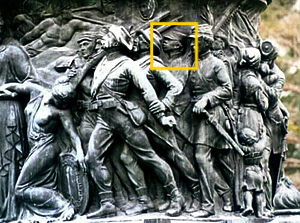 One of the oft-cited elements in discussion of Black Confederates is the inclusion of an African American figure (left) in the frieze encircling the Confederate Monument at Arlington National Cemetery. The monument, funded by the United Daughters of the Confederacy and dedicated in 1914, includes around its base a bronze tableau of Confederate soldiers marching off to war, answering their nation’s call. The young black man, wearing a kepi, marches alongside a group of soldiers; the others are armed but the African American carries no visible weapon. Nonetheless, his presence among the soldiers is usually presented as prima facie evidence that African Americans, too, were enlisted as soldiers in the Confederate Army. He’s cited on multiple websites, such as here, here, here, here and here; a web search on the phrases “Black Confederate” and “Arlington” generates several thousand hits. This descripti0n, on the blog of the California Division of the SCV is typical:
Black Confederate soldier depicted marching in rank with white Confederate soldiers. This is taken from the Confederate monument at Arlington National Cemetery. Designed by Moses Ezekiel, a Jewish Confederate, and erected in 1914. Ezekiel depicted the Confederate Army as he himself witnessed. As such, it is perhaps the first monument honoring a black American soldier.
Sounds pretty convincing. Too bad it’s not, you know, true. As James W. Loewen and Edward H. Sebesta point out in their recent anthology, The Confederate and Neo-Confederate Reader, the booklet published by the United Daughters of the Confederacy at the time of the monument’s dedication gives an entirely different identification. Going back to that original text, it is detailed and explicit:
But our sculptor, who is writing history in bronze, also pictures the South in another attitude, the South as she was in 1861-1865. For decades she had been contending for her constitutional rights, before popular assemblies, in Congress, and in the courts. Here in the forefront of the memorial she is depicted as a beautiful woman, sinking down almost helpless, still holding her shield with “The Constitution” written upon it, the full-panoplied Minerva, the Goddess of War and of Wisdom, compassionately upholding her. In the rear, and beyond the mountains, the Spirits of Avar are blowing their trumpets, turning them in every direction to call the sons and daughters of the South to the aid of their struggling mother. The Furies of War also appear in the background, one with the terrific hair of a Gordon, another in funereal drapery upholding a cinerary urn.
Then the sons and daughters of the South are seen coming from every direction. The manner in which they crowd enthusiastically upon each other is one of the most impressive features of this colossal work. There they come, representing every branch of the service, and in proper garb; soldiers, sailors, sappers and miners, all typified. On the right is a faithful negro body-servant following his young master, Mr. Thomas Nelson Page’s realistic “Marse Chan” over again.
The artist had grown up, like Page, in that embattled old Virginia where “Marse Chan” was so often enacted.
And there is another story told here, illustrating the kindly relations that existed all over the South between the master and the slave — a story that can not be too often repeated to generations in which “Uncle Tom’s Cabin” survives and is still manufacturing false ideas as to the South and slavery in the “fifties.” The astonishing fidelity of the slaves everywhere during the war to the wives and children of those who were absent in the army was convincing proof of the kindly relations between master and slave in the old South. One leading purpose of the U. D. C. is to correct history. Ezekiel is here writing it for them, in characters that will tell their story to generation after generation. Still to the right of the young soldier and his body-servant is an officer, kissing his child in the arms of an old negro “mammy.” Another child holds on to the skirts of “mammy” and is crying, perhaps without knowing why.
My emphasis. “Faithful negro [sic.] body servant” is not a soldier under arms. But it is consistent with the “loyal slave” meme — or “astonishing fidelity,” as the monument’s description calls it — so central to the Lost Cause during those years; similar sentiments appeared on monuments throughout the South.
The comparison to “Marse Chan” further reinforces the theme. “Marse Chan” was a short story by Thomas Nelson Page (1853-1922), that first appeared in Century Magazine in 1884. Nominally set in 1872, “Marse Chan” is told in flashback through the eyes of Sam, a young slave in antebellum Virginia who is assigned as body servant to his master’s son, Tom Channing. Tom grows up and, when the war comes, Sam follows his young master into the army, describing his assignment in the dialect-style of writing commonly used by white authors of the period when writing dialogue for black characters: “an’ I went wid Marse Chan an’ clean he boots, an’ look arfter de tent, an’ tek keer o’ him an’ de hosses.” A contemporary classic of Lost Cause fiction, “Marse Chan” was Page’s best-known work. It would have been familiar to those attending the dedication, who would have understood exactly how its protagonist was the literary parallel of the figure in bronze.
The figure on the monument doesn’t represent a soldier, but it wouldn’t matter much as historical documentation if it did; had the sculptor, Moses Ezekiel, depicted the man explicitly as a soldier, it would reveal only that thought it important to include as part of the story he wanted to present — not necessarily that such men were commonplace. Those claiming the figure as “evidence” of African American soldiers in Confederate ranks a half-century prior to the monument’s unveiling make the common era of assuming that the memorial represents history as it actually was. In fact, no memorial does that; rather, they reflect the story and impressions that their sponsors and artisans want to be remembered, and depict the past in a particular way. Some monuments are more objectively accurate than others, but none is without its bias.
The rush to point to the figure on the Arlington memorial is, sadly, typical of the “scholarship” that informs much of the advocacy for Black Confederates. It reflects a sort of grade-school literalism; there’s a black figure in among the soldiers, therefore this man was a soldier, therefore this is proof of African Americans in the ranks of the Confederate Army more generally. The truth, of course, is not quite so obvious, but revealing it requires taking time to go back to the primary sources and giving some consideration to the context of the time of the monument — 1914, that is, not 1861-65 — and the preferred interpretation of the monument’s sponsors, the UDC. Once you understand those things, and not before, you can start looking for meanings and evidence contained within.
_____________
Additional, October 28: Stan Cohen and Keith Gibson’s Moses Ezekiel: Civil War Soldier, Renowned Sculptor reveals no further information about his design process or his own views on the Confederate Monument at Arlington; it simply repeats the description in the official UDC booklet. Ezekiel also completed statues of Thomas Jefferson for the University of Virginia and of Stonewall Jackson on the parade ground at VMI. It’s beautiful little book, highly recommended.

A Smart Take on Black Confederates
With all due respect to Kevin and Robert and so many others who’ve pulled apart the Black Confederate meme, spread the pieces out on the table and looked at them from different angles to see what makes it run, Adam Serwer today had one of the most insightful, cut-to-the-core, expose-the-man-behind-the-curtain analyses I’ve seen yet:
White guilt is generally characterized as a liberal phenomenon. The idea is that liberals seek to exonerate themselves from past racism rather than simply meet their obligations to their fellow citizens. To the extent that the former is an accurate description of someone’s motives, the criticism is warranted. But the attempt to minimize the suffering caused by slavery and segregation, to recast the Lost Cause as one motivated by “honor” and self-determination rather than racial supremacy and the preservation of chattel slavery, arises out of the same contemptible emotional impulse. The Lost Causer insisting that the Confederacy was not built on racism because of the presence of black soldiers isn’t any less mired in guilt than the liberal quietly mouthing the names of their black friends as they count them on their fingertips. In both cases, the individual trying to free themselves from history ends up drowning in a bottomless pit of self-pity and self-deception that, over time, can only ferment into rage over inability to find an absolution that will be forever beyond their reach.
_____________
h/t, David White of the Golden Horde.

The Greatest American Soldier Since George C. Scott
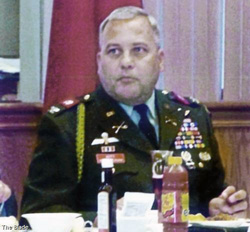
Rich Iott’s campaign website makes much of his military experience:
Rich is a proud member of the Ohio Military Reserve, a component of the Adjutant General’s Department of the State of Ohio, where he holds the rank of Colonel. He is in his 28th year of service. He is a graduate of the USMC Command and Staff College and the USAF Air War College. He has been awarded the highly coveted Israeli jump wings and the Senior Parachutist wings of The Netherlands.
You gotta love the bit about “Israeli jump wings.” How many Waffen SS reenactors can claim that, I wonder.
In response, the Toledo Blade does due diligence and discovers that there’s less there than meets the eye:
One glossy mailing portrays Mr. Iott in civilian and military garb and says, “Rich Iott understands the sacrifices our men and women in uniform have made because he serves himself.”
Another one says, “Reservist Rich Iott will stand up and fight for our veterans.”
But Mr. Iott’s claim to be a member of the military, when he was never on active duty, have rankled those serving in or retired from the armed forces.
Retired Ohio Adjutant General John Smith, a Vietnam veteran who was once commander of the 180th Air National Guard fighter wing based at Toledo, said the OMR has no role in the national defense and has never been called up for duty.
“He’s stretching it in terms of what the Ohio Military Reserve does. He’s giving the impression, I would suggest, that he is involved in matters related to national security and to state matters, and they are not. They are never consulted,” General Smith said.
General Smith said it’s unlikely the governor ever will activate the reserve because of the cost of paying a lot of high-ranking reservists.
The Ohio Military Reserve is a state organization, operating under the Ohio Adjutant General. It is an unarmed, volunteer organization that cannot be called up for national service, like the National Guard or Army Reserve. The State of Ohio can call out the Ohio Military Reserve in the event of an emergency, but never has in the organization’s entire history. Its annual budget is $15,000.
But man, look at those ribbons. Commenter Will, in response to my previous post, nailed it: “Okay, so I got this one for helping out at the first aid tent at the 1997 Cleveland Marathon, and this one was when we beat Indiana at paintball in 2001. . . .”
Twenty years ago, I volunteered for a few months with the local Coast Guard Auxiliary flotilla. They were nice folks and it was a good deal — taught me a lot about boating safety, got me out on the water, performed a useful public service, and so on. It seems roughly comparable to Iott’s involvement with the Ohio Military Reserve. But damn me if I’d ever claim military veteran status over that. What a dishonest poseur.
_________________________
Image: Toledo Blade.





 Dead Confederates, A Civil War Era Blog
2 comments