The Nazi Fanboys
There are exactly four blogs on the intertubes that haven’t addressed the recent revelation that a candidate for the U.S. House of Representatives in Ohio is a military reenactor. Specifically, a World War II German reenactor. More specifically still, an S-freaking-S reenactor, from a unit that has been implicated in serious war crimes. Make that three blogs, because I’m now putting down some of my own thoughts on the matter.
 Not long ago, Josh Green of The Atlantic broke a story that Rich Iott (left), the GOP nominee for Ohio’s 9th Congressional District (Toledo), was for three years (2004-07) a reenactor with Wiking Division, a group of World War II reenactors based in the Upper Midwest. Iott is a long-time reenactor, but the fact that he spent a few years play-acting a Nazi is, understandably, a political bombshell. Though he was always a long-shot in the general election — he’s running against a long-time Democratic incumbent, Marcy Kaptur, in a deep-blue district — the Wiking revelation effectively puts paid to this and any future campaign Mr. Iott may be considering.
In the political scheißesturm that followed, the Wiking group rallied some support from other reenactor groups, including this statement from the Mid-Michigan Chapter of the 82nd Airborne Division Association, which accuses Iott’s critics as playing a “twisted political game” and perpetrating a “blatant lie:”
Reenactors reflect every nation involved in WWII. We have seen not only American and German reenactors, but British, Dutch, French, Polish, Russian, Japanese, Italian and a host of others. To use an educational hobby which provides a teaching tool for all Americans in some twisted political game is not only omitting the true facts, but a blatant lie by conversion of the truth.
They doth protest too much. One of my uncles was a member of the 101st Airborne Division during World War II. I don’t know many details of his service; he died when I was little and he didn’t talk to other family members about those parts of the war. But I know that he witnessed the liberation of some of the concentration camps they discovered at the end of the war. (It may have been a situation like that depicted in Band of Brothers; I don’t really know.) I have no idea how he would’ve viewed modern hobbyists recreating American airborne troops, but it’s impossible for me to believe that he would’ve had any use at all for Rich Iott and his Wiking reenactor buddies.
Rich Iott is not a Nazi. But the objective evidence is that, as a practical matter, he is an imbecile, ein schwachkopf, and that he and his Wiking kameraden are willfully ignoring the very ugly history of the unit they model themselves after. It’s a degree of intentional compartmentalization that’s just staggering. They aren’t Holocaust deniers, who are (for better or worse) straight up about their beliefs; they’re something more insidious, folks for whom it just doesn’t much register. Of all the World War II German military formations, these guys have chosen to recreate the SS, and specifically a unit, the Wiking Division, that was recruited in the occupied countries in the West — Norway, Belgium, the Netherlands — to be composed of men of similar Aryan characteristics to the German SS, or “related stock,” as Himmler put it. The division was explicitly recruited to serve in the East; the antisemitic underpinnings of the SS are explicit in the division’s recruiting materials. Recruiting posters, printed in the local language, sought volunteers to join the fight against Bolshevism, which — inevitably — the Nazis intentionally conflated with Judaism. It’s very ugly stuff, and the Wiking Division was in the center of it, including putting down the Warsaw Uprising in the fall of 1944.
Just last year, a former member of the Wiking Division was charged with atrocities:
A 90-year-old former member of an elite Waffen SS unit has been charged with killing 58 Hungarian Jews who were forced to kneel beside an open pit before being shot and tumbling into their mass grave.
The man, named in the German press as Adolf Storms, becomes the latest pensioner to be prosecuted for alleged Nazi war crimes as courts rush to secure convictions before the defendants become too infirm and the witness testimony too unreliable.
Mr Storms was found by accident last year, as part of a research project by Andreas Forster, a 28-year-old student at the University of Vienna. . . .
Mr Storms was a member of the 5th Panzer Wiking Division which fought on the Eastern Front, moving through Ukraine into the Caucasus, taking part in a bloody fight for Grozny and the tank battles of Kharkov and Kursk before wheeling back through Eastern Europe. By most accounts it left a trail of bodies behind.
By the spring of 1945 the unit was heading to Austria with the intention of surrendering to the Americans rather than to the Red Army.
But first the Wiking Division, led in the early days by General Felix Steiner, who is still revered among neo-Nazis, decided to clean up the evidence against it and eliminate the slave labourers who had dug its fortifications and defensive lines.
According to a statement issued by the regional court in Duisburg, where Mr Storms has spent most of his retirement, 57 of the 58 victims were killed near the Austrian village of Deutsch Schuetzen. The mass grave there was excavated in 1995 by the Austrian Jewish association and the bodies given proper funerals.
Storms died in June 2010, before he could go to trial.
Robert M. Citino of the Military History Center at the University of North Texas, hit the nail on the head when he pointed to what he sees as “an adolescent crush” on Nazi history. He goes on to summarize it nicely in a short essay on HistoryNet:
What you often hear is that the [Wiking] division was never formally accused of anything, but that’s kind of a dodge. The entire German war effort in the East was a racial crusade to rid the world of ‘subhumans,’ Slavs were going to be enslaved in numbers of tens of millions. And of course the multimillion Jewish population of Eastern Europe was going to be exterminated altogether. That’s what all these folks were doing in the East. It sends a shiver up my spine to think that people want to dress up and play SS on the weekend.
I don’t buy for a moment that these reenactors are naive innocents who had no idea that their weekend warrior games were simply beyond the pale of polite company; their reenactor website clearly shows otherwise. It’s been heavily scrubbed in the last few days — including removal of event pictures dating back to Iott’s time with them — but archived copies are still available, including this one from August 2007, the year Iott reportedly was last a participant. None of the reenactors are identified by their real names, including the Wiking group’s public contacts. Iott is included as “Reinhard Pferdmann,” and all the other group member identify only under similar alter-ego names. They are hiding, because they know, they understand, how offensive their identification with the Wiking Division is, and they don’t want to have to answer for it. I’ve known a lot of reenactors, and visited lots of reenactor websites, and never encountered one (including Confederate reenactors) who didn’t identify at least the key members of the group publicly. To me, that’s prima facie evidence that these guys knew very well how their hobby was perceived by the public at large, and (unlike most reenactors) very clearly didn’t want to be publicly associated with it. Iott and his buddies know damn well what they’re doing, and why it’s deeply offensive to so many; that’s why they cower behind names like “Reinhard Pferdmann.” Unlike the Waffen-SS men they so admire, these modern reenactors clearly lack the courage of their convictions.
Twenty-some years ago a Civil War reenactor I knew– he was part of a Union artillery battery — cautioned me that “Civil War reenacting is the lunatic fringe of living history.” His observation was tongue-in-cheek, but endearing. I’ve known a lot of reenactors over the years, and often toyed with the idea of diving into the hobby myself. (Much to the relief of both my wife and my wallet, the feeling passes after a few days.) Reenacting has a lot of appeal, and I think it lends itself well to helping educate the public in certain areas. Reenactors particularly excel in explaining the details of daily life, civilian and military, in earlier times. While it seems unlikely that I’ll be putting on a period uniform myself, I get the appeal, and I understand how folks become so devoted to it.
But there’s something fundamentally different about what Iott and his buddies are up to. They are not exploring their own nation’s history, or their family’s, as many Civil War reenactors are. Their open admiration for the Waffen SS — specifically, a Waffen SS division composed of men who betrayed their own fellow Dutch, Belgian, Norwegian citizens and went over to the enemy — is simply unfathomable. (Later in the war, from 1943 on, some Waffen SS men were conscripted from the occupied countries.) It is reprehensible, and they know it; that’s why they hide behind character names. There are thousands of survivors of the Holocaust and Nazi atrocities on the Eastern Front still living, and millions more of their relatives and friends who have heard firsthand of their experiences and the hands of the Waffen SS and others like them. The Wiking reenactors don’t particularly care about those things, or even acknowledge them; they want to focus entirely on their ehrfurcht gebietend MG42 machine guns — “we also have full automatic weapons for rent!” — and downloadable food tin labels. The people aren’t doing history, or education; they’re getting their jollies at playing at being Nazis. They give living history and historical reenacting a bad name. That they don’t own up to their identities online shows that, on some level, they’re embarrassed by what they do. As they should be.
If Rich Iott wants to play dress-up as a member of the Waffen SS, an organization that was declared criminal at the Nuremberg Trials, and simulate a unit that has been implicated in numerous war crimes, then he is free to do so. The rest of us are free to call him out for it. They want to run around playing Waffen-SS, but not be held accountable for it, individually or as a group. Note to the Wiking kameraden; if your hobby is such an embarrassment that you don’t want others to know about it, do us all a favor and get another damned hobby.

Turret Awning
Ironclad warship were infamously hot, both because of their metal construction and because, compared to traditional wooden-hulled vessels, they were very poorly ventilated. It was said that Monitor‘s galley reached a temperature of 150° F at times. As a result, most of the crew off-watch spent as much time as possible out on deck, and canvas awnings were set up whenever circumstances allowed.
Therer renders are of the awning fitted to Monitor‘s turret.


Monitor’s Screw
It’s funny, and a little scary, how arbitrary the preservation of evidence of our history actually is. As a case in point is Monitor, that remarkable vessel that reportedly encompassed over a hundred new patentable inventions. No official authority bothered to preserve that ship’s construction drawings. They were preserved not by the Navy, which contracted for the ship’s construction, or by Continental Ironworks of New York, which did the actual building, or by John Ericsson himself. Rather, they were saved by Charles W. MacCord, the cantankerous Swede’s chief draftsman. MacCord later served as faculty at the Stevens Institute of Technology, where they would eventually be rediscovered decades later.

Several of these drawings are reproduced in Miller’s U.S.S. Monitor: The Ship that Launched a Modern Navy, including a scale drawing of the ship’s nine-foot, cast-iron propeller, or screw (above). Using this drawing as a guide, I’ve modeled the propeller in three dimensions, after the jump:
You’re All Invited to the Keel-Laying
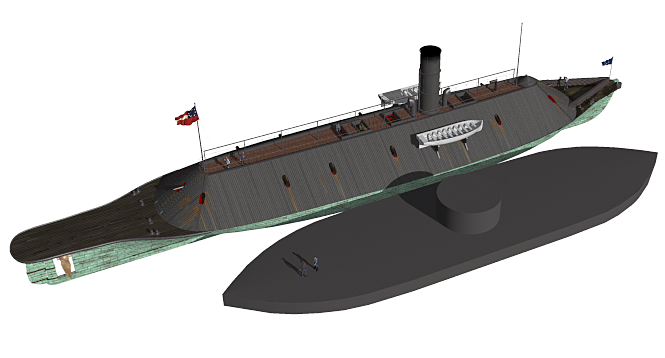
 My copy of U.S.S. Monitor: The Ship that Launched a Modern Navy by Edward M. Miller, with illustrations by Alan B. Chesney, arrived Saturday. The book includes hull lines, profiles and other drawings in considerable detail, as I’d hoped. In addition, it provides a solid basic history of the ship, and an account of the search effort that found the wreck of the ironclad off Hatteras in 1973. The book’s been out of print for a long time, and that’s a shame — it’s a nice reference to one of the most famous and technologically innovative ships in American history.
Looks like more time in the digital shipyard for me!
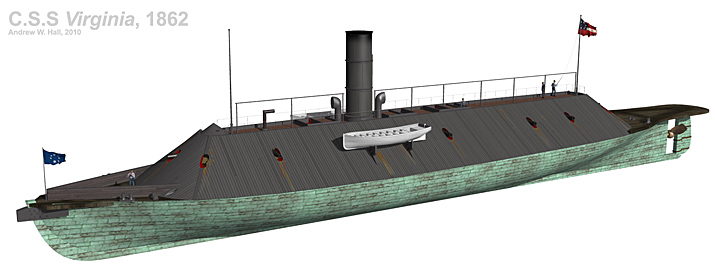
Update: Here’s the rough of Monitor, alongside Virginia, to scale:
______________________
Image: Line drawing by Alan B. Chesney, Leeward Publications, Inc.

Coates’ Civil War
 As some of you are aware, over the last several months we’ve had long, intricate discussions of the Civil War and the Civil War period over at Ta-Nehisi Coates’ blog at The Atlantic. These have dealt with diverse subjects, from current-events issues like the Virginia Confederate History Month debacle last spring, to an ongoing group-read of MacPherson’s Battle Cry of Freedom. It’s a discussion that I’ve had the chance to contribute to in a small way, and it’s helped to both challenge and clarify my own thinking about the war and its continuing legacy.
Now, one of the regulars there who goes by the handle Absurdbeats has assembled a compliation of Civil War related posts from Coates’ place, going back over two years. Both the posts themselves and the discussions that follow are often both fascinating and illuminating. I’m also adding this listing in the links at right.
Happy reading, folks.

A Hot Mess of Historiography
I haven’t written much here about the new book by Ann DeWitt and Kevin M. Weeks, Entangled in Freedom, a novel for young people. The book’s protagonist, Isaac Green, is a young black slave in Civil War Georgia who follows his master into the Confederate Army and, by virtue of having memorized the Bible, quickly finds himself voted by the white soldiers to be the regimental chaplain. I’ve tried to avoid the subject in part because Levin has been all over it since the book was announced, and partly because I had intended to publish here an e-mail interview with Ms. DeWitt, trying to get at some of her background and thinking in writing and publishing the work. I contacted her a couple of weeks ago asking if she’d be willing, and she promptly responded positively. But I got lazy and didn’t send her my questions and, in the meantime, the debate over the book has intensified considerably. Last month Mr. Weeks sent a copy of the book and an angry letter to Levin’s employer — very bad form, that — accusing Levin of “slander” and trying to have the book “silenced.” In the back-and-forth that’s followed, both on Levin’s site and Ms. DeWitt’s, both sides have laid out their cases (and likely will continue to do so), and I’m not sure that there’s any point now in doing the e-mail interview. I don’t think it will illuminate much, since neither “side” in the debate is even speaking the other’s language.
Here is what I mean about not speaking each other’s language: Levin’s (and others’) criticisms of the book — what’s known of it — revolved entirely around the historicity of it, how well the fictional story fits within the known historical framework of that time and place. In response, Ms. DeWitt counters with a response outlining her values and motivations in writing the book:
Imagine writing a novel for young adults which (1) espouses the sanctity of marriage, (2) does not contain profanity, (3) promotes earning ones way in America, (4) advocates true friendship, (5) demonstrates the positive progression of America over the last 150 years, and (6) highlights the strength of the family unit; yet, the novel is dubbed “nonsense” by a recognized Virginia Civil War journalist and historian.
The above six principles are the family narratives of Ann DeWitt. I have no 19th century written documentation of these six family values because they were passed down to me verbally by my ancestors. I do not secretly hide them but proudly share them with the world.
It’s clear that, far from defending the research and historical background presented in the novel, she doesn’t understand the criticism of it. None of those “principles” have anything to do with the historical accuracy of the setting or the plot. One could write such a work in any of a thousand settings, and and frame it in a way that is, if not historically documented, at least plausible. Laura Ingalls Wilder is the obvious example of doing this, although she had the advantage of having actually lived the life she described in her writing.
DeWitt asserts that “these six family values because they were passed down to me verbally by my ancestors.” Okay, fine, but no one’s asking for documentation of her family values. This statement reveals something much more essential here, specifically that, in Ms. DeWitt’s view, criticizing the historical accuracy of the book is criticizing her family, and her values. She sees it not as criticism of her work, but as a personal attack on her. It’s not the same thing at all. I don’t doubt that Ms. DeWitt is a very well-intentioned and sincere person, but having good intentions and a strong moral compass is not enough when it comes to presenting a believable and realistic picture of the past.
Ms. DeWitt and Mr. Weeks haven’t written an historical novel; they’ve written a moral allegory nominally set in the Civil War. But it’s not the South that existed in 1860s or, for that matter, the 1960s. Ms. DeWitt and Mr. Weeks have constructed a Confederacy where wise people “in the Deep South knew all the time that black people are cut from the same board of cloth as whites,” and “knew that slavery wasn’t going to last always.” Alexander Stephens and George Wallace never existed in this version of the American South. Ms. DeWitt and Mr. Weeks have the notion of historical fiction exactly backwards; the goal is to tell a story that fits within the larger, factual context of its setting, not to create a fictional history that supports the particular story one wants to tell for other reasons.
The passage Levin posted recently shows that the historical framework for the novel is based largely on Black Confederate factoids and memes culled from the web. Just that one short passage — 648 words — crams in multiple Black Confederate bullet points, strung together by stilted dialogue. Only a tiny percentage of Confederate soldiers owned slaves? Check. Harper’s Weekly reference to black soldiers at Manassas? Check. Loyal slaves will be delivered “a great prize?” Check. Slaves and owners who “get along fine?” Check.
In defending her book and its thesis, Ms. DeWitt has made some extremely odd arguments — so odd or tangential that one might guess that they were meant in jest, though I don’t think they were. She argues — in all sincerity, it seems — that the slaves who went to war with their masters as body servants were the historical equivalent of present-day, college-educated executive assistant, and then extends that analogy further to the entourage that a modern-day U.S. president travels with. She openly wonders why “mark-and-capture,” a technique used to estimate wildlife populations that involves trapping animals, tagging them and releasing them back into the wild to be recaptured and counted at a later date, hasn’t been used to calculate the numbers of Black Confederates. DeWitt does an online search of Confederate pension records from Alabama’s state archives under the surname “Slave” (!), but says cryptically that the archive “does not document if these African-Americans fought for the Union or the Confederate States Army.” DeWitt lists over two hundred men who received “colored” pensions from the State of Tennessee, helpfully adding that “Colored = Black = African-American,” but omits the fact that Tennessee differentiated these from “S” pensions, issued to soldiers. She hints — both on her website and in the novel — that enlistment or service records that do not explicitly identify the subject as white should be taken as de facto evidence of prospective Black Confederates: “CSA enlistment forms and pension applications did not include race, so . . . the world may never know the total number of African-Americans (Blacks) who served in any and all capacities of the American Civil War.” And then there are explanations that are just odd non-sequiturs:
African-Americans want to know their family history for personal as well as medical reasons. We have turned to scientific DNA testing in order to trace our family lineage. As a human being, it is offensive when historians overall imply that my ancestors in South Carolina were not smart enough to band together and run across a field of dying Confederate soldiers to join the Union Army.
As historiography, this is a hot mess. I don’t know Ms. DeWitt; she seems like a very nice, well-intentioned person who’s deeply devoted to her family and its traditions. That’s a good thing, but I fear that she assumes oral tradition, passed from generation to generation, to be sufficient in not only interpreting her own family’s history — I’ve addressed this before with regard to my own Confederate ancestors — but also in understanding the South, the Confederacy and the fundamental nature of the white supremacist slave society the Confederacy was established to protect and promote. The historical world she presents in Entangled in Freedom isn’t based on research or academic study; it’s the product of intuition and her own, deeply-held faith. But those things are not enough, and to frame what’s intended as an uplifting and inspiring personal story within such a farcical historical context does a real disservice to the public generally, and to students particularly.
It’s a missed opportunity.


Nothing to Bragg About
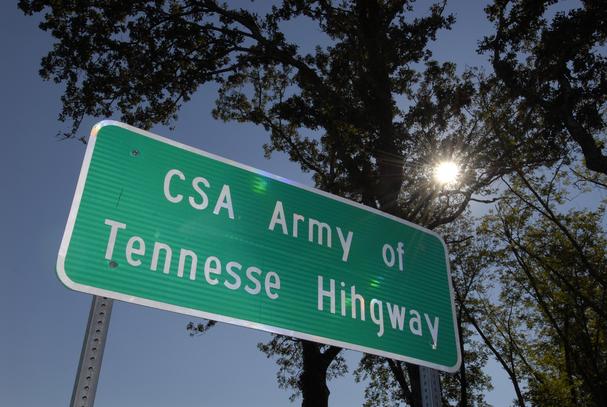
David Woodbury at of Battlefields and Bibliophiles notes some problems with spelling down at the Georgia Department of Transportation’s sign shop.
________________________________
Image: AP Photo/Chattanooga Times Free Press, Laura-Chase McGehee.

Old Dominion Shows the Way

Bloggers Ta-Nehisi Coates and Kevin Levin both call attention to Virginia Governor Bob McDonnell’s announcement Friday that next spring, Confederate History Month will be replaced by Civil War in Virginia Month. This is not only good news, but the governor also chose to make his announcement at the highest-profile venue possible, the 2010 Signature Conference of the Virginia Sesquicentennial of the American Civil War Commission.
The legacies of the Civil War still have the potential to divide us. But there is a central lesson of that conflict that must bond us together today. Until the Civil War, the founding principle that all people are created equal and endowed by their Creator with unalienable rights was dishonored by slavery. Slavery was an evil and inhumane practice which degraded people to property, defied the eternal truth that all people are created in the image and likeness of God, and left a stain on the soul of this state and nation. For this to be truly one nation under God required the abolition of slavery from our soil. Until the Emancipation Proclamation was issued and the Civil War ended, our needed national reconciliation could not begin. It is still a work in progress.
150 years is long enough for Virginia to fight the Civil War.
“Now, on the eve of this anniversary, is a time for us to approach this period with a renewed spirit of goodwill, reverently recalling its losses, eagerly embracing its lessons, and celebrating the measure of unity we have achieved as a diverse nation united by the powerful idea of human freedom.
A modern Virginia has emerged from her past strong, vibrant and diverse. Now, a modern Virginia will remember that past with candor, courage and conciliation. . . .
It’s time to discuss openly how we as Americans, black, white and brown can promote greater reconciliation and trust and greater access to the American Dream for all, so that there is more peace in our hearts and homes, schools and neighborhoods.
This speech is direct, comprehensive, and eloquent. In this address, Bob McDonnell acknowledges and embraces the fundamental truth that so many are unwilling to — that one cannot separate Confederate history from the Civil War, nor the Civil War from this nation’s long, dark legacy of slavery. They are all aspects of the same heritage we share, inextricably intertwined and knotted together.
I have been critical of McDonnell’s original Confederate History Month proclamation — “tone deaf” is about the most charitable thing one can say about it — but today’s remarks really do clean the slate. And while the governor certainly caught a lot of (well-deserved) hell for that earlier document, I’m not going to take a cynical view of his motivations in reversing course here. As Coates said, “You can not ask politicians to do the right thing, and then attack them for doing it.” Amen.
Good for Bob McDonnell. Good for Virginia. Good for the South, and good for our nation. I hope that in this area, has it has so often throughout American history, Virginia sets an example for others to follow.
Added Monday, September 27: Via TPMMuckraker, the SCV responds to McDonnell’s move:
“Our organization is terribly disappointed by this action,” [Virginia SCV Division Commander Brag] Bowling told TPMmuckraker. “[McDonnell] succumbed to his critics, people who don’t support him anyway. And the vast majority of citizens of Virginia support Confederate History Month.”
He said he had spoken with the governor’s office and told them the same thing. He said “Civil War In Virginia Month” is a poor substitute.
“Nobody’s ever been able to reason with me and tell me why we’re honoring Yankees in Virginia,” Bowling said. “The only northerners in Virginia were the ones that came to Virginia and killed thousands of Virginia citizens when they invaded.”
I suppose it’s too much to ask for the SCV to actually respond to the detailed and specific content of McDonnell’s address; instead Bowling drags out the same tired dog-whistles about Yankees and “invasion.” Seriously, folks: get yourselves some new talking points.
Full text of the governor’s address after the jump.
“Possessed of an irascible temper, and naturally disputatious.”

Over at KNOXVILLE 1863, the novel, Dick Stanley has a couple of posts up on Confederate General Braxton Bragg. They paint a picture of a man who was decidedly not popular, either with his men or with his fellow senior officers. He was a prickly man, very much caught up in protocol and form. In his own memoir, Ulysses S. Grant echoes some of their impressions of the man — honest, industrious, and decidedly formal with colleagues. Grant goes on to repeat an anecdote about Bragg from the prewar Army which, accurate or not, vividly captures Bragg’s obsession with procedure:
Bragg was a remarkably intelligent and well-informed man, professionally and otherwise. He was also thoroughly upright. But he was possessed of an irascible temper, and was naturally disputatious. A man of the highest moral character and the most correct habits, yet in the old army he was in frequent trouble. As a subordinate he was always on the lookout to catch his commanding officer infringing his prerogatives; as a post commander he was equally vigilant to detect the slightest neglect, even of the most trivial order.
I have heard in the old army an anecdote very characteristic of Bragg. On one occasion, when stationed at a post of several companies commanded by a field officer, he was himself commanding one of the companies and at the same time acting as post quartermaster and commissary. He was first lieutenant at the time, but his captain was detached on other duty. As commander of the company he made a requisition upon the quartermaster–himself–for something he wanted.
As quartermaster he declined to fill the requisition, and endorsed on the back of it his reasons for so doing. As company commander he responded to this, urging that his requisition called for nothing but what he was entitled to, and that it was the duty of the quartermaster to fill it. As quartermaster he still persisted that he was right. In this condition of affairs Bragg referred the whole matter to the commanding officer of the post. The latter, when he saw the nature of the matter referred, exclaimed: “My God, Mr. Bragg, you have quarreled with every officer in the army, and now you are quarreling with yourself!”
_____________________________





 Dead Confederates, A Civil War Era Blog
7 comments