Foredeck


The major work on the foredeck is blocked out, though a good bit of detail to be added (anchors, cables, etc.).Put anchor chain hawsepipes in the forward casing and similar features for the rudder chains aft.
 As I think I mentioned previously, there’s a lot of ambiguity about Virginia‘s appearance. There are no known photos of the ship, and contemporary illustrations are very inconsistent when it comes to specific details. This is particularly true of the ironclad’s foredeck. Sources generally agree that there was a triangular bulkhead/breakwater, but it’s not entirely clear whether this had been decked over (as planned) at the time of the actions of March 8-9, 1862. Thorough-going modelers have depicted it differently; the model in the Smithsonian’s National Museum of American History has the deck open (and displays an incorrect ensign), while another at the Hampton Roads Naval Museum shows complete decks, fore and aft. The model at the Mariner’s Museum (as well as the plans I’m working from, from the same source) show the space open. Even the same source sometimes offers differing versions — Tom Freeman, a modern artist who work I admire greatly and who puts a great deal of research into his paintings, has depicted it both decked over (left) and open.
Also not sure if the planned shutters (also shown) were ever fitted to the angled ports on either side of the bow port.
Took the covers off the boats — the latter to make for a more visually interesting feature.

“He died without a struggle.”

Army of the Potomac
October 6th, 1862Dear Brother — I was surprised to hear of the death of Henry. I had heard that he was wounded, and got a furlough of two days to go and find him. Starting when your letter came to me, I wandered all day over the field at Antietam. I kept going for miles and miles, looking at every grave I saw, and was about to give up the search from fatigue and hunger (for I had already gone over twenty five miles), but I kept on till dark, and just as I was about to lie down for the night, I saw a few graves under an apple tree, a few rods off, and there I found the grave of our dear brother. It was a solemn time for me as I sat by the grave.
I found a person who watched with him, and was present at his burial. He was shot in the early part of the action. He died without a struggle. It will be a hard struggle for mother. To think he was taken away in so short a time after leaving home, while I have been engaged in six or seven battles! But the thought of his dying so peacefully (and no one can doubt his Christian character or fitness to meet his Maker) will lessen the grief of our mother, and brothers, and sisters. We have lost him; but this we know, he was a Christian, and showed a Christian spirit in all his actions. It seems like a dream. As I look from the “Heights” (Bolivar) [near Harper’s Ferry], I can see the rebel army, and a battle is expected in a few days. I am willing to meet them, no matter how hard the battle, or how long and forced the marches are, if we can only finish the war, or make a beginning of the end. I may too, like Henry, be shot down. If I die, I die in the faith of Christ, and have no fears as to what awaits me. I am happy wherever I am. I can lie down with as much ease, and rest for the night within range of the enemy’s guns, knowing that at dawn we may meet face to face, as I could at home upon my bed. It is near midnight, and I must close.
Sergeant S. P. Keeler
Corporal Henry Keeler enlisted in Company C of the 14th Connecticut Infantry on August 20, 1862. He died four weeks later when the 14th charged Confederate positions along a road later called “Bloody Lane.” Corporal Keeler’s remains were later returned for burial at Ridgefield, Connecticut.
The author, Silas P. Keeler of Waterbury, Connecticut, was a twenty-one-year-old sergeant in Company E, 8th Connecticut Infantry. He had originally enlisted in the 1st Connecticut Infantry in April 1861, mustered out a few months later, and re-enlisted in the Eighth in September 1861. He mustered out of the service in February 1865.
Although the addressee of Sergeant Keeler’s letter is unknown, it seems clear it was written to a family member, with the intent that it would be shared. In addition to assuring that Henry had died “without a struggle ” and the typical assurances of religious faith and comfort in the face of danger, Keeler also mentions that “I found a person who watched with him, and was present at his burial.” This was an important consideration in the 19th century, that even when nothing could be done for the man, he did not die alone, and had a mourner at his interment. Sergeant Keeler was making sure that his family knew that Henry had died a “good” death, as it was understood at the time. Even in his own circumstances, the writer was focused entirely on assuaging the fears and unease of his family in Connecticut.
Letter from Soldier’s Letters from Camp, Battlefield and Prison, ed. by Lydia Minturn Post (New York: Bunce & Huntinton, 1865). Image: “Looking for a Friend,” by Walton Taber.

Screwed
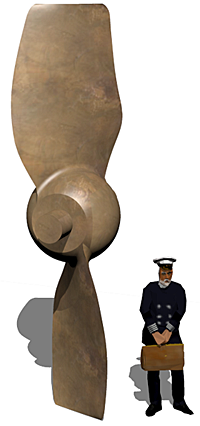 TheRaven asked about the propeller (screw) on the Virginia model and caught me out — it’s a placeholder borrowed from another model. I’m still digging for decent drawings of Virginia’s screw, which would have been her original, fitted when she was in service as U.S.S. Merrimac.
In the meantime, here’s the screw from C.S.S. Alabama, the high-seas raider built by Laird at Birkenhead in 1862. Although fitted out as a steamship, Alabama was intended to spend most of her time at sea under sail to conserve fuel, and so (like many ships of that period) was fitted with a “lifting” screw that could be disconnected from the shaft and hoisted almost entirely out of the water to reduce drag. Alabama‘s screw was 14 feet 3 inches (4.34m) in diameter. This model is based on plans in Andrew Bowcock’s authoritative C.S.S. Alabama: Anatomy of a Confederate Raider, which in turn are based on shipyard-built presentation model of the ship. Ship’s trials data for Alabama are missing, but based on the models and builders’ trials of contemporary vessels, Bowcock suggests that Alabama‘s screw had a pitch angle of 35°, a “slip” — a measure of the difference between the distance that a propeller of a given pitch should have moved forward (as the result of a full rotation) and the distance that it actually moved forward — of 15-20%, and operated at full speed at 60-65 rpm. Alabama‘s screw would have been more technically refined that Merrimac/Virginia‘s, but closer than the one shown in the renders below.

More Virginia
More progress on Virginia. Replaced the appropriate Dahlgrens with Brooke rifles (not that it shows at all), added the upper platform rail, textured the chimney and adjusted the main casemate texture to make sure it lines up properly with the angled gunports, fore and aft. I also replaced the texture on the ship’s boat; the white will stand out better against the dark hull. (Even when striving for as much accuracy as possible, there are lots of situations where, absent actual historical data, there’s room to apply some personal aesthetic.) I’m quickly running out of work above the waterline, and soon will have to dig into the forecastle.


Virginia Progress
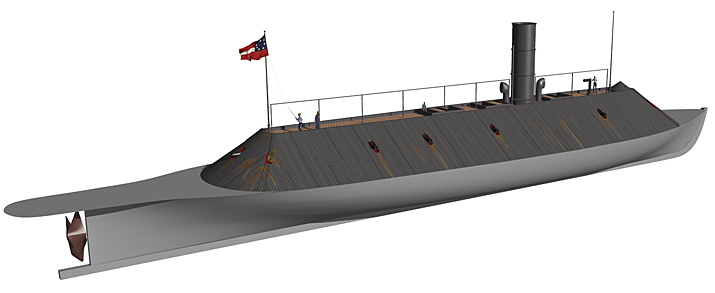
Upper works blocked out and a preliminary texture on the casemate.
Guns added, as well. For now, they’re eight 9-inch Dahlgren smoothbores on the broadside, with a 7-inch Brooke rifle at each end. Two of the Dahlgrens need to be replaced with 6.4-inch Brooke rifles, but I need to be sure of their placement first.
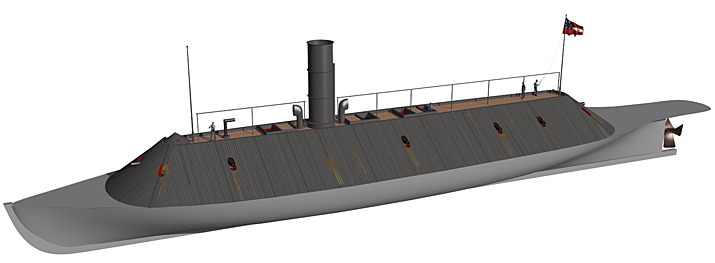
Update: The data cards from the old Yaquinto game Ironclads show the two 6.4-inch Brookes as being the foremost broadside guns. Makes sense.

“Never before was anything like it dreamed of”


A work-in-progress. I’d forgotten what a subtly complex shape Virginia‘s sloped casemate really was. Flat, orthagonal drawings don’t do it justice; there’s not a straight edge in the entire thing. That, and how big the ship actually was. Little wonder they thought it was nigh-on invincible.

“Under Divine blessing we must rely upon the bayonet”
Despite its fearsome reputation, the wounds inflicted by the bayonet were sometimes less horrific, and more quickly healed, than one might suppose. Dick Stanley has a fine new post over at 13th Mississippi Infantry on Dr. Simon Baruch, and his wartime-published case study on bayonet wounds. Previous posts on Baruch here and here.

“They lay as thick as autumn leaves”
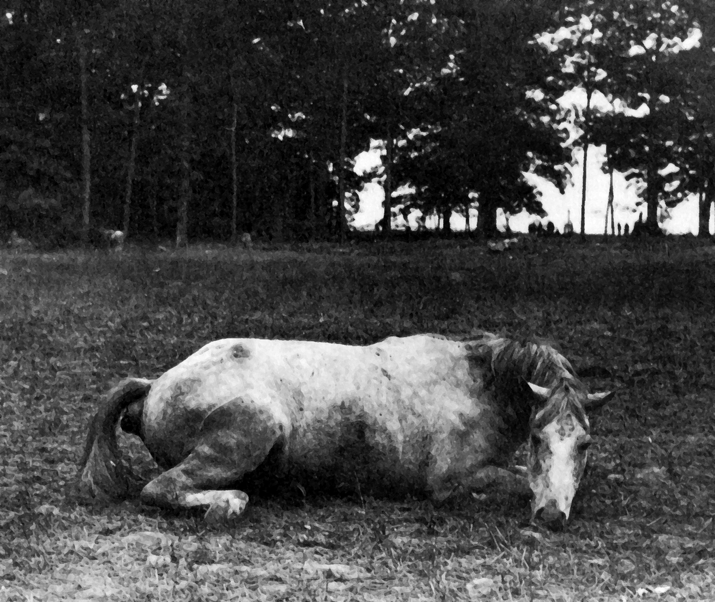
Friday, September 19, 1862, near Sharpsburg, Maryland:
I took the delay to ride over the field of battle. The Rebel dead, even in the woods last occupied by them, was very great. In one place, in front of the position of my corps, apparently a whole regiment had been cut down in line. They lay in two ranks, as straightly aligned as on a dress parade. There must have been a brigade, as part of the line on the left had been buried. I counted what appeared to be a single regiment and found 149 dead in the line and about 70 in front and rear, making over 200 dead in one Rebel regiment. In riding over the field I think I must have seen at least 3,000. In one place for nearly a mile they lay as thick as autumn leaves along a narrow lane cut below the natural surface, into which they seem to have tumbled. Eighty had been buried in one pit, and yet no impression had apparently been made on the unburied host. The cornfield beyond was dotted all over with those killed in retreat.
The wounded Rebels had been carried away in great numbers and yet every farmyard and haystack seemed a large hospital. The number of dead horses was high. They lay, like the men, in all attitudes. One beautiful milk-white animal had died in so graceful a position that I wished for its photograph. Its legs were doubled under and its arched neck gracefully turned to one side, as if looking back to the ball-hole in its side. Until you got to it, it was hard to believe the horse was dead.
Brigadier General Alpheus S. Williams,
Division Commander, Army of the Potomac
Alpheus S. Williams, Milo Milton Quaife (eds.), From the Cannon’s Mouth: The Civil War Letters of General Alpheus S. Williams (Detroit: Wayne State, 1959). Image: Library of Congress.
________________________

A “Gaffe” Is When. . . .
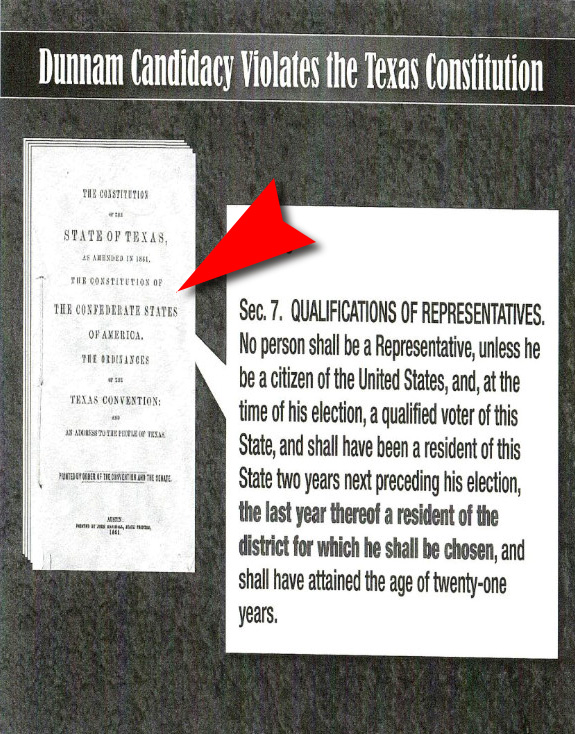
It’s the silly season, and up in Dallas, the Texas GOP recently called a press conference to accuse an incumbent Dem state representative of not actually living in the district he represents. Pretty run-of-the-mill politicking, right up to the point where they handed out press fliers citing the relevant portion of the Texas Constitution — with am image of the Texas Constitution from its time as one of the Confederate States.
“No, categorically no,” state GOP spokesman Bryan Preston said today, when asked if a heady atmosphere of secessionist feeling permeates a party headquarters dominated by Gov. Rick Perry. Last year, after appearing at an Austin tea party rally, Perry told reporters that he understood how frustrated Texans were with the federal government and how they might want to secede from the Union.
Heh.
“Sympathies and antipathies are disabilities in an historian.”
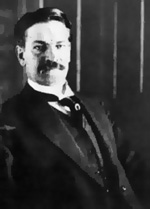 Archibald Gracie IV (1859-1912, left) is today remembered primarily as a survivor of the Titanic disaster, who wrote one of the better first-person accounts of the sinking. Gracie, who had attended (but not graduated from) West Point, was an energetic amateur historian, and was particularly obsessed with the Battle of Chickamauga, in which his father, Archibald Gracie III (1832-1864), had served as a Confederate brigade commander. The younger Gracie spent years researching the battle, work which culminated in his December 1911 publication, The Truth About Chickamauga. Gracie took an extended trip to Europe after completing the volume, booking return passage on the soon-to-be-infamous White Star liner. He apparently hadn’t quite gotten Chickamauga out of his system for, as the late Walter Lord wrote in The Night Lives On, “he cornered Isidor Straus, on whom he had foisted a copy of The Truth About Chickamauga. The book strikes one reader as 462 pages of labored minutiae, but Mr. Straus was famous for his tact; he assured the colonel that he had read it with ‘intense interest.'”
Also not a fan of The Truth About Chickamauga: Ambrose Bierce. The famous writer had served at Chickamauga on the staff of Brigadier General William Babcock Hazen (1830-1887), personally witnessed several key events in the battle, had published several pieces on the action, and apparently gave Gracie at least one face-to-face interview. But Bierce found Gracie’s efforts at telling the truth about Chickamauga to be badly and willfully biased. Here is the opening paragraph of a letter Bierce wrote to Gracie in March 1911, several months before the latter’s book went to press:
March 9, 1911
From the trouble that you took to consult me regarding certain phases of the battle of Chickamauga I infer that you are really desirous of the truth, and that your book is not to belong to that unhappily too large class of books written by “bad losers” for disparagement of antagonists. Sympathies and antipathies are disabilities in an historian that are hard to overcome. That you believe yourself devoid of this disability I do not doubt; yet your strange views of Thomas, Granger and Brannan, and some of the events in which they figured, are (to me) so obviously erroneous that I find myself unable to account for them on the hypothesis of an entirely open mind. All defeated peoples are “bad losers” – history supplies no examples to the contrary, though there are always individual exceptions. (General D. H. Hill is an example of the “good loser,” and, with reference to the battle of Chickamauga, the good winner. I assume your familiarity with his account of that action, and his fine tribute of admiration to some of the men whom he fought — Thomas and others.) The historians who have found, and will indubitably continue to find, general acceptance are those who have most generously affirmed the good faith and valor of their enemies. All this, however, you have of course considered. But consider it again.
Ouch.
______________________
Letter from Phantoms of a Blood-Stained Period: The Complete Civil War Writings of Ambrose Bierce (Russell Duncan and David J. Klooster, eds.)





 Dead Confederates, A Civil War Era Blog
6 comments