No Room for Abolitionist Talk in a “Free” Country
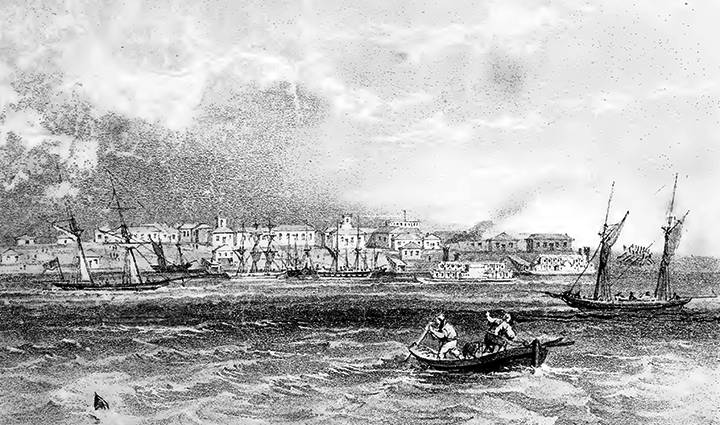
While working on something else, I came across this passage in Matilda Charlotte Houstoun’s Texas and the Gulf of Mexico, or Yachting in the New World, Vol. II (London: John Murray, 1844). Mrs. Houstoun (as she styled herself) was an Englishwoman in her late 20s, who visited Galveston twice during the winter of 1842-43 with her husband, Captain M. C. Houstoun, as they toured the Republic of Texas and other nations around the Gulf of Mexico. Mrs. Houstoun (1815-1892) would go on to a successful career as a novelist, but at this point she was an aspiring author, making notes on her travels:

As on board the steamer, we found the slave question the principal topic of conversation among the good citizens of Galveston. Many of the latter maintained, that individuals have no right to interfere with their lawful property, and were so indignant with the abolitionists, that they banished the principal philanthropist from the city. The person in question was conveyed in a boat to the mainland, and there turned adrift to preach to the inhabitants of the woods and prairies. Another, a black man, and by trade I believe a barber, had likewise incited the displeasure of the inhabitants of Galveston, by advocating the cause of his race in the market-place. He declared his life was in danger, and pretending to be a British subject, claimed the protection of the British minister. One of their own most respected townsmen did not escape their wrath. This person having declared himself opposed to the abolition of slavery, but still inclined to hear the arguments pro and con, was ordered to be silent on the subject. He replied, that his was a free country, where everyone had a right to express his opinions. This right apparently was not acknowledged, for he was put into a boat and sent to the mainland: strange occurrences in a country calling itself free.
Imagine that — Texians responding with anger, threats and even violence against those expressing abolitionist leanings. Why, it’s hard even to imagine such a thing. Oh, wait.
_____________
Image: Galveston harbor in the early 1840s, from Houstoun’s book.

Buh-Bye, Barry.
Barry Landau, the rare-documents dealer who was caught stealing materials from the Maryland Historical Society, will be sentenced later today in federal court in Baltimore. Landau entered a guilty plea last February, admitting that he and his assistant, Jason Savedoff, had an elaborate and extensive scheme for lifting materials — at least 4,000 of them, according to investigators:
Many of the stolen documents are more than 100 years old and some are worth more than $100,000. They include the copies of speeches President Franklin D. Roosevelt read from during his three inaugurations, a land grant signed by President Abraham Lincoln in 1861 and letters written by scientist Isaac Newton, novelist Charles Dickens and French Emperor Napoleon Bonaparte. In a plea agreement signed in February, Landau acknowledged that he and his now 25-year-old assistant Jason Savedoff would visit historical archives and often distract staff while stuffing documents into secret pockets in their clothing. The pair attempted to cover up the thefts by removing card catalog listings for the items and using sandpaper and other methods to remove museum markings, a process they called “performing surgery.”
There’s a good background piece on this case, and the implications for archivists and collections, at the Wall Street Journal. Their modus operandi went beyond secret compartments in their clothing, to just plain ol’ ingratiating themselves to the staff:
Lee Arnold, senior director of the library and collections at the Historical Society of Pennsylvania, recalls a duo with a voracious appetite for documents. He says the pair handled hundreds of boxes of items, visiting 21 times between December and May, and gave out Pepperidge Farm cookies to staff. At the Maryland Historical Society, where the indictment alleges the pair stole roughly 60 documents, a staffer says they tried to charm employees with cupcakes (including a “California Dreamin'” variety with orange citrus-flavored buttercream).
Landau and Savedoff reportedly face up to 15 years for their crimes, though federal sentencing guidelines typically call for much shorter sentences for first-time convictions, or defendants who cooperate with investigators to mitigate the harm they’ve done. I’m not a lock-em-up-and-throw-away-the-key kinda guy, generally, but I’m going to be hard pressed to be sympathetic if the court goes outside the sentencing guidelines and throws the book at these fools. Their actions are, in many ways, more damaging than those of the guy who systematically looted the Petersburg National Battlefield Park. As I said last year, I’ve been to too many collections, and asked to see too many documents listed in the catalog, only to find a note in the folder that reads, “Missing since [date].” The theft of materials from archives — with shrinking staff and often poor security — is a terrible problem. I’ve long believed that a not-insignificant proportion of the documents market is made up from material gone missing from archives, and especially so with autographs; whole letters can often be traced back to their source, but a signature excised from a larger document cannot.
___________
Update, Wednesday afternoon: Landau was sentenced to seven years in prison and $46,000 restitution. His accomplice, Jason Savedoff, pleaded guilty last fall and will be sentenced at a later date.
___________

Old Friends and Small Discoveries

I think my favorite Confederate memoirist must be Val Giles, whose (very) posthumously-published Rags and Hope (Mary Lasswell, ed.) oughter count as one of the great soldier’s accounts of the war. It was published in (as far as I can tell) only a single edition in 1961, and is consequently hard to find.
Apart from its wry observations, self-deprecating humor and mature perspective, Rags and Hope was valuable to me personally for two reasons. First, it served as a sort of surrogate for the experiences of a relative of mine, Lawrence Daffan, who served in the same regiment and went through many of the same battles and ordeals, including imprisonment at Rock Island for the last 18 months of the war. Second, he and Daffan were friends after the war, both being very active in Confederate Veteran activities. I don’t know if they were friends during the war itself, as they were from different parts of the state, and were assigned to different companies. But there were friends later, and Daffan’s daughter — Cou’n Katie in the family — made a grand gesture of placing a little Confederate flag in Giles’ casket at his funeral in 1915.
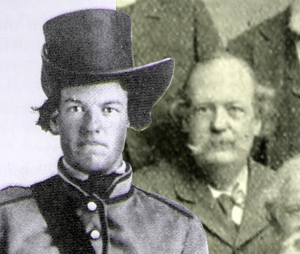 Anyway, I’d long been familiar with the image of Val Giles, as a teenaged recruit in the Tom Green Rifles, posing in the ridiculous top hat his father had insisted on buying him to complete his uniform upon his enlistment in 1861. What I hadn’t seen, until today, was Giles in his later years around the time he started compiling the notes and anecdotes that, decades after his own death, Mary Lasswell would compile into the volume Rags and Hope. Then I happened upon this photo (top) of veterans of the Tom Green Rifles (later Company B, 4th Texas Infantry) in the November 1897 issue of Confederate Veteran. According to the accompanying text, out of over 180 men who passed through that company during the conflict, “less than 20 now survive.”
The eyes haven’t changed in the intervening 36 years.
The man in the back row, far left, is “Uncle” John Price, an African American servant who brought the soldiers rations while under fire at the base of the Little Round Top. Garland Colvin (back row, second from right), the company’s First Sergeant, had been wounded in that same action. He would be wounded again at Chickamauga and taken prisoner in December 1863.
__________

Stonewall Jackson’s “Regiment of Free Negroes”
 Within the smoke-and-mirrors, ignore-that-man-behind-the-curtain game that constitutes advocacy for black Confederate soldiers, one often comes across the claim that Stonewall Jackson commanded two battalions of African American troops. It pops up all over the place, including (briefly) in grade school textbooks in the Old Dominion. Remarkably, with 27 bazillion books published to date on the Civil War, and a fair number of those specifically about Ol’ Blue Light himself, no one’s ever bothered to name those two battalions by their official designation, identify their officers, or point them out on the order of battle for a specific engagement.
I’m not sure where the claim about these battalions originated, but it may be at least in part based on this news item from the front page of the Philadelphia Inquirer of November 27, 1861:

FROM THE UPPER POTOMAC POSITION OF THE REBELS — A FREE NEGRO REGIMENT A letter from Darnestown, Md., dated to-day, says. . . . Gen. JACKSON, who, as Colonel, formerly commanded at Harper’s Ferry, is engaged at Winchester in organizing, arming, and equipping a regiment of free negroes [sic.], said to number fully a thousand. The negroes are reported to be very enthusiastic in their new position.

Rumors and second-hand accounts of African American troops in Confederate service appeared frequently in Northern newspapers, especially during the early part of the war. We’ve seen how a single mention of black troops — from a source that seems dubious to start with — got rewritten and embellished and recycled, over and over, for weeks after the Battle of First Manassas. That one took in a lot of people, including (it seems likely) Frederick Douglass.
So now we’ve got a date (November 1861) and a location (Winchester, Virginia), for at least one (anonymous, second-hand) account of Jackson’s black troops. Anyone who has further details on this regiment — its commanding officer, its official designation, the actions in which it fought, or citations to it in Confederate sources, please drop it in the comments.
I have Fold3 open and waiting.
___________

Juneteenth, History and Tradition
[This post originally appeared here on June 19, 2010.]
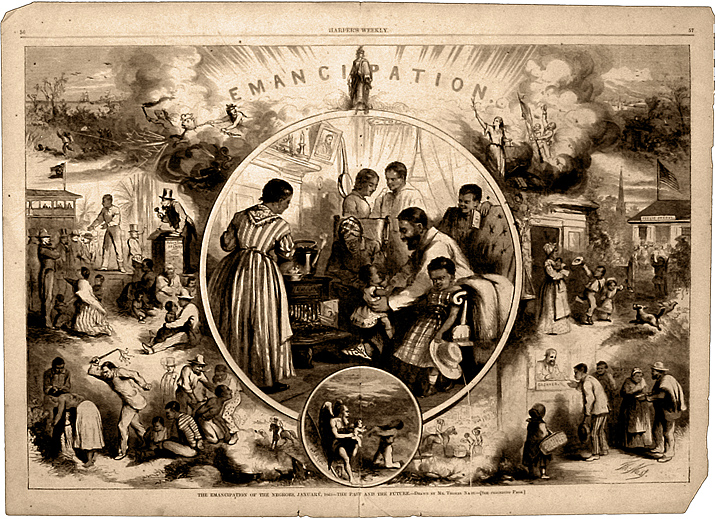
“Emancipation” by Thomas Nast. Ohio State University.

Juneteenth has come again, and (quite rightly) the Galveston County Daily News, the paper that first published General Granger’s order that forms the basis for the holiday, has again called for the day to be recognized as a national holiday:
Those who are lobbying for a national holiday are not asking for a paid day off. They are asking for a commemorative day, like Flag Day on June 14 or Patriot Day on Sept. 11. All that would take is a presidential proclamation. Both the U.S. House and Senate have endorsed the idea. Why is a national celebration for an event that occurred in Galveston and originally affected only those in a single state such a good idea? Because Juneteenth has become a symbol of the end of slavery. No matter how much we may regret the tragedy of slavery and wish it weren’t a part of this nation’s story, it is. Denying the truth about the past is always unwise. For those who don’t know, Juneteenth started in Galveston. On Jan. 1, 1863, the Emancipation Proclamation was issued. But the order was meaningless until it could be enforced. It wasn’t until June 19, 1865 — after the Confederacy had been defeated and Union troops landed in Galveston — that the slaves in Texas were told they were free. People all across the country get this story. That’s why Juneteenth celebrations have been growing all across the country. The celebration started in Galveston. But its significance has come to be understood far, far beyond the island, and far beyond Texas.
This is exactly right. Juneteenth is not just of relevance to African Americans or Texans, but for all who ascribe to the values of liberty and civic participation in this country. A victory for civil rights for any group is a victory for us all, and there is none bigger in this nation’s history than that transformation represented by Juneteenth.
But as widespread as Juneteenth celebrations have become — I was pleased and surprised, some years ago, to see Juneteenth celebration flyers pasted up in Minnesota — there’s an awful lot of confusion and misinformation about the specific events here, in Galveston, in June 1865 that gave birth to the holiday. The best published account of the period appears in Edward T. Cotham’s Battle on the Bay: The Civil War Struggle for Galveston, from which much of what follows is abstracted.
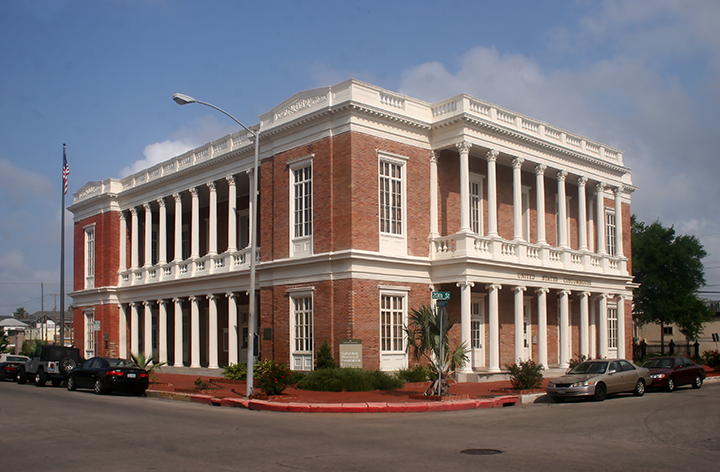
The United States Customs House, Galveston.
On June 5, Captain B. F. Sands entered Galveston harbor with the Union naval vessels Cornubia and Preston. Sands went ashore with a detachment and raised the United States flag over the federal customs house for about half an hour. Sands made a few comments to the largely silent crowd, saying that he saw this event as the closing chapter of the rebellion, and assuring the local citizens that he had only worn a sidearm that day as a gesture of respect for the mayor of the city.
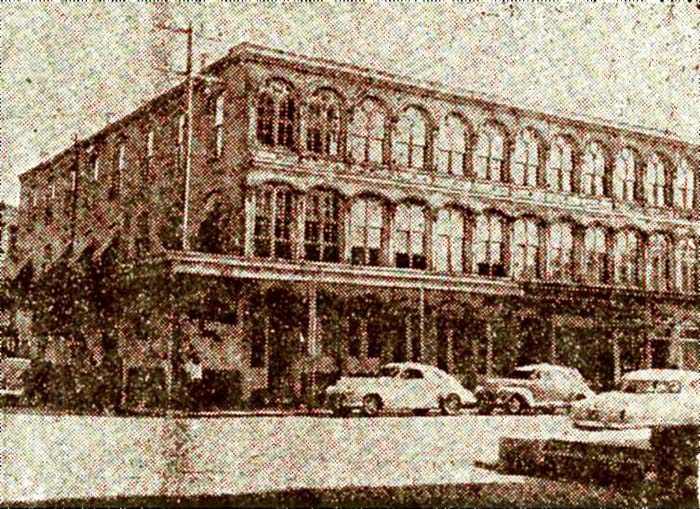
The 1857 Ostermann Building, site of General Granger’s headquarters, at the southwest corner of 22nd Street and Strand. Image via Galveston Historical Foundation.
A large number of Federal troops came ashore over the next two weeks, including detachments of the 76th Illinois Infantry. Union General Gordon Granger, newly-appointed as military governor for Texas, arrived on June 18, and established his headquarters in Ostermann Building (now gone) on the southwest corner of 22nd and Strand. The provost marshal, which acted largely as a military police force, set up in the Customs House. The next day, June 19, a Monday, Granger issued five general orders, establishing his authority over the rest of Texas and laying out the initial priorities of his administration. General Orders Nos. 1 and 2 asserted Granger’s authority over all Federal forces in Texas, and named the key department heads in his administration of the state for various responsibilities. General Order No. 4 voided all actions of the Texas government during the rebellion, and asserted Federal control over all public assets within the state. General Order No. 5 established the Army’s Quartermaster Department as sole authorized buyer for cotton, until such time as Treasury agents could arrive and take over those responsibilities.
It is General Order No. 3, however, that is remembered today. It was short and direct:
Headquarters, District of Texas
Galveston, Texas, June 19, 1865 General Orders, No. 3 The people are informed that, in accordance with a proclamation from the Executive of the United States, all slaves are free. This involves an absolute equality of personal rights and rights of property, between former masters and slaves, and the connection heretofore existing between them, becomes that between employer and hired labor. The Freedmen are advised to remain at their present homes, and work for wages. They are informed that they will not be allowed to collect at military posts; and that they will not be supported in idleness either there or elsewhere. By order of
Major-General Granger
F. W. Emery, Maj. & A.A.G.
What’s less clear is how this order was disseminated. It’s likely that printed copies were put up in public places. It was published on June 21 in the Galveston Daily News, but otherwise it is not known if it was ever given a formal, public and ceremonial reading. Although the symbolic significance of General Order No. 3 cannot be overstated, its main legal purpose was to reaffirm what was well-established and widely known throughout the South, that with the occupation of Federal forces came the emancipation of all slaves within the region now coming under Union control.
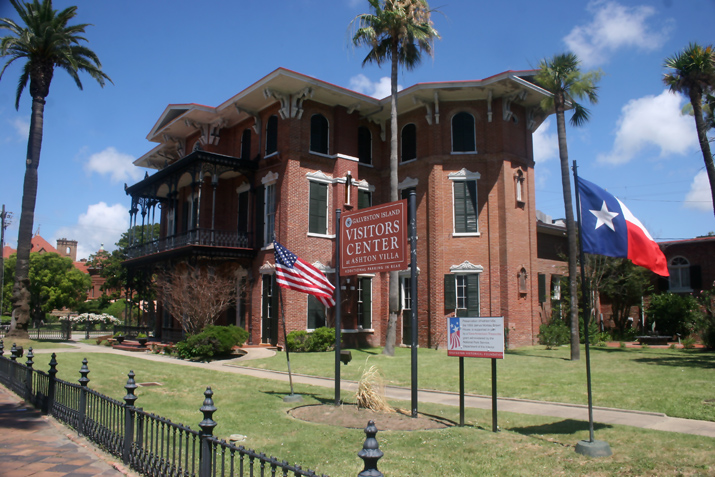
The James Moreau Brown residence, now known as Ashton Villa, at 24th & Broadway in Galveston. This site is well-established in recent local tradition as the site of the original Juneteenth proclamation, although direct evidence is lacking.
Local tradition has long held that General Granger took over James Moreau Brown’s home on Broadway, Ashton Villa, as a residence for himself and his staff. To my knowledge, there is no direct evidence for this. Along with this comes the tradition that the Ashton Villa was also the site where the Emancipation Proclamation was formally read out to the citizenry of Galveston. This belief has prevailed for many years, and is annually reinforced with events commemorating Juneteenth both at the site, and also citing the site. In years past, community groups have even staged “reenactments” of the reading of the Emancipation Proclamation from the second-floor balcony, something which must surely strain the limits of reasonable historical conjecture. As far as I know, the property’s operators, the Galveston Historical Foundation, have never taken an official stand on the interpretation that Juneteenth had its actual origins on the site. Although I myself have serious doubts about Ashton Villa having having any direct role in the original Juneteenth, I also appreciate that, as with the band playing “Nearer, My God, to Thee” as Titanic sank beneath the waves, arguing against this particular cherished belief is undoubtedly a losing battle.
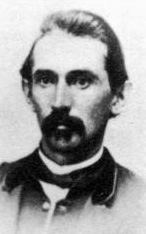 Assuming that either the Emancipation Proclamation (or alternately, Granger’s brief General Order No. 3) was formally, ceremonially read out to the populace, where did it happen? Charles Waldo Hayes, writing several years after the war, says General Order No. 3 was “issued from [Granger’s] headquarters,” but that sounds like a figurative description rather than a literal one. My bet would not be Ashton Villa, but one of two other sites downtown already mentioned: the Ostermann Building, where Granger’s headquarters was located and where the official business of the Federal occupation was done initially, or at the United States Customs House, which was the symbol of Federal property both in Galveston and the state as a whole, and (more important still) was the headquarters of Granger’s provost marshal, Lieutenant Colonel Rankin G. Laughlin (right, 1827-78) of the 94th Illinois Infantry. It’s easy to imagine Lt. Col. Laughlin dragging a crate out onto the sidewalk in front of the Customs House and barking out a brief, and somewhat perfunctory, read-through of all five of the general’s orders in quick succession. No flags, no bands, and probably not much of a crowd to witness the event. My personal suspicion is that, were we to travel back to June 1865 and witness the origin of this most remarkable and uniquely-American holiday, we’d find ourselves very disappointed in how the actual events played out at the time.
Maybe the Ashton Villa tradition is preferable, after all.

Update, June 19: Over at Our Special Artist, Michele Walfred takes a closer look at Nast’s illustration of emancipation.
Update 2, June 19: Via Keith Harris, it looks like retiring U.S. Senator Kay Bailey Hutchison supports a national Juneteenth holiday, too. Good for her.
______________

Federal Judge Tosses Lexington Flag Lawsuit
Via Kevin, the U.S District Court has granted the City of Lexington’s motion to dismiss the SCV’s lawsuit against the city. Rob Baker points to Judge Samuel Wilson’s ruling:
The Constitution does not compel a municipality to provide its citizens a bully pulpit, but rather requires it to refrain from using its own position of authority to infringe free speech. Second, there are highly compelling practical reasons for a city to close its flag poles to private expression. The city that cracks the door to private expression on flag poles practically invites litigation from other groups whose messages it would rather not hoist above the city. Related to that point, private expression might eventually so dominate city flag poles as to swallow whole the flag poles’ actual, official purposes. Third, and finally, the ordinance in this case leaves ample opportunity for SCV and every other group to display the flags of their choice. That is true by the ordinance’s own terms: “Nothing set forth herein is intended in any way to prohibit or curtail individuals from carrying flags in public and/or displaying them on private property.” § 420-205(C)(2). SCV and other groups may therefore carry their flags in parades, fly them from the flag poles at their local offices, or wave them while walking to the grocery store. As such, the ordinance is perfectly reasonable. Because reasonable, nondiscriminatory, content-neutral rules regulating speech in nonpublic fora pass First Amendment constitutional muster regardless of motive, the court will grant the City’s motion to dismiss.
Grafs are added for clarity. And then there’s this:
No court has found that the Constitution compels the government to allow private-party access to government flag poles.
I seem to recall someone saying at the time that the Lexington “ordinance is air tight.” That person was right.
The local SCV, led by Brandon Dorsey, isn’t happy:
As far as I am concerned, this is little different that some states shutting down all their public schools to avoid desegregation and then claiming their motivation for closing them is of no concern because they screwed over everyone.
Of all the possible analogies, Mr. Dorsey, you had to go with that one, didn’t you? It must be hard, getting H. K. Edgerton and Ruby Bridges mixed up like that. Because they’re so much alike, or something. But do try harder next time, please.

Update, June 16: Dorsey’s analogy, comparing the Virginia SCV’s situation to that of African Americans in the Jim Crow South, doesn’t appear to be an off-the-cuff comment; it’s a conscious public relations strategy. Yesterday they vowed to appeal Judge Wilson’s dismissal, and made the same analogy:
In its written statement, Sons of Confederate Veterans maintained that Wilson’s ruling would allow governments to deny everyone access to public places in its effort to silence the groups with whom it disagrees.
“That logic would legitimize many of the wrongs committed by state and local governments during the Civil Rights era,” the statement read.
“In its written statement. . . .”
Many of us have made the point that, in its public actions and rhetoric, the Southron Heritage™ movement is preaching to the choir; they’re doing and saying things calculated to appeal to fellow true believers, going out of their way to prove they’re more unreconstructed than the next guy. As for winning new supporters to their cause, or shaping broader public opinion, it’s a terrible strategy that only distances them farther from mainstream views and attitudes.
This analogy by Dorsey and his fellows doesn’t help their cause; it actively harms it. Anyone who actually remembers the Civil Rights Movement, or who’s studied it since, will be repulsed by such a comparison, and rightly so. It’s an odious analogy, one that should cost them any benefit of the doubt that the public might be willing to entertain about their motivations and supposed good faith. Kevin is right again: “they deserve everything they get.”
_____________

How — and Why — Real Confederates Endorsed Slave Pensions
In another forum recently, there was a lively discussion going on about the historical basis for present-day claims about black Confederates. One of the topics, naturally, was the pensions that some states awarded to African American men who had served as body servants, cooks, and in other roles as personal attendants to white soldiers. One person asked why it was that the former states of the Confederacy were so late in authorizing pensions for these men, or (in some cases) did not authorize them at all. It’s a good question, that I’m sure defies a single, simple answer.
But in the process of looking for something else, I came across this editorial in the October 1913 issue of the Confederate Veteran, calling on the states to provide pensions for a “a particular class of old slaves.” I’m putting it after the jump, because it’s peppered with racial slurs and stereotypes that are hurtful to modern ears, but were wholly unremarkable for that time, place and publication. So let me apologize in advance for the language, and hope that my readers will appreciate the necessity of repeating it here, in full and in proper context, in order to be crystal clear about the author’s meaning and intent. There are times when polite paraphrasing just doesn’t do the job.
As you read this editorial, keep in mind that the Confederate Veteran, by its own masthead, officially represented (1) the United Confederate Veterans, (2) the United Daughters of the Confederacy, (3) the Sons of Veterans (i.e., the SCV), and other groups. The magazine was mostly written by Confederate veterans and their families, to be read by Confederate veterans and their families. While the editorial may not reflect formal UCV/UDC/SCV policy, its appearance in the magazine does indicate that its perspective is one that would be shared by the magazine’s readership, and its call for action would reach a willing and receptive audience.
In short, if you want to know how real Confederate veterans viewed the purpose and necessity of pensions for former slaves, start here:

Coming to a Newsstand Near You
The new issue of the Civil War Monitor is now online, and should be appearing on newsstands and in mailboxes in short order. It’s a great issue this time (again — they keep doing that), with a focus on events in the sesquicentennial year of 1862. Feature articles in this issue include:

Lee: Initial Stride to Greatness
In his first campaign as Confederate army commander, Robert E. Lee established his reputation as a bold leader—and changed the course of the war in the East. By Jeffry D. Wert A Capital in Crisis
Twelve summer days in 1862 marked the darkest time of the Civil War for Washington, D.C. By Stephen W. Sears Faces of 1862
The war’s second year forever changed the lives of countless Americans—soldiers and civilians—on both sides of the conflict. By Ronald S. Coddington Fighting for South Mountain
On the eve of Antietam, Union soldiers won a decisive victory—then fought again to have it remembered. By Brian Matthew Jordan
Northern Divide
The elections of 1862 seemed to offer a severe rebuke to Abraham Lincoln and his preliminary Emancipation Proclamation. The president and his allies, however, read the results much differently. By Louis P. Masur
I particularly like the article by author (and blogger) Ron Coddington, who’s made a sort of scholarship all his own by starting with period CDVs of Civil War soldiers and using those as a jumping-off place for biographical essays that explore the Civil War experience at the micro level. It’s what Barbara Tuchman once described as “history by the ounce,” and it makes for great reading. Toss in some quick book reviews by Brooks Simpson and a fun article on counterfeiting Confederate currency by Ben Tarnoff, and there’s a lot of good stuff in there.
I think I’ve said before that the CWM is not your father’s Civil War magazine. But a subscription would make a nice Father’s Day gift, ya know?
_____________

Focus on U.S.S. Fort Jackson


 My friend Ed Cotham e-mailed me recently with this photo of U.S.S. Fort Jackson, one of the ships making up a part of the blockade fleet off Galveston in the final months of the war. Fort Jackson had a long and active service history, capturing several blockade runners off the East Coast and taking part in the bombardment of Fort Fisher at the end of 1864. When she took up station off Galveston in the early part of 1865, she served as the flotilla’s flagship, under Captain Benjamin F. Sands (1811-1883, right). It was Sands who formally took the surrender of Galveston in June 1865.
When I first saw the image, I thought I’d not seen it before, and told Ed so. Soon after I realized that we’d used a much smaller version of this image on the Denbigh Project website, as it was a lookout aboard Fort Jackson that first sighted the stranded blockade runner at dawn on May 23, 1865, and Sands who ordered the gunboats Cornubia and Princess Royal to open fire. Simultaneously, Sands ordered boats from the blockaders Seminole and Kennebec to board and destroy Denbigh.
A very large proportion of both the U.S. and Confederate navies were vessels that were never built for military service, merchant ships that were either bought while still on the stocks, or pressed into service to meet the rapidly-expanding need for warships. Fort Jackson was one of these. She was built for Cornelius Vanderbilt’s service between New York and Panama, but was purchased by the Navy upon completion in the summer of 1863.
Fort Jackson was a big ship, 250 feet long and 1,850 tons burthen. She normally drew 18 feet of water, which would have made operations close inshore in the Gulf of Mexico difficult. (In fact, when Sands went into the harbor at Galveston to formally take possession of the city, he had to transfer to U.S.S. Cornubia, a smaller ship with a 9-foot draft.) Her two sidewheels were powered by a vertical beam engine, consisting of a single cylinder 80 inches in diameter, with a 12-foot stroke. Fort Jackson was armed with a 100-pounder rifle, two 30-pounder rifles, and eight 9-inch smoothbores.
Anyway, looking at the image there seemed to be a lot of good detail, so I downloaded the full-resolution version from the Library of Congress, and thought it would be fun to see what’s visible. Here we go. . . .
Dr. Leale’s Report
 This is pretty interesting — a researcher working at NARA, Helena Iles Papaioannou, discovered the original report of Dr. Charles A. Leale (right, 1842-1932), the first physician to reach Abraham Lincoln after he was shot at Ford’s Theater on the evening of April 14, 1865. Leale, who had just turned 23 a couple of weeks before, had seen Booth leap to the stage brandishing a dagger, and assumed that the president had been stabbed:
I commenced to to examine his head (as no wound near the shoulder was found) and soon passed my fingers over a large, firm clot of blood situated about one inch below the superior curved line of the occipital bone. The coagula I easily removed and passed the little finger of my left hand through the perfectly smooth opening made by the ball, and found that it had entered the encephalon.
Leale organized the transfer of the president to the Peterson house across the street, and remained to assist after more senior physicians arrived to take over Lincoln’s care. Indeed, Dr. Leale may have been the only witness who was with Lincoln continuously from the first moments after the shooting until he died several hours later. Leale’s report had apparently been filed away for storage, and overlooked until it was discovered last month by a researcher with the Papers of Abraham Lincoln Project.
The manuscript report is a fair copy, probably written out by a clerk in the Surgeon General’s office. You can download a 3.12MB PDF of the original, or read a full transcript after the jump:





 Dead Confederates, A Civil War Era Blog
30 comments