For the Ferroequinologists
Auto-train collision in Hermann Park, Houston, on Sunday. No injuries reported.

Seriously, people, don’t try to “beat the train.” Image via @EssBradley.
______________
Update, January 23: Bob Huddleston points to this video from the train:
_______________

Checking Back on Lexington


Today is the Friday before the third Monday in January, and that means it’s Lee-Jackson Day in Virginia. This seems like an opportune time to check in on Lexington, and see how the Virginia Flaggers’ boycott of the city is going.
Long-time readers here will recall that, as part of their campaign to force the city council to reverse its September 2011 flag ordinance, Confederate Heritage™ advocates urged area residents and visitors to boycott city businesses as a means of putting pressure on the council.
When we last checked, the city had released its comprehensive financial report for FY2012 (July 1, 2011 to June 30, 2012), that covered a period for about ten months after the council vote and the initiation of the boycott. The results were pretty good for the citizens of Lexington, but not so good for those actively working to harm that city’s tourist economy — business activity as measured by sales tax revenue, restaurant food tax revenue and hotel/motel tax revenue all improved substantially over FY2011.

So how did things go in FY2013 (July 1, 2012 to June 30, 2013)? As it turns out, by those same measures, FY2013 was another good year for tourism-related business in Lexington. Here are the numbers from the city’s Comprehensive Annual Financial Report for FY2013 (p. 91):

Note that in each of those tourism-related categories, actual revenues exceeded the city’s own budget projections by several thousand dollars (last column).
So after nearly two years of a tourism boycott led by local SCV leader Brandon Dorsey and promoted by the Virginia Flaggers, what’s been the effect on revenues for the city? An increase of nearly $340K over FY2011 levels, led by a whopping 25.5% boost in restaurant food tax revenue in the past year alone:

I know Dorsey and the Virginia Flaggers want folks to believe that Lexington has turned its back on Lee and Jackson — a claim that seems ludicrous, given those mens’ prominence in local tourism literature (above) — but their boycott doesn’t seem to be having any more more effect than the”Boot Elrod” campaign did in 2012, when the Lexington mayor was re-elected with a larger share of the vote than in 2008. Unemployment in Lexington remains higher than the national average, but it has been for a long time, since well before the flag ordinance, and is substantially lower than in September 2011. The reality is that Lexington’s tourism-related business numbers are strong, and that part of the local economy is doing better than the U.S. national economy overall.
I sure hope Brandon Dorsey and the Virginia Flaggers decide to organize a boycott of tourism in my town; we could use the boost!
___________
Foner on Teaching History
By way of Michael Lynch at Past in the Present, David Cutler’s interview with Pulitzer Prize-winner Eric Foner offers some worthwhile thoughts on the value of studying history, and why we’re mostly teaching it wrong:

 Where should high-school teachers place more emphasis on the skills of history—the literary aspect of it, or the actual content?
I respect what high-school teachers do enormously. They have a much harder job than we do at the college level. I think both are important. I’m strongly in favor of students knowing the facts of history, not just memorizing or having it drilled into their heads. I’m certainly against this testing mania that’s going on now where you can judge whether someone really understands history by their performance on a multiple-choice test.
Knowledge of the events of history is important, obviously, but also I think what I see in college students, that seems to be lacking at least when they come into college, is writing experience. In other words, being able to write that little essay with an argument. I see that they think, “OK, there are the facts of history and that’s it—what more is there to be said?” But of course, the very selection of what is a fact, or what is important as a fact, is itself based on an interpretation. You can’t just separate fact and interpretation quite as simply as many people seem to think. I would love to see students get a little more experience in trying to write history, and trying to understand why historical interpretation changes over time.
Is an emphasis on rote memorization lessening student interest in history, and making the field seem less relevant to younger generations?
I think it probably is. There are many reasons for that. I think there’s a general tendency in education nowadays toward what you might call the pragmatic side of education, which is fine. The students need to have jobs eventually, no question about it. But education is not just a vocational enterprise—teaching people the skills that will enable them to get jobs–although that’s obviously part of it. [We]’re also teaching citizens. We try to teach people the skills that come along with studying history. The skills of evaluating evidence, of posing questions and answering them, of writing, of mobilizing information in order to make an argument. I think all of that is important in a democratic society if people are actually going to be active citizens. Teaching to the test does not really encourage emphasis on those aspects of the study of history.
Where should high-school teachers place more emphasis on the skills of history—the literary aspect of it, or the actual content?
I respect what high-school teachers do enormously. They have a much harder job than we do at the college level. I think both are important. I’m strongly in favor of students knowing the facts of history, not just memorizing or having it drilled into their heads. I’m certainly against this testing mania that’s going on now where you can judge whether someone really understands history by their performance on a multiple-choice test.
Knowledge of the events of history is important, obviously, but also I think what I see in college students, that seems to be lacking at least when they come into college, is writing experience. In other words, being able to write that little essay with an argument. I see that they think, “OK, there are the facts of history and that’s it—what more is there to be said?” But of course, the very selection of what is a fact, or what is important as a fact, is itself based on an interpretation. You can’t just separate fact and interpretation quite as simply as many people seem to think. I would love to see students get a little more experience in trying to write history, and trying to understand why historical interpretation changes over time.
Is an emphasis on rote memorization lessening student interest in history, and making the field seem less relevant to younger generations?
I think it probably is. There are many reasons for that. I think there’s a general tendency in education nowadays toward what you might call the pragmatic side of education, which is fine. The students need to have jobs eventually, no question about it. But education is not just a vocational enterprise—teaching people the skills that will enable them to get jobs–although that’s obviously part of it. [We]’re also teaching citizens. We try to teach people the skills that come along with studying history. The skills of evaluating evidence, of posing questions and answering them, of writing, of mobilizing information in order to make an argument. I think all of that is important in a democratic society if people are actually going to be active citizens. Teaching to the test does not really encourage emphasis on those aspects of the study of history.
Foner’s pretty much dead-on in his critique. I’ve had some great history teachers over the years, but not a one of them before college, and I honestly wouldn’t give two cents for the educating I got in history — world history, U.S. history, Texas history — all the way through high school. Foner’s correct, as well, about the centrality of writing to the practice of history. Writing about historical events, in one form or another, really does seem to be the key to the whole business, as it (hopefully) forces one to think and articulate lucidly about complex and contentious subjects.
I need to write more.
________
Thoughts on Corey’s Departure from Blogging
As many of you know, Corey Meyer took down his blog, The Blood of My Kindred, last week after an incident in which a Confederate flag and a sack of coal, directed at him, were left near his place of work. Kevin Levin sees this as an act of intimidation, and I do, as well. Although several of us have been the targets of threats, violent rhetoric or efforts to make trouble at our jobs, Corey has been a particular favorite of folks employing such tactics; in the last few moths he’s been the target of both a Facebook group and an online petition set up explicitly to cause problems for him at work.
One of the first folks to respond to Corey’s announcement was Dave Tatum, who immediately adopted a “no true Scotsman” refutation, saying that “who ever pulled the stunt with the flag and coal ‘Does Not’ represent The Southern Heritage Community!” I’m not sure why Dave is so certain of this, given that fairly prominent online defenders of Southron Honour™ have repeatedly engaged in threats and endorsements of violence directed against bloggers they dislike. Perhaps Dave has a short memory, and forgot this gem from Carl Roden, posing as a young woman named “Amanda”:
It goes on like that for another 1,650 words.
Or this, just over a year ago, from Josephine Bass:
Bass thinks it’s my “due” to be shot in the face. And she posted that comment about “gone to your kids school and shot up the place” four days after a gunman slaughtered 20 six- and seven-year-olds at an elementary school in Connecticut. Neither Roden nor Bass have suffered any repercussions from Tatum’s revered “Southern Heritage Community” for this sort of foul behavior. There are other examples, but these will suffice.
There’s no reason whatever to doubt that the sort of person who would write something like this — or condone it — would hesitate leaving an anonymous “message” directed at Corey of the type he describes, if that person thought he could get away with it. Furthermore, I’m quite certain that if the person or persons behind this flag business at Corey’s school are found, they will will suffer no repercussions or sincere denunciations from the “Southern Heritage Community.” Because the reality is, they’re just fine with this sort thing, so long as it’s directed at someone they dislike.
The reverse is not true, of course; when I carelessly suggested that the SCV should “stomp” Clint Lacy, who was at the time in the habit of doing lots of really ugly race-baiting on a blog he advertised as being “your voice in the Sons of Confederate Veterans,” Lacy immediately shrieked that I was calling “for a non-for-profit fraternal organization to bring violence to my doorstep.” It was a stupid and careless thing for me to write, but I doubt that anyone — least of all Clint “No Apologies” Lacy himself — believed that was genuinely intended as incitement to physical violence. Nonetheless, I publicly retracted what I’d written and learned a lesson: be careful what you say and do, because it will always be turned back on you if it can be.
Yet, in the meantime, the True Defenders of Southron Honour™ continue to toss violent rhetoric like so much confetti. The day after Corey’s announcement, a foolish young man from Tennessee announced publicly his homicidal intentions to “wipe the yankee scum from the face of the earth.” Fantasy? Undoubtedly, but it’s completely typical of the mindset. It’s just who they are, and they have no compunction about it. The need to fantasize about killing “yankees,” to threaten, to intimidate, to skulk around and try and make trouble for people they dislike, is all part of the same toxic mixture of bile and resentment. It is a mark of their frustration at their own impotence to carry out their agenda through conventional and honorable means, on a level playing field. They seek to silence those they disagree with, by intimidation or threats of violence, if need be. Skulking around an empty school ground over the holiday break to leave an anonymous “message” for someone they dislike? It’s as predictable as it is shameful.
Know them. It’s who they are.
________
Is this Captain Henry Gadsden of the Transport Arago?
If you’ve read much about the U.S. Navy in the Civil War, you’ve probably come across this much-published image:



Sometimes this image is identified as being David Dixon Porter (see here, and here, and here), but that’s almost certainly wrong. Apart from the full, bushy beard, it doesn’t much look like him, the build is wrong (Porter was not a pudgy guy), as is the sleeve braid — in fact, it doesn’t follow any of the sets of uniform regulations that applied during the war for line officers.
Well, I think I found him — he’s the officer conducting gun drill aboard the chartered Army transport Arago:
Check out the irregular spacing between the top stripe and the lower set on the left cuff.
What do you think? Same dude?
The Library of Congress caption identifies the ship with the prefix “U.S.S.” Arago, but that’s incorrect — she was never formally commissioned into the U.S. Navy. Arago was a big, ocean-going sidewheel steamer, launched at New York in 1855. She was 285 feet long, with a beam of just over 40 feet. Her iron-framed paddlewheels were 33 feet in diameter.

Arago probably would have spent her career running between New York or Boston and Europe, but in 1862 she was chartered by the U.S. Navy to hunt down the Confederate ironclad Virginia (Merrimack). The timely arrival of the U.S. Navy’s warship Monitor at Hampton Roads on the night of March 8-9, 1862 would put an end to the threat posed by Virginia, and Arago spent most of the rest of the war under charter to the U.S. Army, transporting men and supplies up and down the eastern seaboard. In July 1863, Arago even captured a blockade runner off the Carolinas, which must have been an extremely rare occurrence for a chartered merchantman. Although she was an important part of the Union’s logistical effort, as far as I can tell Arago was never a commissioned warship, or directly owned by the U.S. government.
But back to the man supervising gun drill on the steamer’s deck. Can he be identified? There is a candidate, Arago‘s master, Henry A. Gadsden. Captain Gadsden appears to have been in command of the ship for much (or perhaps all) of her wartime service. He was in command of her before the war, on the route between Harve, France, Southampton, United Kingdom, and New York. He was in command when Arago took the blockade runner in mid-1863, and finally, in April 1865, when the ship brought back from Charleston the U.S. Secretary of War’s delegation to the ceremonial raising of the U.S. flag over Fort Sumter. (Arago‘s apssengers on that trip included Generals Robert Anderson and Abner Doubleday, both veterans of the Sumter bombardment in 1861, N. H. Swayne, an Assiciate Justice of the Supreme Court, and numerous other members of Congress and government officials.) While I cannot say for sure that his command of the ship was continuous from 1861-65, it might have been.
Is the man with the cuff stripes, the one photographed by the rail with the telescope under his arm, and photographed again supervising gun still on the ship’s main deck, the Arago‘s master? It certainly seems plausible. If so, it’s likely Captain Gadsden himself.
I’d sure like to find out.
__________
Canister!
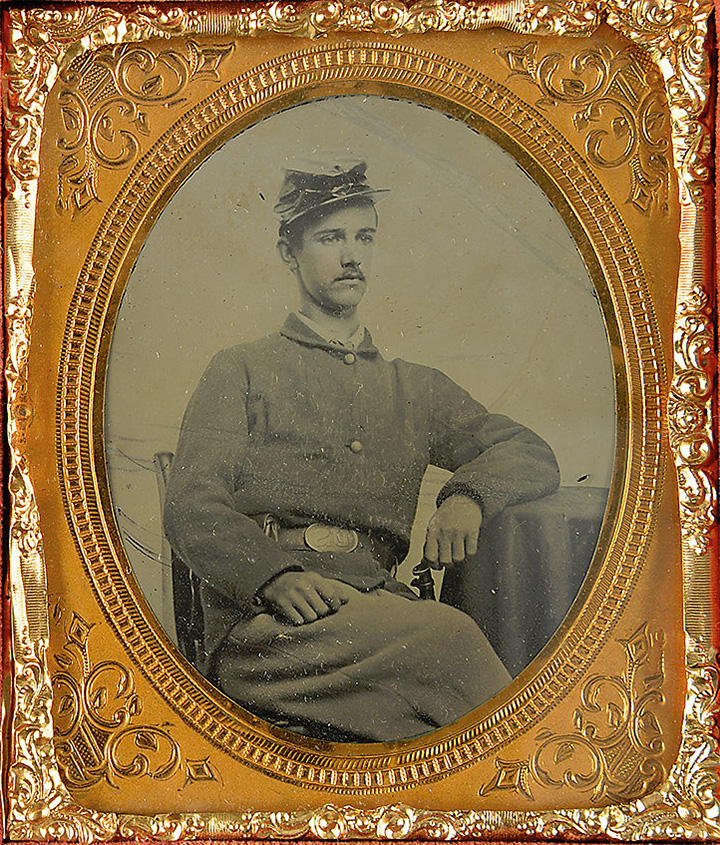
A variety of small stories that don’t warrant posts of their own:
- Most people know Alcatraz for its time as an infamous island prison, but during the Civil War it was part of the primary defenses of San Fransisco Bay and, by extension, the California gold fields beyond. Now a team from Chico State University, along with a faculty member from Texas A&M, is trying to uncover part of that rock’s lost history.
- The Museum of Texas City, Texas is almost ready to debut its exhibit on U.S.S. Westfield and the Battle of Galveston. The article is mostly paywalled, but its first phase will feature the IX-inch Dalhgren recovered from the wreck in 2009. Boom!
- I hadn’t realized that back in early 2012, Matt Heimbach took time out from his, um, “white pride” activities at Towson University to come and stand foursquare with the Virginia Flaggers at one of their big events of the year, protesting the opening of the Museum of the Confederacy site at Appomattox. Looks like he marched with them, too. Quack!
- Long-lost papers of Union officer Luis F. Emilio (above, 1844-1918) will go on auction next month in Maine. Emilio was a company commander in the famous 54th Massachusetts Infantry, and took temporary command of the regiment after the bloody assault on Fort Wagner in July 1863, when all the officers senior to him had been killed or wounded. He was just eighteen years old at the time. Years later, he published the memoir A Brave Black Regiment, one of the first and best accounts of African American fighting troops in the war.
- The struggle against vandalization of Civil War monuments continues.The monument at Mountain View Cemetery in Longmont, Colorado is going to be replaced at a cost of $62,000. The monument, along with more than 100 other stones and memorials, was smashed by vandals last summer.
- I’ve never quite figured out what the recent Duck Dynasty flap was all about. Near as I can make it, the basic dynamic involved is that (1) A&E’s suspension of Phil Robertson because they feared a backlash from viewers and sponsors was tyrannical oppression of the First Amendment, and (2) A&E’s reinstatement of Phil Robertson because they feared a backlash from viewers and sponsors was ZOMG Freedomz! Do I have that right?
- On a related note, it’s worth mentioning that when Robertson was opining about being gay as the gateway to bestiality and all sorts of other bad things, and fondly reminiscing about “the blacks” being “happy,” “singing” in Jim Crow Louisiana he was a bonafide, deep-fried, Southron Heritage hero, but having more recently been quoted as rejecting the Confederate flag as a symbol of his DD-brand redneckitude, he’s now a “Traitor To Everything We Hold Dear!!!!!!” who has “has sold his soul.” Also, “he’s an ass clown.” How the mighty are fallen.
- Christy Coleman and Waite Rawls recently discussed plans for the new museum in Richmond with the Civil War News. In a separate interview, Rawls discussed his view that the new institution will enhance visitors’ understanding of the Confederacy. Despite considerable attention given to plans of preserving and caring for the collection, I don’t expect the interview will have any effect on folks who insist that the real intent is to “liquidate” the MoC’s collections.
- Finally, Michael Givens, Commnder-in-Chief of the SCV, gave the keynote talk at a Lee-Jackson Day Dinner on Friday evening. I don’t know what he said, but the picture accompanying the article is fabulous.
Got any more? Put ’em in the comments.
__________
“the only way i will allow a yankee to live. . . .”
James Montgomery-Ryan is a young man with a dream, and it’s on a schedule:
when i see those images i see….the honor of our occupied nation and the other 2 images make me fightin mad an makes me want ta liberate dixie an take the war to the enemy an wipe the yankee scum from the face of the earth
im half blooded cheyenne and full blooded confederate and i can blame the yankees easily and subject them to the pain and suffering that my people have endured…im sick of the yankees occupying my country and if the yankees dont leave the confederacy by the end of july 2014 i will make sure that the yankees will be wiped from the earth because i will no longer stand yankee occupation or the yankee government selling confederate land to the chinese and russians will not stand
the only way i will allow a yankee to live will be if he/she swears alligance to the confederacy and serves for 10 years with distinction in the confederate army otherwise the only other choices are exile or death by firing squad
I wonder if Charles Goodson knows about this potential recruit for his New Confederate Army.
__________
Friday Night Concert: The Monitor and the Merrimack
If you listen, I will tell you how so handy, O!
The Monitor went smack up to the Merrimack,
And upon her sides played, Yankee Doodle Dandy, O! Chorus: Hip a Doodle-Do, Jeff Davis, how are you?
Our Monitor beat your Merrimack quite handy, O!
Erricson he’s around; in the world, there can’t be found,
A people like the Yankee Doodle Dandy, O! ‘Twas on the Eighth of March, the Merrimack slipped out,
From Norfolk, for to take a cruise so handy, O!
She did not think, she’d meet any thing in our fleet,
Able to give her Yankee Doodle Dandy, O! She went rushing round, smashing everything she found,
Till the Monitor came sailing in so handy, O!
And Worden stopped her fun, soon made her cut and run,
While the shells they whistled, Yankee Doodle Dandy, O! For the Yorktown and the other, they’d be little bother,
To smash and break them both up so handy, O!
For our gunboats they would do to rip them through and through,
While the sailors they’d sing, Yankee Doodle Dandy, O! The Merrimack was some, till the Monitor she come,
And opened up her little ports so handy, O!
Then the shot did fly, till the Merrimack’s men did cry:
It’s the Devil sure, a Yankee Doodle Dandy, O! To Jeff this ought to show, that this Monster is no go,
And that Mechanics in the North, are very handy, O!
That he must surrender soon, or we’ll blow him to the moon,
With inventions of our Yankee Doodle Dandy, O! Now boys, let us cheer the men that don’t know fear,
That worked that little battery so handy, O!
They deserve well of us all, let us pray that none may fall,
May they live long to sing, Yankee Doodle Dandy, O!
________
U.S.S. Monitor Lab Work Suspended


Received this afternoon from the Mariners’ Museum:

Dear members of The Mariners’ Museum family, The Mariners’ Museum has made the difficult decision to temporarily close the 5,000-square foot lab that houses the USS Monitor‘s gun turret and other large artifacts following the Dec. 31, 2013 expiration of an agreement with the National Oceanic and Atmospheric Administration’s National Marine Sanctuary Program. Simply put, The Mariners’ Museum cannot continue to shoulder the conservation costs for these artifacts, which belong to the federal government. In 2013, the conservation cost was approximately $500,000. NOAA was only able to provide 10 percent of funding, and no funding was designated in 2012, the 150th anniversary of the Monitor‘s historic clash with the Confederate ironclad Virginia in Hampton Roads. The decision to close the “wet lab” does not impact the rest of the Museum operation. The Monitor exhibition Ironclad Revolution is still open, as is the rest of the exhibition space at The Mariners’ Museum. Also, though no progress in the artifacts’ treatment will be made during this period, the artifacts remain in a stable environment. This is an emotional move for all of us, who feel deeply invested in the effort to tell the important story of the USS Monitor through its artifacts. Most affected is our team of Monitor conservators, some of whom have dedicated years to this project, and who consider themselves the guardians of the Monitor. NOAA is waiting on Congress’ approval of a budget to determine what funding to make available this coming year. NOAA and The Mariners’ Museum are working together to ensure that funding is in place to continue this important conservation work. The lab will re-open once funding is secured. You can help us by letting legislators and NOAA know you believe the government should designate funding for the Monitor conservation project at The Mariners’ Museum. Here are three ways you can do this:Thank you for your support of our continued desire to tell the USS Monitor story, and to preserve these artifacts for many generations to come.
- Sign our change.org petition
- Message NOAA and The Mariners’ to let us know of your support
- Forward this e-mail to your friends
I don’t know what to add except that this is extremely discouraging. The amounts involved in this case are effectively a rounding error compared to most of the stuff the federal government does. It’s easy to believe that the federal agency with direct oversight of this project, NOAA, as the villain in this, but I don’t think they’re receiving the appropriations needed, either. (High-profile projects like Hatteras in 2012 have been underwritten by generous private donors, as the agency itself lacks the funds to do basic maritime heritage fieldwork as part of its mission.) It’s a bad situation.
__________
What City is This?
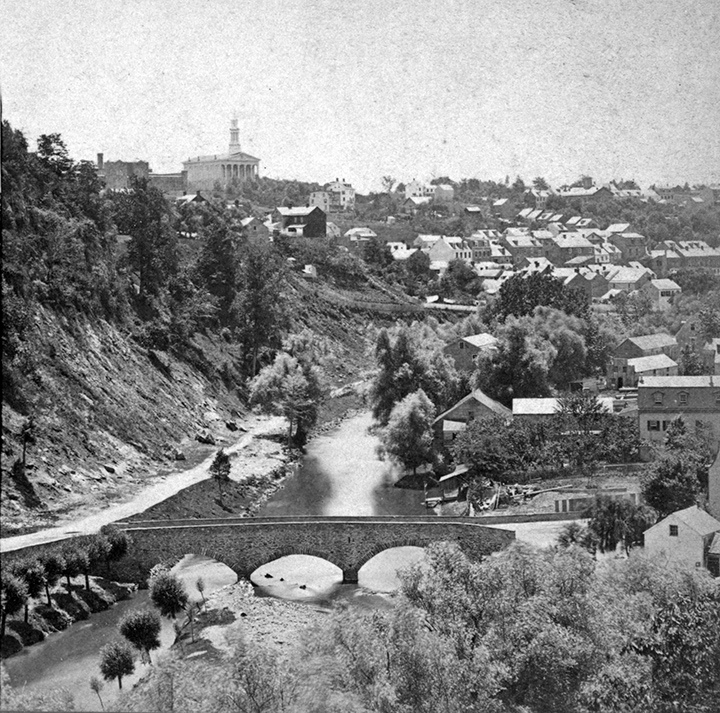
Update: January 6: A reader from Virginia notes that the structure with the tower looks a lot like the Old Northampton County Courthouse in Easton, Pennsylvania. It sure does. Perhaps more indicative, the structure immediately to the left of it matches the original entrance to the Northampton County Prison, next door. The prison was completed in 1871, which would date this image to sometime after that. If this identification is correct, and I believe it is, this view is looking roughly southwest from the hill where part of Lafayette College now stands, overlooking Bushkill Creek and Highway 22, the Lehigh Valley Thruway.
Well done! Thanks!

The Library of Congress has this image identified as Richmond, Virginia, and I’m pretty certain that’s wrong. Although there are some broad similarities between Richmond and the town in the photograph, the details are all wrong. Civil War-era images of Richmond are full of easily-identifiable landmarks, but none match this town. Folks who actually live in Richmond seem to agree — it’s not their city.
So what town is it? You can view a high-res version here. We discussed this over at Civil War Talk, and ran through a lot of possibilities — Vicksburg, Memphis, Nashville, Petersburg — none of them has a match for the building on the hill at left. I’m not even sure this is in the South — something about this says New England or upstate New York to me, but I could be wrong about that.
I’m not interested in running down folks’ guesses — done that already — so if you think you’ve got the answer, post a link to the evidence in the comments. For sure, somebody recognizes this town.
_________




 Dead Confederates, A Civil War Era Blog


12 comments