Deep Water Shipwrecks — Houston, October 14


On Tuesday, October 14 at 7 p.m., Amy Borgens and Fritz Hanselmann will discuss the recent deep-water shipwrecks expedition to investigate the wrecks of three sailing vessels, believed to have been overtaken by a catastrophic event with a presumed loss of all on board. These vessels were lost to history until 2011, when they were detected as three unknown sonar targets during a Shell Oil seafloor hazard and archaeological survey. A deep-water remotely operated vehicle investigation by NOAA’s Office of Ocean Exploration and Research unveiled a copperclad shipwreck with collections of small arms and six cannon lying at a depth of approximately 4300 ft. A team of underwater archaeologists from several federal and state organizations returned to the site in July 2013 and recovered a small collection of artifacts to help identify the shipwreck. An investigation of the two nearby Shell Oil targets confirmed these were indeed shipwrecks – one a merchant vessel transporting hides among its cargo and a third vessel of unknown purpose believed to be a three-masted ship. The archaeological team continues to research the video and photographic documentation of the sites and learn more about the artifact assemblage as conservation continues.
Deep-Water Discoveries: The Monterrey Shipwrecks in the Gulf of Mexico
Tuesday, October 14
7:00-8:00 PM
Houston Maritime Museum, 2204 Dorrington
Houston, Texas 77030
Free to the Public
__________

Acadia Goes Aground

This stretch of seaweed-strewn beach is near where the blockade runner Acadia went aground in February 1865, in a pea-soup fog. That was a bad time for runners off the Texas coast, with the loss of two big steamers and the near-loss of a third.
Excerpt from Civil War Blockade Running on the Texas Coast.
____________

Are True Southrons Actually Hobbits?
In the introductory lecture to his course on the coming of the Civil War, Eric Foner discusses the nature of historical revisionism, and why so many people are deeply uncomfortable with it:
One needs always to keep in mind that the whole secession-wasn’t-about-slavery thing is itself revisionist, deliberately nurtured and embedded in the public consciousness in the decades after the war as the foundation of Lost Cause orthodoxy by people like Jubal Early and Mildred Rutherford. But the fact that it existed long before its modern-day advocates were born doesn’t make it any more true.
“Familiarity is not the measure of the truthfulness of historical accounts.” That kinda gets to the core of things, doesn’t it?
___________
The Blockade and San Luis Pass

At the west end of Galveston Island lies San Luis Pass, a half-mile-wide channel between West Galveston Bay and the Gulf of Mexico. Deep-draft vessels could not get safely over the bar across its entrance, but it was a popular spot for smaller, mostly sailing vessels running in and out of West Bay. And consequently, it was a headache for the U.S. Navy, that never seemed to have enough ships to watch every part of the coast continuously.
I was coming back from Quintana this afternoon and snapped this image (top) from the bridge that now spans San Luis Pass. It’s a beautiful day here, but windy, and the water is rough. About a half mile away, you can see an almost continuous, horizontal white line of surf, with green water inside and blue water outside — those are the breakers on the bar that forced Pickering to release his prize and prisoners.
___________
Talkin’ Blockade Runners and that Wicked Ol’ Charles Morgan
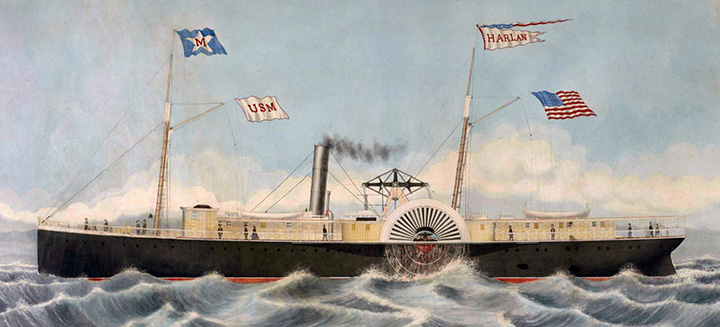
In three weeks, I’ll be giving a couple of talks, one in Arlington, that I’ve mentioned before, and one in Houston, that I haven’t.
On Friday evening, October 10 at 7:30, I’ll be speaking on “Civil War Blockade Running on the Texas Coast” at the University of Texas at Arlington Central Library, Sixth Floor. There will be a reception and a book-signing after. This event is open to the public and everyone’s invited. To RSVP, please call 817-272-1413 or email LibraryFriends@uta.edu. This will be my second trip to North Texas in the last few months, and it should be great fun.
Then, on Saturday the 11th, I’ll be participating in the Fourth Annual Houston History Conference. The conference will be held at the the Julia Ideson Building of the Houston Public Library, 550 McKinney.The theme this year, in recognition of the centennial of the official opening of the Port of Houston. My presentation is “Charles Morgan and the Genesis of the Houston Ship Channel,” a wonderful little story of economic boosterism and Gilded-Age avarice. Space is limited so advance reservations are recommended, but not required. The cost of the conference is $50 per person before October 3; $40 for seniors, presenters and exhibitors; and $25 for teachers not covered by scholarships from their respected school systems. If space allows, on-site registration will be available. All tickets include lunch and admission for a full day of activities. For more information or to enroll in the conference, visit www.houstonhistoryassociation.org or email info@houstonhistoryassociation.org.
The full listing for the Houston History Conference follows below the jump. Hope to see y’all there!
____________
Scotland Votes

Russell Cheyne/Reuters
Cuckoo’s Bakery in Edinburgh has been tracking support for Scots independence based on sales of cupcakes emblazoned with Scots and Union flags (above). As of today, the “no” vote is running about four points ahead of the “yes,” a figure that seems to be reflected in actual polling. By this time tomorrow, we’ll know how accurate both the bakery and the polls are.
Regardless of the outcome, it’s important to note that the Scots have not gone about achieving independence by laying siege to the Royal Navy base at Faslane.
Having most of my own lineage come from every part of Great Britain, I have no great stake in this fight, or notion as to whether an independent Scotland is a good thing or not. But if independence encourages sartorial atrocities such as this, it’s just not worth it. No one needs that.
______________
Freedmen’s Patrol Goes Looking for a “Good” Slaveholder
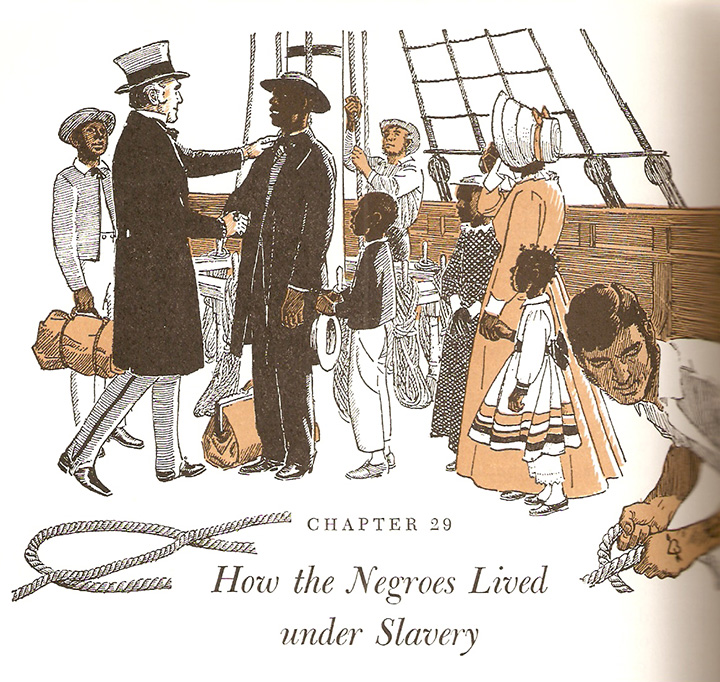
Building off a post by Kevin Levin, one of the best (and least-heralded) CW blogs out there thoroughly dismantles the notion of a “good” slaveholder, making it clear that even masters who saw themselves as benevolent patriarchs relied on the threat of intimidation and violence to maintain their authority — and did not hesitate to use it when they needed to. (You know, benevolent patriarchs like Bobby Lee.)
___________
Finding Franklin

Big news in the nautical archaeology world — last week a team from Parks Canada discovered one of the ships of the famous Franklin Expedition of 1845-48. The expedition, that originally set out to find the fabled Northwest Passage across the top of the North American continent, vanished without a trace and became one of the enduring mysteries of maritime history.
Good stuff. Nothing happens in a vacuum, of course, and the reality is that Parks Canada, the arm of the Canadian federal government that does historical archaeology work (similar to NPS or NOAA here in the U.S.), has gone through multiple rounds of deep budget cuts:
Many of Parks Canada’s remaining resources re-directed toward finding evidence of the Franklin Expedition — a worthy goal, for sure, but debatable given the severely-limited resources needed elsewhere. Harper’s reference to “Canada’s Arctic sovereignty” is very intentional, because his government is pushing hard for territorial claims in the Arctic for drilling. The discovery of one of Franklin’s ships, one that is older than the creation of Canada itself, provides a nice historical exclamation point for the prime minister’s scramble for Arctic oil and gas.
Still, it’s an amazing find, and kudos to the Parks Canada team that pulled it off.
_____________
Update: Here’s a Slate story from May that provides background on Harper’s specific interest in finding remains of the Franklin Expedition.
“There’s a girl from Tennessee, she’s long and she’s tall. . . .”
Many years ago, Alan Lomax recorded the legend of the Wabash Cannonball, a sort of Flying Dutchman of American railroading:
This particular video is a wonderful bit of stagecraft, opening with a 1940 clip of Roy Acuff performing the song in the film Grand Old Opry, which transitions into a video clip from the Opry in 1973, which then transitions into a live performance, led by Ketch Secor and Old Crow Medicine Show. Grand Ole Opry members joining them on stage include Bobby Osborne, Marty Stuart and Connie Smith, Clint Black, Ricky Skaggs, and Riders in the Sky, among many others.
Lotta talent on that stage, right there.
__________
“We have certainly earned the honor. . . .”
I almost forgot — today, Tuesday, is 150th anniversary of my wife’s uncles, James Bradley Ridge and George B. Ridge, both of Company K, Fifth Connecticut Volunteers, marching into Atlanta at the head of Sherman’s column. Seems like a moment worth remembering. From the regimental history:
I don’t have any Yankees in my own attic, but my wife does. We have a mixed marriage, you see.
___________




5 comments